Huygens’ Principle
Physics 101 Learning Objects
Stacey Young
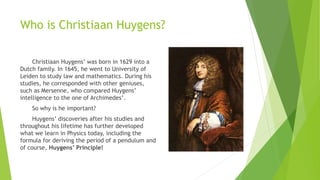
Who is Christiaan Huygens?
Christiaan Huygens’ was born in 1629 into a
Dutch family. In 1645, he went to University of
Leiden to study law and mathematics. During his
studies, he corresponded with other geniuses,
such as Mersenne, who compared Huygens’
intelligence to the one of Archimedes’.
So why is he important?
Huygens’ discoveries after his studies and
throughout his lifetime has further developed
what we learn in Physics today, including the
formula for deriving the period of a pendulum and
of course, Huygens’ Principle!
Huygens’ Principle
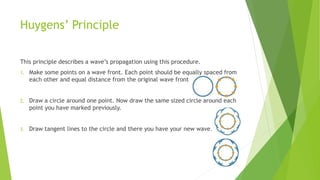
This principle describes a wave’s propagation using this procedure.
1. Make some points on a wave front. Each point should be equally spaced from
each other and equal distance from the original wave front
2. Draw a circle around one point. Now draw the same sized circle around each
point you have marked previously.
3. Draw tangent lines to the circle and there you have your new wave.
Wave Propagation
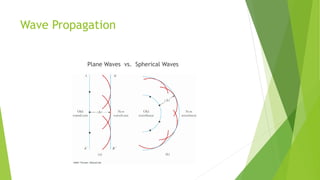
Plane Waves vs. Spherical Waves
Plane Waves
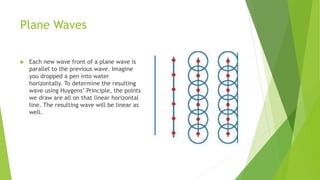
 Each new wave front of a plane wave is
parallel to the previous wave. Imagine
you dropped a pen into water
horizontally. To determine the resulting
wave using Huygens’ Principle, the points
we draw are all on that linear horizontal
line. The resulting wave will be linear as
well.
Spherical Waves
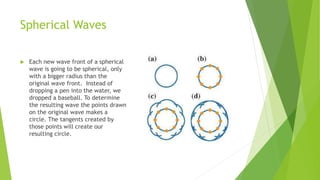
 Each new wave front of a spherical
wave is going to be spherical, only
with a bigger radius than the
original wave front. Instead of
dropping a pen into the water, we
dropped a baseball. To determine
the resulting wave the points drawn
on the original wave makes a
circle. The tangents created by
those points will create our
resulting circle.
Checking for Understanding
 Using Huygens’ Principle, find the resulting wave front.

Huygens’ principle

  • 1.
    Huygens’ Principle Physics 101Learning Objects Stacey Young
  • 2.
    Who is ChristiaanHuygens? Christiaan Huygens’ was born in 1629 into a Dutch family. In 1645, he went to University of Leiden to study law and mathematics. During his studies, he corresponded with other geniuses, such as Mersenne, who compared Huygens’ intelligence to the one of Archimedes’. So why is he important? Huygens’ discoveries after his studies and throughout his lifetime has further developed what we learn in Physics today, including the formula for deriving the period of a pendulum and of course, Huygens’ Principle!
  • 3.
    Huygens’ Principle This principledescribes a wave’s propagation using this procedure. 1. Make some points on a wave front. Each point should be equally spaced from each other and equal distance from the original wave front 2. Draw a circle around one point. Now draw the same sized circle around each point you have marked previously. 3. Draw tangent lines to the circle and there you have your new wave.
  • 4.
    Wave Propagation Plane Wavesvs. Spherical Waves
  • 5.
    Plane Waves  Eachnew wave front of a plane wave is parallel to the previous wave. Imagine you dropped a pen into water horizontally. To determine the resulting wave using Huygens’ Principle, the points we draw are all on that linear horizontal line. The resulting wave will be linear as well.
  • 6.
    Spherical Waves  Eachnew wave front of a spherical wave is going to be spherical, only with a bigger radius than the original wave front. Instead of dropping a pen into the water, we dropped a baseball. To determine the resulting wave the points drawn on the original wave makes a circle. The tangents created by those points will create our resulting circle.
  • 7.
    Checking for Understanding Using Huygens’ Principle, find the resulting wave front.