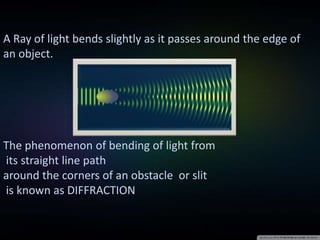
A Ray of light bends slightly as it passes around the edge of
an object.
The phenomenon of bending of light from
its straight line path
around the corners of an obstacle or slit
is known as DIFFRACTION
We can see many diffraction patterns in our day-to-day life…
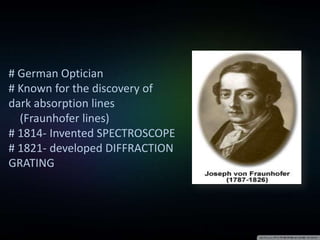
# German Optician
# Known for the discovery of
dark absorption lines
(Fraunhofer lines)
# 1814- Invented SPECTROSCOPE
# 1821- developed DIFFRACTION
GRATING
Important aspects of Fraunhofer Diffraction :-
1. Distance of slit from source and screen is infinite.
2. Wavefront incident on slit & screen is plane.
3. Lenses are required to observe diffraction pattern.
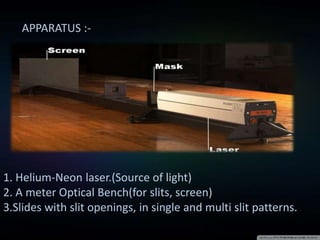
APPARATUS :-
1. Helium-Neon laser.(Source of light)
2. A meter Optical Bench(for slits, screen)
3.Slides with slit openings, in single and multi slit patterns.
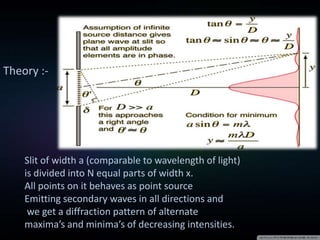
Theory :-
Slit of width a (comparable to wavelength of light)
is divided into N equal parts of width x.
All points on it behaves as point source
Emitting secondary waves in all directions and
we get a diffraction pattern of alternate
maxima’s and minima’s of decreasing intensities.
Results:-
1. Central maximum is formed at @= 0
i.e it is formed along incident direction.
2. Condition for minimum intensity = [ a*sin@= n*wavelength ]
3. Condition for secondary maxima = [ a*sin@=(n+0.5)* wavelength ]
4. Width of central maxima = W=[2*D*wavelength/a]
Dependence on slit width :-
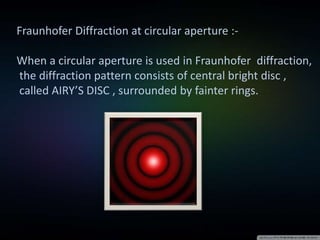
Fraunhofer Diffraction at circular aperture :-
When a circular aperture is used in Fraunhofer diffraction,
the diffraction pattern consists of central bright disc ,
called AIRY’S DISC , surrounded by fainter rings.
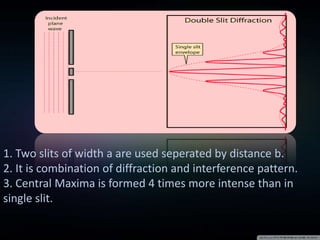
1. Two slits of width a are used seperated by distance b.
2. It is combination of diffraction and interference pattern.
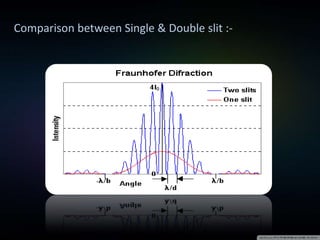
3. Central Maxima is formed 4 times more intense than in
single slit.
Comparison between Single & Double slit :-
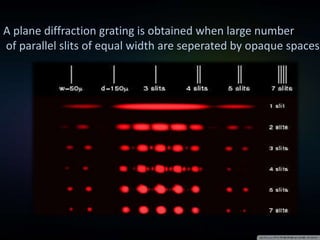
A plane diffraction grating is obtained when large number
of parallel slits of equal width are seperated by opaque spaces.
Application :-
1. Diffraction plays a major role in
light- and electron microscopy.
2. Diffraction is used in X-ray crystallography,
called Bragg diffraction
to deduce the structure of a crystal from the angles
at which X-rays are diffracted from it.

Fraunhoffer diffraction

  • 2.
    A Ray oflight bends slightly as it passes around the edge of an object. The phenomenon of bending of light from its straight line path around the corners of an obstacle or slit is known as DIFFRACTION
  • 3.
    We can seemany diffraction patterns in our day-to-day life…
  • 4.
    # German Optician #Known for the discovery of dark absorption lines (Fraunhofer lines) # 1814- Invented SPECTROSCOPE # 1821- developed DIFFRACTION GRATING
  • 5.
    Important aspects ofFraunhofer Diffraction :- 1. Distance of slit from source and screen is infinite. 2. Wavefront incident on slit & screen is plane. 3. Lenses are required to observe diffraction pattern.
  • 7.
    APPARATUS :- 1. Helium-Neonlaser.(Source of light) 2. A meter Optical Bench(for slits, screen) 3.Slides with slit openings, in single and multi slit patterns.
  • 8.
    Theory :- Slit ofwidth a (comparable to wavelength of light) is divided into N equal parts of width x. All points on it behaves as point source Emitting secondary waves in all directions and we get a diffraction pattern of alternate maxima’s and minima’s of decreasing intensities.
  • 9.
    Results:- 1. Central maximumis formed at @= 0 i.e it is formed along incident direction. 2. Condition for minimum intensity = [ a*sin@= n*wavelength ] 3. Condition for secondary maxima = [ a*sin@=(n+0.5)* wavelength ] 4. Width of central maxima = W=[2*D*wavelength/a] Dependence on slit width :-
  • 10.
    Fraunhofer Diffraction atcircular aperture :- When a circular aperture is used in Fraunhofer diffraction, the diffraction pattern consists of central bright disc , called AIRY’S DISC , surrounded by fainter rings.
  • 12.
    1. Two slitsof width a are used seperated by distance b. 2. It is combination of diffraction and interference pattern. 3. Central Maxima is formed 4 times more intense than in single slit.
  • 13.
    Comparison between Single& Double slit :-
  • 14.
    A plane diffractiongrating is obtained when large number of parallel slits of equal width are seperated by opaque spaces.
  • 15.
    Application :- 1. Diffractionplays a major role in light- and electron microscopy. 2. Diffraction is used in X-ray crystallography, called Bragg diffraction to deduce the structure of a crystal from the angles at which X-rays are diffracted from it.