Curve fitting (Theory & problems)
Session: 2013-14 (Group no: 05)
CEE-149 Credit 02
Curve fitting (Theory & problems)
Numerical Analysis
Definition
• Curve fitting: is the process of constructing a curve,
or mathematical function, that has the best fit to a
series of data points, possibly subject to
constraints.
• It is a statistical technique use to drive coefficient
values for equations that express the value of
one(dependent) variable as a function of another
(independent variable)
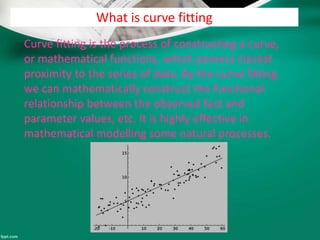
What is curve fitting
Curve fitting is the process of constructing a curve,
or mathematical functions, which possess closest
proximity to the series of data. By the curve fitting
we can mathematically construct the functional
relationship between the observed fact and
parameter values, etc. It is highly effective in
mathematical modelling some natural processes.
Interpolation & Curve fitting
• In many application areas, one is faced with the test
of describing data, often measured, with an analytic
function. There are two approaches to this problem:-
• 1. In Interpolation, the data is assumed to be correct
and what is desired is some way to descibe what
happens between the data points.
• 2. The other approach is called curve fitting or
regression, one looks for some smooth curve that
``best fits'' the data, but does not necessarily pass
through any data points.
Curve fitting
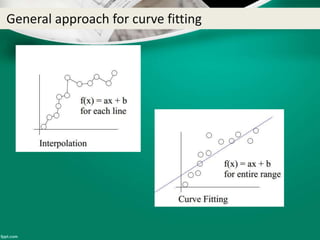
• There are two general approaches for curve fitting:
• Least squares regression:
Data exhibit a significant degree of scatter. The
strategy is to derive a single curve that represents the
general trend of the data.
Interpolation:
Data is very precise. The strategy is to pass a curve or a
series of curve through each of the points.
General approach for curve fitting
Engineering applications of curve fitting technique
• 1.Trend Analysis:- Predicating values of dependent
variable ,may include extrapolation beyond data
points or interpolation between data points.
Some important relevant parameters
In engineering, two types of applications are encountered:
– Trend analysis. Predicting values of dependent
variable, may include extrapolation beyond data
points or interpolation between data points.
– Hypothesis testing. Comparing existing mathematical
model with measured data.
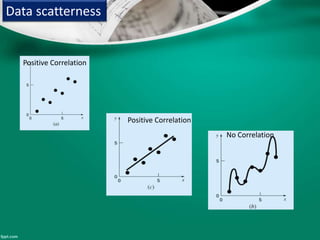
Data scatterness
Positive Correlation
No Correlation
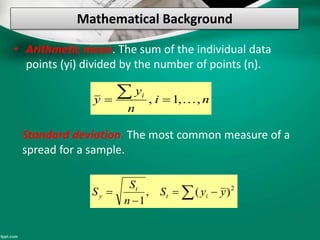
Mathematical Background
• Arithmetic mean. The sum of the individual data
points (yi) divided by the number of points (n).
Standard deviation. The most common measure of a
spread for a sample.
ni
n
y
y i
,,1, 

 

 2
)(,
1
yyS
n
S
S it
t
y
Mathematical Background (cont’d)
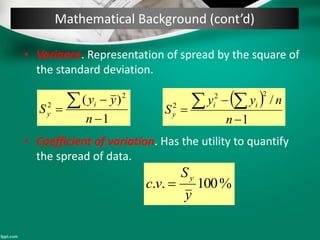
• Variance. Representation of spread by the square of
the standard deviation.
• Coefficient of variation. Has the utility to quantify
the spread of data.
1
)( 2
2




n
yy
S i
y
 
1
/
22
2



 
n
nyy
S ii
y
%100..
y
S
vc
y

Least square method
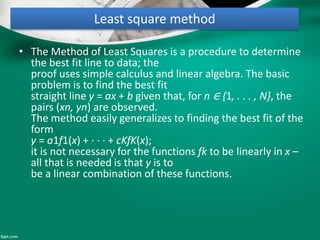
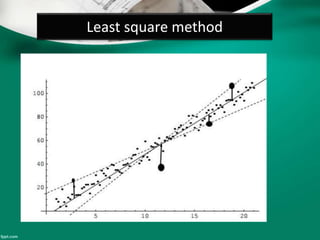
• The Method of Least Squares is a procedure to determine
the best fit line to data; the
proof uses simple calculus and linear algebra. The basic
problem is to find the best fit
straight line y = ax + b given that, for n ∈ {1, . . . , N}, the
pairs (xn, yn) are observed.
The method easily generalizes to finding the best fit of the
form
y = a1f1(x) + · · · + cKfK(x);
it is not necessary for the functions fk to be linearly in x –
all that is needed is that y is to
be a linear combination of these functions.
Least square method
Least Squares Regression
Linear Regression
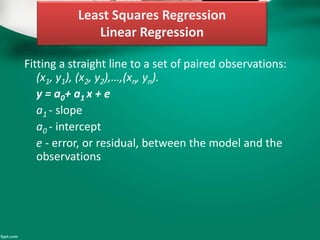
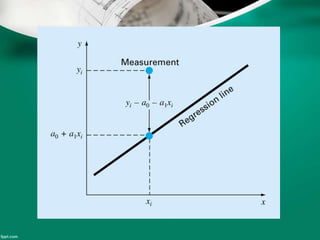
Fitting a straight line to a set of paired observations:
(x1, y1), (x2, y2),…,(xn, yn).
y = a0+ a1 x + e
a1 - slope
a0 - intercept
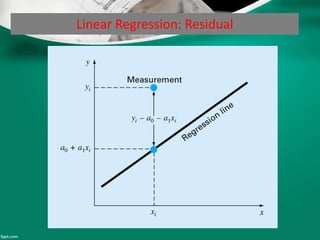
e - error, or residual, between the model and the
observations
Linear Regression: Residual
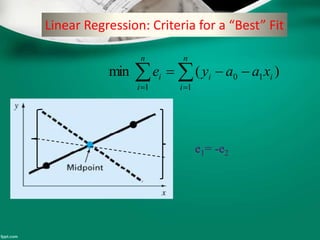
Linear Regression: Criteria for a “Best” Fit
 

n
i
ii
n
i
i xaaye
1
10
1
)(min
e1= -e2
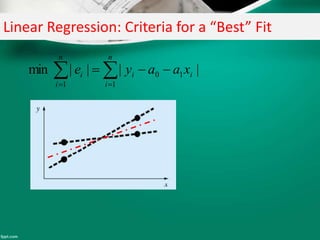
Linear Regression: Criteria for a “Best” Fit
 

n
i
ii
n
i
i xaaye
1
10
1
||||min
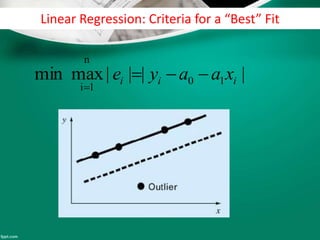
Linear Regression: Criteria for a “Best” Fit
||||maxmin 10
n
1i
iii xaaye 

Linear curve fitting (Straight line)?
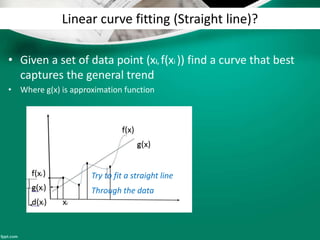
• Given a set of data point (xi, f(xi )) find a curve that best
captures the general trend
• Where g(x) is approximation function
Try to fit a straight line
Through the data
Linear curve fitting (Straight line)?
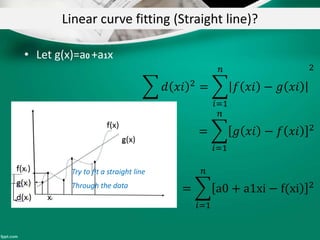
• Let g(x)=a0 +a1x
𝑑 𝑥𝑖 2 =
𝑖=1
𝑛
𝑓 𝑥𝑖 − 𝑔 𝑥𝑖
2
=
𝑖=1
𝑛
𝑔 𝑥𝑖 − 𝑓 𝑥𝑖 2
=
𝑖=1
𝑛
a0 + a1xi − f(xi 2
Try to fit a straight line
Through the data
Linear curve fitting(straight line)
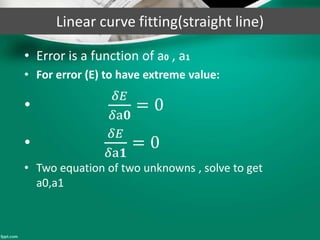
• Error is a function of a0 , a1
• For error (E) to have extreme value:
•
𝛿𝐸
𝛿a𝟎
= 0
•
𝛿𝐸
𝛿a𝟏
= 0
• Two equation of two unknowns , solve to get
a0,a1
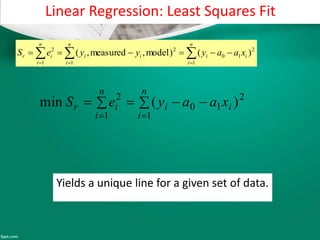
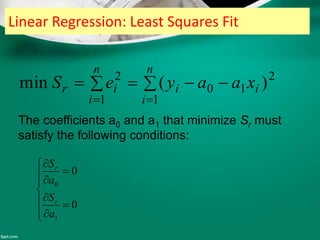
Linear Regression: Least Squares Fit
   

n
i
n
i
iiii
n
i
ir xaayyyeS
1 1
2
10
2
1
2
)()model,measured,(
 

n
i
ii
n
i
ir xaayeS
1
2
10
1
2
)(min
Yields a unique line for a given set of data.
Linear Regression: Least Squares Fit
 

n
i
ii
n
i
ir xaayeS
1
2
10
1
2
)(min
The coefficients a0 and a1 that minimize Sr must
satisfy the following conditions:













0
0
1
0
a
S
a
S
r
r
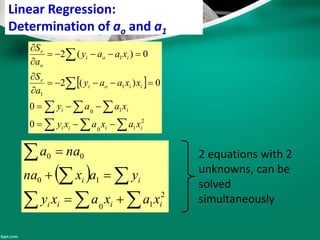
Linear Regression:
Determination of ao and a1
 
 
 










2
10
10
1
1
1
0
0
0)(2
0)(2
iiii
ii
iioi
r
ioi
o
r
xaxaxy
xaay
xxaay
a
S
xaay
a
S
 
 





2
10
10
00
iiii
ii
xaxaxy
yaxna
naa 2 equations with 2
unknowns, can be
solved
simultaneously
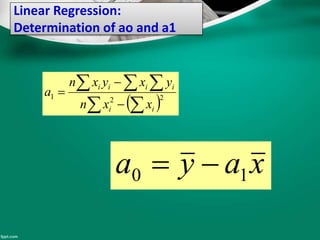
Linear Regression:
Determination of ao and a1
  
  


 221
ii
iiii
xxn
yxyxn
a
xaya 10 
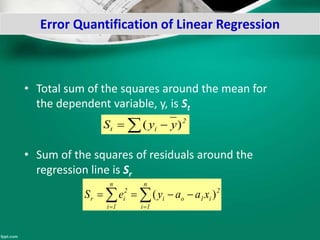
Error Quantification of Linear Regression
• Total sum of the squares around the mean for
the dependent variable, y, is St
• Sum of the squares of residuals around the
regression line is Sr
  2
it yyS )(
2
n
1i
i1oi
n
1i
2
ir xaayeS )( 

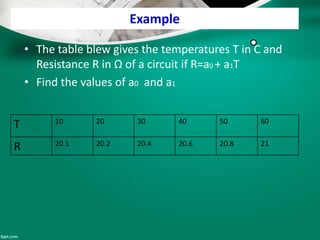
Example
• The table blew gives the temperatures T in C and
Resistance R in Ω of a circuit if R=a0 + a1T
• Find the values of a0 and a1
T 10 20 30 40 50 60
R 20.1 20.2 20.4 20.6 20.8 21
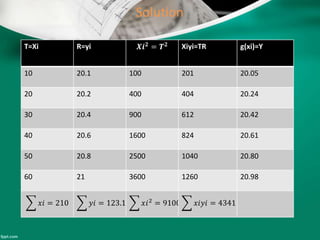
Solution
T=Xi R=yi 𝑿𝒊 𝟐
= 𝑻 𝟐 Xiyi=TR g(xi)=Y
10 20.1 100 201 20.05
20 20.2 400 404 20.24
30 20.4 900 612 20.42
40 20.6 1600 824 20.61
50 20.8 2500 1040 20.80
60 21 3600 1260 20.98
𝑥𝑖 = 210 𝑦𝑖 = 123.1 𝑥𝑖2
= 9100 𝑥𝑖𝑦𝑖 = 4341
Solution
• 6a0+210a1=123.1 a0=19.867
• 210a0+9100a1=4341 a1 =0.01857
• g(x)=19.867+0.01857*T
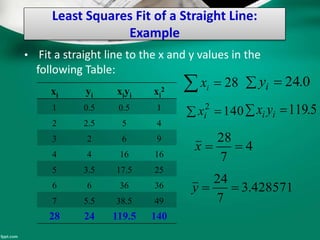
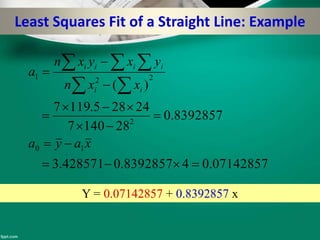
Least Squares Fit of a Straight Line:
Example
• Fit a straight line to the x and y values in the
following Table:
28 ix 0.24 iy
1402
 ix 5.119 ii yx
3
7
24
4
7
28
 yx
428571.3
7
24
4
7
28
 yx
xi yi xiyi xi
2
1 0.5 0.5 1
2 2.5 5 4
3 2 6 9
4 4 16 16
5 3.5 17.5 25
6 6 36 36
7 5.5 38.5 49
28 24 119.5 140
Least Squares Fit of a Straight Line: Example
07142857.048392857.0428571.3
8392857.0
281407
24285.1197
)(
10
2
221









 
  
xaya
xxn
yxyxn
a
ii
iiii
Y = 0.07142857 + 0.8392857 x
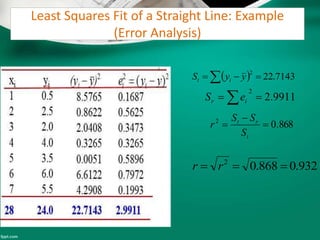
Least Squares Fit of a Straight Line: Example
(Error Analysis)
9911.2
2
  ir eS
868.02



t
rt
S
SS
r
  7143.22
2
  yyS it
932.0868.02
 rr
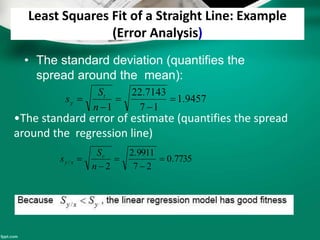
Least Squares Fit of a Straight Line: Example
(Error Analysis)
• The standard deviation (quantifies the
spread around the mean):
9457.1
17
7143.22
1





n
S
s t
y
•The standard error of estimate (quantifies the spread
around the regression line)
7735.0
27
9911.2
2
/ 




n
S
s r
xy
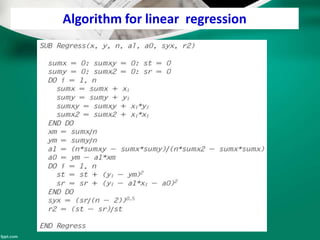
Algorithm for linear regression
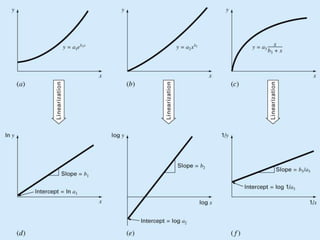
Linearization of Nonlinear Relationships
• The relationship between the dependent and
independent variables is linear.
• However, a few types of nonlinear functions can
be transformed into linear regression problems.
 The exponential equation.
 The power equation.
 The saturation-growth-rate equation.
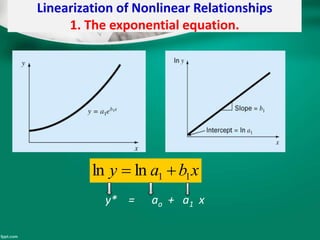
Linearization of Nonlinear Relationships
1. The exponential equation.
xbay 11lnln 
y* = ao + a1 x
Linearization of Nonlinear Relationships
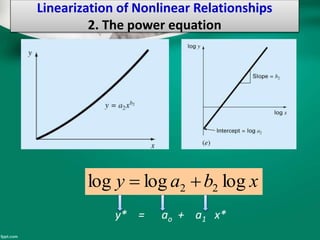
2. The power equation
xbay logloglog 22 
y* = ao + a1 x*
Linearization of Nonlinear Relationships
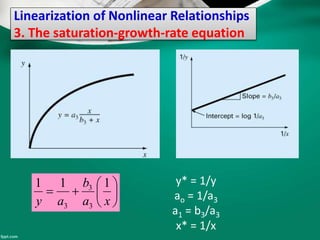
3. The saturation-growth-rate equation







xa
b
ay
111
3
3
3
y* = 1/y
ao = 1/a3
a1 = b3/a3
x* = 1/x
Example
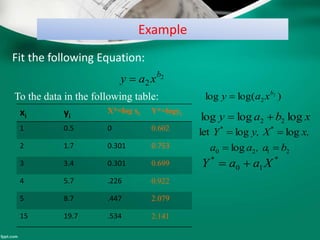
Fit the following Equation:
2
2
b
xay 
To the data in the following table:
xi yi
X*=log xi Y*=logyi
1 0.5 0 0.602
2 1.7 0.301 0.753
3 3.4 0.301 0.699
4 5.7 .226 0.922
5 8.7 .447 2.079
15 19.7 .534 2.141
)log(log 2
2
b
xay 
2120
**
log
logloglet
b, aaa
x,y, XY


xbay logloglog 22 
*
10
*
XaaY 
Example
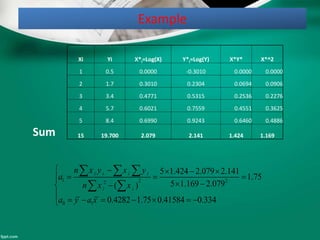
Xi Yi X*i=Log(X) Y*i=Log(Y) X*Y* X*^2
1 0.5 0.0000 -0.3010 0.0000 0.0000
2 1.7 0.3010 0.2304 0.0694 0.0906
3 3.4 0.4771 0.5315 0.2536 0.2276
4 5.7 0.6021 0.7559 0.4551 0.3625
5 8.4 0.6990 0.9243 0.6460 0.4886
Sum 15 19.700 2.079 2.141 1.424 1.169
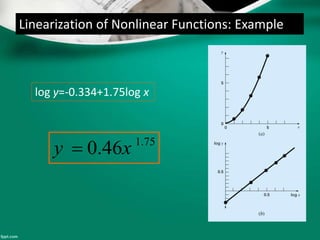
1 2 22
0 1
5 1.424 2.079 2.141
1.75
5 1.169 2.079( )
0.4282 1.75 0.41584 0.334
i i i i
i i
n x y x y
a
n x x
a y a x
    
  
 

      
  
 
Linearization of Nonlinear Functions: Example
log y=-0.334+1.75log x
1.75
0.46y x
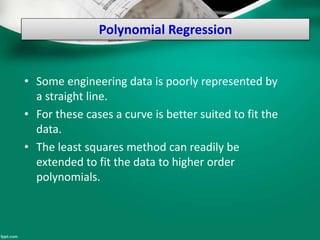
Polynomial Regression
• Some engineering data is poorly represented by
a straight line.
• For these cases a curve is better suited to fit the
data.
• The least squares method can readily be
extended to fit the data to higher order
polynomials.
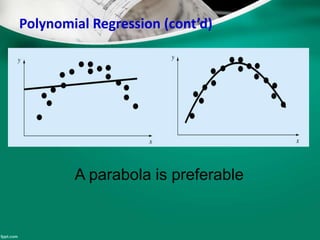
Polynomial Regression (cont’d)
A parabola is preferable
Polynomial Regression (cont’d)
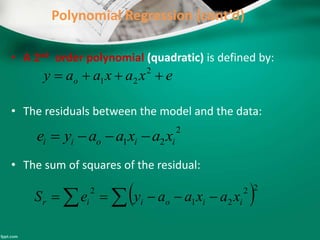
• A 2nd order polynomial (quadratic) is defined by:
• The residuals between the model and the data:
• The sum of squares of the residual:
exaxaay o  2
21
2
21 iioii xaxaaye 
  
22
21
2
iioiir xaxaayeS
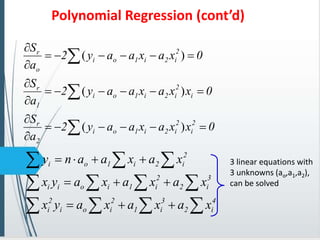
Polynomial Regression (cont’d)
0xxaxaay2
a
S
0xxaxaay2
a
S
0xaxaay2
a
S
2
i
2
i2i1oi
2
r
i
2
i2i1oi
1
r
2
i2i1oi
o
r












)(
)(
)(
 
 




4
i2
3
i1
2
ioi
2
i
3
i2
2
i1ioii
2
i2i1oi
xaxaxayx
xaxaxayx
xaxaany 3 linear equations with
3 unknowns (ao,a1,a2),
can be solved
Polynomial Regression (cont’d)
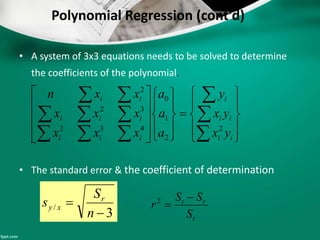
• A system of 3x3 equations needs to be solved to determine
the coefficients of the polynomial.
• The standard error & the coefficient of determination
3
/


n
S
s r
xy
t
rt
S
SS
r

2





































ii
ii
i
iii
iii
ii
yx
yx
y
a
a
a
xxx
xxx
xxn
2
2
1
0
432
32
2
Polynomial Regression (cont’d)
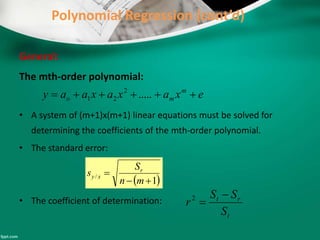
General:
The mth-order polynomial:
• A system of (m+1)x(m+1) linear equations must be solved for
determining the coefficients of the mth-order polynomial.
• The standard error:
• The coefficient of determination:
exaxaxaay m
mo  .....2
21
 1
/


mn
S
s r
xy
t
rt
S
SS
r

2
Polynomial Regression- Example
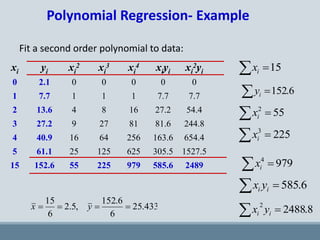
Fit a second order polynomial to data:
2253
 ix
9794
 ix
xi yi xi
2 xi
3 xi
4 xiyi xi
2yi
0 2.1 0 0 0 0 0
1 7.7 1 1 1 7.7 7.7
2 13.6 4 8 16 27.2 54.4
3 27.2 9 27 81 81.6 244.8
4 40.9 16 64 256 163.6 654.4
5 61.1 25 125 625 305.5 1527.5
15 152.6 55 225 979 585.6 2489
6.585 ii yx
15 ix
6.152 iy
552
 ix
433.25
6
6.152
,5.2
6
15
 yx 8.2488
2
 ii yx
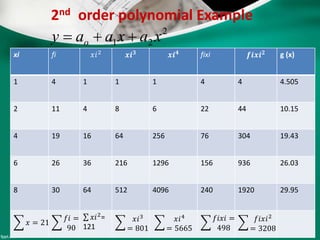
2nd order polynomial Example
2
21 xaxaay o 
xi fi 𝑥𝑖2
𝒙𝒊 𝟑 𝒙𝒊 𝟒 fixi 𝒇𝒊𝒙𝒊 𝟐 g (x)
1 4 1 1 1 4 4 4.505
2 11 4 8 6 22 44 10.15
4 19 16 64 256 76 304 19.43
6 26 36 216 1296 156 936 26.03
8 30 64 512 4096 240 1920 29.95
𝑥 = 21
𝑓𝑖 =
90
𝑥𝑖2
=
121
𝑥𝑖3
= 801
𝑥𝑖4
= 5665
𝑓𝑖𝑥𝑖 =
498
𝑓𝑖𝑥𝑖2
= 3208
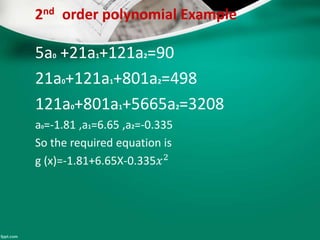
2nd order polynomial Example
5a0 +21a1+121a2=90
21a0+121a1+801a2=498
121a0+801a1+5665a2=3208
a0=-1.81 ,a1=6.65 ,a2=-0.335
So the required equation is
g (x)=-1.81+6.65X-0.335𝑥2
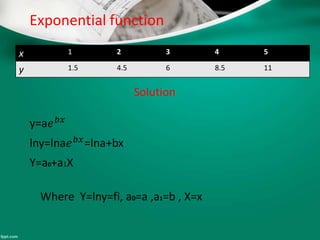
Exponential function
x 1 2 3 4 5
y 1.5 4.5 6 8.5 11
Solution
y=a𝑒 𝑏𝑥
lny=lna𝑒 𝑏𝑥
=lna+bx
Y=a0+a1X
Where Y=lny=fi, a0=a ,a1=b , X=x
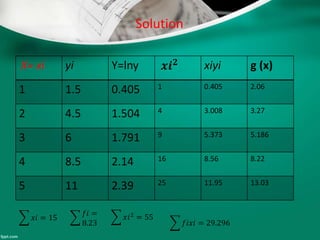
X= xi yi Y=lny 𝒙𝒊 𝟐 xiyi g (x)
1 1.5 0.405 1 0.405 2.06
2 4.5 1.504 4 3.008 3.27
3 6 1.791 9 5.373 5.186
4 8.5 2.14 16 8.56 8.22
5 11 2.39 25 11.95 13.03
𝑥𝑖 = 15
𝑓𝑖 =
8.23
𝑥𝑖2 = 55
𝑓𝑖𝑥𝑖 = 29.296
Solution
Solution
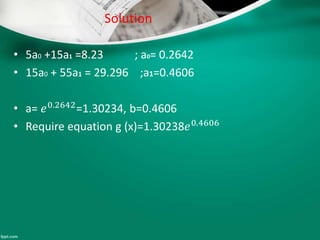
• 5a0 +15a1 =8.23 ; a0= 0.2642
• 15a0 + 55a1 = 29.296 ;a1=0.4606
• a= 𝑒0.2642=1.30234, b=0.4606
• Require equation g (x)=1.30238𝑒0.4606
Example
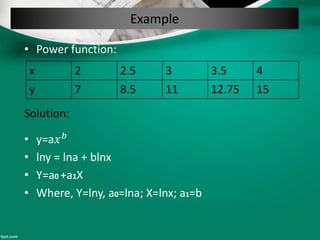
• Power function:
• y=a𝑥 𝑏
• lny = lna + blnx
• Y=a0 +a1X
• Where, Y=lny, a0=lna; X=lnx; a1=b
x 2 2.5 3 3.5 4
y 7 8.5 11 12.75 15
Solution:
Solution
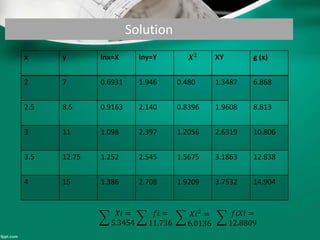
x y lnx=X lny=Y 𝑿 𝟐 XY g (x)
2 7 0.6931 1.946 0.480 1.3487 6.868
2.5 8.5 0.9163 2.140 0.8396 1.9608 8.813
3 11 1.098 2.397 1.2056 2.6319 10.806
3.5 12.75 1.252 2.545 1.5675 3.1863 12.838
4 15 1.386 2.708 1.9209 3.7532 14.904
𝑋𝑖 =
5.3454
𝑓𝑖 =
11.736
𝑋𝑖2 =
6.0136
𝑓𝑖𝑋𝑖 =
12.8809
Solution
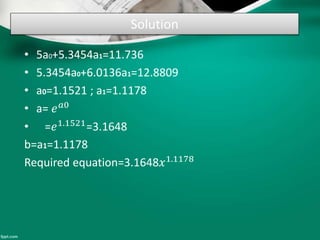
• 5a0+5.3454a1=11.736
• 5.3454a0+6.0136a1=12.8809
• a0=1.1521 ; a1=1.1178
• a= 𝑒 𝑎0
• =𝑒1.1521
=3.1648
b=a1=1.1178
Required equation=3.1648𝑥1.1178
Polynomial Regression- Example (cont’d)
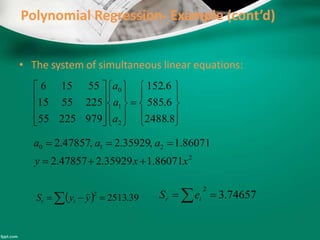
• The system of simultaneous linear equations:
2
210
86071.135929.247857.2
86071.1,35929.2,47857.2
xxy
aaa

































8.2488
6.585
6.152
97922555
2255515
55156
2
1
0
a
a
a
74657.3
2
  ir eS  39.2513
2
  yyS it
Polynomial Regression- Example (cont’d)
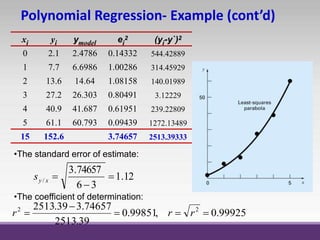
xi yi ymodel ei
2 (yi-y`)2
0 2.1 2.4786 0.14332 544.42889
1 7.7 6.6986 1.00286 314.45929
2 13.6 14.64 1.08158 140.01989
3 27.2 26.303 0.80491 3.12229
4 40.9 41.687 0.61951 239.22809
5 61.1 60.793 0.09439 1272.13489
15 152.6 3.74657 2513.39333
•The standard error of estimate:
•The coefficient of determination:
12.1
36
74657.3
/ 

xys
99925.0,99851.0
39.2513
74657.339.2513 22


 rrr
Reference
• Introduction Method of Numerical Analysis
(S.S Sastry) Page: 126-175
• Numerical methods for engineers ( Steven c.
Chapra, Raymond p. canale) page: 561-69
• https://en.wikipedia.org/wiki/Curve_fitting
• http://site.iugaza.edu.ps/iismail/files/Ch17-
curve-fitting.ppt
• http://caig.cs.nctu.edu.tw/course/NM07S/slide
s/chap3_1.pdf
Reference
• http://www.eas.uccs.edu/wickert/ece1010/lectu
re_notes/1010n6a.PDF
• http://www.chee.uh.edu/sites/chbe.egr.uh.edu/f
iles/files/CHEE3334.pdf
• Lecture Sheet of (Dr. Md. Shahidur Rahman
• Assistant Pro. CEE, SUST)
THE END
THANK FOR BEING
WITH US

Curve fitting

  • 1.
    Curve fitting (Theory& problems) Session: 2013-14 (Group no: 05) CEE-149 Credit 02 Curve fitting (Theory & problems) Numerical Analysis
  • 2.
    Definition • Curve fitting:is the process of constructing a curve, or mathematical function, that has the best fit to a series of data points, possibly subject to constraints. • It is a statistical technique use to drive coefficient values for equations that express the value of one(dependent) variable as a function of another (independent variable)
  • 3.
    What is curvefitting Curve fitting is the process of constructing a curve, or mathematical functions, which possess closest proximity to the series of data. By the curve fitting we can mathematically construct the functional relationship between the observed fact and parameter values, etc. It is highly effective in mathematical modelling some natural processes.
  • 4.
    Interpolation & Curvefitting • In many application areas, one is faced with the test of describing data, often measured, with an analytic function. There are two approaches to this problem:- • 1. In Interpolation, the data is assumed to be correct and what is desired is some way to descibe what happens between the data points. • 2. The other approach is called curve fitting or regression, one looks for some smooth curve that ``best fits'' the data, but does not necessarily pass through any data points.
  • 5.
    Curve fitting • Thereare two general approaches for curve fitting: • Least squares regression: Data exhibit a significant degree of scatter. The strategy is to derive a single curve that represents the general trend of the data. Interpolation: Data is very precise. The strategy is to pass a curve or a series of curve through each of the points.
  • 6.
    General approach forcurve fitting
  • 7.
    Engineering applications ofcurve fitting technique • 1.Trend Analysis:- Predicating values of dependent variable ,may include extrapolation beyond data points or interpolation between data points.
  • 8.
    Some important relevantparameters In engineering, two types of applications are encountered: – Trend analysis. Predicting values of dependent variable, may include extrapolation beyond data points or interpolation between data points. – Hypothesis testing. Comparing existing mathematical model with measured data.
  • 9.
  • 10.
    Mathematical Background • Arithmeticmean. The sum of the individual data points (yi) divided by the number of points (n). Standard deviation. The most common measure of a spread for a sample. ni n y y i ,,1,       2 )(, 1 yyS n S S it t y
  • 11.
    Mathematical Background (cont’d) •Variance. Representation of spread by the square of the standard deviation. • Coefficient of variation. Has the utility to quantify the spread of data. 1 )( 2 2     n yy S i y   1 / 22 2      n nyy S ii y %100.. y S vc y 
  • 12.
    Least square method •The Method of Least Squares is a procedure to determine the best fit line to data; the proof uses simple calculus and linear algebra. The basic problem is to find the best fit straight line y = ax + b given that, for n ∈ {1, . . . , N}, the pairs (xn, yn) are observed. The method easily generalizes to finding the best fit of the form y = a1f1(x) + · · · + cKfK(x); it is not necessary for the functions fk to be linearly in x – all that is needed is that y is to be a linear combination of these functions.
  • 13.
  • 14.
    Least Squares Regression LinearRegression Fitting a straight line to a set of paired observations: (x1, y1), (x2, y2),…,(xn, yn). y = a0+ a1 x + e a1 - slope a0 - intercept e - error, or residual, between the model and the observations
  • 15.
  • 16.
    Linear Regression: Criteriafor a “Best” Fit    n i ii n i i xaaye 1 10 1 )(min e1= -e2
  • 17.
    Linear Regression: Criteriafor a “Best” Fit    n i ii n i i xaaye 1 10 1 ||||min
  • 18.
    Linear Regression: Criteriafor a “Best” Fit ||||maxmin 10 n 1i iii xaaye  
  • 19.
    Linear curve fitting(Straight line)? • Given a set of data point (xi, f(xi )) find a curve that best captures the general trend • Where g(x) is approximation function Try to fit a straight line Through the data
  • 20.
    Linear curve fitting(Straight line)? • Let g(x)=a0 +a1x 𝑑 𝑥𝑖 2 = 𝑖=1 𝑛 𝑓 𝑥𝑖 − 𝑔 𝑥𝑖 2 = 𝑖=1 𝑛 𝑔 𝑥𝑖 − 𝑓 𝑥𝑖 2 = 𝑖=1 𝑛 a0 + a1xi − f(xi 2 Try to fit a straight line Through the data
  • 21.
    Linear curve fitting(straightline) • Error is a function of a0 , a1 • For error (E) to have extreme value: • 𝛿𝐸 𝛿a𝟎 = 0 • 𝛿𝐸 𝛿a𝟏 = 0 • Two equation of two unknowns , solve to get a0,a1
  • 22.
    Linear Regression: LeastSquares Fit      n i n i iiii n i ir xaayyyeS 1 1 2 10 2 1 2 )()model,measured,(    n i ii n i ir xaayeS 1 2 10 1 2 )(min Yields a unique line for a given set of data.
  • 23.
    Linear Regression: LeastSquares Fit    n i ii n i ir xaayeS 1 2 10 1 2 )(min The coefficients a0 and a1 that minimize Sr must satisfy the following conditions:              0 0 1 0 a S a S r r
  • 24.
    Linear Regression: Determination ofao and a1                 2 10 10 1 1 1 0 0 0)(2 0)(2 iiii ii iioi r ioi o r xaxaxy xaay xxaay a S xaay a S          2 10 10 00 iiii ii xaxaxy yaxna naa 2 equations with 2 unknowns, can be solved simultaneously
  • 25.
    Linear Regression: Determination ofao and a1          221 ii iiii xxn yxyxn a xaya 10 
  • 27.
    Error Quantification ofLinear Regression • Total sum of the squares around the mean for the dependent variable, y, is St • Sum of the squares of residuals around the regression line is Sr   2 it yyS )( 2 n 1i i1oi n 1i 2 ir xaayeS )(  
  • 28.
    Example • The tableblew gives the temperatures T in C and Resistance R in Ω of a circuit if R=a0 + a1T • Find the values of a0 and a1 T 10 20 30 40 50 60 R 20.1 20.2 20.4 20.6 20.8 21
  • 29.
    Solution T=Xi R=yi 𝑿𝒊𝟐 = 𝑻 𝟐 Xiyi=TR g(xi)=Y 10 20.1 100 201 20.05 20 20.2 400 404 20.24 30 20.4 900 612 20.42 40 20.6 1600 824 20.61 50 20.8 2500 1040 20.80 60 21 3600 1260 20.98 𝑥𝑖 = 210 𝑦𝑖 = 123.1 𝑥𝑖2 = 9100 𝑥𝑖𝑦𝑖 = 4341
  • 30.
    Solution • 6a0+210a1=123.1 a0=19.867 •210a0+9100a1=4341 a1 =0.01857 • g(x)=19.867+0.01857*T
  • 31.
    Least Squares Fitof a Straight Line: Example • Fit a straight line to the x and y values in the following Table: 28 ix 0.24 iy 1402  ix 5.119 ii yx 3 7 24 4 7 28  yx 428571.3 7 24 4 7 28  yx xi yi xiyi xi 2 1 0.5 0.5 1 2 2.5 5 4 3 2 6 9 4 4 16 16 5 3.5 17.5 25 6 6 36 36 7 5.5 38.5 49 28 24 119.5 140
  • 32.
    Least Squares Fitof a Straight Line: Example 07142857.048392857.0428571.3 8392857.0 281407 24285.1197 )( 10 2 221               xaya xxn yxyxn a ii iiii Y = 0.07142857 + 0.8392857 x
  • 33.
    Least Squares Fitof a Straight Line: Example (Error Analysis) 9911.2 2   ir eS 868.02    t rt S SS r   7143.22 2   yyS it 932.0868.02  rr
  • 34.
    Least Squares Fitof a Straight Line: Example (Error Analysis) • The standard deviation (quantifies the spread around the mean): 9457.1 17 7143.22 1      n S s t y •The standard error of estimate (quantifies the spread around the regression line) 7735.0 27 9911.2 2 /      n S s r xy
  • 35.
  • 36.
    Linearization of NonlinearRelationships • The relationship between the dependent and independent variables is linear. • However, a few types of nonlinear functions can be transformed into linear regression problems.  The exponential equation.  The power equation.  The saturation-growth-rate equation.
  • 38.
    Linearization of NonlinearRelationships 1. The exponential equation. xbay 11lnln  y* = ao + a1 x
  • 39.
    Linearization of NonlinearRelationships 2. The power equation xbay logloglog 22  y* = ao + a1 x*
  • 40.
    Linearization of NonlinearRelationships 3. The saturation-growth-rate equation        xa b ay 111 3 3 3 y* = 1/y ao = 1/a3 a1 = b3/a3 x* = 1/x
  • 41.
    Example Fit the followingEquation: 2 2 b xay  To the data in the following table: xi yi X*=log xi Y*=logyi 1 0.5 0 0.602 2 1.7 0.301 0.753 3 3.4 0.301 0.699 4 5.7 .226 0.922 5 8.7 .447 2.079 15 19.7 .534 2.141 )log(log 2 2 b xay  2120 ** log logloglet b, aaa x,y, XY   xbay logloglog 22  * 10 * XaaY 
  • 42.
    Example Xi Yi X*i=Log(X)Y*i=Log(Y) X*Y* X*^2 1 0.5 0.0000 -0.3010 0.0000 0.0000 2 1.7 0.3010 0.2304 0.0694 0.0906 3 3.4 0.4771 0.5315 0.2536 0.2276 4 5.7 0.6021 0.7559 0.4551 0.3625 5 8.4 0.6990 0.9243 0.6460 0.4886 Sum 15 19.700 2.079 2.141 1.424 1.169 1 2 22 0 1 5 1.424 2.079 2.141 1.75 5 1.169 2.079( ) 0.4282 1.75 0.41584 0.334 i i i i i i n x y x y a n x x a y a x                       
  • 43.
    Linearization of NonlinearFunctions: Example log y=-0.334+1.75log x 1.75 0.46y x
  • 44.
    Polynomial Regression • Someengineering data is poorly represented by a straight line. • For these cases a curve is better suited to fit the data. • The least squares method can readily be extended to fit the data to higher order polynomials.
  • 45.
    Polynomial Regression (cont’d) Aparabola is preferable
  • 46.
    Polynomial Regression (cont’d) •A 2nd order polynomial (quadratic) is defined by: • The residuals between the model and the data: • The sum of squares of the residual: exaxaay o  2 21 2 21 iioii xaxaaye     22 21 2 iioiir xaxaayeS
  • 47.
    Polynomial Regression (cont’d) 0xxaxaay2 a S 0xxaxaay2 a S 0xaxaay2 a S 2 i 2 i2i1oi 2 r i 2 i2i1oi 1 r 2 i2i1oi o r             )( )( )(        4 i2 3 i1 2 ioi 2 i 3 i2 2 i1ioii 2 i2i1oi xaxaxayx xaxaxayx xaxaany 3 linear equations with 3 unknowns (ao,a1,a2), can be solved
  • 48.
    Polynomial Regression (cont’d) •A system of 3x3 equations needs to be solved to determine the coefficients of the polynomial. • The standard error & the coefficient of determination 3 /   n S s r xy t rt S SS r  2                                      ii ii i iii iii ii yx yx y a a a xxx xxx xxn 2 2 1 0 432 32 2
  • 49.
    Polynomial Regression (cont’d) General: Themth-order polynomial: • A system of (m+1)x(m+1) linear equations must be solved for determining the coefficients of the mth-order polynomial. • The standard error: • The coefficient of determination: exaxaxaay m mo  .....2 21  1 /   mn S s r xy t rt S SS r  2
  • 50.
    Polynomial Regression- Example Fita second order polynomial to data: 2253  ix 9794  ix xi yi xi 2 xi 3 xi 4 xiyi xi 2yi 0 2.1 0 0 0 0 0 1 7.7 1 1 1 7.7 7.7 2 13.6 4 8 16 27.2 54.4 3 27.2 9 27 81 81.6 244.8 4 40.9 16 64 256 163.6 654.4 5 61.1 25 125 625 305.5 1527.5 15 152.6 55 225 979 585.6 2489 6.585 ii yx 15 ix 6.152 iy 552  ix 433.25 6 6.152 ,5.2 6 15  yx 8.2488 2  ii yx
  • 51.
    2nd order polynomialExample 2 21 xaxaay o  xi fi 𝑥𝑖2 𝒙𝒊 𝟑 𝒙𝒊 𝟒 fixi 𝒇𝒊𝒙𝒊 𝟐 g (x) 1 4 1 1 1 4 4 4.505 2 11 4 8 6 22 44 10.15 4 19 16 64 256 76 304 19.43 6 26 36 216 1296 156 936 26.03 8 30 64 512 4096 240 1920 29.95 𝑥 = 21 𝑓𝑖 = 90 𝑥𝑖2 = 121 𝑥𝑖3 = 801 𝑥𝑖4 = 5665 𝑓𝑖𝑥𝑖 = 498 𝑓𝑖𝑥𝑖2 = 3208
  • 52.
    2nd order polynomialExample 5a0 +21a1+121a2=90 21a0+121a1+801a2=498 121a0+801a1+5665a2=3208 a0=-1.81 ,a1=6.65 ,a2=-0.335 So the required equation is g (x)=-1.81+6.65X-0.335𝑥2
  • 53.
    Exponential function x 12 3 4 5 y 1.5 4.5 6 8.5 11 Solution y=a𝑒 𝑏𝑥 lny=lna𝑒 𝑏𝑥 =lna+bx Y=a0+a1X Where Y=lny=fi, a0=a ,a1=b , X=x
  • 54.
    X= xi yiY=lny 𝒙𝒊 𝟐 xiyi g (x) 1 1.5 0.405 1 0.405 2.06 2 4.5 1.504 4 3.008 3.27 3 6 1.791 9 5.373 5.186 4 8.5 2.14 16 8.56 8.22 5 11 2.39 25 11.95 13.03 𝑥𝑖 = 15 𝑓𝑖 = 8.23 𝑥𝑖2 = 55 𝑓𝑖𝑥𝑖 = 29.296 Solution
  • 55.
    Solution • 5a0 +15a1=8.23 ; a0= 0.2642 • 15a0 + 55a1 = 29.296 ;a1=0.4606 • a= 𝑒0.2642=1.30234, b=0.4606 • Require equation g (x)=1.30238𝑒0.4606
  • 56.
    Example • Power function: •y=a𝑥 𝑏 • lny = lna + blnx • Y=a0 +a1X • Where, Y=lny, a0=lna; X=lnx; a1=b x 2 2.5 3 3.5 4 y 7 8.5 11 12.75 15 Solution:
  • 57.
    Solution x y lnx=Xlny=Y 𝑿 𝟐 XY g (x) 2 7 0.6931 1.946 0.480 1.3487 6.868 2.5 8.5 0.9163 2.140 0.8396 1.9608 8.813 3 11 1.098 2.397 1.2056 2.6319 10.806 3.5 12.75 1.252 2.545 1.5675 3.1863 12.838 4 15 1.386 2.708 1.9209 3.7532 14.904 𝑋𝑖 = 5.3454 𝑓𝑖 = 11.736 𝑋𝑖2 = 6.0136 𝑓𝑖𝑋𝑖 = 12.8809
  • 58.
    Solution • 5a0+5.3454a1=11.736 • 5.3454a0+6.0136a1=12.8809 •a0=1.1521 ; a1=1.1178 • a= 𝑒 𝑎0 • =𝑒1.1521 =3.1648 b=a1=1.1178 Required equation=3.1648𝑥1.1178
  • 59.
    Polynomial Regression- Example(cont’d) • The system of simultaneous linear equations: 2 210 86071.135929.247857.2 86071.1,35929.2,47857.2 xxy aaa                                  8.2488 6.585 6.152 97922555 2255515 55156 2 1 0 a a a 74657.3 2   ir eS  39.2513 2   yyS it
  • 60.
    Polynomial Regression- Example(cont’d) xi yi ymodel ei 2 (yi-y`)2 0 2.1 2.4786 0.14332 544.42889 1 7.7 6.6986 1.00286 314.45929 2 13.6 14.64 1.08158 140.01989 3 27.2 26.303 0.80491 3.12229 4 40.9 41.687 0.61951 239.22809 5 61.1 60.793 0.09439 1272.13489 15 152.6 3.74657 2513.39333 •The standard error of estimate: •The coefficient of determination: 12.1 36 74657.3 /   xys 99925.0,99851.0 39.2513 74657.339.2513 22    rrr
  • 61.
    Reference • Introduction Methodof Numerical Analysis (S.S Sastry) Page: 126-175 • Numerical methods for engineers ( Steven c. Chapra, Raymond p. canale) page: 561-69 • https://en.wikipedia.org/wiki/Curve_fitting • http://site.iugaza.edu.ps/iismail/files/Ch17- curve-fitting.ppt • http://caig.cs.nctu.edu.tw/course/NM07S/slide s/chap3_1.pdf
  • 62.
  • 63.
    THE END THANK FORBEING WITH US