What is a Comparator?
Types of Comparators
http://www.edgefxkits.com/
Introduction
What is a Comparator? Types of
Comparators
 Comparators play an essential role in designing electrical and electronic
projects. In electronic circuits, an op-amp is used with negative feedback
and it can also be used as a comparator. The comparator is mainly
designed without feedback for open loop configuration. These are widely
used in A/D converters. When the i/p signal is sampled, then this signal is
applied to multiple comparators to convert the digital form from analog.
http://www.edgefxkits.com/
What is a Comparator? Types of
Comparators
What is a Comparator?
 A comparator is defined as, a device which includes two i/p terminals
namely inverting and non inverting terminals.
 One input terminal is fed with reference i/p signal and the remaining
i/p is fed with the actual values of the signal.
 The o/p signal can be generated based on the difference between two
i/p signals either high or low.
 Here low and high signals are denoted by 0 and 1.
http://www.edgefxkits.com/
What is a Comparator? Types of
Comparators
What is a Comparator?
 The main purpose of the comparator is to compare two currents or voltages.
 It fed to the two i/p signals and generates binary digital o/p signal that specifies
which is greater is called as a comparator.
 The two i/p terminals of the comparators are V+ and V- and the digital o/p is
V0.
 This o/p signal can be defined as
 If V+ is greater than V- then V0 = 1and
 If V+ is less than V- then V0 = 0,
http://www.edgefxkits.com/
What is a Comparator? Types of
Comparators
Types of Comparators
Comparators are classified into different types such as
• Mechanical Comparator
• Mechanical-Optical Comparator
• Reed Type Comparator
• Electrical-Electronic Comparator
• Pneumatic Comparator
http://www.edgefxkits.com/
What is a Comparator? Types of
Comparators
Mechanical Comparator
http://www.edgefxkits.com/
What is a Comparator? Types of
Comparators
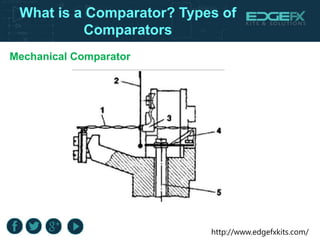
 The mechanical comparator comprises the following parts
Mechanical Comparator
• Spring
• Pointer
• Pointer Attachment Fitting
• Damping Lever
• Measurement Spindle
http://www.edgefxkits.com/
What is a Comparator? Types of
Comparators
Mechanical Comparator
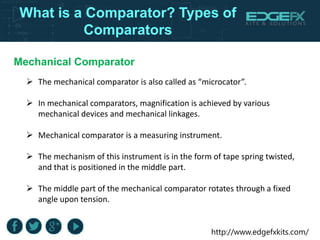
 The mechanical comparator is also called as “microcator”.
 In mechanical comparators, magnification is achieved by various
mechanical devices and mechanical linkages.
 Mechanical comparator is a measuring instrument.
 The mechanism of this instrument is in the form of tape spring twisted,
and that is positioned in the middle part.
 The middle part of the mechanical comparator rotates through a fixed
angle upon tension.
http://www.edgefxkits.com/
What is a Comparator? Types of
Comparators
Mechanical Comparator
 Mechanical comparators are classified into four types such as
• Dial Gauge Comparator
• Johansson Mikrokator Comparator
• Reed Type Comparator
• Sigma Comparator.
http://www.edgefxkits.com/
What is a Comparator? Types of
Comparators
Advantage
 Mechanical Comparator Less costly as compared to other devices.
 Instrument do not require any external agency like air or electricity.
 Usually mechanical Comparators have linear scales.
 They are compact in design They are easily portable
http://www.edgefxkits.com/
What is a Comparator? Types of
Comparators
Mechanical-Optical Comparator
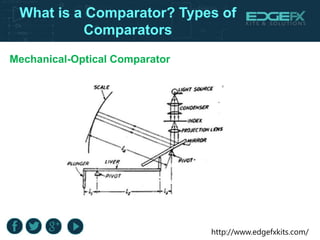
 In this comparator a small dislocation of the measuring plunger is first
amplified by a mechanical system comprising of pivoted levers.
 The mechanical movement which is amplified by an optical system
connecting the outcrop an image.
 The general arrangement of mechanical system causes a reflector to angle
near the image
 An axis of an index estimated on a scale on the inner glass screen.
 Optical magnification offers a high degree of precision measuring.
http://www.edgefxkits.com/
What is a Comparator? Types of
Comparators
Mechanical-Optical Comparator
http://www.edgefxkits.com/
What is a Comparator? Types of
Comparators
Mechanical-Optical Comparator
 In this system, the mechanical amplification is multiplied by optical
amplification.
 if the mirror is sloped by an angle 60, then the image will be sloped by 2×66.
 Therefore, the total magnification of the system is 2 x (Z^i) (J4//3).
 The optical comparators are proficient of giving a high degree of calculating
accuracy.
 It is because of high magnification & the discount off moving members to a
minimum.
http://www.edgefxkits.com/
What is a Comparator? Types of
Comparators
Mechanical-Optical Comparator
 In this type of comparator, front reflection type mirror is used instead of
normal back reflection type mirror.
 In normal back reflection mirror type, there are two reflected images such
as front and back.
 One image is bright and other one is blurred both are observed.
 The main advantage of this comparator is that deliver of an illumined scale
allows readings to be taken without favour to the conditions of room
lighting.
http://www.edgefxkits.com/
What is a Comparator? Types of
Comparators
Reed Type Comparator
http://www.edgefxkits.com/
What Is a Comparator? Types of
Comparators
Reed Type Comparator
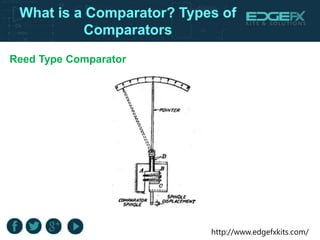
 This is a frictionless device for expanding small motions of the spindle.
 It comprises of a static block A, which is strictly attached to the gauge head
case.
 The floating block B carries the gauging spindle & is connected horizontally
to the static block by reeds C.
 A perpendicular reed is attached to every block with the higher ends
combined together
http://www.edgefxkits.com/
What is a Comparator? Types of
Comparators
 A linear motion of the spindle travels the free block perpendicularly
causing the perpendicular reed to slide.
 This effort roots the target to swing through an arc over the scale
related to the distance moved by the spindle.
 This type of comparators may have the compassions of the order of
0.25 micro/scale division.
Reed Type Comparator
http://www.edgefxkits.com/
What is a Comparator? Types of
Comparators
Electric Comparators
 In this comparator, the measuring contact movement is changed into an
electrical signal.
 Then this signal is recorded by a device that can be adjusted in terms of
plunger movement.
 For this, an AC Wheatstone bridge circuit including a galvanometer is
used.
 This electric comparator comprises of a tough stylus, an iron armature.
http://www.edgefxkits.com/
What is a Comparator? Types of
Comparators
Electric Comparators
 It breaks against the W and spring and W1.
 If the armature is located between the coils W & W1, then the inductance
of these coils is equal.
 The Wheatstone bridge is stable and forms the datum line.
 When the work piece is located under the stylus for the measurement
purpose due to the difference in datum.
 The armature, component size would either be raised up or down.
http://www.edgefxkits.com/
What is a Comparator? Types of
Comparators
Electric Comparators
 It defeats the Wheatstone bridge balance that results the unbalanced
current flow.
 This current is directly adjusted into difference in size of the component
which is expanded by an amplifier specified by the galvanometer.
 This current is directly adjusted into difference in size of the component
which is expanded by an amplifier specified by the galvanometer.
 The main advantages of these comparators are no moving parts,
sensitivity and accuracy over long periods.
http://www.edgefxkits.com/
What is a Comparator? Types of
Comparators
Electric Comparators
 An electrical comparator consists of as follows
• Base a stand.
• Power unit.
• Measuring unit.
• Indication unit.
• Amplification unit.
http://www.edgefxkits.com/
What is a Comparator? Types of
Comparators
Pneumatic Comparator
http://www.edgefxkits.com/
What is a Comparator? Types of
Comparators
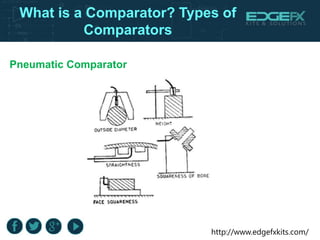
Pneumatic Comparator
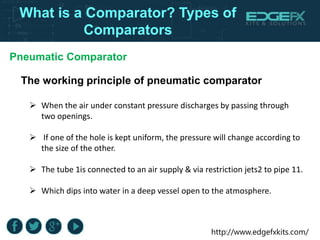
The working principle of pneumatic comparator
 When the air under constant pressure discharges by passing through
two openings.
 If one of the hole is kept uniform, the pressure will change according to
the size of the other.
 The tube 1is connected to an air supply & via restriction jets2 to pipe 11.
 Which dips into water in a deep vessel open to the atmosphere.
http://www.edgefxkits.com/
What is a Comparator? Types of
Comparators
Pneumatic Comparator
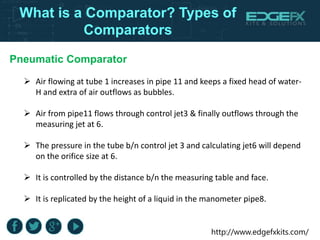
 Air flowing at tube 1 increases in pipe 11 and keeps a fixed head of water-
H and extra of air outflows as bubbles.
 Air from pipe11 flows through control jet3 & finally outflows through the
measuring jet at 6.
 The pressure in the tube b/n control jet 3 and calculating jet6 will depend
on the orifice size at 6.
 It is controlled by the distance b/n the measuring table and face.
 It is replicated by the height of a liquid in the manometer pipe8.
http://www.edgefxkits.com/
What is a Comparator? Types of
Comparators
Pneumatic Comparator
 The scale 9 is also adjusted that a head difference h specifies changes in
the gap d enlarged various hundred times.
 The main advantages of this comparator is, easy to operate, cheap,
independent of the constant pressure.
 It is free from mechanical wear and magnification is high as 10,000
times.
http://www.edgefxkits.com/
What is a Comparator? Types of
Comparators
Applications of Comparators
 Mainly involve in BLDC operating motors.
 Zero crossing detectors.
 Switching power regulators.
 Peak detectors.
http://www.edgefxkits.com/
What is a Comparator? Types of
Comparators
Conclusion
 This is all about a comparator and the types of
comparators and its wide applications. A comparator
compares two analog signals and produces a one bit
digital signal.
http://www.edgefxkits.com/

Different Types Comparators And It's Working

  • 1.
    What is aComparator? Types of Comparators
  • 2.
    http://www.edgefxkits.com/ Introduction What is aComparator? Types of Comparators  Comparators play an essential role in designing electrical and electronic projects. In electronic circuits, an op-amp is used with negative feedback and it can also be used as a comparator. The comparator is mainly designed without feedback for open loop configuration. These are widely used in A/D converters. When the i/p signal is sampled, then this signal is applied to multiple comparators to convert the digital form from analog.
  • 3.
    http://www.edgefxkits.com/ What is aComparator? Types of Comparators What is a Comparator?  A comparator is defined as, a device which includes two i/p terminals namely inverting and non inverting terminals.  One input terminal is fed with reference i/p signal and the remaining i/p is fed with the actual values of the signal.  The o/p signal can be generated based on the difference between two i/p signals either high or low.  Here low and high signals are denoted by 0 and 1.
  • 4.
    http://www.edgefxkits.com/ What is aComparator? Types of Comparators What is a Comparator?  The main purpose of the comparator is to compare two currents or voltages.  It fed to the two i/p signals and generates binary digital o/p signal that specifies which is greater is called as a comparator.  The two i/p terminals of the comparators are V+ and V- and the digital o/p is V0.  This o/p signal can be defined as  If V+ is greater than V- then V0 = 1and  If V+ is less than V- then V0 = 0,
  • 5.
    http://www.edgefxkits.com/ What is aComparator? Types of Comparators Types of Comparators Comparators are classified into different types such as • Mechanical Comparator • Mechanical-Optical Comparator • Reed Type Comparator • Electrical-Electronic Comparator • Pneumatic Comparator
  • 6.
    http://www.edgefxkits.com/ What is aComparator? Types of Comparators Mechanical Comparator
  • 7.
    http://www.edgefxkits.com/ What is aComparator? Types of Comparators  The mechanical comparator comprises the following parts Mechanical Comparator • Spring • Pointer • Pointer Attachment Fitting • Damping Lever • Measurement Spindle
  • 8.
    http://www.edgefxkits.com/ What is aComparator? Types of Comparators Mechanical Comparator  The mechanical comparator is also called as “microcator”.  In mechanical comparators, magnification is achieved by various mechanical devices and mechanical linkages.  Mechanical comparator is a measuring instrument.  The mechanism of this instrument is in the form of tape spring twisted, and that is positioned in the middle part.  The middle part of the mechanical comparator rotates through a fixed angle upon tension.
  • 9.
    http://www.edgefxkits.com/ What is aComparator? Types of Comparators Mechanical Comparator  Mechanical comparators are classified into four types such as • Dial Gauge Comparator • Johansson Mikrokator Comparator • Reed Type Comparator • Sigma Comparator.
  • 10.
    http://www.edgefxkits.com/ What is aComparator? Types of Comparators Advantage  Mechanical Comparator Less costly as compared to other devices.  Instrument do not require any external agency like air or electricity.  Usually mechanical Comparators have linear scales.  They are compact in design They are easily portable
  • 11.
    http://www.edgefxkits.com/ What is aComparator? Types of Comparators Mechanical-Optical Comparator  In this comparator a small dislocation of the measuring plunger is first amplified by a mechanical system comprising of pivoted levers.  The mechanical movement which is amplified by an optical system connecting the outcrop an image.  The general arrangement of mechanical system causes a reflector to angle near the image  An axis of an index estimated on a scale on the inner glass screen.  Optical magnification offers a high degree of precision measuring.
  • 12.
    http://www.edgefxkits.com/ What is aComparator? Types of Comparators Mechanical-Optical Comparator
  • 13.
    http://www.edgefxkits.com/ What is aComparator? Types of Comparators Mechanical-Optical Comparator  In this system, the mechanical amplification is multiplied by optical amplification.  if the mirror is sloped by an angle 60, then the image will be sloped by 2×66.  Therefore, the total magnification of the system is 2 x (Z^i) (J4//3).  The optical comparators are proficient of giving a high degree of calculating accuracy.  It is because of high magnification & the discount off moving members to a minimum.
  • 14.
    http://www.edgefxkits.com/ What is aComparator? Types of Comparators Mechanical-Optical Comparator  In this type of comparator, front reflection type mirror is used instead of normal back reflection type mirror.  In normal back reflection mirror type, there are two reflected images such as front and back.  One image is bright and other one is blurred both are observed.  The main advantage of this comparator is that deliver of an illumined scale allows readings to be taken without favour to the conditions of room lighting.
  • 15.
    http://www.edgefxkits.com/ What is aComparator? Types of Comparators Reed Type Comparator
  • 16.
    http://www.edgefxkits.com/ What Is aComparator? Types of Comparators Reed Type Comparator  This is a frictionless device for expanding small motions of the spindle.  It comprises of a static block A, which is strictly attached to the gauge head case.  The floating block B carries the gauging spindle & is connected horizontally to the static block by reeds C.  A perpendicular reed is attached to every block with the higher ends combined together
  • 17.
    http://www.edgefxkits.com/ What is aComparator? Types of Comparators  A linear motion of the spindle travels the free block perpendicularly causing the perpendicular reed to slide.  This effort roots the target to swing through an arc over the scale related to the distance moved by the spindle.  This type of comparators may have the compassions of the order of 0.25 micro/scale division. Reed Type Comparator
  • 18.
    http://www.edgefxkits.com/ What is aComparator? Types of Comparators Electric Comparators  In this comparator, the measuring contact movement is changed into an electrical signal.  Then this signal is recorded by a device that can be adjusted in terms of plunger movement.  For this, an AC Wheatstone bridge circuit including a galvanometer is used.  This electric comparator comprises of a tough stylus, an iron armature.
  • 19.
    http://www.edgefxkits.com/ What is aComparator? Types of Comparators Electric Comparators  It breaks against the W and spring and W1.  If the armature is located between the coils W & W1, then the inductance of these coils is equal.  The Wheatstone bridge is stable and forms the datum line.  When the work piece is located under the stylus for the measurement purpose due to the difference in datum.  The armature, component size would either be raised up or down.
  • 20.
    http://www.edgefxkits.com/ What is aComparator? Types of Comparators Electric Comparators  It defeats the Wheatstone bridge balance that results the unbalanced current flow.  This current is directly adjusted into difference in size of the component which is expanded by an amplifier specified by the galvanometer.  This current is directly adjusted into difference in size of the component which is expanded by an amplifier specified by the galvanometer.  The main advantages of these comparators are no moving parts, sensitivity and accuracy over long periods.
  • 21.
    http://www.edgefxkits.com/ What is aComparator? Types of Comparators Electric Comparators  An electrical comparator consists of as follows • Base a stand. • Power unit. • Measuring unit. • Indication unit. • Amplification unit.
  • 22.
    http://www.edgefxkits.com/ What is aComparator? Types of Comparators Pneumatic Comparator
  • 23.
    http://www.edgefxkits.com/ What is aComparator? Types of Comparators Pneumatic Comparator The working principle of pneumatic comparator  When the air under constant pressure discharges by passing through two openings.  If one of the hole is kept uniform, the pressure will change according to the size of the other.  The tube 1is connected to an air supply & via restriction jets2 to pipe 11.  Which dips into water in a deep vessel open to the atmosphere.
  • 24.
    http://www.edgefxkits.com/ What is aComparator? Types of Comparators Pneumatic Comparator  Air flowing at tube 1 increases in pipe 11 and keeps a fixed head of water- H and extra of air outflows as bubbles.  Air from pipe11 flows through control jet3 & finally outflows through the measuring jet at 6.  The pressure in the tube b/n control jet 3 and calculating jet6 will depend on the orifice size at 6.  It is controlled by the distance b/n the measuring table and face.  It is replicated by the height of a liquid in the manometer pipe8.
  • 25.
    http://www.edgefxkits.com/ What is aComparator? Types of Comparators Pneumatic Comparator  The scale 9 is also adjusted that a head difference h specifies changes in the gap d enlarged various hundred times.  The main advantages of this comparator is, easy to operate, cheap, independent of the constant pressure.  It is free from mechanical wear and magnification is high as 10,000 times.
  • 26.
    http://www.edgefxkits.com/ What is aComparator? Types of Comparators Applications of Comparators  Mainly involve in BLDC operating motors.  Zero crossing detectors.  Switching power regulators.  Peak detectors.
  • 27.
    http://www.edgefxkits.com/ What is aComparator? Types of Comparators Conclusion  This is all about a comparator and the types of comparators and its wide applications. A comparator compares two analog signals and produces a one bit digital signal.
  • 28.