Chapter 5: Comparators
5.1 Introduction
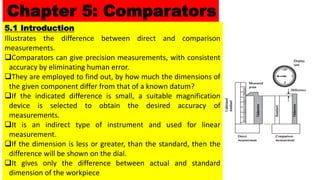
Illustrates the difference between direct and comparison
measurements.
Comparators can give precision measurements, with consistent
accuracy by eliminating human error.
They are employed to find out, by how much the dimensions of
the given component differ from that of a known datum?
If the indicated difference is small, a suitable magnification
device is selected to obtain the desired accuracy of
measurements.
It is an indirect type of instrument and used for linear
measurement.
If the dimension is less or greater, than the standard, then the
difference will be shown on the dial.
It gives only the difference between actual and standard
dimension of the workpiece.
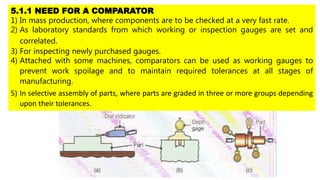
5.1.1 NEED FOR A COMPARATOR
1) In mass production, where components are to be checked at a very fast rate.
2) As laboratory standards from which working or inspection gauges are set and
correlated.
3) For inspecting newly purchased gauges.
4) Attached with some machines, comparators can be used as working gauges to
prevent work spoilage and to maintain required tolerances at all stages of
manufacturing.
5) In selective assembly of parts, where parts are graded in three or more groups depending
upon their tolerances.
5.2 Function Requirements
A comparator has to fulfil many functional requirements in order to be effective
in the industry. We can summarize the major requirements of a comparator as
follows:
1. A comparator should have a high degree of accuracy and precision.
2. The scale should be linear and have a wide range.
3. A comparator is required to have high amplification.
4. A comparator should have good resolution, which is the least possible unit of
measurement that can be read on the display device of the comparator.
5. There should be a provision incorporated to compensate for temperature effects.
6. Finally, the comparator should be versatile.
5.2.1 Characteristics of Good Comparators
1) Compact.
2) Easy to handle.
3) Quick response or quick result.
4) Reliable, while in use.
5) No effects of environment
6) Less weight.
7) Cost
8) Availability
9) Sensitivity
10)It should be linear in scale so that it is easy to read and get uniform response
5.3 Classification of Comparators
With respect to the principle used for amplifying and recording measurements,
comparators are classified as follows:
1. Mechanical comparators
2. Mechanical–optical comparators
3. Electrical and electronic comparators
4. Pneumatic comparators
5. Other types such as projection comparators and multi-check comparators
each of these types of comparators has many variants, which provide
flexibility to the user to make an appropriate and economical selection for a
particular metrological application.
5.4 Mechanical Comparators
Mechanical comparators have a long history and have been used for many
centuries. The following are some of the important comparators in metrology.
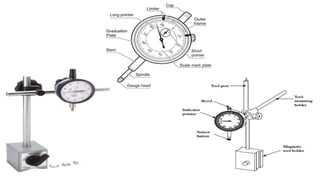
5.4.1 Dial Indicator
The dial indicator or the dial gauge is one of the simplest and the most widely
used comparator. It is primarily used to compare workpieces against a master
Functional parts of a dial indicator Dial indicator mounted on a stand
5.5 Johansson Mikrokator
The two halves of the thin metal strip, which carries the light pointer, are
in opposite directions. Therefore, any pull on the strip will cause the pointer to
rotate.
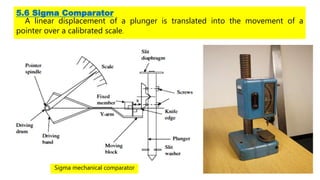
5.6 Sigma Comparator
A linear displacement of a plunger is translated into the movement of a
pointer over a calibrated scale.
Sigma mechanical comparator
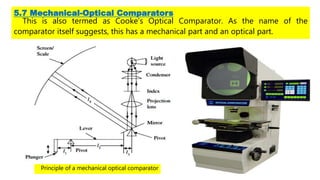
5.7 Mechanical-Optical Comparators
This is also termed as Cooke’s Optical Comparator. As the name of the
comparator itself suggests, this has a mechanical part and an optical part.
Principle of a mechanical optical comparator
5.8 Zeiss Ultra-optimeter
The Zeiss ultra-optimeter is another mechanical optical comparator that can
provide higher magnification than the simple mechanical optical comparators. This
magnification is made possible by the use of two mirrors, which create double
reflection of light.
Zeiss Ultra-Optimeter
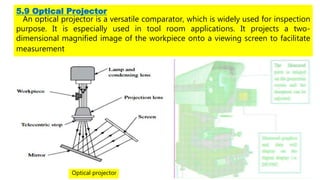
5.9 Optical Projector
An optical projector is a versatile comparator, which is widely used for inspection
purpose. It is especially used in tool room applications. It projects a two-
dimensional magnified image of the workpiece onto a viewing screen to facilitate
measurement
Optical projector
5.10 Electrical Comparators
An electronic comparator, in particular, can achieve an exceptionally high
magnification of the order of 105:1 quite easily. Electrical and electronic
comparators mainly differ with respect to magnification and type of output.
However, both rely on mechanical contact with the work to be measured
Elements of an electrical comparator
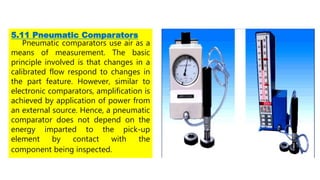
5.11 Pneumatic Comparators
Pneumatic comparators use air as a
means of measurement. The basic
principle involved is that changes in a
calibrated flow respond to changes in
the part feature. However, similar to
electronic comparators, amplification is
achieved by application of power from
an external source. Hence, a pneumatic
comparator does not depend on the
energy imparted to the pick-up
element by contact with the
component being inspected.
5.12 Free Flow Air Gauge
This uses a simple pneumatic circuit. Compressed air with a pressure in the range
1.5–2 bar is passed through a tapered glass column that contains a small metal float.
This restricts the flow of air, thereby changing the position of the float inside the
tapered glass column.
Free flow air gauge Air gaps in air gauging
5.13 Back Pressure Gauge
This system uses a two-orifice arrangement. While the orifice O1 is called the
control orifice, the orifice O2 is referred to as the measuring orifice. The measuring
head gets compressed air supply at a constant pressure P, which is called the
source pressure.
Back pressure gauge

Chapter 5 Comparators.pptx

  • 1.
    Chapter 5: Comparators 5.1Introduction Illustrates the difference between direct and comparison measurements. Comparators can give precision measurements, with consistent accuracy by eliminating human error. They are employed to find out, by how much the dimensions of the given component differ from that of a known datum? If the indicated difference is small, a suitable magnification device is selected to obtain the desired accuracy of measurements. It is an indirect type of instrument and used for linear measurement. If the dimension is less or greater, than the standard, then the difference will be shown on the dial. It gives only the difference between actual and standard dimension of the workpiece.
  • 2.
    5.1.1 NEED FORA COMPARATOR 1) In mass production, where components are to be checked at a very fast rate. 2) As laboratory standards from which working or inspection gauges are set and correlated. 3) For inspecting newly purchased gauges. 4) Attached with some machines, comparators can be used as working gauges to prevent work spoilage and to maintain required tolerances at all stages of manufacturing. 5) In selective assembly of parts, where parts are graded in three or more groups depending upon their tolerances.
  • 3.
    5.2 Function Requirements Acomparator has to fulfil many functional requirements in order to be effective in the industry. We can summarize the major requirements of a comparator as follows: 1. A comparator should have a high degree of accuracy and precision. 2. The scale should be linear and have a wide range. 3. A comparator is required to have high amplification. 4. A comparator should have good resolution, which is the least possible unit of measurement that can be read on the display device of the comparator. 5. There should be a provision incorporated to compensate for temperature effects. 6. Finally, the comparator should be versatile.
  • 4.
    5.2.1 Characteristics ofGood Comparators 1) Compact. 2) Easy to handle. 3) Quick response or quick result. 4) Reliable, while in use. 5) No effects of environment 6) Less weight. 7) Cost 8) Availability 9) Sensitivity 10)It should be linear in scale so that it is easy to read and get uniform response
  • 5.
    5.3 Classification ofComparators With respect to the principle used for amplifying and recording measurements, comparators are classified as follows: 1. Mechanical comparators 2. Mechanical–optical comparators 3. Electrical and electronic comparators 4. Pneumatic comparators 5. Other types such as projection comparators and multi-check comparators each of these types of comparators has many variants, which provide flexibility to the user to make an appropriate and economical selection for a particular metrological application.
  • 6.
    5.4 Mechanical Comparators Mechanicalcomparators have a long history and have been used for many centuries. The following are some of the important comparators in metrology. 5.4.1 Dial Indicator The dial indicator or the dial gauge is one of the simplest and the most widely used comparator. It is primarily used to compare workpieces against a master Functional parts of a dial indicator Dial indicator mounted on a stand
  • 9.
    5.5 Johansson Mikrokator Thetwo halves of the thin metal strip, which carries the light pointer, are in opposite directions. Therefore, any pull on the strip will cause the pointer to rotate.
  • 10.
    5.6 Sigma Comparator Alinear displacement of a plunger is translated into the movement of a pointer over a calibrated scale. Sigma mechanical comparator
  • 11.
    5.7 Mechanical-Optical Comparators Thisis also termed as Cooke’s Optical Comparator. As the name of the comparator itself suggests, this has a mechanical part and an optical part. Principle of a mechanical optical comparator
  • 12.
    5.8 Zeiss Ultra-optimeter TheZeiss ultra-optimeter is another mechanical optical comparator that can provide higher magnification than the simple mechanical optical comparators. This magnification is made possible by the use of two mirrors, which create double reflection of light. Zeiss Ultra-Optimeter
  • 13.
    5.9 Optical Projector Anoptical projector is a versatile comparator, which is widely used for inspection purpose. It is especially used in tool room applications. It projects a two- dimensional magnified image of the workpiece onto a viewing screen to facilitate measurement Optical projector
  • 14.
    5.10 Electrical Comparators Anelectronic comparator, in particular, can achieve an exceptionally high magnification of the order of 105:1 quite easily. Electrical and electronic comparators mainly differ with respect to magnification and type of output. However, both rely on mechanical contact with the work to be measured Elements of an electrical comparator
  • 15.
    5.11 Pneumatic Comparators Pneumaticcomparators use air as a means of measurement. The basic principle involved is that changes in a calibrated flow respond to changes in the part feature. However, similar to electronic comparators, amplification is achieved by application of power from an external source. Hence, a pneumatic comparator does not depend on the energy imparted to the pick-up element by contact with the component being inspected.
  • 16.
    5.12 Free FlowAir Gauge This uses a simple pneumatic circuit. Compressed air with a pressure in the range 1.5–2 bar is passed through a tapered glass column that contains a small metal float. This restricts the flow of air, thereby changing the position of the float inside the tapered glass column. Free flow air gauge Air gaps in air gauging
  • 17.
    5.13 Back PressureGauge This system uses a two-orifice arrangement. While the orifice O1 is called the control orifice, the orifice O2 is referred to as the measuring orifice. The measuring head gets compressed air supply at a constant pressure P, which is called the source pressure. Back pressure gauge