Mechanical Comparators
By :Bhavik Pandya
COMPARATORS
The general principle of comparator is to indicate the
differences in size between the standard and the work
being measured by means of some pointer on a scale
with sufficient magnification
It thus does not measure the actual dimension but
indicates how much it differs from the basic
dimension
All comparators consist of three basic features
1)A sensing device
• which faithfully senses the input signal
2) A Magnifying or amplifying system
• to increase the signal to suitable magnitude.
Mechanical, Optical, Pneumatic,hydraulic and electronic
methods are used for this purpose.
3) A display system (usually a scale and pointer)
Which utilizes the amplified signal to provide a suitable
readout.
Need for a comparator
A comparator is used in mass production to inspect the
components to close tolerances with high degree
of precision and speed. Ex: Piston
• Use of line standards such as vernier and micrometer
calipers require considerable skill
• Many dimensions can be checked in a very short time
Comparators can be classified as
1. Mechanical 2. Optical 3. Electrical &Electronic
4. Pneumatic
5. Fluid displacement comparators
6. Mechanical optical comparator
7. Electro-mechanical comparator
8. Multi-check comparator.
Design Consideration
1.Ability to record variation of at least 0.0025 mm
2.Linear recording scale
3.Variance free (Instrument readings should not vary
when repeated measurements of given quantity are
made
4.Scale indicators clear and free from oscillations
5.Free from backlash, unnecessary friction &clearances
inertia should be low.
6.Measuring pressure should be low and constant
7.Supporting frame to be rigid and withstand reasonable
ill usage without permanent damage
8.Capable of measuring wide range.
Basic operation
1. The comparator is first adjusted to zero on its dial
with a gauge block in position
2. The work piece to be checked is then placed in
position
3. The comparator gives the difference in dimension
in relation to the gauge block.
Uses of comparator
1. Laboratory Standards:
to set the working or inspection gauges
2.Working Gauges
To prevent the work spoilage and to maintain required
tolerances
3. Final Inspection Gauges
4. Receiving Inspection Gauges
5. For checking newly purchased gauges
Essential characteristics of a comparator
1. Robust design and construction
2. Linear characteristics of scale
3. High magnification
4. Quick in Results
5. Versatility
6. Minimum Wear of contact Point
7. Free from Oscillations
8. Free from backlash
9. Quick insertion of work piece
10. Adjustable table
11. Compensation from temperature effects
12. Means to prevent damage
 Mechanical comparator 
Types of Mechanical Comparators
1. Dial indicator (Dial Gauge)
2. Read Type
3. Johansson Mikrokator
4. Sigma Comparator
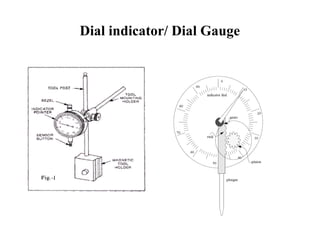
Dial indicator/ Dial Gauge
• The simplest type of mechanical comparator
• It consists of a base with a rigid column rising from
its rear
• An arm mounted on this column and it carries a dial
gauge at its outer end
• The indicator is set at zero by the use of slip gauges
• The part to be checked is placed below the plunger
• The linear movement of the plunger is magnified by
means of mechanical means to a sizable rotation of
the pointer
This type is generally used for inspection of small
precision machined parts
The dial gauge with various attachments are commonly
used
This comparator is ideal for the checking of components
with a tolerance of + 0.005 mm
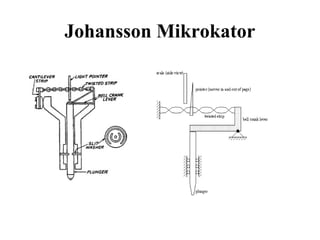
Johansson Mikrokator
Working of the comparator
A very thin metal strip at the centre carries a light
pointer made up of glass .
One end of the strip is connected to the adjustable
cantilever strip and the other end is to the spring
elbow, in turn connected to the plunger.
The slight movements of the plunger will make the
bell crank lever to rotate.
This rotation will create tension in the strip and causes
the strip to rotate thereby the strip start to untwist
resulting in the movement of the point
The spring ensures that the plunger returns when the
contact is removed
The length of the cantilever can be varied to adjust the
magnification
The mechanical magnification is obtained by
“Abramson Movement”
Reed Type Comparator
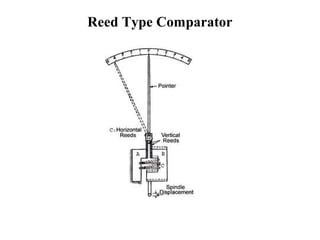
The gauging head is usually a sensitive, high quality,
dial indicator mounted on a base supported by a sturdy
column.
The reed mechanism is frictionless device for
magnifying small motions of spindle.
It consists of a fixed block A which is rigidly fastened to
the gauge head case, and floating block B, which carries
the gauging spindle and is connected horizontally to the
fixed block by reeds C
Vertical reed is attached to each block with upper
ends joined together. These vertical reeds are shown
in the figure by letter D. Beyond this joint extends a
pointer or target.
A linear motion of the spindle moves the free block
vertically causing the vertical reed on the floating
block to slide past the vertical reed on the fixed
block.
How- ever, as these vertical reeds are joined at the
upper end, instead of slipping, the movement causes
both reeds swing through an arc and as the target is
merely an extension of the vertical reeds, it swings
through a much wider arc.
The amount of target swing is proportional to the
distance, the floating block has moved but of course
very much magnified.
The scale may be calibrated by means of gauge block
(slip gauges) to indicate any deviation from an initial
setting.
Sensitivities of the order of 0.25 micron per scale
division.
The mechanical amplification is usually less than 100,
but it is multiplied by the optical lens system. It is
available in amplifications ranging from x 500 to x
1000.
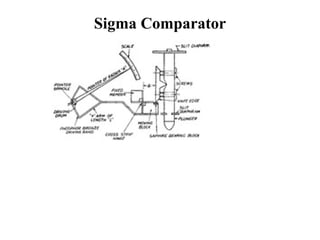
Sigma Comparator
The plunger is mounted on a pair of slit diaphragms in
order to have frictionless linear movement. A knife
edge is mounted on it and bears upon the face of the
moving member of a cross strip hinge.
The cross strip hinge consists of the moving
component and a fixed member which are connected
by thin flexible strips alternately at right angle to each
other.
Thus if an external force is applied to the moving
member ; it will pivot, as would a hinge, about the
line of intersection of the strips.
To the moving member an arm of Y shape and having
effective length I is attached.
Advantages of mechanical comparators
1.Cheaper than all the other type of comparators
2.Does not require any external source of power or
air supply
3.These comparators use a linear scale that can be
easily understood.
4.Usually these comparators are robust and compact
but are very easy to handle
5.These are small in size and can are portable from one
place to other very easily without much difficulty
Disadvantages
1.Contains more number of moving parts so there
develops friction which in turn reduces the accuracy
2.Slackness in the moving parts reduces accuracy very
drastically
3.These have more inertia so the instrument is prone to
vibrational effects
4. Limited range of the instrument is another drawback
as the pointer moves over a fixed scale
5. Parallax error may also arise when proper scale is
used

Mechanical comparator

  • 1.
  • 2.
  • 3.
    The general principleof comparator is to indicate the differences in size between the standard and the work being measured by means of some pointer on a scale with sufficient magnification It thus does not measure the actual dimension but indicates how much it differs from the basic dimension
  • 4.
    All comparators consistof three basic features 1)A sensing device • which faithfully senses the input signal 2) A Magnifying or amplifying system • to increase the signal to suitable magnitude. Mechanical, Optical, Pneumatic,hydraulic and electronic methods are used for this purpose. 3) A display system (usually a scale and pointer) Which utilizes the amplified signal to provide a suitable readout.
  • 5.
    Need for acomparator A comparator is used in mass production to inspect the components to close tolerances with high degree of precision and speed. Ex: Piston • Use of line standards such as vernier and micrometer calipers require considerable skill • Many dimensions can be checked in a very short time Comparators can be classified as 1. Mechanical 2. Optical 3. Electrical &Electronic 4. Pneumatic 5. Fluid displacement comparators 6. Mechanical optical comparator 7. Electro-mechanical comparator 8. Multi-check comparator.
  • 6.
    Design Consideration 1.Ability torecord variation of at least 0.0025 mm 2.Linear recording scale 3.Variance free (Instrument readings should not vary when repeated measurements of given quantity are made 4.Scale indicators clear and free from oscillations 5.Free from backlash, unnecessary friction &clearances inertia should be low. 6.Measuring pressure should be low and constant 7.Supporting frame to be rigid and withstand reasonable ill usage without permanent damage 8.Capable of measuring wide range.
  • 7.
    Basic operation 1. Thecomparator is first adjusted to zero on its dial with a gauge block in position 2. The work piece to be checked is then placed in position 3. The comparator gives the difference in dimension in relation to the gauge block.
  • 8.
    Uses of comparator 1.Laboratory Standards: to set the working or inspection gauges 2.Working Gauges To prevent the work spoilage and to maintain required tolerances 3. Final Inspection Gauges 4. Receiving Inspection Gauges 5. For checking newly purchased gauges
  • 9.
    Essential characteristics ofa comparator 1. Robust design and construction 2. Linear characteristics of scale 3. High magnification 4. Quick in Results 5. Versatility 6. Minimum Wear of contact Point 7. Free from Oscillations 8. Free from backlash 9. Quick insertion of work piece 10. Adjustable table 11. Compensation from temperature effects 12. Means to prevent damage
  • 10.
  • 11.
    Types of MechanicalComparators 1. Dial indicator (Dial Gauge) 2. Read Type 3. Johansson Mikrokator 4. Sigma Comparator
  • 12.
  • 13.
    • The simplesttype of mechanical comparator • It consists of a base with a rigid column rising from its rear • An arm mounted on this column and it carries a dial gauge at its outer end • The indicator is set at zero by the use of slip gauges • The part to be checked is placed below the plunger • The linear movement of the plunger is magnified by means of mechanical means to a sizable rotation of the pointer
  • 14.
    This type isgenerally used for inspection of small precision machined parts The dial gauge with various attachments are commonly used This comparator is ideal for the checking of components with a tolerance of + 0.005 mm
  • 15.
  • 17.
    Working of thecomparator A very thin metal strip at the centre carries a light pointer made up of glass . One end of the strip is connected to the adjustable cantilever strip and the other end is to the spring elbow, in turn connected to the plunger. The slight movements of the plunger will make the bell crank lever to rotate. This rotation will create tension in the strip and causes the strip to rotate thereby the strip start to untwist resulting in the movement of the point
  • 18.
    The spring ensuresthat the plunger returns when the contact is removed The length of the cantilever can be varied to adjust the magnification The mechanical magnification is obtained by “Abramson Movement”
  • 19.
  • 20.
    The gauging headis usually a sensitive, high quality, dial indicator mounted on a base supported by a sturdy column. The reed mechanism is frictionless device for magnifying small motions of spindle. It consists of a fixed block A which is rigidly fastened to the gauge head case, and floating block B, which carries the gauging spindle and is connected horizontally to the fixed block by reeds C
  • 21.
    Vertical reed isattached to each block with upper ends joined together. These vertical reeds are shown in the figure by letter D. Beyond this joint extends a pointer or target. A linear motion of the spindle moves the free block vertically causing the vertical reed on the floating block to slide past the vertical reed on the fixed block. How- ever, as these vertical reeds are joined at the upper end, instead of slipping, the movement causes both reeds swing through an arc and as the target is merely an extension of the vertical reeds, it swings through a much wider arc.
  • 22.
    The amount oftarget swing is proportional to the distance, the floating block has moved but of course very much magnified. The scale may be calibrated by means of gauge block (slip gauges) to indicate any deviation from an initial setting. Sensitivities of the order of 0.25 micron per scale division. The mechanical amplification is usually less than 100, but it is multiplied by the optical lens system. It is available in amplifications ranging from x 500 to x 1000.
  • 23.
  • 24.
    The plunger ismounted on a pair of slit diaphragms in order to have frictionless linear movement. A knife edge is mounted on it and bears upon the face of the moving member of a cross strip hinge. The cross strip hinge consists of the moving component and a fixed member which are connected by thin flexible strips alternately at right angle to each other. Thus if an external force is applied to the moving member ; it will pivot, as would a hinge, about the line of intersection of the strips. To the moving member an arm of Y shape and having effective length I is attached.
  • 25.
    Advantages of mechanicalcomparators 1.Cheaper than all the other type of comparators 2.Does not require any external source of power or air supply 3.These comparators use a linear scale that can be easily understood. 4.Usually these comparators are robust and compact but are very easy to handle 5.These are small in size and can are portable from one place to other very easily without much difficulty
  • 26.
    Disadvantages 1.Contains more numberof moving parts so there develops friction which in turn reduces the accuracy 2.Slackness in the moving parts reduces accuracy very drastically 3.These have more inertia so the instrument is prone to vibrational effects 4. Limited range of the instrument is another drawback as the pointer moves over a fixed scale 5. Parallax error may also arise when proper scale is used