WHAT IS METROLOGY
SCIENCE OF MEASUREMENTS
Everything
has to do with
measurement
Designing
Conducting
Analyzing
Results
Experiment
or test
within the Metrology realm
Allowing people to
plan their lives

and make
commercial
exchange with
confidence
CAN BE SEEN
EVERYWHERE
 Metrology is mainly concerned with:
(1) Establishing the units of measurements, ensuring
the uniformity of measurements.
(2) Developing methods of measurement.
(3) Errors of measurement.
(4) Accuracy of measuring instruments and their care.
(5) Industrial inspection and its various techniques.
Linear and Angular MeasurementLinear and Angular Measurement
G.GopinathGG - Unit II
Linear and AngularLinear and Angular
MeasurementMeasurement
The Linear Measurement includes
measurements of length, diameters,
heights and thickness
The Angular measurement includes the
measurement of angles or tapers
GG - Unit II
DimensionsDimensions
A very common measurement is that of
dimensions, i.e., length, width, height of
an object
Dimensions of the measuring instruments
are classified as follows
◦ Low resolution devices (up to 0.25mm)
◦ Medium resolution devices (up to
0.0025mm)
◦ High resolution devices (less than microns)
GG - Unit II
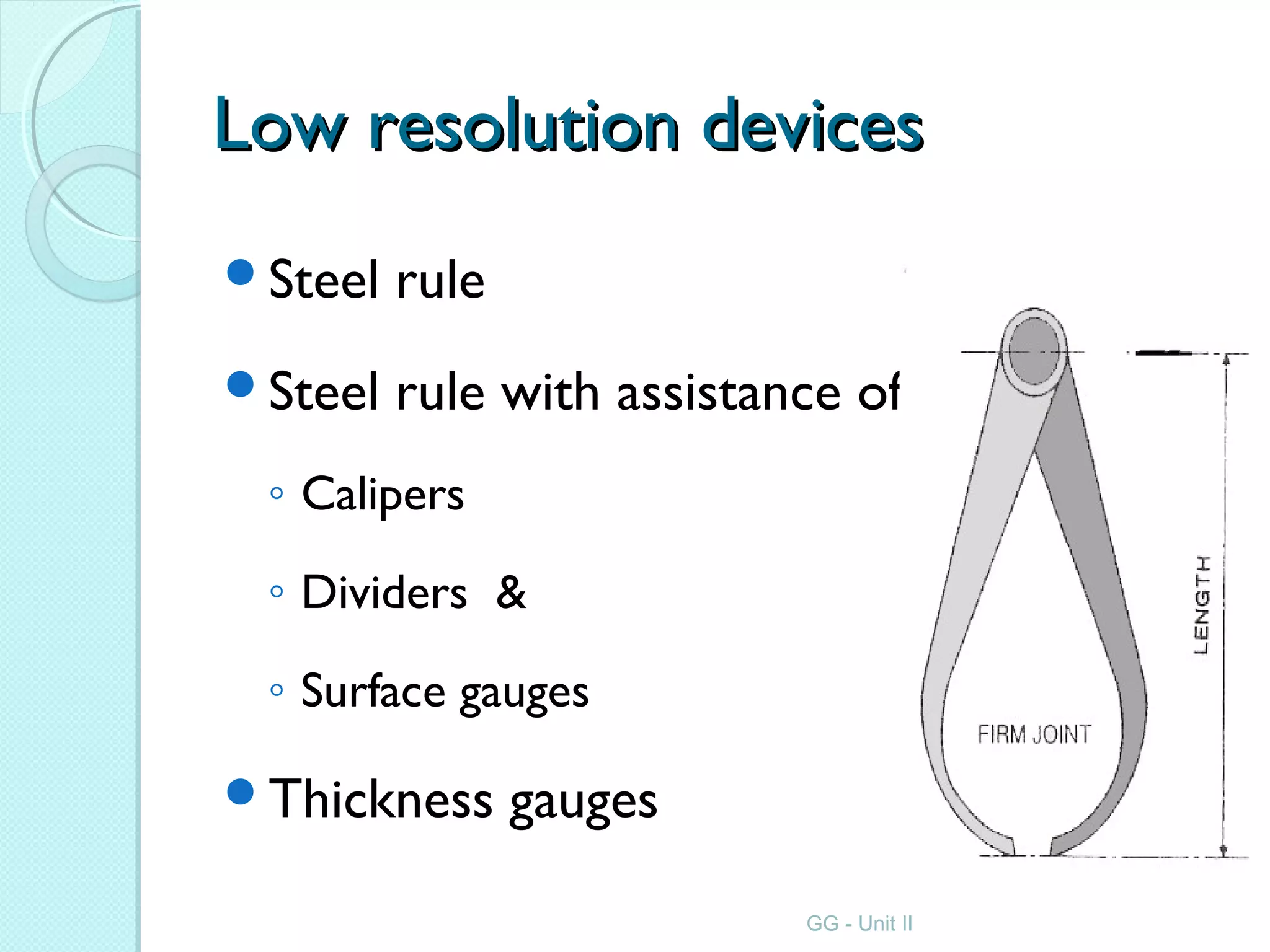
Low resolution devicesLow resolution devices
Steel rule
Steel rule with assistance of
◦ Calipers
◦ Dividers &
◦ Surface gauges
Thickness gauges
GG - Unit II
Medium resolution devicesMedium resolution devices
Micrometer
Micrometer with assistance of
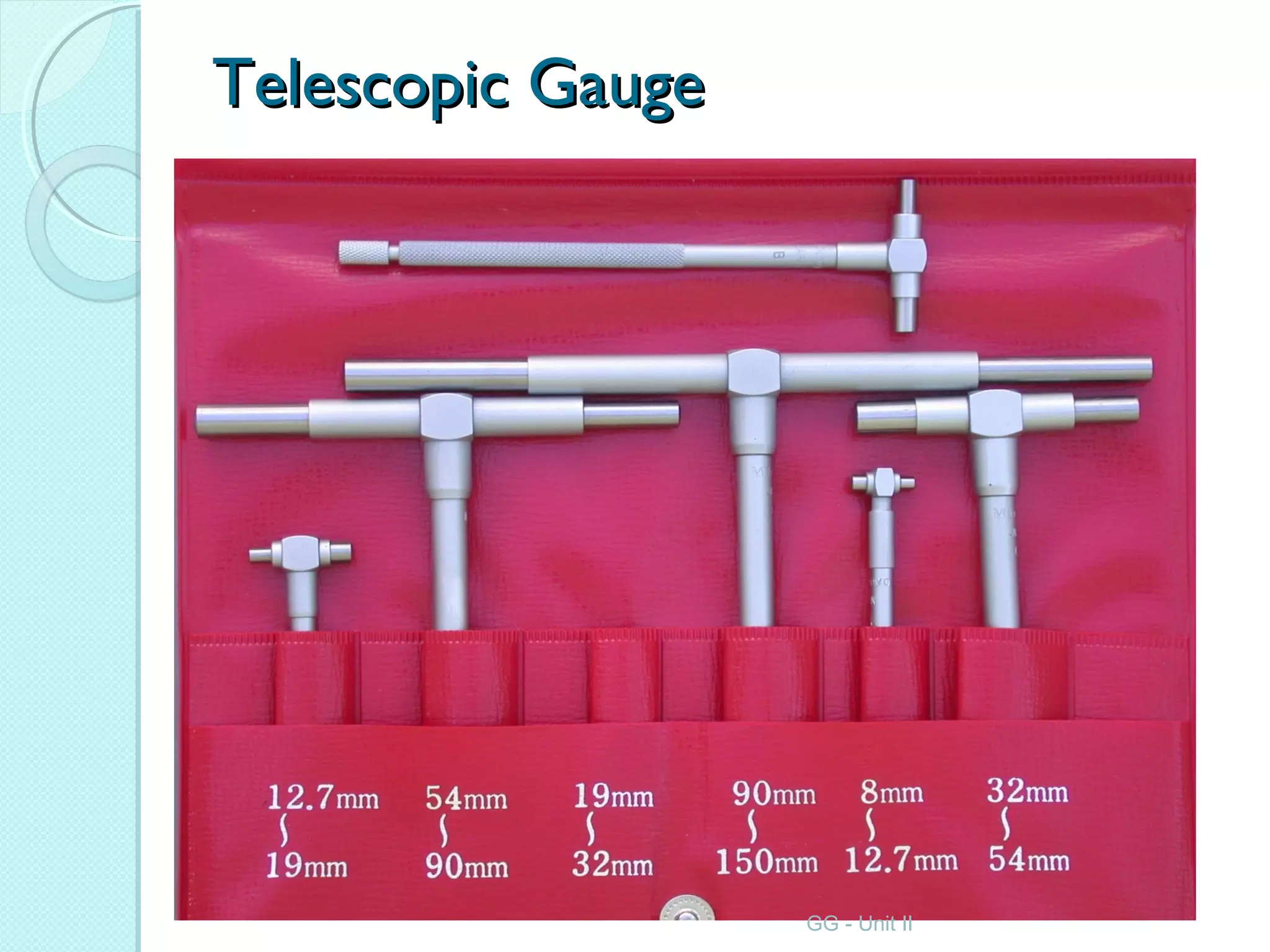
◦ Telescoping
◦ Extendable ball gauges
Vernier calipers
Dial indicators
Microscope
GG - Unit II
High resolution devicesHigh resolution devices
Gauge blocks
Gauge block with assistance of
◦ Mechanical comparator
◦ Electronic comparator
◦ Pneumatic comparator
◦ Optical flats
GG - Unit II
Linear Measuring InstrumentsLinear Measuring Instruments
Vernier caliper
Micrometer
Slip gauge or gauge blocks
Optical flats
Interferometer
Comparators
GG - Unit II
Vernier caliperVernier caliper
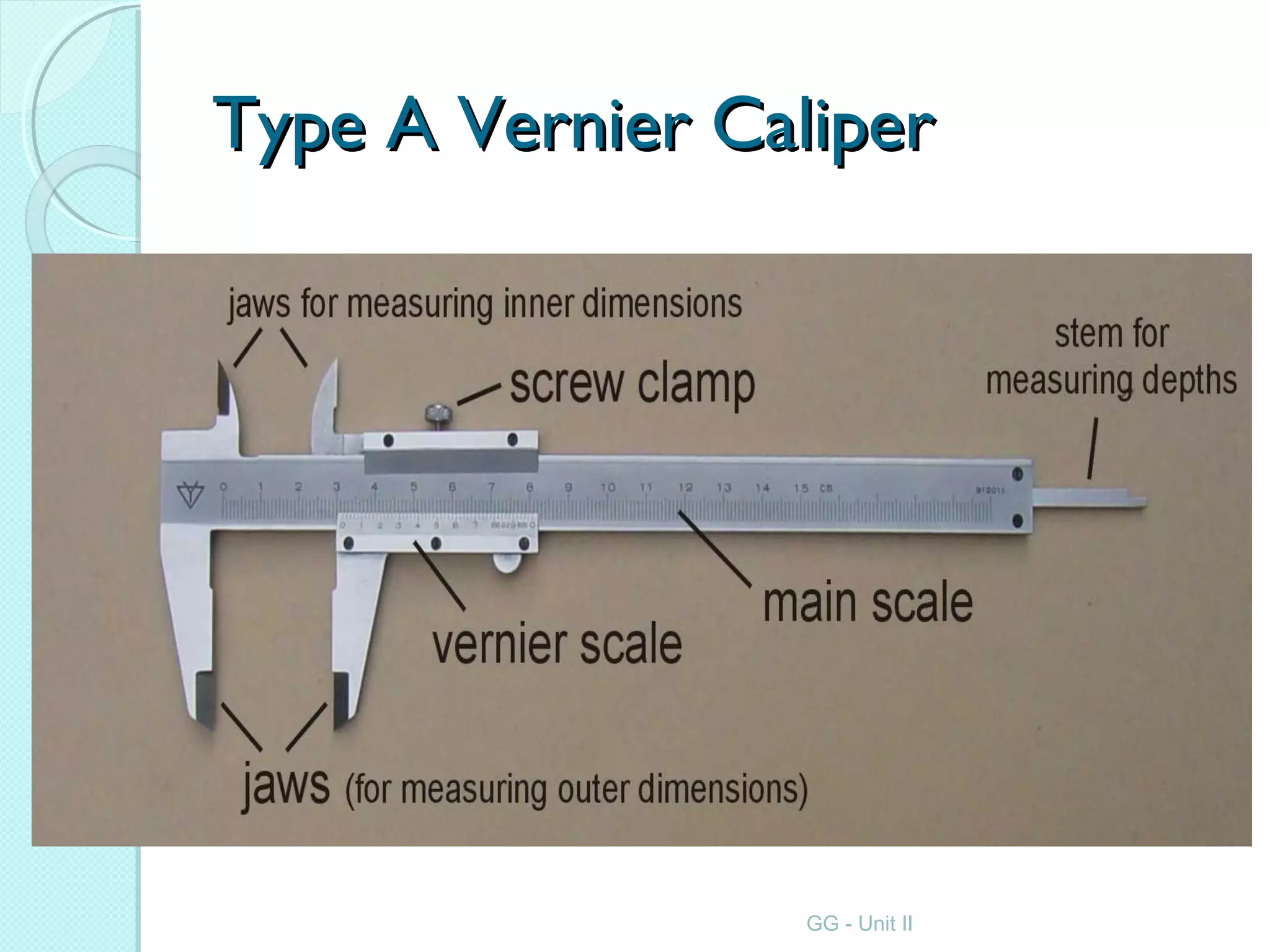
Components of vernier calipers are
◦ Main scale
◦ Vernier scale
◦ Fixed jaw
◦ Movable jaw
Types of vernier calipers
◦ Type A vernier caliper
◦ Type B vernier caliper
◦ Type C vernier caliper
GG - Unit II
Type A Vernier CaliperType A Vernier Caliper
GG - Unit II
Type B Vernier CaliperType B Vernier Caliper
GG - Unit II
Type C Vernier CaliperType C Vernier Caliper
GG - Unit II
Vernier caliperVernier caliper
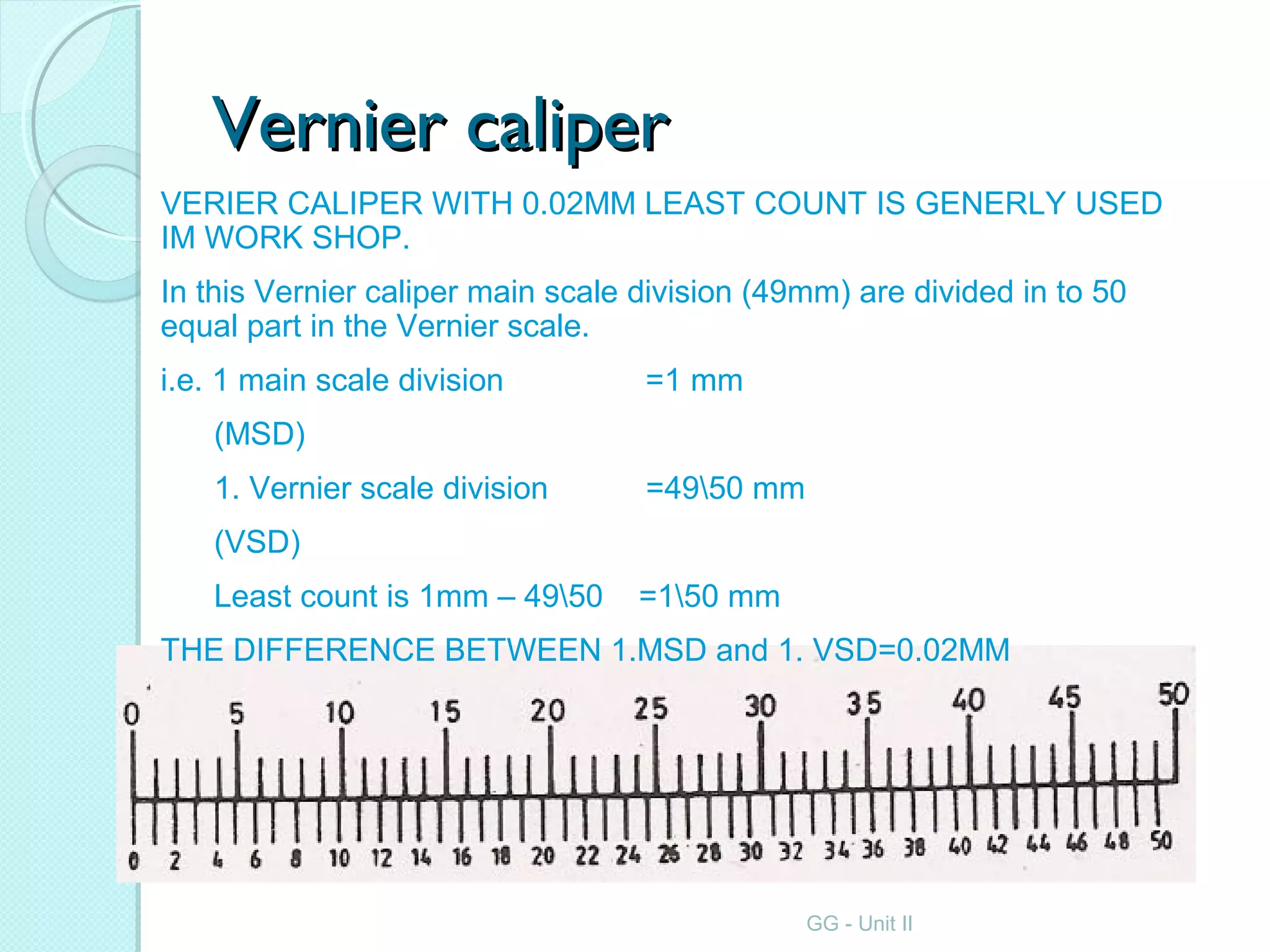
VERIER CALIPER WITH 0.02MM LEAST COUNT IS GENERLY USED
IM WORK SHOP.
In this Vernier caliper main scale division (49mm) are divided in to 50
equal part in the Vernier scale.
i.e. 1 main scale division =1 mm
(MSD)
1. Vernier scale division =4950 mm
(VSD)
Least count is 1mm – 4950 =150 mm
THE DIFFERENCE BETWEEN 1.MSD and 1. VSD=0.02MM
GG - Unit II
ExampleExample
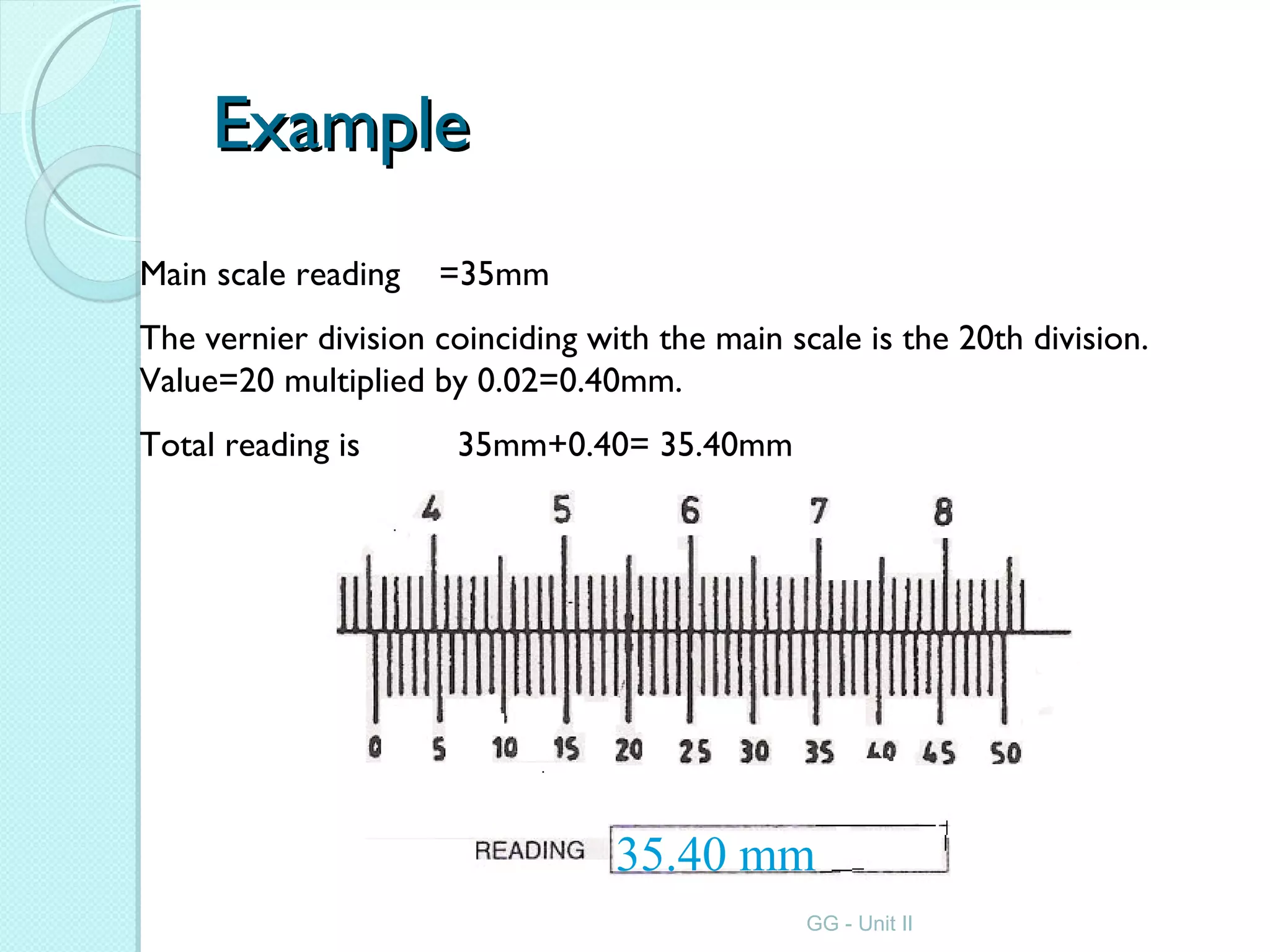
Main scale reading =35mm
The vernier division coinciding with the main scale is the 20th division.
Value=20 multiplied by 0.02=0.40mm.
Total reading is 35mm+0.40= 35.40mm
35.40 mm
GG - Unit II
Vernier Depth GaugeVernier Depth Gauge
A vernier depth is very commonly used
precision instrument for measuring depth of
holes recesses, slot and step.
Its construction and method of reading
are similar to those of a vernier caliper.
GG - Unit II
VERNIER DEPTH GAUGEVERNIER DEPTH GAUGE
Base
Graduated beam
Clamping screw
Fine adjustment
mechanism
Vernier scale
GG - Unit II
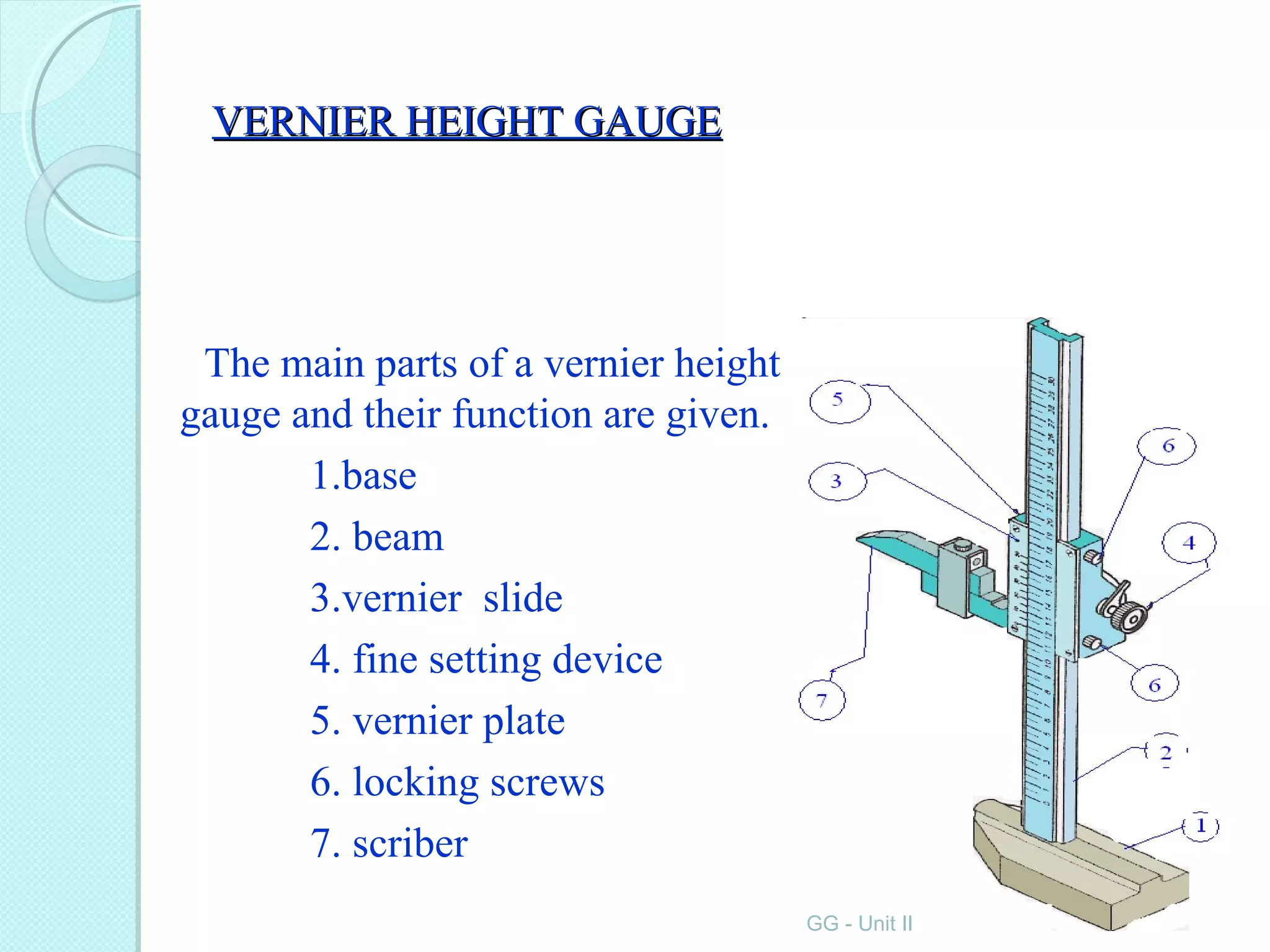
VERNIER HEIGHT GAUGEVERNIER HEIGHT GAUGE
The main parts of a vernier height
gauge and their function are given.
1.base
2. beam
3.vernier slide
4. fine setting device
5. vernier plate
6. locking screws
7. scriber
GG - Unit II
Gear Tooth VernierGear Tooth Vernier
GG - Unit II
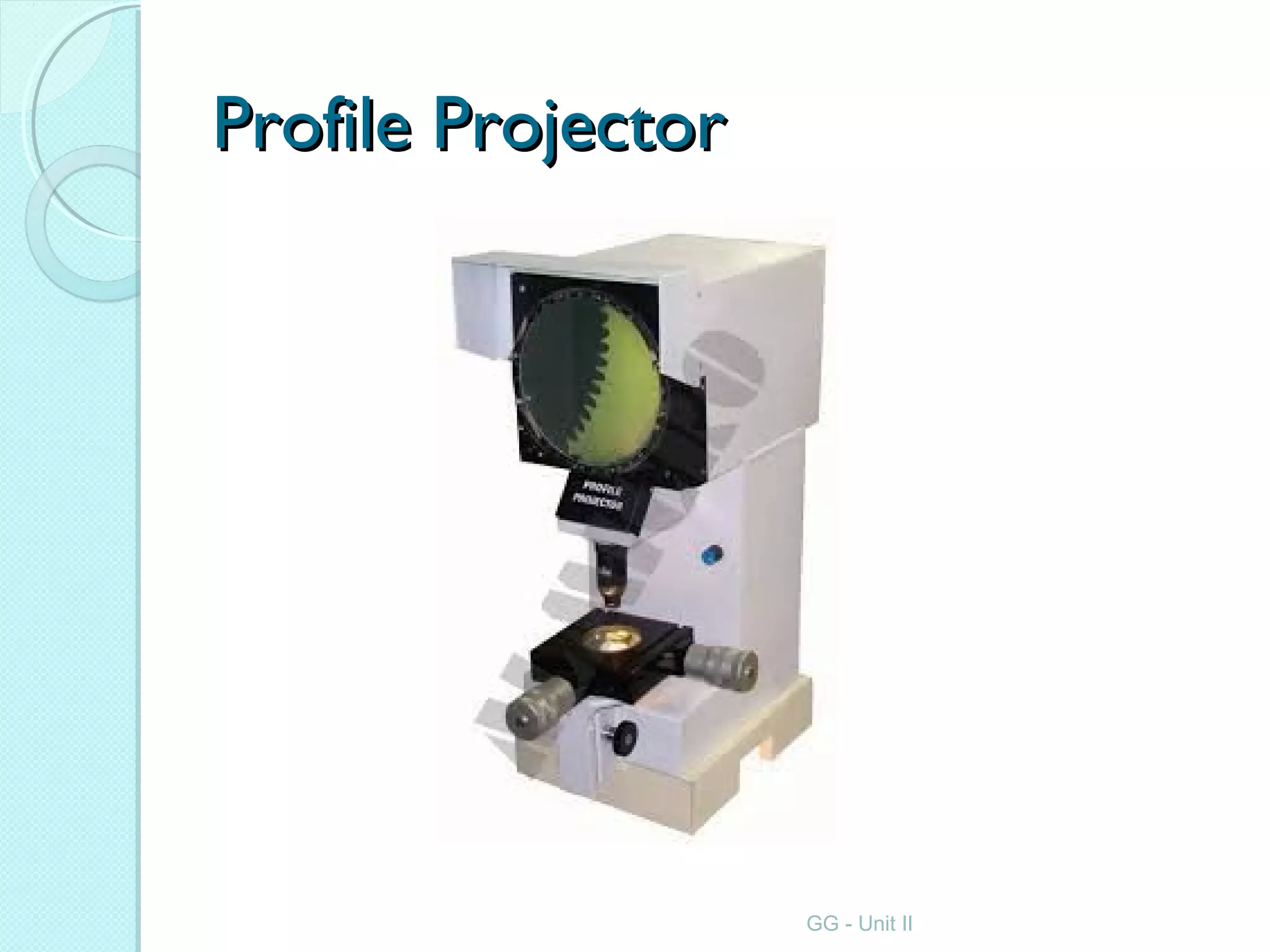
Profile ProjectorProfile Projector
GG - Unit II
MICRO METERMICRO METER
A micro meter is a precision instrument
used to measure a job, generally within an
accuracy of 0.01mm.Micrometer used to take
the outside measurements are know as outside
micrometer.
GG - Unit II
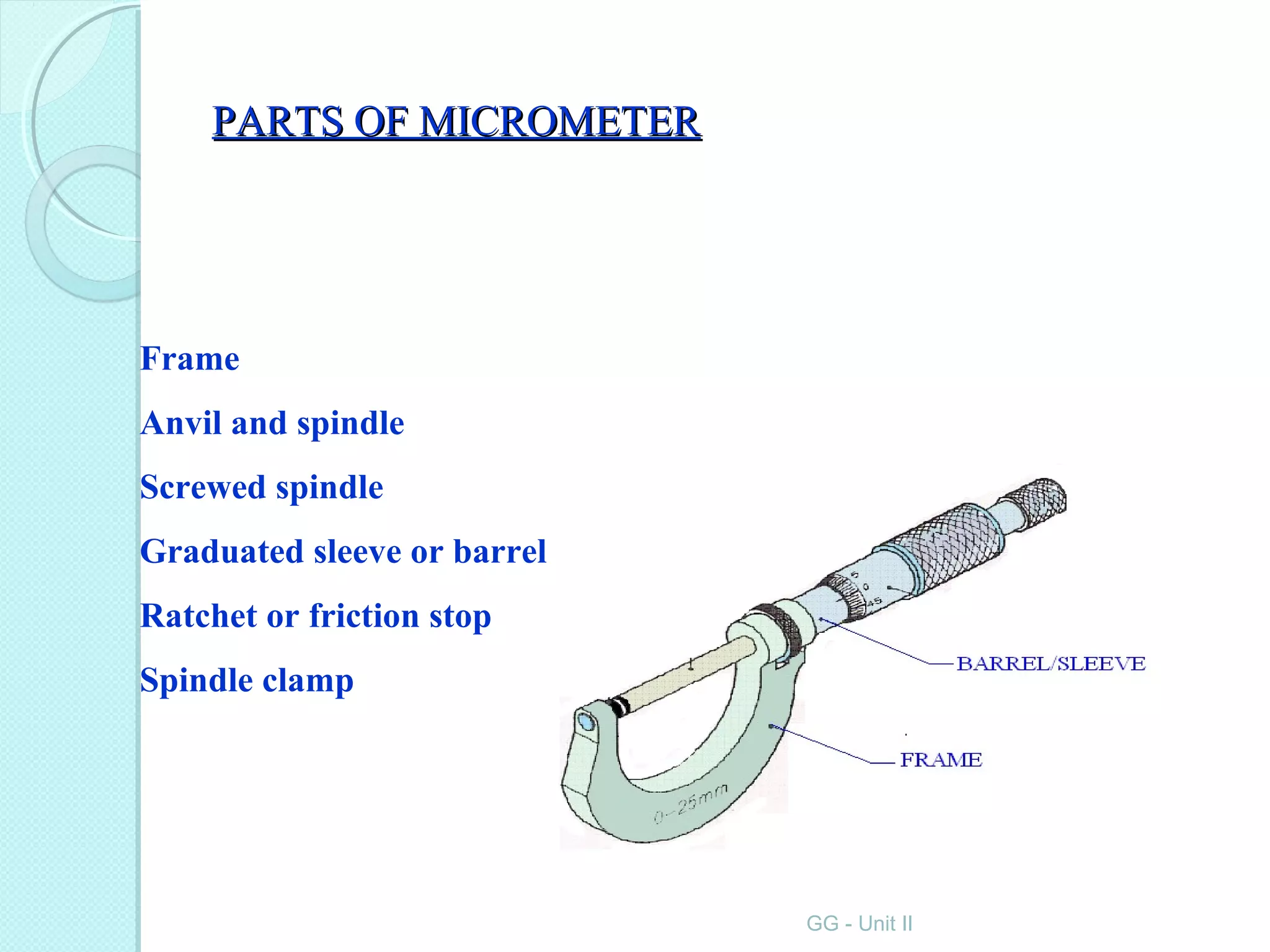
PARTS OF MICROMETERPARTS OF MICROMETER
Frame
Anvil and spindle
Screwed spindle
Graduated sleeve or barrel
Ratchet or friction stop
Spindle clamp
GG - Unit II
Interval measurementsInterval measurements
Slip gauges
Interferometer
Optical flats and limit gauges
Comparators
GG - Unit II
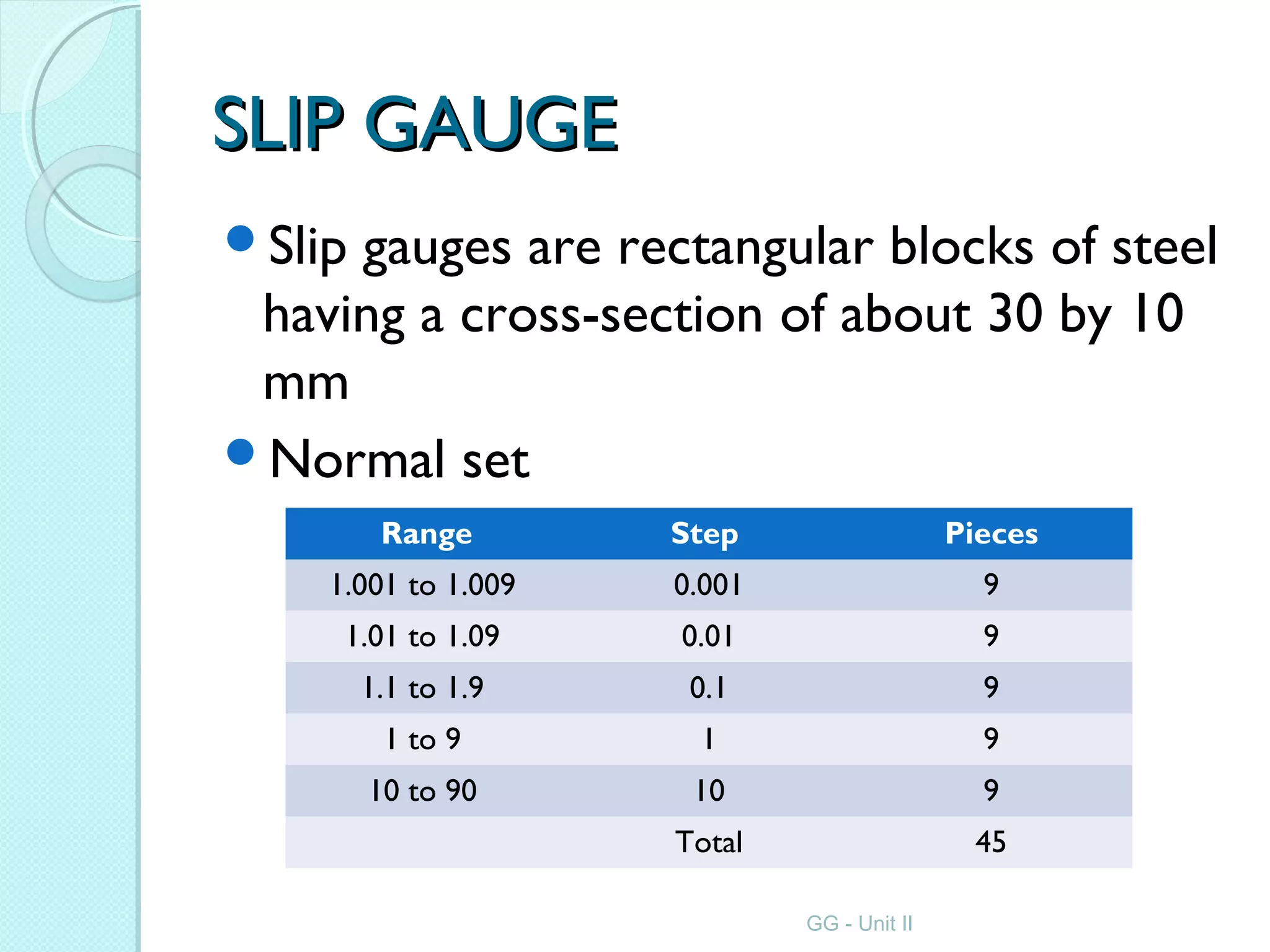
SLIP GAUGESLIP GAUGE
Slip gauges are rectangular blocks of steel
having a cross-section of about 30 by 10
mm
Normal set
Range Step Pieces
1.001 to 1.009 0.001 9
1.01 to 1.09 0.01 9
1.1 to 1.9 0.1 9
1 to 9 1 9
10 to 90 10 9
Total 45
GG - Unit II
Special Set
Range Step Pieces
1.001 to 1.009 0.001 9
1.01 to 1.49 0.01 49
1.5 to 9.5 0.5 19
10 to 90 10 9
Total 86
GG - Unit II
Limit gaugesLimit gauges
GG - Unit II
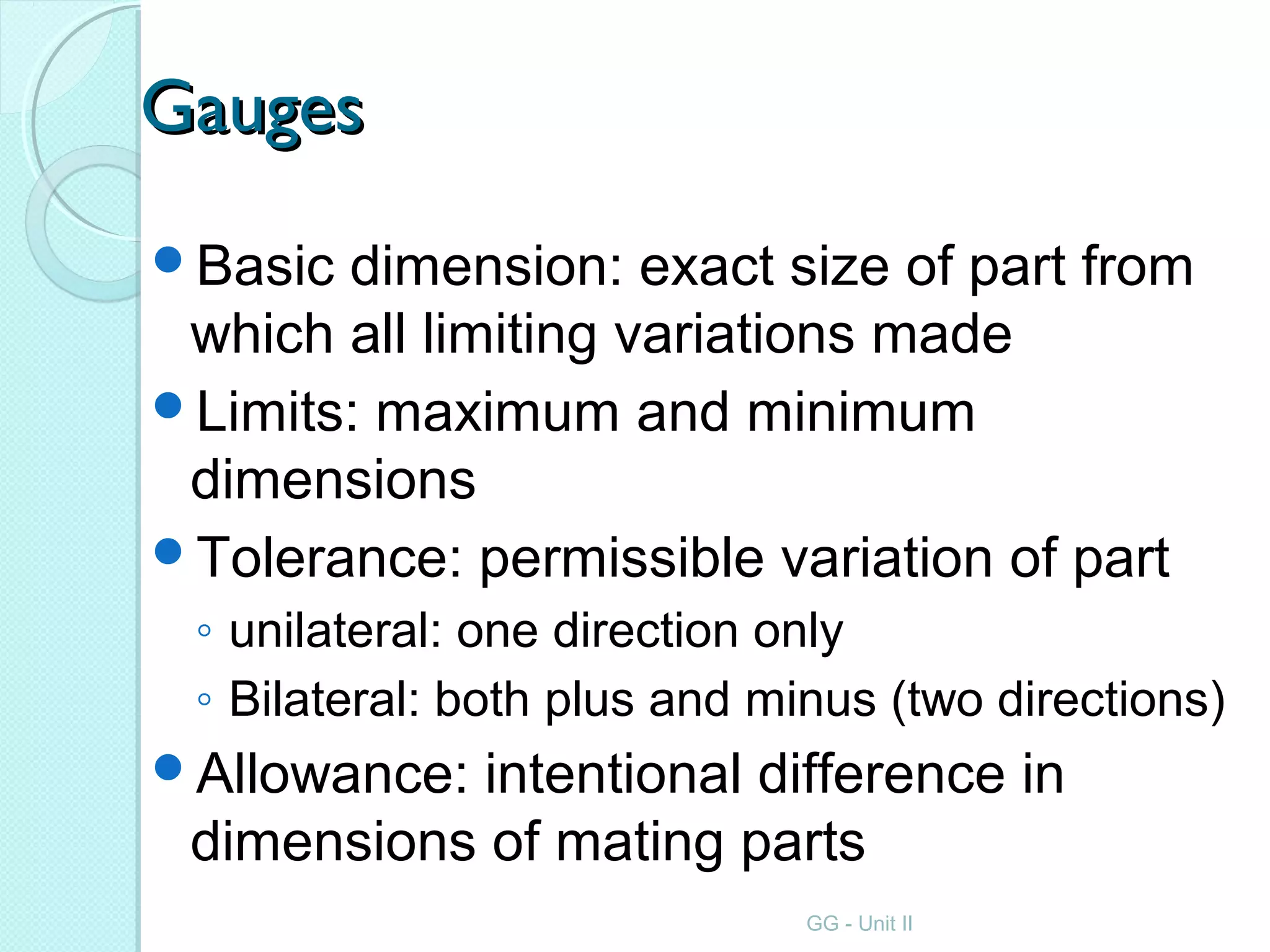
GaugesGauges
Basic dimension: exact size of part from
which all limiting variations made
Limits: maximum and minimum
dimensions
Tolerance: permissible variation of part
◦ unilateral: one direction only
◦ Bilateral: both plus and minus (two directions)
Allowance: intentional difference in
dimensions of mating parts
GG - Unit II
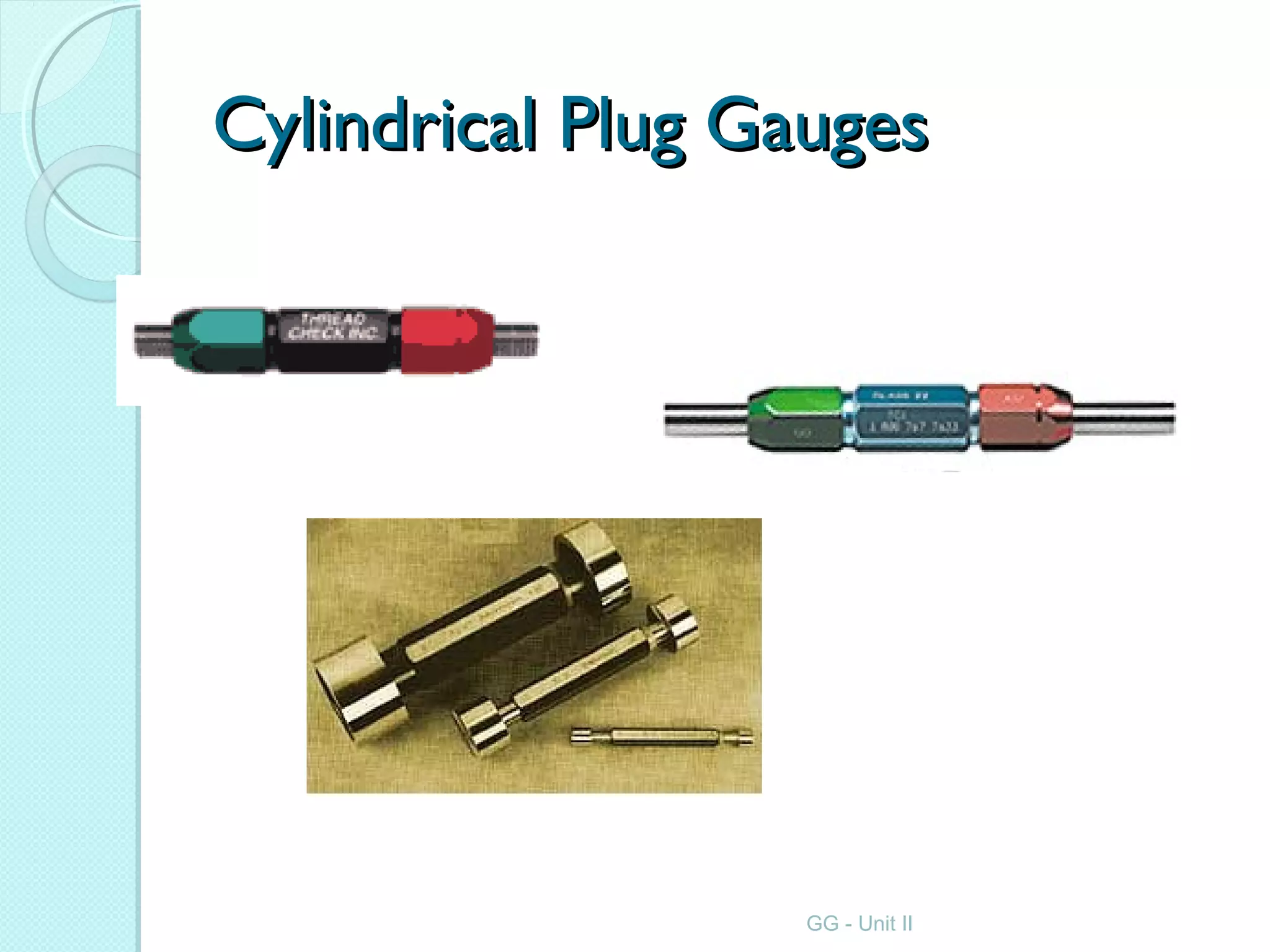
Cylindrical Plug GaugesCylindrical Plug Gauges
GG - Unit II
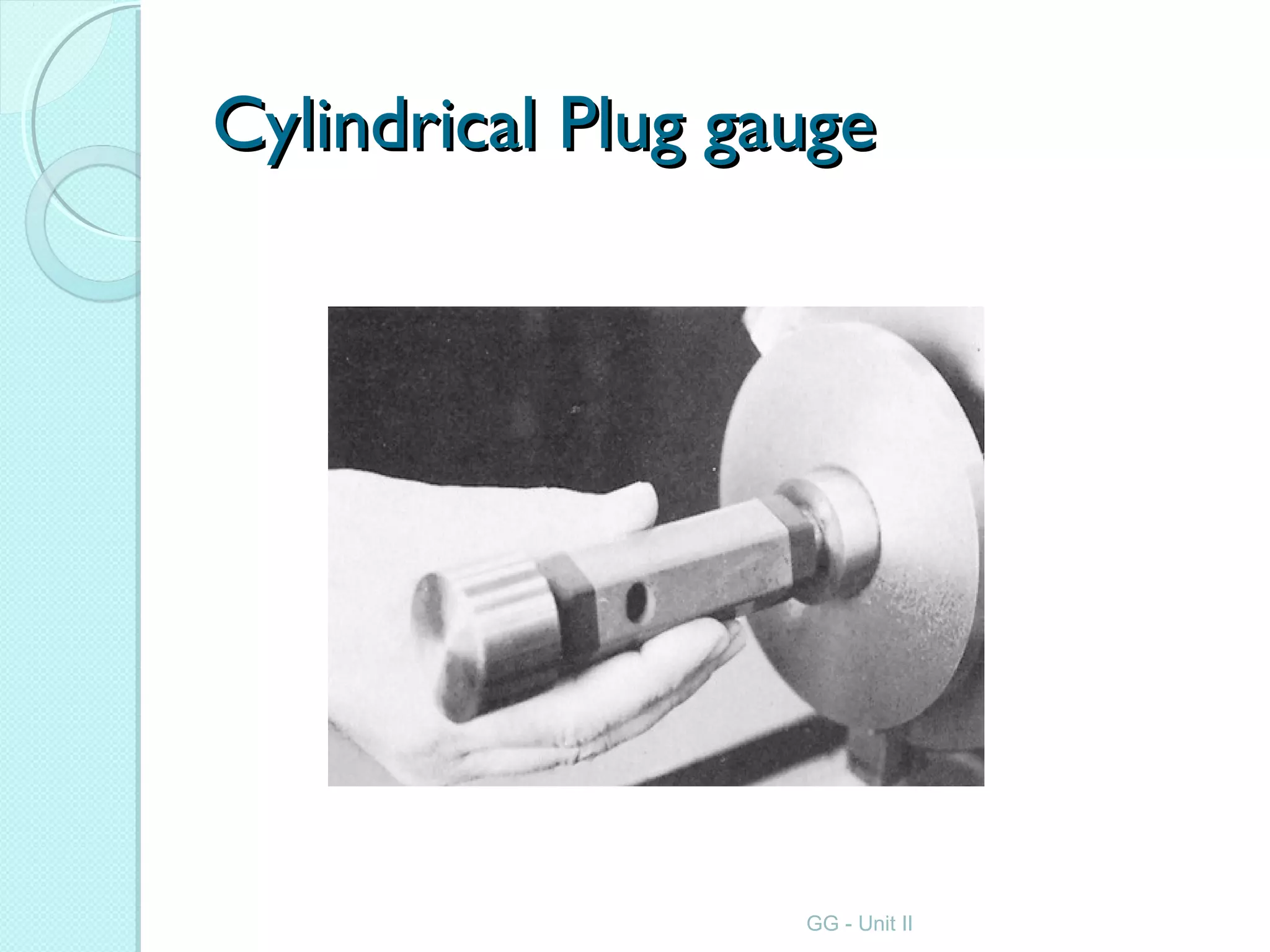
Cylindrical Plug gaugeCylindrical Plug gauge
GG - Unit II
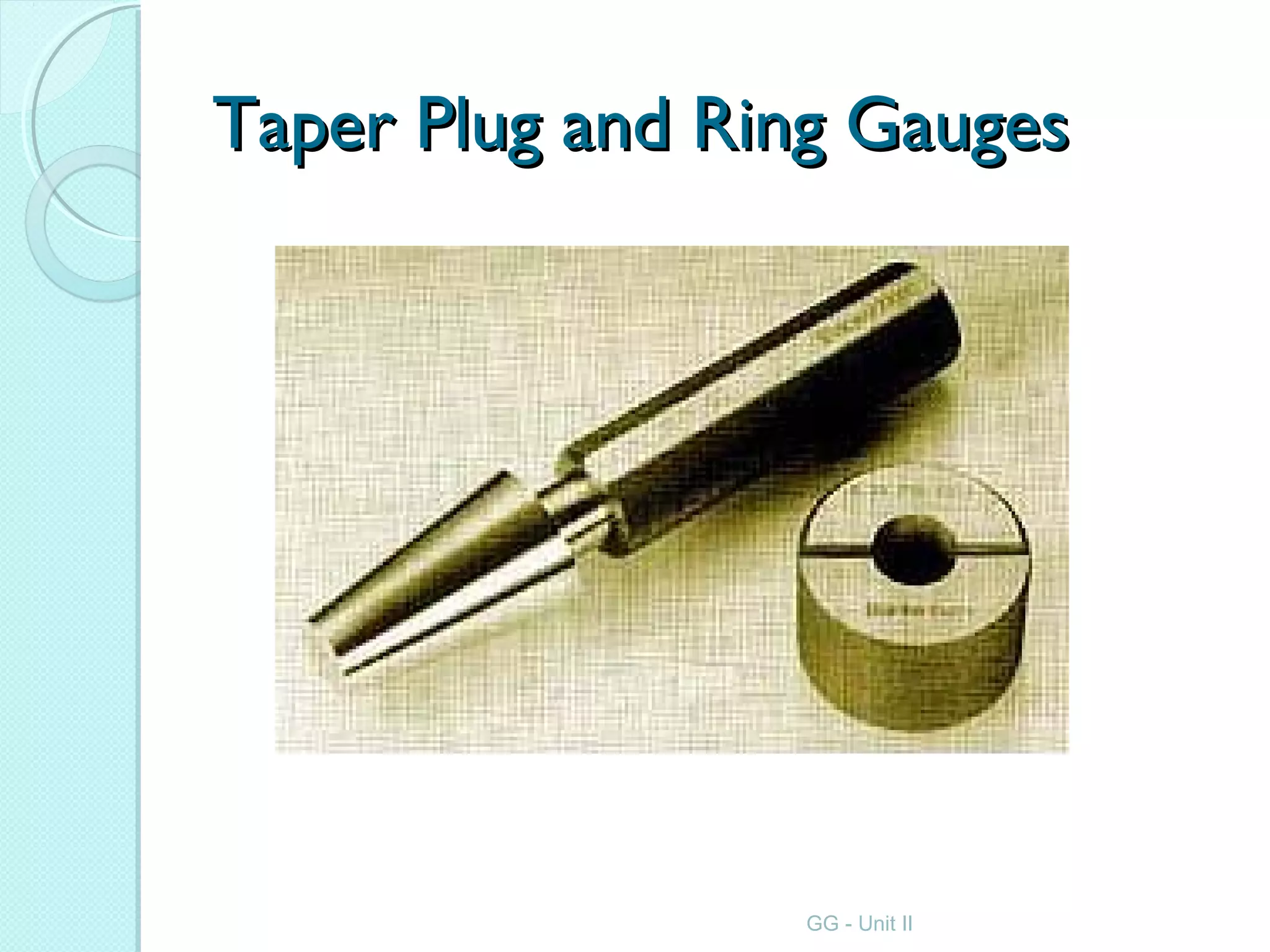
Taper Plug GaugesTaper Plug Gauges
Used to check size of hole and taper
accuracy
Made with standard or special tapers
Some have "go" and "no-go" rings scribed
◦ gauge fits into hole between two rings means
within required tolerance
GG - Unit II
Taper Plug and Ring GaugesTaper Plug and Ring Gauges
GG - Unit II
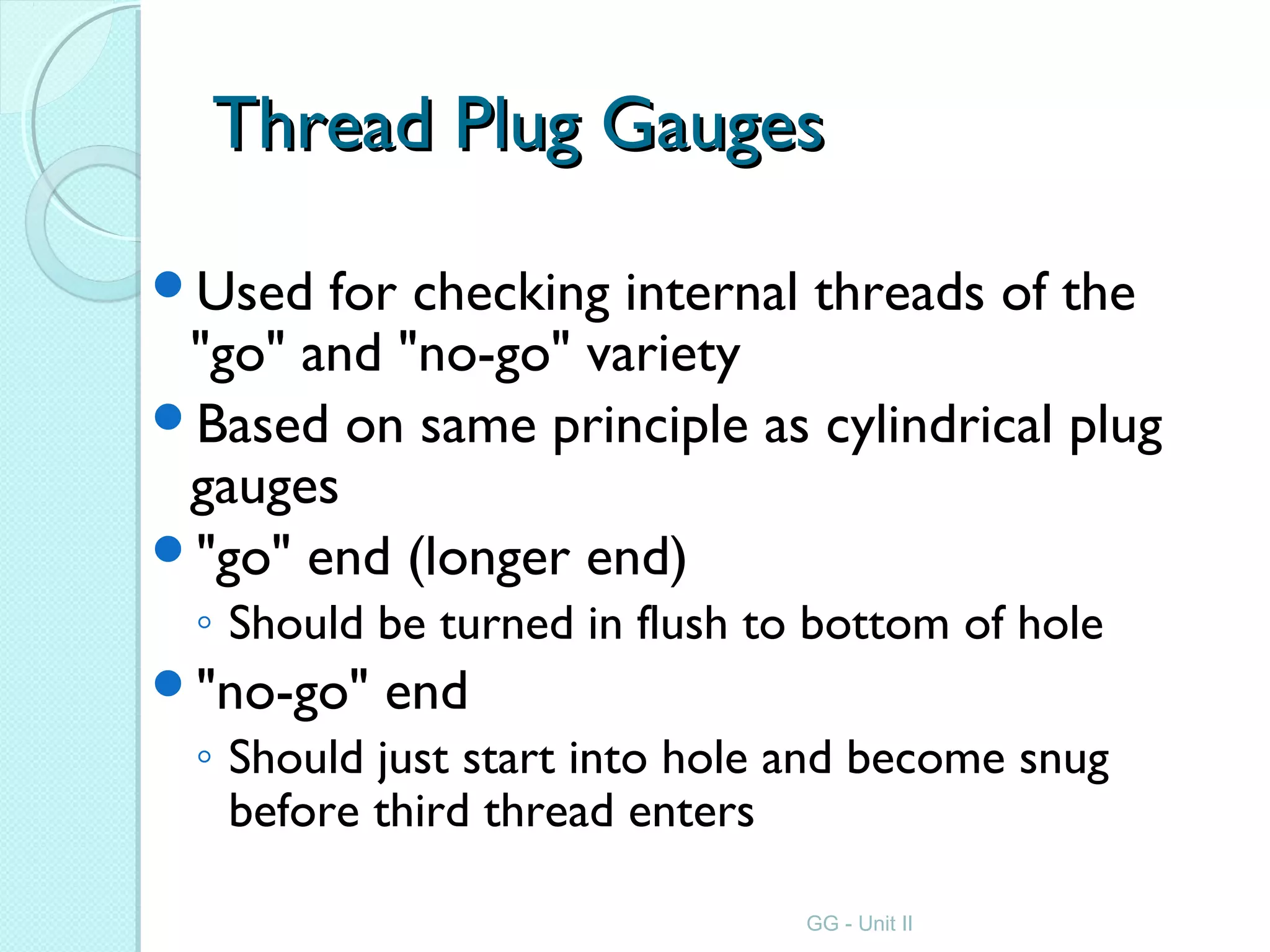
Thread Plug GaugesThread Plug Gauges
Used for checking internal threads of the
"go" and "no-go" variety
Based on same principle as cylindrical plug
gauges
"go" end (longer end)
◦ Should be turned in flush to bottom of hole
"no-go" end
◦ Should just start into hole and become snug
before third thread enters
GG - Unit II
Thread Plug GaugesThread Plug Gauges
GG - Unit II
Thread Ring GaugesThread Ring Gauges
GG - Unit II
FEELER GAUGEFEELER GAUGE
A feeler gauge (also
known as a thickness
gauge) is an accurately
manufactured strip of
metal that is used to
determine the gap or
clearance between two
components.
FEELER GAUGEFEELER GAUGE
 A feeler gauge can be
used to check the
following:
◦ Piston ring gap
◦ Piston ring side clearance
◦ Connecting rod side
clearance
Radius GaugeRadius Gauge
A radius gauge is a tool used to
measure the radius of an object.
GG - Unit II
Thread Pitch GaugeThread Pitch Gauge
It used to quickly determine the pitch of
various threads by matching the teeth on
the leaves with teeth on the work.
GG - Unit II
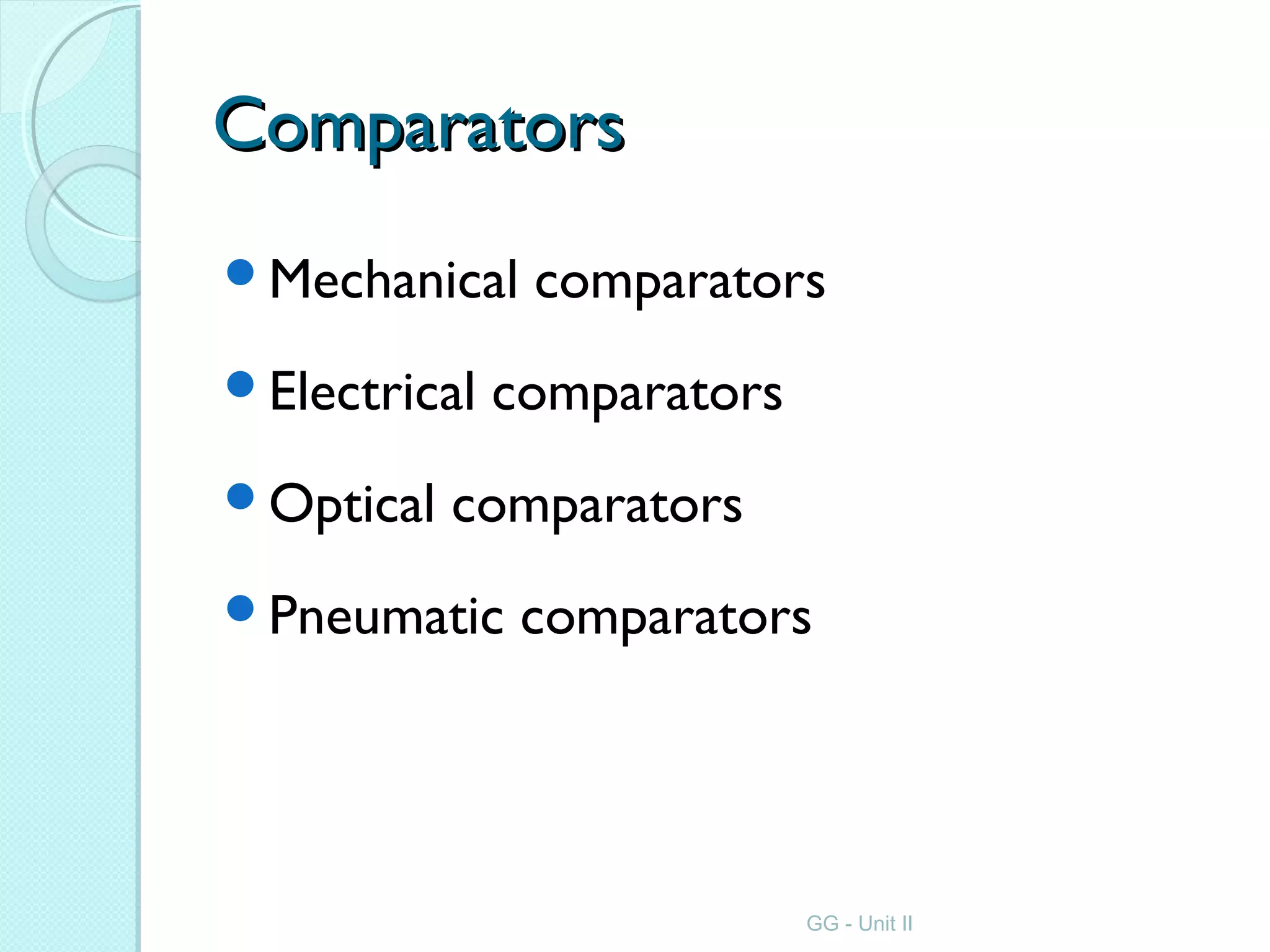
ComparatorsComparators
Mechanical comparators
Electrical comparators
Optical comparators
Pneumatic comparators
GG - Unit II
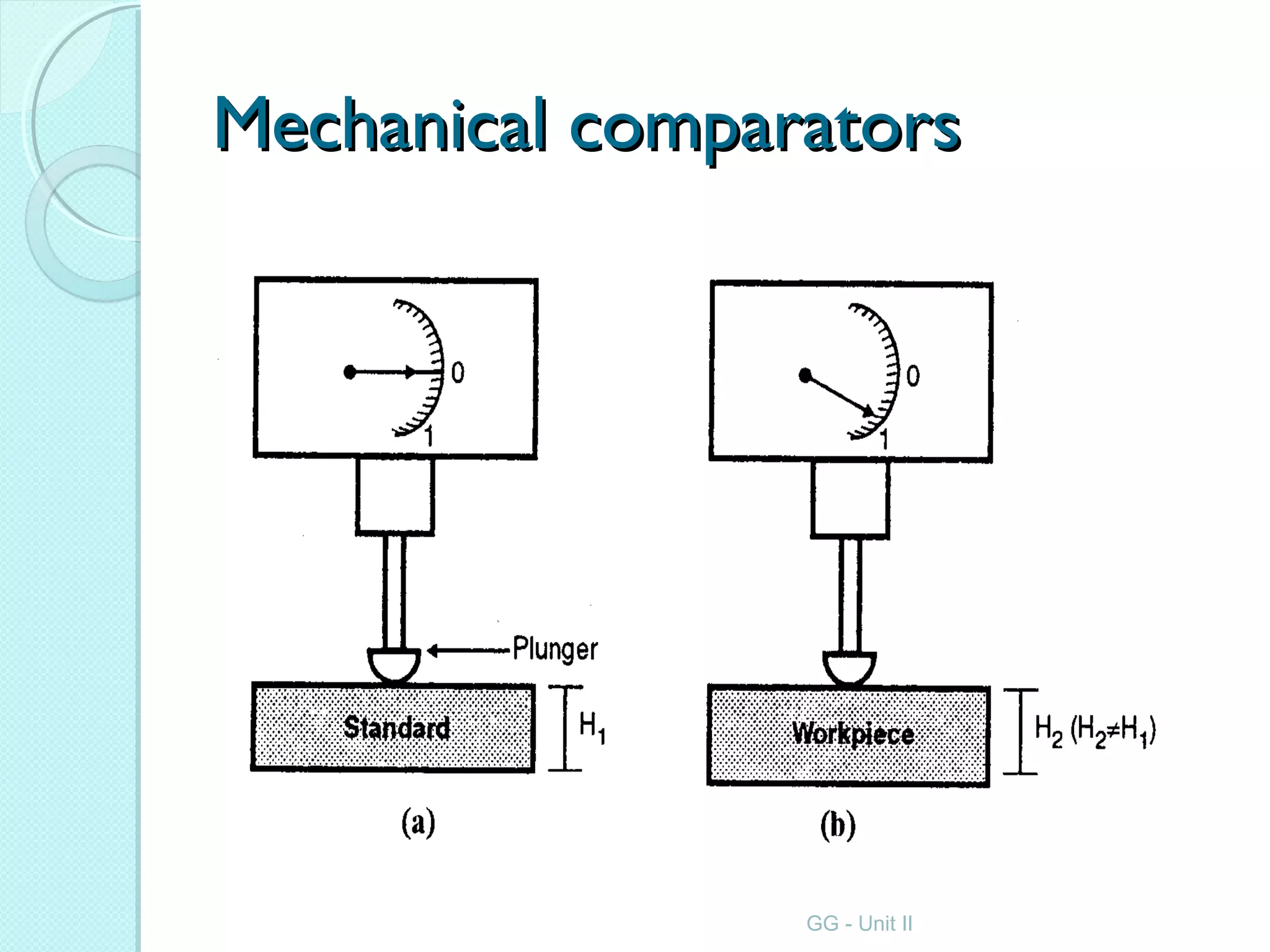
Mechanical comparatorsMechanical comparators
GG - Unit II
It is a precision instrument employed to
compare the dimension of a given
component with a working standard
It does not measure the actual dimension
but indicates how much it differs from
the basic dimension
GG - Unit II
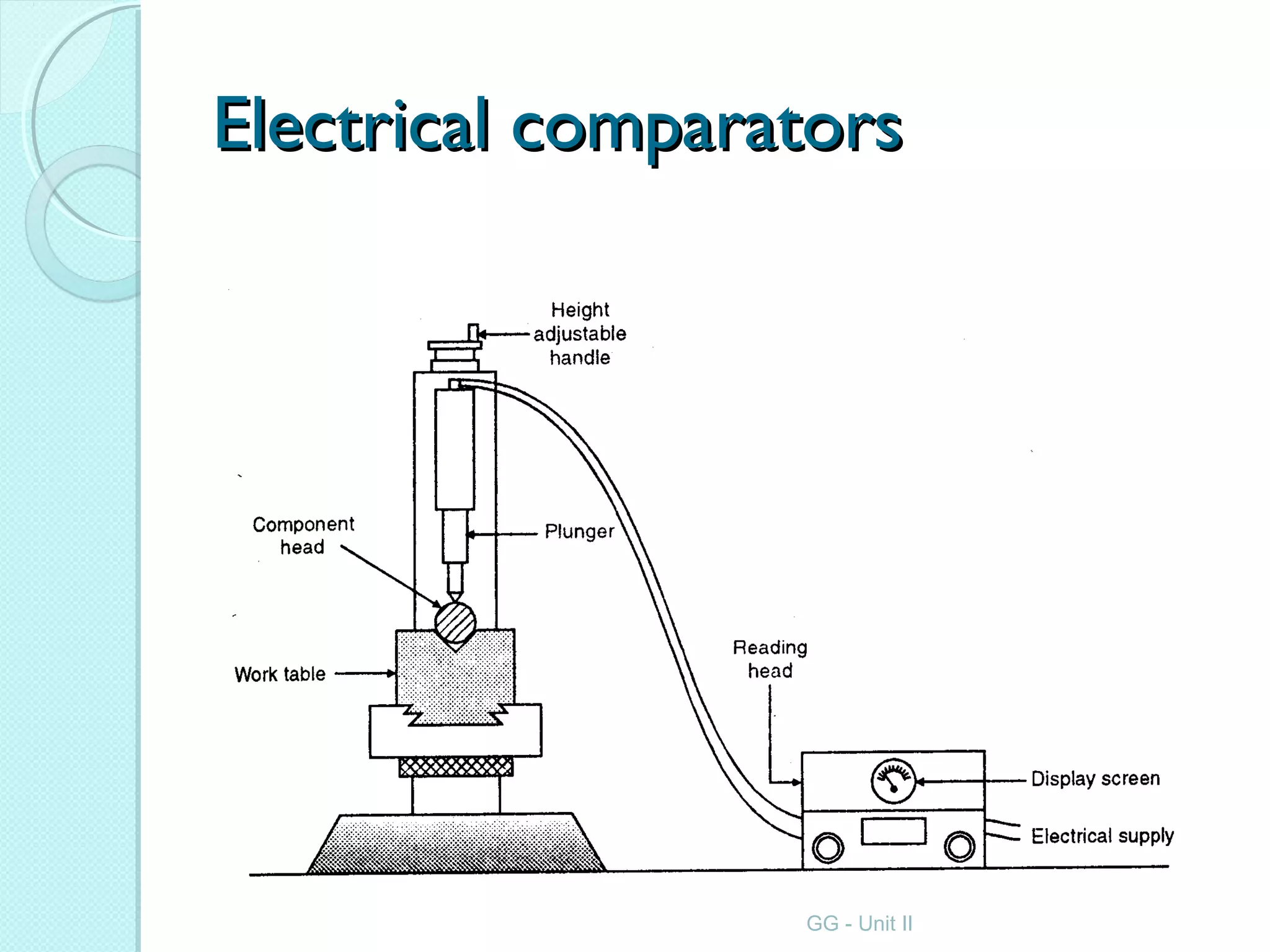
Electrical comparatorsElectrical comparators
GG - Unit II
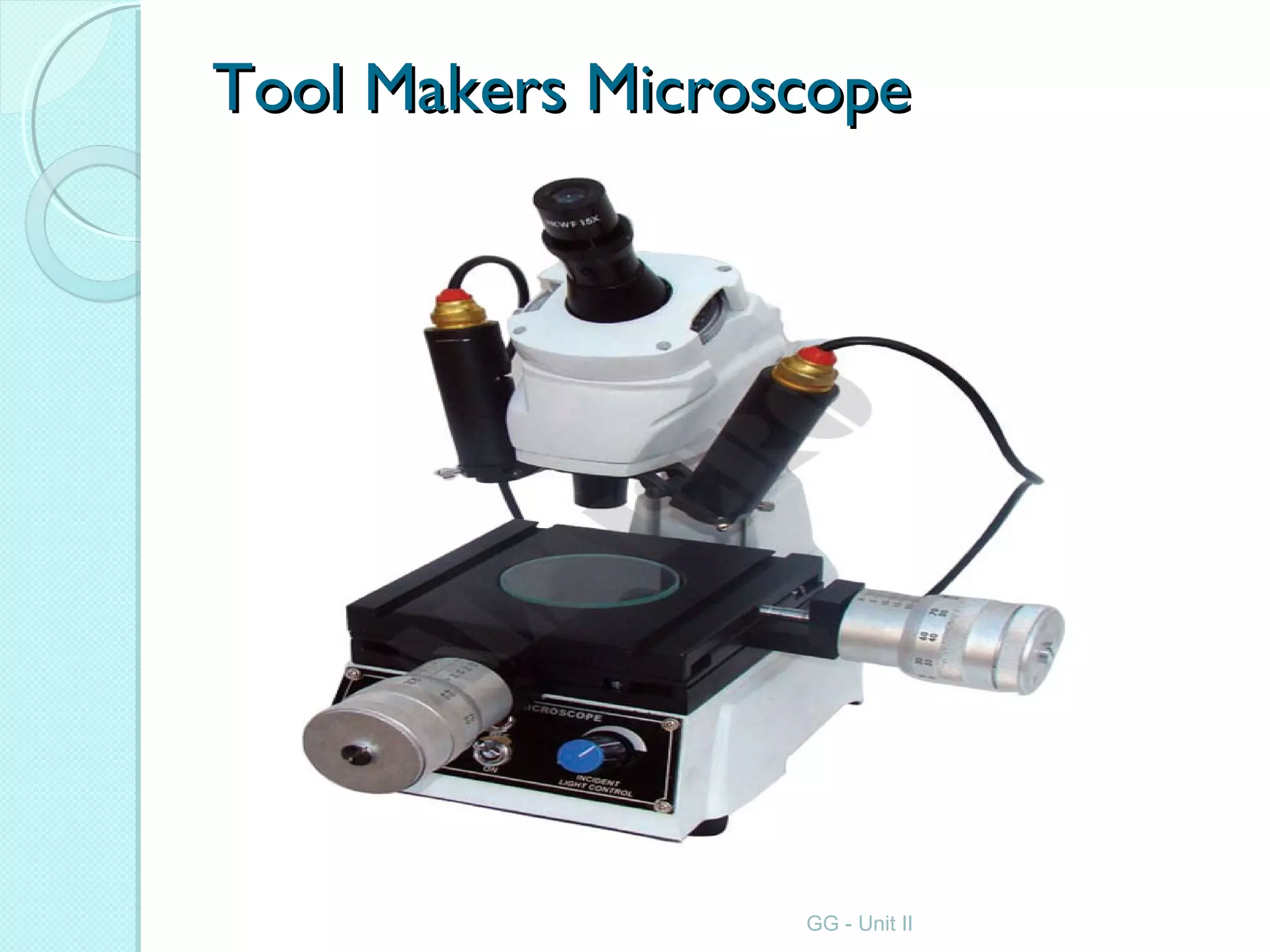
Tool Makers MicroscopeTool Makers Microscope
GG - Unit II
Telescopic GaugeTelescopic Gauge
GG - Unit II
Bore diameter measurement using micrometer
GG - Unit II
CMMCMM
GG - Unit II

Metrology

  • 1.
    WHAT IS METROLOGY SCIENCEOF MEASUREMENTS Everything has to do with measurement Designing Conducting Analyzing Results Experiment or test within the Metrology realm Allowing people to plan their lives and make commercial exchange with confidence CAN BE SEEN EVERYWHERE
  • 2.
     Metrology ismainly concerned with: (1) Establishing the units of measurements, ensuring the uniformity of measurements. (2) Developing methods of measurement. (3) Errors of measurement. (4) Accuracy of measuring instruments and their care. (5) Industrial inspection and its various techniques.
  • 3.
    Linear and AngularMeasurementLinear and Angular Measurement G.GopinathGG - Unit II
  • 4.
    Linear and AngularLinearand Angular MeasurementMeasurement The Linear Measurement includes measurements of length, diameters, heights and thickness The Angular measurement includes the measurement of angles or tapers GG - Unit II
  • 5.
    DimensionsDimensions A very commonmeasurement is that of dimensions, i.e., length, width, height of an object Dimensions of the measuring instruments are classified as follows ◦ Low resolution devices (up to 0.25mm) ◦ Medium resolution devices (up to 0.0025mm) ◦ High resolution devices (less than microns) GG - Unit II
  • 6.
    Low resolution devicesLowresolution devices Steel rule Steel rule with assistance of ◦ Calipers ◦ Dividers & ◦ Surface gauges Thickness gauges GG - Unit II
  • 7.
    Medium resolution devicesMediumresolution devices Micrometer Micrometer with assistance of ◦ Telescoping ◦ Extendable ball gauges Vernier calipers Dial indicators Microscope GG - Unit II
  • 8.
    High resolution devicesHighresolution devices Gauge blocks Gauge block with assistance of ◦ Mechanical comparator ◦ Electronic comparator ◦ Pneumatic comparator ◦ Optical flats GG - Unit II
  • 9.
    Linear Measuring InstrumentsLinearMeasuring Instruments Vernier caliper Micrometer Slip gauge or gauge blocks Optical flats Interferometer Comparators GG - Unit II
  • 10.
    Vernier caliperVernier caliper Componentsof vernier calipers are ◦ Main scale ◦ Vernier scale ◦ Fixed jaw ◦ Movable jaw Types of vernier calipers ◦ Type A vernier caliper ◦ Type B vernier caliper ◦ Type C vernier caliper GG - Unit II
  • 11.
    Type A VernierCaliperType A Vernier Caliper GG - Unit II
  • 12.
    Type B VernierCaliperType B Vernier Caliper GG - Unit II
  • 13.
    Type C VernierCaliperType C Vernier Caliper GG - Unit II
  • 14.
    Vernier caliperVernier caliper VERIERCALIPER WITH 0.02MM LEAST COUNT IS GENERLY USED IM WORK SHOP. In this Vernier caliper main scale division (49mm) are divided in to 50 equal part in the Vernier scale. i.e. 1 main scale division =1 mm (MSD) 1. Vernier scale division =4950 mm (VSD) Least count is 1mm – 4950 =150 mm THE DIFFERENCE BETWEEN 1.MSD and 1. VSD=0.02MM GG - Unit II
  • 15.
    ExampleExample Main scale reading=35mm The vernier division coinciding with the main scale is the 20th division. Value=20 multiplied by 0.02=0.40mm. Total reading is 35mm+0.40= 35.40mm 35.40 mm GG - Unit II
  • 16.
    Vernier Depth GaugeVernierDepth Gauge A vernier depth is very commonly used precision instrument for measuring depth of holes recesses, slot and step. Its construction and method of reading are similar to those of a vernier caliper. GG - Unit II
  • 17.
    VERNIER DEPTH GAUGEVERNIERDEPTH GAUGE Base Graduated beam Clamping screw Fine adjustment mechanism Vernier scale GG - Unit II
  • 18.
    VERNIER HEIGHT GAUGEVERNIERHEIGHT GAUGE The main parts of a vernier height gauge and their function are given. 1.base 2. beam 3.vernier slide 4. fine setting device 5. vernier plate 6. locking screws 7. scriber GG - Unit II
  • 19.
    Gear Tooth VernierGearTooth Vernier GG - Unit II
  • 20.
  • 21.
    MICRO METERMICRO METER Amicro meter is a precision instrument used to measure a job, generally within an accuracy of 0.01mm.Micrometer used to take the outside measurements are know as outside micrometer. GG - Unit II
  • 22.
    PARTS OF MICROMETERPARTSOF MICROMETER Frame Anvil and spindle Screwed spindle Graduated sleeve or barrel Ratchet or friction stop Spindle clamp GG - Unit II
  • 23.
    Interval measurementsInterval measurements Slipgauges Interferometer Optical flats and limit gauges Comparators GG - Unit II
  • 24.
    SLIP GAUGESLIP GAUGE Slipgauges are rectangular blocks of steel having a cross-section of about 30 by 10 mm Normal set Range Step Pieces 1.001 to 1.009 0.001 9 1.01 to 1.09 0.01 9 1.1 to 1.9 0.1 9 1 to 9 1 9 10 to 90 10 9 Total 45 GG - Unit II
  • 25.
    Special Set Range StepPieces 1.001 to 1.009 0.001 9 1.01 to 1.49 0.01 49 1.5 to 9.5 0.5 19 10 to 90 10 9 Total 86 GG - Unit II
  • 26.
  • 27.
    GaugesGauges Basic dimension: exactsize of part from which all limiting variations made Limits: maximum and minimum dimensions Tolerance: permissible variation of part ◦ unilateral: one direction only ◦ Bilateral: both plus and minus (two directions) Allowance: intentional difference in dimensions of mating parts GG - Unit II
  • 28.
    Cylindrical Plug GaugesCylindricalPlug Gauges GG - Unit II
  • 29.
    Cylindrical Plug gaugeCylindricalPlug gauge GG - Unit II
  • 30.
    Taper Plug GaugesTaperPlug Gauges Used to check size of hole and taper accuracy Made with standard or special tapers Some have "go" and "no-go" rings scribed ◦ gauge fits into hole between two rings means within required tolerance GG - Unit II
  • 31.
    Taper Plug andRing GaugesTaper Plug and Ring Gauges GG - Unit II
  • 32.
    Thread Plug GaugesThreadPlug Gauges Used for checking internal threads of the "go" and "no-go" variety Based on same principle as cylindrical plug gauges "go" end (longer end) ◦ Should be turned in flush to bottom of hole "no-go" end ◦ Should just start into hole and become snug before third thread enters GG - Unit II
  • 33.
    Thread Plug GaugesThreadPlug Gauges GG - Unit II
  • 34.
    Thread Ring GaugesThreadRing Gauges GG - Unit II
  • 35.
    FEELER GAUGEFEELER GAUGE Afeeler gauge (also known as a thickness gauge) is an accurately manufactured strip of metal that is used to determine the gap or clearance between two components.
  • 36.
    FEELER GAUGEFEELER GAUGE A feeler gauge can be used to check the following: ◦ Piston ring gap ◦ Piston ring side clearance ◦ Connecting rod side clearance
  • 37.
    Radius GaugeRadius Gauge Aradius gauge is a tool used to measure the radius of an object. GG - Unit II
  • 38.
    Thread Pitch GaugeThreadPitch Gauge It used to quickly determine the pitch of various threads by matching the teeth on the leaves with teeth on the work. GG - Unit II
  • 39.
  • 40.
  • 41.
    It is aprecision instrument employed to compare the dimension of a given component with a working standard It does not measure the actual dimension but indicates how much it differs from the basic dimension GG - Unit II
  • 42.
  • 43.
    Tool Makers MicroscopeToolMakers Microscope GG - Unit II
  • 44.
  • 45.
    Bore diameter measurementusing micrometer GG - Unit II
  • 46.