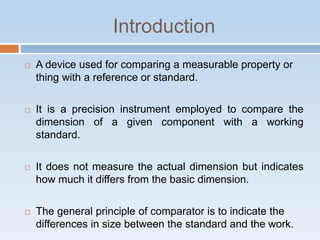
COMPARATOR
S
Introduction
 A device used for comparing a measurable property or
thing with a reference or standard.
 It is a precision instrument employed to compare the
dimension of a given component with a working
standard.
 It does not measure the actual dimension but indicates
how much it differs from the basic dimension.
 The general principle of comparator is to indicate the
differences in size between the standard and the work.
Need For A Comparator
 In mass production, where components are to be
checked at a very fast rate.
 As laboratory standards from which working or
inspection gauges are set and correlated.
 For inspecting newly purchased gauges.
 Attached with some machines, comparators can be
used as working gauges to prevent work spoilage
and to maintain required tolerances at all stages of
manufacturing.
 In selective assembly of parts, where parts are
graded in three or more groups depending upon their
Desirable features of
Comparators
 Robust design and construction
 Linear characteristics of scale
 High magnification
 Quick in Results
 Versatility
 Minimum Wear of contact Point
 Free from Oscillations
 Free from backlash
 Quick insertion of work piece
 Adjustable table
 Compensation from temperature effects
 Means to prevent damage
Principle of Comparators
All comparators consist of three basic features:
1)A sensing device
Which faithfully senses the input signal
2) A Magnifying or amplifying system
To increase the signal to suitable magnitude.
Mechanical, Optical, Pneumatic, hydraulic and electronic
methods are used for this purpose.
3) A display system (usually a scale and pointer)
Which utilizes the amplified signal to provide a
suitable readout.
Classification of Comparators
Mechanical comparators
Optical comparators
Electrical and Electronic comparators
Pneumatic comparators
Fluid displacement comparators
Projection comparators
Multi-check comparators
Automatic gauging machines
CMM
Mechanical Comparator
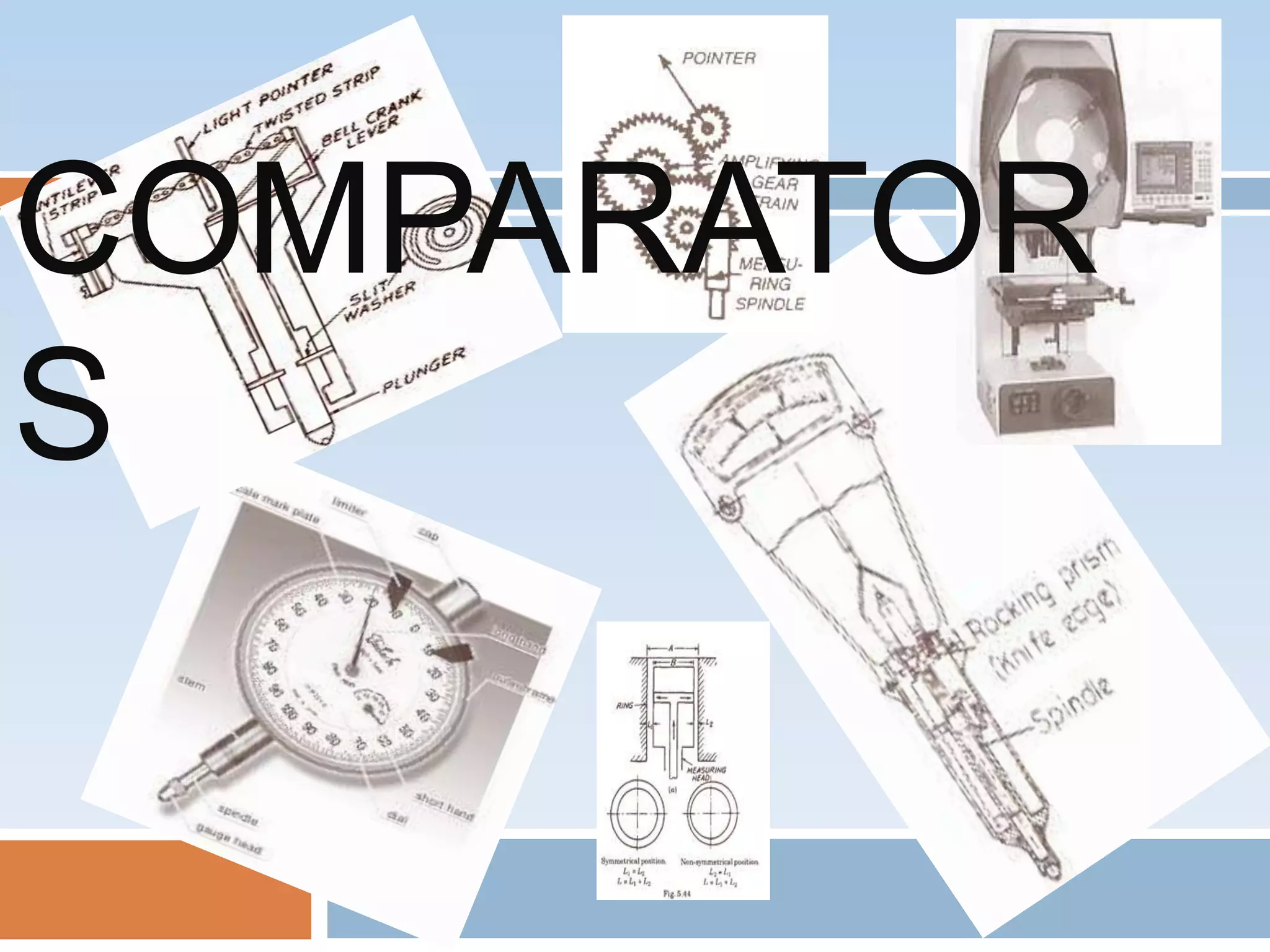
 The mechanical comparator is also called as
“microcator”.
 In mechanical comparators, magnification is achieved
by various mechanical devices and mechanical
linkages.
 Mechanical comparator is a measuring instrument.
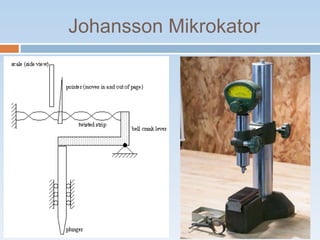
 The mechanism of this instrument is in the form of
tape spring twisted, and that is positioned in the
middle part.
 The middle part of the mechanical comparator rotates
through a fixed angle upon tension.
Working principle of a Mechanical
Comparator
 A mechanical comparator employees mechanical
means for magnifying the small movement of the
stylus.

 the magnification of the small stylus movement is
obtained by means of levers, gear trains, rack and
pinion or a combination.
 The usual magnification obtained by these
comparators ranges from about 250 to 1000.
Types of Mechanical
Comparators
 Dial Indicator
 Johansson Mikrokator
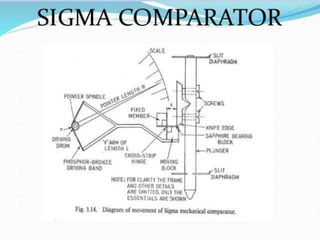
 Sigma Mechanical Comparator
 Dial Thickness Gauge
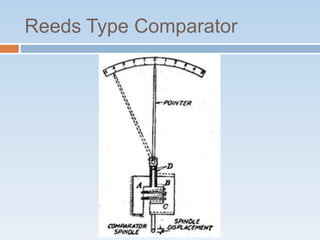
 Reeds Type Comparator
 External & internal Groove Comparator
 Plate Gauge Type comparator
Dial Indicator
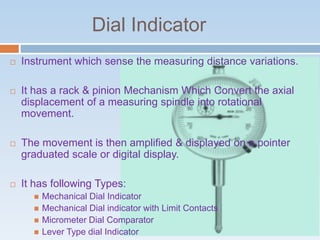
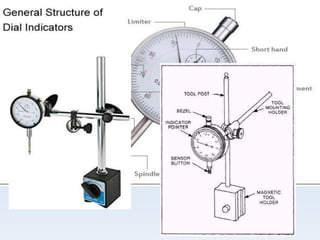
 Instrument which sense the measuring distance variations.
 It has a rack & pinion Mechanism Which Convert the axial
displacement of a measuring spindle into rotational
movement.
 The movement is then amplified & displayed on a pointer
graduated scale or digital display.
 It has following Types:
 Mechanical Dial Indicator
 Mechanical Dial indicator with Limit Contacts
 Micrometer Dial Comparator
 Lever Type dial Indicator
Johansson Mikrokator
Reeds Type Comparator
Advantages of Mechanical Comparator
 Cheaper than all the other type of comparators
 Does not require any external source of power or air
supply
 These comparators use a linear scale that can be easily
understood.
 Usually these comparators are robust and compact but
are very easy to handle
 These are small in size and can are portable from one
Limitations of Mechanical
Comparator
 Contains more number of moving parts so there develops
friction which in turn reduces the accuracy
 Slackness in the moving parts reduces accuracy very
drastically
 These have more inertia so the instrument is prone to
vibrational effects
 Limited range of the instrument is another drawback as the
pointer moves over a fixed scale
Optical Comparators
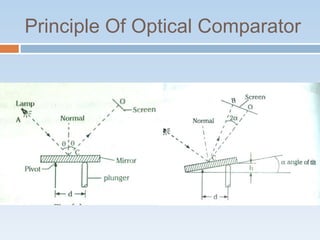
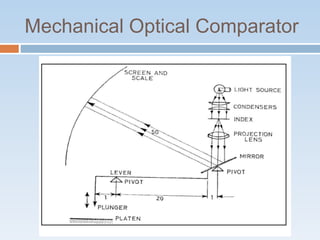
 In this comparator a small dislocation of the measuring
plunger is first amplified by a mechanical system
comprising of pivoted levers.
 The mechanical movement which is amplified by an
optical system connecting the outcrop an image.
 The general arrangement of mechanical system causes
a reflector to angle near the image
 An axis of an index estimated on a scale on the inner
glass screen.
Principle Of Optical Comparator
Types of Optical Comparator
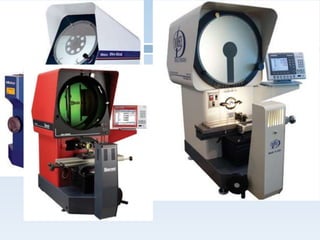
 Profile (optical) Projector
 Mechanical Optical Comparator
 Zesis Optical Comparator
 Electrical Optical Comparator
Mechanical Optical Comparator
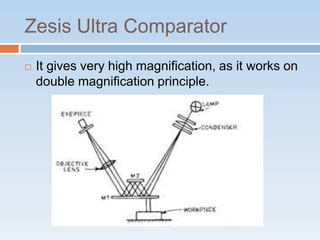
Zesis Ultra Comparator
 It gives very high magnification, as it works on
double magnification principle.
Advantages of Optical
Comparators
 It has small number of moving parts and hence a
higher accuracy.
 In the optical comparators, the scale can be
made to move past a datum line and thus have
high range and no parallax errors.
 It has very high magnification.
 Optical lever is weightless
Limitations of Optical
Comparators
 As the instrument has high magnification, heat from the
lamp, transformer etc. may cause the setting to drift.
 An electrical supply is necessary.
 The apparatus is usually large and expensive.
 When the scale is projected on a screen, then it is essential
to use the instrument to a dark room in order to take the
readings easily.
 The instruments in which the scale is viewed through the
eyepiece of a microscope are not convenient for continuous
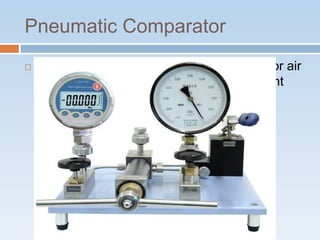
Pneumatic Comparator
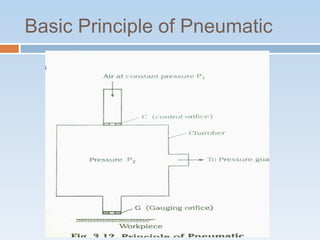
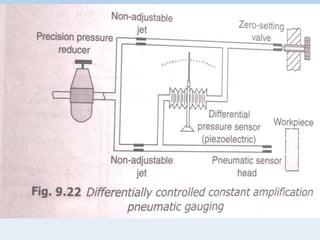
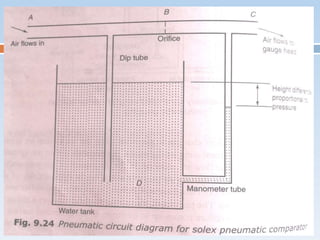
 In pneumatic comparators, either air flow or air
pressure is measured to give measurement
deviations from a standard.
Basic Principle of Pneumatic
Types of Pneumatic
Comparator
 Differential Back-Pressure-Type Comparator
 Solex Comparator
 Velocity Differential-Type Air gauge with Barr
Graph & Digital Display
Advantages of Pneumatic
Comparator
 The gauging member does not come into contact with the
part to be measured and hence practically no wear takes
place on the gauging member.
 It has usually very small number of moving parts and in
some cases none. Thus the accuracy is more due to less
friction and less inertia.
 Measuring pressure is very small and the jet of air helps in
cleaning the dust, if any, from the part to be measured.
 It is possible to have very high magnification.
 The indicating instrument can be remote from the measuring
unit.
 It is very suitable device for measuring diameter of holes
where the diameter is small compared with the length.
Limitations of Pneumatic
Comparators
 It requires elaborate auxiliary equipment such as accurate
pressure regulator.
 The scale is generally not uniform.
 When indicating device is the glass tube, then high
magnification is necessary in order to avoid the meniscus
errors.
 The apparatus is not easily portable and is rather
elaborate for many industrial applications.
Electric & Electronic
Comparators
 It is essentially consist of a transducer for
converting a displacement into a corresponding
change in current or Potential difference.
 The change in displacement is calibrated in three
ways:
 Using Inductive Principle
 Using Capacitive Principle
 Using Resistive principle
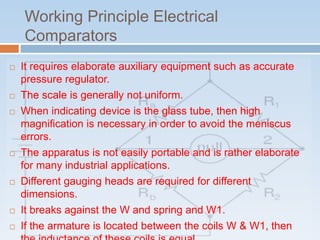
 It requires elaborate auxiliary equipment such as accurate
pressure regulator.
 The scale is generally not uniform.
 When indicating device is the glass tube, then high
magnification is necessary in order to avoid the meniscus
errors.
 The apparatus is not easily portable and is rather elaborate
for many industrial applications.
 Different gauging heads are required for different
dimensions.
 It breaks against the W and spring and W1.
 If the armature is located between the coils W & W1, then
Working Principle Electrical
Comparators
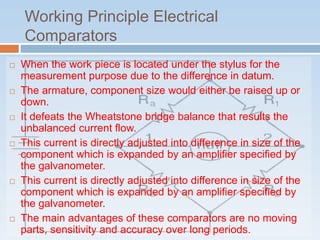
 When the work piece is located under the stylus for the
measurement purpose due to the difference in datum.
 The armature, component size would either be raised up or
down.
 It defeats the Wheatstone bridge balance that results the
unbalanced current flow.
 This current is directly adjusted into difference in size of the
component which is expanded by an amplifier specified by
the galvanometer.
 This current is directly adjusted into difference in size of the
component which is expanded by an amplifier specified by
the galvanometer.
 The main advantages of these comparators are no moving
parts, sensitivity and accuracy over long periods.
Working Principle Electrical
Comparators
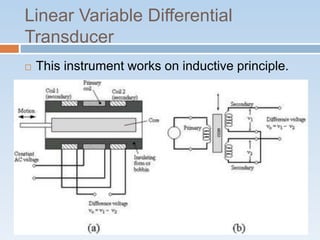
Linear Variable Differential
Transducer
 This instrument works on inductive principle.
Advantages & Limitations of
Electrical Comparators
 Advantages:
 It has got small number of moving parts.
 It is possible to have high & more number of
magnification by an instrument.
 The mechanism carrying the core is very light & is not
sensitive to vibrations.
 Limitations:
 Heating of the coil in measuring unit may cause zero
drift and hence alter the calibration.
 This is generally more expensive than others
comparators.
 External Power source is required.
Comparators...4

Comparators...4

  • 1.
  • 2.
    Introduction  A deviceused for comparing a measurable property or thing with a reference or standard.  It is a precision instrument employed to compare the dimension of a given component with a working standard.  It does not measure the actual dimension but indicates how much it differs from the basic dimension.  The general principle of comparator is to indicate the differences in size between the standard and the work.
  • 3.
    Need For AComparator  In mass production, where components are to be checked at a very fast rate.  As laboratory standards from which working or inspection gauges are set and correlated.  For inspecting newly purchased gauges.  Attached with some machines, comparators can be used as working gauges to prevent work spoilage and to maintain required tolerances at all stages of manufacturing.  In selective assembly of parts, where parts are graded in three or more groups depending upon their
  • 4.
    Desirable features of Comparators Robust design and construction  Linear characteristics of scale  High magnification  Quick in Results  Versatility  Minimum Wear of contact Point  Free from Oscillations  Free from backlash  Quick insertion of work piece  Adjustable table  Compensation from temperature effects  Means to prevent damage
  • 5.
    Principle of Comparators Allcomparators consist of three basic features: 1)A sensing device Which faithfully senses the input signal 2) A Magnifying or amplifying system To increase the signal to suitable magnitude. Mechanical, Optical, Pneumatic, hydraulic and electronic methods are used for this purpose. 3) A display system (usually a scale and pointer) Which utilizes the amplified signal to provide a suitable readout.
  • 6.
    Classification of Comparators Mechanicalcomparators Optical comparators Electrical and Electronic comparators Pneumatic comparators Fluid displacement comparators Projection comparators Multi-check comparators Automatic gauging machines CMM
  • 7.
    Mechanical Comparator  Themechanical comparator is also called as “microcator”.  In mechanical comparators, magnification is achieved by various mechanical devices and mechanical linkages.  Mechanical comparator is a measuring instrument.  The mechanism of this instrument is in the form of tape spring twisted, and that is positioned in the middle part.  The middle part of the mechanical comparator rotates through a fixed angle upon tension.
  • 8.
    Working principle ofa Mechanical Comparator  A mechanical comparator employees mechanical means for magnifying the small movement of the stylus.  the magnification of the small stylus movement is obtained by means of levers, gear trains, rack and pinion or a combination.  The usual magnification obtained by these comparators ranges from about 250 to 1000.
  • 9.
    Types of Mechanical Comparators Dial Indicator  Johansson Mikrokator  Sigma Mechanical Comparator  Dial Thickness Gauge  Reeds Type Comparator  External & internal Groove Comparator  Plate Gauge Type comparator
  • 10.
    Dial Indicator  Instrumentwhich sense the measuring distance variations.  It has a rack & pinion Mechanism Which Convert the axial displacement of a measuring spindle into rotational movement.  The movement is then amplified & displayed on a pointer graduated scale or digital display.  It has following Types:  Mechanical Dial Indicator  Mechanical Dial indicator with Limit Contacts  Micrometer Dial Comparator  Lever Type dial Indicator
  • 12.
  • 14.
  • 15.
    Advantages of MechanicalComparator  Cheaper than all the other type of comparators  Does not require any external source of power or air supply  These comparators use a linear scale that can be easily understood.  Usually these comparators are robust and compact but are very easy to handle  These are small in size and can are portable from one
  • 16.
    Limitations of Mechanical Comparator Contains more number of moving parts so there develops friction which in turn reduces the accuracy  Slackness in the moving parts reduces accuracy very drastically  These have more inertia so the instrument is prone to vibrational effects  Limited range of the instrument is another drawback as the pointer moves over a fixed scale
  • 17.
    Optical Comparators  Inthis comparator a small dislocation of the measuring plunger is first amplified by a mechanical system comprising of pivoted levers.  The mechanical movement which is amplified by an optical system connecting the outcrop an image.  The general arrangement of mechanical system causes a reflector to angle near the image  An axis of an index estimated on a scale on the inner glass screen.
  • 18.
  • 19.
    Types of OpticalComparator  Profile (optical) Projector  Mechanical Optical Comparator  Zesis Optical Comparator  Electrical Optical Comparator
  • 20.
  • 21.
    Zesis Ultra Comparator It gives very high magnification, as it works on double magnification principle.
  • 23.
    Advantages of Optical Comparators It has small number of moving parts and hence a higher accuracy.  In the optical comparators, the scale can be made to move past a datum line and thus have high range and no parallax errors.  It has very high magnification.  Optical lever is weightless
  • 24.
    Limitations of Optical Comparators As the instrument has high magnification, heat from the lamp, transformer etc. may cause the setting to drift.  An electrical supply is necessary.  The apparatus is usually large and expensive.  When the scale is projected on a screen, then it is essential to use the instrument to a dark room in order to take the readings easily.  The instruments in which the scale is viewed through the eyepiece of a microscope are not convenient for continuous
  • 25.
    Pneumatic Comparator  Inpneumatic comparators, either air flow or air pressure is measured to give measurement deviations from a standard.
  • 26.
  • 27.
    Types of Pneumatic Comparator Differential Back-Pressure-Type Comparator  Solex Comparator  Velocity Differential-Type Air gauge with Barr Graph & Digital Display
  • 30.
    Advantages of Pneumatic Comparator The gauging member does not come into contact with the part to be measured and hence practically no wear takes place on the gauging member.  It has usually very small number of moving parts and in some cases none. Thus the accuracy is more due to less friction and less inertia.  Measuring pressure is very small and the jet of air helps in cleaning the dust, if any, from the part to be measured.  It is possible to have very high magnification.  The indicating instrument can be remote from the measuring unit.  It is very suitable device for measuring diameter of holes where the diameter is small compared with the length.
  • 31.
    Limitations of Pneumatic Comparators It requires elaborate auxiliary equipment such as accurate pressure regulator.  The scale is generally not uniform.  When indicating device is the glass tube, then high magnification is necessary in order to avoid the meniscus errors.  The apparatus is not easily portable and is rather elaborate for many industrial applications.
  • 32.
    Electric & Electronic Comparators It is essentially consist of a transducer for converting a displacement into a corresponding change in current or Potential difference.  The change in displacement is calibrated in three ways:  Using Inductive Principle  Using Capacitive Principle  Using Resistive principle
  • 33.
     It requireselaborate auxiliary equipment such as accurate pressure regulator.  The scale is generally not uniform.  When indicating device is the glass tube, then high magnification is necessary in order to avoid the meniscus errors.  The apparatus is not easily portable and is rather elaborate for many industrial applications.  Different gauging heads are required for different dimensions.  It breaks against the W and spring and W1.  If the armature is located between the coils W & W1, then Working Principle Electrical Comparators
  • 34.
     When thework piece is located under the stylus for the measurement purpose due to the difference in datum.  The armature, component size would either be raised up or down.  It defeats the Wheatstone bridge balance that results the unbalanced current flow.  This current is directly adjusted into difference in size of the component which is expanded by an amplifier specified by the galvanometer.  This current is directly adjusted into difference in size of the component which is expanded by an amplifier specified by the galvanometer.  The main advantages of these comparators are no moving parts, sensitivity and accuracy over long periods. Working Principle Electrical Comparators
  • 35.
    Linear Variable Differential Transducer This instrument works on inductive principle.
  • 36.
    Advantages & Limitationsof Electrical Comparators  Advantages:  It has got small number of moving parts.  It is possible to have high & more number of magnification by an instrument.  The mechanism carrying the core is very light & is not sensitive to vibrations.  Limitations:  Heating of the coil in measuring unit may cause zero drift and hence alter the calibration.  This is generally more expensive than others comparators.  External Power source is required.

Editor's Notes

  • #7 We will discuss here the four with Blue Background.