COMPARATORS
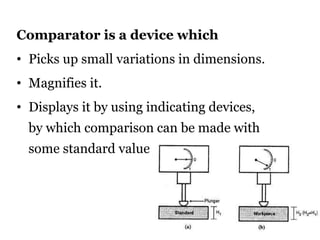
Comparator is a device which
• Picks up small variations in dimensions.
• Magnifies it.
• Displays it by using indicating devices,
by which comparison can be made with
some standard value.
Comparators
• Classification of comparators
• Mechanical
• Electrical and Electronics comparators
• Optical comparators
• Pneumatic comparators
• Fluid displacement comparators
• Mechanical comparators (It works on gears pinions, linkages, levers, springs etc.)
– Dial indicator
– Johnson Mikrokator
– Sigma comparators
• Optical comparators (Optical comparator works by using lens, mirrors, light source etc.)
– Principles,
– Zeiss ultra optimeter
• Pneumatic comparators (Pneumatic comparator works by using high pressure air, valves,
back pressure etc)
– Back pressure gauges,
– Solex comparators.
• Electrical Comparator: Works by using step up, step down transformers.
• Electronic Comparator: It works by using amplifier, digital signal etc.
• Combined Comparator: The combination of any two of the above types can give the best
result.
Characteristics of Good
Comparators:
1. It should be compact.
2. It should be easy to handle.
3. It should give quick response or quick result.
4. It should be reliable, while in use.
5. There should be no effects of environment on the comparator.
6. Its weight must be less.
7. It must be cheaper.
8. It must be easily available in the market.
9. It should be sensitive as per the requirement.
10. The design should be robust.
11. It should be linear in scale so that it is easy to read and get uniform response
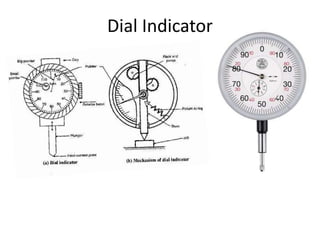
Dial Indicator
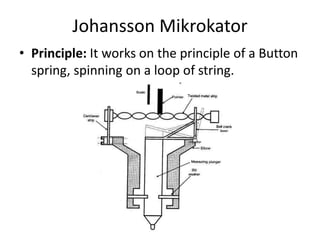
Johansson Mikrokator
• Principle: It works on the principle of a Button
spring, spinning on a loop of string.
Sigma Comparator
Electrical Comparator
Mechanical - Optical Comparator
• Principle : In mechanical optical comparator, small
variation in the plunger movement is magnified: first by
mechanical system and then by optical system.
Pneumatic comparators
Solex comparator
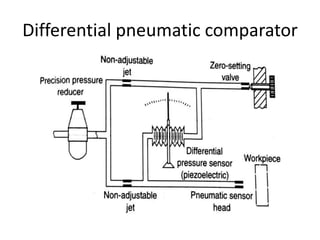
Differential pneumatic comparator
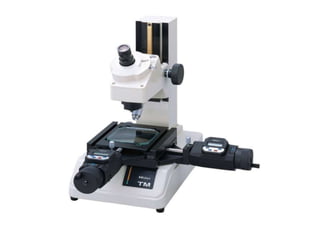
Principle of microscopy
Angle Gauges
27
29

Comparators

  • 1.
  • 2.
    Comparator is adevice which • Picks up small variations in dimensions. • Magnifies it. • Displays it by using indicating devices, by which comparison can be made with some standard value.
  • 3.
    Comparators • Classification ofcomparators • Mechanical • Electrical and Electronics comparators • Optical comparators • Pneumatic comparators • Fluid displacement comparators
  • 4.
    • Mechanical comparators(It works on gears pinions, linkages, levers, springs etc.) – Dial indicator – Johnson Mikrokator – Sigma comparators • Optical comparators (Optical comparator works by using lens, mirrors, light source etc.) – Principles, – Zeiss ultra optimeter • Pneumatic comparators (Pneumatic comparator works by using high pressure air, valves, back pressure etc) – Back pressure gauges, – Solex comparators. • Electrical Comparator: Works by using step up, step down transformers. • Electronic Comparator: It works by using amplifier, digital signal etc. • Combined Comparator: The combination of any two of the above types can give the best result.
  • 5.
    Characteristics of Good Comparators: 1.It should be compact. 2. It should be easy to handle. 3. It should give quick response or quick result. 4. It should be reliable, while in use. 5. There should be no effects of environment on the comparator. 6. Its weight must be less. 7. It must be cheaper. 8. It must be easily available in the market. 9. It should be sensitive as per the requirement. 10. The design should be robust. 11. It should be linear in scale so that it is easy to read and get uniform response
  • 6.
  • 8.
    Johansson Mikrokator • Principle:It works on the principle of a Button spring, spinning on a loop of string.
  • 9.
  • 10.
  • 11.
    Mechanical - OpticalComparator • Principle : In mechanical optical comparator, small variation in the plunger movement is magnified: first by mechanical system and then by optical system.
  • 13.
  • 15.
  • 16.
  • 27.
  • 29.