THE DISUNITED KINGDOM English social studies 2008 More at this webpage:  http://annmic.wordpress.com/
THE UNITED KINGDOM OF GREAT BRITAIN AND NOTHERN IRELAND Name adopted in  1927 . England is the oldest country  In the 13th century Wales was united with England Scotland 1707 Ireland in 1801.  The major part of Ireland got full independence in 1922 6 northern counties remain in union as Nothern Ireland
CONSTITUTIONAL MONARCHY One of the oldest democracies in the world Constitutional monarchy  since the 13 th  century. That the monarchy has limited power No written constitution  2 important adoptions securing the power of parliament Magna Carta (1215) Bill of Rights (1689)
DEVOLUTION The labor party came to power in 1997 with devolution as one of its key policies Devolution means the transferring of power from central government to regional or local authorities Following a referendum in 1999 on the matter of devolution Wales, Scotland and Nothern Ireland now have their own national assemblies.  Scottish Parliament and a Welsh Assembly.
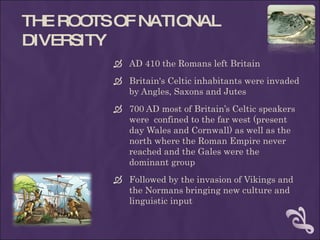
THE ROOTS OF NATIONAL DIVERSITY AD 410 the Romans left Britain Britain's Celtic inhabitants were invaded by Angles, Saxons and Jutes 700 AD most of Britain’s Celtic speakers were  confined to the far west (present day Wales and Cornwall) as well as the north where the Roman Empire never reached and the Gales were the dominant group Followed by the invasion of Vikings and the Normans bringing new culture and linguistic input
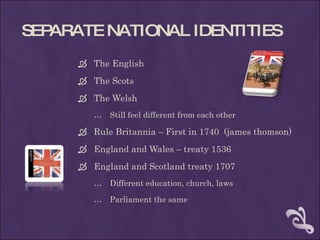
SEPARATE NATIONAL IDENTITIES The English The Scots The Welsh Still feel different from each other Rule Britannia  – First in 1740  (james thomson) England and Wales – treaty 1536 England and Scotland treaty 1707 Different education, church, laws Parliament the same
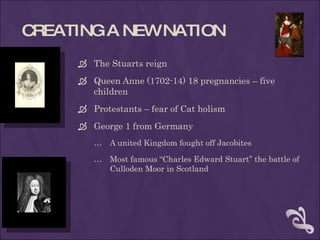
CREATING A NEW NATION The Stuarts reign Queen Anne  (1702-14) 18 pregnancies – five children Protestants – fear of Catholics George 1 from Germany  A united Kingdom fought off Jacobites Most famous “ Charles Edward Stuart ”  the battle of Culloden Moor  “in Scotland
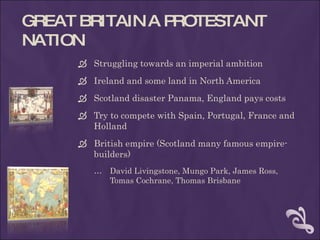
GREAT BRITAIN A PROTESTANT NATION Struggling towards an imperial ambition Ireland and some land in North America Scotland disaster Panama, England pays costs Try to compete with Spain, Portugal, France and Holland British empire (Scotland many famous empire-builders) David Livingstone, Mungo Park, James Ross, Tomas Cochrane, Thomas Brisbane
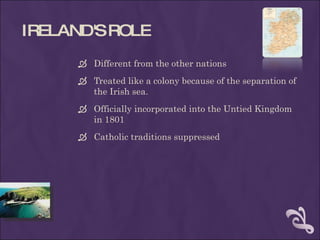
IRELAND'S ROLE Different from the other nations Treated like a colony because of the separation of the Irish sea.  Officially incorporated into the Untied Kingdom in 1801 Catholic traditions suppressed
SCOTLAND Election of 2007 The Scottish Nationalist Party won the election SNP’s goal is independence for Scotland A 1997 poll asked the Scots: do you feel more Scottish or British? 63 % Scottish SNP’s policy was then to go for devolution as a temporary stage on the road to full independence  The Scottish parliament of 1997 to deal with health, prisons, education.
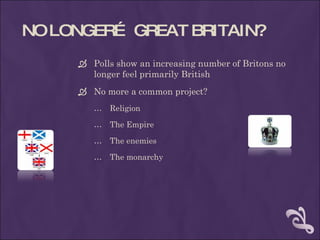
NO LONGER… GREAT  BRITAIN ? Polls show an increasing number of Britons no longer feel primarily British No more a common project? Religion The Empire The enemies The monarchy
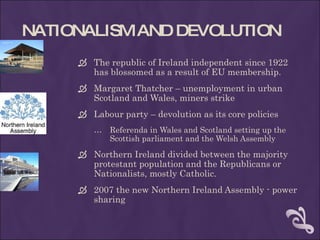
NATIONALISM AND DEVOLUTION The republic of Ireland independent since 1922 has blossomed as a result of EU membership. Margaret Thatcher – unemployment in urban Scotland and Wales, miners strike Labour party – devolution as its core policies Referenda in Wales and Scotland setting up the Scottish parliament and the Welsh Assembly Northern Ireland divided between the majority protestant population and the Republicans or Nationalists, mostly Catholic.  2007 the new Northern Ireland Assembly - power sharing
ENGLISHNESS An English national identity Union Jack – the red and white cross of St. George West Lothian Question Welsh Assembly,  Scottish parliament Scottish parliament 2007 – the Scottish national Party the largest SNP wants to keep an independent Scotland in the European Union Wales Plaid Cymru the biggest opposition facing  labour
BREAKING UP IS HARD TO DO Uk’s position in the Security Council at the United Nations Nuclear deterrent  British army Monarchy?

Devolution

  • 1.
    THE DISUNITED KINGDOMEnglish social studies 2008 More at this webpage: http://annmic.wordpress.com/
  • 2.
    THE UNITED KINGDOMOF GREAT BRITAIN AND NOTHERN IRELAND Name adopted in 1927 . England is the oldest country In the 13th century Wales was united with England Scotland 1707 Ireland in 1801. The major part of Ireland got full independence in 1922 6 northern counties remain in union as Nothern Ireland
  • 3.
    CONSTITUTIONAL MONARCHY Oneof the oldest democracies in the world Constitutional monarchy since the 13 th century. That the monarchy has limited power No written constitution 2 important adoptions securing the power of parliament Magna Carta (1215) Bill of Rights (1689)
  • 4.
    DEVOLUTION The laborparty came to power in 1997 with devolution as one of its key policies Devolution means the transferring of power from central government to regional or local authorities Following a referendum in 1999 on the matter of devolution Wales, Scotland and Nothern Ireland now have their own national assemblies. Scottish Parliament and a Welsh Assembly.
  • 5.
    THE ROOTS OFNATIONAL DIVERSITY AD 410 the Romans left Britain Britain's Celtic inhabitants were invaded by Angles, Saxons and Jutes 700 AD most of Britain’s Celtic speakers were confined to the far west (present day Wales and Cornwall) as well as the north where the Roman Empire never reached and the Gales were the dominant group Followed by the invasion of Vikings and the Normans bringing new culture and linguistic input
  • 6.
    SEPARATE NATIONAL IDENTITIESThe English The Scots The Welsh Still feel different from each other Rule Britannia – First in 1740 (james thomson) England and Wales – treaty 1536 England and Scotland treaty 1707 Different education, church, laws Parliament the same
  • 7.
    CREATING A NEWNATION The Stuarts reign Queen Anne (1702-14) 18 pregnancies – five children Protestants – fear of Catholics George 1 from Germany A united Kingdom fought off Jacobites Most famous “ Charles Edward Stuart ” the battle of Culloden Moor “in Scotland
  • 8.
    GREAT BRITAIN APROTESTANT NATION Struggling towards an imperial ambition Ireland and some land in North America Scotland disaster Panama, England pays costs Try to compete with Spain, Portugal, France and Holland British empire (Scotland many famous empire-builders) David Livingstone, Mungo Park, James Ross, Tomas Cochrane, Thomas Brisbane
  • 9.
    IRELAND'S ROLE Differentfrom the other nations Treated like a colony because of the separation of the Irish sea. Officially incorporated into the Untied Kingdom in 1801 Catholic traditions suppressed
  • 10.
    SCOTLAND Election of2007 The Scottish Nationalist Party won the election SNP’s goal is independence for Scotland A 1997 poll asked the Scots: do you feel more Scottish or British? 63 % Scottish SNP’s policy was then to go for devolution as a temporary stage on the road to full independence The Scottish parliament of 1997 to deal with health, prisons, education.
  • 11.
    NO LONGER… GREAT BRITAIN ? Polls show an increasing number of Britons no longer feel primarily British No more a common project? Religion The Empire The enemies The monarchy
  • 12.
    NATIONALISM AND DEVOLUTIONThe republic of Ireland independent since 1922 has blossomed as a result of EU membership. Margaret Thatcher – unemployment in urban Scotland and Wales, miners strike Labour party – devolution as its core policies Referenda in Wales and Scotland setting up the Scottish parliament and the Welsh Assembly Northern Ireland divided between the majority protestant population and the Republicans or Nationalists, mostly Catholic. 2007 the new Northern Ireland Assembly - power sharing
  • 13.
    ENGLISHNESS An Englishnational identity Union Jack – the red and white cross of St. George West Lothian Question Welsh Assembly, Scottish parliament Scottish parliament 2007 – the Scottish national Party the largest SNP wants to keep an independent Scotland in the European Union Wales Plaid Cymru the biggest opposition facing labour
  • 14.
    BREAKING UP ISHARD TO DO Uk’s position in the Security Council at the United Nations Nuclear deterrent British army Monarchy?