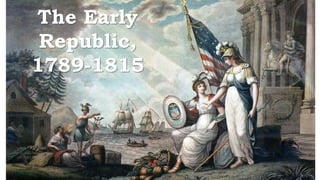
The Early
Republic,
1789-1815
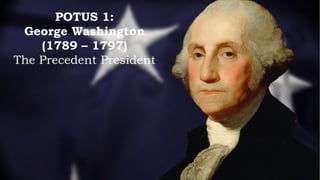
POTUS 1:
George Washington
(1789 – 1797)
The Precedent President
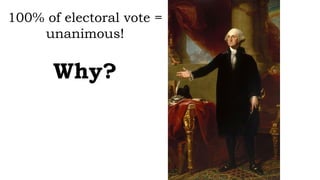
100% of electoral vote =
unanimous!
Why?
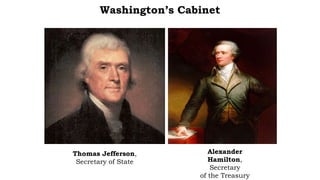
Washington’s Cabinet
Thomas Jefferson,
Secretary of State
Alexander
Hamilton,
Secretary
of the Treasury
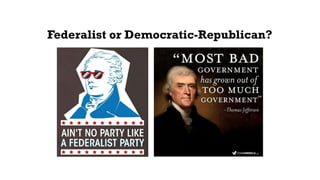
Federalist or Democratic-Republican?
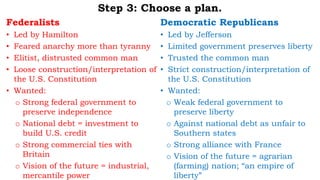
Step 3: Choose a plan.
Federalists
• Led by Hamilton
• Feared anarchy more than tyranny
• Elitist, distrusted common man
• Loose construction/interpretation of
the U.S. Constitution
• Wanted:
o Strong federal government to
preserve independence
o National debt = investment to
build U.S. credit
o Strong commercial ties with
Britain
o Vision of the future = industrial,
mercantile power
Democratic Republicans
• Led by Jefferson
• Limited government preserves liberty
• Trusted the common man
• Strict construction/interpretation of
the U.S. Constitution
• Wanted:
o Weak federal government to
preserve liberty
o Against national debt as unfair to
Southern states
o Strong alliance with France
o Vision of the future = agrarian
(farming) nation; “an empire of
liberty”
Component Pro Con
• U.S. federal government assumes
states’ debt
• National debt is sold to investors
as government bonds
• U.S. builds credit
• Investors become stakeholders
• Economic elites control the nation
= plutocracy (rule by the rich)
• Southern states had paid
Revolutionary War debts
• Create a national Bank of the
United States as a mixed private-
public venture
• Handle government finances
• Investors become stakeholders
• Plutocracy
• Is it constitutional?
• Tariff (tax on imports) • Raise revenue
• Spur industrial growth by making
U.S. manufacturing more
competitive against foreign goods
• Southern states import more and
will pay a higher share of taxes
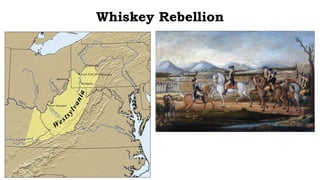
• Excise tax on whiskey • Raise revenue • Targets poor frontier farmers
Hamilton’s Economic Plan
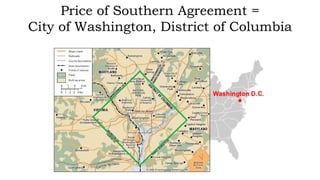
Price of Southern Agreement =
City of Washington, District of Columbia
Whiskey Rebellion
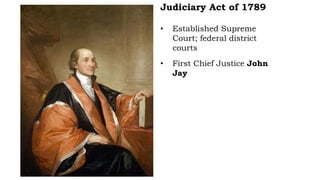
Judiciary Act of 1789
• Established Supreme
Court; federal district
courts
• First Chief Justice John
Jay
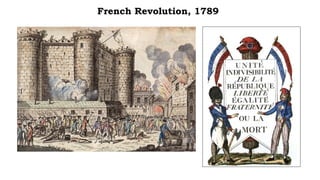
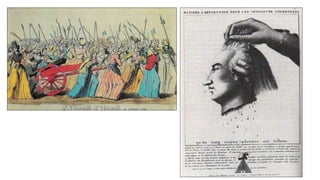
French Revolution, 1789
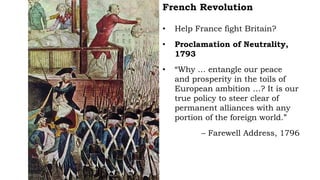
French Revolution
• Help France fight Britain?
• Proclamation of Neutrality,
1793
• “Why … entangle our peace
and prosperity in the toils of
European ambition …? It is our
true policy to steer clear of
permanent alliances with any
portion of the foreign world.”
– Farewell Address, 1796
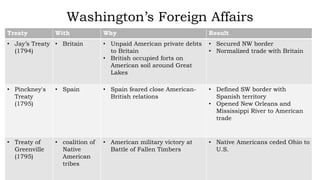
Washington’s Foreign Affairs
Treaty With Why Result
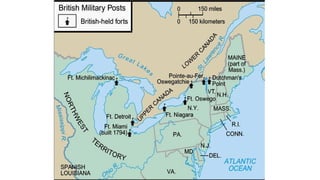
• Jay’s Treaty
(1794)
• Britain • Unpaid American private debts
to Britain
• British occupied forts on
American soil around Great
Lakes
• Secured NW border
• Normalized trade with Britain
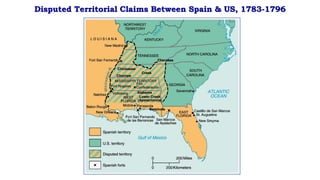
• Pinckney's
Treaty
(1795)
• Spain • Spain feared close American-
British relations
• Defined SW border with
Spanish territory
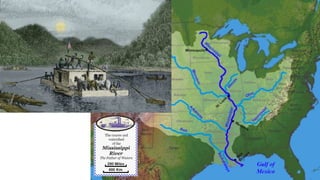
• Opened New Orleans and
Mississippi River to American
trade
• Treaty of
Greenville
(1795)
• coalition of
Native
American
tribes
• American military victory at
Battle of Fallen Timbers
• Native Americans ceded Ohio to
U.S.
Disputed Territorial Claims Between Spain & US, 1783-1796
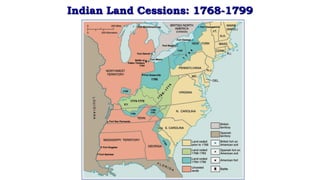
Indian Land Cessions: 1768-1799
Washington’s Farewell
Address, 1796
"However [political parties]
may now and then answer
popular ends, they are likely
in the course of time and
things, to become potent
engines, by which cunning,
ambitious, and unprincipled
men will be enabled to
subvert the power of the
people and to usurp for
themselves the reins of
government …”
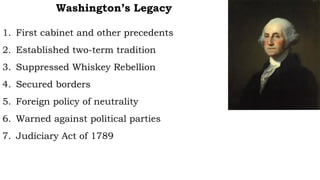
Washington’s Legacy
1. First cabinet and other precedents
2. Established two-term tradition
3. Suppressed Whiskey Rebellion
4. Secured borders
5. Foreign policy of neutrality
6. Warned against political parties
7. Judiciary Act of 1789
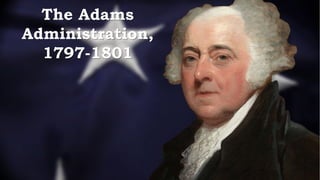
The Adams
Administration,
1797-1801
Quasi War and the XYZ Affair:
• French harassing American ships
• Adams sent diplomats to France
• French ministers (identified as X, Y, and Z) demanded bribe  XYZ Affair
• Federalists demand war with France
• Adams sent second diplomatic mission; successful
• Adams lost Federalist Party support
Alien and Sedition Acts
• Federalists exploit war fever; want to silence Democratic-Republican
criticism
• Federalists build up U.S. Army to “repel French invasion”; actual purpose
to suppress domestic Democratic-Republican opposition to Federalists
• Alien Act: increased naturalization from 5 to 14 years since many
immigrants supported Democratic-Republicans
• Sedition Act: illegal to publish criticism of federal government, especially
the president
Kentucky and Virginia Resolutions
• U.S. federal courts would not overturn Alien and Sedition Acts since all
judges were Federalists
• Jefferson and Madison encourage passage of Kentucky and Virginia
Resolutions nullifying (cancelling) federal laws
• Nullification remained a topic of national debate
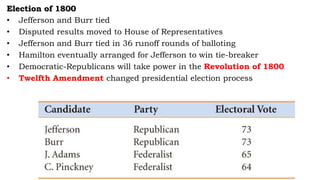
Election of 1800
• Jefferson and Burr tied
• Disputed results moved to House of Representatives
• Jefferson and Burr tied in 36 runoff rounds of balloting
• Hamilton eventually arranged for Jefferson to win tie-breaker
• Democratic-Republicans will take power in the Revolution of 1800
• Twelfth Amendment changed presidential election process
Judiciary Act of 1801
• Federalists passed the Judiciary Act of 1801 allowing Adams to appoint
new federal judges on his final day in office
• Midnight judges would allow Federalists to influence federal policy for
decades through court rulings
• Jefferson’s Secretary of State James Madison failed to deliver some
appointments; Federalist appointee William Marbury sued
• Chief Justice of the Supreme Court John Marshall argued in Marbury v.
Madison that the Judiciary Act of 1801 was unconstitutional
• Marbury v. Madison established the principle of judicial review
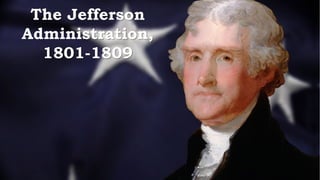
The Jefferson
Administration,
1801-1809
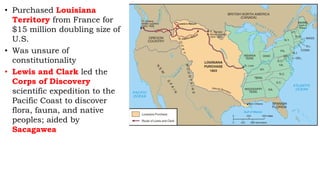
• Purchased Louisiana
Territory from France for
$15 million doubling size of
U.S.
• Was unsure of
constitutionality
• Lewis and Clark led the
Corps of Discovery
scientific expedition to the
Pacific Coast to discover
flora, fauna, and native
peoples; aided by
Sacagawea
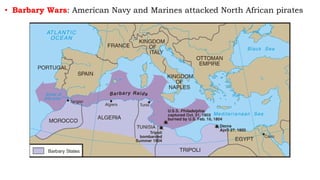
• Barbary Wars: American Navy and Marines attacked North African pirates
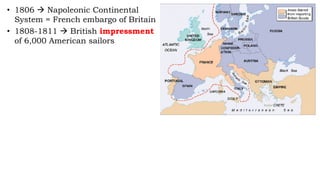
• 1806  Napoleonic Continental
System = French embargo of Britain
• 1808-1811  British impressment
of 6,000 American sailors
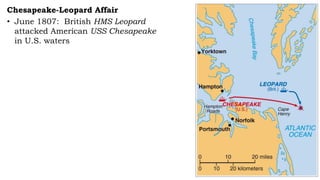
Chesapeake-Leopard Affair
• June 1807: British HMS Leopard
attacked American USS Chesapeake
in U.S. waters
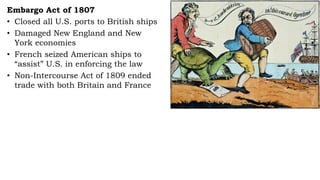
Embargo Act of 1807
• Closed all U.S. ports to British ships
• Damaged New England and New
York economies
• French seized American ships to
“assist” U.S. in enforcing the law
• Non-Intercourse Act of 1809 ended
trade with both Britain and France
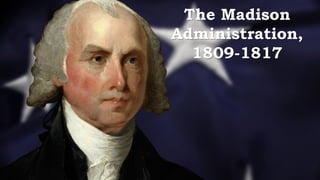
The Madison
Administration,
1809-1817
Macon’s Bill No. 2 of 1810
• Authorized the president to resume trade with either Britain or France and
embargo the other
• France normalized; embargo was maintained against Britain
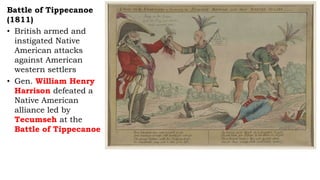
Battle of Tippecanoe
(1811)
• British armed and
instigated Native
American attacks
against American
western settlers
• Gen. William Henry
Harrison defeated a
Native American
alliance led by
Tecumseh at the
Battle of Tippecanoe
War of 1812
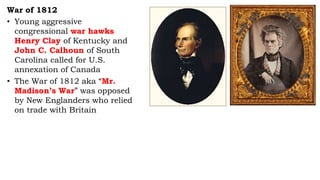
• Young aggressive
congressional war hawks
Henry Clay of Kentucky and
John C. Calhoun of South
Carolina called for U.S.
annexation of Canada
• The War of 1812 aka “Mr.
Madison’s War” was opposed
by New Englanders who relied
on trade with Britain
War of 1812
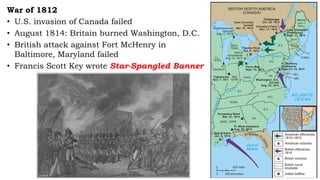
• U.S. invasion of Canada failed
• August 1814: Britain burned Washington, D.C.
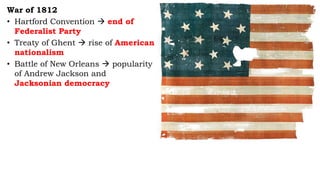
• British attack against Fort McHenry in
Baltimore, Maryland failed
• Francis Scott Key wrote Star-Spangled Banner
War of 1812
• December 1814: Federalist
Party met at the Hartford
Convention to discuss
secession of New England and
a separate peace with Britain
• December 24, 1814: The
Treaty of Ghent ended
conflict and resumed status
quo antebellum
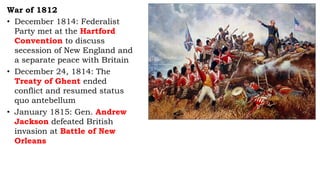
• January 1815: Gen. Andrew
Jackson defeated British
invasion at Battle of New
Orleans
War of 1812
• Hartford Convention  end of
Federalist Party
• Treaty of Ghent  rise of American
nationalism
• Battle of New Orleans  popularity
of Andrew Jackson and
Jacksonian democracy

The Early Republic 1789-1815.pdf

  • 1.
  • 2.
    POTUS 1: George Washington (1789– 1797) The Precedent President
  • 3.
    100% of electoralvote = unanimous! Why?
  • 4.
    Washington’s Cabinet Thomas Jefferson, Secretaryof State Alexander Hamilton, Secretary of the Treasury
  • 5.
  • 6.
    Step 3: Choosea plan. Federalists • Led by Hamilton • Feared anarchy more than tyranny • Elitist, distrusted common man • Loose construction/interpretation of the U.S. Constitution • Wanted: o Strong federal government to preserve independence o National debt = investment to build U.S. credit o Strong commercial ties with Britain o Vision of the future = industrial, mercantile power Democratic Republicans • Led by Jefferson • Limited government preserves liberty • Trusted the common man • Strict construction/interpretation of the U.S. Constitution • Wanted: o Weak federal government to preserve liberty o Against national debt as unfair to Southern states o Strong alliance with France o Vision of the future = agrarian (farming) nation; “an empire of liberty”
  • 7.
    Component Pro Con •U.S. federal government assumes states’ debt • National debt is sold to investors as government bonds • U.S. builds credit • Investors become stakeholders • Economic elites control the nation = plutocracy (rule by the rich) • Southern states had paid Revolutionary War debts • Create a national Bank of the United States as a mixed private- public venture • Handle government finances • Investors become stakeholders • Plutocracy • Is it constitutional? • Tariff (tax on imports) • Raise revenue • Spur industrial growth by making U.S. manufacturing more competitive against foreign goods • Southern states import more and will pay a higher share of taxes • Excise tax on whiskey • Raise revenue • Targets poor frontier farmers Hamilton’s Economic Plan
  • 9.
    Price of SouthernAgreement = City of Washington, District of Columbia
  • 10.
  • 11.
    Judiciary Act of1789 • Established Supreme Court; federal district courts • First Chief Justice John Jay
  • 12.
  • 14.
    French Revolution • HelpFrance fight Britain? • Proclamation of Neutrality, 1793 • “Why … entangle our peace and prosperity in the toils of European ambition …? It is our true policy to steer clear of permanent alliances with any portion of the foreign world.” – Farewell Address, 1796
  • 15.
    Washington’s Foreign Affairs TreatyWith Why Result • Jay’s Treaty (1794) • Britain • Unpaid American private debts to Britain • British occupied forts on American soil around Great Lakes • Secured NW border • Normalized trade with Britain • Pinckney's Treaty (1795) • Spain • Spain feared close American- British relations • Defined SW border with Spanish territory • Opened New Orleans and Mississippi River to American trade • Treaty of Greenville (1795) • coalition of Native American tribes • American military victory at Battle of Fallen Timbers • Native Americans ceded Ohio to U.S.
  • 17.
    Disputed Territorial ClaimsBetween Spain & US, 1783-1796
  • 18.
  • 19.
    Washington’s Farewell Address, 1796 "However[political parties] may now and then answer popular ends, they are likely in the course of time and things, to become potent engines, by which cunning, ambitious, and unprincipled men will be enabled to subvert the power of the people and to usurp for themselves the reins of government …”
  • 20.
    Washington’s Legacy 1. Firstcabinet and other precedents 2. Established two-term tradition 3. Suppressed Whiskey Rebellion 4. Secured borders 5. Foreign policy of neutrality 6. Warned against political parties 7. Judiciary Act of 1789
  • 21.
  • 22.
    Quasi War andthe XYZ Affair: • French harassing American ships • Adams sent diplomats to France • French ministers (identified as X, Y, and Z) demanded bribe  XYZ Affair • Federalists demand war with France • Adams sent second diplomatic mission; successful • Adams lost Federalist Party support
  • 23.
    Alien and SeditionActs • Federalists exploit war fever; want to silence Democratic-Republican criticism • Federalists build up U.S. Army to “repel French invasion”; actual purpose to suppress domestic Democratic-Republican opposition to Federalists • Alien Act: increased naturalization from 5 to 14 years since many immigrants supported Democratic-Republicans • Sedition Act: illegal to publish criticism of federal government, especially the president
  • 24.
    Kentucky and VirginiaResolutions • U.S. federal courts would not overturn Alien and Sedition Acts since all judges were Federalists • Jefferson and Madison encourage passage of Kentucky and Virginia Resolutions nullifying (cancelling) federal laws • Nullification remained a topic of national debate
  • 25.
    Election of 1800 •Jefferson and Burr tied • Disputed results moved to House of Representatives • Jefferson and Burr tied in 36 runoff rounds of balloting • Hamilton eventually arranged for Jefferson to win tie-breaker • Democratic-Republicans will take power in the Revolution of 1800 • Twelfth Amendment changed presidential election process
  • 26.
    Judiciary Act of1801 • Federalists passed the Judiciary Act of 1801 allowing Adams to appoint new federal judges on his final day in office • Midnight judges would allow Federalists to influence federal policy for decades through court rulings • Jefferson’s Secretary of State James Madison failed to deliver some appointments; Federalist appointee William Marbury sued • Chief Justice of the Supreme Court John Marshall argued in Marbury v. Madison that the Judiciary Act of 1801 was unconstitutional • Marbury v. Madison established the principle of judicial review
  • 27.
  • 28.
    • Purchased Louisiana Territoryfrom France for $15 million doubling size of U.S. • Was unsure of constitutionality • Lewis and Clark led the Corps of Discovery scientific expedition to the Pacific Coast to discover flora, fauna, and native peoples; aided by Sacagawea
  • 29.
    • Barbary Wars:American Navy and Marines attacked North African pirates
  • 30.
    • 1806 Napoleonic Continental System = French embargo of Britain • 1808-1811  British impressment of 6,000 American sailors
  • 31.
    Chesapeake-Leopard Affair • June1807: British HMS Leopard attacked American USS Chesapeake in U.S. waters
  • 32.
    Embargo Act of1807 • Closed all U.S. ports to British ships • Damaged New England and New York economies • French seized American ships to “assist” U.S. in enforcing the law • Non-Intercourse Act of 1809 ended trade with both Britain and France
  • 33.
  • 34.
    Macon’s Bill No.2 of 1810 • Authorized the president to resume trade with either Britain or France and embargo the other • France normalized; embargo was maintained against Britain
  • 35.
    Battle of Tippecanoe (1811) •British armed and instigated Native American attacks against American western settlers • Gen. William Henry Harrison defeated a Native American alliance led by Tecumseh at the Battle of Tippecanoe
  • 36.
    War of 1812 •Young aggressive congressional war hawks Henry Clay of Kentucky and John C. Calhoun of South Carolina called for U.S. annexation of Canada • The War of 1812 aka “Mr. Madison’s War” was opposed by New Englanders who relied on trade with Britain
  • 37.
    War of 1812 •U.S. invasion of Canada failed • August 1814: Britain burned Washington, D.C. • British attack against Fort McHenry in Baltimore, Maryland failed • Francis Scott Key wrote Star-Spangled Banner
  • 38.
    War of 1812 •December 1814: Federalist Party met at the Hartford Convention to discuss secession of New England and a separate peace with Britain • December 24, 1814: The Treaty of Ghent ended conflict and resumed status quo antebellum • January 1815: Gen. Andrew Jackson defeated British invasion at Battle of New Orleans
  • 39.
    War of 1812 •Hartford Convention  end of Federalist Party • Treaty of Ghent  rise of American nationalism • Battle of New Orleans  popularity of Andrew Jackson and Jacksonian democracy