ProgressivismReform in the late 19th-early 20th century
ProgressivismDominated US politics from 1890s to 1920sAdvocated social reform through governmentWWI ended progressivismProgressivism is often considered the beginning of liberalism in American politicsLiberal or progressivePerson willing to accept changeConservativePerson resistant to changeReactionary: wants to undo progress and return to some “ideal time” in past
Problems in AmericaHuge gap between rich and poorRich had the political power and did nothing for problems of America’s poor and working classPolitics was corruptMachines dominated city political sceneWorking class lived in squalid slums where health was poor and conditions atrociousPay was low and working conditions unsafe
ProgressivismReaction to:“extremes” of modern lifeCapitalism & individualismUrbanization & IndustrializationLabor conflictImmigrationEnvironmental exploitationSocial “problems”
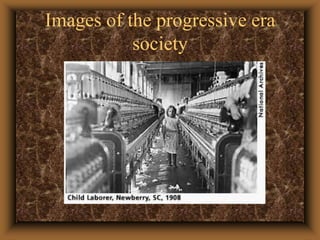
Images of the progressive era society
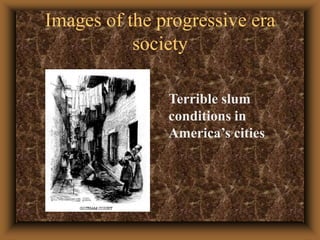
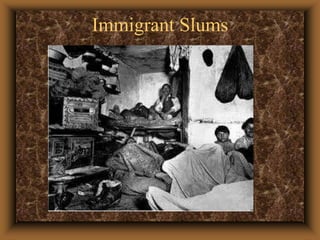
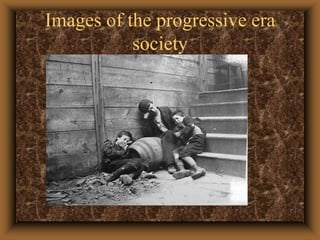
Images of the progressive era societyTerrible slum conditions in America’s cities
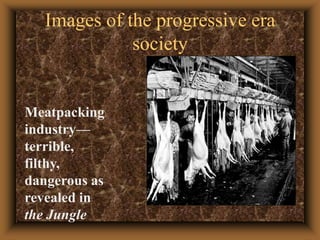
Images of the progressive era societyMeatpacking industry—terrible, filthy, dangerous as revealed in the Jungle
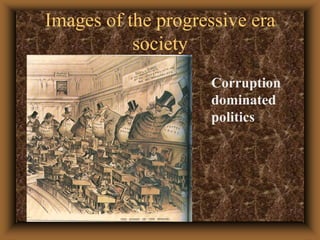
Images of the progressive era societyCorruption dominated politics
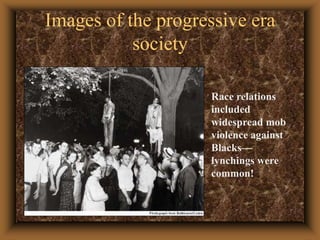
Images of the progressive era societyRace relations included widespread mob violence against Blacks— lynchings were common!
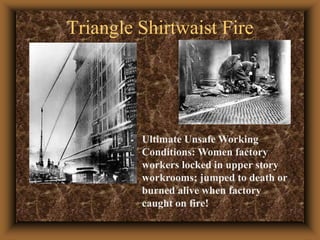
Triangle Shirtwaist FireUltimate Unsafe Working Conditions: Women factory workers locked in upper story workrooms; jumped to death or burned alive when factory caught on fire!
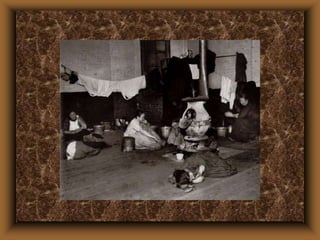
Immigrant Slums
Images of the progressive era society
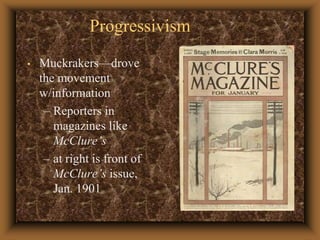
ProgressivismMuckrakers—drove the movement w/informationReporters in magazines like McClure’sat right is front of McClure’s issue, Jan. 1901
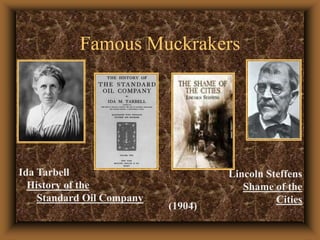
Famous MuckrakersIda TarbellHistory of the Standard Oil CompanyLincoln SteffensShame of the Cities   (1904)
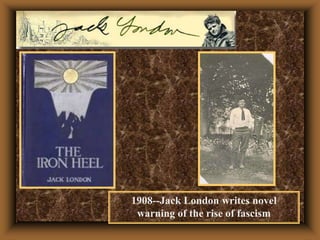
1908--Jack London writes novel warning of the rise of fascism
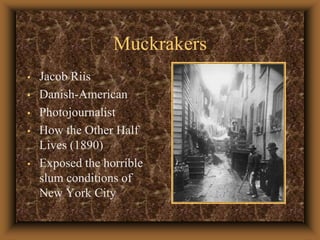
MuckrakersJacob RiisDanish-AmericanPhotojournalistHow the Other Half Lives (1890)Exposed the horrible slum conditions of New York City
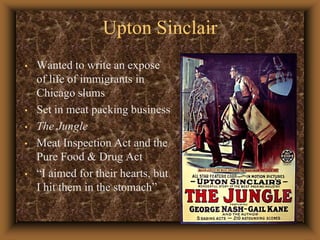
Upton SinclairWanted to write an expose of life of immigrants in Chicago slumsSet in meat packing businessThe JungleMeat Inspection Act and the Pure Food & Drug Act “I aimed for their hearts, but I hit them in the stomach”
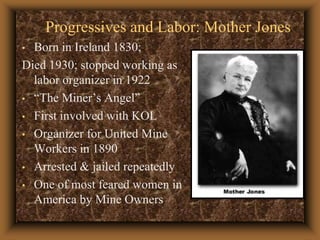
Progressives and Labor: Mother JonesBorn in Ireland 1830;Died 1930; stopped working as labor organizer in 1922“The Miner’s Angel”First involved with KOLOrganizer for United Mine Workers in 1890Arrested & jailed repeatedlyOne of most feared women in America by Mine Owners
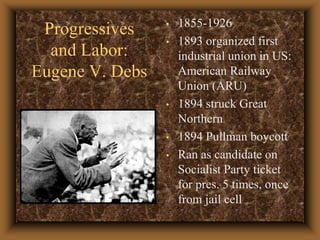
Progressives and Labor: Eugene V. Debs1855-19261893 organized first industrial union in US: American Railway Union (ARU)1894 struck Great Northern1894 Pullman boycottRan as candidate on Socialist Party ticket for pres. 5 times, once from jail cell
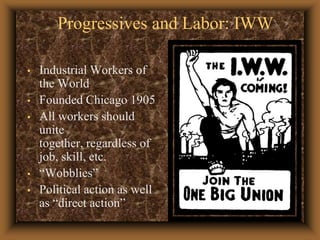
Progressives and Labor: IWWIndustrial Workers of the WorldFounded Chicago 1905All workers should unite together, regardless of job, skill, etc.“Wobblies”Political action as well as “direct action”
Progressives and Labor:  Clayton Act1914Granted workers the right to organize without violating Sherman Anti-TrustLimited use of injunctions against unionsCalled the “Magna Carta” of American labor movement
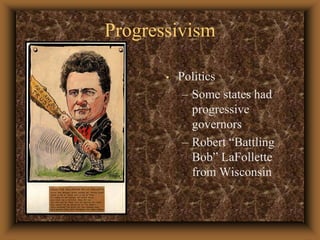
ProgressivismPoliticsSome states had progressive governorsRobert “Battling Bob” LaFollette from Wisconsin
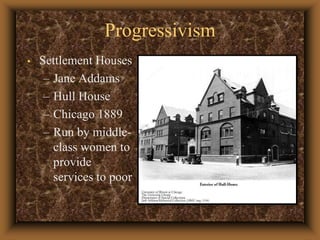
ProgressivismSettlement HousesJane AddamsHull HouseChicago 1889Run by middle-class women to provide services to poor
Successes of MovementPolitical reformsInitiative and referendum adopted in many statesSecret Ballot first adopted in Wisconsin as well as direct primary elections 16th Amendment passed –graduated income tax 17th Amendment - Direct Election of Senators 1913
Successes of MovementWomen's Rights National American Women’s Suffrage Association under Carrie Chapman Catt National Women’s Party under Alice Paul 19th Amendment in 1919
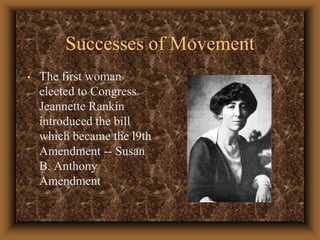
Successes of MovementThe first woman elected to Congress Jeannette Rankin introduced the bill which became the l9th Amendment -- Susan B. Anthony Amendment
Successes of MovementOther feminist areas Charlotte Perkins Gilman urged economic independence for women Margaret Sanger–reproductive rights (birth control movement)
Progressive Failures Race Relations and Civil Rights Many progressives were racistsNo significant steps taken to challenge Jim Crow laws of southTeddy Roosevelt had Booker T Washington to dinner at White HouseWilson, born in south, was racist
Jim Crow LawsIn the South mostly (but other areas, too)Laws designed to undo the rights guaranteed African Americans during ReconstructionPlessy v. Ferguson (1896)  “separate but equal” does not violate 14th AmendmentWilliams v Mississippi (1898) poll tax, literacy test does not violate 14th Amendment
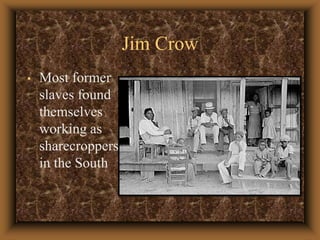
Jim CrowMost former slaves found themselves working as sharecroppers in the South
Crop Lien SystemEach area had “furnishing merchants” who sold the tenant farmers things on creditCharged interest Had a lien on the crop until paid backBecause of falling prices, debt could not be paidFarmer in “debt slavery” and could not leave
Jim Crow LawsAfter Plessy, laws enforced separate:Public places of all sortsWaiting rooms, water fountains, restrooms (often not provided), hotels, dining roomsMiscegenation laws passedSeparate schools by lawJury duty banned
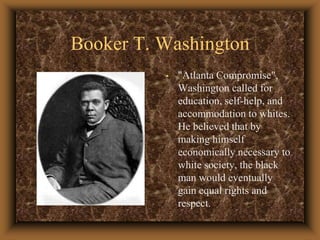
Booker T. Washington"Atlanta Compromise", Washington called for education, self-help, and accommodation to whites. He believed that by making himself economically necessary to white society, the black man would eventually gain equal rights and respect.
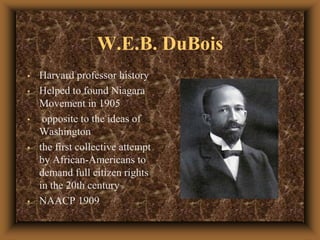
W.E.B.DuBoisHarvard professor historyHelped to found Niagara Movement in 1905 opposite to the ideas of Washingtonthe first collective attempt by African-Americans to demand full citizen rights in the 20th century NAACP 1909
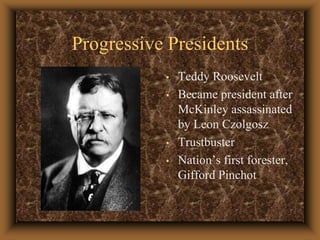
Progressive Presidents Teddy RooseveltBecame president after McKinley assassinated by Leon Czolgosz TrustbusterNation’s first forester, Gifford Pinchot
Roosevelt’s AccomplishmentsMain strengths of progressivism came in areas of conservation Got Newlands Reclamation Act passed in 1902 for irrigation projects in the West Set aside millions of acres under Forest Reserve Act including 85 million acres in Alaska Created 5 new National Parks such as Crater Lake in Oregon and Mesa Verde in Colorado Created the first National Monument, Devil’s Tower in Wyoming 51 wildlife sanctuaries created
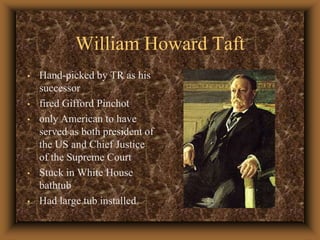
William Howard TaftHand-picked by TR as his successor fired Gifford Pinchot only American to have served as both president of the US and Chief Justice of the Supreme Court Stuck in White House bathtubHad large tub installed
TaftTaft was also the first president to throw out the opening pitch in baseball and created the custom of the seventh inning stretch and was president when the Titanic went down Teddy & Taft had falling out & in election of 1912, Teddy ran against Taft on Bull Moose PartyWilson won when TR split Republican vote
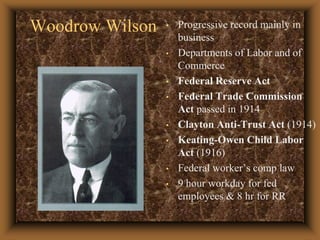
Woodrow WilsonProgressive record mainly in businessDepartments of Labor and of Commerce Federal Reserve ActFederal Trade Commission Act passed in 1914 Clayton Anti-Trust Act (1914) Keating-Owen Child Labor Act (1916)Federal worker’s comp law9 hour workday for fed employees & 8 hr for RR
ProgressivismConclusionProgressives tried to spread themselves too thin over too many areas of concern. This confused workers and supporters. But progressives succeeded in several areas, especially political reforms and business reforms. They failed in areas like civil rights soundly and all-too-often attempted to force upon a multi-cultural society values of the white middle class.

The Progressive Era

  • 1.
    ProgressivismReform in thelate 19th-early 20th century
  • 2.
    ProgressivismDominated US politicsfrom 1890s to 1920sAdvocated social reform through governmentWWI ended progressivismProgressivism is often considered the beginning of liberalism in American politicsLiberal or progressivePerson willing to accept changeConservativePerson resistant to changeReactionary: wants to undo progress and return to some “ideal time” in past
  • 3.
    Problems in AmericaHugegap between rich and poorRich had the political power and did nothing for problems of America’s poor and working classPolitics was corruptMachines dominated city political sceneWorking class lived in squalid slums where health was poor and conditions atrociousPay was low and working conditions unsafe
  • 4.
    ProgressivismReaction to:“extremes” ofmodern lifeCapitalism & individualismUrbanization & IndustrializationLabor conflictImmigrationEnvironmental exploitationSocial “problems”
  • 5.
    Images of theprogressive era society
  • 6.
    Images of theprogressive era societyTerrible slum conditions in America’s cities
  • 7.
    Images of theprogressive era societyMeatpacking industry—terrible, filthy, dangerous as revealed in the Jungle
  • 8.
    Images of theprogressive era societyCorruption dominated politics
  • 9.
    Images of theprogressive era societyRace relations included widespread mob violence against Blacks— lynchings were common!
  • 10.
    Triangle Shirtwaist FireUltimateUnsafe Working Conditions: Women factory workers locked in upper story workrooms; jumped to death or burned alive when factory caught on fire!
  • 11.
  • 12.
    Images of theprogressive era society
  • 15.
    ProgressivismMuckrakers—drove the movementw/informationReporters in magazines like McClure’sat right is front of McClure’s issue, Jan. 1901
  • 16.
    Famous MuckrakersIda TarbellHistoryof the Standard Oil CompanyLincoln SteffensShame of the Cities (1904)
  • 17.
    1908--Jack London writesnovel warning of the rise of fascism
  • 18.
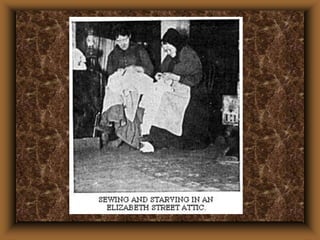
    MuckrakersJacob RiisDanish-AmericanPhotojournalistHow theOther Half Lives (1890)Exposed the horrible slum conditions of New York City
  • 19.
    Upton SinclairWanted towrite an expose of life of immigrants in Chicago slumsSet in meat packing businessThe JungleMeat Inspection Act and the Pure Food & Drug Act “I aimed for their hearts, but I hit them in the stomach”
  • 20.
    Progressives and Labor:Mother JonesBorn in Ireland 1830;Died 1930; stopped working as labor organizer in 1922“The Miner’s Angel”First involved with KOLOrganizer for United Mine Workers in 1890Arrested & jailed repeatedlyOne of most feared women in America by Mine Owners
  • 21.
    Progressives and Labor:Eugene V. Debs1855-19261893 organized first industrial union in US: American Railway Union (ARU)1894 struck Great Northern1894 Pullman boycottRan as candidate on Socialist Party ticket for pres. 5 times, once from jail cell
  • 22.
    Progressives and Labor:IWWIndustrial Workers of the WorldFounded Chicago 1905All workers should unite together, regardless of job, skill, etc.“Wobblies”Political action as well as “direct action”
  • 23.
    Progressives and Labor: Clayton Act1914Granted workers the right to organize without violating Sherman Anti-TrustLimited use of injunctions against unionsCalled the “Magna Carta” of American labor movement
  • 24.
    ProgressivismPoliticsSome states hadprogressive governorsRobert “Battling Bob” LaFollette from Wisconsin
  • 25.
    ProgressivismSettlement HousesJane AddamsHullHouseChicago 1889Run by middle-class women to provide services to poor
  • 26.
    Successes of MovementPoliticalreformsInitiative and referendum adopted in many statesSecret Ballot first adopted in Wisconsin as well as direct primary elections 16th Amendment passed –graduated income tax 17th Amendment - Direct Election of Senators 1913
  • 27.
    Successes of MovementWomen'sRights National American Women’s Suffrage Association under Carrie Chapman Catt National Women’s Party under Alice Paul 19th Amendment in 1919
  • 28.
    Successes of MovementThefirst woman elected to Congress Jeannette Rankin introduced the bill which became the l9th Amendment -- Susan B. Anthony Amendment
  • 29.
    Successes of MovementOtherfeminist areas Charlotte Perkins Gilman urged economic independence for women Margaret Sanger–reproductive rights (birth control movement)
  • 30.
    Progressive Failures RaceRelations and Civil Rights Many progressives were racistsNo significant steps taken to challenge Jim Crow laws of southTeddy Roosevelt had Booker T Washington to dinner at White HouseWilson, born in south, was racist
  • 31.
    Jim Crow LawsInthe South mostly (but other areas, too)Laws designed to undo the rights guaranteed African Americans during ReconstructionPlessy v. Ferguson (1896) “separate but equal” does not violate 14th AmendmentWilliams v Mississippi (1898) poll tax, literacy test does not violate 14th Amendment
  • 32.
    Jim CrowMost formerslaves found themselves working as sharecroppers in the South
  • 33.
    Crop Lien SystemEacharea had “furnishing merchants” who sold the tenant farmers things on creditCharged interest Had a lien on the crop until paid backBecause of falling prices, debt could not be paidFarmer in “debt slavery” and could not leave
  • 34.
    Jim Crow LawsAfterPlessy, laws enforced separate:Public places of all sortsWaiting rooms, water fountains, restrooms (often not provided), hotels, dining roomsMiscegenation laws passedSeparate schools by lawJury duty banned
  • 35.
    Booker T. Washington"AtlantaCompromise", Washington called for education, self-help, and accommodation to whites. He believed that by making himself economically necessary to white society, the black man would eventually gain equal rights and respect.
  • 36.
    W.E.B.DuBoisHarvard professor historyHelpedto found Niagara Movement in 1905 opposite to the ideas of Washingtonthe first collective attempt by African-Americans to demand full citizen rights in the 20th century NAACP 1909
  • 37.
    Progressive Presidents TeddyRooseveltBecame president after McKinley assassinated by Leon Czolgosz TrustbusterNation’s first forester, Gifford Pinchot
  • 38.
    Roosevelt’s AccomplishmentsMain strengthsof progressivism came in areas of conservation Got Newlands Reclamation Act passed in 1902 for irrigation projects in the West Set aside millions of acres under Forest Reserve Act including 85 million acres in Alaska Created 5 new National Parks such as Crater Lake in Oregon and Mesa Verde in Colorado Created the first National Monument, Devil’s Tower in Wyoming 51 wildlife sanctuaries created
  • 39.
    William Howard TaftHand-pickedby TR as his successor fired Gifford Pinchot only American to have served as both president of the US and Chief Justice of the Supreme Court Stuck in White House bathtubHad large tub installed
  • 40.
    TaftTaft was alsothe first president to throw out the opening pitch in baseball and created the custom of the seventh inning stretch and was president when the Titanic went down Teddy & Taft had falling out & in election of 1912, Teddy ran against Taft on Bull Moose PartyWilson won when TR split Republican vote
  • 41.
    Woodrow WilsonProgressive recordmainly in businessDepartments of Labor and of Commerce Federal Reserve ActFederal Trade Commission Act passed in 1914 Clayton Anti-Trust Act (1914) Keating-Owen Child Labor Act (1916)Federal worker’s comp law9 hour workday for fed employees & 8 hr for RR
  • 42.
    ProgressivismConclusionProgressives tried tospread themselves too thin over too many areas of concern. This confused workers and supporters. But progressives succeeded in several areas, especially political reforms and business reforms. They failed in areas like civil rights soundly and all-too-often attempted to force upon a multi-cultural society values of the white middle class.