

• Public management in global perspective by Schiavo-campo, Salvatore
and Mcferson, HazelM.
• Bureaucracy in Pakistan by Charles H.Kannedy
• Report of International Crisis group “Reforming Pakistan's Civil
Service” Asia Report N°185 – 16 February 2010
• Pakistan: A Civil service in An Obsolescing Imperial Tradition by
GARTH N. JONES
• Daily Times News Paper on Wednesday, March 31, 2010
• NCGR Report
• Report on Revision of basic pay scales, allowances and pension of civil
employees of federal government (2005) by Finance Division
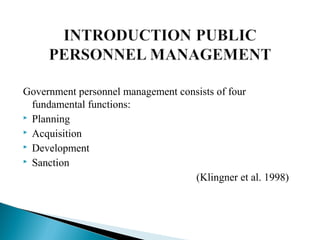
Government personnel management consists of four
fundamental functions:
 Planning
 Acquisition
 Development
 Sanction
(Klingner et al. 1998)
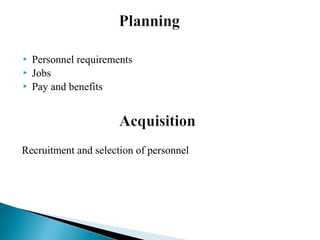
 Personnel requirements
 Jobs
 Pay and benefits
Recruitment and selection of personnel
Task of :
 Orienting
 Training
 Motivating
 Evaluating employees
 Establishment and maintenance of expectations and
obligations
 Different social values have led to different
personnel systems in different countries.
 In general, evolution of government personnel
systems has shown a transition from political
patronage and personalism to a merit based
system, political neutrality, continutiy, integratiy
and professionalism.
 Permanent ( e.g. civil service)
 Fixed term contracts
 Part time work
 Casual or contractual appointments
 From the dawn of the British raj, member of the bureaucracy
were divided into covenanted and un- covenanted public
servants
 later into those who were Gazetted and non Gazetted
 Afterwards it was converted into 4 classes ranging from
officer level class I, to menial level class IV
 In 1973 the ranks were reorganized into 22 national pay
grades
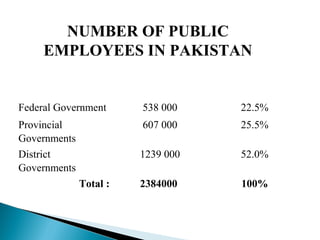
Federal Government 538 000 22.5%
Provincial
Governments
607 000 25.5%
District
Governments
1239 000 52.0%
Total : 2384000 100%
NUMBER OF PUBLIC
EMPLOYEES IN PAKISTAN
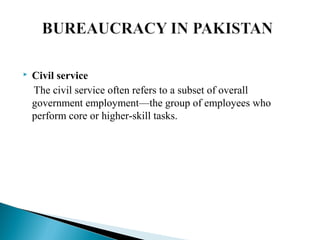
 Civil service
The civil service often refers to a subset of overall
government employment—the group of employees who
perform core or higher-skill tasks.
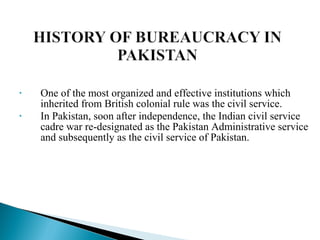
• One of the most organized and effective institutions which
inherited from British colonial rule was the civil service.
• In Pakistan, soon after independence, the Indian civil service
cadre war re-designated as the Pakistan Administrative service
and subsequently as the civil service of Pakistan.
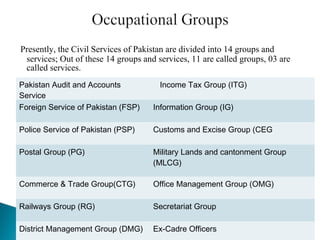
Presently, the Civil Services of Pakistan are divided into 14 groups and
services; Out of these 14 groups and services, 11 are called groups, 03 are
called services.
Pakistan Audit and Accounts
Service
Income Tax Group (ITG)
Foreign Service of Pakistan (FSP) Information Group (IG)
Police Service of Pakistan (PSP) Customs and Excise Group (CEG
Postal Group (PG) Military Lands and cantonment Group
(MLCG)
Commerce & Trade Group(CTG) Office Management Group (OMG)
Railways Group (RG) Secretariat Group
District Management Group (DMG) Ex-Cadre Officers
FPSC
 Is responsible for direct recruitment to officer level positions
in the federal bureaucracy
 FPSC conducts tests and examinations to all federal posts of
and above a specified level of seniority
Direct induction of military officers
 Military inductees do not have to take the CSS examination or
any other entry test, and are instead simply nominated by their
respective military hierarchies and then subject to an interview
by the FPSC.
 Advertisement against listed vacancies in ministries and
departments
 Ad hoc recruitment by departments or ministries for
temporary vacancies
Each of the provinces has its own public service commission,
constituted along similar lines to the FPSC and responsible for
recruitment to the provincial civil service.
The provincial commission comprise of;
 Punjab Public Service Commission(PPSC)
 Sindh Public Service Commission(SPSC)
 Baluchistan Public Service Commission(BPSC)
 K.P.K Public Service Commission (KPSC)
 Merit Quota . . . . . . . . . . . . . . …………………………. 10%
 Punjab (including the Federal area Islamabad) . . . . . . . . .50%
 Sindh (including Karachi) . . . . . . . . . . . . . . . . . . . . . . . . 19%
The share of Sindh is further sub-allocated in the following
ratio:
 Urban Areas, Karachi, Hyderabad & Sukhar . . . …........40%
 Rural Areas i.e. the rest of Sindh excluding Karachi,
Hyderabad & Sukhar……………………………………60%
 K.P.K . . . . . . . . . . . . . . . . .…………………………….11.5%
 Baluchistan . . . . . . . . . . ………………………………..3.5%
 Northern Areas & Federally Administrated Tribal Areas . .4%
 Azad Kashmir . . . . . . . . ………………………………… 2%
 Women Quota……10% of each Provincial / Regional Quota
a) Pre Service Training:
i. Common Training Program (CTP) for CSS Probationers
Civil Services Academy Lahore, provides pre-service
training to Grade 17 officer appointed as probationers to the
Central Superior Services.
ii. Specialized training Program (STP):
The CSA also holds a 20 weeks specialized training program
for DMG probationers
b) In-Service Training:
 i) Secretariat Training Institute (STI):
 STI provides both probationary and in-service training to
the directly recruited and promoted section officers of the
Federal Government
 ii) Pakistan Provincial Services Academy (PPSA):
 PPSA, Peshawar was established to impart pre-service
training to the probationary officers of the Provincial Civil
Service cadre
 iii) National Institute of Public Administration
 NMI administers two 16 weeks advanced courses
annually in Administration and Development, to officers of
the Federal and Provincial Governments at middle-
management levels up to the level of Deputy Secretary or
equivalent.
iv) Pakistan Academy for Rural Development (PARD),
Peshawar:
PARD arranges in-service training on selected topics/issues
for Federal and Provincial Government Officers.
v) National Defense University (NDU):
NDU provides a few seats to civil service officers of BS- 20
for training
vi) National Management College (NMC) formerly Pakistan
Administrative Staff College (PASC):
NMC is an in-service institution catering exclusively to the
training of senior officers of BS-20 drawn from all the civil
services.
 Training of “selected personnel” is arranged by the respective
Ministries/ Divisions through their own foreign courses or by
EAD (Employment Authorization Document) through
technical assistance programs abroad.
 Capacity Building project financed by the World Bank,
officers in BS 17-19 are sent under Professional Development
Program for obtaining Master’s degrees and senior officers in
BS-20-21 attend the Kennedy School at Harvard under
Executive Development Program.
 Promotions in the bureaucracy are based on a combination of
seniority and merit. The Central Selection Board makes
promotions to “selection posts”
 Promotions are generally based on four criteria: minimum
length of active service; an unblemished disciplinary record;
the required threshold in performance evaluation reports
(PERs); and successful completion of the mandatory training
course.
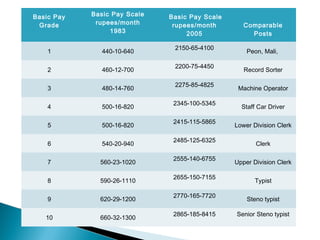
 Compensation is given according to the basic pay scale for
every grade.
Basic Pay
Grade
Basic Pay Scale
rupees/month
1983
 Basic Pay Scale
rupees/month
2005
Comparable
Posts
1 440-10-640
2150-65-4100
Peon, Mali,
2 460-12-700
2200-75-4450
Record Sorter
3 480-14-760
2275-85-4825
Machine Operator
4 500-16-820
2345-100-5345
Staff Car Driver
5 500-16-820
2415-115-5865
Lower Division Clerk
6 540-20-940
2485-125-6325
Clerk
7 560-23-1020
2555-140-6755
Upper Division Clerk
8 590-26-1110
2655-150-7155
Typist
9 620-29-1200
2770-165-7720
Steno typist
10 660-32-1300
2865-185-8415 Senior Steno typist
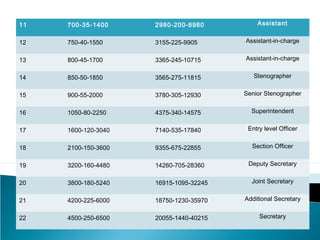
11 700-35-1400 2980-200-8980 Assistant
12 750-40-1550 3155-225-9905 Assistant-in-charge
13 800-45-1700 3365-245-10715 Assistant-in-charge
14 850-50-1850 3565-275-11815 Stenographer
15 900-55-2000 3780-305-12930 Senior Stenographer
16 1050-80-2250 4375-340-14575 Superintendent
17 1600-120-3040 7140-535-17840 Entry level Officer
18 2100-150-3600 9355-675-22855 Section Officer
19 3200-160-4480 14260-705-28360 Deputy Secretary
20 3800-180-5240 16915-1095-32245 Joint Secretary
21 4200-225-6000 18750-1230-35970 Additional Secretary
22 4500-250-6500 20055-1440-40215 Secretary
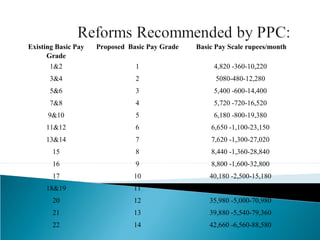
Existing Basic Pay
Grade
Proposed Basic Pay Grade Basic Pay Scale rupees/month
1&2 1 4,820 -360-10,220
3&4 2 5080-480-12,280
5&6 3 5,400 -600-14,400
7&8 4 5,720 -720-16,520
9&10 5 6,180 -800-19,380
11&12 6 6,650 -1,100-23,150
13&14 7 7,620 -1,300-27,020
15 8 8,440 -1,360-28,840
16 9 8,800 -1,600-32,800
17 10 40,180 -2,500-15,180
18&19 11 19,900 -4,250-62,400
20 12 35,980 -5,000-70,980
21 13 39,880 -5,540-79,360
22 14 42,660 -6,560-88,580
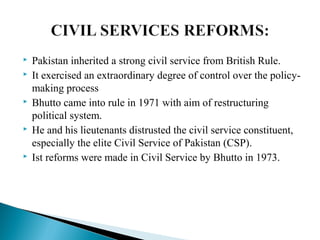
 Pakistan inherited a strong civil service from British Rule.
 It exercised an extraordinary degree of control over the policy-
making process
 Bhutto came into rule in 1971 with aim of restructuring
political system.
 He and his lieutenants distrusted the civil service constituent,
especially the elite Civil Service of Pakistan (CSP).
 Ist reforms were made in Civil Service by Bhutto in 1973.
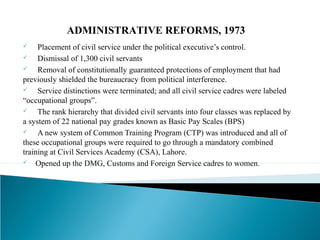
 Placement of civil service under the political executive’s control.
 Dismissal of 1,300 civil servants
 Removal of constitutionally guaranteed protections of employment that had
previously shielded the bureaucracy from political interference.
 Service distinctions were terminated; and all civil service cadres were labeled
“occupational groups”.
 The rank hierarchy that divided civil servants into four classes was replaced by
a system of 22 national pay grades known as Basic Pay Scales (BPS)
 A new system of Common Training Program (CTP) was introduced and all of
these occupational groups were required to go through a mandatory combined
training at Civil Services Academy (CSA), Lahore.
 Opened up the DMG, Customs and Foreign Service cadres to women.
ADMINISTRATIVE REFORMS, 1973
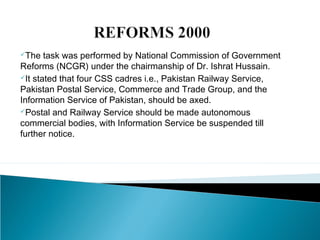
The task was performed by National Commission of Government
Reforms (NCGR) under the chairmanship of Dr. Ishrat Hussain.
It stated that four CSS cadres i.e., Pakistan Railway Service,
Pakistan Postal Service, Commerce and Trade Group, and the
Information Service of Pakistan, should be axed.
Postal and Railway Service should be made autonomous
commercial bodies, with Information Service be suspended till
further notice.
 In public perceptions, the country’s 2.4 million civil servants are widely seen as
unresponsive and corrupt, and bureaucratic procedures cumbersome and
exploitative.
 General Pervez Musharraf’s eight-year military rule left behind a demoralised and
inefficient bureaucracy that was used to ensure regime survival.
 There was a dramatic rise in military encroachments as retired generals were
appointed to key civil posts.
 The military regime’s poorly conceived devolution of power led to further
administrative confusion and the breakdown of service delivery at the district
level.
 The decision to vest revenue and law and order functions in nazims (mayors), led
to greater collusion between unscrupulous district officials and corrupt police.
 Both (PPP) and (PML-N) needed to enhance the bureaucracy’s ability to execute
government policies and respond to public grievances and needs
 Enhance civil service performance and revive a spirit of public service
 Eliminate military interference
 Enhance the functioning of federal and provincial secretariats
 Institute effective accountability over the civil bureaucracy
 Promote fairness and eliminate opportunities for political manipulation at all levels of
the civil administration
 The recommendations of the National Commission on Government Reforms (NCGR),
if properly implemented could help reform the civil service
 Improve land administration and local governance
 Modernize civil service systems and processes and enhance inter-agency coordination
through e-governance technology
 Improve police functioning
 Mainstream FATA’s bureaucracy
 Prioritise reforms that transform this key institution into a leaner, more effective and
accountable body
 One of the weak areas in public sector organization is
inadequate capacity at the operational and middle level to
execute public policies, projects and programmes.
 "Capability' is to perform the specific assigned task effectively
and efficiently on a continuous basis. This comprises a
complete set of human skills, equipment, tools, procedures,
rules, regulation, which work in unison to achieve goals.
Public personnel management

Public personnel management

  • 3.
    • Public managementin global perspective by Schiavo-campo, Salvatore and Mcferson, HazelM. • Bureaucracy in Pakistan by Charles H.Kannedy • Report of International Crisis group “Reforming Pakistan's Civil Service” Asia Report N°185 – 16 February 2010 • Pakistan: A Civil service in An Obsolescing Imperial Tradition by GARTH N. JONES • Daily Times News Paper on Wednesday, March 31, 2010 • NCGR Report • Report on Revision of basic pay scales, allowances and pension of civil employees of federal government (2005) by Finance Division
  • 4.
    Government personnel managementconsists of four fundamental functions:  Planning  Acquisition  Development  Sanction (Klingner et al. 1998)
  • 5.
     Personnel requirements Jobs  Pay and benefits Recruitment and selection of personnel
  • 6.
    Task of : Orienting  Training  Motivating  Evaluating employees  Establishment and maintenance of expectations and obligations
  • 7.
     Different socialvalues have led to different personnel systems in different countries.  In general, evolution of government personnel systems has shown a transition from political patronage and personalism to a merit based system, political neutrality, continutiy, integratiy and professionalism.
  • 8.
     Permanent (e.g. civil service)  Fixed term contracts  Part time work  Casual or contractual appointments
  • 9.
     From thedawn of the British raj, member of the bureaucracy were divided into covenanted and un- covenanted public servants  later into those who were Gazetted and non Gazetted  Afterwards it was converted into 4 classes ranging from officer level class I, to menial level class IV  In 1973 the ranks were reorganized into 22 national pay grades
  • 10.
    Federal Government 538000 22.5% Provincial Governments 607 000 25.5% District Governments 1239 000 52.0% Total : 2384000 100% NUMBER OF PUBLIC EMPLOYEES IN PAKISTAN
  • 11.
     Civil service Thecivil service often refers to a subset of overall government employment—the group of employees who perform core or higher-skill tasks.
  • 12.
    • One ofthe most organized and effective institutions which inherited from British colonial rule was the civil service. • In Pakistan, soon after independence, the Indian civil service cadre war re-designated as the Pakistan Administrative service and subsequently as the civil service of Pakistan.
  • 13.
    Presently, the CivilServices of Pakistan are divided into 14 groups and services; Out of these 14 groups and services, 11 are called groups, 03 are called services. Pakistan Audit and Accounts Service Income Tax Group (ITG) Foreign Service of Pakistan (FSP) Information Group (IG) Police Service of Pakistan (PSP) Customs and Excise Group (CEG Postal Group (PG) Military Lands and cantonment Group (MLCG) Commerce & Trade Group(CTG) Office Management Group (OMG) Railways Group (RG) Secretariat Group District Management Group (DMG) Ex-Cadre Officers
  • 14.
    FPSC  Is responsiblefor direct recruitment to officer level positions in the federal bureaucracy  FPSC conducts tests and examinations to all federal posts of and above a specified level of seniority Direct induction of military officers  Military inductees do not have to take the CSS examination or any other entry test, and are instead simply nominated by their respective military hierarchies and then subject to an interview by the FPSC.
  • 15.
     Advertisement againstlisted vacancies in ministries and departments  Ad hoc recruitment by departments or ministries for temporary vacancies
  • 17.
    Each of theprovinces has its own public service commission, constituted along similar lines to the FPSC and responsible for recruitment to the provincial civil service. The provincial commission comprise of;  Punjab Public Service Commission(PPSC)  Sindh Public Service Commission(SPSC)  Baluchistan Public Service Commission(BPSC)  K.P.K Public Service Commission (KPSC)
  • 18.
     Merit Quota. . . . . . . . . . . . . . …………………………. 10%  Punjab (including the Federal area Islamabad) . . . . . . . . .50%  Sindh (including Karachi) . . . . . . . . . . . . . . . . . . . . . . . . 19% The share of Sindh is further sub-allocated in the following ratio:  Urban Areas, Karachi, Hyderabad & Sukhar . . . …........40%  Rural Areas i.e. the rest of Sindh excluding Karachi, Hyderabad & Sukhar……………………………………60%  K.P.K . . . . . . . . . . . . . . . . .…………………………….11.5%  Baluchistan . . . . . . . . . . ………………………………..3.5%  Northern Areas & Federally Administrated Tribal Areas . .4%  Azad Kashmir . . . . . . . . ………………………………… 2%  Women Quota……10% of each Provincial / Regional Quota
  • 19.
    a) Pre ServiceTraining: i. Common Training Program (CTP) for CSS Probationers Civil Services Academy Lahore, provides pre-service training to Grade 17 officer appointed as probationers to the Central Superior Services. ii. Specialized training Program (STP): The CSA also holds a 20 weeks specialized training program for DMG probationers
  • 20.
    b) In-Service Training: i) Secretariat Training Institute (STI):  STI provides both probationary and in-service training to the directly recruited and promoted section officers of the Federal Government  ii) Pakistan Provincial Services Academy (PPSA):  PPSA, Peshawar was established to impart pre-service training to the probationary officers of the Provincial Civil Service cadre  iii) National Institute of Public Administration  NMI administers two 16 weeks advanced courses annually in Administration and Development, to officers of the Federal and Provincial Governments at middle- management levels up to the level of Deputy Secretary or equivalent.
  • 21.
    iv) Pakistan Academyfor Rural Development (PARD), Peshawar: PARD arranges in-service training on selected topics/issues for Federal and Provincial Government Officers. v) National Defense University (NDU): NDU provides a few seats to civil service officers of BS- 20 for training vi) National Management College (NMC) formerly Pakistan Administrative Staff College (PASC): NMC is an in-service institution catering exclusively to the training of senior officers of BS-20 drawn from all the civil services.
  • 22.
     Training of“selected personnel” is arranged by the respective Ministries/ Divisions through their own foreign courses or by EAD (Employment Authorization Document) through technical assistance programs abroad.  Capacity Building project financed by the World Bank, officers in BS 17-19 are sent under Professional Development Program for obtaining Master’s degrees and senior officers in BS-20-21 attend the Kennedy School at Harvard under Executive Development Program.
  • 23.
     Promotions inthe bureaucracy are based on a combination of seniority and merit. The Central Selection Board makes promotions to “selection posts”  Promotions are generally based on four criteria: minimum length of active service; an unblemished disciplinary record; the required threshold in performance evaluation reports (PERs); and successful completion of the mandatory training course.
  • 24.
     Compensation isgiven according to the basic pay scale for every grade.
  • 25.
    Basic Pay Grade Basic PayScale rupees/month 1983  Basic Pay Scale rupees/month 2005 Comparable Posts 1 440-10-640 2150-65-4100 Peon, Mali, 2 460-12-700 2200-75-4450 Record Sorter 3 480-14-760 2275-85-4825 Machine Operator 4 500-16-820 2345-100-5345 Staff Car Driver 5 500-16-820 2415-115-5865 Lower Division Clerk 6 540-20-940 2485-125-6325 Clerk 7 560-23-1020 2555-140-6755 Upper Division Clerk 8 590-26-1110 2655-150-7155 Typist 9 620-29-1200 2770-165-7720 Steno typist 10 660-32-1300 2865-185-8415 Senior Steno typist
  • 26.
    11 700-35-1400 2980-200-8980Assistant 12 750-40-1550 3155-225-9905 Assistant-in-charge 13 800-45-1700 3365-245-10715 Assistant-in-charge 14 850-50-1850 3565-275-11815 Stenographer 15 900-55-2000 3780-305-12930 Senior Stenographer 16 1050-80-2250 4375-340-14575 Superintendent 17 1600-120-3040 7140-535-17840 Entry level Officer 18 2100-150-3600 9355-675-22855 Section Officer 19 3200-160-4480 14260-705-28360 Deputy Secretary 20 3800-180-5240 16915-1095-32245 Joint Secretary 21 4200-225-6000 18750-1230-35970 Additional Secretary 22 4500-250-6500 20055-1440-40215 Secretary
  • 27.
    Existing Basic Pay Grade ProposedBasic Pay Grade Basic Pay Scale rupees/month 1&2 1 4,820 -360-10,220 3&4 2 5080-480-12,280 5&6 3 5,400 -600-14,400 7&8 4 5,720 -720-16,520 9&10 5 6,180 -800-19,380 11&12 6 6,650 -1,100-23,150 13&14 7 7,620 -1,300-27,020 15 8 8,440 -1,360-28,840 16 9 8,800 -1,600-32,800 17 10 40,180 -2,500-15,180 18&19 11 19,900 -4,250-62,400 20 12 35,980 -5,000-70,980 21 13 39,880 -5,540-79,360 22 14 42,660 -6,560-88,580
  • 28.
     Pakistan inheriteda strong civil service from British Rule.  It exercised an extraordinary degree of control over the policy- making process  Bhutto came into rule in 1971 with aim of restructuring political system.  He and his lieutenants distrusted the civil service constituent, especially the elite Civil Service of Pakistan (CSP).  Ist reforms were made in Civil Service by Bhutto in 1973.
  • 29.
     Placement ofcivil service under the political executive’s control.  Dismissal of 1,300 civil servants  Removal of constitutionally guaranteed protections of employment that had previously shielded the bureaucracy from political interference.  Service distinctions were terminated; and all civil service cadres were labeled “occupational groups”.  The rank hierarchy that divided civil servants into four classes was replaced by a system of 22 national pay grades known as Basic Pay Scales (BPS)  A new system of Common Training Program (CTP) was introduced and all of these occupational groups were required to go through a mandatory combined training at Civil Services Academy (CSA), Lahore.  Opened up the DMG, Customs and Foreign Service cadres to women. ADMINISTRATIVE REFORMS, 1973
  • 30.
    The task wasperformed by National Commission of Government Reforms (NCGR) under the chairmanship of Dr. Ishrat Hussain. It stated that four CSS cadres i.e., Pakistan Railway Service, Pakistan Postal Service, Commerce and Trade Group, and the Information Service of Pakistan, should be axed. Postal and Railway Service should be made autonomous commercial bodies, with Information Service be suspended till further notice.
  • 31.
     In publicperceptions, the country’s 2.4 million civil servants are widely seen as unresponsive and corrupt, and bureaucratic procedures cumbersome and exploitative.  General Pervez Musharraf’s eight-year military rule left behind a demoralised and inefficient bureaucracy that was used to ensure regime survival.  There was a dramatic rise in military encroachments as retired generals were appointed to key civil posts.  The military regime’s poorly conceived devolution of power led to further administrative confusion and the breakdown of service delivery at the district level.  The decision to vest revenue and law and order functions in nazims (mayors), led to greater collusion between unscrupulous district officials and corrupt police.  Both (PPP) and (PML-N) needed to enhance the bureaucracy’s ability to execute government policies and respond to public grievances and needs
  • 32.
     Enhance civilservice performance and revive a spirit of public service  Eliminate military interference  Enhance the functioning of federal and provincial secretariats  Institute effective accountability over the civil bureaucracy  Promote fairness and eliminate opportunities for political manipulation at all levels of the civil administration  The recommendations of the National Commission on Government Reforms (NCGR), if properly implemented could help reform the civil service  Improve land administration and local governance  Modernize civil service systems and processes and enhance inter-agency coordination through e-governance technology  Improve police functioning  Mainstream FATA’s bureaucracy  Prioritise reforms that transform this key institution into a leaner, more effective and accountable body
  • 33.
     One ofthe weak areas in public sector organization is inadequate capacity at the operational and middle level to execute public policies, projects and programmes.  "Capability' is to perform the specific assigned task effectively and efficiently on a continuous basis. This comprises a complete set of human skills, equipment, tools, procedures, rules, regulation, which work in unison to achieve goals.