UK Politics and
Government
Devolution and devolved
system of government
DrVaezade
SepehrArefmanesh
Spring 2014
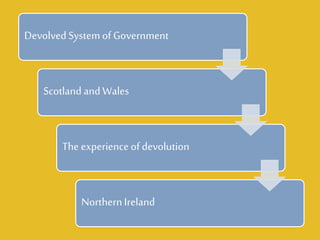
Devolved Systemof Government
Scotland andWales
The experience of devolution
NorthernIreland
Devolved
Government? What
does it mean
Devolution vs. Federalism
Devolution is the
transfer of power
from a central
government, to a
local authority.
Decentralization of London
Changing Westminster
system
Multi-level government
Keeping the UK united
Labor Party
1979
1997 and the
packages
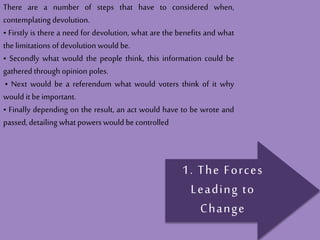
1. The Forces
Leading to
Change
There are a number of steps that have to considered when,
contemplating devolution.
• Firstly is there a need for devolution, what are the benefits and what
the limitations of devolution would be.
• Secondly what would the people think, this information could be
gathered through opinion poles.
• Next would be a referendum what would voters think of it why
would it be important.
• Finally depending on the result, an act would have to be wrote and
passed, detailing what powers would becontrolled
Scotland
Under Thatcher, the Scots and Welsh resented the fact that the Conservative
MANDATE was weak in the two countries. As Conservative support weakened, so
demands for self government grew
The Labour Party in Scotland and Wales felt threatened by nationalist voting. It
feared it might lose support like the Conservatives.
Scotland was hugely resentful over the early introduction of the Poll Tax one year
before Englandand Wales. This was the final nail inthe conservative coffin
1988 saw the Scottish Constitutional Convention come out firmly in favour of
devolution. This was anexample of multi-party political opinion
Wales WelshAssembly
• In existence since 1999
• Less devolved power than Scotland (Education)
• The Silk Commission reported in August 2013
• There would be a big transfer of power from
London to Cardiff if its 33 recommendations
were enacted.
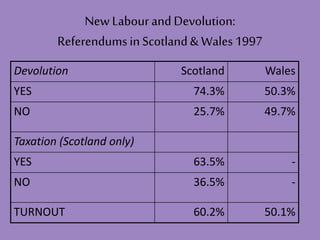
New Labour and Devolution:
Referendums in Scotland& Wales1997
Devolution Scotland Wales
YES 74.3% 50.3%
NO 25.7% 49.7%
Taxation (Scotland only)
YES 63.5% -
NO 36.5% -
TURNOUT 60.2% 50.1%
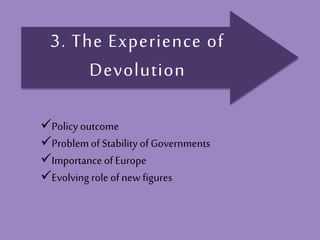
3. The Experience of
Devolution
Policy outcome
Problemof Stability of Governments
Importance of Europe
Evolving role of new figures
Northern
Ireland
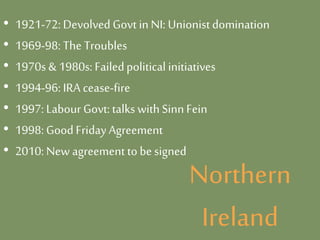
• 1921-72: Devolved Govt in NI: Unionistdomination
• 1969-98: The Troubles
• 1970s & 1980s: Failedpolitical initiatives
• 1994-96: IRA cease-fire
• 1997: Labour Govt: talks withSinnFein
• 1998: GoodFridayAgreement
• 2010: New agreement to be signed
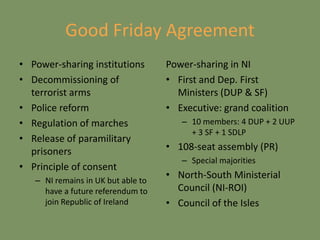
Good Friday Agreement
• Power-sharing institutions
• Decommissioning of
terrorist arms
• Police reform
• Regulation of marches
• Release of paramilitary
prisoners
• Principle of consent
– NI remains in UK but able to
have a future referendum to
join Republic of Ireland
Power-sharing in NI
• First and Dep. First
Ministers (DUP & SF)
• Executive: grand coalition
– 10 members: 4 DUP + 2 UUP
+ 3 SF + 1 SDLP
• 108-seat assembly (PR)
– Special majorities
• North-South Ministerial
Council (NI-ROI)
• Council of the Isles

Uk politics and government- devolution

  • 1.
    UK Politics and Government Devolutionand devolved system of government DrVaezade SepehrArefmanesh Spring 2014
  • 2.
    Devolved Systemof Government ScotlandandWales The experience of devolution NorthernIreland
  • 3.
    Devolved Government? What does itmean Devolution vs. Federalism Devolution is the transfer of power from a central government, to a local authority.
  • 4.
    Decentralization of London ChangingWestminster system Multi-level government Keeping the UK united Labor Party 1979 1997 and the packages
  • 5.
    1. The Forces Leadingto Change There are a number of steps that have to considered when, contemplating devolution. • Firstly is there a need for devolution, what are the benefits and what the limitations of devolution would be. • Secondly what would the people think, this information could be gathered through opinion poles. • Next would be a referendum what would voters think of it why would it be important. • Finally depending on the result, an act would have to be wrote and passed, detailing what powers would becontrolled
  • 6.
    Scotland Under Thatcher, theScots and Welsh resented the fact that the Conservative MANDATE was weak in the two countries. As Conservative support weakened, so demands for self government grew The Labour Party in Scotland and Wales felt threatened by nationalist voting. It feared it might lose support like the Conservatives. Scotland was hugely resentful over the early introduction of the Poll Tax one year before Englandand Wales. This was the final nail inthe conservative coffin 1988 saw the Scottish Constitutional Convention come out firmly in favour of devolution. This was anexample of multi-party political opinion
  • 7.
    Wales WelshAssembly • Inexistence since 1999 • Less devolved power than Scotland (Education) • The Silk Commission reported in August 2013 • There would be a big transfer of power from London to Cardiff if its 33 recommendations were enacted.
  • 8.
    New Labour andDevolution: Referendums in Scotland& Wales1997 Devolution Scotland Wales YES 74.3% 50.3% NO 25.7% 49.7% Taxation (Scotland only) YES 63.5% - NO 36.5% - TURNOUT 60.2% 50.1%
  • 9.
    3. The Experienceof Devolution Policy outcome Problemof Stability of Governments Importance of Europe Evolving role of new figures
  • 11.
    Northern Ireland • 1921-72: DevolvedGovt in NI: Unionistdomination • 1969-98: The Troubles • 1970s & 1980s: Failedpolitical initiatives • 1994-96: IRA cease-fire • 1997: Labour Govt: talks withSinnFein • 1998: GoodFridayAgreement • 2010: New agreement to be signed
  • 12.
    Good Friday Agreement •Power-sharing institutions • Decommissioning of terrorist arms • Police reform • Regulation of marches • Release of paramilitary prisoners • Principle of consent – NI remains in UK but able to have a future referendum to join Republic of Ireland Power-sharing in NI • First and Dep. First Ministers (DUP & SF) • Executive: grand coalition – 10 members: 4 DUP + 2 UUP + 3 SF + 1 SDLP • 108-seat assembly (PR) – Special majorities • North-South Ministerial Council (NI-ROI) • Council of the Isles

Editor's Notes

  • #4 1. Devolution 2. What Is Devolution • Devolution is the transfer of power from a central government, to a local authority. • An example is the transference of certain powers from the central government in parliament, to the Scottish parliament in Edinburgh. 3. Devolution vs. Federalism • Devolution allows a more lenient approach to the way an area or country is governed. • Whereas Federalism is restricted in what it can do. 4. Road to devolution and features • There are a number of steps that have to considered when, contemplating devolution. • Firstly is there a need for devolution, what are the benefits and what the limitations of devolution would be. • Secondly what would the people think, this information could be gathered through opinion poles. • Next would be a referendum what would voters think of it why would it be important. • Finally depending on the result, an act would have to be wrote and passed, detailing what powers would be controlled 5. Devolution in Scotland • Scottish devolution has always being a topic of discussion, before the devolution of power in 1999, however a previous referendum in 1979 saw less than 40% of the population voted so although there was a majority, it was deemed to be against the interests of the Scottish people. However the labour government that agreed to the referendum, lost the general election and a conservative government against devolution of powers came to power. It would be 18 years until a new labour government, allowed to a referendum to be held and a majority voted in favour of devolution of powers. 6. Scottish Parliament • • • • • The Scottish parliament is based in Holyrood, Edinburgh. The SNP currently have a majority with 67 seats. There are 129 MSP. Elections for the Scottish parliament are held every 5 years The Scottish parliament building was constructed in 2004 and opened by he Queen. 7. Devolved Powers • Although many powers formally controlled by Westminster were transferred, there are some notable exceptions, including the following: • The constitution • Defense • Foreign Affairs • Electricity, Coal, Gas and Oil • Financial and economic maters • To name a few, unusually however tax related topics were handed over to the Scottish parliament. 8. Scottish independence Yes or No • Depending on what side of the border you live on you will more than likely have different opinions. • For the Scottish people, it would enable greater say over what there government does and how it effects them however it would also provide greater economic risks. • For someone living in England, Scottish independence would not matter a great deal, however the UK economy would be reduced in size. There is also a very unlikely chance that the British overseas status would be diluted. • The above point also related to the general for or against argument.
  • #5 Further tiers of government now in Scotland, Wales and Northern Ireland to which significant powers have been devolved by Westminster Not inevitable that devolution will lead to full independence Labour argued that devolution would safeguard the union of Britain: One Nation speech.