A SURVEY OF
AMERICAN HISTORY
Unit 2: Westward Expansion and Civil War

Part 2: John Adams
ADAMS’

MAJOR ISSUES
Avoiding war with France

Passing the Alien and Sedition Acts
THE QUASI-WAR
In 1798, two years after his
election, John Adams faced the
prospect of a naval war with
France. Most of his actions beyond
this point were directed towards
avoiding entry into this war.
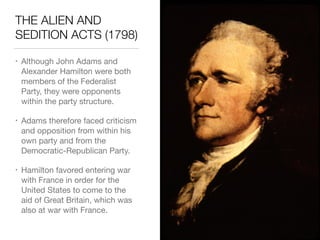
THE ALIEN AND
SEDITION ACTS (1798)
• Although John Adams and
Alexander Hamilton were both
members of the Federalist
Party, they were opponents
within the party structure.

• Adams therefore faced criticism
and opposition from within his
own party and from the
Democratic-Republican Party.

• Hamilton favored entering war
with France in order for the
United States to come to the
aid of Great Britain, which was
also at war with France.
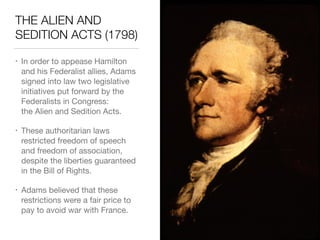
THE ALIEN AND
SEDITION ACTS (1798)
• In order to appease Hamilton
and his Federalist allies, Adams
signed into law two legislative
initiatives put forward by the
Federalists in Congress:

the Alien and Sedition Acts.

• These authoritarian laws
restricted freedom of speech
and freedom of association,
despite the liberties guaranteed
in the Bill of Rights.

• Adams believed that these
restrictions were a fair price to
pay to avoid war with France.
THE VIRGINIA AND
KENTUCKY RESOLUTIONS
• Adams’ Democratic-Republican
opponents, Thomas Jefferson
and James Madison, found a
way to publicly criticize the
Alien and Sedition Acts without
violating the prohibition on
individuals speaking out against
the federal government.

• They persuaded the state
legislatures of Virginia and
Kentucky to denounce the

Alien and Sedition Acts,

arguing that the acts did not
restrict the freedom of speech
of government institutions.
THE VIRGINIA AND
KENTUCKY RESOLUTIONS
• They also went one step further
with the state legislatures of
Virginia and Kentucky, arguing
that states that denounced the
Alien and Sedition Acts had the
right to refuse to uphold them.

• This refusal set a dangerous
precedent, since it meant that
any state could refuse to
uphold any law that its own
legislators disapproved of.

• This precedent is one of the
things that would eventually
spark the American Civil War.
STRICT
CONSTRUCTIONISTS
• Mostly Democratic-Republicans.

• Believed that the powers of the
federal government were limited
to those explicitly enumerated in
the Constitution, and all other
powers remained with the states.

• If the Constitution does not
clearly and specifically say that
the government can do x, then
the government cannot do x.
BROAD
CONSTRUCTIONISTS
• Mostly Federalists.

• Believed that the powers of the
federal government superseded
those of the states, and were
unlimited except where the
Constitution enumerated what the
federal government could not do.

• If the Constitution does not say
that the government cannot do x,
then the government can do x.
A SURVEY OF
AMERICAN HISTORY
Unit 2: Westward Expansion and Civil War

Part 2: John Adams

22 John Adams

  • 1.
    A SURVEY OF AMERICANHISTORY Unit 2: Westward Expansion and Civil War Part 2: John Adams
  • 2.
    ADAMS’
 MAJOR ISSUES Avoiding warwith France Passing the Alien and Sedition Acts
  • 3.
    THE QUASI-WAR In 1798,two years after his election, John Adams faced the prospect of a naval war with France. Most of his actions beyond this point were directed towards avoiding entry into this war.
  • 4.
    THE ALIEN AND SEDITIONACTS (1798) • Although John Adams and Alexander Hamilton were both members of the Federalist Party, they were opponents within the party structure. • Adams therefore faced criticism and opposition from within his own party and from the Democratic-Republican Party. • Hamilton favored entering war with France in order for the United States to come to the aid of Great Britain, which was also at war with France.
  • 5.
    THE ALIEN AND SEDITIONACTS (1798) • In order to appease Hamilton and his Federalist allies, Adams signed into law two legislative initiatives put forward by the Federalists in Congress:
 the Alien and Sedition Acts. • These authoritarian laws restricted freedom of speech and freedom of association, despite the liberties guaranteed in the Bill of Rights. • Adams believed that these restrictions were a fair price to pay to avoid war with France.
  • 6.
    THE VIRGINIA AND KENTUCKYRESOLUTIONS • Adams’ Democratic-Republican opponents, Thomas Jefferson and James Madison, found a way to publicly criticize the Alien and Sedition Acts without violating the prohibition on individuals speaking out against the federal government. • They persuaded the state legislatures of Virginia and Kentucky to denounce the
 Alien and Sedition Acts,
 arguing that the acts did not restrict the freedom of speech of government institutions.
  • 7.
    THE VIRGINIA AND KENTUCKYRESOLUTIONS • They also went one step further with the state legislatures of Virginia and Kentucky, arguing that states that denounced the Alien and Sedition Acts had the right to refuse to uphold them. • This refusal set a dangerous precedent, since it meant that any state could refuse to uphold any law that its own legislators disapproved of. • This precedent is one of the things that would eventually spark the American Civil War.
  • 8.
    STRICT CONSTRUCTIONISTS • Mostly Democratic-Republicans. •Believed that the powers of the federal government were limited to those explicitly enumerated in the Constitution, and all other powers remained with the states. • If the Constitution does not clearly and specifically say that the government can do x, then the government cannot do x.
  • 9.
    BROAD CONSTRUCTIONISTS • Mostly Federalists. •Believed that the powers of the federal government superseded those of the states, and were unlimited except where the Constitution enumerated what the federal government could not do. • If the Constitution does not say that the government cannot do x, then the government can do x.
  • 10.
    A SURVEY OF AMERICANHISTORY Unit 2: Westward Expansion and Civil War Part 2: John Adams