HISTORY OF BRITISH
Group 8
Bui Thi Huyen Trang
Duong Thi Huyen Trang
Nguyen Duc Tuan
Nguyen Thi Tuoi
Do Tu Uyen
Table of Contents
Prehistory
01
The Roman period
(43-410)
02
The Germanic invasions
(410-1066)
03
The medieval period
(1066-1458)
04 05 06
16th century 17th century
07 08 09
18th century 19th century 20th century
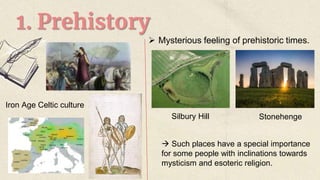
1. Prehistory
Iron Age Celtic culture
 Mysterious feeling of prehistoric times.
Silbury Hill Stonehenge
 Such places have a special importance
for some people with inclinations towards
mysticism and esoteric religion.
2. The Roman period (43-410)
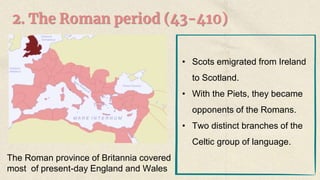
The Roman province of Britannia covered
most of present-day England and Wales
• Scots emigrated from Ireland
to Scotland.
• With the Piets, they became
opponents of the Romans.
• Two distinct branches of the
Celtic group of language.
3. The Germanic invasions (410-1066)
 The Roman occupation had been a matter of
colonial control rather than large-scale settlement.
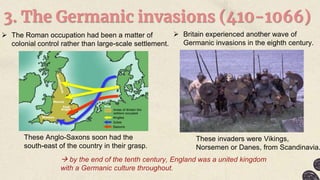
These Anglo-Saxons soon had the
south-east of the country in their grasp.
 Britain experienced another wave of
Germanic invasions in the eighth century.
These invaders were Vikings,
Norsemen or Danes, from Scandinavia.
 by the end of the tenth century, England was a united kingdom
with a Germanic culture throughout.
4. The medieval period (1066-1458)
 The successful Norman invasion of England (1066) brought
Britain into the mainstream o f western European culture.
 In the 250 years after the Norman Conquest, it was a Germanic
language, Middle English, and not the Norman (French)
language, which had become the dominant one in all classes of
society in England.
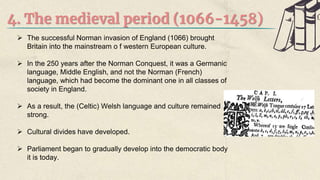
 As a result, the (Celtic) Welsh language and culture remained
strong.
 Cultural divides have developed.
 Parliament began to gradually develop into the democratic body
it is today.
5. The sixteenth century
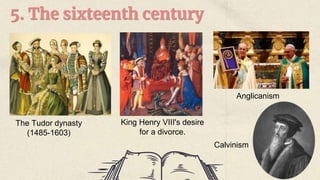
The Tudor dynasty
(1485-1603)
King Henry VIII's desire
for a divorce.
Anglicanism
Calvinism
6. The seventeenth century.
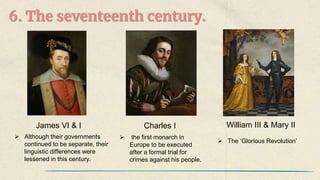
James VI & I
 Although their governments
continued to be separate, their
linguistic differences were
lessened in this century.
Charles I
 the first monarch in
Europe to be executed
after a formal trial for
crimes against his people.
William III & Mary II
 The ‘Glorious Revolution’
7. The eighteenth century.
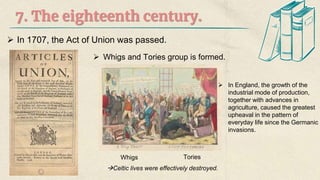
 In 1707, the Act of Union was passed.
 Whigs and Tories group is formed.
Whigs Tories
Celtic lives were effectively destroyed.
 In England, the growth of the
industrial mode of production,
together with advances in
agriculture, caused the greatest
upheaval in the pattern of
everyday life since the Germanic
invasions.
8. The nineteenth century
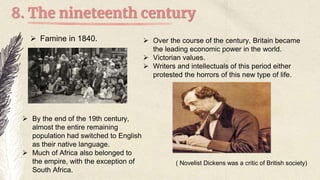
 Famine in 1840.
 By the end of the 19th century,
almost the entire remaining
population had switched to English
as their native language.
 Much of Africa also belonged to
the empire, with the exception of
South Africa.
 Over the course of the century, Britain became
the leading economic power in the world.
 Victorian values.
 Writers and intellectuals of this period either
protested the horrors of this new type of life.
( Novelist Dickens was a critic of British society)
9.The twentieth century.
 Britain ceased to be the world’s richest country.
 In 1920, extremism is gone.
 The British Empire reached its greatest extent in 1919. By this time,
however, it had become less of an empire and more of an alliance.
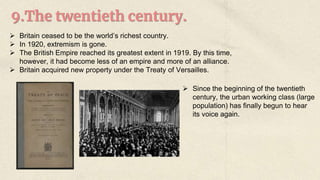
 Britain acquired new property under the Treaty of Versailles.
 Since the beginning of the twentieth
century, the urban working class (large
population) has finally begun to hear
its voice again.
CREDITS:
This presentation template was created by
Slidesgo, including icons by Flaticon, infographics
& images by Freepik
Thanks

history-of-British.pptx

  • 1.
    HISTORY OF BRITISH Group8 Bui Thi Huyen Trang Duong Thi Huyen Trang Nguyen Duc Tuan Nguyen Thi Tuoi Do Tu Uyen
  • 2.
    Table of Contents Prehistory 01 TheRoman period (43-410) 02 The Germanic invasions (410-1066) 03 The medieval period (1066-1458) 04 05 06 16th century 17th century 07 08 09 18th century 19th century 20th century
  • 3.
    1. Prehistory Iron AgeCeltic culture  Mysterious feeling of prehistoric times. Silbury Hill Stonehenge  Such places have a special importance for some people with inclinations towards mysticism and esoteric religion.
  • 4.
    2. The Romanperiod (43-410) The Roman province of Britannia covered most of present-day England and Wales • Scots emigrated from Ireland to Scotland. • With the Piets, they became opponents of the Romans. • Two distinct branches of the Celtic group of language.
  • 5.
    3. The Germanicinvasions (410-1066)  The Roman occupation had been a matter of colonial control rather than large-scale settlement. These Anglo-Saxons soon had the south-east of the country in their grasp.  Britain experienced another wave of Germanic invasions in the eighth century. These invaders were Vikings, Norsemen or Danes, from Scandinavia.  by the end of the tenth century, England was a united kingdom with a Germanic culture throughout.
  • 6.
    4. The medievalperiod (1066-1458)  The successful Norman invasion of England (1066) brought Britain into the mainstream o f western European culture.  In the 250 years after the Norman Conquest, it was a Germanic language, Middle English, and not the Norman (French) language, which had become the dominant one in all classes of society in England.  As a result, the (Celtic) Welsh language and culture remained strong.  Cultural divides have developed.  Parliament began to gradually develop into the democratic body it is today.
  • 7.
    5. The sixteenthcentury The Tudor dynasty (1485-1603) King Henry VIII's desire for a divorce. Anglicanism Calvinism
  • 8.
    6. The seventeenthcentury. James VI & I  Although their governments continued to be separate, their linguistic differences were lessened in this century. Charles I  the first monarch in Europe to be executed after a formal trial for crimes against his people. William III & Mary II  The ‘Glorious Revolution’
  • 9.
    7. The eighteenthcentury.  In 1707, the Act of Union was passed.  Whigs and Tories group is formed. Whigs Tories Celtic lives were effectively destroyed.  In England, the growth of the industrial mode of production, together with advances in agriculture, caused the greatest upheaval in the pattern of everyday life since the Germanic invasions.
  • 10.
    8. The nineteenthcentury  Famine in 1840.  By the end of the 19th century, almost the entire remaining population had switched to English as their native language.  Much of Africa also belonged to the empire, with the exception of South Africa.  Over the course of the century, Britain became the leading economic power in the world.  Victorian values.  Writers and intellectuals of this period either protested the horrors of this new type of life. ( Novelist Dickens was a critic of British society)
  • 11.
    9.The twentieth century. Britain ceased to be the world’s richest country.  In 1920, extremism is gone.  The British Empire reached its greatest extent in 1919. By this time, however, it had become less of an empire and more of an alliance.  Britain acquired new property under the Treaty of Versailles.  Since the beginning of the twentieth century, the urban working class (large population) has finally begun to hear its voice again.
  • 12.
    CREDITS: This presentation templatewas created by Slidesgo, including icons by Flaticon, infographics & images by Freepik Thanks