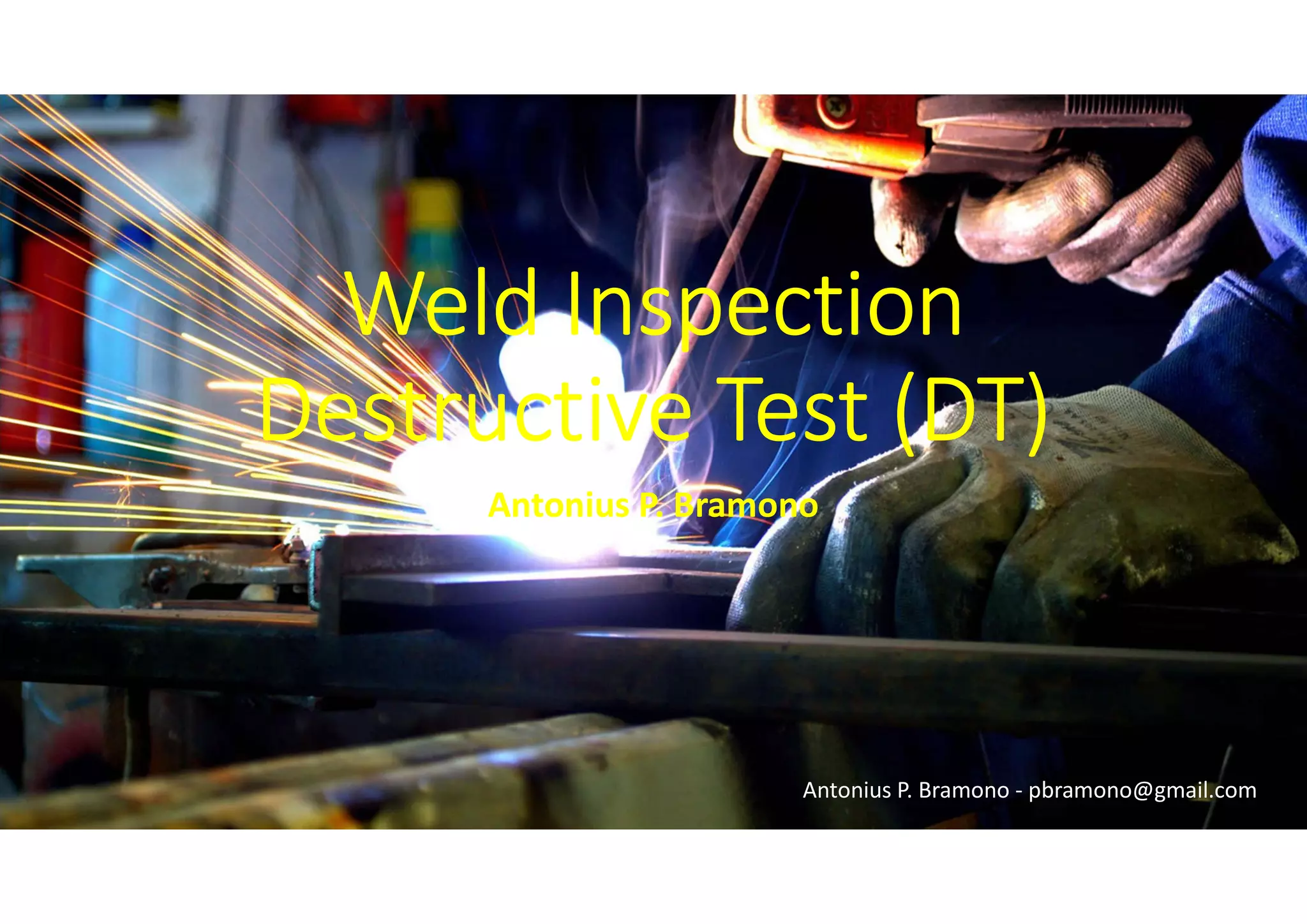
Weld Inspection
Destructive Test (DT)
Antonius P. Bramono
Antonius P. Bramono - pbramono@gmail.com
• Quality control is used throughout the welding industry to
monitor the quality of the items produced.
• All manufactured items are made to specifications.
• Inspections must be made during and after the
manufacturing cycle to ensure that parts meet the
requirements of the specifications.
Introduction
Antonius P. Bramono - pbramono@gmail.com
Welders need to ensure that all aspects of the operation are
performed correctly. At a minimum, welders should check the
following areas:
• Base material is as specified.
• Joint design is as specified and within required tolerances.
• Filler metal type and size are correct.
• Required welding equipment is available and operating
satisfactorily.
• Tooling has been adequately tested to determine that it will
properly support the operation.
Inspection Areas
Antonius P. Bramono - pbramono@gmail.com
• Parts have been properly cleaned.
• Welder training or certification is sufficient for the weld
operation.
• Proper welding procedure is used and the welding
equipment is set up properly for the operation.
• Inspections and tests required during the welding operation
are performed as specified.
Inspection Areas – cont’d
Antonius P. Bramono - pbramono@gmail.com
Inspection in Welding
Antonius P. Bramono - pbramono@gmail.com
•Destructive tests are used for welder qualification
and certification, as well as welding procedure
qualifications.
•In large production runs, destructive tests are often
made by pulling apart sample units.
•It is often less expensive to scrap a part to make a
destructive quality test than to test the parts using
more expensive nondestructive tests.
Destructive Test (DT)
Antonius P. Bramono - pbramono@gmail.com
Bend Test
Antonius P. Bramono - pbramono@gmail.com
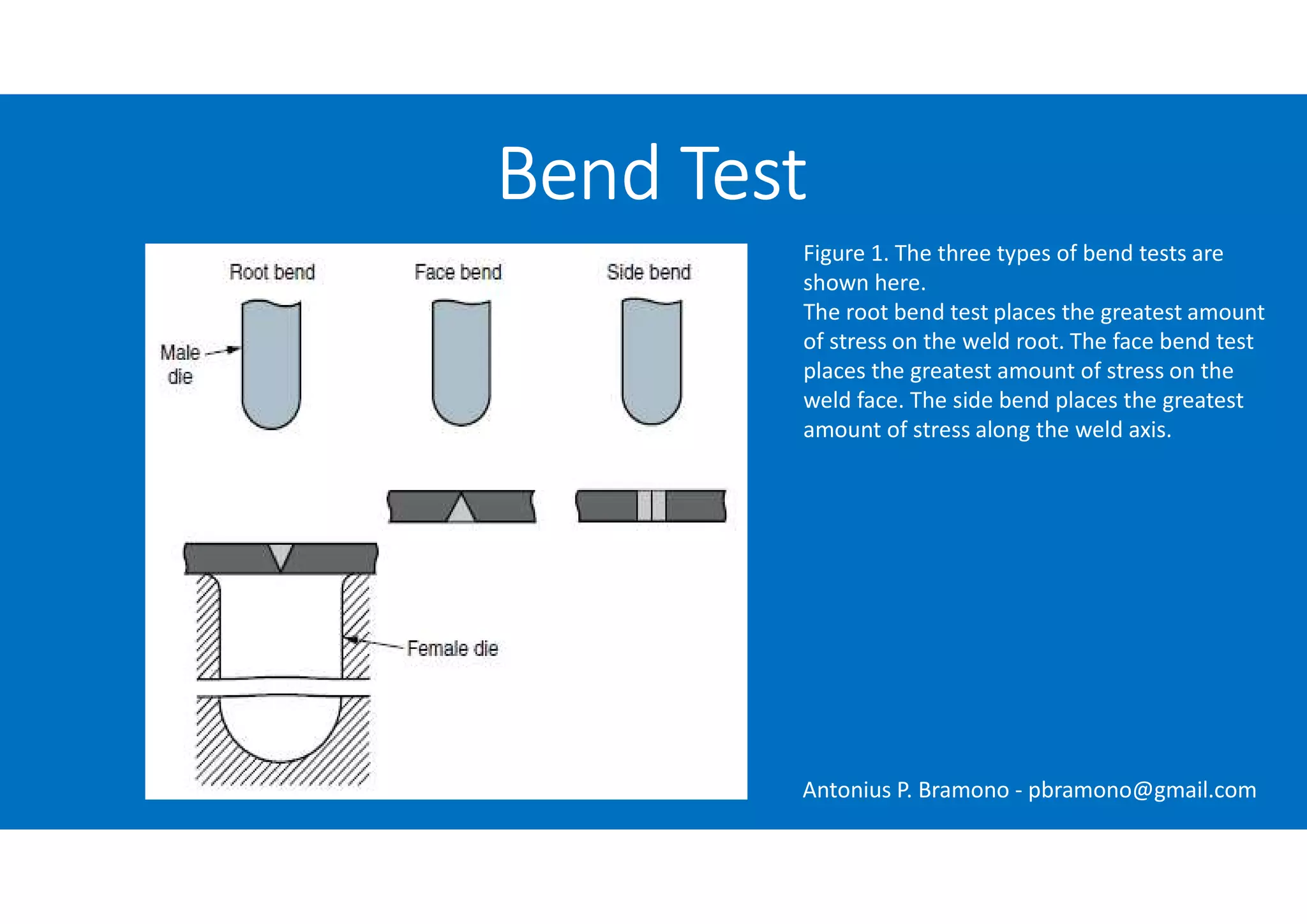
• Bend tests are used to determine internal weld quality. As shown
in Figure 1, there are three different types of bend tests:

a. face bend (face of the weld is tested)
b. root bend (root of the weld is tested)
c. side bend (sides of the weld are tested)
• In bend tests, a weldment is sliced into test strips, called
coupons. The weld is then bent around a die of a specific size,
creating a horseshoe of the coupon. This process stretches the
weld to test the weld’s integrity.
1. Bend Test
Antonius P. Bramono - pbramono@gmail.com
Bend Test
Figure 1. The three types of bend tests are
shown here.
The root bend test places the greatest amount
of stress on the weld root. The face bend test
places the greatest amount of stress on the
weld face. The side bend places the greatest
amount of stress along the weld axis.
Antonius P. Bramono - pbramono@gmail.com
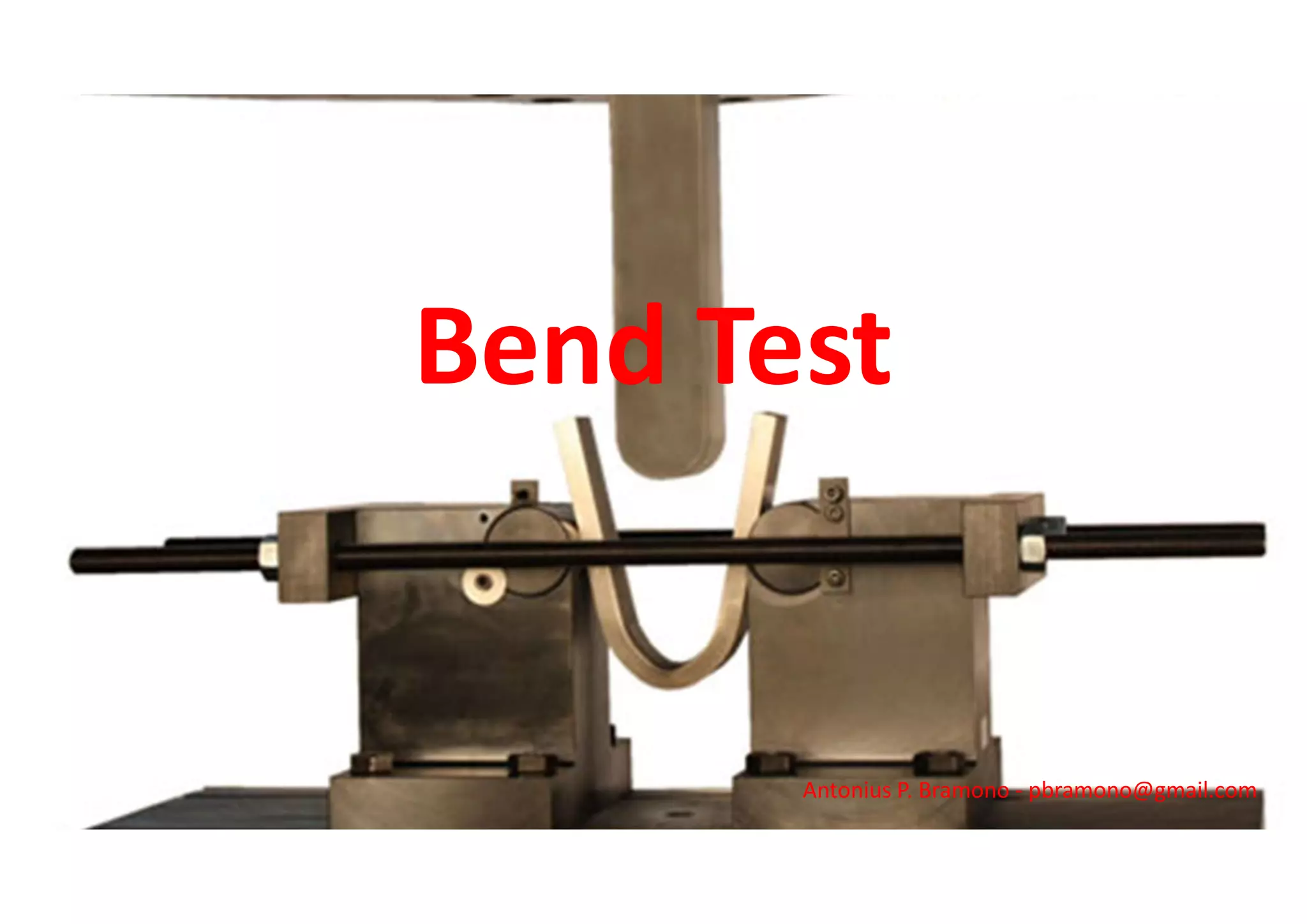
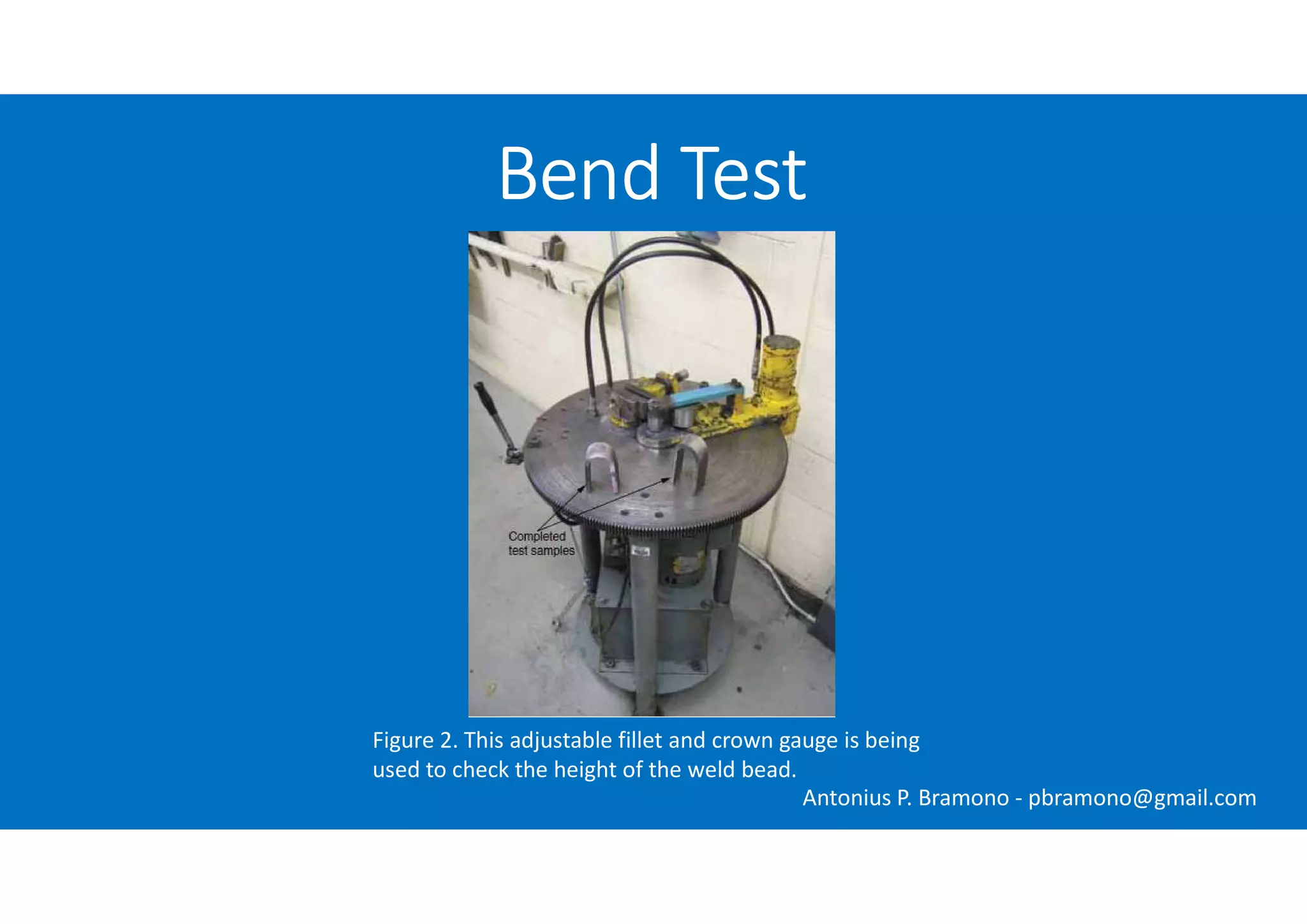
• Figure 2 shows a radius bend testing machine. This machine
bends the prepared test coupon into a U form over a
specified radius, which is dependent on the thickness and
strength of the material. After bending, the outer surface
and the inner surface of the U are checked for cracks and
other indications as required by the weld inspection criteria.
The outer face of the bend may be examined by a visual,
penetrant, or magnetic particle test to detect defects such as
cracks, lack of fusion, and lack of penetration.
1. Bend Test
Antonius P. Bramono - pbramono@gmail.com
Figure 2. This adjustable fillet and crown gauge is being
used to check the height of the weld bead.
Bend Test
Antonius P. Bramono - pbramono@gmail.com
Tensile Test
Antonius P. Bramono - pbramono@gmail.com
Tensile Test
• Tensile tests are used to compare the weldment to the base
metal mechanical values and specification requirements.
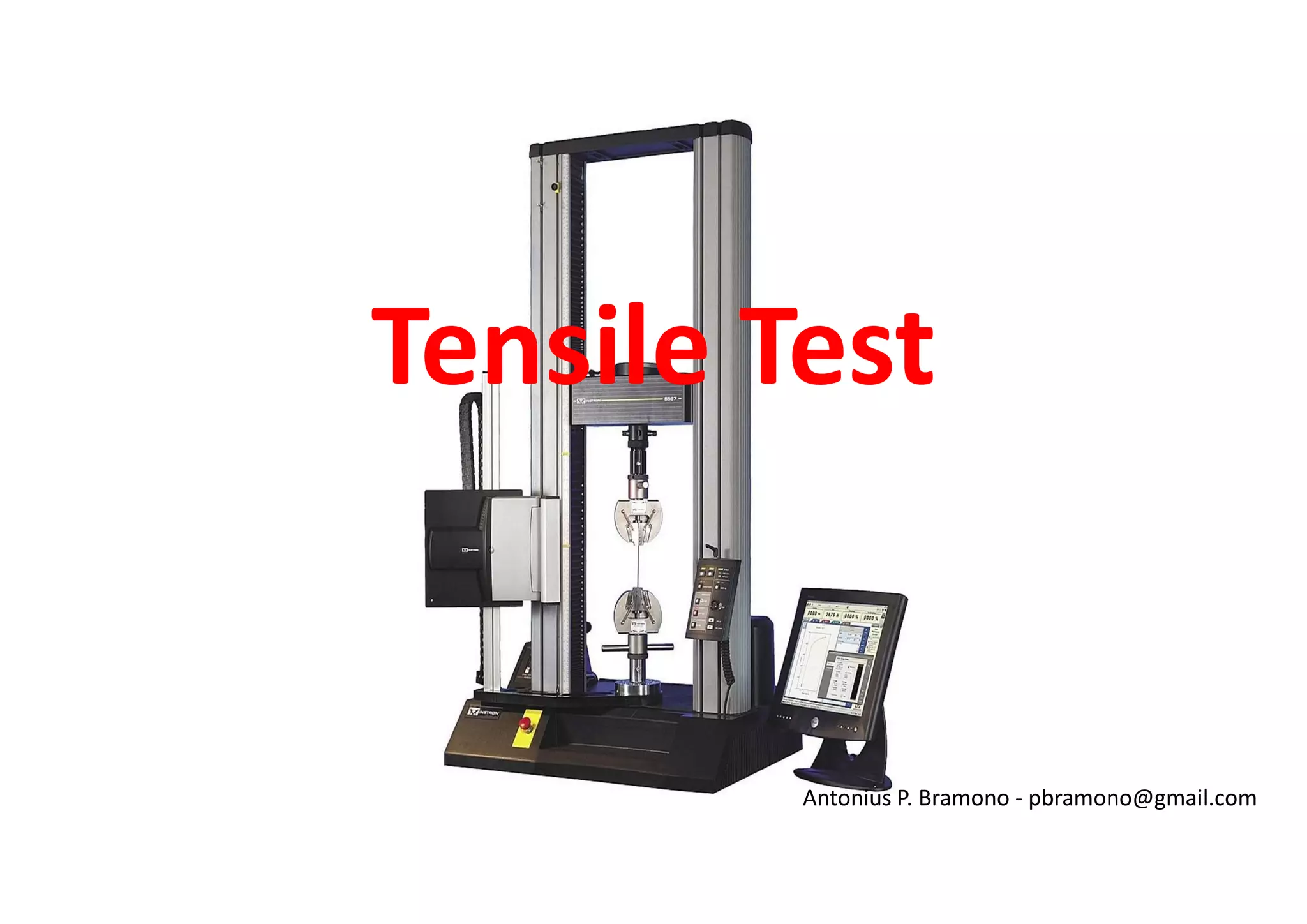
• The weldment is sliced into coupons, and then each end of
the coupon is pulled in opposite directions until the coupon
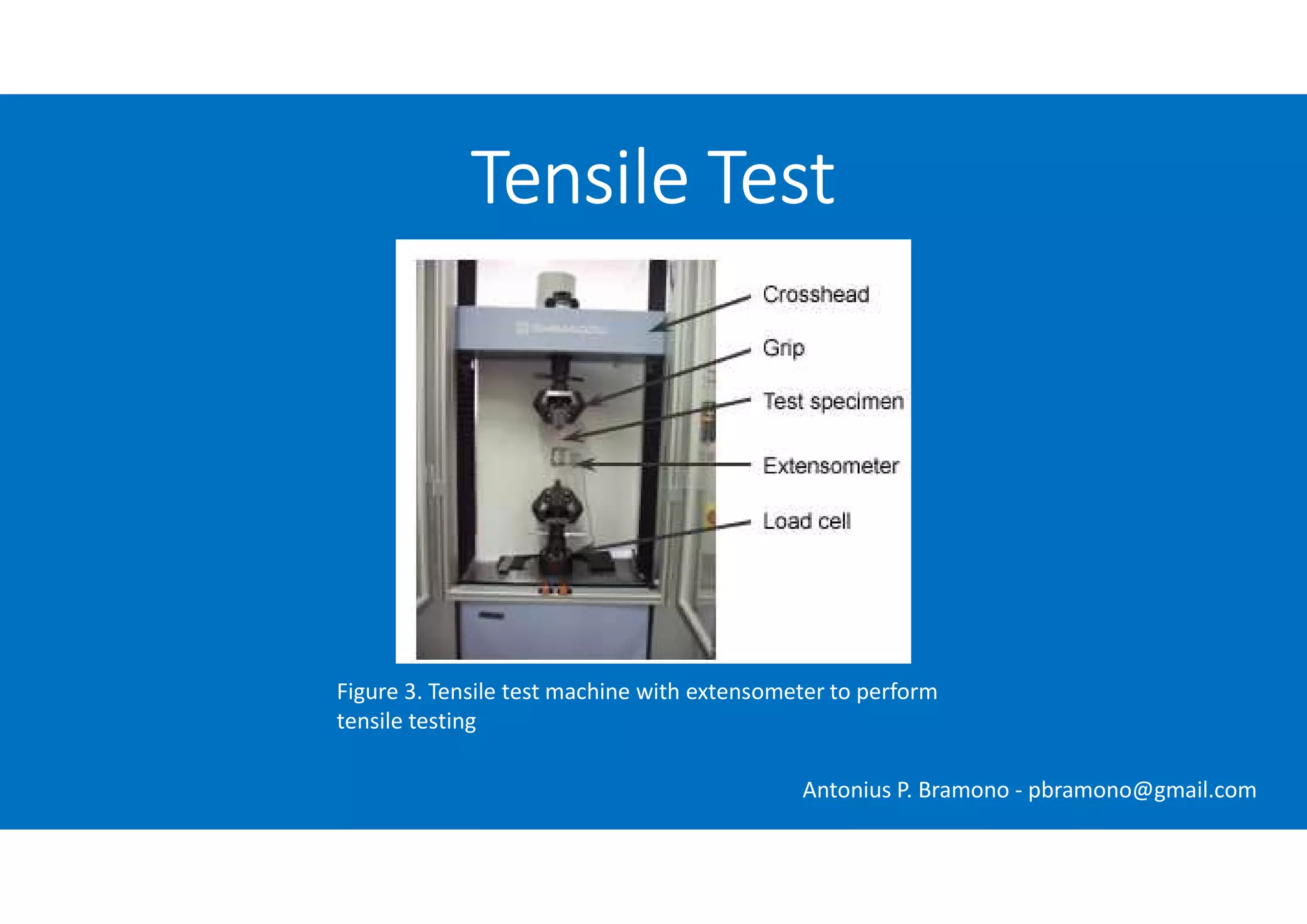
fails (breaks). A tensile test machine is shown in Figure 3.
Antonius P. Bramono - pbramono@gmail.com
Tensile tests are made to determine the following:
• Ultimate strength of the weld. This is the point at which the
weld fails under tension.
• Yield strength of the weld. This is the point at which the
weld yields or stretches under tension and will not return to
its original dimensions.
• Elongation. This is the amount of stretch that occurs during
the tensile test. It is measured by placing gauge marks on the
sample or coupon before testing and comparing the after-
break distance with the original gauge marks.
Tensile Test
Antonius P. Bramono - pbramono@gmail.com
Figure 3. Tensile test machine with extensometer to perform
tensile testing
Tensile Test
Antonius P. Bramono - pbramono@gmail.com
Notch-Toughness Test
Antonius P. Bramono - pbramono@gmail.com
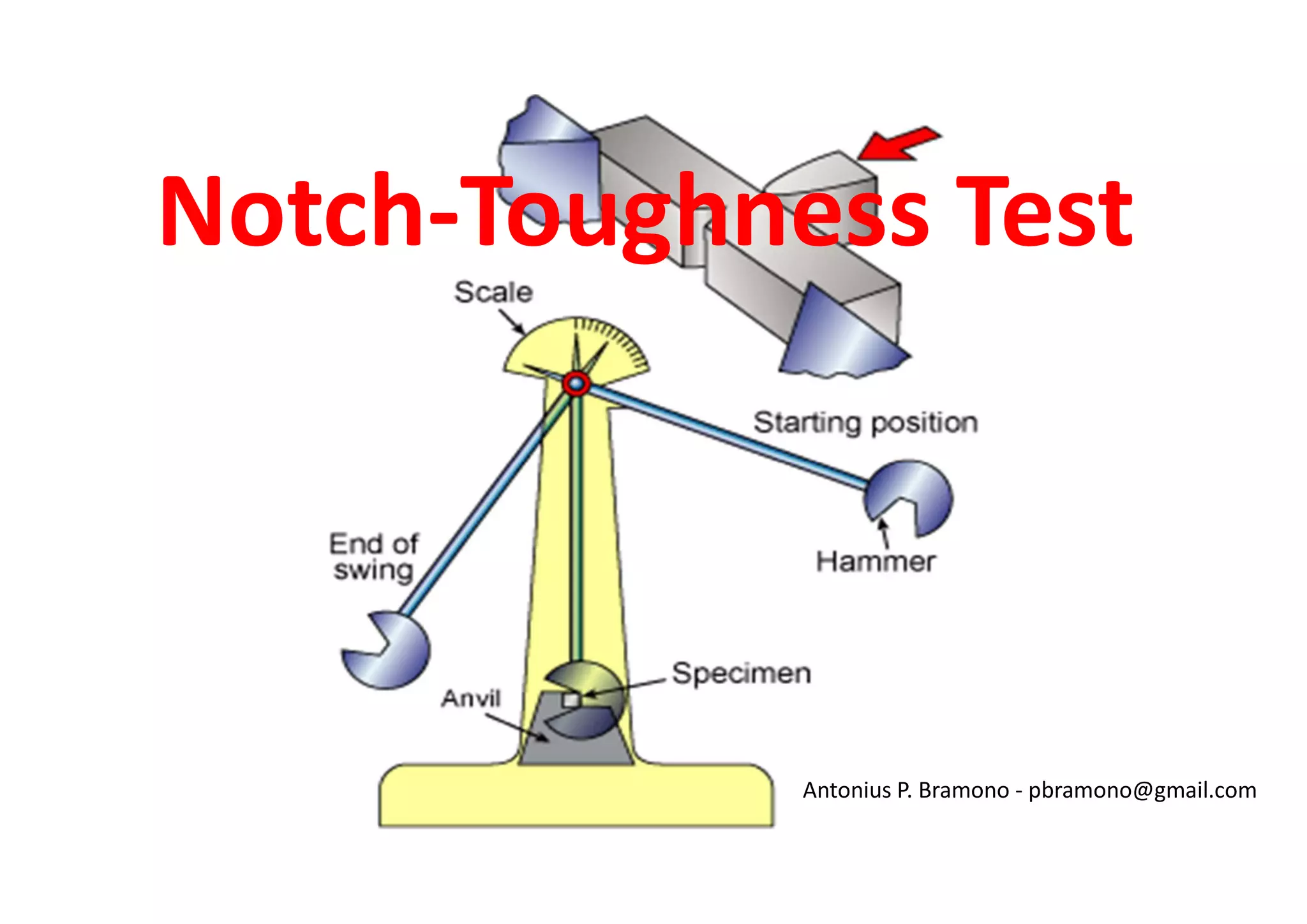
• Notch-toughness tests are used to define the ability of welds
to resist cracking or crack propagation at low temperatures
under loads.
• These tests are used on welds that are intended for use in
low temperature environments with pulsating or vibrating
loading.
• The weldment is cut into test coupons, which are then
notched, cooled to a low temperature, and put under
pressure until they fail.
Notch-Toughness Test
Antonius P. Bramono - pbramono@gmail.com
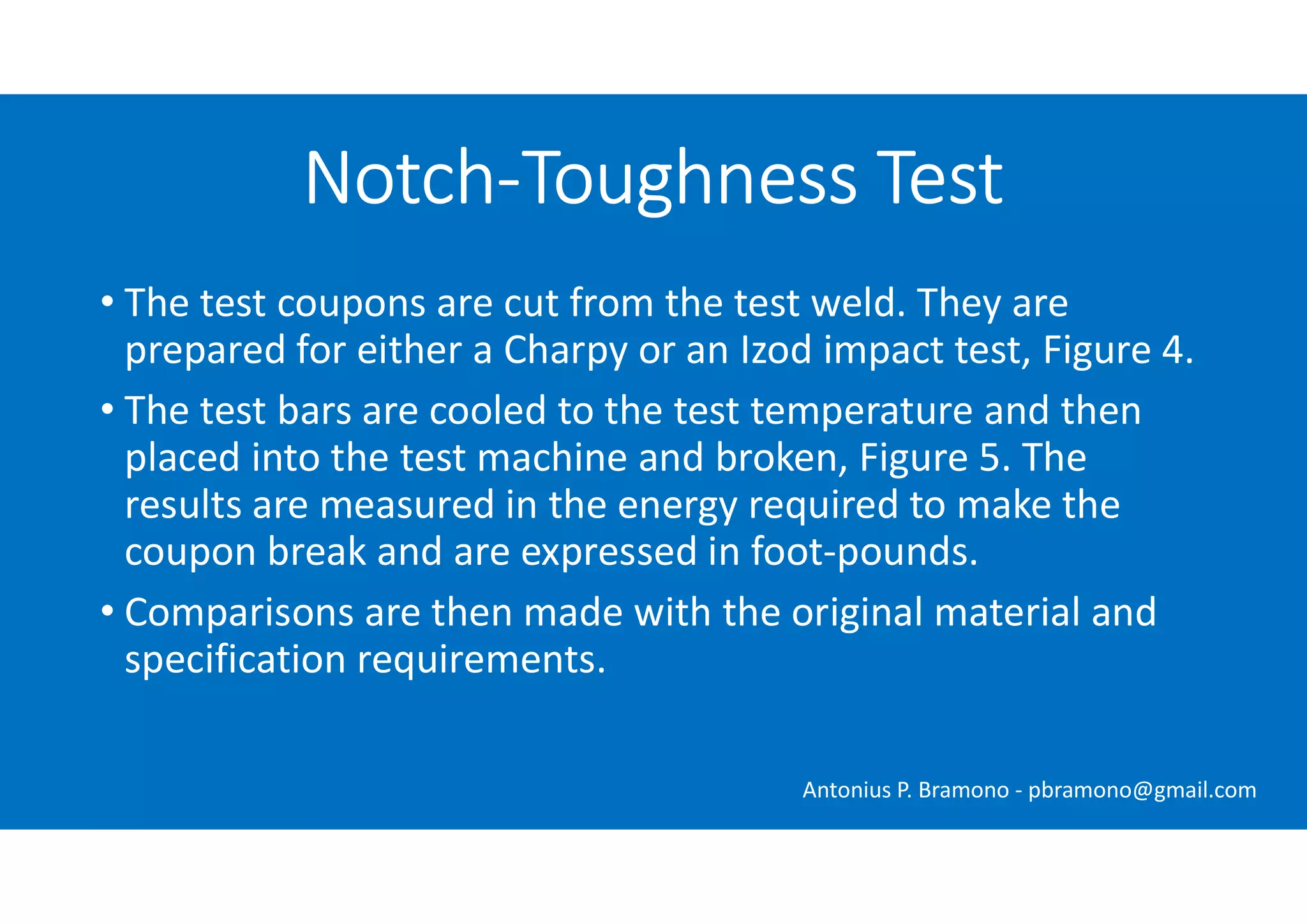
• The test coupons are cut from the test weld. They are
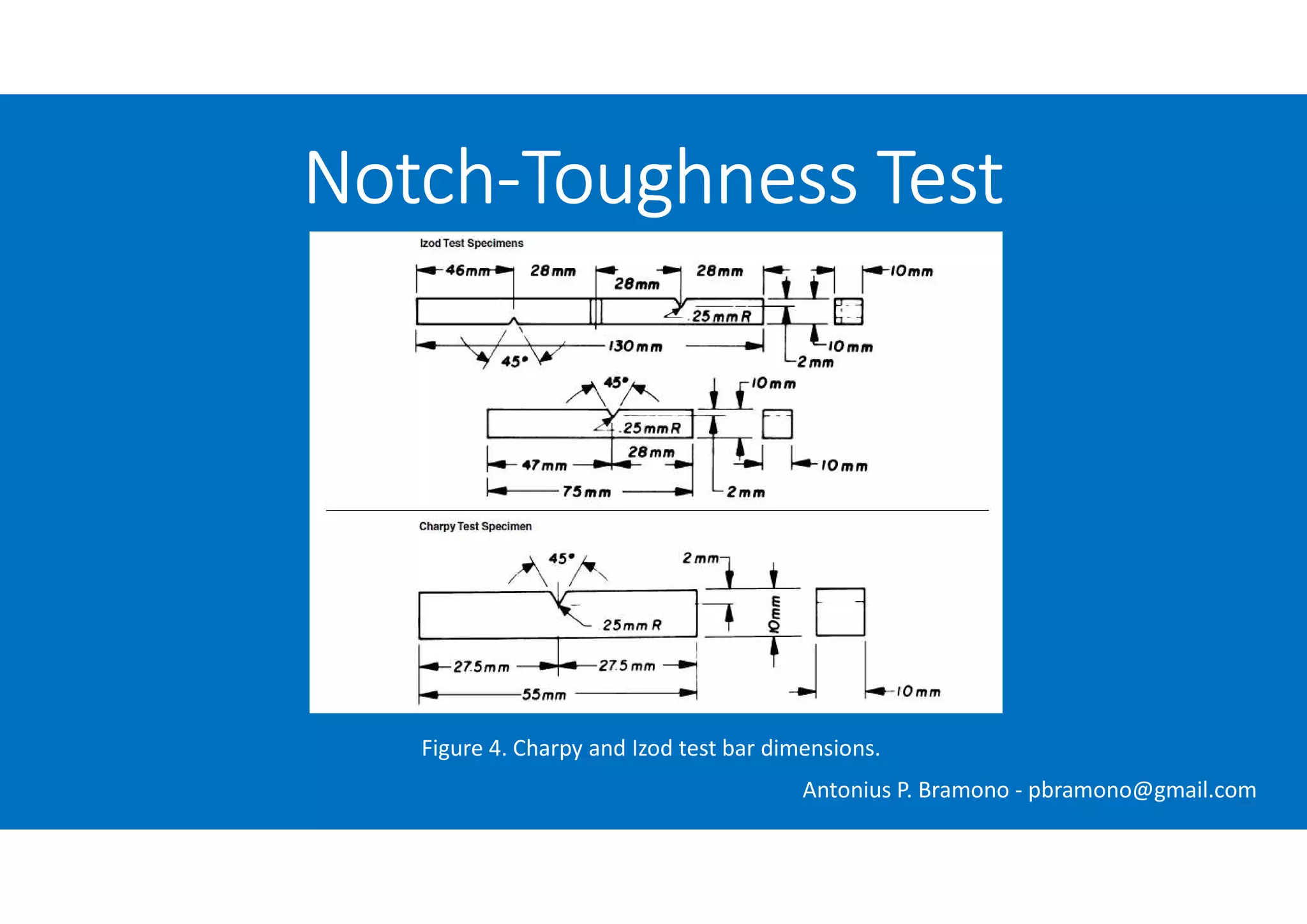
prepared for either a Charpy or an Izod impact test, Figure 4.
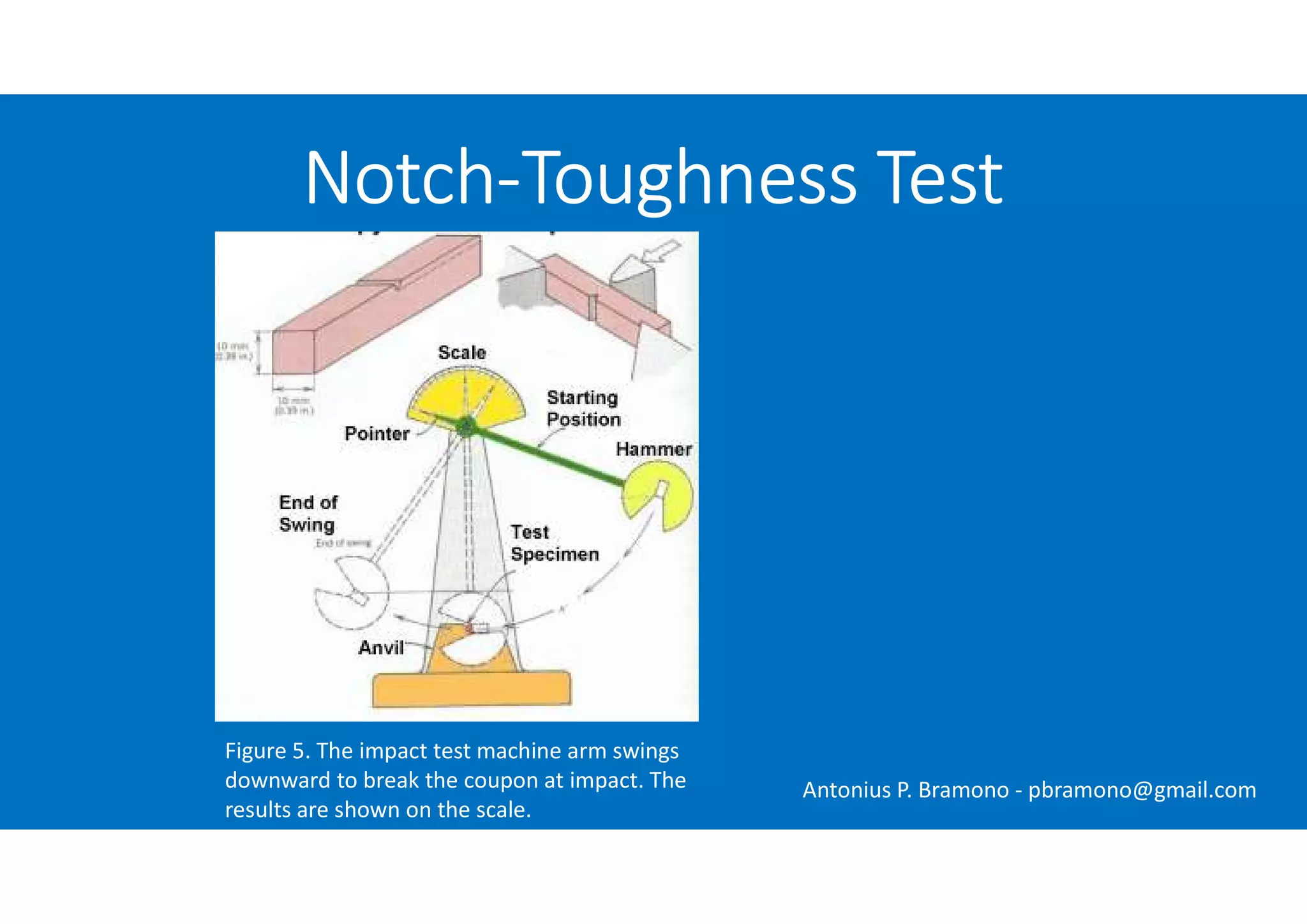
• The test bars are cooled to the test temperature and then
placed into the test machine and broken, Figure 5. The
results are measured in the energy required to make the
coupon break and are expressed in foot-pounds.
• Comparisons are then made with the original material and
specification requirements.
Notch-Toughness Test
Antonius P. Bramono - pbramono@gmail.com
Notch-Toughness Test
Figure 4. Charpy and Izod test bar dimensions.
Antonius P. Bramono - pbramono@gmail.com
Notch-Toughness Test
Figure 5. The impact test machine arm swings
downward to break the coupon at impact. The
results are shown on the scale.
Antonius P. Bramono - pbramono@gmail.com
Cross Section Test
Antonius P. Bramono - pbramono@gmail.com
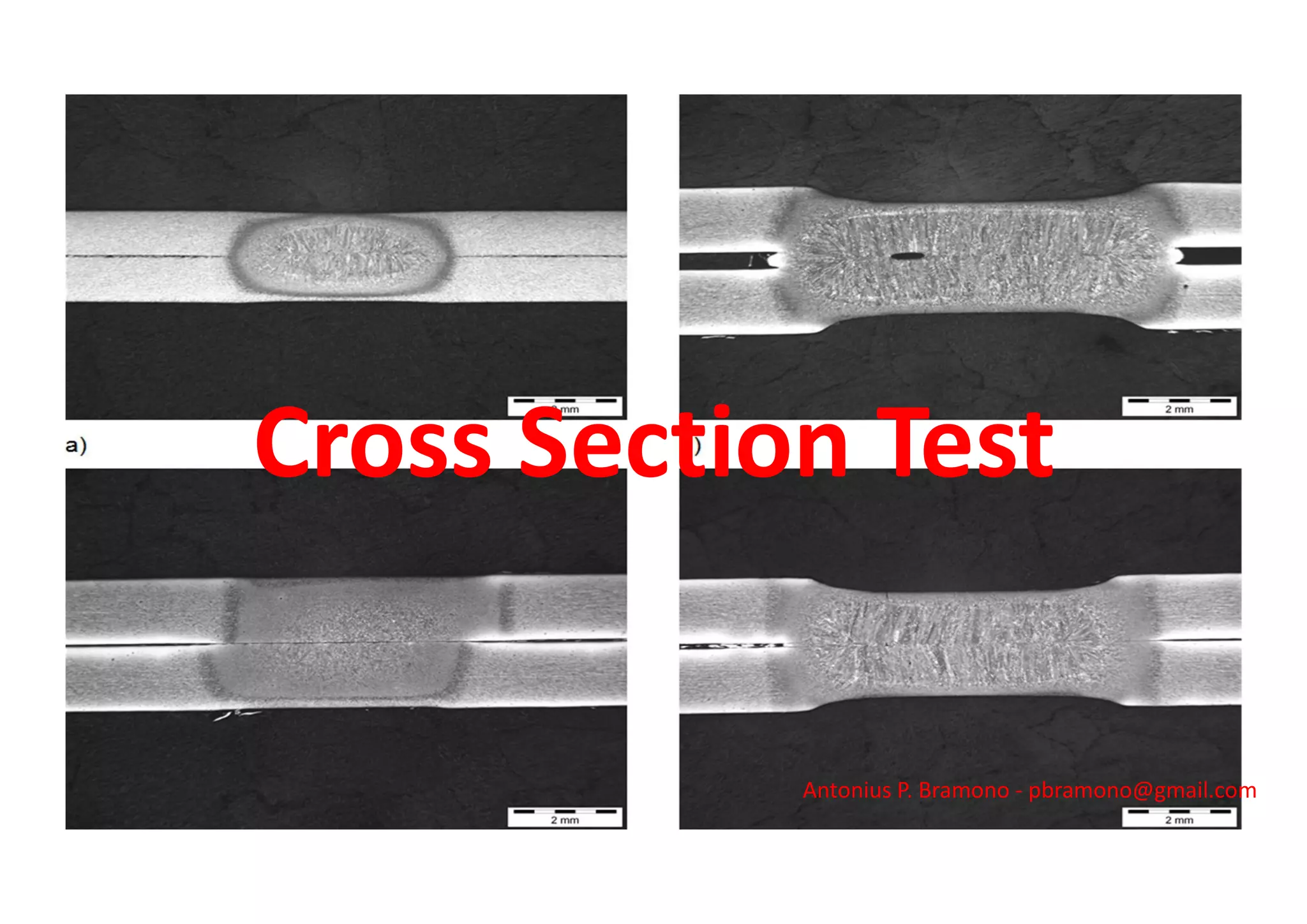
• Cross section tests are used to define the internal quality and
structure of the weld. The weldment is cut into cross
sections, which are then polished, etched, and examined
visually or with specialized testing equipment.
• Cross section tests include the following types:
Macrotest. Polished sections of the weld are prepared for
viewing with the naked eye or a magnifying glass (low
magnification). Increased definition of the weld layers and
passes can often be obtained by etching the sample with a
suitable etchant.
Cross Section Test
Antonius P. Bramono - pbramono@gmail.com
Microtest. Very highly polished sections of the weld are
prepared for viewing with highpower microscopes. This
type of test is used to determine grain size, content, and
structure.
Microhardness test. Very highly polished sections of the
weld are tested on special machines to determine the
hardness of a very small area. The results can then be
evaluated to determine the hardness variations within the
grain structures and the weld zones.
Cross Section Test (cont’d)
Antonius P. Bramono - pbramono@gmail.com
Nick-Break Test
Antonius P. Bramono - pbramono@gmail.com
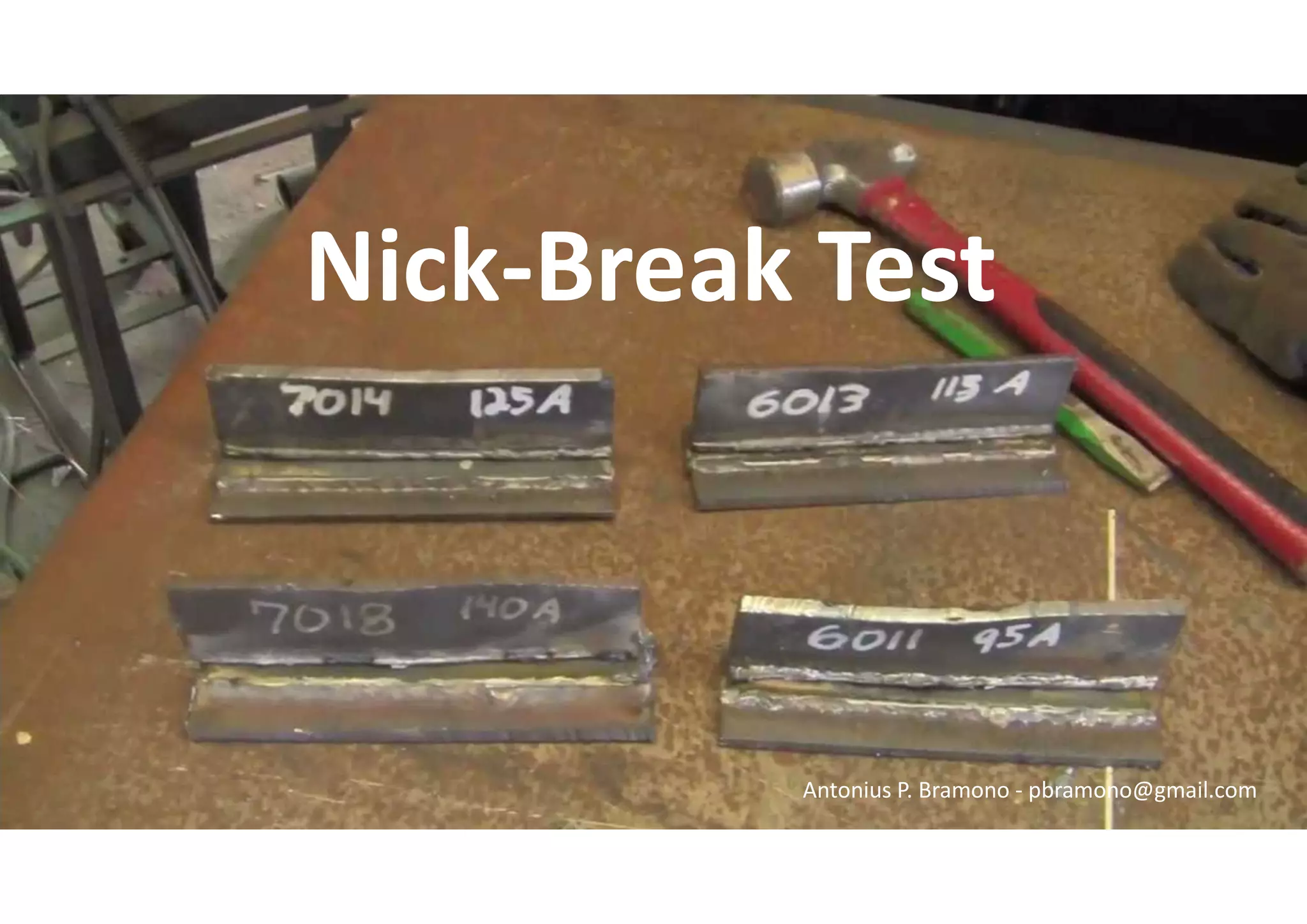
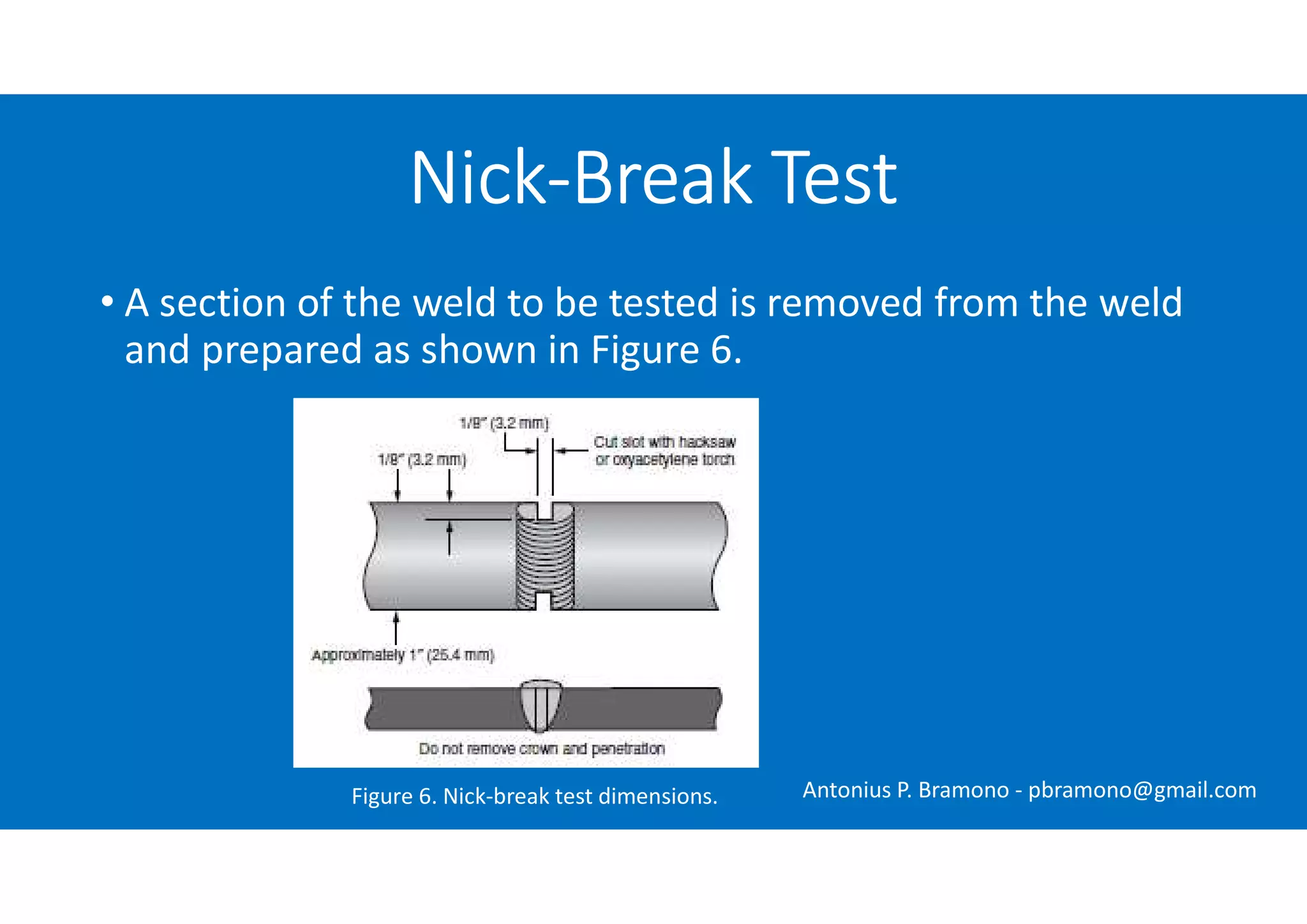
• Nick-break tests are destructive tests that are very simple to
make. They are used to determine the internal quality of a
weld with regard to porosity, lack of fusion, and slag.
• Notches are cut in the sides of a weld coupon in the weld
area. The coupons are then laid across a support on each
end and force is applied with a hammer to try to break the
weld sideways for a simple internal inspection. A nick or
groove cut into the weld helps the specimen break when
force is applied.
Nick-Break Test
Antonius P. Bramono - pbramono@gmail.com
• A section of the weld to be tested is removed from the weld
and prepared as shown in Figure 6.
Nick-Break Test
Figure 6. Nick-break test dimensions. Antonius P. Bramono - pbramono@gmail.com
Pressure Test
Antonius P. Bramono - pbramono@gmail.com
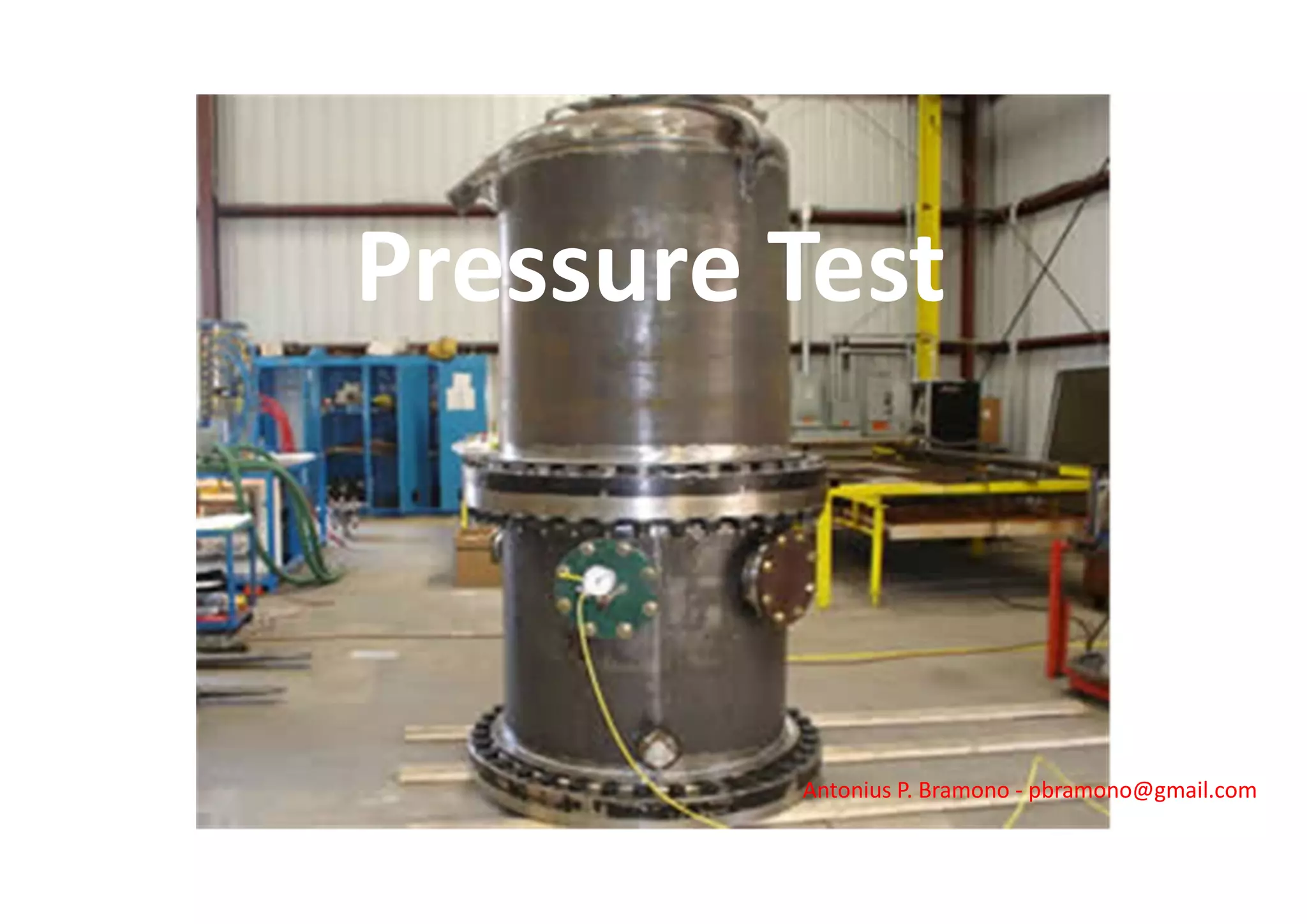
• Pressure tests subject a vessel, tank, piping, or tubing to internal
pressure. Pressure tests can use either air or fluid. If a fluid is used,
the test is called a hydrostatic test.
• The test program may require a number of cycles to be performed,
simulating the use of the part in actual service.
• During the test, the part will expand. This expansion should not be
restricted with tools, or undue stresses will build within the part.
 When conducting a pressure test, be alert to the possible failure of
the unit. Before beginning the test, make sure the test procedure
ensures the safety of everyone in the testing area.
Pressure Test
Antonius P. Bramono - pbramono@gmail.com
Hardness Test
Antonius P. Bramono - pbramono@gmail.com
• Hardness tests involve pressing a test probe into the surface of
the weld. The amount of pressure required to deform the
surface of the weld metal is an indication of the hardness of
the weld or weldment. If the weldment has been heat-treated
(annealed, hardened, tempered, etc.) after fabrication, the
hardness test will determine the effect of the heat treatment.
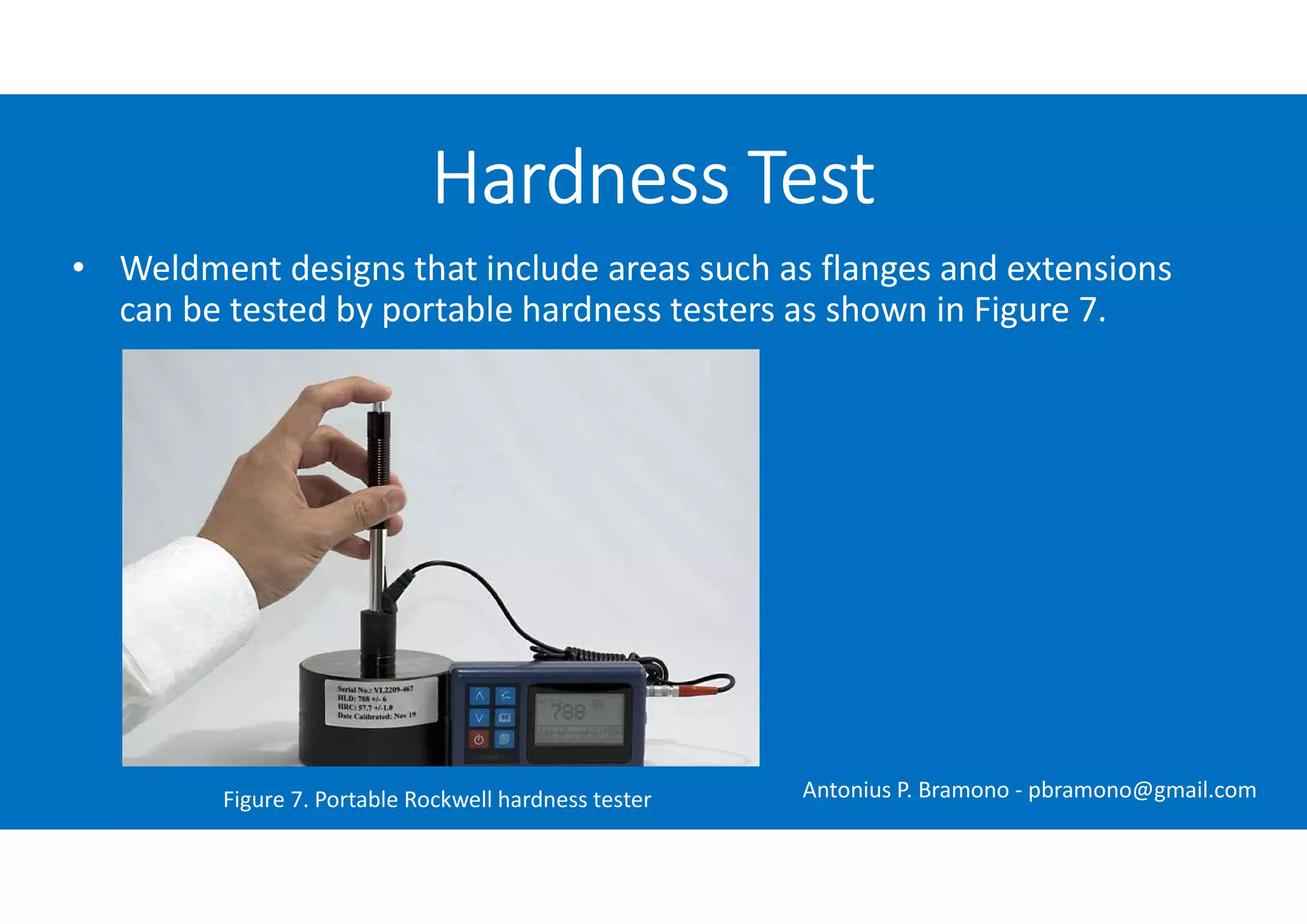
A hardness tester is shown in Figure 7.
• Hardness test results can also be used to determine the
ultimate tensile strength of the material. The test results can
be compared with standard tables.
Hardness Test
Antonius P. Bramono - pbramono@gmail.com
• Weldment designs that include areas such as flanges and extensions
can be tested by portable hardness testers as shown in Figure 7.
Hardness Test
Figure 7. Portable Rockwell hardness tester Antonius P. Bramono - pbramono@gmail.com
Corrosion Test
Antonius P. Bramono - pbramono@gmail.com
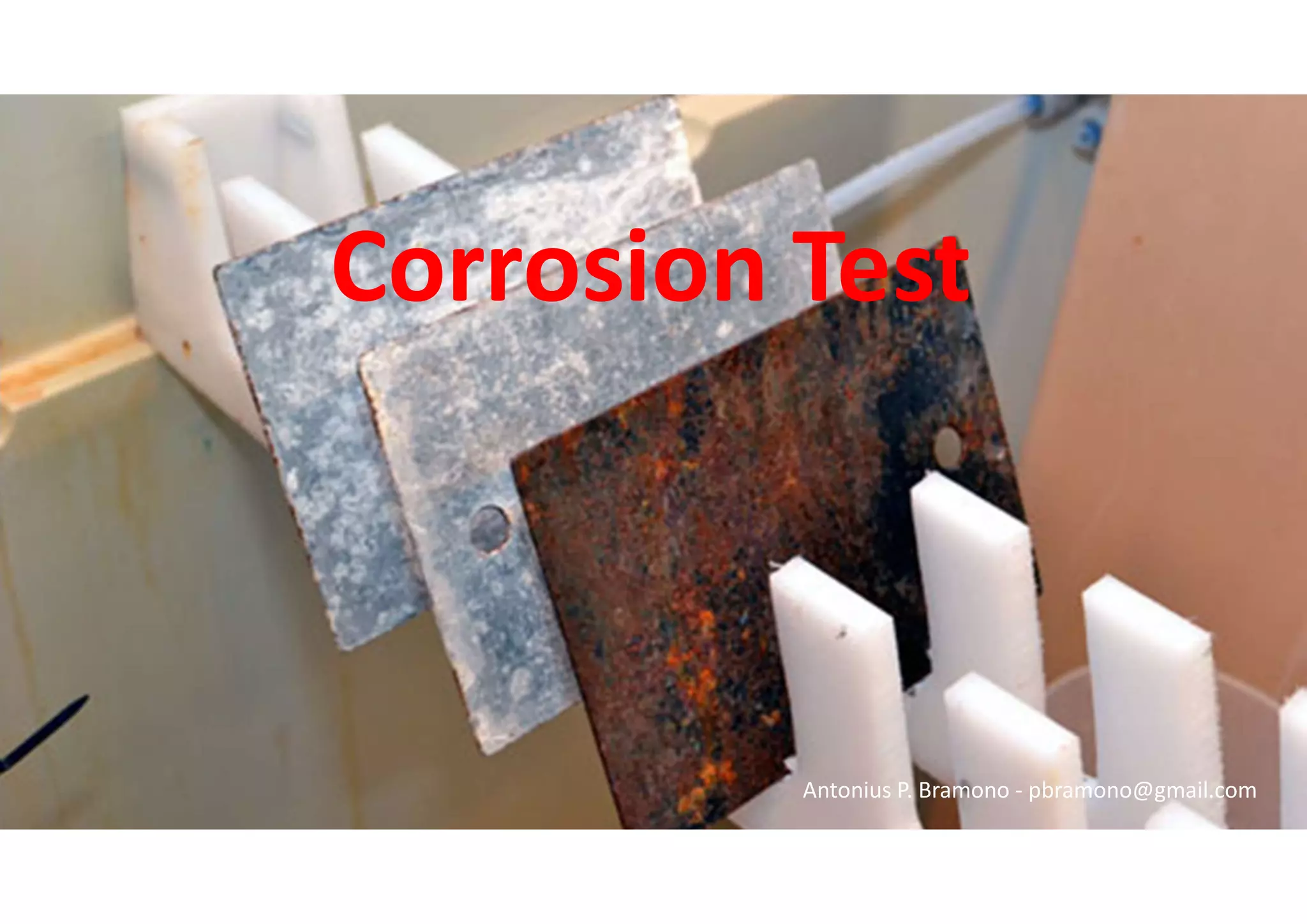
• Corrosion tests measure the ability of a weld to restrict
corrosion by a specific material.
• These tests are usually performed on test weldments. The test
parts are sprayed with a salt mixture and allowed to corrode,
simulating years of exposure to the weather.
• Such tests are usually required by the specification used by the
fabricator.
• Weld test parameters made on the qualification test
weldments must be duplicated on the production part without
deviation to maintain the proper corrosion resistance.
Corrosion Test
Antonius P. Bramono - pbramono@gmail.com
Ferrite Test
Antonius P. Bramono - pbramono@gmail.com
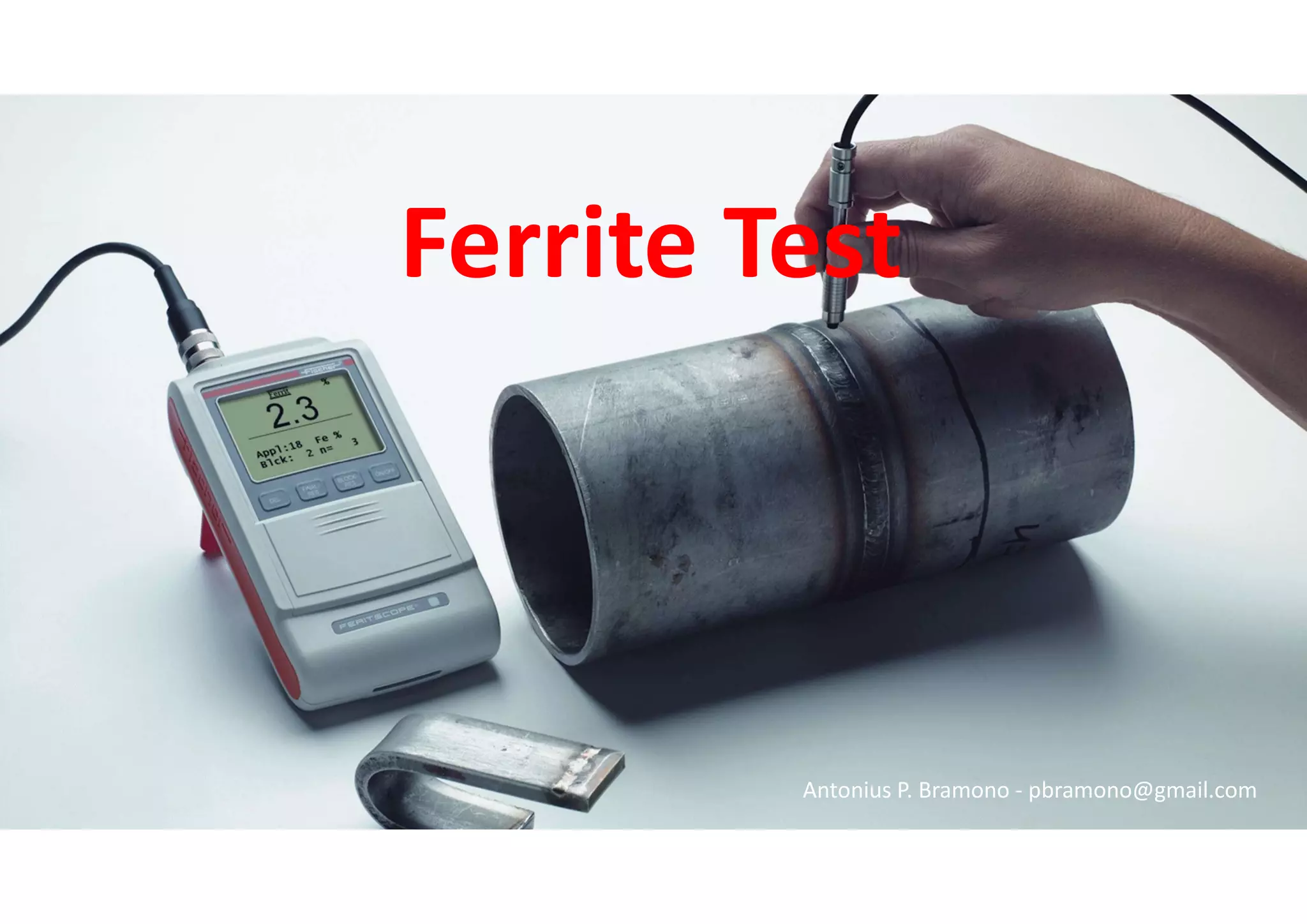
• A ferrite test on completed stainless steel welds determines
the amount of magnetic ferrite in an austenitic (nonmagnetic)
weld.
• Insufficient ferrite in a weld made under high restraint is prone
to cracking at red heat. Limits of ferrite will depend on the use
of the final weldment. These amounts are usually specified in
the fabrication specification.
• Weld test parameters and filler metals used on qualification
test weldments must be duplicated on the production part
without deviation to maintain the proper ferrite content.
Ferrite Test
Antonius P. Bramono - pbramono@gmail.com
Feel free to contact:
Antonius P. Bramono
 E: pbramono@gmail.com
Antonius P. Bramono - pbramono@gmail.com

Destructive test

  • 1.
    Weld Inspection Destructive Test(DT) Antonius P. Bramono Antonius P. Bramono - pbramono@gmail.com
  • 2.
    • Quality controlis used throughout the welding industry to monitor the quality of the items produced. • All manufactured items are made to specifications. • Inspections must be made during and after the manufacturing cycle to ensure that parts meet the requirements of the specifications. Introduction Antonius P. Bramono - pbramono@gmail.com
  • 3.
    Welders need toensure that all aspects of the operation are performed correctly. At a minimum, welders should check the following areas: • Base material is as specified. • Joint design is as specified and within required tolerances. • Filler metal type and size are correct. • Required welding equipment is available and operating satisfactorily. • Tooling has been adequately tested to determine that it will properly support the operation. Inspection Areas Antonius P. Bramono - pbramono@gmail.com
  • 4.
    • Parts havebeen properly cleaned. • Welder training or certification is sufficient for the weld operation. • Proper welding procedure is used and the welding equipment is set up properly for the operation. • Inspections and tests required during the welding operation are performed as specified. Inspection Areas – cont’d Antonius P. Bramono - pbramono@gmail.com
  • 5.
    Inspection in Welding AntoniusP. Bramono - pbramono@gmail.com
  • 6.
    •Destructive tests areused for welder qualification and certification, as well as welding procedure qualifications. •In large production runs, destructive tests are often made by pulling apart sample units. •It is often less expensive to scrap a part to make a destructive quality test than to test the parts using more expensive nondestructive tests. Destructive Test (DT) Antonius P. Bramono - pbramono@gmail.com
  • 7.
    Bend Test Antonius P.Bramono - pbramono@gmail.com
  • 8.
    • Bend testsare used to determine internal weld quality. As shown in Figure 1, there are three different types of bend tests: a. face bend (face of the weld is tested) b. root bend (root of the weld is tested) c. side bend (sides of the weld are tested) • In bend tests, a weldment is sliced into test strips, called coupons. The weld is then bent around a die of a specific size, creating a horseshoe of the coupon. This process stretches the weld to test the weld’s integrity. 1. Bend Test Antonius P. Bramono - pbramono@gmail.com
  • 9.
    Bend Test Figure 1.The three types of bend tests are shown here. The root bend test places the greatest amount of stress on the weld root. The face bend test places the greatest amount of stress on the weld face. The side bend places the greatest amount of stress along the weld axis. Antonius P. Bramono - pbramono@gmail.com
  • 10.
    • Figure 2shows a radius bend testing machine. This machine bends the prepared test coupon into a U form over a specified radius, which is dependent on the thickness and strength of the material. After bending, the outer surface and the inner surface of the U are checked for cracks and other indications as required by the weld inspection criteria. The outer face of the bend may be examined by a visual, penetrant, or magnetic particle test to detect defects such as cracks, lack of fusion, and lack of penetration. 1. Bend Test Antonius P. Bramono - pbramono@gmail.com
  • 11.
    Figure 2. Thisadjustable fillet and crown gauge is being used to check the height of the weld bead. Bend Test Antonius P. Bramono - pbramono@gmail.com
  • 12.
    Tensile Test Antonius P.Bramono - pbramono@gmail.com
  • 13.
    Tensile Test • Tensiletests are used to compare the weldment to the base metal mechanical values and specification requirements. • The weldment is sliced into coupons, and then each end of the coupon is pulled in opposite directions until the coupon fails (breaks). A tensile test machine is shown in Figure 3. Antonius P. Bramono - pbramono@gmail.com
  • 14.
    Tensile tests aremade to determine the following: • Ultimate strength of the weld. This is the point at which the weld fails under tension. • Yield strength of the weld. This is the point at which the weld yields or stretches under tension and will not return to its original dimensions. • Elongation. This is the amount of stretch that occurs during the tensile test. It is measured by placing gauge marks on the sample or coupon before testing and comparing the after- break distance with the original gauge marks. Tensile Test Antonius P. Bramono - pbramono@gmail.com
  • 15.
    Figure 3. Tensiletest machine with extensometer to perform tensile testing Tensile Test Antonius P. Bramono - pbramono@gmail.com
  • 16.
    Notch-Toughness Test Antonius P.Bramono - pbramono@gmail.com
  • 17.
    • Notch-toughness testsare used to define the ability of welds to resist cracking or crack propagation at low temperatures under loads. • These tests are used on welds that are intended for use in low temperature environments with pulsating or vibrating loading. • The weldment is cut into test coupons, which are then notched, cooled to a low temperature, and put under pressure until they fail. Notch-Toughness Test Antonius P. Bramono - pbramono@gmail.com
  • 18.
    • The testcoupons are cut from the test weld. They are prepared for either a Charpy or an Izod impact test, Figure 4. • The test bars are cooled to the test temperature and then placed into the test machine and broken, Figure 5. The results are measured in the energy required to make the coupon break and are expressed in foot-pounds. • Comparisons are then made with the original material and specification requirements. Notch-Toughness Test Antonius P. Bramono - pbramono@gmail.com
  • 19.
    Notch-Toughness Test Figure 4.Charpy and Izod test bar dimensions. Antonius P. Bramono - pbramono@gmail.com
  • 20.
    Notch-Toughness Test Figure 5.The impact test machine arm swings downward to break the coupon at impact. The results are shown on the scale. Antonius P. Bramono - pbramono@gmail.com
  • 21.
    Cross Section Test AntoniusP. Bramono - pbramono@gmail.com
  • 22.
    • Cross sectiontests are used to define the internal quality and structure of the weld. The weldment is cut into cross sections, which are then polished, etched, and examined visually or with specialized testing equipment. • Cross section tests include the following types: Macrotest. Polished sections of the weld are prepared for viewing with the naked eye or a magnifying glass (low magnification). Increased definition of the weld layers and passes can often be obtained by etching the sample with a suitable etchant. Cross Section Test Antonius P. Bramono - pbramono@gmail.com
  • 23.
    Microtest. Very highlypolished sections of the weld are prepared for viewing with highpower microscopes. This type of test is used to determine grain size, content, and structure. Microhardness test. Very highly polished sections of the weld are tested on special machines to determine the hardness of a very small area. The results can then be evaluated to determine the hardness variations within the grain structures and the weld zones. Cross Section Test (cont’d) Antonius P. Bramono - pbramono@gmail.com
  • 24.
    Nick-Break Test Antonius P.Bramono - pbramono@gmail.com
  • 25.
    • Nick-break testsare destructive tests that are very simple to make. They are used to determine the internal quality of a weld with regard to porosity, lack of fusion, and slag. • Notches are cut in the sides of a weld coupon in the weld area. The coupons are then laid across a support on each end and force is applied with a hammer to try to break the weld sideways for a simple internal inspection. A nick or groove cut into the weld helps the specimen break when force is applied. Nick-Break Test Antonius P. Bramono - pbramono@gmail.com
  • 26.
    • A sectionof the weld to be tested is removed from the weld and prepared as shown in Figure 6. Nick-Break Test Figure 6. Nick-break test dimensions. Antonius P. Bramono - pbramono@gmail.com
  • 27.
    Pressure Test Antonius P.Bramono - pbramono@gmail.com
  • 28.
    • Pressure testssubject a vessel, tank, piping, or tubing to internal pressure. Pressure tests can use either air or fluid. If a fluid is used, the test is called a hydrostatic test. • The test program may require a number of cycles to be performed, simulating the use of the part in actual service. • During the test, the part will expand. This expansion should not be restricted with tools, or undue stresses will build within the part.  When conducting a pressure test, be alert to the possible failure of the unit. Before beginning the test, make sure the test procedure ensures the safety of everyone in the testing area. Pressure Test Antonius P. Bramono - pbramono@gmail.com
  • 29.
    Hardness Test Antonius P.Bramono - pbramono@gmail.com
  • 30.
    • Hardness testsinvolve pressing a test probe into the surface of the weld. The amount of pressure required to deform the surface of the weld metal is an indication of the hardness of the weld or weldment. If the weldment has been heat-treated (annealed, hardened, tempered, etc.) after fabrication, the hardness test will determine the effect of the heat treatment. A hardness tester is shown in Figure 7. • Hardness test results can also be used to determine the ultimate tensile strength of the material. The test results can be compared with standard tables. Hardness Test Antonius P. Bramono - pbramono@gmail.com
  • 31.
    • Weldment designsthat include areas such as flanges and extensions can be tested by portable hardness testers as shown in Figure 7. Hardness Test Figure 7. Portable Rockwell hardness tester Antonius P. Bramono - pbramono@gmail.com
  • 32.
    Corrosion Test Antonius P.Bramono - pbramono@gmail.com
  • 33.
    • Corrosion testsmeasure the ability of a weld to restrict corrosion by a specific material. • These tests are usually performed on test weldments. The test parts are sprayed with a salt mixture and allowed to corrode, simulating years of exposure to the weather. • Such tests are usually required by the specification used by the fabricator. • Weld test parameters made on the qualification test weldments must be duplicated on the production part without deviation to maintain the proper corrosion resistance. Corrosion Test Antonius P. Bramono - pbramono@gmail.com
  • 34.
    Ferrite Test Antonius P.Bramono - pbramono@gmail.com
  • 35.
    • A ferritetest on completed stainless steel welds determines the amount of magnetic ferrite in an austenitic (nonmagnetic) weld. • Insufficient ferrite in a weld made under high restraint is prone to cracking at red heat. Limits of ferrite will depend on the use of the final weldment. These amounts are usually specified in the fabrication specification. • Weld test parameters and filler metals used on qualification test weldments must be duplicated on the production part without deviation to maintain the proper ferrite content. Ferrite Test Antonius P. Bramono - pbramono@gmail.com
  • 36.
    Antonius P. Bramono- pbramono@gmail.com
  • 37.
    Antonius P. Bramono- pbramono@gmail.com
  • 38.
    Feel free tocontact: Antonius P. Bramono  E: pbramono@gmail.com Antonius P. Bramono - pbramono@gmail.com