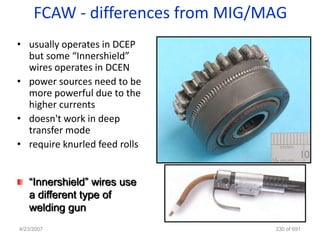
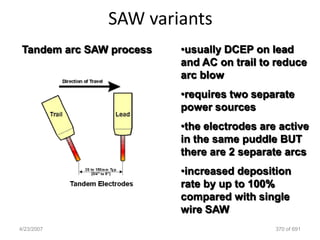
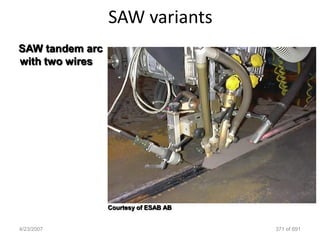
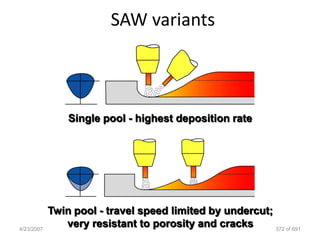
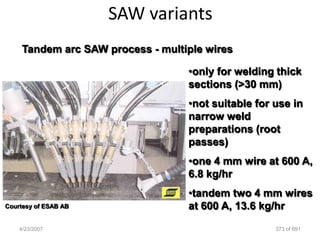
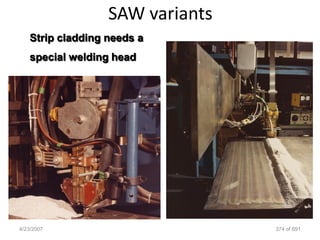
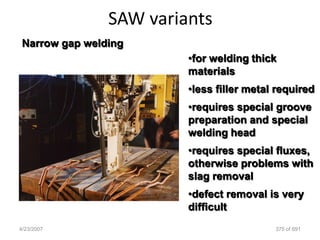
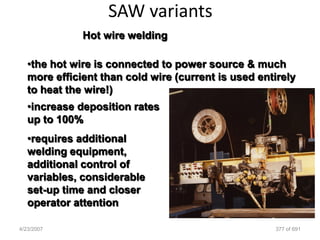
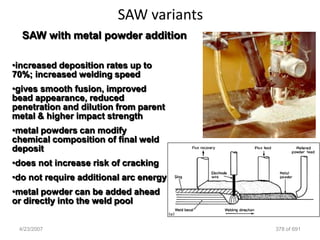
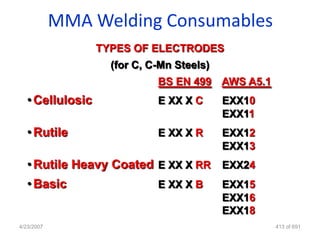
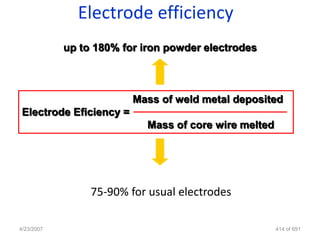
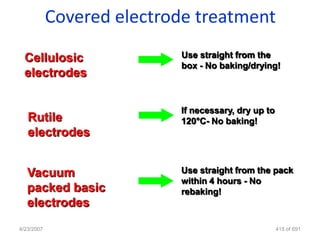
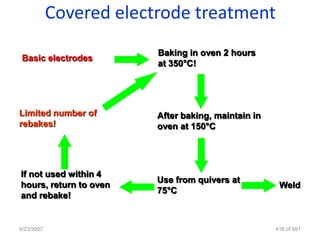
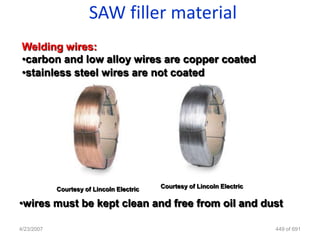
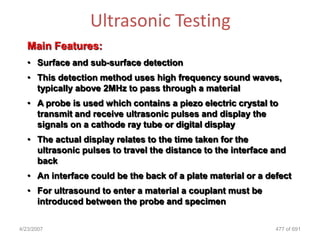
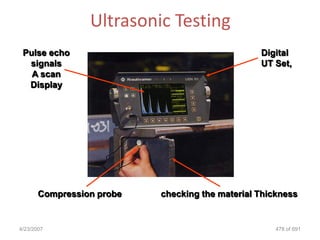
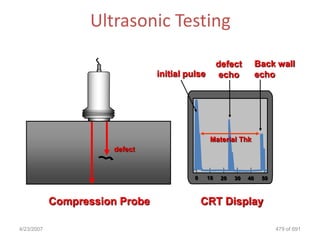
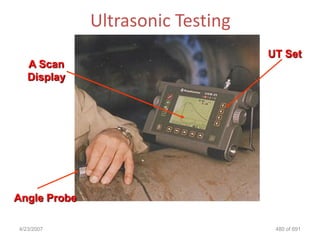
Welding Inspector


    Duties and Responsibilities
             Section 1


4/23/2007                       1 of 691
Main Responsibilities     1.1


                    •   Code compliance


                •   Workmanship control


            •       Documentation control

4/23/2007                                       2 of 691
Personal Attributes                    1.1


   Important qualities that good Inspectors are expected to have
   are:
                                   •   Honesty

                                   Integrity
                                   •


                               •Knowledge

                       •Good communicator

                           Physical fitness
                           •


                           •   Good eyesight

4/23/2007                                                          3 of 691
Standard for Visual Inspection 1.1

                      Basic Requirements
   BS EN 970 - Non-destructive examination of fusion
     welds - Visual examination
   Welding Inspection Personnel should:
   •   be familiar with relevant standards, rules and specifications
       applicable to the fabrication work to be undertaken
   •   be informed about the welding procedures to be used
   •   have good vision (which should be checked every 12
       months)


4/23/2007                                                        4 of 691
Welding Inspection                     1.2


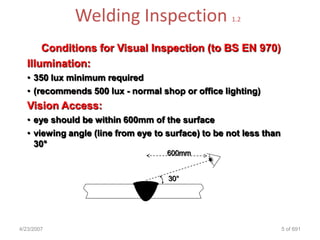
      Conditions for Visual Inspection (to BS EN 970)
  Illumination:
  • 350 lux minimum required
  • (recommends 500 lux - normal shop or office lighting)
  Vision Access:
  • eye should be within 600mm of the surface
  • viewing angle (line from eye to surface) to be not less than
    30°
                                    600mm


                                    30°


4/23/2007                                                          5 of 691
Welding Inspection                        1.3


            Aids to Visual Inspection (to BS EN 970)
  When access is restricted may use:
  • a mirrored boroscope
  • a fibre optic viewing system
                                        }   usually by
                                            agreement
  Other aids:
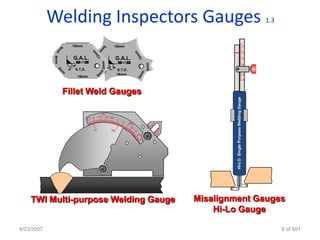
  • welding gauges (for checking bevel angles, weld profile, fillet
    sizing, undercut depth)
  • dedicated weld-gap gauges and linear misalignment (high-low)
    gauges
  • straight edges and measuring tapes
  • magnifying lens (if magnification lens used it should have
    magnification between X2 to X5)


4/23/2007                                                         6 of 691
Welding Inspectors Equipment     1.3


   Measuring devices:
   •   flexible tape, steel rule
   •   Temperature indicating crayons
   •   Welding gauges
   •   Voltmeter
   •   Ammeter
   •   Magnifying glass
   •   Torch / flash light
   •   Gas flow-meter


4/23/2007                               7 of 691
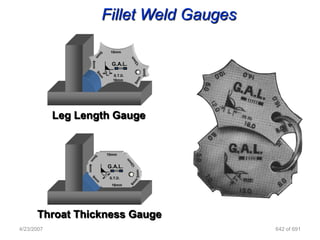
Welding Inspectors Gauges                                                                 1.3


               10mm                        10mm                                                   1

                                                                                                  2

               G.A.L.                      G.A.L.                                                 3

                                                                                                  4

                S.T.D.              L      S.T.D.
                                           16mm                                                   5
                 16mm
                                                                                                  6


             Fillet Weld Gauges


                                                             HI-LO Single Purpose Welding Gauge
                                IN
                         0   1/4 1/2 3/4


    TWI Multi-purpose Welding Gauge                 Misalignment Gauges
                                                        Hi-Lo Gauge

4/23/2007                                                                                                   8 of 691
Welding Inspectors Equipment   1.3


Voltmeter                              Ammeter


                      Tong Tester
4/23/2007                                        9 of 691
Welding Inspection 1.3

            Stages of Visual Inspection (to BS EN 970)
   Extent of examination and when required should be defined in
   the application standard or by agreement between the
   contracting parties

   For high integrity fabrications inspection required throughout
   the fabrication process:
                         Before welding
               (Before assemble & After assembly)
                         During welding
                         After welding


4/23/2007                                                     10 of 691
Typical Duties of a Welding Inspector                                  1.5


                           Before Welding
   Preparation:
   Familiarisation with relevant „documents‟…
   •    Application Standard/Code - for visual acceptance
        requirements
   •    Drawings - item details and positions/tolerances etc
   •    Quality Control Procedures - for activities such as material
        handling, documentation control, storage & issue of
        welding consumables
   •    Quality Plan/Inspection & Test Plan/Inspection Checklist -
        details of inspection requirements, inspection procedures
        & records required


4/23/2007                                                        11 of 691
Typical Duties of a Welding Inspector                              1.5


                            Before Welding
   Welding Procedures:
   •    are applicable to joints to be welded & approved
   •    are available to welders & inspectors
   Welder Qualifications:
   •    list of available qualified welders related to WPS‟s
   •    certificates are valid and ‘in-date’


4/23/2007                                                      12 of 691
Typical Duties of a Welding Inspector 1.5
                            Before Welding
   Equipment:
   • all inspection equipment is in good condition & calibrated as
     necessary
   • all safety requirements are understood & necessary equipment
     available
   Materials:
   • can be identified & related to test certificates, traceability !
   • are of correct dimensions
   • are in suitable condition (no damage/contamination)


4/23/2007                                                               13 of 691
Typical Duties of a Welding Inspector 1.5
                          Before Welding
   Consumables:
   • in accordance with WPS’s
   • are being controlled in accordance with Procedure
   Weld Preparations:
   • comply with WPS/drawing
   • free from defects & contamination
   Welding Equipment:
   • in good order & calibrated as required by Procedure


4/23/2007                                                  14 of 691
Typical Duties of a Welding Inspector 1.5
                    Before Welding
   Fit-up
   • complies with WPS
   • Number / size of tack welds to Code / good
     workmanship
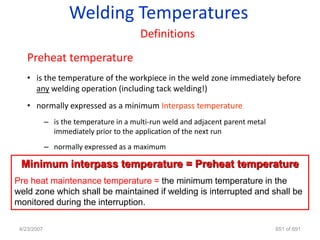
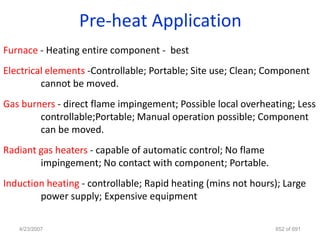
   Pre-heat
   • if specified
   • minimum temperature complies with WPS


4/23/2007                                         15 of 691
Typical Duties of a Welding Inspector                 1.5


                             During Welding
   Weather conditions
   •    suitable if site / field welding
   Welding Process(es)
   •    in accordance with WPS
   Welder
   •    is approved to weld the joint
   Pre-heat (if required)
   •    minimum temperature as specified by WPS
   •    maximum interpass temperature as WPS


4/23/2007                                         16 of 691
Typical Duties of a Welding Inspector                                   1.6


                             During Welding
   Welding consumables
   • in accordance with WPS
   • in suitable condition
   • controlled issue and handling
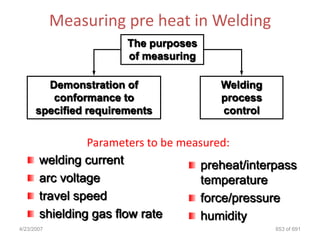
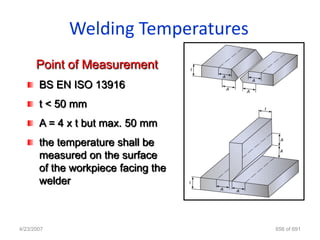
   Welding Parameters
   • current, voltage & travel speed – as WPS
   Root runs
   • if possible, visually inspect root before single-sided welds are
     filled up


4/23/2007                                                           17 of 691
Typical Duties of a Welding Inspector                          1.6


                        During Welding
   Inter-run cleaning
   in accordance with an approved method (& back gouging) to
      good workmanship standard
   Distortion control
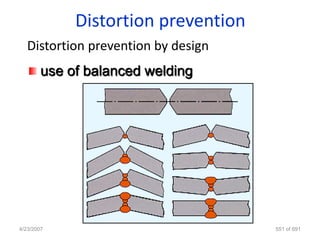
   • welding is balanced & over-welding is avoided


4/23/2007                                                18 of 691
Typical Duties of a Welding Inspector                           1.6


                           After Welding
   Weld Identification
   •   identified/numbered as required
   •   is marked with welder‟s identity
   Visual Inspection
   •   ensure weld is suitable for all NDT
   •   visually inspect & „sentence‟ to Code requirements
   Dimensional Survey
   •   ensure dimensions comply with Code/drawing
   Other NDT
   •   ensure all NDT is completed & reports available

4/23/2007                                                   19 of 691
Typical Duties of a Welding Inspector                              1.6

                            After Welding
   Repairs
   • monitor repairs to ensure compliance with Procedure, ensure
     NDT after repairs is completed
   • PWHT
   • monitor for compliance with Procedure
   • check chart records confirm Procedure compliance
   Pressure / Load Test
   • ensure test equipment is suitably calibrated
   • monitor to ensure compliance with Procedure
   • ensure all records are available


4/23/2007                                                     20 of 691
Typical Duties of a Welding Inspector                          1.6


                         After Welding
   Documentation
   • ensure any modifications are on ‘as-built’ drawings
   • ensure all required documents are available
   • Collate / file documents for manufacturing records
   • Sign all documentation and forward it to QC department.


4/23/2007                                                  21 of 691
Summary of Duties
It is the duty of a Welding Inspector to ensure all the welding and
associated actions are carried out in accordance with the
specification and any applicable procedures.
A Welding Inspector must:
•   Observe
    To observe all relevant actions related to weld quality throughout
    production.

•   Record
    To record, or log all production inspection points relevant to quality,
    including a final report showing all identified imperfections

•   Compare
    To compare all recorded information with the acceptance criteria
    and any other relevant clauses in the applied application standard


4/23/2007                                                                     22 of 691
Welding Inspector
            Terms & Definitions
                Section 2


4/23/2007                         23 of 691
Welding Terminology & Definitions                             2.1


  What is a Weld?
  •    A localised coalescence of metals or non-metals produced
       either by heating the materials to the welding temperature,
       with or without the application of pressure, or by the
       application of pressure alone (AWS)

  •    A permanent union between materials caused by heat, and
       or pressure (BS499)

  •    An Autogenous weld:
       A weld made with out the use of a filler material and can
       only be made by TIG or Oxy-Gas Welding


4/23/2007                                                          24 of 691
Welding Terminology & Definitions                     2.1


  What is a Joint?

  • The junction of members or the edges of members that are
    to be joined or have been joined (AWS)

  • A configuration of members (BS499)


4/23/2007                                               25 of 691
Joint Terminology 2.2


     Edge   Open & Closed Corner         Lap


                         Tee              Butt
     Cruciform

4/23/2007                                        26 of 691
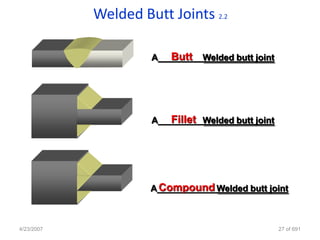
Welded Butt Joints 2.2

                         Butt
                     A_________Welded butt joint


                         Fillet
                     A_________Welded butt joint


                      Compound
                     A____________Welded butt joint


4/23/2007                                          27 of 691
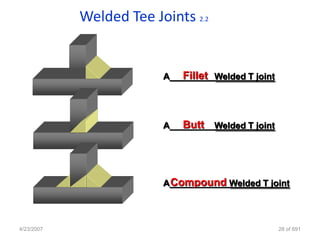
Welded Tee Joints 2.2


                             Fillet
                         A_________Welded T joint


                             Butt
                         A_________Welded T joint


                          Compound
                         A____________Welded T joint


4/23/2007                                           28 of 691
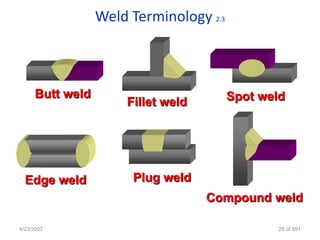
Weld Terminology 2.3


     Butt weld                          Spot weld
                     Fillet weld


  Edge weld           Plug weld
                                   Compound weld

4/23/2007                                       29 of 691
Butt Preparations – Sizes                2.4


                                Partial Penetration Butt Weld

Actual Throat
                            Design Throat
    Thickness
                             Thickness


        Full Penetration Butt Weld


                                     Design Throat     Actual Throat

                                     Thickness             Thickness


4/23/2007                                                     30 of 691
Weld Zone Terminology 2.5

                                 Face
            A                                     B


            Weld
            metal

            Heat                              Weld
            Affected                          Boundary
            Zone

                    C                   D
                          Root
                    A, B, C & D = Weld Toes
4/23/2007                                                31 of 691
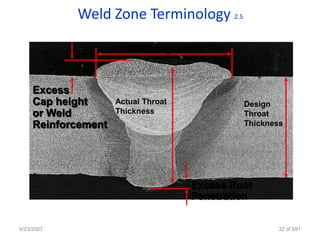
Weld Zone Terminology 2.5

                       Weld cap width


     Excess
     Cap height      Actual Throat            Design
     or Weld         Thickness                Throat
     Reinforcement                            Thickness


                                     Excess Root
                                     Penetration


4/23/2007                                            32 of 691
Heat Affected Zone (HAZ) 2.5

       Maximum      solid   solid-liquid Boundary
      Temperature   weld
                              grain growth zone
                    metal
                                 recrystallised zone
                                      partially transformed zone
                                       tempered zone
                                             unaffected base
                                                 material


4/23/2007                                                          33 of 691
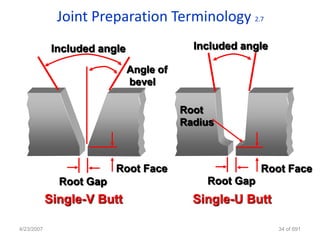
Joint Preparation Terminology 2.7
             Included angle                Included angle

                              Angle of
                              bevel

                                         Root
                                         Radius


                         Root Face                      Root Face
              Root Gap                       Root Gap
            Single-V Butt                  Single-U Butt

4/23/2007                                                   34 of 691
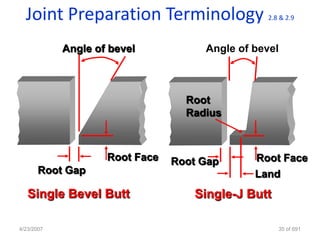
Joint Preparation Terminology                 2.8 & 2.9


            Angle of bevel           Angle of bevel


                                  Root
                                  Radius


                    Root Face   Root Gap      Root Face
      Root Gap                                Land
   Single Bevel Butt               Single-J Butt

4/23/2007                                          35 of 691
Single Sided Butt Preparations               2.10


Single sided preparations are normally made on thinner materials, or
             when access form both sides is restricted


               Single Bevel                Single Vee


                 Single-J                   Single-U


 4/23/2007                                                       36 of 691
Double Sided Butt Preparations             2.11


Double sided preparations are normally made on thicker materials, or
           when access form both sides is unrestricted


             Double -Bevel                Double -Vee


              Double - J                   Double - U

 4/23/2007                                                     37 of 691
Weld Preparation
            Terminology & Typical Dimensions:                 V-Joints
              bevel angle
                                             included angle


                                                  root face
                                root gap


                             Typical Dimensions
               bevel angle                 30 to 35°
               root face                   ~1.5 to ~2.5mm
               root gap                    ~2 to ~4mm


4/23/2007                                                          38 of 691
Butt Weld - Toe Blend
                              6 mm      •Most codes quote the weld
                                         toes shall blend smoothly
                      80                •This statement is not
                                         quantitative and therefore
                                         open to individual
            Poor Weld Toe Blend Angle    interpretation
                              3 mm      •The higher the toe blend
                                         angle the greater the
                      20                 amount of stress
                                         concentration
                                        •The toe blend angle ideally
            Improved Weld Toe Blend
                     Angle               should be between 20o-30o


4/23/2007                                                     39 of 691
Fillet Weld Features          2.13


                                            Excess
                                             Weld
                                             Metal
              Vertical
               Leg
              Length       Design
                           Throat


                         Horizontal leg
                            Length


4/23/2007                                            40 of 691
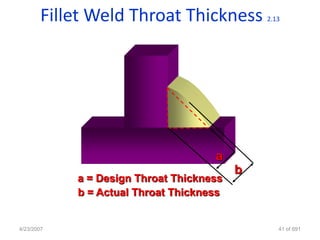
Fillet Weld Throat Thickness           2.13


                                     a
                                          b
            a = Design Throat Thickness
            b = Actual Throat Thickness


4/23/2007                                        41 of 691
Deep Penetration Fillet Weld Features 2.13


                                              a
                a = Design Throat Thickness       b
                b = Actual Throat Thickness


4/23/2007                                                42 of 691
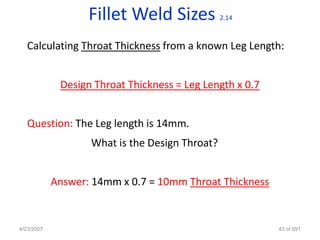
Fillet Weld Sizes            2.14


   Calculating Throat Thickness from a known Leg Length:


             Design Throat Thickness = Leg Length x 0.7


   Question: The Leg length is 14mm.
                   What is the Design Throat?


            Answer: 14mm x 0.7 = 10mm Throat Thickness


4/23/2007                                                 43 of 691
Fillet Weld Sizes          2.14


 Calculating Leg Length from a known Design Throat
 Thickness:


            Leg Length = Design Throat Thickness x 1.4


 Question: The Design Throat is 10mm.
                 What is the Leg length?


            Answer: 10mm x 1.4 = 14mm Leg Length


4/23/2007                                                44 of 691
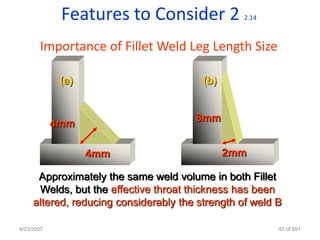
Features to Consider 2              2.14


       Importance of Fillet Weld Leg Length Size

             (a)                         (b)


                                       8mm
            4mm

                   4mm                         2mm

      Approximately the same weld volume in both Fillet
      Welds, but the effective throat thickness has been
     altered, reducing considerably the strength of weld B

4/23/2007                                                45 of 691
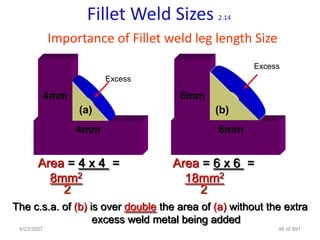
Fillet Weld Sizes        2.14


             Importance of Fillet weld leg length Size
              (a)                      (b)            Excess
                          Excess

         4mm                         6mm
                    (a)                      (b)
                    4mm                       6mm


        Area = 4 x 4 =             Area = 6 x 6 =
          8mm2                       18mm2
            2                          2
The c.s.a. of (b) is over double the area of (a) without the extra
                   excess weld metal being added
 4/23/2007                                                 46 of 691
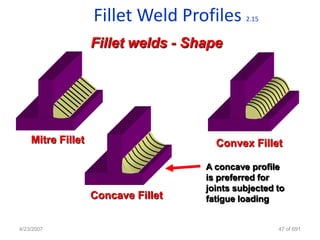
Fillet Weld Profiles      2.15


                   Fillet welds - Shape


    Mitre Fillet                      Convex Fillet

                                    A concave profile
                                    is preferred for
                                    joints subjected to
                   Concave Fillet   fatigue loading


4/23/2007                                            47 of 691
Fillet Features to Consider                        2.15


            EFFECTIVE THROAT THICKNESS
“a” = Nominal throat thickness   “s” = Effective throat thickness


                     a                s

 Deep penetration fillet welds from high heat
 input welding process MAG, FCAW & SAW etc
4/23/2007                                                   48 of 691
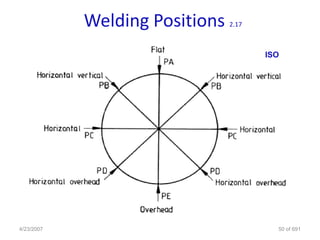
Welding Positions                2.17


        PA    1G / 1F         Flat / Downhand

        PB      2F           Horizontal-Vertical

        PC      2G               Horizontal
        PD      4F      Horizontal-Vertical (Overhead)

        PE      4G                Overhead

        PF    3G / 5G            Vertical-Up

        PG    3G / 5G           Vertical-Down

     H-L045     6G         Inclined Pipe (Upwards)

     J-L045     6G       Inclined Pipe (Downwards)

4/23/2007                                                49 of 691
Welding Positions   2.17


                                       ISO


4/23/2007                                50 of 691
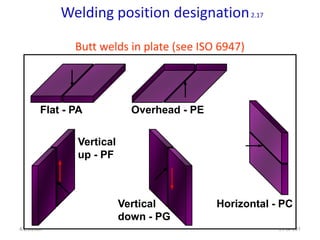
Welding position designation 2.17

              Butt welds in plate (see ISO 6947)


       Flat - PA            Overhead - PE


               Vertical
               up - PF


                          Vertical          Horizontal - PC
                          down - PG
4/23/2007                                               51 of 691
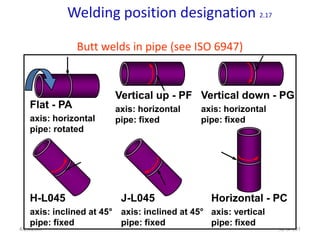
Welding position designation 2.17

                Butt welds in pipe (see ISO 6947)


                         Vertical up - PF Vertical down - PG
    Flat - PA            axis: horizontal     axis: horizontal
    axis: horizontal     pipe: fixed          pipe: fixed
    pipe: rotated


    H-L045                J-L045                Horizontal - PC
    axis: inclined at 45° axis: inclined at 45° axis: vertical
    pipe: fixed           pipe: fixed           pipe: fixed
4/23/2007                                                        52 of 691
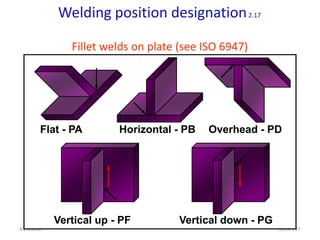
Welding position designation 2.17

               Fillet welds on plate (see ISO 6947)


       Flat - PA         Horizontal - PB   Overhead - PD


            Vertical up - PF        Vertical down - PG
4/23/2007                                                53 of 691
Welding position designation 2.17

               Fillet welds on pipe (see ISO 6947)


   Flat - PA                  Horizontal - PB      Overhead - PD
   axis: inclined at 45°      axis: vertical       axis: vertical
   pipe: rotated              pipe: fixed          pipe: fixed


   Horizontal - PB Vertical up - PF Vertical down - PG
   axis: horizontal        axis: horizontal    axis: horizontal
   pipe: rotated           pipe: fixed         pipe: fixed
4/23/2007                                                           54 of 691
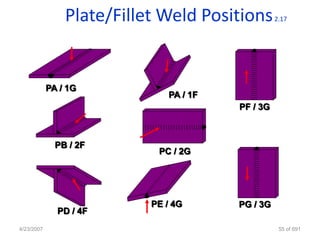
Plate/Fillet Weld Positions       2.17


            PA / 1G
                              PA / 1F
                                        PF / 3G


              PB / 2F
                            PC / 2G


                           PE / 4G      PG / 3G
              PD / 4F
4/23/2007                                          55 of 691
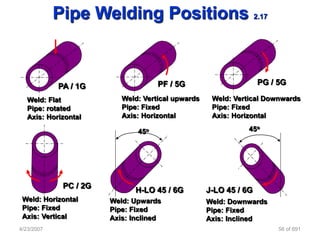
Pipe Welding Positions                                2.17


                                    PF / 5G                        PG / 5G
            PA / 1G
  Weld: Flat              Weld: Vertical upwards    Weld: Vertical Downwards
  Pipe: rotated           Pipe: Fixed               Pipe: Fixed
  Axis: Horizontal        Axis: Horizontal          Axis: Horizontal

                              45o                             45o


             PC / 2G
                              H-LO 45 / 6G         J-LO 45 / 6G
 Weld: Horizontal      Weld: Upwards               Weld: Downwards
 Pipe: Fixed           Pipe: Fixed                 Pipe: Fixed
 Axis: Vertical        Axis: Inclined              Axis: Inclined
4/23/2007                                                                56 of 691
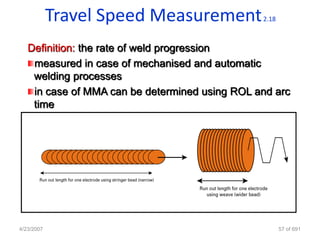
Travel Speed Measurement            2.18


   Definition: the rate of weld progression
    measured in case of mechanised and automatic
    welding processes
    in case of MMA can be determined using ROL and arc
    time


4/23/2007                                              57 of 691
Welding Inspector
            Welding Imperfections
                  Section 3


4/23/2007                           58 of 691
Welding Imperfections                      3.1


   All welds have imperfections
   •   Imperfections are classed as defects when they are of a
       type, or size, not allowed by the Acceptance Standard

   A defect is an unacceptable imperfection
   •   A weld imperfection may be allowed by one Acceptance
       Standard but be classed as a defect by another Standard
       and require removal/rectification


4/23/2007                                                        59 of 691
Welding Imperfections                    3.1


                Standards for Welding Imperfections

   BS EN ISO 6520-1(1998) Welding and allied processes –
                          Classification of geometric
                          imperfections in metallic materials -
                          Part 1: Fusion welding
   Imperfections are classified into 6 groups, namely:
                         1 Cracks
                         2 Cavities
                         3 Solid inclusions
                         4 Lack of fusion and penetration
                         5 Imperfect shape and dimensions
                         6 Miscellaneous imperfections


4/23/2007                                                   60 of 691
Welding Imperfections                        3.1


                Standards for Welding Imperfections

   EN ISO 5817 (2003) Welding - Fusion-welded joints in steel,
                      nickel, titanium and their alloys (beam
                      welding excluded) - Quality levels for
                      imperfections
   This main imperfections given in EN ISO 6520-1 are listed in
   EN ISO 5817 with acceptance criteria at 3 levels, namely
                          Level B (highest)
                          Level C (intermediate)
                          Level D (general)
   This Standard is „directly applicable to visual testing of welds‟
              ...(weld surfaces & macro examination)


4/23/2007                                                       61 of 691
Welding imperfections   3.1


                 classification


                    Cracks


4/23/2007                                 62 of 691
Cracks   3.1


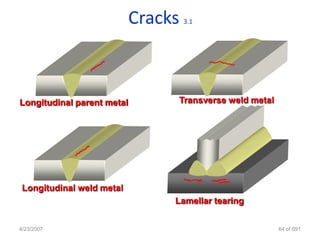
 Cracks that may occur in welded materials are
 caused generally by many factors and may be
 classified by shape and position.
    Classified by Shape   Classified by Position
    •Longitudinal         •HAZ
    •Transverse           •Centerline
    •Chevron              •Crater
    •Lamellar Tear        •Fusion zone
                          •Parent metal


 Note: Cracks are classed as Planar Defects.
4/23/2007                                          63 of 691
Cracks   3.1


Longitudinal parent metal        Transverse weld metal


 Longitudinal weld metal
                                 Lamellar tearing


4/23/2007                                                64 of 691
Cracks   3.1


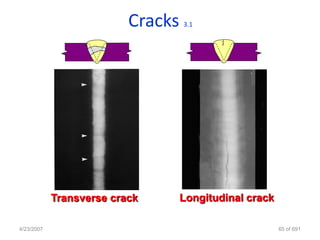
            Transverse crack       Longitudinal crack

4/23/2007                                               65 of 691
Cracks    3.2


            Main Crack Types
            •   Solidification Cracks
            •   Hydrogen Induced Cracks
            •   Lamellar Tearing
            •   Reheat cracks


4/23/2007                                 66 of 691
Cracks       3.2


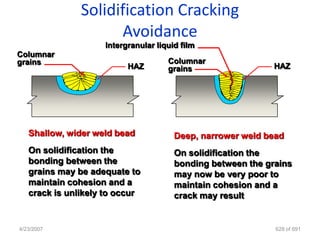
   Solidification Cracking
   • Occurs during weld solidification process
   • Steels with high sulphur impurities content (low ductility
     at elevated temperature)
   • Requires high tensile stress
   • Occur longitudinally down centre of weld


4/23/2007                                                    67 of 691
Cracks       3.3


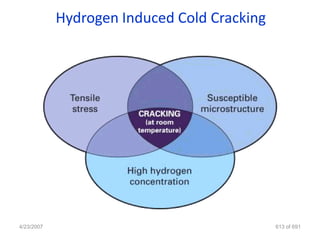
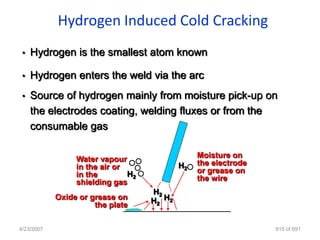
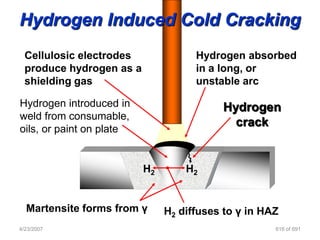
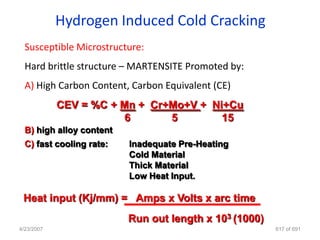
   Hydrogen Induced Cold Cracking
   • Requires susceptible hard grain structure, stress, low
     temperature and hydrogen
   • Hydrogen enters weld via welding arc mainly as result of
     contaminated electrode or preparation
   • Hydrogen diffuses out into parent metal on cooling
   • Cracking developing most likely in HAZ


4/23/2007                                                     68 of 691
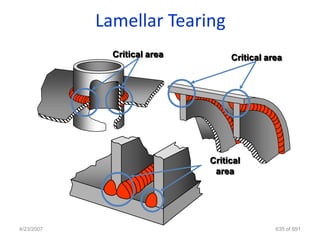
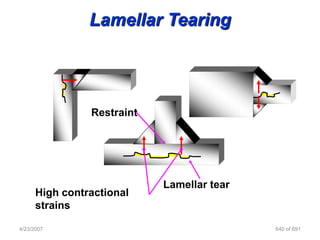
Lamellar Tearing             3.5

   • Location: Parent metal
   • Steel Type: Any steel type possible
   • Susceptible Microstructure: Poor through thickness ductility
   •   Lamellar tearing has a step like appearance due to the solid
       inclusions in the parent material (e.g. sulphides and
       silicates) linking up under the influence of welding stresses
   •   Low ductile materials in the short transverse direction
       containing high levels of impurities are very susceptible to
       lamellar tearing
   •   It forms when the welding stresses act in the short
       transverse direction of the material (through thickness
       direction)

4/23/2007                                                        69 of 691
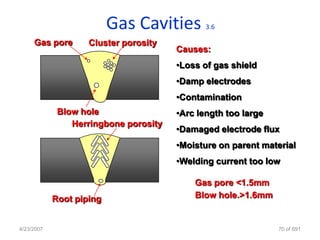
Gas Cavities        3.6

     Gas pore       Cluster porosity
                                       Causes:
                                       •Loss of gas shield
                                       •Damp electrodes
                                       •Contamination
             Blow hole                 •Arc length too large
                Herringbone porosity
                                       •Damaged electrode flux
                                       •Moisture on parent material
                                       •Welding current too low

                                           Gas pore <1.5mm
            Root piping                    Blow hole.>1.6mm


4/23/2007                                                      70 of 691
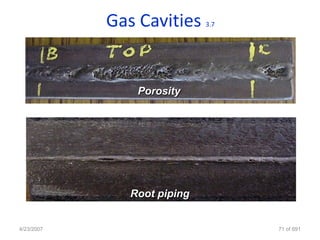
Gas Cavities     3.7


                Porosity


               Root piping


4/23/2007                          71 of 691
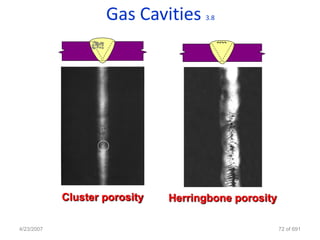
Gas Cavities     3.8


            Cluster porosity   Herringbone porosity

4/23/2007                                             72 of 691
Crater Pipe   3.9


                          Weld crater


                                Crater pipe


4/23/2007                                     73 of 691
Crater Pipe             3.9

    Crater pipe is a shrinkage defect and not a gas defect, it has
    the appearance of a gas pore in the weld crater


             Crater cracks               Causes:
             (Star cracks)
                                         •   Too fast a cooling
                                             rate
                                         •   Deoxidization
                                             reactions and
                                             liquid to solid
        Crater pipe                          volume change
                                         •   Contamination

4/23/2007                                                       74 of 691
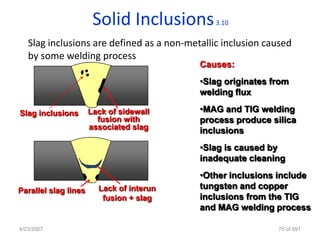
Solid Inclusions        3.10

   Slag inclusions are defined as a non-metallic inclusion caused
   by some welding process
                                           Causes:
                                           •Slag originates from
                                           welding flux

Slag inclusions       Lack of sidewall     •MAG and TIG welding
                        fusion with        process produce silica
                      associated slag      inclusions
                                           •Slag is caused by
                                           inadequate cleaning
                                           •Other inclusions include
Parallel slag lines     Lack of interun    tungsten and copper
                         fusion + slag     inclusions from the TIG
                                           and MAG welding process

4/23/2007                                                    75 of 691
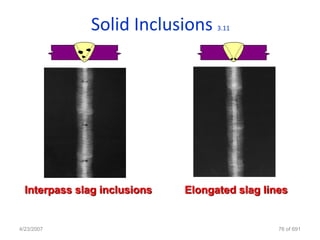
Solid Inclusions     3.11


  Interpass slag inclusions   Elongated slag lines


4/23/2007                                       76 of 691
Welding Imperfections                       3.13


       Typical Causes of Lack of Fusion:
       • welding current too low
       • bevel angle too steep
       • root face too large (single-sided weld)
       • root gap too small (single-sided weld)
       • incorrect electrode angle
       • linear misalignment
       • welding speed too high
       • welding process related – particularly dip-transfer GMAW
       • flooding the joint with too much weld metal (blocking Out)


4/23/2007                                                      77 of 691
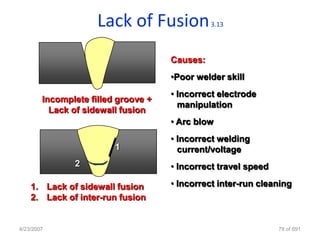
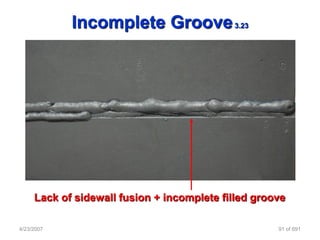
Lack of Fusion            3.13


                                     Causes:
                                     •Poor welder skill
                                     • Incorrect electrode
        Incomplete filled groove +
                                       manipulation
          Lack of sidewall fusion
                                     • Arc blow
                                     • Incorrect welding
                         1             current/voltage
               2                     • Incorrect travel speed

    1. Lack of sidewall fusion       • Incorrect inter-run cleaning
    2. Lack of inter-run fusion


4/23/2007                                                       78 of 691
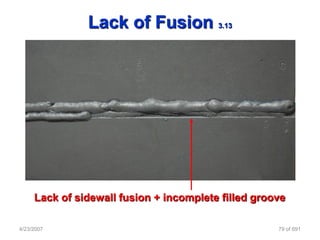
Lack of Fusion            3.13


     Lack of sidewall fusion + incomplete filled groove

4/23/2007                                            79 of 691
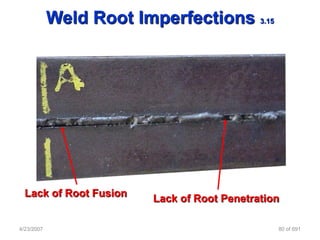
Weld Root Imperfections         3.15


  Lack of Root Fusion   Lack of Root Penetration

4/23/2007                                          80 of 691
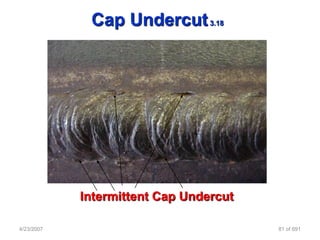
Cap Undercut        3.18


            Intermittent Cap Undercut

4/23/2007                               81 of 691
Undercut   3.18


            Root undercut      Cap undercut

4/23/2007                                     82 of 691
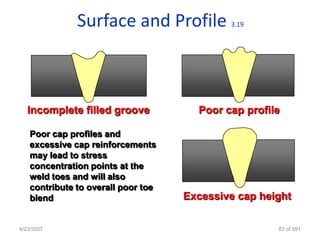
Surface and Profile           3.19


   Incomplete filled groove           Poor cap profile

   Poor cap profiles and
   excessive cap reinforcements
   may lead to stress
   concentration points at the
   weld toes and will also
   contribute to overall poor toe
   blend                            Excessive cap height

4/23/2007                                            83 of 691
Surface and Profile        3.19


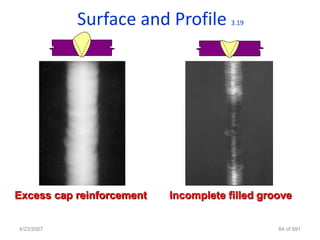
Excess cap reinforcement   Incomplete filled groove


4/23/2007                                       84 of 691
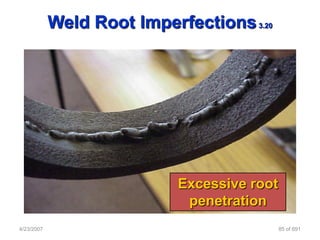
Weld Root Imperfections   3.20


                          Excessive root
                           penetration
4/23/2007                                    85 of 691
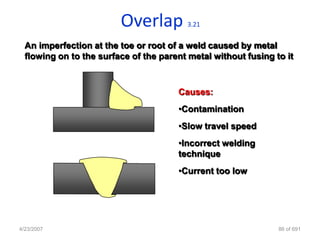
Overlap          3.21


  An imperfection at the toe or root of a weld caused by metal
  flowing on to the surface of the parent metal without fusing to it


                                       Causes:
                                       •Contamination
                                       •Slow travel speed
                                       •Incorrect welding
                                       technique
                                       •Current too low


4/23/2007                                                       86 of 691
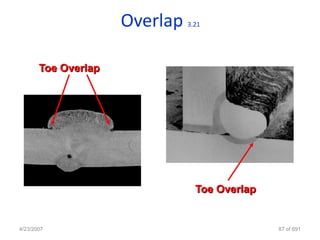
Overlap   3.21


       Toe Overlap


                                 Toe Overlap


4/23/2007                                      87 of 691
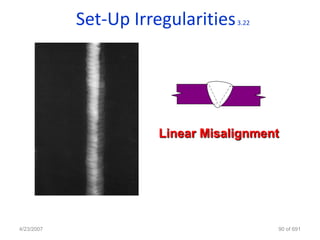
Set-Up Irregularities                3.22


                                     Linear misalignment is
                                     measured from the lowest
                                     plate to the highest point.

    Plate/pipe Linear Misalignment
                 (Hi-Lo)


                                     Angular misalignment is
                                     measured in degrees


        Angular Misalignment


4/23/2007                                                     88 of 691
Set-Up Irregularities   3.22


              Linear Misalignment

4/23/2007                                  89 of 691
Set-Up Irregularities   3.22


                      Linear Misalignment


4/23/2007                                  90 of 691
Incomplete Groove               3.23


     Lack of sidewall fusion + incomplete filled groove

4/23/2007                                            91 of 691
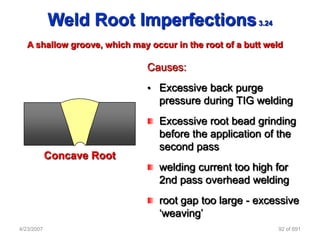
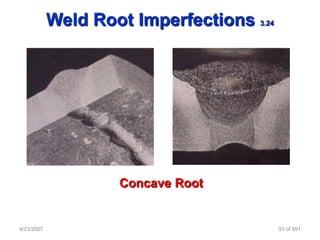
Weld Root Imperfections                      3.24


   A shallow groove, which may occur in the root of a butt weld

                               Causes:
                               • Excessive back purge
                                 pressure during TIG welding
                                 Excessive root bead grinding
                                 before the application of the
                                 second pass
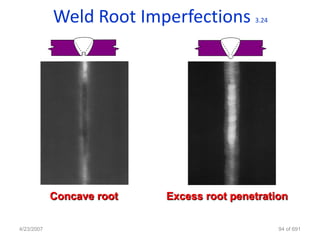
            Concave Root
                                 welding current too high for
                                 2nd pass overhead welding
                                 root gap too large - excessive
                                 „weaving‟
4/23/2007                                                       92 of 691
Weld Root Imperfections   3.24


                    Concave Root


4/23/2007                                    93 of 691
Weld Root Imperfections        3.24


            Concave root   Excess root penetration

4/23/2007                                         94 of 691
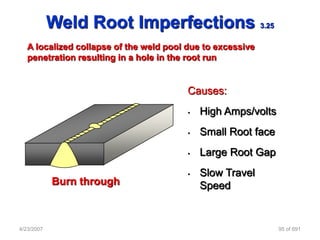
Weld Root Imperfections                         3.25


   A localized collapse of the weld pool due to excessive
   penetration resulting in a hole in the root run


                                         Causes:
                                         •   High Amps/volts
                                         •   Small Root face
                                         •   Large Root Gap
                                         •   Slow Travel
            Burn through                     Speed


4/23/2007                                                          95 of 691
Weld Root Imperfections   3.25


                    Burn Through


4/23/2007                                    96 of 691
Oxidized Root (Root Coking)
                     Causes:
                     •   Loss or insufficient
                         back purging gas (TIG)

                     •   Most commonly occurs
                         when welding stainless
                         steels

                     •   Purging gases include
                         argon, helium and
                         occasionally nitrogen

4/23/2007                                        97 of 691
Miscellaneous Imperfections                       3.26


                         Causes:
                         • Accidental striking of the
                           arc onto the parent
                           material
                         • Faulty electrode holder
                         • Poor cable insulation
                         • Poor return lead
                           clamping

            Arc strike

4/23/2007                                            98 of 691
Miscellaneous Imperfections             3.27


                       Causes:
                       •   Excessive current
                       •   Damp electrodes
                       •   Contamination
                       •   Incorrect wire feed
                           speed when welding
                           with the MAG welding
                           process
            Spatter    •   Arc blow

4/23/2007                                         99 of 691
Mechanical Damage             3.28


   Mechanical damage can be defined as any surface material
   damage cause during the manufacturing process.


            • Grinding
            • Hammering
            • Chiselling
            • Chipping
            • Breaking off welded attachments
             (torn surfaces)
            • Using needle guns to compress
             weld capping runs
4/23/2007                                                100 of 691
Mechanical Damage           3.28

                    Chipping Marks


            Mechanical Damage/Grinding Mark

4/23/2007                                      101 of 691
Welding Inspector
            Destructive Testing
                Section 4


4/23/2007                         102 of 691
Qualitative and Quantitative Tests 4.1
The following mechanical tests have units and are termed
quantitative tests to measure Mechanical Properties
• Tensile tests (Transverse Welded Joint, All Weld Metal)
• Toughness testing (Charpy, Izod, CTOD)
• Hardness tests (Brinell, Rockwell, Vickers)

The following mechanical tests have no units and are termed
qualitative tests for assessing joint quality
• Macro testing
• Bend testing
• Fillet weld fracture testing
• Butt weld nick-break testing
4/23/2007                                                   104 of 691
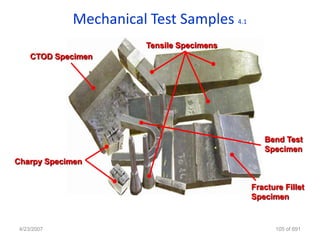
Mechanical Test Samples 4.1
                        Tensile Specimens
     CTOD Specimen


                                               Bend Test
                                               Specimen
Charpy Specimen


                                            Fracture Fillet
                                            Specimen


 4/23/2007                                        105 of 691
Destructive Testing 4.1
            WELDING PROCEDURE QUALIFICATION TESTING

            top of fixed pipe
                                2       Typical Positions for Test
                                        Pieces
                                        Specimen Type         Position
                                        •Macro + Hardness        5
                                    3
                                        •Transverse Tensile      2, 4
                                        •Bend Tests              2, 4
                                        •Charpy Impact Tests     3

                                4       •Additional Tests        3

                   5
4/23/2007                                                            106 of 691
Definitions
 Mechanical Properties of metals are related to the amount of
 deformation which metals can withstand under different
 circumstances of force application.


   • Malleability                 Ability of a material to
                                  withstand deformation
   • Ductility
                                  under static compressive
   • Toughness                    loading without rupture
   • Hardness
   • Tensile Strength


4/23/2007                                                   107 of 691
Definitions
 Mechanical Properties of metals are related to the amount of
 deformation which metals can withstand under different
 circumstances of force application.


   • Malleability                 Ability of a material
                                  undergo plastic
   • Ductility
                                  deformation under static
   • Toughness                    tensile loading without
   • Hardness                     rupture. Measurable
                                  elongation and reduction
   • Tensile Strength             in cross section area


4/23/2007                                                   108 of 691
Definitions
 Mechanical Properties of metals are related to the amount of
 deformation which metals can withstand under different
 circumstances of force application.


   • Malleability                 Ability of a material to
                                  withstand bending or the
   • Ductility
                                  application of shear
   • Toughness                    stresses by impact loading
   • Hardness                     without fracture.

   • Tensile Strength


4/23/2007                                                   109 of 691
Definitions
 Mechanical Properties of metals are related to the amount of
 deformation which metals can withstand under different
 circumstances of force application.


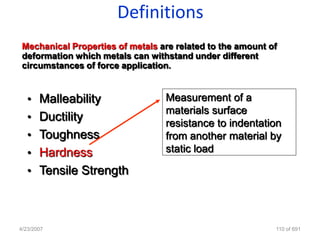
   • Malleability                 Measurement of a
                                  materials surface
   • Ductility
                                  resistance to indentation
   • Toughness                    from another material by
   • Hardness                     static load

   • Tensile Strength


4/23/2007                                                   110 of 691
Definitions
 Mechanical Properties of metals are related to the amount of
 deformation which metals can withstand under different
 circumstances of force application.


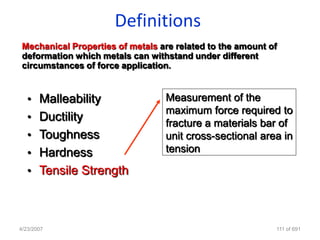
   • Malleability                 Measurement of the
                                  maximum force required to
   • Ductility
                                  fracture a materials bar of
   • Toughness                    unit cross-sectional area in
   • Hardness                     tension

   • Tensile Strength


4/23/2007                                                   111 of 691
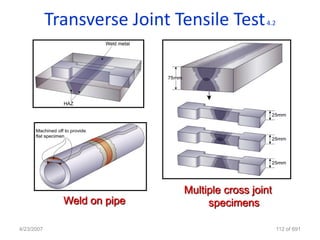
Transverse Joint Tensile Test       4.2


             Weld on plate


                              Multiple cross joint
              Weld on pipe         specimens

4/23/2007                                             112 of 691
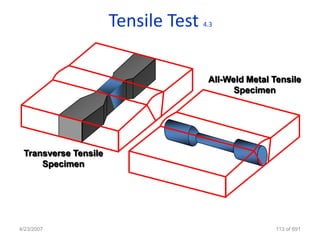
Tensile Test   4.3


                                      All-Weld Metal Tensile
                                            Specimen


 Transverse Tensile
     Specimen


4/23/2007                                             113 of 691
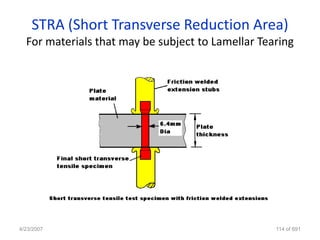
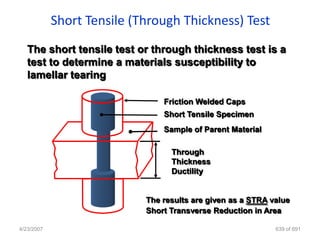
STRA (Short Transverse Reduction Area)
  For materials that may be subject to Lamellar Tearing


4/23/2007                                          114 of 691
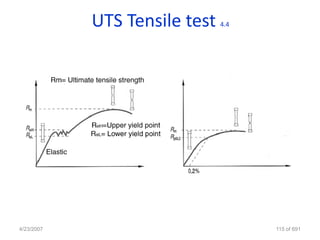
UTS Tensile test   4.4


4/23/2007                            115 of 691
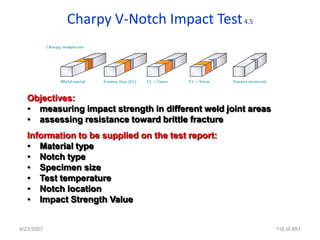
Charpy V-Notch Impact Test 4.5


   Objectives:
   • measuring impact strength in different weld joint areas
   • assessing resistance toward brittle fracture
   Information to be supplied on the test report:
   • Material type
   • Notch type
   • Specimen size
   • Test temperature
   • Notch location
   • Impact Strength Value


4/23/2007                                                      116 of 691
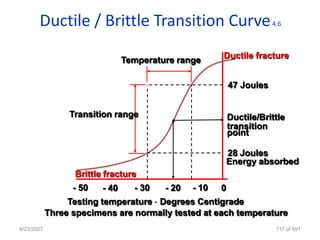
Ductile / Brittle Transition Curve                              4.6


                                                       Ductile fracture
                                Temperature range

                                                           47 Joules


                 Transition range                          Ductile/Brittle
                                                           transition
                                                           point

                                                           28 Joules
                                                           Energy absorbed
                  Brittle fracture
                  - 50   - 40     - 30   - 20   - 10   0
                 Testing temperature - Degrees Centigrade
            Three specimens are normally tested at each temperature
4/23/2007                                                               117 of 691
Comparison Charpy Impact Test Results 4.6

                   Impact Energy Joules
            Room Temperature     -20oC Temperature

             1.   197 Joules     1.     49 Joules
             2.   191 Joules     2.     53 Joules
             3.   186 Joules     3.     51 Joules

        Average = 191 Joules     Average = 51 Joules
   The test results show the specimens carried out at room
   temperature absorb more energy than the specimens carried
   out at -20oC

4/23/2007                                                118 of 691
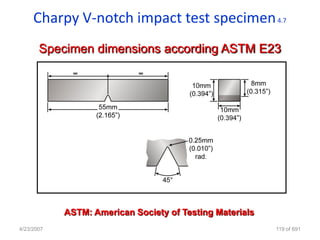
Charpy V-notch impact test specimen 4.7
       Specimen dimensions according ASTM E23


            ASTM: American Society of Testing Materials
4/23/2007                                                 119 of 691
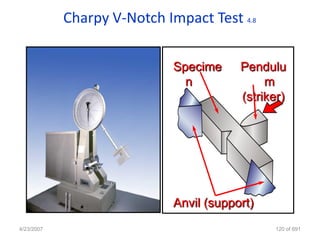
Charpy V-Notch Impact Test 4.8


                             Specime     Pendulu
                               n              m
                                         (striker)


                             Anvil (support)
4/23/2007                                      120 of 691
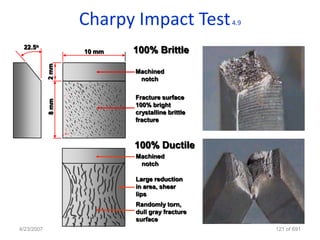
Charpy Impact Test            4.9


 22.5o
            2 mm   10 mm   100% Brittle

                           Machined
                            notch

                           Fracture surface
            8 mm


                           100% bright
                           crystalline brittle
                           fracture


                           100% Ductile
                           Machined
                            notch

                           Large reduction
                           in area, shear
                           lips
                           Randomly torn,
                           dull gray fracture
                           surface
4/23/2007                                              121 of 691
Hardness Testing           4.10


  Definition
       Measurement of resistance of a material against
       penetration of an indenter under a constant load
       There is a direct correlation between UTS and
       hardness

  Hardness tests:
       Brinell
       Vickers
       Rockwell

4/23/2007                                                 122 of 691
Hardness Testing                4.10


    Objectives:
    •   measuring hardness in different areas of a welded joint
    •   assessing resistance toward brittle fracture, cold cracking
        and corrosion sensitivity within a H2S (Hydrogen Sulphide)
        environment.

    Information to be supplied on the test report:
    •   material type
    •   location of indentation
    •   type of hardness test and load applied on the indenter
    •   hardness value


4/23/2007                                                         123 of 691
Vickers Hardness Test                4.11

   Vickers hardness tests:
       indentation body is a square based diamond pyramid
       (136º included angle)
       the average diagonal (d) of the impression is
       converted to a hardness number from a table
       it is measured in HV5, HV10 or HV025
                                               Adjustable
     Diamond                    Indentation    shutters
     indentor


4/23/2007                                               124 of 691
Vickers Hardness Test Machine   4.11


4/23/2007                           125 of 691
Brinell Hardness Test               4.11


   • Hardened steel ball of given diameter is subjected for
     a given time to a given load
   • Load divided by area of indentation gives Brinell
     hardness in kg/mm2
   • More suitable for on site hardness testing
                        30KN


                  Ø=10mm
                  steel ball

4/23/2007                                                126 of 691
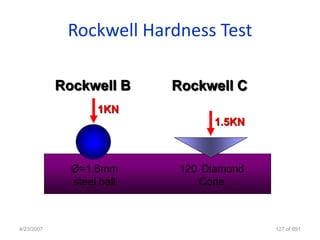
Rockwell Hardness Test

            Rockwell B     Rockwell C
                   1KN
                                 1.5KN


              Ø=1.6mm       120 Diamond
              steel ball       Cone


4/23/2007                                 127 of 691
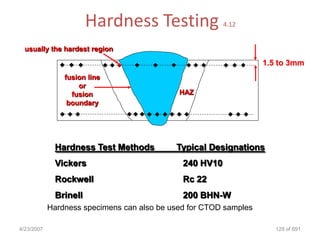
Hardness Testing                  4.12


  usually the hardest region
                                                                   1.5 to 3mm
                fusion line
                    or
                  fusion                     HAZ
                 boundary


             Hardness Test Methods          Typical Designations
             Vickers                          240 HV10
             Rockwell                         Rc 22
             Brinell                          200 BHN-W
            Hardness specimens can also be used for CTOD samples

4/23/2007                                                             128 of 691
Crack Tip Opening Displacement testing 4.12

• Test is for fracture toughness
• Square bar machined with a notch placed in
  the centre.
• Tested below ambient temperature at a
  specified temperature.
• Load is applied at either end of the test
  specimen in an attempt to open a crack at the
  bottom of the notch
• Normally 3 samples
4/23/2007                                  129 of 691
Fatigue Fracture      4.13


   Location: Any stress concentration area


   Steel Type: All steel types


   Susceptible Microstructure: All grain structures


            Test for Fracture Toughness is CTOD
             (Crack Tip Opening Displacement)


4/23/2007                                         130 of 691
Fatigue Fracture             4.13


  •   Fatigue cracks occur under cyclic stress conditions
  •   Fracture normally occurs at a change in section, notch
      and weld defects i.e stress concentration area
  •   All materials are susceptible to fatigue cracking
  •   Fatigue cracking starts at a specific point referred to as
      a initiation point
  •   The fracture surface is smooth in appearance
      sometimes displaying beach markings
  •   The final mode of failure may be brittle or ductile or a
      combination of both

4/23/2007                                                    131 of 691
Fatigue Fracture
Precautions against Fatigue Cracks
•   Toe grinding, profile grinding.
•   The elimination of poor profiles
•   The elimination of partial penetration welds and weld
    defects
•   Operating conditions under the materials endurance limits
•   The elimination of notch effects e.g. mechanical damage
    cap/root undercut
•   The selection of the correct material for the service
    conditions of the component
4/23/2007                                                   132 of 691
Fatigue Fracture
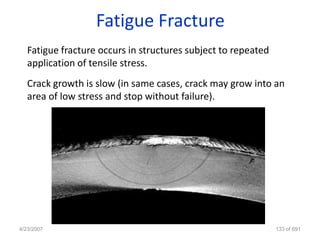
   Fatigue fracture occurs in structures subject to repeated
   application of tensile stress.
   Crack growth is slow (in same cases, crack may grow into an
   area of low stress and stop without failure).


4/23/2007                                                      133 of 691
Fatigue Fracture
   Secondary mode of failure           Fatigue fracture surface
   ductile fracture rough fibrous
   appearance                          smooth in appearance


    Initiation points / weld defects
4/23/2007                                                     134 of 691
Fatigue Fracture
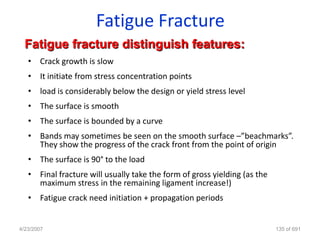
  Fatigue fracture distinguish features:
   • Crack growth is slow
   • It initiate from stress concentration points
   • load is considerably below the design or yield stress level
   • The surface is smooth
   • The surface is bounded by a curve
   • Bands may sometimes be seen on the smooth surface –”beachmarks”.
     They show the progress of the crack front from the point of origin
   • The surface is 90° to the load
   • Final fracture will usually take the form of gross yielding (as the
     maximum stress in the remaining ligament increase!)
   • Fatigue crack need initiation + propagation periods


4/23/2007                                                                  135 of 691
Bend Tests         4.15

      Object of test:
      •   To determine the soundness of the weld zone. Bend
          testing can also be used to give an assessment of
          weld zone ductility.
      •   There are three ways to perform a bend test:


                               Face bend
          Root bend                                   Side bend
Side bend tests are normally carried out on welds over 12mm in thickness
   4/23/2007                                                  136 of 691
Bending test                4.16


             Types of bend test for welds (acc. BS EN 910):


“t” up to 12 mm                Root / face
                                 bend

Thickness of material - “t”


 “t” over 12 mm                Side bend


 4/23/2007                                                    137 of 691
Fillet Weld Fracture Tests                 4.17


   Object of test:
   • To break open the joint through the weld to permit
     examination of the fracture surfaces
   • Specimens are cut to the required length
   • A saw cut approximately 2mm in depth is applied along
     the fillet welds length
   • Fracture is usually made by striking the specimen with a
     single hammer blow
   • Visual inspection for defects


4/23/2007                                                     138 of 691
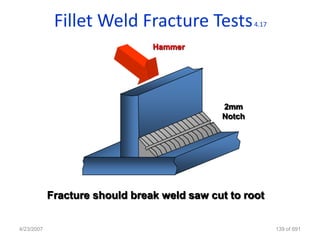
Fillet Weld Fracture Tests              4.17


                                Hammer


                                             2mm
                                             Notch


            Fracture should break weld saw cut to root


4/23/2007                                                   139 of 691
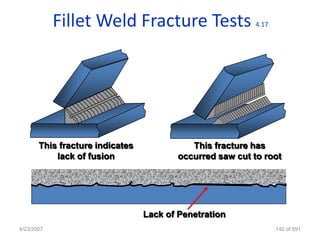
Fillet Weld Fracture Tests                    4.17


       This fracture indicates             This fracture has
           lack of fusion               occurred saw cut to root


                                 Lack of Penetration
4/23/2007                                                        140 of 691
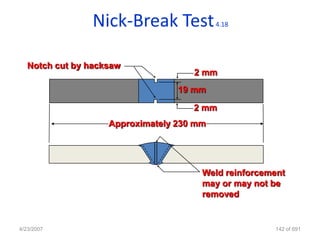
Nick-Break Test               4.18


   Object of test:
   • To permit evaluation of any weld defects across the
     fracture surface of a butt weld.
   • Specimens are cut transverse to the weld
   • A saw cut approximately 2mm in depth is applied along the
     welds root and cap
   • Fracture is usually made by striking the specimen with a
     single hammer blow
   • Visual inspection for defects


4/23/2007                                                       141 of 691
Nick-Break Test           4.18


   Notch cut by hacksaw
                                     2 mm
                                  19 mm

                                     2 mm
                    Approximately 230 mm


                                       Weld reinforcement
                                       may or may not be
                                       removed


4/23/2007                                             142 of 691
Nick Break Test             4.18


                                        Alternative nick-break test
                                        specimen, notch applied all
                                        way around the specimen


            Lack of root penetration   Inclusions on fracture
            or fusion                  line


4/23/2007                                                         143 of 691
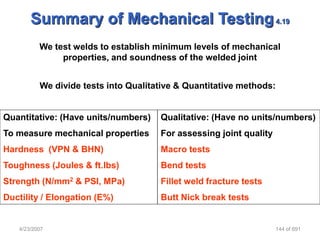
Summary of Mechanical Testing 4.19
          We test welds to establish minimum levels of mechanical
               properties, and soundness of the welded joint


          We divide tests into Qualitative & Quantitative methods:


Quantitative: (Have units/numbers)    Qualitative: (Have no units/numbers)
To measure mechanical properties      For assessing joint quality
Hardness (VPN & BHN)                  Macro tests
Toughness (Joules & ft.lbs)           Bend tests
Strength (N/mm2 & PSI, MPa)           Fillet weld fracture tests
Ductility / Elongation (E%)           Butt Nick break tests


   4/23/2007                                                        144 of 691
Welding Inspector
            WPS – Welder Qualifications
                    Section 5


4/23/2007                                 145 of 691
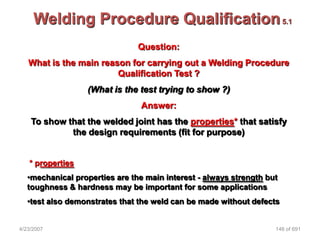
Welding Procedure Qualification 5.1
                                Question:
   What is the main reason for carrying out a Welding Procedure
                        Qualification Test ?
                  (What is the test trying to show ?)
                                 Answer:
    To show that the welded joint has the properties* that satisfy
             the design requirements (fit for purpose)


   * properties
   •mechanical properties are the main interest - always strength but
   toughness & hardness may be important for some applications
   •test also demonstrates that the weld can be made without defects


4/23/2007                                                           146 of 691
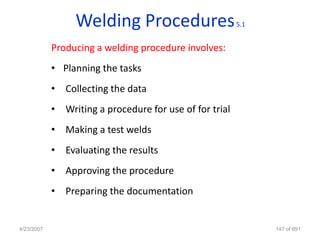
Welding Procedures                      5.1


            Producing a welding procedure involves:
            • Planning the tasks
            • Collecting the data
            • Writing a procedure for use of for trial
            • Making a test welds
            • Evaluating the results
            • Approving the procedure
            • Preparing the documentation


4/23/2007                                                      147 of 691
Welding Procedures 5.2
    In most codes reference is made to how the procedure are to
    be devised and whether approval of these procedures is
    required.
    The approach used for procedure approval depends on the
    code:
    Example codes:
    •   AWS D.1.1: Structural Steel Welding Code
    •   BS 2633: Class 1 welding of Steel Pipe Work
    •   API 1104: Welding of Pipelines
    •   BS 4515: Welding of Pipelines over 7 Bar

    Other codes may not specifically deal with the requirement of
    a procedure but may contain information that may be used in
    writing a weld procedure
    •       EN 1011Process of Arc Welding Steels
4/23/2007                                                    148 of 691
Welding Procedure Qualification 5.3

                 (according to EN ISO 15614)


 The welding engineer writes qualified Welding Procedure
 Specifications (WPS) for production welding


 Production welding conditions must remain within the range of
 qualification allowed by the WPQR


4/23/2007                                                  149 of 691
Welding Procedure Qualification                                        5.3


                       (according to EN Standards)
            welding conditions are called welding variables
  welding variables are classified by the EN ISO Standard as:

                        •Essential variables
                     •Non-essential variables
                       •Additional variables
   Note: additional variables = ASME supplementary essential
  The range of qualification for production welding is based on
  the limits that the EN ISO Standard specifies for essential
  variables*
            (* and when applicable - the additional variables)

4/23/2007                                                        150 of 691
Welding Procedure Qualification                                      5.3


                      (according to EN Standards)

               WELDING ESSENTIAL VARIABLES
   Question:
   Why are some welding variables classified as essential ?
   Answer:
   A variable, that if changed beyond certain limits (specified by
   the Welding Standard) may have a significant effect on the
   properties* of the joint
               * particularly joint strength and ductility


4/23/2007                                                      151 of 691
Welding Procedure Qualification 5.3
                        (according to EN Standards)
              SOME TYPICAL ESSENTIAL VARIABLES
   • Welding Process
   • Post Weld Heat Treatment (PWHT)
   • Material Type
   • Electrode Type, Filler Wire Type (Classification)
   • Material Thickness
   • Polarity (AC, DC+ve / DC-ve)
   • Pre-Heat Temperature
   • Heat Input
   • Welding Position


4/23/2007                                                152 of 691
Welding Procedures                   5.3


              Components of a welding procedure
   Parent material
        • Type (Grouping)
        • Thickness
        • Diameter (Pipes)
        • Surface condition)
   Welding process
        • Type of process (MMA, MAG, TIG, SAW etc)
        • Equipment parameters
        • Amps, Volts, Travel speed
   Welding Consumables
        • Type of consumable/diameter of consumable
        • Brand/classification
        • Heat treatments/ storage

4/23/2007                                                   153 of 691
Welding Procedures                        5.3


                   Components of a welding procedure
   Joint design
        •Edge preparation
        •Root gap, root face
        •Jigging and tacking
        •Type of baking
   Welding Position
        •Location, shop or site
        •Welding position e.g. 1G, 2G, 3G etc
        •Any weather precaution
   Thermal heat treatments
        •Preheat, temps
        •Post weld heat treatments e.g. stress relieving

4/23/2007                                                        154 of 691
Welding Procedures                   5.3


   Object of a welding procedure test
            To give maximum confidence that the welds mechanical
            and metallurgical properties meet the requirements of the
            applicable code/specification.
            Each welding procedure will show a range to which the
            procedure is approved (extent of approval)
            If a customer queries the approval evidence can be
            supplied to prove its validity


4/23/2007                                                         155 of 691
Welding Procedures
   Summary of designations:
   pWPS: Preliminary Welding Procedure Specification
   (Before procedure approval)

   WPAR (WPQR): Welding Procedure Approval Record
   (Welding procedure Qualification record)

   WPS: Welding Procedure Specification
   (After procedure approval)


4/23/2007                                              156 of 691
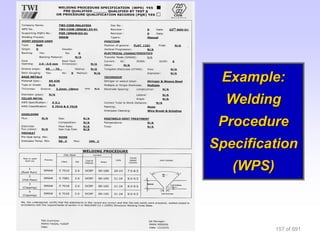
Example:
              Welding
             Procedure
            Specification
               (WPS)


4/23/2007              157 of 691
Welder Qualification                  5.4


   Numerous codes and standards deal with welder qualification,
    e.g. BS EN 287.
   • Once the content of the procedure is approved the next
     stage is to approve the welders to the approved procedure.
   • A welders test know as a Welders Qualification Test (WQT).
   Object of a welding qualification test:
   • To give maximum confidence that the welder meets the
     quality requirements of the approved procedure (WPS).
   • The test weld should be carried out on the same material and
     same conditions as for the production welds.


4/23/2007                                                    158 of 691
Welder Qualification                       5.4 & 5.5


                    (according to EN Standards)
   Question:
   What is the main reason for qualifying a welder ?


   Answer:
   To show that he has the skill to be able to make production
   welds that are free from defects
   Note: when welding in accordance with a Qualified WPS


4/23/2007                                                          159 of 691
Welder Qualification
                      (according to EN 287 )
                                                                 5.5


      The welder is allowed to make production welds within the
       range of qualification shown on the Certificate
      The range of qualification allowed for production welding is
       based on the limits that the EN Standard specifies for the
       welder qualification essential variables

      A Certificate may be withdrawn by the Employer if there is
        reason to doubt the ability of the welder, for example
      • a high repair rate
      • not working in accordance with a qualified WPS


The qualification shall remain valid for 2 years provided there is certified
confirmation of welding to the WPS in that time.
A Welder‟s Qualification Certificate automatically expires if the welder has not
used the welding process for 6 months or longer.

    4/23/2007                                                            160 of 691
Welding Procedure Qualification 5.7
                    (according to EN ISO 15614)
        Welding Engineer writes a preliminary Welding Procedure
          Specification (pWPS) for each test weld to be made

   • A welder makes a test weld in accordance with the pWPS

   • A welding inspector records all the welding conditions used
   for the test weld (referred to as the „as-run‟ conditions)

   An Independent Examiner/ Examining Body/ Third Party
   inspector may be requested to monitor the qualification
   process


    The finished test weld is subjected to NDT in accordance with
    the methods specified by the EN ISO Standard - Visual, MT or
                             PT & RT or UT

4/23/2007                                                     161 of 691
Welding Procedure Qualification 5.7
                   (according to EN ISO 15614)

  Test weld is subjected to destructive testing (tensile, bend,
  macro)
  The Application Standard, or Client, may require additional
  tests such as impact tests, hardness tests (and for some
  materials - corrosion tests)

  A Welding Procedure Qualification Record (WPQR) is prepared
  giving details of: -
          • The welding conditions used for the test weld
          • Results of the NDT
          • Results of the destructive tests
          • The welding conditions that the test weld allows for
            production welding
  The Third Party may be requested to sign the WPQR as a true
  record

4/23/2007                                                         162 of 691
Welder Qualification                   5.9

                       (according to EN 287 )

    An approved WPS should be available covering the range of
          qualification required for the welder approval.


   • The welder qualifies in accordance with an approved WPS

   • A welding inspector monitors the welding to make sure that the
   welder uses the conditions specified by the WPS

   EN Welding Standard states that an Independent Examiner,
   Examining Body or Third Party Inspector may be required to
   monitor the qualification process


4/23/2007                                                    163 of 691
Welder Qualification                        5.9

                         (according to EN 287 )


   The finished test weld is subjected to NDT by the methods
   specified by the EN Standard - Visual, MT or PT & RT or UT
   The test weld may need to be destructively tested - for certain
   materials and/or welding processes specified by the EN
   Standard or the Client Specification

   • A Welder‟s Qualification Certificate is prepared showing the
   conditions used for the test weld and the range of qualification
   allowed by the EN Standard for production welding
   • The Qualification Certificate is usually endorsed by a Third
   Party Inspector as a true record of the test


4/23/2007                                                      164 of 691
Welder Qualification                        5.10


Information that should be included on a welders test certificate are,
which the welder should have or have access to a copy of !

 •   Welders name and identification number
 •   Date of test and expiry date of certificate
 •   Standard/code e.g. BS EN 287
 •   Test piece details
 •   Welding process.
 •   Welding parameters, amps, volts
 •   Consumables, flux type and filler classification details
 •   Sketch of run sequence
 •   Welding positions
 •   Joint configuration details
 •   Material type qualified, pipe diameter etc
 •   Test results, remarks
 •   Test location and witnessed by
 •   Extent (range) of approval


     4/23/2007                                                         165 of 691
Welding Inspector
            Materials Inspection
                Section 6


4/23/2007                          167 of 691
Material Inspection
One of the most important items to consider is Traceability.
   The materials are of little use if we can not, by use of an effective QA
   system trace them from specification and purchase order to final
   documentation package handed over to the Client.
All materials arriving on site should be inspected for:
• Size / dimensions
• Condition
• Type / specification
   In addition other elements may need to be considered depending on
   the materials form or shape


   4/23/2007                                                      168 of 691
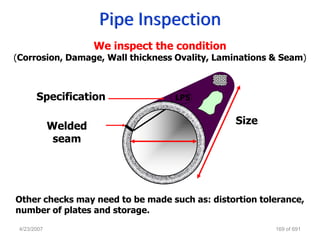
Pipe Inspection
                      We inspect the condition
(Corrosion, Damage, Wall thickness Ovality, Laminations & Seam)


       Specification                LP5


             Welded                              Size
              seam


Other checks may need to be made such as: distortion tolerance,
number of plates and storage.
 4/23/2007                                              169 of 691
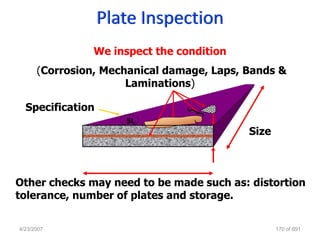
Plate Inspection
                We inspect the condition
      (Corrosion, Mechanical damage, Laps, Bands &
                      Laminations)

  Specification
                     5L
                                           Size


Other checks may need to be made such as: distortion
tolerance, number of plates and storage.

4/23/2007                                         170 of 691
Parent Material Imperfections
            Mechanical damage                     Lap


     Lamination


                                            Segregation line
Laminations are caused in the parent plate by the steel making
process, originating from ingot casting defects.
Segregation bands occur in the centre of the plate and are low
melting point impurities such as sulphur and phosphorous.
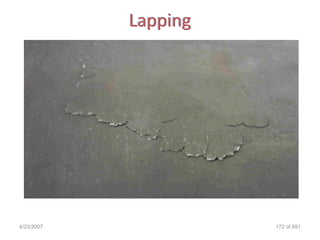
Laps are caused during rolling when overlapping metal does not
fuse to the base material.


4/23/2007                                                   171 of 691
Lapping


4/23/2007             172 of 691
Lamination


4/23/2007                173 of 691
Laminations


            Plate Lamination

4/23/2007                      174 of 691
Welding Inspector
            Codes & Standards
                Section 7


4/23/2007                       175 of 691
Codes & Standards
The 3 agencies generally identified in a code or standard:
The customer, or client
The manufacturer, or contractor
The 3rd party inspection, or clients representative


Codes often do not contain all relevant data, but may
refer to other standards


4/23/2007                                             176 of 691
Standard/Codes/Specifications
                        STANDARDS


SPECIFICATIONS                           CODES

            Examples                    Examples
        plate, pipe                  pressure vessels
  forgings, castings                     bridges
             valves                     pipelines
        electrodes                        tanks


4/23/2007                                         177 of 691
Welding Inspector
             Welding Symbols
                Section 8


4/23/2007                       178 of 691
Weld symbols on drawings
  Advantages of symbolic representation:
  • simple and quick plotting on the drawing
  • does not over-burden the drawing
  • no need for additional view
  • gives all necessary indications regarding the specific joint to
    be obtained


  Disadvantages of symbolic representation:
  • used only for usual joints
  • requires training for properly understanding of symbols

4/23/2007                                                     179 of 691
Weld symbols on drawings

 The symbolic representation includes:
 • an arrow line
 • a reference line
 • an elementary symbol

 The elementary symbol may be completed by:
 • a supplementary symbol
 • a means of showing dimensions
 • some complementary indications

4/23/2007                                     180 of 691
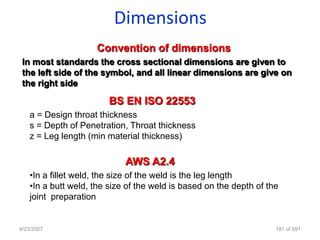
Dimensions
                    Convention of dimensions
 In most standards the cross sectional dimensions are given to
 the left side of the symbol, and all linear dimensions are give on
 the right side

                        BS EN ISO 22553
   a = Design throat thickness
   s = Depth of Penetration, Throat thickness
   z = Leg length (min material thickness)

                            AWS A2.4
   •In a fillet weld, the size of the weld is the leg length
   •In a butt weld, the size of the weld is based on the depth of the
   joint preparation


4/23/2007                                                           181 of 691
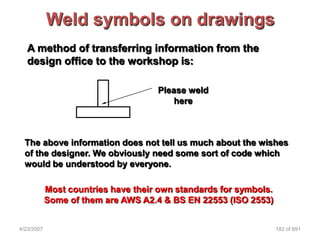
Weld symbols on drawings
   A method of transferring information from the
   design office to the workshop is:

                                     Please weld
                                         here


  The above information does not tell us much about the wishes
  of the designer. We obviously need some sort of code which
  would be understood by everyone.

            Most countries have their own standards for symbols.
            Some of them are AWS A2.4 & BS EN 22553 (ISO 2553)


4/23/2007                                                          182 of 691
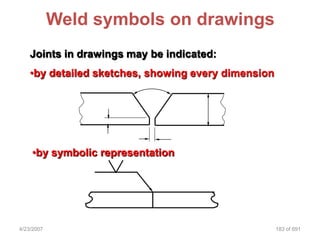
Weld symbols on drawings
    Joints in drawings may be indicated:
    •by detailed sketches, showing every dimension


    •by symbolic representation


4/23/2007                                            183 of 691
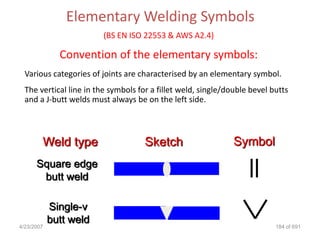
Elementary Welding Symbols
                         (BS EN ISO 22553 & AWS A2.4)

              Convention of the elementary symbols:
  Various categories of joints are characterised by an elementary symbol.
  The vertical line in the symbols for a fillet weld, single/double bevel butts
  and a J-butt welds must always be on the left side.


        Weld type                    Sketch                    Symbol
      Square edge
       butt weld

            Single-v
            butt weld
4/23/2007                                                                  184 of 691
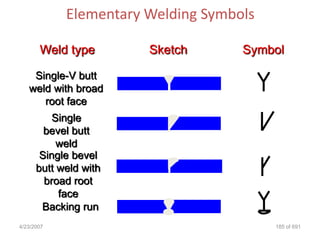
Elementary Welding Symbols

       Weld type       Sketch       Symbol

    Single-V butt
   weld with broad
      root face
          Single
        bevel butt
           weld
       Single bevel
      butt weld with
        broad root
           face
       Backing run
4/23/2007                                185 of 691
Elementary Welding Symbols

        Weld type      Sketch       Symbol
       Single-U
       butt weld

        Single-J
        butt weld

        Surfacing


        Fillet weld

4/23/2007                                 186 of 691
ISO 2553 / BS EN 22553


               Plug weld           Square Butt weld


            Resistance spot weld   Steep flanked
                                   Single-V Butt


            Resistance seam weld     Surfacing
4/23/2007                                          187 of 691
Arrow Line
                (BS EN ISO 22553 & AWS A2.4):
                  Convention of the arrow line:
   •   Shall touch the joint intersection
   •   Shall not be parallel to the drawing
   •   Shall point towards a single plate preparation (when only
       one plate has preparation)


4/23/2007                                                     188 of 691
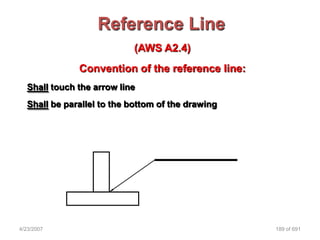
Reference Line
                           (AWS A2.4)
              Convention of the reference line:
  Shall touch the arrow line
  Shall be parallel to the bottom of the drawing


4/23/2007                                          189 of 691
Reference Line
                             (BS EN ISO 22553)
                    Convention of the reference line:
   •        Shall touch the arrow line
   •        Shall be parallel to the bottom of the drawing
   •        There shall be a further broken identification line above or
            beneath the reference line (Not necessary where the weld
            is symmetrical!)

                                                 or


4/23/2007                                                           190 of 691
Double side weld symbols
                   (BS EN ISO 22553 & AWS A2.4)
            Convention of the double side weld symbols:
   Representation of welds done from both sides of the joint
   intersection, touched by the arrow head


               Fillet weld        Double bevel       Double J


                             Double V     Double U


4/23/2007                                                       191 of 691
ISO 2553 / BS EN 22553

                              Reference lines

                       Arrow line

              Other side            Arrow side


              Arrow side            Other side


4/23/2007                                        192 of 691
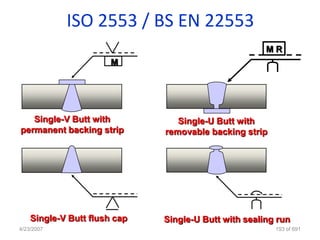
ISO 2553 / BS EN 22553
                                                      MR
                       M


   Single-V Butt with            Single-U Butt with
permanent backing strip       removable backing strip


    Single-V Butt flush cap   Single-U Butt with sealing run
4/23/2007                                               193 of 691
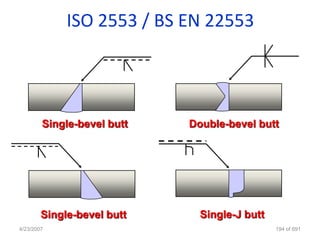
ISO 2553 / BS EN 22553


        Single-bevel butt   Double-bevel butt


        Single-bevel butt     Single-J butt
4/23/2007                                     194 of 691
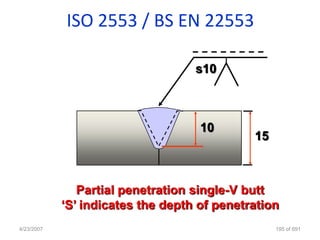
ISO 2553 / BS EN 22553

                                   s10


                                    10
                                             15


               Partial penetration single-V butt
            „S‟ indicates the depth of penetration
4/23/2007                                         195 of 691
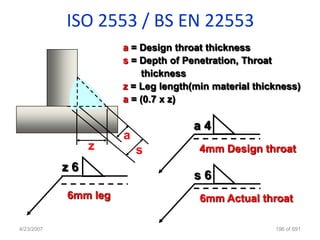
ISO 2553 / BS EN 22553
                      a = Design throat thickness
                      s = Depth of Penetration, Throat
                          thickness
                      z = Leg length(min material thickness)
                      a = (0.7 x z)

                                     a4
                      a
                 z        s           4mm Design throat
            z6
                                     s6
            6mm leg                   6mm Actual throat

4/23/2007                                             196 of 691
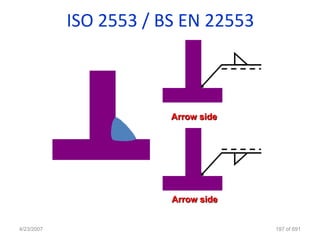
ISO 2553 / BS EN 22553


                        Arrow side


                        Arrow side


4/23/2007                            197 of 691
ISO 2553 / BS EN 22553
                                       s6


6mm fillet weld


                              Other side


                                           s6


                              Other side


  4/23/2007                                     198 of 691
ISO 2553 / BS EN 22553
            n = number of weld elements
            l = length of each weld element
            (e) = distance between each weld element


                  n x l (e)

                                            Welds to be
                                            staggered
                         2 x 40 (50)
                                            111
                         3 x 40 (50)
                                                  Process

4/23/2007                                                   199 of 691
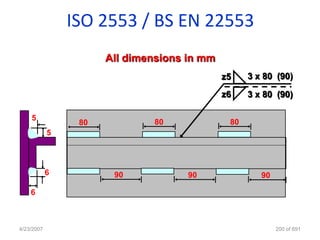
ISO 2553 / BS EN 22553
                      All dimensions in mm
                                             z5    3 x 80 (90)

                                             z6    3 x 80 (90)

    5
                 80           80              80
            5


            6          90            90               90

    6


4/23/2007                                                  200 of 691
ISO 2553 / BS EN 22553
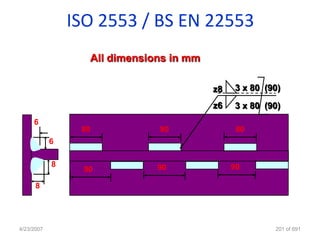
                   All dimensions in mm

                                          z8   3 x 80 (90)
                                          z6   3 x 80 (90)
     6
                 80            80               80
            6

            8                  90              90
                  90

      8


4/23/2007                                               201 of 691
Supplementary symbols
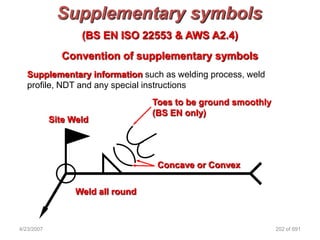
                   (BS EN ISO 22553 & AWS A2.4)
              Convention of supplementary symbols
   Supplementary information such as welding process, weld
   profile, NDT and any special instructions
                                   Toes to be ground smoothly
                                   (BS EN only)
            Site Weld


                                    Concave or Convex

                  Weld all round


4/23/2007                                                       202 of 691
Supplementary symbols
                (BS EN ISO 22553 & AWS A2.4)
            Convention of supplementary symbols
  Supplementary information such as welding process, weld profile,
  NDT and any special instructions
            Ground flush


                                                           111
                MR               M

             Removable       Permanent             Welding process
            backing strip   backing strip          numerical BS EN

  Further supplementary information, such as WPS number, or
  NDT may be placed in the fish tail
4/23/2007                                                     203 of 691
ISO 2553 / BS EN 22553

                    a      b


                   c       d

4/23/2007                            204 of 691
ISO 2553 / BS EN 22553


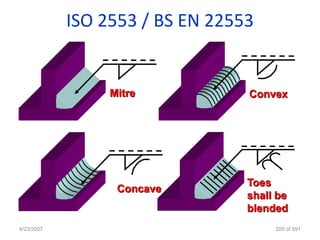
                 Mitre           Convex


                                 Toes
                  Concave
                                 shall be
                                 blended
4/23/2007                             205 of 691
ISO 2553 / BS EN 22553
                      a = Design throat thickness
                      s = Depth of Penetration, Throat
                          thickness
                      z = Leg length(min material thickness)
                      a = (0.7 x z)

                                     a4
                      a
                 z        s           4mm Design throat
            z6
                                     s6
            6mm leg                   6mm Actual throat

4/23/2007                                             206 of 691
ISO 2553 / BS EN 22553
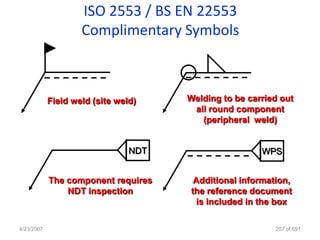
                    Complimentary Symbols


            Field weld (site weld)    Welding to be carried out
                                       all round component
                                         (peripheral weld)


                                NDT                    WPS


            The component requires     Additional information,
                NDT inspection        the reference document
                                        is included in the box

4/23/2007                                                 207 of 691
ISO 2553 / BS EN 22553
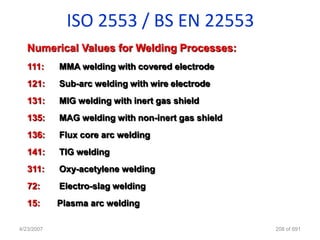
   Numerical Values for Welding Processes:
   111:     MMA welding with covered electrode
   121:     Sub-arc welding with wire electrode
   131:     MIG welding with inert gas shield
   135:     MAG welding with non-inert gas shield
   136:     Flux core arc welding
   141:     TIG welding
   311:     Oxy-acetylene welding
   72:      Electro-slag welding
   15:      Plasma arc welding

4/23/2007                                           208 of 691
AWS A2.4 Welding Symbols


4/23/2007                              209 of 691
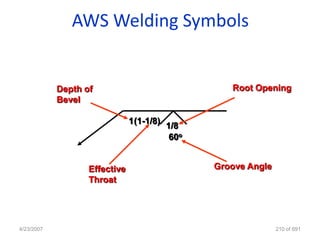
AWS Welding Symbols


            Depth of                                Root Opening
            Bevel

                               1(1-1/8)
                                          1/8
                                           60o


                   Effective                     Groove Angle
                   Throat


4/23/2007                                                       210 of 691
AWS Welding Symbols

                   Welding Process


                                         GSFCAW
                       1(1-1/8)
                                  1/8
                                   60o

            GMAW
            GTAW
            SAW


4/23/2007                                     211 of 691
AWS Welding Symbols
                   Welds to be
                   staggered

                  3 – 10
                                 SMAW
                  3 – 10
                                    Process

                   3                      3


                  10
4/23/2007                                     212 of 691
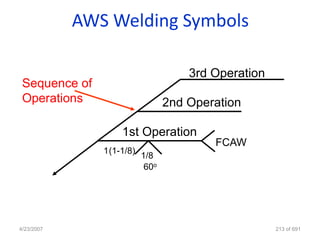
AWS Welding Symbols

                                     3rd Operation
 Sequence of
 Operations                      2nd Operation

                   1st Operation
                                         FCAW
               1(1-1/8)
                          1/8
                           60o


4/23/2007                                            213 of 691
AWS Welding Symbols

                                        RT
   Sequence of
   Operations                      MT
                                   MT
                                         FCAW
                 1(1-1/8)
                            1/8
                             60o


4/23/2007                                       214 of 691
AWS Welding Symbols
              Dimensions- Leg Length


                          6 leg on member A
                   6/8


                    Member A    6

                                      8

                                Member B
4/23/2007                                     215 of 691
Welding Inspector
            Intro To Welding Processes
                     Section 9


4/23/2007                                221 of 691
Welding Processes
   Welding is regarded as a joining process in which the work
   pieces are in atomic contact

            Pressure welding        Fusion welding
            • Forge welding         • Oxy-acetylene
            • Friction welding      • MMA (SMAW)
            • Resistance Welding    • MIG/MAG (GMAW)
                                    • TIG (GTAW)
                                    • Sub-arc (SAW)
                                    • Electro-slag (ESW)
                                    • Laser Beam (LBW)
                                    • Electron-Beam (EBW)


4/23/2007                                                   222 of 691
Constant Current Power Source
                    (Drooping Characteristic)
           100
                                                   O.C.V. Striking voltage (typical) for
           90
                                                   arc initiation
           80

                                                          Required for: MMA, TIG, Plasma
           70
                                                            arc and SAW > 1000 AMPS
           60
 Voltage


           50


           40                                                               Large voltage variation, e.g. +
                            Normal Operating                                10v (due to changes in arc
           30               Voltage Range                                   length)
                                                                            Small amperage change
           20
                                                                            resulting in virtually constant
                                                                            current e.g. + 5A.
           10

                  20   40   60   80   100   120   130   140   160   180   200

                                 Amperage
4/23/2007                                                                                    225 of 691
Monitoring Heat Input
• Heat Input:
The amount of heat generated in the
 welding arc per unit length of weld.
Expressed in kilo Joules per millimetre
length of weld (kJ/mm).

Heat Input (kJ/mm)= Volts x Amps
            Travel speed(mm/s) x 1000

4/23/2007                                 227 of 691
Monitoring Heat Input


            Weld and weld pool temperatures


4/23/2007                                     228 of 691
Monitoring Heat Input


4/23/2007                           229 of 691
Monitoring Heat Input
 • Monitoring Heat Input As Required by
 • BS EN ISO 15614-1:2004
 • In accordance with EN 1011-1:1998
When impact requirements and/or hardness requirements are
specified, impact test shall be taken from the weld in the highest
heat input position and hardness tests shall be taken from the
weld in the lowest heat input position in order to qualify for all
positions


 4/23/2007                                               230 of 691
Welding Inspector
              MMA Welding
               Section 10


4/23/2007                       231 of 691
MMA - Principle of operation


4/23/2007                                  233 of 691
MMA welding

Main features:
• Shielding provided by decomposition of flux covering
• Electrode consumable
• Manual process


Welder controls:
•    Arc length
•    Angle of electrode
•    Speed of travel
•    Amperage settings
4/23/2007                                                234 of 691
Manual Metal Arc Basic Equipment


 Control panel                         Power source
 (amps, volts)

       Electrode                       Holding oven
            oven
     Electrodes                        Inverter power
                                       source
   Return lead
                                       Electrode holder
Welding visor
  filter glass                         Power cables


4/23/2007                                      235 of 691
MMA Welding Plant
   Transformer:
   • Changes mains supply voltage to a voltage suitable for welding.
     Has no moving parts and is often termed static plant.
   Rectifier:
   • Changes a.c. to d.c., can be mechanically or statically achieved.
   Generator:
   • Produces welding current. The generator consists of an armature
     rotating in a magnetic field, the armature must be rotated at a
     constant speed either by a motor unit or, in the absence of
     electrical power, by an internal combustion engine.
   Inverter:
   • An inverter changes d.c. to a.c. at a higher frequency.


4/23/2007                                                         236 of 691
MMA Welding Variables
   Voltage
   • The arc voltage in the MMA process is measured as close to
     the arc as possible. It is variable with a change in arc length
   O.C.V.
   • The open circuit voltage is the voltage required to initiate, or
     re-ignite the electrical arc and will change with the type of
     electrode being used e.g 70-90 volts
   Current
   • The current used will be determined by the choice of
     electrode, electrode diameter and material type and
     thickness. Current has the most effect on penetration.
   Polarity
   • Polarity is generally determined by operation and electrode
     type e.g DC +ve, DC –ve or AC

4/23/2007                                                        237 of 691
Constant Current Power Source
                     (Drooping Characteristic)
            100

                                                   O.C.V. Striking voltage (typical) for arc
            90
                                                   initiation
            80


            70

            60
  Voltage


            50


            40                                                               Large voltage variation, e.g. +
                             Normal Operating                                10v (due to changes in arc
            30               Voltage Range                                   length)
                                                                             Small amperage change
            20
                                                                             resulting in virtually constant
                                                                             current e.g. + 5A.
            10

                   20   40   60   80   100   120   130   140   160   180   200

                                  Amperage
4/23/2007                                                                                    239 of 691
MMA welding parameters
                          Travel speed

                             Travel
      Too low                speed             Too high

•wide weld bead contour                  •lack of root fusion
•lack of penetration                     •incomplete root
•burn-through                            penetration
                                         •undercut
                                         •poor bead profile,
                                         difficult slag removal


4/23/2007                                            240 of 691
MMA welding parameters
  Type of current:
  • voltage drop in welding cables is lower with AC
  • inductive looses can appear with AC if cables are coiled
  • cheaper power source for AC
  • no problems with arc blow with AC
  • DC provides a more stable and easy to strike arc, especially
    with low current, better positional weld, thin sheet applications
  • welding with a short arc length (low arc voltage) is easier with
    DC, better mechanical properties
  • DC provides a smoother metal transfer, less spatter


4/23/2007                                                        241 of 691
MMA welding parameters
                         Welding current
     – approx. 35 A/mm of diameter
     – governed by thickness, type of joint and welding
            position

                             Welding
      Too low                current              Too high

•poor starting                                 •spatter
•slag inclusions                               •excess
•weld bead contour too                         penetration
high                                           •undercut
•lack of                                       •burn-through
fusion/penetration

4/23/2007                                                 242 of 691
MMA welding parameters
                  Arc length = arc voltage
                             Arc
      Too low              voltage              Too high

•arc can be extinguished                     •spatter
•“stubbing”                                  •porosity
                                             •excess
                                             penetration
                                             •undercut
                                             •burn-through


 Polarity: DCEP generally gives deeper penetration


4/23/2007                                                243 of 691
MMA - Troubleshooting


                  MMA quality (left to right)
            current, arc length and travel speed normal;
                           current too low;
                           current too high;
                        arc length too short;
                         arc length too long;
                       travel speed too slow;
4/23/2007               travel speed too high              244 of 691
MMA electrode holder


                               “Tongs” type with
        Collet or twist type
                               spring-loaded jaws
4/23/2007                                       245 of 691
MMA Welding Consumables

            MMA Covered Electrodes

 The three main electrode covering types used in MMA welding

 • Cellulosic - deep penetration/fusion
 • Rutile - general purpose
 • Basic - low hydrogen
 (Covered in more detail in Section 14)


4/23/2007                                                246 of 691
MMA welding typical defects
   Most welding defects in MMA are caused by a lack of welder
   skill (not an easily controlled process), the incorrect settings
   of the equipment, or the incorrect use, and treatment of
   electrodes
   Typical Welding Defects:
     •Slag inclusions
     •Arc strikes
     •Porosity
     •Undercut
     •Shape defects (overlap, excessive root penetration, etc.)


4/23/2007                                                         247 of 691
Manual Metal Arc Welding (MMA)
   Advantages:
   •    Field or shop use
   •    Range of consumables
   •    All positions
   •    Portable
   •    Simple equipment
   Disadvantages:
   •    High welder skill required
   •    High levels of fume
   •    Hydrogen control (flux)
   •    Stop/start problems
   •    Comparatively uneconomic when compared with some
        other processes i.e MAG, SAW and FCAW


4/23/2007                                              248 of 691
Welding Inspector
               TIG Welding
                Section 11


4/23/2007                       249 of 691
Tungsten Inert Gas Welding
   The TIG welding process was first developed in the USA
    during the 2nd world war for the welding of aluminum alloys
   • The process uses a non-consumable tungsten electrode
   • The process requires a high level of welder skill
   • The process produces very high quality welds.
   • The TIG process is considered as a slow process compared
     to other arc welding processes
   • The arc may be initiated by a high frequency to avoid scratch
     starting, which could cause contamination of the tungsten
     and weld


4/23/2007                                                    250 of 691
TIG - Principle of operation


4/23/2007                                  251 of 691
TIG Welding Variables
   Voltage
   The voltage of the TIG welding process is variable only by the
   type of gas being used, and changes in the arc length

   Current
   The current is adjusted proportionally to the tungsten
   electrodes diameter being used. The higher the current the
   deeper the penetration and fusion

   Polarity
   The polarity used for steels is always DC –ve as most of the
   heat is concentrated at the +ve pole, this is required to keep
   the tungsten electrode at the cool end of the arc. When
   welding aluminium and its alloys AC current is used

4/23/2007                                                      254 of 691
Types of current
               DC       • can be DCEN or DCEP
                        • DCEN gives deep penetration


               AC          can be sine or square wave
Type of                    requires a HF current (continuos
welding                    or periodical)
current                    provide cleaning action


             Pulsed • requires special power source
             current • low frequency - up to 20 pulses/sec
                       (thermal pulsing)
                     • better weld pool control
                     • weld pool partially solidifies
 4/23/2007             between pulses                 256 of 691
Choosing the proper electrode
                                      Current type influence


                                      + -                        +   -                      +   -
                                  +         -                +           -              +           -
                              +                 -        +                   -      +                   -


Current type & polarity           DCEN                 AC (balanced)                        DCEP

Heat balance                70% at work                 50% at work                35% at work
                          30% at electrode            50% at electrode           65% at electrode
Penetration                 Deep, narrow                     Medium                Shallow, wide
Oxide cleaning action              No               Yes - every half cycle                Yes
Electrode capacity             Excellent                     Good                        Poor
                          (e.g. 3,2 mm/400A)         (e.g. 3,2 mm/225A)          (e.g. 6,4 mm/120A)

   4/23/2007                                                                                            257 of 691
ARC CHARACTERISTICS
             Constant Current/Amperage Characteristic

                                      Large change in voltage =
        OCV                          Smaller change in amperage

       Volts
Large arc gap
                   Welding Voltage

  Small arc
    gap


                                     Amps

 4/23/2007                                                   258 of 691
TIG - arc initiation methods
                                  Arc initiation
                                    method
               Lift arc                                 HF start
• simple method                                need a HF generator (spark-
• tungsten electrode is in contact             gap oscillator) that generates a
  with the workpiece!
                                               high voltage AC output (radio
• high initial arc current due to the
  short circuit                                frequency) costly
• impractical to set arc length in             reliable method required on
  advance                                      both DC (for start) and AC (to
• electrode should tap the                     re-ignite the arc)
  workpiece - no scratch!
                                               can be used remotely
• ineffective in case of AC
• used when a high quality is not              HF produce interference
  essential                                    requires superior insulation

   4/23/2007                                                         259 of 691
Pulsed current
                                             • usually peak current is 2-10 times
                 Pulse Cycle Peak Background   background current
Current (A)


                 time time current  current
                                             • useful on metals sensitive to high heat
                                               input
                                             • reduced distortions
                                             • in case of dissimilar thicknesses equal
                                               penetration can be achieved


                          Average current
                                            Time

                one set of variables can be used in all positions
                used for bridging gaps in open root joints
                require special power source

              4/23/2007                                                     260 of 691
Choosing the proper electrode

            Polarity Influence – cathodic cleaning effect


4/23/2007                                                   261 of 691
Tungsten Electrodes
  Old types: (Slightly Radioactive)
  • Thoriated: DC electrode -ve - steels and most metals
  • 1% thoriated + tungsten for higher current values
  • 2% thoriated for lower current values
  • Zirconiated: AC - aluminum alloys and magnesium

  New types: (Not Radioactive)
  • Cerium: DC electrode -ve - steels and most metals
  • Lanthanum: AC - Aluminum alloys and magnesium


4/23/2007                                                  262 of 691
TIG torch set-up
     • Electrode extension


   Stickout                   2-3 times
                              electrode
                  Electrode   diameter
                  extension


Low electron                               Overheating
                Too    Electrode    Too
 emission                                     Tungsten
               small   extension   large
Unstable arc                                inclusions
  4/23/2007                                      263 of 691
Choosing the correct electrode
            Polarity Influence – cathodic cleaning effect


4/23/2007                                                   264 of 691
Tungsten Electrodes
  Old types: (Slightly Radioactive)
  • Thoriated: DC electrode -ve - steels and most metals
  • 1% thoriated + tungsten for higher current values
  • 2% thoriated for lower current values
  • Zirconiated: AC - aluminum alloys and magnesium

  New types: (Not Radioactive)
  • Cerium: DC electrode -ve - steels and most metals
  • Lanthanum: AC - Aluminum alloys and magnesium


4/23/2007                                                  265 of 691
Tungsten electrode types
   Pure tungsten electrodes:
       colour code - green
       no alloy additions
       low current carrying capacity
       maintains a clean balled end
       can be used for AC welding of Al and Mg alloys
       poor arc initiation and arc stability with AC compared
       with other electrode types
       used on less critical applications
       low cost
4/23/2007                                                 266 of 691
Tungsten electrode types
   Thoriated tungsten electrodes:
       colour code - yellow/red/violet
       20% higher current carrying capacity compared to
       pure tungsten electrodes
       longer life - greater resistance to contamination
       thermionic - easy arc initiation, more stable arc
       maintain a sharpened tip
       recommended for DCEN, seldom used on AC
       (difficult to maintain a balled tip)
       This slightly radioactive
4/23/2007                                                  267 of 691
Tungsten electrode types
  Ceriated tungsten electrodes:
      colour code - grey (orange acc. AWS A-5.12)
      operate successfully with AC or DC
      Ce not radioactive - replacement for thoriated types
   Lanthaniated tungsten electrodes:
       colour code - black/gold/blue
       operating characteristics similar with ceriated
       electrode


4/23/2007                                                268 of 691
Tungsten electrode types
  Zirconiated tungsten electrodes:
       colour code - brown/white
       operating characteristics fall between those of pure
       and thoriated electrodes
       retains a balled end during welding - good for AC
       welding
       high resistance to contamination
       preferred for radiographic quality welds


4/23/2007                                                  269 of 691
Electrode tip for DCEN
                              Penetration
                               increase
   electrode diameter


                                 Increase
       2-2,5 times


                                  Vertex
                                  angle

                                 Decrease

                              Bead width
                               increase
Electrode tip prepared for low         Electrode tip prepared for high
       current welding                        current welding
   4/23/2007                                                     270 of 691
Electrode tip for AC
            DC -ve                   AC


                              Electrode tip ground and
   Electrode tip ground
                                  then conditioned
4/23/2007                                         271 of 691
TIG Welding Variables
   Tungsten electrodes
   The electrode diameter, type and vertex angle are all critical
   factors considered as essential variables. The vertex angle is
   as shown

     DC -ve                               AC


    Vetex angle
                                      Note: when welding
     Note: too fine an angle will     aluminium with AC
     promote melting of the           current, the tungsten end
     electrodes tip                   is chamfered and forms a
                                      ball end when welding
4/23/2007                                                     272 of 691
Choosing the proper electrode
  Factors to be considered:


Electrode tip                               Excessive
                Too    Welding      Too
not properly                                melting or
                low    current      high
   heated                                  volatilisation


  Unstable                                   Tungsten
    arc               Penetration           inclusions


4/23/2007                                         273 of 691
Shielding gas requirements
• Preflow and                       Shielding gas flow

  postflow                          Welding current


                          Preflow                        Postflow


                      Flow rate                            Flow rate
                       too low                             too high


  4/23/2007                                                  275 of 691
Special shielding methods
Pipe root run shielding – Back Purging to prevent
excessive oxidation during welding, normally argon.


4/23/2007                                        276 of 691
TIG torch set-up
                 Electrode extension


   Stickout                   2-3 times
                              electrode
                  Electrode   diameter
                  extension


Low electron                               Overheating
                Too    Electrode    Too
 emission                                     Tungsten
               small   extension   large
Unstable arc                                inclusions
  4/23/2007                                      277 of 691
TIG Welding Consumables
   Welding consumables for TIG:
   •Filler wires, Shielding gases, tungsten electrodes (non-
    consumable).
   •Filler wires of different materials composition and variable
    diameters available in standard lengths, with applicable
    code stamped for identification
   •Steel Filler wires of very high quality, with copper coating to
    resist corrosion.
   •shielding gases mainly Argon and Helium, usually of highest
    purity (99.9%).


4/23/2007                                                      278 of 691
Tungsten Inclusion

 May be caused by Thermal Shock of
  heating to fast and small fragments
break off and enter the weld pool, so a
 “slope up” device is normally fitted to
prevent this could be caused by touch
               down also.
Most TIG sets these days have slope-
 up devices that brings the current to
   the set level over a short period of
 time so the tungsten is heated more
            slowly and gently


            A Tungsten Inclusion always shows up as
                  bright white on a radiograph
4/23/2007                                             279 of 691
TIG typical defects
   Most welding defects with TIG are caused by a lack of welder
   skill, or incorrect setting of the equipment. i.e. current, torch
   manipulation, welding speed, gas flow rate, etc.
     • Tungsten inclusions (low skill or wrong vertex angle)
     • Surface porosity (loss of gas shield mainly on site)
     • Crater pipes (bad weld finish technique i.e. slope out)
     • Oxidation of S/S weld bead, or root by poor gas cover
     • Root concavity (excess purge pressure in pipe)
     • Lack of penetration/fusion (widely on root runs)


4/23/2007                                                        280 of 691
Tungsten Inert Gas Welding
Advantages                 Disadvantages
• High quality             • High skill factor required
• Good control             • Low deposition rate
• All positions            • Small consumable range
• Lowest H2 process        • High protection required
• Minimal cleaning         • Complex equipment
• Autogenous welding       • Low productivity
    (No filler material)   • High ozone levels +HF
• Can be automated
4/23/2007                                            281 of 691
Welding Inspector
            MIG/MAG Welding
               Section 12


4/23/2007                       282 of 691
Gas Metal Arc Welding
   The MIG/MAG welding process was initially developed in the
   USA in the late 1940s for the welding of aluminum alloys.
   The latest EN Welding Standards now refer the process by the
   American term GMAW (Gas Metal Arc Welding)
     • The process uses a continuously fed wire electrode
     • The weld pool is protected by a separately supplied
       shielding gas
     • The process is classified as a semi-automatic welding
       process but may be fully automated
     • The wire electrode can be either bare/solid wire or flux
       cored hollow wire


4/23/2007                                                         283 of 691
MIG/MAG - Principle of operation


4/23/2007                                      284 of 691
MIG/MAG process variables
 • Welding current


                       •Increasing welding current
                       •Increase in depth and width
                       •Increase in deposition rate

• Polarity


4/23/2007                                             286 of 691
MIG/MAG process variables

• Arc voltage


                     •Increasing arc voltage
                     •Reduced penetration, increased width
                     •Excessive voltage can cause porosity,
                     spatter and undercut


• Travel speed
                     •Increasing travel speed
                     •Reduced penetration and width, undercut
4/23/2007                                                 287 of 691
Gas Metal Arc Welding
                     Types of Shielding Gas
  MIG (Metal Inert Gas)
  • Inert Gas is required for all non-ferrous alloys (Al, Cu, Ni)
  • Most common inert gas is Argon
  • Argon + Helium used to give a „hotter‟ arc - better for thicker
    joints and alloys with higher thermal conductivity


4/23/2007                                                           289 of 691
MIG/MAG – shielding gases
            Type of material      Shielding gas


             Carbon steel       CO2 , Ar+(5-20)%CO2


              Stainless steel   Ar+2%O2


                Aluminium       Ar


4/23/2007                                             290 of 691
MIG/MAG shielding gases
            Ar       Ar-He           He             CO2


  Argon (Ar):
   higher density than air; low thermal conductivity the arc
   has a high energy inner cone; good wetting at the toes; low
   ionisation potential
  Helium (He):
   lower density than air; high thermal conductivity uniformly
   distributed arc energy; parabolic profile; high ionisation
   potential
  Carbon Dioxide (CO2):
   cheap; deep penetration profile; cannot support spray
   transfer; poor wetting; high spatter
4/23/2007                                                 291 of 691
MIG/MAG shielding gases
                    Gases for dip transfer:
• CO2: carbon steels only: deep penetration; fast welding
  speed; high spatter levels
• Ar + up to 25% CO2: carbon and low alloy steels: minimum
  spatter; good wetting and bead contour
• 90% He + 7.5% Ar + 2.5% CO2:stainless steels: minimises
  undercut; small HAZ
• Ar: Al, Mg, Cu, Ni and their alloys on thin sections
• Ar + He mixtures: Al, Mg, Cu, Ni and their alloys on thicker
  sections (over 3 mm)

4/23/2007                                                   292 of 691
MIG/MAG shielding gases
                   Gases for spray transfer
• Ar + (5-18)% CO2: carbon steels: minimum spatter; good
  wetting and bead contour
• Ar + 2% O2: low alloy steels: minimise undercut; provides
  good toughness
• Ar + 2% O2 or CO2: stainless steels: improved arc stability;
  provides good fusion
• Ar: Al, Mg, Cu, Ni, Ti and their alloys
• Ar + He mixtures: Al, Cu, Ni and their alloys: hotter arc than
  pure Ar to offset heat dissipation
• Ar + (25-30)% N2: Cu alloys: greater heat input

4/23/2007                                                    293 of 691
Gas Metal Arc Welding
                     Types of Shielding Gas
   MAG (Metal Active Gas)
   • Active gases used are Oxygen and Carbon Dioxide
   • Argon with a small % of active gas is required for all steels
     (including stainless steels) to ensure a stable arc & good
     droplet wetting into the weld pool
   • Typical active gases are
   Ar + 20% CO2 for C-Mn & low alloy steels
   Ar + 2% O2             for stainless steels
   100% CO2               can be used for C - steels
4/23/2007                                                      294 of 691
MIG/MAG Gas Metal Arc Welding

Electrode
orientation


                Penetration        Deep   Moderate Shallow
                Excess weld metal Maximum Moderate Minimum
                Undercut          Severe Moderate Minimum


Electrode extension
                                  •Increased extension
4/23/2007                                                295 of 691
MIG / MAG - self-regulating arc
                Stable condition                               Sudden change in gun position
                              Arc length L = 6,4 mm                       Arc length L‟ = 12,7 mm
                              Arc voltage = 24V                           Arc voltage = 29V
                              Welding current = 250A                      Welding current = 220A
                              WFS = 6,4 m/min                             WFS = 6,4 m/min
                              Melt off rate = 6,4 m/min                   Melt off rate = 5,6
                                                                          m/min
                                                          L‟            25 mm
            L                 19 mm
                Voltage (V)


                                                                      Current (A)

4/23/2007                                                                             296 of 691
MIG/MAG - self-regulating arc
            Sudden change in gun position                          Re-established stable condition
                                   Arc length L‟ = 12,7 mm                      Arc length L = 6,4 mm
                                   Arc voltage = 29V                            Arc voltage = 24V
                                   Welding current = 220A                       Welding current = 250A
                                   WFS = 6,4 m/min                              WFS = 6,4 m/min
                                   Melt off rate = 5,6 m/min                    Melt off rate = 6,4 m/min

       L‟                          25 mm                                      25 mm
                                                               L
                     Voltage (V)


                                                                            Current (A)


4/23/2007                                                                                       297 of 691
Terminating the arc
      Crater fill
    • Burnback time
     – delayed current cut-off to prevent wire freeze
       in the weld end crater
     – depends on WFS (set as short as possible!)
  Contact tip
                                            3 mm
                              8 mm                 Current - 250A
                   14 mm
                                      Insulatin    Voltage - 27V
                                        g slag     WFS - 7,8 m/min
                                                   Wire diam. - 1,2 mm
Burnback time 0.05 sec   0.10 sec    0.15 sec
                                                   Shielding gas -
   Workpiec
                                                   Ar+18%CO2
      e

 4/23/2007                                                           298 of 691
MIG/MAG - metal transfer modes


                                   Contact tip          Electrode
Contact tip                        recessed             extension
extension              Electrode
                                   (3-5 mm)             19-25 mm
(0-3,2 mm)             extension
                       6-13 mm


    Set-up for dip transfer          Set-up for spray transfer

  4/23/2007                                             299 of 691
MIG/MAG - metal transfer modes
                                                 Electrode diameter = 1,2 mm
        Voltage
                                                 WFS = 8,3 m/min
                                                 Current = 295 A
                                                 Voltage = 28V


                  Globular           Spray
                  transfer          transfer

                                            Electrode diameter = 1,2 mm
                                            WFS = 3,2 m/min
                                            Current = 145 A

                             Dip transfer   Voltage = 18-20V

                                                              Current


4/23/2007
                  Current/voltage conditions                            301 of 691
MIG/MAG-methods of metal transfer
                  Dip transfer
        Transfer occur due to short circuits
        between wire and weld pool, high
        level of spatter, need inductance
        control to limit current raise
        Can use pure CO2 or Ar- CO2
        mixtures as shielding gas
        Metal transfer occur when arc is
        extinguished
        Requires low welding current/arc
        voltage, a low heat input process.
        Resulting in low residual stress
        and distortion
        Used for thin materials and all
        position welds
4/23/2007                                      303 of 691
MIG/MAG-methods of metal transfer
              Spray transfer
       Transfer occur due to pinch
       effect NO contact between wire
       and weld pool!
       Requires argon-rich shielding
       gas
       Metal transfer occur in small
       droplets, a large volume weld
       pool
       Requires high welding
       current/arc voltage, a high heat
       input process. Resulting in high
       residual stress and distortion
       Used for thick materials and
       flat/horizontal position welds
4/23/2007                                 306 of 691
MIG/MAG-methods of metal transfer
                         Pulsed transfer
       Controlled metal transfer, one droplet per pulse,
       No transfer between droplet and weld pool!
       Requires special power sources
       Metal transfer occur in small droplets (diameter equal
       to that of electrode)
       Requires moderate welding current/arc voltage, a
       reduced heat input . Resulting in smaller residual
       stress and distortion compared to spray transfer
       Pulse frequency controls the volume of weld pool,
       used for root runs and out of position welds
4/23/2007                                                   307 of 691
MIG/MAG - metal transfer modes
                 Pulsed transfer

       Controlled metal transfer. one droplet
       per pulse. NO transfer during
       background current!
       Requires special power sources
       Metal transfer occur in small droplets
       (diameter equal to that of electrode)
      Requires moderate welding current/arc voltage, reduced
      heat input‟ smaller residual stress and distortions
      compared to spray transfer
      Pulse frequency controls the volume of weld pool, used
      for root runs and out of position welds
4/23/2007                                             308 of 691
MIG/MAG-methods of metal transfer
   Globular transfer
       Transfer occur due to gravity or
       short circuits between drops and
       weld pool
       Requires CO2 shielding gas
       Metal transfer occur in large drops
       (diameter larger than that of
       electrode) hence severe spatter
       Requires high welding current/arc
       voltage, a high heat input process.
       Resulting in high residual stress
       and distortion
       Non desired mode of transfer!


4/23/2007                                    310 of 691
Flat or Constant Voltage Characteristic

                 Flat or Constant Voltage Characteristic Used With
                        MIG/MAG, ESW & SAW < 1000 amps
                                                    O.C.V. Arc Voltage
                                                    Virtually no Change.
      33

      32

       31
            Small Voltage
            Change.
 Voltage
                                  Large Current Change


                            100                          200                 300
                                      Amperage

4/23/2007                                                                  315 of 691
MIG/MAG welding gun assembly
                      Gas           The Push-Pull gun
      Contact         diffuser
      tip


                  Union nut


                        Trigger        WFS remote
             Gas
                                       control
             nozzle
                                       potentiometer
                           Handle

4/23/2007                                       316 of 691
Gas Metal Arc Welding
                    PROCESS CHARACTERISTICS
   • Requires a constant voltage power source, gas supply, wire
     feeder, welding torch/gun and „hose package‟
   • Wire is fed continuously through the conduit and is burnt-off
     at a rate that maintains a constant arc length/arc voltage
   • Wire feed speed is directly related to burn-off rate
   • Wire burn-off rate is directly related to current
   • When the welder holds the welding gun the process is said
     to be a semi-automatic process
   • The process can be mechanised and also automated
   • In Europe the process is usually called MIG or MAG

4/23/2007                                                     318 of 691
MIG/MAG typical defects
  Most welding imperfections in MIG/MAG are caused by lack of
  welder skill, or incorrect settings of the equipment
  •Worn contact tips will cause poor power pick up, or transfer
  •Bad power connections will cause a loss of voltage in the arc
  •Silica inclusions (in Fe steels) due to poor inter-run cleaning
  •Lack of fusion (primarily with dip transfer)
  •Porosity (from loss of gas shield on site etc)
  •Solidification problems (cracking, centerline pipes, crater
  pipes) especially on deep narrow welds


4/23/2007                                                        322 of 691
WELDING PROCESS

               Flux Core Arc Welding

            (Not In The Training Manual)


4/23/2007                                  323 of 691
Flux cored arc welding
                     FCAW
                    methods


    With gas       Without gas     With metal
   shielding -      shielding -    powder -
  “Outershield”   “Innershield”   “Metal core”


4/23/2007                                  324 of 691
“Outershield” - principle of operation


4/23/2007                                   325 of 691
“Innershield” - principle of operation


4/23/2007                                    326 of 691
ARC CHARACTERISTICS
                   Constant Voltage Characteristic


   OCV                                Small change in voltage =
                                      large change in amperage
Large arc gap

Small arc gap

                                                    The self
          Volts                                  adjusting arc.


                              Amps

  4/23/2007                                                327 of 691
Flux Core Arc Welding (FCAW)

                Flux core              Insulated extension nozzle

                                       Current carrying guild tube
                Wire joint
                                       Flux cored hollow wire

                                       Flux powder
                                       Arc shield composed of
                                       vaporized and slag forming
Flux core                              compounds
  wires


                              Molten
                              weld     Metal droplets covered
            Solidified weld   pool
                                       with thin slag coating
            metal and slag
4/23/2007                                              328 of 691
Flux cored arc welding
                             FCAW
                            methods


    With gas            Without gas        With metal
   shielding -           shielding -       powder -
  “Outershield”        “Innershield”      “Metal core”
                            (114)


             With active          With inert gas
            gas shielding         shielding (137)
                (136)
4/23/2007                                           329 of 691
FCAW - differences from MIG/MAG
• usually operates in DCEP
  but some “Innershield”
  wires operates in DCEN
• power sources need to be
  more powerful due to the
  higher currents
• doesn't work in deep
  transfer mode
• require knurled feed rolls


   “Innershield” wires use
   a different type of
   welding gun
4/23/2007                         330 of 691
Backhand (“drag”) technique
   Advantages
       preferred method for flat or horizontal position
       slower progression of the weld
       deeper penetration
       weld stays hot longer, easy to remove dissolved
       gasses
 Disadvantages
     produce a higher weld profile
     difficult to follow the weld joint
     can lead to burn-through on thin sheet plates
4/23/2007                                        331 of 691
Forehand (“push”) technique
   Advantages
        preferred method for vertical up or overhead
        position
        arc is directed towards the unwelded joint , preheat
        effect
        easy to follow the weld joint and control the
        penetration
   Disadvantages
      produce a low weld profile, with coarser ripples
      fast weld progression, shallower depth of penetration
      the amount of spatter can increase


4/23/2007                                                 332 of 691
FCAW advantages
 • less sensitive to lack of fusion
 • requires smaller included angle compared to MMA
 • high productivity
 • all positional
 • smooth bead surface, less danger of undercut
 • basic types produce excellent toughness properties
 • good control of the weld pool in positional welding especially
   with rutile wires
 • seamless wires have no torsional strain, twist free
 • ease of varying the alloying constituents
 • no need for shielding gas

4/23/2007                                                  333 of 691
FCAW disadvantages
   • limited to steels and Ni-base alloys
   • slag covering must be removed
   • FCAW wire is more expensive on a weight basis than solid
     wires (exception: some high alloy steels)
   • for gas shielded process, the gaseous shield may be
     affected by winds and drafts
   • more smoke and fumes are generated compared with
     MIG/MAG
   • in case of Innershield wires, it might be necessary to
     break the wire for restart (due to the high amount of
     insulating slag formed at the tip of the wire)


4/23/2007                                                 334 of 691
FCAW advantages/disadvantages
             Advantages:        Disadvantages:

1) Field or shop use       1) High skill factor

2) High productivity       2) Slag inclusions

3) All positional          3) Cored wire is
                               Expensive
4) Slag supports and
    shapes the weld Bead   4) High level of fume
                               (Inner-shield)
5) No need for shielding
    gas                    5) Limited to steels and
                               nickel alloys

 4/23/2007                                         335 of 691
Welding Inspector
            Submerged Arc Welding
                 Section 13


4/23/2007                           336 of 691
Submerged Arc Welding Introduction
   • Submerged arc welding was developed in the Soviet Union
     during the 2nd world war for the welding of thick section steel.
   • The process is normally mechanized.
   • The process uses amps in the range of 100 to over 2000, which
     gives a very high current density in the wire producing deep
     penetration and high dilution welds.
   • A flux is supplied separately via a flux hopper in the form of either
     fused or agglomerated.
   • The arc is not visible as it is submerged beneath the flux layer
     and no eye protection is required.


4/23/2007                                                               337 of 691
SAW Principle of operation


4/23/2007                                338 of 691
Principles of operation
  Factors that determine whether to use SAW chemical
  composition and mechanical properties required for the weld
  deposit
     • thickness of base metal to be welded
     • joint accessibility
     • position in which the weld is to be made
     • frequency or volume of welding to be performed

                             SAW methods


Semiautomatic                Mechanised             Automatic

4/23/2007                                                 339 of 691
Submerged Arc Welding
                     Filler wire spool
                                      Flux hopper
                Power
                supply


                   -   +

                                           Slide rail
            Wire electrode

                                       Flux


4/23/2007                                               340 of 691
SAW process variables
   • welding current
   • current type and polarity
   • welding voltage
   • travel speed
   • electrode size
   • electrode extension
   • width and depth of the layer of flux


4/23/2007                                   341 of 691
SAW process variables
 Welding current
   •controls depth of penetration and the amount of
   base metal melted & dilution


4/23/2007                                        342 of 691
SAW operating variables
   Current type and polarity

                               •Usually DCEP, deep
                               penetration, better
                               resistance to
                               porosity
                               •DCEN increase
                               deposition rate but
                               reduce penetration
                               (surfacing)
                               •AC used to avoid
                               arc blow; can give
                               unstable arc
4/23/2007                                    343 of 691
SAW Consumables
                    (Covered in detail in Section 14)

  Fused fluxes advantages:
    •good chemical homogeneity
    •easy removal of fines without affecting flux
    composition
    •normally not hygroscopic & easy storage and handling
    •readily recycled without significant change in particle
    size or composition

  Fused fluxes disadvantages:
     •difficult to add deoxidizers and ferro-alloys (due to
     segregation or extremely high loss)
     •high temperatures needed to melt ingredients limit the
     range of flux compositions

4/23/2007                                                     344 of 691
SAW Consumables
   Agglomerated fluxes advantages:
   • easy addition of deoxidizers and alloying elements
   • usable with thicker layer of flux when welding
   • colour identification


   Agglomerated fluxes disadvantages:
   • tendency to absorb moisture
   • possible gas evolution from the molten slag leading to
     porosity
   • possible change in flux composition due to segregation or
     removal of fine mesh particles

4/23/2007                                                     345 of 691
SAW equipment
  Power sources can be:
  •    transformers for AC
  •    transformer-rectifiers for DC
  Static characteristic can be:
  •    Constant Voltage (flat) - most of the power sources
  •    Constant Current (drooping)


4/23/2007                                                    346 of 691
SAW equipment
   Constant Voltage (Flat Characteristic) power sources:
   •    most commonly used supplies for SAW
   •    can be used for both semiautomatic and automatic welding
   •    self-regulating arc
   •    simple wire feed speed control
   •    wire feed speed controls the current and power supply
        controls the voltage
   •    applications for DC are limited to 1000A due to severe arc
        blow (also thin wires!)


4/23/2007                                                       347 of 691
ARC CHARACTERISTICS
                   Constant Voltage Characteristic


   OCV                                Small change in voltage =
                                      large change in amperage
Large arc gap

Small arc gap

                                                    The self
          Volts                                  adjusting arc.


                              Amps

  4/23/2007                                                348 of 691
SAW equipment
   Constant Current (Drooping Characteristic) power sources:
   •   Over 1000A - very fast speed required - control of burn off
       rate and stick out length
   •   can be used for both semiautomatic and automatic welding
   •   not self-regulating arc
   •   must be used with a voltage-sensing variable wire feed
       speed control
   •   more expensive due to more complex wire feed speed
       control
   •   arc voltage depends upon wire feed speed whilst the power
       source controls the current
   •   cannot be used for high-speed welding of thin steel

4/23/2007                                                       349 of 691
SAW equipment
   Welding heads can be mounted on a:
   Tractor type carriage
   •   provides travel along straight or
       gently curved joints
   •   can ride on tracks set up along the
       joint (with grooved wheels) or on
       the workpiece itself                    Courtesy of ESAB AB

   •   can use guide wheels as tracking
       device
   •   due to their portability, are used in
       field welding or where the piece
       cannot be moved


4/23/2007
                                               Courtesy of ESAB AB   350 of 691
SAW operating variables
 Welding current
  •too high current: excessive excess weld metal
  (waste of electrode), increase weld shrinkage and
  causes greater distortions
   •excessively high current: digging arc, undercut,
   burn through; also a high and narrow bead &
   solidification cracking
   •too low current: incomplete
   fusion or inadequate penetration
   •excessively low current:
   unstable arc


4/23/2007                                              351 of 691
SAW operating variables
  Welding voltage
                                      •welding voltage controls arc
                                      length
                                      •increase in voltage produce a
                                      flatter and wider bead
                                      •increase in voltage increase
                                      flux consumption
                                      •increase in voltage tend to
                                      reduce porosity
                                      •an increased voltage may
                                      help bridging an excessive
                                      root gap
•an increased voltage can increase pick-up of alloying elements
from an alloy flux
4/23/2007                                                   352 of 691
SAW operating variables
 Welding voltage


   •low voltage produce a
   “stiffer” arc & improves
   penetration in a deep
   weld groove and resists
   arc blow
   •excessive low voltage
   produce a high narrow
   bead & difficult slag
   removal


4/23/2007                             353 of 691
SAW operating variables
 Welding voltage

   •excessively high voltage
   produce a “hat-shaped” bead
   & tendency to crack

  •excessively high voltage
  increase undercut & make slag
  removal difficult in groove
  welds

  •excessively high voltage
  produce a concave fillet weld
  that is subject to cracking
4/23/2007                             354 of 691
SAW operating variables
 Travel speed
 •increase in travel speed: decrease heat input & less
 filler metal applied per unit of length, less excess
 weld metal & weld bead becomes smaller


4/23/2007                                          355 of 691
SAW operating variables
 Travel speed

   •excessively high speed
   lead to undercut, arc
   blow and porosity


  •excessively low speed
  produce “hat-shaped” beads
    danger of cracking

   •excessively low speed produce rough beads and
   lead to slag inclusions

4/23/2007                                       356 of 691
SAW operating variables
                 Electrode size
    •at the same current, small electrodes have higher
    current density & higher deposition rates


4/23/2007                                           357 of 691
SAW operating variables
 Electrode extension
    •increased electrode extension adds resistance in the
    welding circuit I increase in deposition rate, decrease in
    penetration and bead width


    •to keep a proper weld shape, when electrode extension is
    increased, voltage must also be increased
    •when burn-through is a problem (e.g. thin gauge), increase
    electrode extension
    •excessive electrode extension: it is more difficult to
    maintain the electrode tip in the correct position

4/23/2007                                                        358 of 691
SAW operating variables
 Depth of flux
    •depth of flux layer influence the appearance of weld
    •usually, depth of flux is 25-30 mm
    •if flux layer is to deep the arc is too confined, result is
    a rough ropelike appearing weld
    •if flux layer is to deep the gases cannot escape & the
    surface of molten weld metal becomes irregularly
    distorted
    •if flux layer is too shallow, flashing and spattering will
    occur, give a poor appearance and porous weld

4/23/2007                                                359 of 691
SAW technological variables
             Travel angle effect - Butt weld on plates


        Penetration            Deep      Moderate   Shallow
        Excess weld metal      Maximum   Moderate   Minimum
        Tendency to undercut   Severe    Moderate   Minimum
4/23/2007                                                363 of 691
SAW technological variables
   Earth position          +

            Direction of
            travel

                                          -


•welding towards earth produces backward arc blow
•deep penetration
•convex weld profile


4/23/2007                                      364 of 691
SAW technological variables
   Earth position
                           +

            Direction of
            travel

              -


     •welding away earth produces forward arc blow
     •normal penetration depth
     •smooth, even weld profile


4/23/2007                                            365 of 691
Weld backing

    Backing strip


   Backing weld


   Copper backing


4/23/2007                          366 of 691
Starting/finishing the weld


4/23/2007                                 367 of 691
SAW variants
 Twin wire SAW welding   •two electrodes are feed
                         into the same weld pool
                         •wire diameter usually 1,6 to
                         3,2 mm
                         •electrodes are connected
                         to a single power source & a
                         single arc is established
                         •normally operate with
                         DCEP
                         •offers increased deposition
                         rate by up to 80% compared
                         to single wire SAW
4/23/2007                                     368 of 691
SAW variants


                      Wires can be oriented
                      for maximum or
                      minimum penetration


4/23/2007                            369 of 691
SAW variants
 Tandem arc SAW process   •usually DCEP on lead
                          and AC on trail to reduce
                          arc blow
                          •requires two separate
                          power sources
                          •the electrodes are active
                          in the same puddle BUT
                          there are 2 separate arcs
                          •increased deposition
                          rate by up to 100%
                          compared with single
                          wire SAW
4/23/2007                                    370 of 691
SAW variants
SAW tandem arc
with two wires


                 Courtesy of ESAB AB


4/23/2007                              371 of 691
SAW variants


                Single pool - highest deposition rate


            Twin pool - travel speed limited by undercut;
4/23/2007
               very resistant to porosity and cracks      372 of 691
SAW variants
     Tandem arc SAW process - multiple wires

                                   •only for welding thick
                                   sections (>30 mm)
                                   •not suitable for use in
                                   narrow weld
                                   preparations (root
                                   passes)
                                   •one 4 mm wire at 600 A,
                                   6.8 kg/hr
                                   •tandem two 4 mm wires
Courtesy of ESAB AB                at 600 A, 13.6 kg/hr

    4/23/2007                                        373 of 691
SAW variants
   Strip cladding needs a
   special welding head


4/23/2007                        374 of 691
SAW variants
 Narrow gap welding
                         •for welding thick
                         materials
                         •less filler metal required
                         •requires special groove
                         preparation and special
                         welding head
                         •requires special fluxes,
                         otherwise problems with
                         slag removal
                         •defect removal is very
                         difficult
4/23/2007                                  375 of 691
SAW variants
              Hot wire welding

   •the hot wire is connected to power source & much
   more efficient than cold wire (current is used entirely
   to heat the wire!)
   •increase deposition rates
   up to 100%
   •requires additional
   welding equipment,
   additional control of
   variables, considerable
   set-up time and closer
   operator attention

4/23/2007                                            377 of 691
SAW variants
  SAW with metal powder addition

•increased deposition rates up to
70%; increased welding speed
•gives smooth fusion, improved
bead appearance, reduced
penetration and dilution from parent
metal & higher impact strength
•metal powders can modify
chemical composition of final weld
deposit
•does not increase risk of cracking
•do not require additional arc energy
•metal powder can be added ahead
or directly into the weld pool


 4/23/2007                              378 of 691
SAW variants
 SAW with metal powder addition
 •magnetic attachment of powder


                             •SAW with metal cored wires


4/23/2007                                         379 of 691
SAW variants
                                     Storage tank
                                     SAW of circular
                                     welds


Courtesy of ESAB AB

  4/23/2007                                  380 of 691
Advantages of SAW
  • high current density, high deposition rates (up to 10 times
    those for MMA), high productivity
  • deep penetration allowing the use of small welding grooves
  • fast travel speed, less distortion
  • deslagging is easier
  • uniform bead appearance with good surface finish and good
    fatigue properties
  • can be easily performed mechanised, giving a higher duty
    cycle and low skill level required
  • provide consistent quality when performed automatic or
    mechanised
  • Virtually assured radiographically sound welds
  • arc is not visible
  • little smoke/fumes are developed
4/23/2007                                                     382 of 691
Submerged Arc Welding

      Advantages                 Disadvantages
      • Low weld-metal cost    • Restricted welding
                                 positions
      • Easily automated
                               • Arc blow on DC
      • Low levels of ozone      current
      • High productivity      • Shrinkage defects
      • No visible arc light   • Difficult penetration
                                 control
      • Minimum cleaning
                               • Limited joints


4/23/2007                                                384 of 691
Welding Inspector
            Welding Consumables
                 Section 14


4/23/2007                         385 of 691
BS EN 499 MMA Covered Electrodes
                          E 50 3 2Ni B 7 2 H10
   Covered Electrode
   Yield Strength N/mm2
   Toughness
   Chemical composition
   Flux Covering
   Weld Metal Recovery
   and Current Type
   Welding Position
   Hydrogen Content

4/23/2007                                  386 of 691
Welding consumables
   Welding consumables are any products that are used up in
     the production of a weld

   Welding consumables may be:
   •   Covered electrodes, filler wires and electrode wires.
   •   Shielding or oxy-fuel gases.
   •   Separately supplied fluxes.
   •   Fusible inserts.


4/23/2007                                                      387 of 691
Welding Consumable Standards
                                MIG/MAG (GMAW) TIG (GTAW)
MMA (SMAW)                      • BS 2901: Filler wires
• BS EN 499: Steel electrodes   • BS EN 440: Wire electrodes
• AWS A5.1 Non-alloyed steel    • AWS A5.9: Filler wires
     electrodes                 • BS EN 439: Shielding gases
• AWS A5.4 Chromium             SAW
     electrodes                 • BS 4165: Wire and fluxes
• AWS A5.5 Alloyed steel        • BS EN 756: Wire electrodes
     electrodes                 • BS EN 760: Fluxes
                                • AWS A5.17: Wires and fluxes


4/23/2007                                                       388 of 691
Welding Consumable Gases
                 welding gases
      • GMAW, FCAW, TIG, Oxy- Fuel
      • Supplied in cylinders or storage
        tanks for large quantities
      • Colour coded cylinders to minimise
        wrong use
      • Subject to regulations concerned
        handling, quantities and positioning
        of storage areas
      • Moisture content is limited to avoid
        cold cracking
      • Dew point (the temperature at which
        the vapour begins to condense)
        must be checked


4/23/2007                                      389 of 691
Welding Consumables
   Each consumable is critical in respect to:
   • Size, (diameter and length)
   • Classification / Supplier
   • Condition
   • Treatments e.g. baking / drying
   • Handling and storage is critical for consumable control
   • Handling and storage of gases is critical for safety


4/23/2007                                                      390 of 691
MMA Welding Consumables

            MMA Covered Electrodes

 The three main electrode covering types used in MMA welding

 • Cellulosic - deep penetration/fusion
 • Rutile - general purpose
 • Basic - low hydrogen


4/23/2007                                                392 of 691
MMA Welding Consumables
Welding consumables for MMA:
• Consist of a core wire typically between 350-450mm in length
  and from 2.5mm - 6mm in diameter
• The wire is covered with an extruded flux coating
• The core wire is generally of a low quality rimming steel
• The weld quality is refined by the addition of alloying and
  refining agents in the flux coating
• The flux coating contains many elements and compounds
  that all have a variety of functions during welding

4/23/2007                                                     393 of 691
MMA Welding Consumables
   Function of the Electrode Covering:
   • To facilitate arc ignition and give arc stability
   • To generate gas for shielding the arc & molten metal from air
     contamination
   • To de-oxidise the weld metal and flux impurities into the slag
   • To form a protective slag blanket over the solidifying and
     cooling weld metal
   • To provide alloying elements to give the required weld metal
     properties
   • To aid positional welding (slag design to have suitable
     freezing temperature to support the molten weld metal)
   • To control hydrogen contents in the weld (basic type)


4/23/2007                                                      394 of 691
Covered electrode inspection
 1: Electrode size (diameter and length)


2: Covering condition: adherence, cracks, chips and concentricity


 3: Electrode designation

                                               EN 499-E 51 3 B

Arc ignition enhancing materials (optional!)

            See BS EN ISO 544 for further information
4/23/2007                                                        395 of 691
MMA Welding Consumables
                               Plastic foil sealed cardboard box
                               •rutile electrodes
                               •general purpose basic electrodes


Courtesy of Lincoln Electric


                                                                          Courtesy of Lincoln Electric
                               Tin can
                               •cellulosic electrodes


                               Vacuum sealed pack
                               •extra low hydrogen electrodes
4/23/2007                                                          396 of 691
MMA Welding Consumables
   Cellulosic electrodes:
   • covering contains cellulose (organic material).
   • produce a gas shield high in hydrogen raising the arc
     voltage.
   • Deep penetration / fusion characteristics enables welding
     at high speed without risk of lack of fusion.
   • generates high level of fumes and H2 cold cracking.
   • Forms a thin slag layer with coarse weld profile.
   • not require baking or drying (excessive heat will damage
     electrode covering!).
   • Mainly used for stove pipe welding
   • hydrogen content is 80-90 ml/100 g of weld metal.
4/23/2007                                                    397 of 691
MMA Welding Consumables
                       Cellulosic Electrodes
   Disadvantages:
   • weld beads have high hydrogen
   • risk of cracking (need to keep joint hot during welding to allow
     H to escape)
   • not suitable for higher strength steels - cracking risk too
     high (may not be allowed for Grades stronger than X70)
   • not suitable for very thick sections (may not be used on
     thicknesses > ~ 35mm)
   • not suitable when low temperature toughness is required
     (impact toughness satisfactory down to ~ -20°C)


4/23/2007                                                          398 of 691
MMA Welding Consumables
                       Cellulosic Electrodes


Advantages:                          Disadvantages:
• Deep penetration/fusion            • High in hydrogen
• Suitable for welding in all        • High crack tendency
  positions                          • Rough weld appearance
• Fast travel speeds                 • High spatter contents
• Large volumes of shielding gas     • Low deposition rates
• Low control

4/23/2007                                                    399 of 691
MMA Welding Consumables
   Rutile electrodes:
   • covering contains TiO2 slag former and arc stabiliser.
   • easy to strike arc, less spatter, excellent for positional
     welding.
   • stable, easy-to-use arc can operate in both DC and AC.
   • slag easy to detach, smooth profile.
   • Reasonably good strength weld metal.
   • Used mainly on general purpose work.
   • Low pressure pipework, support brackets.
   • electrodes can be dried to lower H2 content but cannot be
     baked as it will destroy the coating.
   • hydrogen content is 25-30 ml/100 g of weld metal.


4/23/2007                                                         400 of 691
MMA Welding Consumables
                        Rutile electrodes
   Disadvantages:
   • they cannot be made with a low hydrogen content
   • cannot be used on high strength steels or thick joints -
     cracking risk too high
   • they do not give good toughness at low temperatures
   • these limitations mean that they are only suitable for general
     engineering - low strength, thin steel


4/23/2007                                                       401 of 691
MMA Welding Consumables
                          Rutile Electrodes
   Advantages:                       Disadvantages:
   • Easy to use                     • High in hydrogen
   • Low cost / control              • High crack tendency
   • Smooth weld profiles            • Low strength
   • Slag easily detachable          • Low toughness values
   • High deposition possible
     with the addition of iron
     powder


4/23/2007                                                    402 of 691
MMA Welding Consumables
                          Rutile Variants
               High Recovery Rutile Electrodes
   Characteristics:
   • coating is „bulked out‟ with iron powder
   • iron powder gives the electrode „high recovery‟
   • extra weld metal from the iron powder can mean that weld
     deposit from a single electrode can be as high as 180% of
     the core wire weight
   • give good productivity
   • large weld beads with smooth profile can look very similar to
     SAW welds


4/23/2007                                                     403 of 691
MMA Welding Consumables
               High Recovery Rutile Electrodes
   Disadvantages:
   • Same as standard rutile electrodes with respect to hydrogen
     control
   • large weld beads produced cannot be used for all-positional
     welding
   • the very high recovery types usually limited to PA & PB
     positions
   • more moderate recovery may allow PC use


4/23/2007                                                      404 of 691
MMA Welding Consumables
   Basic covering:
   • Produce convex weld profile and difficult to detach slag.
   • Very suitable for for high pressure work, thick section steel
     and for high strength steels.
   • Prior to use electrodes should be baked, typically 350°C for 2
     hour plus to reduce moisture to very low levels and achieve
     low hydrogen potential status.
   • Contain calcium fluoride and calcium carbonate compounds.
   • cannot be re-baked indefinitely!
   • low hydrogen potential gives weld metal very good
     toughness and YS.
   • have the lowest level of hydrogen (less than 5 ml/100 g of
     weld metal).

4/23/2007                                                        405 of 691
MMA Welding Consumables
                         Basic Electrodes
                         Disadvantages:
   • Careful control of baking and/or issuing of electrodes is
     essential to maintain low hydrogen status and avoid risk of
     cracking
   • Typical baking temperature 350°C for 1 to 2hours.
   • Holding temperature 120 to 150°C.
   • Issue in heated quivers typically 70°C.
   • Welders need to take more care / require greater skill.
   • Weld profile usually more convex.
   • Deslagging requires more effort than for other types.


4/23/2007                                                      406 of 691
MMA Welding Consumables
                      Basic Electrodes
   Advantages                    Disadvantages
   • High toughness values      • High cost
   • Low hydrogen contents      • High control
   • Low crack tendency         • High welder skill
                                  required
                                • Convex weld profiles
                                • Poor stop / start
                                  properties


4/23/2007                                                407 of 691
BS EN 499 MMA Covered Electrodes
                          E 50 3 2Ni B 7 2 H10
   Covered Electrode
   Yield Strength N/mm2
   Toughness
   Chemical composition
   Flux Covering
   Weld Metal Recovery
   and Current Type
   Welding Position
   Hydrogen Content

4/23/2007                                  408 of 691
BS EN 499 MMA Covered Electrodes
   Electrodes classified as follows:
   • E 35 - Minimum yield strength 350 N/mm2
              Tensile strength 440 - 570 N/mm2
   • E 38 - Minimum yield strength 380 N/mm2
              Tensile strength 470 - 600 N/mm2
   • E 42 - Minimum yield strength 420 N/mm2
              Tensile strength 500 - 640 N/mm2
   • E 46 - Minimum yield strength 460 N/mm2
              Tensile strength 530 - 680 N/mm2
   • E 50 - Minimum yield strength 500 N/mm2
              Tensile strength 560 - 720 N/mm2
4/23/2007                                        409 of 691
AWS A5.1 Alloyed Electrodes
                              E 60 1 3


   Covered Electrode
   Tensile Strength (p.s.i)
   Welding Position
   Flux Covering


4/23/2007                                 411 of 691
AWS A5.5 Alloyed Electrodes
                              E 70 1 8 M G


   Covered Electrode
   Tensile Strength (p.s.i)
   Welding Position
   Flux Covering
   Moisture Control
   Alloy Content


4/23/2007                                 412 of 691
MMA Welding Consumables
                  TYPES OF ELECTRODES
                    (for C, C-Mn Steels)
                             BS EN 499 AWS A5.1
   • Cellulosic              E XX X C      EXX10
                                           EXX11
   • Rutile                  E XX X R      EXX12
                                           EXX13
   • Rutile Heavy Coated E XX X RR EXX24
   • Basic                   E XX X B      EXX15
                                           EXX16
                                           EXX18
4/23/2007                                          413 of 691
Electrode efficiency
            up to 180% for iron powder electrodes


                         Mass of weld metal deposited
 Electrode Eficiency =
                            Mass of core wire melted


                 75-90% for usual electrodes

4/23/2007                                              414 of 691
Covered electrode treatment
  Cellulosic               Use straight from the
                           box - No baking/drying!
  electrodes

                           If necessary, dry up to
   Rutile                  120°C- No baking!
   electrodes


   Vacuum                  Use straight from the pack
                           within 4 hours - No
   packed basic            rebaking!
   electrodes
4/23/2007                                            415 of 691
Covered electrode treatment
                         Baking in oven 2 hours
 Basic electrodes
                         at 350°C!


Limited number of        After baking, maintain in
rebakes!                 oven at 150°C


If not used within 4
                         Use from quivers at
hours, return to oven                                 Weld
                         75°C
and rebake!


4/23/2007                                            416 of 691
Welding Consumables


              TIG Consumables


4/23/2007                         417 of 691
TIG Welding Consumables
   Welding consumables for TIG:
   •Filler wires, Shielding gases, tungsten electrodes (non-
    consumable).
   •Filler wires of different materials composition and variable
    diameters available in standard lengths, with applicable
    code stamped for identification
   •Steel Filler wires of very high quality, with copper coating to
    resist corrosion.
   •shielding gases mainly Argon and Helium, usually of highest
    purity (99.9%).


4/23/2007                                                      418 of 691
TIG Welding Consumables
 Welding rods:

  •supplied in cardboard/plastic tubes


                 Courtesy of Lincoln Electric


   •must be kept clean and free from oil and dust
   •might require degreasing


4/23/2007                                           419 of 691
Fusible Inserts
                        Pre-placed filler material


            Before Welding                      After Welding


                             Other terms used include:

                              EB inserts (Electric Boat Company)

                              Consumable socket rings (CSR)


4/23/2007                                                       420 of 691
Fusible Inserts
   Consumable inserts:
   • used for root runs on pipes
   • used in conjunction with TIG welding
   • available for carbon steel, Cr-Mo steel, austenitic stainless
     steel, nickel and copper-nickel alloys
   • different shapes to suit application


                                            Radius
4/23/2007                                                       421 of 691
Fusible Inserts
   Application of consumable inserts


4/23/2007                              422 of 691
Shielding gases for TIG welding
   Argon
   • low cost and greater availability
   • heavier than air - lower flow rates than Helium
   • low thermal conductivity - wide top bead profile
   • low ionisation potential - easier arc starting, better arc
     stability with AC, cleaning effect
   • for the same arc current produce less heat than helium -
     reduced penetration, wider HAZ
   • to obtain the same arc arc power, argon requires a higher
     current - increased undercut

4/23/2007                                                         423 of 691
Shielding gases for TIG welding

   Helium
   • costly and lower availability than Argon
   • lighter than air - requires a higher flow rate compared with
     argon (2-3 times)
   • higher ionisation potential - poor arc stability with AC, less
     forgiving for manual welding
   • for the same arc current produce more heat than argon -
     increased penetration, welding of metals with high melting
     point or thermal conductivity
   • to obtain the same arc arc power, helium requires a lower
     current - no undercut
4/23/2007                                                       424 of 691
Shielding gases for TIG welding
   Hydrogen
   • not an inert gas - not used as a primary shielding gas
   • increase the heat input - faster travel speed and increased
     penetration
   • better wetting action - improved bead profile
   • produce a cleaner weld bead surface
   • added to argon (up to 5%) - only for austenitic stainless
     steels and nickel alloys
   • flammable and explosive


4/23/2007                                                        425 of 691
Shielding gases for TIG welding

Nitrogen
• not an inert gas
• high availability - cheap
• added to argon (up to 5%) - only for back purge for duplex
  stainless, austenitic stainless steels and copper alloys
• not used for mild steels (age embritlement)
• strictly prohibited in case of Ni and Ni alloys (porosity)


4/23/2007                                                      426 of 691
Welding Consumables


            MIG / MAG Consumables
               (Gases Covered previously)


4/23/2007                                   427 of 691
MIG/MAG Welding Consumables
   Welding consumables for MIG/MAG
   • Spools of Continuous electrode wires and shielding gases
   • variable spool size (1-15Kg) and Wire diameter (0.6-
     1.6mm) supplied in random or orderly layers
   • Basic Selection of different materials and their alloys as
     electrode wires.
   • Some Steel Electrode wires copper coating purpose is
     corrosion resistance and electrical pick-up
   • Gases can be pure CO2, CO2+Argon mixes and Argon+2%O2
     mixes (stainless steels).

4/23/2007                                                     428 of 691
MIG/MAG Welding Consumables
   Welding wires:
   •carbon and low alloy wires may be copper coated
   • stainless steel wires are not coated


       Courtesy of Lincoln Electric       Courtesy of ESAB AB


            •wires must be kept clean and free from oil and dust
             •flux cored wires does not require baking or drying
4/23/2007                                                          429 of 691
Welding Consumables


            Flux Core Wire Consumables
                   (Not in training manual)


4/23/2007                                     433 of 691
Flux Core Wire Consumables


 Functions of metallic sheath:       Function of the filling powder:
            provide form stability     stabilise the arc
            to the wire                add alloy elements
            serves as current          produce gaseous
            transfer during            shield
            welding                    produce slag
                                       add iron powder

4/23/2007                                                    434 of 691
Types of cored wire


         Seamless                     Butt joint              Overlapping
         cored wire                  cored wire                cored wire

• not sensitive to moisture         • good resistance to        sensitive to
  pick-up                             moisture pick-up          moisture pick-
• can be copper coated, better      • can be copper coated      up
  current transfer                                              cannot be
                                    • thick sheath
• thick sheath, good form                                       copper coated
  stability, 2 roll drive feeding   • difficult to seal the
  possible                            sheath                    thin sheath
• difficult to manufacture                                      easy to
                                                                manufacture
   4/23/2007                                                          435 of 691
Core elements and their function
      Aluminium - deoxidize & denitrify
      Calcium - provide shielding & form slag
      Carbon - increase hardness & strength
      Manganese - deoxidize & increase strength and toughness
      Molybdenum - increase hardness & strength
      Nickel - improve hardness, strength, toughness & corrosion
                resistance
      Potassium - stabilize the arc & form slag
      Silicon - deoxidize & form slag
      Sodium - stabilize arc & form slag
      Titanium - deoxidize, denitrify & form slag
4/23/2007                                                          436 of 691
Welding Consumables


              SAW Consumables


4/23/2007                         437 of 691
SAW Consumables
  Welding fluxes:
  • are granular mineral compounds mixed according to various
    formulations
  • shield the molten weld pool from the atmosphere
  • clean the molten weld pool
  • can modify the chemical composition of the weld metal
  • prevents rapid escape of heat from welding zone
  • influence the shape of the weld bead (wetting action)
  • can be fused, agglomerated or mixed
  • must be kept warm and dry to avoid porosity


4/23/2007                                                   438 of 691
SAW Consumables
   Welding flux:
   • might be fused or agglomerated
   • supplied in bags
   • must be kept warm and dry
   • handling and stacking requires care          Courtesy of Lincoln Electric

  • Fused fluxes are normally not hygroscopic but particles can
    hold surface moisture so only drying
  • Agglomerated fluxes contain chemically bonded water. Similar
    treatment as basic electrodes
  • If flux is too fine it will pack and not feed properly. It cannot be
    recycled indefinitely

4/23/2007                                                                  439 of 691
SAW Consumables
   Fused Flux
   • Flaky appearance
   • Lower weld quality
   • Low moisture intake
   • Low dust tendency
   • Good re-cycling
   • Very smooth weld
     profile
  Fused Flux:
  Baked at high temperature, glossy, hard and black in colour,
  cannot add ferro-manganese, non moisture absorbent and
  tends to be of the acidic type

4/23/2007                                                    441 of 691
SAW Consumables
                                 TYPES OF FLUX
        FUSED (ACID TYPE)
        • name indicates method of manufacture
        • minerals are fused (melted) and granules produced by
          allowing to cool to a solid mass and then crushing or by
          spraying the molten flux into water
        • flux tends to be „glass-like‟ (high in Silica)
        • granules are hard and may appear shiny
        • granules do not absorb moisture
        • granules do not tend break down into powder when being
          re-circulated
        • are effectively a low hydrogen flux
        • welds do not tend to give good toughness at low
          temperatures

4/23/2007                                                       442 of 691
SAW Consumables
    Fused fluxes advantages:
   •good chemical homogeneity
   •easy removal of fines without affecting flux
   composition
   •normally not hygroscopic    easy storage and
   handling
   •readily recycled without significant change in
   particle size or composition
  Fused fluxes disadvantages:
   •difficult to add deoxidizers and ferro-alloys (due to
   segregation or extremely high loss)
     •high temperatures needed to melt ingredients limit
     the range of flux compositions
4/23/2007                                            443 of 691
SAW Consumables
  Agglomerated Flux
  • Granulated appearance
  • High weld quality
  • Addition of alloys
  • Lower consumption
  • Easy slag removal
  • Smooth weld profile
   Agglomerated Flux:
   Baked at a lower temperature, dull, irregularly shaped, friable,
   (easily crushed) can easily add alloying elements, moisture
   absorbent and tend to be of the basic type

4/23/2007                                                       444 of 691
SAW Consumables
   Agglomerated fluxes advantages:
   • easy addition of deoxidizers and alloying elements
   • usable with thicker layer of flux when welding
   • colour identification


   Agglomerated fluxes disadvantages:
   • tendency to absorb moisture
   • possible gas evolution from the molten slag leading to
     porosity
   • possible change in flux composition due to segregation or
     removal of fine mesh particles

4/23/2007                                                     445 of 691
SAW Consumables
                                TYPES OF FLUX
        AGGLOMERATED (BASIC TYPE)
        • name indicates method of manufacture
        • basic minerals are used in powder form and are mixed with a
          binder to form individual granules
        • granules are soft and easily crushed to powder
        • granules will absorb moisture and it is necessary to protect
          the flux from moisture pick-up - usually by holding in a
          heated silo
        • granules tend to break down into powder when being re-
          circulated
        • are a low hydrogen flux - if correctly controlled
        • welds give good toughness at low temperatures

4/23/2007                                                       446 of 691
SAW Consumables
 Mixed fluxes - two or more fused or bonded fluxes are
 mixed in any ratio necessary to yield the desired
 results
 Mixed fluxes advantages:
   •several commercial fluxes may be mixed for highly
   critical or proprietary welding operations
 Mixed fluxes disadvantages:
   •segregation of the combined fluxes during
   shipment, storage and handling
     •segregation occurring in the feeding and recovery
     systems during welding
     •inconsistency in the combined flux from mix to mix

4/23/2007                                           447 of 691
SAW filler material
 Welding wires can be used to weld:
           •carbon steels
            •low alloy steels
            •creep resisting steels
            •stainless steels
            •nickel-base alloys
            •special alloys for surfacing applications
Welding wires can be:
            •solid wires
             •metal-cored wires
4/23/2007                                           448 of 691
SAW filler material
 Welding wires:
 •carbon and low alloy wires are copper coated
 •stainless steel wires are not coated


            Courtesy of Lincoln Electric   Courtesy of Lincoln Electric

•wires must be kept clean and free from oil and dust

4/23/2007                                                                 449 of 691
SAW filler material
 Copper coating functions:

     •to assure a good electric contact between wire
     and contact tip
     •to assure a smooth feed of the wire through the
     guide tube, feed rolls and contact tip (decrease
     contact tube wear)
     •to provide protection against corrosion


4/23/2007                                              450 of 691
Welding Inspector
            Non Destructive Testing
                 Section 15


4/23/2007                             452 of 691
Non-Destructive Testing
 A welding inspector should have a working knowledge of NDT
 methods and their applications, advantages and
 disadvantages.

 Four basic NDT methods
            • Radiographic inspection (RT)
            • Ultrasonic inspection (UT)
            • Magnetic particle inspection (MT)
            • Dye penetrant inspection (PT)


4/23/2007                                              453 of 691
Non-Destructive Testing
   Surface Crack Detection
     •      Liquid Penetrant (PT or Dye-Penetrant)
     •      Magnetic Particle Inspection (MT or MPI)

   Volumetric & Planar Inspection
     •      Ultrasonics (UT)
     •      Radiography (RT)
   Each technique has advantages & disadvantages with respect
   to:
     •      Technical Capability and Cost
   Note: The choice of NDT techniques is based on consideration
   of these advantages and disadvantages

4/23/2007                                                  454 of 691
Radiographic Testing (RT)


4/23/2007                               455 of 691
Radiographic Testing
   The principles of radiography
   •   X or Gamma radiation is imposed upon a test object
   •   Radiation is transmitted to varying degrees
       dependant upon the density of the material through
       which it is travelling
   •   Thinner areas and materials of a less density show as
       darker areas on the radiograph
   •   Thicker areas and materials of a greater density show
       as lighter areas on a radiograph
   •   Applicable to metals,non-metals and composites

4/23/2007                                                456 of 691
Radiographic Testing


            X – Rays               Gamma Rays
       Electrically generated   Generated by the decay
                                   of unstable atoms


4/23/2007                                          457 of 691
Radiographic Testing
            Source

Radiation beam                   Image quality indicator


                                           Test specimen


     Radiographic film with latent image after exposure
4/23/2007                                           458 of 691
Radiographic Testing
      Density - relates to the degree of darkness


                          Densitometer

      Contrast - relates to the degree of difference
      Definition - relates to the degree of sharpness
      Sensitivity - relates to the overall quality of the radiograph

4/23/2007                                                         459 of 691
Radiographic Sensitivity


     7FE12


            Step / Hole type IQI   Wire type IQI
4/23/2007                                      460 of 691
Radiographic Sensitivity


            Step/Hole Type IQI


                          Wire Type IQI
4/23/2007                                 461 of 691
Radiographic Techniques
   Single Wall Single Image (SWSI)
   • film inside, source outside

   Single Wall Single Image (SWSI) panoramic
   • film outside, source inside (internal exposure)

   Double Wall Single Image (DWSI)
   • film outside, source outside (external exposure)

   Double Wall Double Image (DWDI)
   • film outside, source outside (elliptical exposure)


4/23/2007                                                 462 of 691
Single Wall Single Image (SWSI)


                                 Film


                               Film


  IQI‟s should be placed source side


4/23/2007                                     463 of 691
Single Wall Single Image Panoramic


                                  Film

      • IQI‟s are placed on the film side
      • Source inside film outside (single exposure)

4/23/2007                                              464 of 691
Double Wall Single Image (DWSI)


                                Film
     • IQI‟s are placed on the film side
     • Source outside film outside (multiple exposure)
     • This technique is intended for pipe diameters
       over 100mm
4/23/2007                                              465 of 691
Double Wall Single Image (DWSI)


 • Identification

 • Unique identification
                                     EN W10


 • IQI placing

 • Pitch marks indicating     A                B
   readable film length
                                   ID MR11


                                  Radiograph
4/23/2007                                      466 of 691
Double Wall Single Image (DWSI)


                        Radiograph
4/23/2007                                     467 of 691
Double Wall Double Image (DWDI)


                                      Film
 • IQI‟s are placed on the source or film side
 • Source outside film outside (multiple exposure)
 • A minimum of two exposures
 • This technique is intended for pipe diameters less than 100mm
4/23/2007                                                  468 of 691
Double Wall Double Image (DWDI)

  • Identification           4                    3
 • Unique identification            EN W10


  • IQI placing

  • Pitch marks indicating   1                    2
    readable film length
                                 ID MR12

                             Shot A Radiograph

4/23/2007                                    469 of 691
Double Wall Double Image (DWDI)


                4              3


               1              2

               Elliptical Radiograph
4/23/2007                              470 of 691
Radiography
                   PENETRATING POWER
   Question:
   What determines the penetrating power of an X-ray ?
   •the kilo-voltage applied (between anode & cathode)

   Question:
   What determines the penetrating power of a gamma ray ?
   •the type of isotope (the wavelength of the gamma rays)


4/23/2007                                                    471 of 691
Radiography
                    GAMMA SOURCES
    Isotope               Typical Thickness Range
    • Iridium 192         10 to 50 mm (mostly used)

    • Cobalt 60           > 50 mm

    • Ytterbium           < 10 mm
    • Thulium             < 10 mm
    • Cesium              < 10 mm


4/23/2007                                             472 of 691
Radiographic Testing
                                   Disadvantages
  Advantages
                                   • Expensive consumables
  • Permanent record
                                   • Bulky equipment
  • Little surface preparation
                                   • Harmful radiation
  • Defect identification
                                   • Defect require significant
  • No material type limitation
                                     depth in relation to the
  • Not so reliant upon operator     radiation beam (not good
    skill                            for planar defects)

  • Thin materials                 • Slow results
                                   • Very little indication of
                                     depths
                                   • Access to both sides
                                     required
4/23/2007                                                        473 of 691
Radiographic Testing
              Comparison with Ultrasonic Examination
   ADVANTAGES
   good for non-planar defects
   good for thin sections
   gives permanent record
   easier for 2nd party interpretation
   can use on all material types
   high productivity
   direct image of imperfections


4/23/2007                                              474 of 691
Radiographic Testing
              Comparison with Ultrasonic Examination
   DISADVANTAGES
   • health & safety hazard
   • not good for thick sections
   • high capital and relatively high running costs
   • not good for planar defects
   • X-ray sets not very portable
   • requires access to both sides of weld
   • frequent replacement of gamma source needed (half life)

4/23/2007                                                      475 of 691
Ultrasonic Testing (UT)


4/23/2007                             476 of 691
Ultrasonic Testing
   Main Features:
   • Surface and sub-surface detection
   • This detection method uses high frequency sound waves,
     typically above 2MHz to pass through a material
   • A probe is used which contains a piezo electric crystal to
     transmit and receive ultrasonic pulses and display the
     signals on a cathode ray tube or digital display
   • The actual display relates to the time taken for the
     ultrasonic pulses to travel the distance to the interface and
     back
   • An interface could be the back of a plate material or a defect
   • For ultrasound to enter a material a couplant must be
     introduced between the probe and specimen

4/23/2007                                                      477 of 691
Ultrasonic Testing
 Pulse echo                                      Digital
  signals                                        UT Set,
   A scan
  Display


       Compression probe   checking the material Thickness


4/23/2007                                            478 of 691
Ultrasonic Testing

                                                     defect          Back wall
                                initial pulse         echo           echo


                                                 Material Thk
                      defect


                                          0     10    20   30   40    50


            Compression Probe                 CRT Display

4/23/2007                                                                  479 of 691
Ultrasonic Testing
                                   UT Set
   A Scan
   Display


Angle Probe

4/23/2007                           480 of 691
Ultrasonic Testing

                            initial pulse

                            defect echo
                   defect                   0 10 20 30 40 50

            ½ Skip                          CRT Display


                            initial pulse

                            defect echo
                   defect                   0 10 20 30 40 50

            Full Skip                       CRT Display
4/23/2007                                             481 of 691
Ultrasonic Testing
                                Disadvantages
   Advantages
                                 Trained and skilled operator
    Rapid results
                                  required
    Both surface and
                                 Requires high operator skill
     sub-surface detection
                                 Good surface finish required
    Safe
                                 Defect identification
    Capable of measuring the
                                 Couplant may contaminate
     depth of defects
                                 No permanent record
    May be battery powered
                                 Calibration Required
    Portable
                                 Ferritic Material (Mostly)


4/23/2007                                                      482 of 691
Ultrasonic Testing
                      Comparison with Radiography
   ADVANTAGES
   •good for planar defects
   •good for thick sections
   •instant results
   •can use on complex joints
   •can automate
   •very portable
   •no safety problems (‘parallel’ working is possible)
   •low capital & running costs


4/23/2007                                                 483 of 691
Ultrasonic Testing
                   Comparison with Radiography
   DISADVANTAGES
   • no permanent record (with standard equipment)
   • not suitable for very thin joints <8mm
   • reliant on operator interpretation
   • not good for sizing Porosity
   • good/smooth surface profile needed
   • not suitable for coarse grain materials (e.g., castings)
   • Ferritic Materials (with standard equipment)
4/23/2007                                                       484 of 691
Magnetic Particle testing (MT)


4/23/2007                        485 of 691
Magnetic Particle Testing
   Main features:
   • Surface and slight sub-surface detection
   • Relies on magnetization of component being tested
   • Only Ferro-magnetic materials can be tested
   • A magnetic field is introduced into a specimen being tested
   • Methods of applying a magnetic field, yoke, permanent
     magnet, prods and flexible cables.
   • Fine particles of iron powder are applied to the test area
   • Any defect which interrupts the magnetic field, will create a
     leakage field, which attracts the particles
   • Any defect will show up as either a dark indication or in the
     case of fluorescent particles under UV-A light a green/yellow
     indication

4/23/2007                                                       486 of 691
Magnetic Particle Testing

Collection of ink
particles due to
leakage field


                           Electro-magnet (yoke) DC or AC


                            Prods DC or AC
4/23/2007                                          487 of 691
Magnetic Particle Testing


    A crack like
     indication


4/23/2007                               488 of 691
Magnetic Particle Testing


   Alternatively to contrast inks, fluorescent inks may be used
   for greater sensitivity. These inks require a UV-A light source
   and a darkened viewing area to inspect the component


4/23/2007                                                       489 of 691
Magnetic Particle Testing
  Typical sequence of operations to inspect a weld
  • Clean area to be tested
  • Apply contrast paint
  • Apply magnetisism to the component
  • Apply ferro-magnetic ink to the component during
    magnatising
  • Iterpret the test area
  • Post clean and de-magnatise if required


4/23/2007                                              490 of 691
Magnetic Particle Testing
   Advantages                      Disadvantages

   • Simple to use                 • Surface or slight sub-surface
                                     detection only
   • Inexpensive
                                   • Magnetic materials only
   • Rapid results
                                   • No indication of defects
   • Little surface preparation      depths
     required
                                   • Only suitable for linear
   • Possible to inspect through     defects
     thin coatings
                                   • Detection is required in two
                                     directions


4/23/2007                                                       491 of 691
Magnetic Particle Testing
                 Comparison with Penetrant Testing
  ADVANTAGES
    • much quicker than PT
    • instant results
    • can detect near-surface imperfections (by current flow
    technique)
    • less surface preparation needed
  DISADVANTAGES
    • only suitable for ferromagnetic materials
    • electrical power for most techniques
    • may need to de-magnetise (machine components)


4/23/2007                                                      492 of 691
Penetrant Testing (PT)


4/23/2007                            493 of 691
Penetrant Testing
   Main features:
   • Detection of surface breaking defects only.
   • This test method uses the forces of capillary action
   • Applicable on any material type, as long they are non porous.
   • Penetrants are available in many different types:
            • Water washable contrast
            • Solvent removable contrast
            • Water washable fluorescent
            • Solvent removable fluorescent
            • Post-emulsifiable fluorescent

4/23/2007                                                       494 of 691
Penetrant Testing
 Step 1. Pre-Cleaning
 Ensure surface is very Clean normally with the use of a solvent


4/23/2007                                                   495 of 691
Penetrant Testing
  Step 2. Apply penetrant
  After the application, the penetrant is normally left on the
  components surface for approximately 15-20 minutes (dwell
  time).
  The penetrant enters any defects that may be present by
  capillary action.


4/23/2007                                                    496 of 691
Penetrant Testing
 Step 3. Clean off penetrant
 the penetrant is removed after sufficient penetration time (dwell
 time).
 Care must be taken not to wash any penetrant out off any
 defects present


4/23/2007                                                    497 of 691
Penetrant Testing
  Step 3. Apply developer
  After the penetrant has be cleaned sufficiently, a thin layer of
  developer is applied.
  The developer acts as a contrast against the penetrant and
  allows for reverse capillary action to take place.


4/23/2007                                                       498 of 691
Penetrant Testing
  Step 4. Inspection / development time
  Inspection should take place immediately after the developer
  has been applied.
  any defects present will show as a bleed out during
  development time.
  After full inspection has been carried out post cleaning is
  generally required.


4/23/2007                                                   499 of 691
Penetrant Testing
     Fluorescent Penetrant        Bleed out viewed
                                  under a UV-A light
                                  source


            Bleed out viewed
            under white light
                                Colour contrast Penetrant
4/23/2007                                          500 of 691
Penetrant Testing

Advantages                      Disadvantages
• Simple to use                 • Surface breaking defect only
• Inexpensive                   • little indication of depths
• Quick results                 • Penetrant may contaminate
                                  component
• Can be used on any non-       • Surface preparation critical
  porous material
                                • Post cleaning required
• Portability                   • Potentially hazardous
• Low operator skill required     chemicals
                                • Can not test unlimited times
                                • Temperature dependant


4/23/2007                                                501 of 691
Penetrant Testing
            Comparison with Magnetic Particle Inspection
   ADVANTAGES
   •easy to interpret results
   •no power requirements
   •relatively little training required
   •can use on all materials
   DISADVANTAGES
   •good surface finish needed
   •relatively slow
   •chemicals - health & safety issue


4/23/2007                                                  502 of 691
Welding Inspector
              Weld Repairs
               Section 16


4/23/2007                       503 of 691
Weld Repairs
  Weld repairs can be divided into 2 specific areas:
  • Production repairs
  • In service repairs


4/23/2007                                              504 of 691
Weld Repairs
   A weld repair can be a relatively straight forward activity, but
   in many instances it is quite complex, and various
   engineering disciplines may need to be involved to ensure a
   successful outcome.
     • Analysis of the defect types may be carried out by the
       Q/C department to discover the likely reason for their
       occurrence, (Material/Process or Skill related).


            In general terms, a welding repair involves What!


4/23/2007                                                       505 of 691
Weld Repairs
   A weld repair may be used to improve weld profiles or
   extensive metal removal:
     •Repairs to fabrication defects are generally easier than
      repairs to service failures because the repair procedure
      may be followed
     •The main problem with repairing a weld is the
      maintenance of mechanical properties
     •During the inspection of the removed area prior to
      welding the inspector must ensure that the defects have
      been totally removed and the original joint profile has
      been maintained as close as possible

4/23/2007                                                    506 of 691
Weld Repairs
   In the event of repair, it is required:
   • Authorization and procedure for repair

   • Removal of material and preparation for repair

   • Monitoring of repair Weld

   • Testing of repair - visual and NDT


4/23/2007                                             507 of 691
Weld Repairs
   There are a number of key factors that need to be considered
    before undertaking any repair:
   • The most important - is it financially worthwhile?
   • Can structural integrity be achieved if the item is repaired?
   • Are there any alternatives to welding?
   • What caused the defect and is it likely to happen again?
   • How is the defect to be removed and what welding process is to
     be used?
   • What NDE is required to ensure complete removal of the defect?
   • Will the welding procedures require approval/re-approval?

4/23/2007                                                            508 of 691
Weld Repairs
  • Cleaning the repair area, (removal of paint, grease, etc)
  • A detailed assessment to find out the extremity of the defect.
    This may involve the use of a surface or sub surface NDE method.
  • Once established the excavation site must be clearly identified
    and marked out.
  • An excavation procedure may be required (method used i.e.
    grinding, arc-air gouging, preheat requirements etc).
  • NDE should be used to locate the defect and confirm its removal.
  • A welding repair procedure/method statement with the
    appropriate welding process, consumable, technique, controlled
    heat input and interpass temperatures etc will need to be
    approved.


4/23/2007                                                        509 of 691
Weld Repairs
  • Use of approved welders.
  • Dressing the weld and final visual.
  • A NDT procedure/technique prepared and carried out to ensure
    that the defect has been successfully removed and repaired.
  • Any post repair heat treatment requirements.
  • Final NDT procedure/technique prepared and carried out after
    heat treatment requirements.
  • Applying protective treatments (painting etc as required).
  • (*Appropriate’ means suitable for the alloys being repaired and
    may not apply in specific situations)


4/23/2007                                                        510 of 691
Weld Repairs
  • What will be the effect of welding distortion and residual
    stress?
  • Will heat treatment be required?
  • What NDE is required and how can acceptability of the
    repair be demonstrated?
  • Will approval of the repair be required – if yes, how and by
    whom?


4/23/2007                                                    511 of 691
Production Weld Repairs
  Before the repair can commence, a number of elements need
  to be fulfilled:
  If the defect is surface breaking and has occurred at the fusion
  face the problem could be cracking or lack of sidewall fusion.
  If the defect is found to be cracking the cause may be
  associated with the material or the welding procedure
  If the defect is lack of sidewall fusion this can be apportioned
  to the lack of skill of the welder.
  In this particular case as the defect is open to the surface, MPI
  or DYE-PEN may be used to gauge the length of the defect and
  U/T inspection used to gauge the depth.


4/23/2007                                                       512 of 691
Weld Repairs
   The specification or procedure will govern how the defective
   areas are to be removed. The method of removal may be:
     • Grinding
     • Chipping
     • Machining
     • Filing
     • Oxy-Gas gouging
     • Arc air gouging


4/23/2007                                                  513 of 691
Defect Excavation

        Arc-air gouging


4/23/2007                           514 of 691
Arc-air gouging features
   • Operate ONLY on DCEP
   • Special gouging copper
     coated carbon electrode
   • Can be used on carbon
     and low alloy steels,
     austenitic stainless steels
     and non-ferrous materials
   • Requires CLEAN/DRY
     compressed air supply
   • Provides fast rate of metal removal
   • Can remove complex shape defects
   • After gouging, grinding of carbured layer is mandatory
   • Gouging doesn‟t require a qualified welder!

4/23/2007                                                     515 of 691
Production Weld Repairs
   Production Repairs
   • are usually identified during production inspection
   • evaluation of the reports is usually carried out by
     the Welding Inspector, or NDT operator


4/23/2007                                             516 of 691
Production Weld Repairs


                Plan View of defect


4/23/2007                             517 of 691
Production Weld Repairs
              Side View of defect excavation

                     W

               D


               Side View of repair welding


4/23/2007                                      518 of 691
In Service Weld Repairs
   In service repairs
   • Can be of a very complex nature, as the component is very
     likely to be in a different welding position and condition
     than it was during production
   • It may also have been in contact with toxic, or combustible
     fluids hence a permit to work will need to be sought prior
     to any work being carried out
   • The repair welding procedure may look very different to the
     original production procedure due to changes in these
     elements.


4/23/2007                                                    519 of 691
In Service Weld Repairs
   Other factors to be taken into consideration:
     Effect of heat on any surrounding areas of the component
     i.e. electrical components, or materials that may become
     damaged by the repair procedure.
    This may also include difficulty in carrying out any required
    pre or post welding heat treatments and a possible
    restriction of access to the area to be repaired.
    For large fabrications it is likely that the repair must also
    take place on site and without a shut down of operations,
    which may bring other elements that need to be
    considered.

4/23/2007                                                   520 of 691
Weld Repairs
  • Is welding the best method of repair?
  • Is the repair really like earlier repairs?
  • What is the composition and weldability of the base metal?
  • What strength is required from the repair?
  • Can preheat be tolerated?
  • Can softening or hardening of the HAZ be tolerated?
  • Is PWHT necessary and practicable?
  • Will the fatigue resistance of the repair be adequate?
  • Will the repair resist its environment?
  • Can the repair be inspected and tested?
4/23/2007                                                        521 of 691
Weld repair related problems
   • heat from welding may affect dimensional stability and/or
     mechanical properties of repaired assembly
   • due to heat from welding, YS goes down, danger of
     collapse
   • filler materials used on dissimilar welds may lead to
     galvanic corrosion
   • local preheat may induce residual stresses
   • cost of weld metal deposited during a weld joint repair
     can reach up to 10 times the original weld metal cost!


4/23/2007                                                    522 of 691
Welding Inspector
            Residual Stress & Distortion
                    Section 17


4/23/2007                                  523 of 691
Residual stress
 Residual stresses are undesirable because:

      they lead to distortion
      they affect dimensional stability of the
      welded assembly
      they enhance the risk of brittle fracture
      they can facilitate certain types of
      corrosion

4/23/2007                                     524 of 691
Residual Stresses
  The heating and subsequent cooling from welding produces
  expansion and contractions which affect the weld metal and
  adjacent material.
  If this contraction is prevented or inhibited residual stress will
  develop.
  The tendency to develop residual stresses increases when the
  heating and cooling is localised.
  Residual stresses are very difficult to measure with any real
  accuracy.
  Residual stresses are self balancing internal forces and not
  stresses induced whilst applying external load
  Stresses are more concentrated at the surface of the
  component.
  The removal of residual stresses is termed stress relieving.
4/23/2007                                                       525 of 691
Stresses
   Normal Stress
   Stress arising from a force perpendicular to the
   cross sectional area


                      Compression


                         Tension
4/23/2007                                             526 of 691
Stresses
  Shear Stress
  Stress arising from forces which are parallel to, and
  lie in the plane of the cross sectional area.


                      Shear Stress


4/23/2007                                           527 of 691
Stresses
   Hoop Stress
   Internal stress acting on the wall a pipe or cylinder
   due to internal pressure.


                       Hoop Stress
4/23/2007                                             528 of 691
Residual Stresses
   Residual stresses occur in welds in the following directions
     Along the weld – longitudinal residual stresses

     Across the weld – transverse residual stresses

     Through the weld – short transverse residual stresses


                                           Longitudinal


                              Transverse


                  Short Transverse
4/23/2007                                                     529 of 691
Residual stress

      Heating and
      cooling causes
      expansion and
      contraction


4/23/2007                        530 of 691
Residual stress

    In case of a heated
    bar, the resistance
    of the surrounding
    material to the
    expansion and
    contraction leads
    to formation of
    residual stress

4/23/2007                        531 of 691
Summary
   1. Residual stresses are locked in elastic strain, which is
      caused by local expansion and contraction in the weld
      area.
   2. Residual stresses should be removed from structures
      after welding.
   3. The amount of contraction is controlled by, the volume of
      weld metal in the joint, the thickness, heat input, joint
      design and the materials properties
   4. Offsetting may be used to finalise the position of the joint.
   5. If plates or pipes are prevented from moving by tacking,
      clamping or jigging etc (restraint), then the amount of
      residual stresses that remain will be higher.


4/23/2007                                                        532 of 691
Summary
  6. The movement caused by welding related stresses is
     called distortion.
  7. The directions of contractional stresses and distortion is
     very complex, as is the amount and type of final distortion,
     however we can say that there are three directions:
        a. Longitudinal b. Transverse c. Short transverse
  8. A high percentage of residual stresses can be removed by
     heat treatments.
  9. The peening of weld faces will only redistribute the
     residual stress, and place the weld face in compression.


4/23/2007                                                    533 of 691
Types of distortion
   Angular distortion


4/23/2007                          534 of 691
Distortion


       Angular Distortion
                             Transverse Distortion


 Bowing Distortion           Longitudinal Distortion

4/23/2007                                      535 of 691
Distortion
   Factors which affect distortion
   • Material properties and condition
   • Heat input
   • The amount of restrain
   • The amount of weld metal deposited

Control of distortion my be achieved in the following way:
•The used of a different joint design
•Presetting the joints to be welded – so that the metal distorts
into the required position.
•The use of a balanced welding technique
•The use of clamps, jigs and fixtures.
4/23/2007                                                     536 of 691
Distortion
  • Distortion will occur in all welded joints if the material are
    free to move i.e. not restrained
  • Restrained materials result in low distortion but high
    residual stress
  • More than one type of distortion may occur at one time
  • Highly restrained joints also have a higher crack tendency
    than joints of a low restraint
  • The action of residual stress in welded joints is to cause
   distortion


4/23/2007                                                        537 of 691
Distortion
Factors affecting distortion:

   parent material properties
   amount of restrain
   joint design
   fit-up
   welding sequence


4/23/2007                         538 of 691
Factors affecting distortion
 Parent material properties:
       thermal expansion coefficient - the greater the value, the
       greater the residual stress
       yield strength - the greater the value, the greater the
       residual stress
       Young‟s modulus - the greater the value (increase in
       stiffness), the greater the residual stress
       thermal conductivity - the higher the value, the lower the
       residual stress
       transformation temperature - during phase
       transformation, expansion/contraction takes place. The
       lower the transformation temperature, the lower the
       residual stress

4/23/2007                                                 539 of 691
Factors affecting distortion
 Joint design:
       weld metal volume
       type of joint - butt vs. fillet, single vs. double side
 Amount of restrain:
       thickness - as thickness increase, so do the stresses
       high level of restrain lead to high stresses
       preheat may increase the level of stresses (pipe
       welding!)
 Fit-up:
      misalignment may reduce stresses in some cases
      root gap - increase in root gap increases shrinkage

4/23/2007                                                        540 of 691
Factors affecting distortion
 Welding sequence:
       number of passes - every pass adds to the total
       contraction
       heat input - the higher the heat input, the greater
       the shrinkage
       travel speed - the faster the welding speed, the
       less the stress
       build-up sequence


4/23/2007                                           541 of 691
Distortion prevention

Distortion prevention by pre-setting


                            a) pre-setting of fillet joint to
                               prevent angular distortion
                            b) pre-setting of butt joint to
                               prevent angular distortion
                            c) tapered gap to prevent
                               closure


4/23/2007                                               542 of 691
Distortion
   Pre-set or Offsetting:
   The amount of offsetting required is generally a function of
   trial and error.


4/23/2007                                                     543 of 691
Distortion prevention
     Distortion prevention by pre-bending using
       strongbacks and wedges


4/23/2007                                     544 of 691
Distortion
   Clamping and jigging:
   The materials to be welded are prevented from moving by the
   clamp or jig the main advantage of using a jig is that the
   elements in a fabrication can be precisely located in the
   position to be welded. Main disadvantage of jigging is high
   restraint and high levels of residual stresses.


4/23/2007                                                  545 of 691
Distortion prevention
Distortion prevention by restraint techniques


                         a) use of welding jigs


                         b) use of flexible
                           clamps
4/23/2007                                     546 of 691
Distortion prevention
Distortion prevention by restraint techniques


                         c) use of strongbacks
                           with wedges


                         d) use of fully welded
                           strongbacks

4/23/2007                                   547 of 691
Distortion prevention
   Distortion prevention by design
   Consider eliminating the welding!!


            a) by forming the plate
            b) by use of rolled or extruded sections
4/23/2007                                       548 of 691
Distortion prevention
   Distortion prevention by design

consider weld placement


reduce weld metal volume
and/or number of runs


4/23/2007                            549 of 691
Distortion prevention
  The volume of weld metal in a joint will affect the amount of
  local expansion and contraction, hence the more weld
  deposited the higher amount of distortion

    Preparation angle 60o


    Preparation angle 40o


    Preparation angle 0o


4/23/2007                                                     550 of 691
Distortion prevention
   Distortion prevention by design
        use of balanced welding


4/23/2007                            551 of 691
Distortion prevention
  Distortions prevention by design
  Allowances to cover shrinkage
      - Transverse Shrinkage
      Fillet Welds 0.8mm per weld where the leg length
      does not exceed 3/4 plate thickness
      Butt weld 1.5 to 3mm per weld for 60° V joint,
      depending on number of runs
      - Longitudinal Shrinkage
      Fillet Welds 0.8mm per 3m of weld
      Butt Welds 3mm per 3m of weld
4/23/2007                                              552 of 691
Distortion prevention
Distortion prevention by fabrication techniques

         tack welding
                           a) tack weld straight through
                              to end of joint
                           b) tack weld one end, then use
                              back-step technique for
                              tacking the rest of the joint
                           c) tack weld the centre, then
                              complete the tack welding
                              by the back-step technique


  4/23/2007                                         553 of 691
Distortion prevention
Distortion prevention by fabrication techniques

          back to back assembly

                            a) assemblies tacked together
                               before welding
                            b) use of wedges for
                               components that distort on
                               separation after welding


  4/23/2007                                       554 of 691
Distortion prevention
Distortion prevention by fabrication techniques

        use of stiffeners


      control welding process by:
   - deposit the weld metal as quickly as possible
   - use the least number of runs to fill the joint
4/23/2007                                             555 of 691
Distortion prevention
Distortion prevention by welding procedure


                      reduce the number of
                      runs required to make a
                      weld (e.g. angular
                      distortion as a function
                      of number of runs for a
                      10 mm leg length weld)

4/23/2007                                    556 of 691
Distortion prevention

     Distortion prevention by welding procedure


       control welding techniques by use
       balanced welding about the neutral axis
       control welding techniques by keeping
       the time between runs to a minimum


4/23/2007                                    557 of 691
Distortion prevention
Distortion prevention by welding procedure


             control welding techniques by
            a) Back-step welding
            b) Skip welding
4/23/2007                                    558 of 691
Distortion prevention
      Back-step welding technique

               1.    2.    3.    4.      5.   6.


       Back-skip welding technique


               1.    4.    2.       5.   3.   6.


4/23/2007                                          559 of 691
Distortion prevention
Distortion - Best practice for fabrication corrective techniques


      using tack welds to set up and maintain the joint gap
      identical components welded back to back so welding can be
      balanced about the neutral axis
      attachment of longitudinal stiffeners to prevent longitudinal
      bowing in butt welds of thin plate structures
      where there is choice of welding procedure, process and
      technique should aim to deposit the weld metal as quickly as
      possible; MIG in preference to MMA or gas welding and
      mechanised rather than manual welding
      in long runs, the whole weld should not be completed in one
      direction; back-step or skip welding techniques should be used
   4/23/2007                                                       560 of 691
Distortion corrective techniques
 Distortion - mechanical corrective techniques


  Use of press to correct bowing in T butt joint
4/23/2007                                   561 of 691
Distortion corrective techniques
Distortion - Best practice for mechanical corrective techniques

      Use packing pieces which will over correct the distortion so
      that spring-back will return the component to the correct shape
      Check that the component is adequately supported during
      pressing to prevent buckling
      Use a former (or rolling) to achieve a straight component or
      produce a curvature
      As unsecured packing pieces may fly out from the press, the
      following safe practice must be adopted:
   - bolt the packing pieces to the platen
   - place a metal plate of adequate thickness to intercept the
      'missile'
   - clear personnel from the hazard area
   4/23/2007                                                      562 of 691
Distortion corrective techniques
  Distortion - thermal corrective techniques


                          Localised heating to
                            correct distortion


                          Spot heating for
                           correcting buckling

4/23/2007                                      563 of 691
Distortion corrective techniques
 Distortion - thermal corrective techniques


                Line heating to correct angular
                  distortion in a fillet weld


                Use of wedge shaped heating
                 to straighten plate

4/23/2007                                     564 of 691
Distortion corrective techniques
  Distortion - thermal corrective techniques
   Wedge shaped heating to correct distortion


a) standard rolled     b) buckled edge of           c) box fabrication
   steel section          plate

 General guidelines:
 •Length of wedge = two-thirds of the plate width
 •Width of wedge (base) = one sixth of its length (base to apex)
 4/23/2007                                                      565 of 691
Distortion corrective techniques
Distortion - thermal corrective techniques
•use spot heating to remove buckling in thin sheet structures
•other than in spot heating of thin panels, use a wedge-shaped
heating technique
•use line heating to correct angular distortion in plate
•restrict the area of heating to avoid over-shrinking the component
•limit the temperature to 60° to 650°C (dull red heat) in steels to
prevent metallurgical damage
•in wedge heating, heat from the base to the apex of the wedge,
penetrate evenly through the plate thickness and maintain an even
temperature


4/23/2007                                                       566 of 691
Welding Inspector
             Heat Treatment
               Section 18


4/23/2007                       567 of 691
Heat Treatment
  Why?
       Improve mechanical properties
       Change microstructure
       Reduce residual stress level
       Change chemical composition
  How?
       Flame oven
       Electric oven/electric heating blankets
       induction/HF heating elements
    Global                  Where?               Local

4/23/2007                                           568 of 691
Heat Treatments
Many metals must be given heat treatment before and after
welding.
The inspector’s function is to ensure that the treatment is
given correctly in accordance with the specification or as per
the details supplied.
Types of heat treatment available:
•Preheat
•Annealing
•Normalising
•Quench Hardening
•Temper
•Stress Relief
   4/23/2007                                                     569 of 691
Heat Treatments
   Pre-heat treatments
   • are used to increase weldability, by reducing sudden
     reduction of temperature, and control expansion and
     contraction forces during welding


   Post weld heat treatments
   • are used to change the properties of the weld metal,
     controlling the formation of crystalline structures


4/23/2007                                                   570 of 691
Post Weld -Heat Treatments
Post Hydrogen Release (according to BS EN1011-2)
Temperature: Approximately 250 C hold up to 3 hours
Cooling: Slow cool in air
Result: Relieves residual hydrogen
Procedure: Maintaining pre-heat / interpass temperature after
           completion of welding for 2 to 3 hours.


 4/23/2007                                                 571 of 691
Post Weld Heat Treatments
 A                B

                          (A) Normalised
                          (B) Fully Annealed
                          (C) Water-quenched
                          (D) Water-quenched & tempered

 C                D


4/23/2007                                       572 of 691
Post Weld Heat Treatments
   The inspector, in general, should ensure that:
   • Equipment is as specified
   • Temperature control equipment is in good condition
   • Procedures as specified, is being used e.g.
            o Method of application
            o Rate of heating and cooling
            o Maximum temperature
            o Soak time
            o Temperature measurement (and calibration)

   • DOCUMENTATION AND RECORDS
4/23/2007                                                 573 of 691
Post Weld Heat Treatment Cycle
 Variables for heat treatment process must be carefully controlled

      Temperature
                      SoakingTemperature
                      and time at the
                      attained temperature

       heating rate                           Cooling rate


                                                             Time

            Heating         Soaking          Cooling


4/23/2007                                                    575 of 691
Post Weld Heat Treatment
                         Removal of Residual Stress

                  Cr-Mo steel - typical               • At PWHT temp. the yield
  Yield     500                                       strength of steel reduced
Strength
                                                      so that it it is not strong
(N/mm2 )
            400                                       enough to give restraint.
                  C-Mn steel - typical

            300
                                                      • Residual stress reduced
                                                      to very low level by
            200                                       straining (typically < ~
                                                      0.5% strain)
            100


                      100   200    300    400   500    600   700
                                    Temperature (°C)


4/23/2007                                                                  576 of 691
Heat Treatment
                       Recommendations
  • Provide adequate support (low YS at high temperature!)
  • Control heating rate to avoid uneven thermal expansions
  • Control soak time to equalise temperatures
  • Control temperature gradients - NO direct flame impingement!
  • Control furnace atmosphere to reduce scaling
  • Control cooling rate to avoid brittle structure formation


4/23/2007                                                       577 of 691
Post Weld Heat Treatment Methods

                                    Advantages:
                                     Easy to set up
                                     Good portability
                                     repeatability and
                                     temperature uniformity


                                    Disadvantages:
       Gas furnace heat treatment    Limited to size of parts


4/23/2007                                           578 of 691
Post Weld Heat Treatment Methods
                                           Advantages:
                                            High heating rates
                                            Ability to heat a
                                            narrow band


                                           Disadvantages:
                                            High equipment
                                            cost
                                            Large equipment,
     HF (Induction) local heat treatment    less portable

4/23/2007                                                 579 of 691
Post Weld Heat Treatment Methods

                                     Advantages:
                                      Ability to vary
                                      heat
                                      Ability to
                                      continuously
                                      maintain heat


                                     Disadvantages:
                                      Elements may
                                      burn out or arcing
        Local heat treatment using    during heating
         electric heating blankets
4/23/2007                                               580 of 691
Welding Inspector
             Cutting Processes
                Section 19


4/23/2007                        581 of 691
Use of gas flame


  Welding        Brazing       Cutting    Gouging


Heating     Straightening   Blasting     Spraying
4/23/2007                                   582 of 691
Regulators


       Oxygen regulator           Fuel gas regulator
             Single stage   used when slight rise in delivery
                            pressure from full to empty cylinder
Regulator                   condition can be tolerated
  type

             Two stage      used when a constant delivery
                            pressure from full to empty
 4/23/2007
                            cylinder condition is required of 691
                                                        583
Flashback arrestors
Flashback - recession of the flame into or back of the mixing chamber
                             SAFETY SAFETY SAFETY


         Normal                     Reverse               Flashback
          flow                       flow


                  Built-                Built-in
                  in                    check                   Flashback
                  check                 valve                   flame
                  Flame
                  valve                 stops                   quenched
                  barrie                reverse                 at the
                  r                     flow                    flashback
                                                                barrier


   4/23/2007                                                       584 of 691
Oxyfuel gas cutting process
  A jet of pure oxygen reacts with iron, that has been
  preheated to its ignition point, to produce the
  oxide Fe3O4 by exothermic reaction.This oxide is
  then blown through the material by the velocity of
  the oxygen stream
  Different types of fuel gases may be used for the
  pre-heating flame in oxy fuel gas cutting: i.e.
  acetylene, hydrogen, propane. etc
  By adding iron powder to the flame we are able
  to cut most metals - “Iron Powder Injection”
  The high intensity of heat and rapid cooling will
  cause hardening in low alloy and medium/high C
  steels they are thus pre-heated to avoid the
  hardening effect

4/23/2007                                        585 of 691
Oxyfuel gas cutting equipment
      The cutting torch


Neutral cutting flame


 Neutral cutting flame with
 oxygen cutting stream
   4/23/2007                     586 of 691
Oxyfuel gas cutting related terms


4/23/2007                              587 of 691
Oxyfuel gas cutting quality
   • Good cut - sharp top edge, fine and even drag lines, little
     oxide and a sharp bottom edge


Cut too slow - top edge is                  Cut too fast -
melted, deep groves in the                  pronounced break in
lower portion, heavy scaling,               the drag line,
rough bottom edge                           irregular cut edge
4/23/2007                                                    588 of 691
Oxyfuel gas cutting quality
   • Good cut - sharp top edge, fine and even drag lines, little
     oxide and a sharp bottom edge


Preheat flame too low -                 Preheat flame too high -
deep groves in the lower                top edge is melted,
part of the cut face                    irregular cut, excess of
4/23/2007
                                        adherent dross      589 of 691
Oxyfuel gas cutting quality
   • Good cut - sharp top edge, fine and even drag lines, little
     oxide and a sharp bottom edge


Nozzle is too high above
the works - excessive               Irregular travel speed - uneven
melting of the top edge,            space between drag lines,
much oxide                          irregular bottom with adherent
4/23/2007
                                    oxide                   590 of 691
Mechanised oxyfuel cutting
   • can use portable carriages or gantry type machines and
     obtain high productivity
   • accurate cutting for complicate shapes


4/23/2007                                                 591 of 691
OFW/C advantages/disadvantages
             Advantages:           Disadvantages:
1) No need for power          1) High skill factor
supply, portable
                              2) Wide HAZ
2) Versatile: preheat,
brazing, surfacing, repair,   3) Safety issues
straightening                 4) Slow process
3) Low equipment cost         5) Limited range of
                              consumables
4) Can cut carbon and low
alloy steels                  6) Not suitable for reactive
                              & refractory metals
5) Good on thin materials
 4/23/2007                                           592 of 691
Special oxyfuel operations
   • Gouging                Rivet cutting


4/23/2007                                   593 of 691
Special oxyfuel operations
• Thin sheet cutting      Rivet washing


4/23/2007                                 594 of 691
Cutting Processes
Plasma arc cutting
• Uses high velocity jet of ionised gas through a
  constricted nozzle to remove the molten
  metal
• Uses a tungsten electrode and water cooled
  nozzle
• High quality cutting
• High intensity and UV radiation – EYES !
4/23/2007                                    595 of 691
Cutting Processes
            Air-arc for cutting or gouging


4/23/2007                                    596 of 691
Air-arc gouging features
   • Operate ONLY on DCEP
   • Special gouging copper
     coated carbon electrode
   • Can be used on carbon
     and low alloy steels,
     austenitic stainless steels
     and non-ferrous materials
   • Requires CLEAN/DRY
     compressed air supply
   • Provides fast rate of metal removal
   • Can remove complex shape defects
   • After gouging, grinding of carbured layer is mandatory
   • Gouging doesn‟t require a qualified welder!

4/23/2007                                                     597 of 691
Welding Inspector
            Arc Welding Safety
              Please discuss
                Section 20


4/23/2007                        598 of 691
Safety
• Electrical safety
• Heat & Light
      – Visible light
      – UV radiation - effects on skin
        and eyes
•   Fumes & Explosive Gasses
•   Noise levels
•   Fire Hazards
•   Scaffolding & Staging
•   Slips, trips and falls
•   Protection of others from
    exposure


4/23/2007                                599 of 691
Welding Inspector
            Weldability Of Steels
                Section 21


4/23/2007                           600 of 691
Weldability of Steels
                             Definition
   It relates to the ability of the metal (or alloy) to be welded with
   mechanical soundness by most of the common welding processes,
   and the resulting welded joint retain the properties for which it
   has been designed.
   is a function of many inter-related factors but these may be
   summarised as:
   •Composition of parent material
   •Joint design and size
   •Process and technique
   •Access

4/23/2007                                                         601 of 691
Weldability of Steels
The weldability of steel is mainly dependant on carbon & other alloying
elements content.

If a material has limited weldability, we need to take special measures to
ensure the maintenance of the properties required

Poor weldability normally results in the occurrence of cracking

A steel is considered to have poor weldability when:

  • an acceptable joint can only be made by using very narrow range of
    welding conditions

  • great precautions to avoid cracking are essential (e.g., high pre-heat etc)


4/23/2007                                                               602 of 691
The Effect of Alloying on Steels
  Elements may be added to steels to produce the properties
  required to make it useful for an application.
  Most elements can have many effects on the properties of
  steels.
  Other factors which affect material properties are:
     •The temperature reached before and during welding
     •Heat input
     •The cooling rate after welding and or PWHT


4/23/2007                                                 603 of 691
Steel Alloying Elements
Iron (Fe): Main steel constituent. On its own, is relatively soft, ductile, with low
       strength.
Carbon (C): Major alloying element in steels, a strengthening element with
     major influence on HAZ hardness. Decreases weldability.
         •typically < ~ 0.25%
Manganese (Mn): Secondary only to carbon for strength, toughness and
     ductility, secondary de-oxidiser and also reacts with sulphur to form
     manganese sulphide.
         < ~0.8% is residual from steel de-oxidation
         •up to ~1.6% (in C-Mn steels) improves strength & toughness
Silicon (Si): Residual element from steel de-oxidation.
         •typically to ~0.35%

    4/23/2007                                                              604 of 691
Steel Alloying Elements
Phosphorus (P): Residual element from steel-making minerals. difficult to reduce
            below < ~ 0.015% brittleness

Sulphur (S): Residual element from steel-making minerals
              < ~ 0.015% in modern steels
              < ~ 0.003% in very clean steels

Aluminium (Al): De-oxidant and grain size control
              •typically ~ 0.02 to ~ 0.05%

Chromium (Cr): For creep resistance & oxidation (scaling) resistance for elevated
            temperature service. Widely used in stainless steels for corrosion resistance,
            increases hardness and strength but reduces ductility.
              •typically ~ 1 to 9% in low alloy steels


4/23/2007                                                                           605 of 691
Steel Alloying Elements
Nickel (Ni): Used in stainless steels, high resistance to corrosion from acids,
            increases strength and toughness

Molybdenum (Mo): Affects hardenability. Steels containing molybdenum
            are less susceptible to temper brittleness than other alloy steels.
            Increases the high temperature tensile and creep strengths of steel.
            typically ~ 0.5 to 1.0%

Niobium (Nb): a grain refiner, typically~ 0.05%
Vanadium (V): a grain refiner, typically ~ 0.05%
Titanium (Ti): a grain refiner, typically ~ 0.05%
Copper (Cu): present as a residual, (typically < ~ 0.30%)
             added to ‘weathering steels’ (~ 0.6%) to give better resistance to
             atmospheric corrosion

4/23/2007                                                                   606 of 691
Classification of Steels
  Mild steel (CE < 0.4)
  •    Readily weldable, preheat generally not required if low hydrogen
       processes or electrodes are used
  •    Preheat may be required when welding thick section material, high
       restraint and with higher levels of hydrogen being generated

  C-Mn, medium carbon, low alloy steels (CE 0.4 to 0.5)
  • Thin sections can be welded without preheat but thicker sections will
     require low preheat levels and low hydrogen processes or electrodes
     should be used

  Higher carbon and alloyed steels (CE > 0.5)
  • Preheat, low hydrogen processes or electrodes, post weld heating and
     slow cooling may be required


4/23/2007                                                             607 of 691
Process Cracks
• Hydrogen Induced HAZ Cracking (C/Mn steels)

• Hydrogen Induced Weld Metal Cracking (HSLA steels).

• Solidification or Hot Cracking (All steels)

• Lamellar Tearing (All steels)

• Re-heat Cracking (All steels, very susceptible Cr/Mo/V steels)

• Inter-Crystalline Corrosion or Weld Decay (stainless steels)


4/23/2007                                                   608 of 691
Cracking
When considering any type of cracking mechanism, three
elements must always be present:
    • Stress
       Residual stress is always present in a weldment, through
       unbalanced local expansion and contraction

        •   Restraint
            Restraint may be a local restriction, or through plates
            being welded to each other

        •   Susceptible microstructure
            The microstructure may be made susceptible to
            cracking by the process of welding

4/23/2007                                                       609 of 691
Cracks


        Hydrogen Induced Cold Cracking


4/23/2007                                610 of 691
Hydrogen Induced Cold Cracking
May occur:                        Also know as:
• up to 48 hrs after completion   Cold Cracking, happens when
                                  the welds cool down.
• In weld metal, HAZ, parent
  metal.                          HAZ cracking, normally occurs
                                  in the HAZ.
• At weld toes
                                  Delayed cracking, as it takes
• Under weld beads                time for the hydrogen to
                                  migrate. 48 Hours normally but
• At stress raisers.
                                  up to 72,
                                  Under-bead cracking, normally
                                  happens in the HAZ under a
                                  weld bead
   4/23/2007                                             611 of 691
Hydrogen Induced Cold Cracking

   There is a risk of hydrogen cracking when all of the 4 factors
   occur together:
   •Hydrogen              More than 15ml/100g of weld metal
   •Stress        More than ½ the yield stress
   •Temperature Below 300oC
   •Hardness              Greater than 400HV Vickers


   •Susceptible Microstructure (Martensite)


4/23/2007                                                     612 of 691
Hydrogen Induced Cold Cracking


4/23/2007                                    613 of 691
Hydrogen Induced Cold Cracking
   Precautions for controlling hydrogen cracking
   • Pre heat, removes moisture from the joint preparations, and
     slows down the cooling rate
   • Ensure joint preparations are clean and free from
     contamination
   • The use of a low hydrogen welding process and correct arc
     length
   • Ensure all welding is carried out is carried out under controlled
     environmental conditions
   • Ensure good fit-up as to reduced stress
   • The use of a PWHT
   •    Avoid poor weld profiles
4/23/2007                                                          614 of 691
Hydrogen Induced Cold Cracking
 •   Hydrogen is the smallest atom known

 •   Hydrogen enters the weld via the arc
 •   Source of hydrogen mainly from moisture pick-up on
     the electrodes coating, welding fluxes or from the
     consumable gas


                 Water vapour                    Moisture on
                 in the air or              H2   the electrode
                 in the        H2                or grease on
                 shielding gas                   the wire
                                    H2
            Oxide or grease on      H2 H2
                      the plate

4/23/2007                                                        615 of 691
Hydrogen Induced Cold Cracking
  Cellulosic electrodes              Hydrogen absorbed
  produce hydrogen as a              in a long, or
  shielding gas                      unstable arc

Hydrogen introduced in                    Hydrogen
weld from consumable,
                                            crack
oils, or paint on plate


                          H2       H2


  Martensite forms from γ      H2 diffuses to γ in HAZ
4/23/2007                                            616 of 691
Hydrogen Induced Cold Cracking
  Susceptible Microstructure:
  Hard brittle structure – MARTENSITE Promoted by:
  A) High Carbon Content, Carbon Equivalent (CE)
            CEV = %C + Mn + Cr+Mo+V + Ni+Cu
                        6      5        15
  B) high alloy content
  C) fast cooling rate:   Inadequate Pre-Heating
                          Cold Material
                          Thick Material
                          Low Heat Input.

 Heat input (Kj/mm) = Amps x Volts x arc time
                          Run out length x 103 (1000)
4/23/2007                                               617 of 691
Hydrogen Induced Cold Cracking


               Typical locations for Cold Cracking
4/23/2007                                            618 of 691
HICC in HSLA steels
   •HSLA or Micro-Alloyed Steels are high strength steels
   (800MPa/N/mm2) that derive their high strength from small
   percentage alloying (over-alloyed Weld metal to match the
   strength of parent metal)
   •Typically the level of alloying is in the elements such as
   vanadium molybdenum and titanium, nickel and chromium
   Strength. are used. It would be impossible to match this micro
   alloying in the electrode due to the effect of losses across an
   electric arc (Ti burn in the arc)
   •It is however important to match the strength of the weld to
   the strength of the plate, Mn 1.6 Cr Ni Mo


4/23/2007                                                     619 of 691
Hydrogen Scales

List of hydrogen scales from BS EN 1011:part 2.
Hydrogen content related to 100 grams of weld metal
  deposited.
• Scale A          High: >15 ml
• Scale B          Medium: 10 ml - 15 ml
• Scale C          Low: 5 ml - 10 ml
• Scale D          Very low: 3 ml - 5 ml
• Scale E          Ultra-low: < 3 ml

4/23/2007                                         621 of 691
Potential Hydrogen Level Processes
list of welding processes in order of potential lowest hydrogen
content with regards to 100g of deposited weld metal.

•TIG                                   < 3 ml
•MIG                                   < 5 ml
•ESW                          < 5 ml
•MMA (Basic Electrodes) < 5 ml
•SAW                          < 10ml
•FCAW                                  < 15 ml

4/23/2007                                                   622 of 691
Weldability
            Solidification Cracking


4/23/2007                             623 of 691
Solidification Cracking


            Usually Occurs in Weld Centerline
4/23/2007                                       624 of 691
Solidification Cracking
Also referred as
Hot Cracking: Occurring at high temperatures while the weld is hot
Centerline cracking: cracks appear down the centre line of the bead.
Crater cracking: Small cracks in weld centers are solidification cracks

Crack type:     Solidification cracking
Location:       Weld centreline (longitudinal)
Steel types:    High sulphur & phosphor concentration in steels.
Susceptible Microstructure: Columnar grains In direction
                     of solidification

    4/23/2007                                                             625 of 691
Solidification Cracking
   Factors for solidification cracking
   •    Columnar grain growth with impurities in weld metal (sulphur,
        phosphor and carbon)
   •    The amount of stress/restraint
   •    Joint design high depth to width ratios
        Liquid iron sulphides are formed around solidifying grains.
        High contractional strains are present
        High dilution processes are being used.
        There is a high carbon content in the weld metal
   •    Most commonly occurring in sub-arc welded joints


4/23/2007                                                             626 of 691
Solidification Cracking
   •   Sulphur in the parent material may dilute in the weld
       metal to form iron sulphides (low strength, low melting
       point compounds)
   •   During weld metal solidification, columnar crystals push
       still liquid iron sulphides in front to the last place of
       solidification, weld centerline.
   •   The bonding between the grains which are themselves
       under great stress and may now be very poor to maintain
       cohesion and a crack will result, weld centerline.


4/23/2007                                                     627 of 691
Solidification Cracking
                     Avoidance
                    Intergranular liquid film
Columnar
grains                               Columnar
                          HAZ        grains                  HAZ


   Shallow, wider weld bead            Deep, narrower weld bead
   On solidification the               On solidification the
   bonding between the                 bonding between the grains
   grains may be adequate to           may now be very poor to
   maintain cohesion and a             maintain cohesion and a
   crack is unlikely to occur          crack may result


4/23/2007                                                    628 of 691
Solidification Cracking
  Precautions for controlling solidification cracking
  •The first steps in eliminating this problem would be to choose a low
  dilution process, and change the joint design
  Grind and seal in any lamination and avoid further dilution????
  Add Manganese to the electrode to form spherical Mn/S which form
  between the grain and maintain grain cohesion
  As carbon increases the Mn/S ratio required increases
  exponentially and is a major factor. Carbon content % should be a
  minimised by careful control in electrode and dilution
  Limit the heat input, hence low contraction, & minimise restraint


4/23/2007                                                             629 of 691
Solidification Cracking
Precautions for controlling solidification cracking
• The use of high manganese and low carbon content fillers
• Minimise the amount of stress / restraint acting on the joint
  during welding
• The use of high quality parent materials, low levels of
  impurities (Phosphor & sulphur)
• Clean joint preparations contaminants (oil, grease, paints and
  any other sulphur containing product)
• Joint design selection depth to width ratios


 4/23/2007                                                   630 of 691
Solidification Cracking
   Solidification cracking in Austenitic Stainless Steel
   • particularly prone to solidification cracking

   • large grain size gives rise to a reduction in grain boundary area with
     high concentration of impurities

   • Austenitic structure very intolerant to contaminants (sulphur,
     phosphorous and other impurities).

   • High coefficient of thermal expansion /Low coefficient of thermal
     conductivity, with high resultant residual stress

   • same precautions against cracking as for plain carbon steels with extra
     emphasis on thorough cleaning and high dilution controls.


4/23/2007                                                                631 of 691
Cracks


            Lamellar Tearing


4/23/2007                      632 of 691
Lamellar Tearing
Factors for lamellar tearing to occur
Cracks only occur in the rolled plate !
Close to or just outside the HAZ !
Cracks lay parallel to the plate surface and the fusion boundary
   of the weld and has a stepped aspect.
• Low quality parent materials, high levels of impurities
• Joint design, direction of stress
• The amount of stress acting across the joint during welding
• Note: very susceptible joints may form lamellar tearing under
  very low levels of stress
4/23/2007                                                   633 of 691
Lamellar Tearing
Susceptible joint types combined with susceptible rolled plate
used to make a joint.

High stresses act in the through thickness direction of the plate
(know as the short transverse direction).

T, K & Y joints normally end up with a tensile residual stress
component in the through thickness direction.


    Tee fillet weld           Tee butt weld        Corner butt weld
                             (double-bevel)         (single-bevel)
   4/23/2007                                                634 of 691
Lamellar Tearing
              Critical area        Critical area


                              Critical
                               area


4/23/2007                                     635 of 691
Lamellar Tearing
     Modifying a corner joint to avoid lamellar tearing


            Susceptible                    Non-Susceptible


               Prior welding both          An open corner joint
               plates may be grooved       may be selected to
               to avoid lamellar tearing   avoid lamellar tearing


4/23/2007                                                           636 of 691
Lamellar Tearing
   Precautions for controlling lamellar tearing
   •   The use of high quality parent materials, low levels of
       impurities
   •   The use of buttering runs
   •   A gap can be left between the horizontal and vertical
       members enabling the contraction movement to take
       place
   •   Joint design selection
   •   Minimise the amount of stress / restraint acting on the
       joint during welding
   •   Hydrogen precautions
4/23/2007                                                        637 of 691
Lamellar Tearing
Crack type:              Lamellar tearing
Location:                Below weld HAZ
Steel types:             High sulphur & phosphorous steels
Microstructure:          Lamination & Segregation

  Occurs when:
      High contractional strains are through the short
      transverse direction. There is a high sulfur content in
      the base metal.
      There is low through thickness ductility in the base
      metal.
      There is high restraint on the work
4/23/2007                                                    638 of 691
Short Tensile (Through Thickness) Test
   The short tensile test or through thickness test is a
   test to determine a materials susceptibility to
   lamellar tearing

                                Friction Welded Caps
                                Short Tensile Specimen
                                Sample of Parent Material

                                  Through
                                  Thickness
                                  Ductility


                            The results are given as a STRA value
                            Short Transverse Reduction in Area

4/23/2007                                                    639 of 691
Lamellar Tearing


                Restraint


                            Lamellar tear
      High contractional
      strains

4/23/2007                                   640 of 691
Welding Inspector
            Practical Visual Inspection
                    Section 22


4/23/2007                                 641 of 691
Fillet Weld Gauges

                         10mm


                          G.A.L.
                     L    S.T.D.
                          16mm


            Leg Length Gauge


                     10mm


                     G.A.L.

                         S.T.D.
                          16mm


      Throat Thickness Gauge
4/23/2007                                642 of 691
HI-LO Welding Gauge

                                                 1

                                                 2

                                                 3

                                                 4


                                                 5

                                                 6
                                                                 Root gap
                                                                 dimension
            HI-LO Single Purpose Welding Gauge


                                                     Internal
                                                     alignment


4/23/2007                                                                    643 of 691
Plate / Pipe Inspection


4/23/2007                             644 of 691
Plate Inspection Examination

     Remember in the CSWIP 3.1 Welding Inspectors
     examination your are required to conduct a practical
     examination of a plate test weld, complete a thumb
     print sketch and a final report on your findings

      Time allowed 1 hour and 15 minutes

      The code is provided


4/23/2007                                               645 of 691
Plate Inspection Points

   1) Use a pencil for the arrow lines, but make all
      written comments and measurements in ink
      only
   2) Report everything that you can observe

   3) Do not forget to compare and sentence your
      report
   4) Do not forget to date & sign your report

   5) Make any observations, such as
      recommendations for further investigation for
      crack-like imperfections.
4/23/2007                                              646 of 691
Plate Thumb Print Report

       After you have observed an imperfection and
       determined its type, you must be able to take
       measurements and complete the thumb print report
       sketch
       The first thumb print report sketch should be in the
       form of a repair map of the weld. (i.e. All
       observations are Identified Sized and Located)
       The thumb print report sketch used in CSWIP exam
       will look like the following example.


4/23/2007                                               647 of 691
Plate Inspection Final Report

    After you have completed your thumb print report
    sketch of your test plate the next step is to complete
    your final report again the report must be completed in
    ink (no pencil).
    The report must be completed to your thumb print
    sketch, do not leave any boxes empty, every box must
    be completed or dashed out. You must also make any
    comments you feel are necessary regarding any
    defects observed.

     The report form used in CSWIP will look like the
     following example.
4/23/2007                                               648 of 691
Pipe Inspection

   Remember in the CSWIP 3.1 Welding Inspectors
   examination your are required to conduct a
   practical examination of a pipe test weld, complete
   a thumb print sketch and a final report on your
   findings

    Time allowed 1 hour and 45 minutes

    The code is nominated e.g API 1104


4/23/2007                                            649 of 691
Welding Inspector

            Application & Control of Pre heat
                       Section 23


4/23/2007                                   650 of 691
Welding Temperatures
                                         Definitions
    Preheat temperature
    • is the temperature of the workpiece in the weld zone immediately before
      any welding operation (including tack welding!)
    • normally expressed as a minimum Interpass temperature
             – is the temperature in a multi-run weld and adjacent parent metal
               immediately prior to the application of the next run
             – normally expressed as a maximum

 Minimum interpass temperature = Preheat temperature
Pre heat maintenance temperature = the minimum temperature in the
weld zone which shall be maintained if welding is interrupted and shall be
monitored during the interruption.

 4/23/2007                                                                        651 of 691
Pre-heat Application
Furnace - Heating entire component - best
Electrical elements -Controllable; Portable; Site use; Clean; Component
         cannot be moved.
Gas burners - direct flame impingement; Possible local overheating; Less
        controllable;Portable; Manual operation possible; Component
        can be moved.
Radiant gas heaters - capable of automatic control; No flame
        impingement; No contact with component; Portable.
Induction heating - controllable; Rapid heating (mins not hours); Large
        power supply; Expensive equipment

   4/23/2007                                                   652 of 691
Measuring pre heat in Welding
                       The purposes
                       of measuring

        Demonstration of               Welding
         conformance to                process
      specified requirements           control


                Parameters to be measured:
       welding current              preheat/interpass
       arc voltage                  temperature
       travel speed                 force/pressure
       shielding gas flow rate      humidity
4/23/2007                                        653 of 691
Pre-heat Application

Application Of Preheat
• Heat either side of joint
• Measure temp 2 mins after heat removal
• Always best to heat complete component rather than local if
  possible to avoid distortion
• Preheat always higher for fillet than butt welds due to
  different combined thicknesses and chill effect factors.


4/23/2007                                                    654 of 691
Pre-Heat Application


       Electrical Heated   Manual Gas Operation
            Elements

4/23/2007                                   655 of 691
Welding Temperatures
      Point of Measurement
       BS EN ISO 13916
       t < 50 mm
       A = 4 x t but max. 50 mm
       the temperature shall be
       measured on the surface
       of the workpiece facing the
       welder


4/23/2007                            656 of 691
Welding Temperatures
  Point of Measurement
  BS EN ISO 13916
  t > 50mm
  A = 75mm minimum
  the temperature shall be
  measured on the face
  opposite to that being
  heated
     allow 2 min per every 25
     mm of parent metal
     thickness for temperature
     equalisation
4/23/2007                        657 of 691
Combined Thickness
            The Chilling Effect of the Joint


4/23/2007                                      658 of 691
Combined Thickness
            The Chilling Effect of the Joint


4/23/2007                                      659 of 691
Combined Thickness
Combined chilling effect of joint type and
thickness.


4/23/2007                                    660 of 691
The Chill Effect of the Material


4/23/2007                             661 of 691
Heating Temperature Control
• TEMPILSTICKS - crayons, melt at set temps. Will not measure
  max temp.
• Pyrometers - contact or remote, measure actual temp.
• Thermocouples - contact or attached, very accurate, measure
  actual temp.


4/23/2007                                                662 of 691
Temperature Test Equipment
Temperature sensitive
materials:
•crayons, paints and
pills
•cheap
•convenient, easy to
use
•doesn‟t measure the
actual temperature!


4/23/2007                                663 of 691
Temperature Test Equipment
     Contact thermometer
     •Accurate
     •Easy to use
     •Gives the actual temperature
     •Requires calibration
     •suitable for moderate
     temperatures


4/23/2007                                664 of 691
Temperature Test Equipment
   Thermocouple
   • based on measuring the thermoelectric potential difference
     between a hot junction (on weld) and a cold junction
   • accurate method
   • measures over a wide range of temperatures
   • gives the actual temperature
   • need calibration


4/23/2007                                                    665 of 691
Temperature Test Equipment
   Thermistors
   • temperature-sensitive resistors
     whose resistance varies inversely
     with temperature
   • used when high sensitivity is
     required
   • gives the actual temperature
   • need calibration
   • can be used up to 999°C


4/23/2007                                666 of 691
Temperature test equipment
 Devices for contactless measurement

 • IR radiation and optical
   pyrometer
 • measure the radiant energy
   emitted by the hot body
 • contactless method, can be
   used for remote measurements
 • very complex
 • for measuring high
   temperatures


4/23/2007                                667 of 691
Welding Inspector
               Calibration
               Section 24


4/23/2007                       668 of 691
Calibration, validation and monitoring
                            Definitions:
       Measurement = set of operations for determining a value of a
       quantity
       Repeatability = closeness between successive measuring
       results of the same instrument carried out under the same
       conditions
       Accuracy class = class of measuring instruments that are
       intended to keep the errors within specified limits
       Calibration = checking the errors in a meter or measuring
       device
       Validation = checking the control knobs and switches provide
       the same level of accuracy when returned to a pre-determined
       point
       Monitoring = checking the welding parameters (and other
       items) are in accordance with the procedure or specification
4/23/2007                                                    669 of 691
Calibration and validation
   Frequency - When it is required?
            once a year unless otherwise specified
            whenever there are indications that the
            instrument does not register properly
            whenever the equipment has been
            damaged, misused or subject to severe
            stress
            whenever the equipment has been rebuild
            or repaired
               See BS EN ISO 17662 for details!
4/23/2007                                         670 of 691
Welding parameter calibration/validation
 Which parameters need calibration/validation?
 How accurate?
      depends on the application
      welding current - ±2,5%
      arc voltage - ±5%
      wire feed speed - ±2,5%
      gas flow rate - ±20% (±25% for backing gas flow rate)
      temperature (thermocouple) - ±5%
      depends on the welding process
      see BS EN ISO 17662 and BS 7570 for details


4/23/2007                                               671 of 691
PAMS (Portable Arc Monitor System)
                What does a PAMS measure?
                                            Gas flow
Welding                                     rate
current (Hall                               (heating
effect                                      element
device)                                     sensor)


 Arc voltage
 (connection                                Wire feed
 leads)                                     speed
                    Temperature             (tachometer)
                    (thermocouple)

4/23/2007                                        672 of 691
PAMS (Portable Arc Monitor System)
                   The purposes of
                       a PAMS

For measuring                        For calibrating
and recording                        and validating
 the welding                          the welding
 parameters                            equipment


4/23/2007                                      673 of 691
Use of PAMS
Wire feed speed
monitoring


Incorporated pair of
rolls connected to a
tachogenerator


 4/23/2007                       674 of 691
Use of PAMS
 Shielding gas flow
 rate monitoring


    Heating element
    sensor


4/23/2007                       675 of 691
Summary
   • a welding power source can only be calibrated if it has
     meters fitted

   • the inspector should check for calibration stickers, dates
     etc.

   • a welding power source without meters can only be
     validated that the control knobs provide repeatability

   • the main role is to carryout “in process monitoring” to
     ensure that the welding requirements are met during
     production

4/23/2007                                                      676 of 691
Welding Inspector
            Macro/Micro Examination
                  Section 25


4/23/2007                             677 of 691
Macro Preparation
Purpose
To examine the weld cross-section to give assurance that: -
•       The weld has been made in accordance with the WPS
•       The weld is free from defects
Specimen Preparation
•       Full thickness slice taken from the weld (typically ~10mm thick)
•       Width of slice sufficient to show all the weld and HAZ on both sides
        plus some unaffected base material
•       One face ground to a progressively fine finish (grit sizes 120 to ~ 400)
•       Prepared face heavily etched to show all weld runs & all HAZ
•       Prepared face examined at up to x10 (& usually photographed for records)
•       Prepared face may also be used for a hardness survey


    4/23/2007                                                                678 of 691
Micro Preparation
Purpose
To examine a particular region of the weld or HAZ in order to:-
• To examine the microstructure
• Identify the nature of a crack or other imperfection
Specimen Preparation
• A small piece is cut from the region of interest
            (typically up to ~ 20mm x 20mm)

• The piece is mounted in plastic mould and the surface of interest
prepared by progressive grinding (to grit size 600 or 800)
• Surface polished on diamond impregnated cloths to a mirror finish
• Prepared face may be examined in as-polished condition & then lightly
etched
• Prepared face examined under the microscope at up to ~ x 600


4/23/2007                                                             679 of 691
Macro / Micro Examination
   Object:
   • Macro / microscopic examinations are used to give a visual
     evaluation of a cross-section of a welded joint
   • Carried out on full thickness specimens
   • The width of the specimen should include HAZ, weld and
     parent plate
   • They maybe cut from a stop/start area on a welders
     approval test


4/23/2007                                                 680 of 691
Macro / Micro Examination
   Will Reveal:
   • Weld soundness
   • Distribution of inclusions
   • Number of weld passes
   • Metallurgical structure of weld, fusion zone and HAZ
   • Location and depth of penetration of weld
   • Fillet weld leg and throat dimensions


4/23/2007                                                   681 of 691
Macro                              Micro
   •   Visual examination for       •   Visual examination for
       defects                          defects & grain structure
   •   Cut transverse from the      •   Cut transverse from a
       weld                             weld
   •   Ground & polished P400       •   Ground & polished P1200
       grit paper                       grit paper, 1µm paste
   •   Acid etch using 5-10%        •   Acid etch using 1-5%
       nitric acid solution             nitric acid solution
   •   Wash and dry                 •   Wash and dry
   •   Visual evaluation under 5x   •   Visual evaluation under
       magnification                    100-1000x magnification
   •   Report on results            •   Report on results

4/23/2007                                                       682 of 691
Metallographic Examination


      Macro examination    Micro examination


4/23/2007                                  683 of 691

Welding Inspection Cswip

  • 1.
    Welding Inspector Duties and Responsibilities Section 1 4/23/2007 1 of 691
  • 2.
    Main Responsibilities 1.1 • Code compliance • Workmanship control • Documentation control 4/23/2007 2 of 691
  • 3.
    Personal Attributes 1.1 Important qualities that good Inspectors are expected to have are: • Honesty Integrity • •Knowledge •Good communicator Physical fitness • • Good eyesight 4/23/2007 3 of 691
  • 4.
    Standard for VisualInspection 1.1 Basic Requirements BS EN 970 - Non-destructive examination of fusion welds - Visual examination Welding Inspection Personnel should: • be familiar with relevant standards, rules and specifications applicable to the fabrication work to be undertaken • be informed about the welding procedures to be used • have good vision (which should be checked every 12 months) 4/23/2007 4 of 691
  • 5.
    Welding Inspection 1.2 Conditions for Visual Inspection (to BS EN 970) Illumination: • 350 lux minimum required • (recommends 500 lux - normal shop or office lighting) Vision Access: • eye should be within 600mm of the surface • viewing angle (line from eye to surface) to be not less than 30° 600mm 30° 4/23/2007 5 of 691
  • 6.
    Welding Inspection 1.3 Aids to Visual Inspection (to BS EN 970) When access is restricted may use: • a mirrored boroscope • a fibre optic viewing system } usually by agreement Other aids: • welding gauges (for checking bevel angles, weld profile, fillet sizing, undercut depth) • dedicated weld-gap gauges and linear misalignment (high-low) gauges • straight edges and measuring tapes • magnifying lens (if magnification lens used it should have magnification between X2 to X5) 4/23/2007 6 of 691
  • 7.
    Welding Inspectors Equipment 1.3 Measuring devices: • flexible tape, steel rule • Temperature indicating crayons • Welding gauges • Voltmeter • Ammeter • Magnifying glass • Torch / flash light • Gas flow-meter 4/23/2007 7 of 691
  • 8.
    Welding Inspectors Gauges 1.3 10mm 10mm 1 2 G.A.L. G.A.L. 3 4 S.T.D. L S.T.D. 16mm 5 16mm 6 Fillet Weld Gauges HI-LO Single Purpose Welding Gauge IN 0 1/4 1/2 3/4 TWI Multi-purpose Welding Gauge Misalignment Gauges Hi-Lo Gauge 4/23/2007 8 of 691
  • 9.
    Welding Inspectors Equipment 1.3 Voltmeter Ammeter Tong Tester 4/23/2007 9 of 691
  • 10.
    Welding Inspection 1.3 Stages of Visual Inspection (to BS EN 970) Extent of examination and when required should be defined in the application standard or by agreement between the contracting parties For high integrity fabrications inspection required throughout the fabrication process: Before welding (Before assemble & After assembly) During welding After welding 4/23/2007 10 of 691
  • 11.
    Typical Duties ofa Welding Inspector 1.5 Before Welding Preparation: Familiarisation with relevant „documents‟… • Application Standard/Code - for visual acceptance requirements • Drawings - item details and positions/tolerances etc • Quality Control Procedures - for activities such as material handling, documentation control, storage & issue of welding consumables • Quality Plan/Inspection & Test Plan/Inspection Checklist - details of inspection requirements, inspection procedures & records required 4/23/2007 11 of 691
  • 12.
    Typical Duties ofa Welding Inspector 1.5 Before Welding Welding Procedures: • are applicable to joints to be welded & approved • are available to welders & inspectors Welder Qualifications: • list of available qualified welders related to WPS‟s • certificates are valid and ‘in-date’ 4/23/2007 12 of 691
  • 13.
    Typical Duties ofa Welding Inspector 1.5 Before Welding Equipment: • all inspection equipment is in good condition & calibrated as necessary • all safety requirements are understood & necessary equipment available Materials: • can be identified & related to test certificates, traceability ! • are of correct dimensions • are in suitable condition (no damage/contamination) 4/23/2007 13 of 691
  • 14.
    Typical Duties ofa Welding Inspector 1.5 Before Welding Consumables: • in accordance with WPS’s • are being controlled in accordance with Procedure Weld Preparations: • comply with WPS/drawing • free from defects & contamination Welding Equipment: • in good order & calibrated as required by Procedure 4/23/2007 14 of 691
  • 15.
    Typical Duties ofa Welding Inspector 1.5 Before Welding Fit-up • complies with WPS • Number / size of tack welds to Code / good workmanship Pre-heat • if specified • minimum temperature complies with WPS 4/23/2007 15 of 691
  • 16.
    Typical Duties ofa Welding Inspector 1.5 During Welding Weather conditions • suitable if site / field welding Welding Process(es) • in accordance with WPS Welder • is approved to weld the joint Pre-heat (if required) • minimum temperature as specified by WPS • maximum interpass temperature as WPS 4/23/2007 16 of 691
  • 17.
    Typical Duties ofa Welding Inspector 1.6 During Welding Welding consumables • in accordance with WPS • in suitable condition • controlled issue and handling Welding Parameters • current, voltage & travel speed – as WPS Root runs • if possible, visually inspect root before single-sided welds are filled up 4/23/2007 17 of 691
  • 18.
    Typical Duties ofa Welding Inspector 1.6 During Welding Inter-run cleaning in accordance with an approved method (& back gouging) to good workmanship standard Distortion control • welding is balanced & over-welding is avoided 4/23/2007 18 of 691
  • 19.
    Typical Duties ofa Welding Inspector 1.6 After Welding Weld Identification • identified/numbered as required • is marked with welder‟s identity Visual Inspection • ensure weld is suitable for all NDT • visually inspect & „sentence‟ to Code requirements Dimensional Survey • ensure dimensions comply with Code/drawing Other NDT • ensure all NDT is completed & reports available 4/23/2007 19 of 691
  • 20.
    Typical Duties ofa Welding Inspector 1.6 After Welding Repairs • monitor repairs to ensure compliance with Procedure, ensure NDT after repairs is completed • PWHT • monitor for compliance with Procedure • check chart records confirm Procedure compliance Pressure / Load Test • ensure test equipment is suitably calibrated • monitor to ensure compliance with Procedure • ensure all records are available 4/23/2007 20 of 691
  • 21.
    Typical Duties ofa Welding Inspector 1.6 After Welding Documentation • ensure any modifications are on ‘as-built’ drawings • ensure all required documents are available • Collate / file documents for manufacturing records • Sign all documentation and forward it to QC department. 4/23/2007 21 of 691
  • 22.
    Summary of Duties Itis the duty of a Welding Inspector to ensure all the welding and associated actions are carried out in accordance with the specification and any applicable procedures. A Welding Inspector must: • Observe To observe all relevant actions related to weld quality throughout production. • Record To record, or log all production inspection points relevant to quality, including a final report showing all identified imperfections • Compare To compare all recorded information with the acceptance criteria and any other relevant clauses in the applied application standard 4/23/2007 22 of 691
  • 23.
    Welding Inspector Terms & Definitions Section 2 4/23/2007 23 of 691
  • 24.
    Welding Terminology &Definitions 2.1 What is a Weld? • A localised coalescence of metals or non-metals produced either by heating the materials to the welding temperature, with or without the application of pressure, or by the application of pressure alone (AWS) • A permanent union between materials caused by heat, and or pressure (BS499) • An Autogenous weld: A weld made with out the use of a filler material and can only be made by TIG or Oxy-Gas Welding 4/23/2007 24 of 691
  • 25.
    Welding Terminology &Definitions 2.1 What is a Joint? • The junction of members or the edges of members that are to be joined or have been joined (AWS) • A configuration of members (BS499) 4/23/2007 25 of 691
  • 26.
    Joint Terminology 2.2 Edge Open & Closed Corner Lap Tee Butt Cruciform 4/23/2007 26 of 691
  • 27.
    Welded Butt Joints2.2 Butt A_________Welded butt joint Fillet A_________Welded butt joint Compound A____________Welded butt joint 4/23/2007 27 of 691
  • 28.
    Welded Tee Joints2.2 Fillet A_________Welded T joint Butt A_________Welded T joint Compound A____________Welded T joint 4/23/2007 28 of 691
  • 29.
    Weld Terminology 2.3 Butt weld Spot weld Fillet weld Edge weld Plug weld Compound weld 4/23/2007 29 of 691
  • 30.
    Butt Preparations –Sizes 2.4 Partial Penetration Butt Weld Actual Throat Design Throat Thickness Thickness Full Penetration Butt Weld Design Throat Actual Throat Thickness Thickness 4/23/2007 30 of 691
  • 31.
    Weld Zone Terminology2.5 Face A B Weld metal Heat Weld Affected Boundary Zone C D Root A, B, C & D = Weld Toes 4/23/2007 31 of 691
  • 32.
    Weld Zone Terminology2.5 Weld cap width Excess Cap height Actual Throat Design or Weld Thickness Throat Reinforcement Thickness Excess Root Penetration 4/23/2007 32 of 691
  • 33.
    Heat Affected Zone(HAZ) 2.5 Maximum solid solid-liquid Boundary Temperature weld grain growth zone metal recrystallised zone partially transformed zone tempered zone unaffected base material 4/23/2007 33 of 691
  • 34.
    Joint Preparation Terminology2.7 Included angle Included angle Angle of bevel Root Radius Root Face Root Face Root Gap Root Gap Single-V Butt Single-U Butt 4/23/2007 34 of 691
  • 35.
    Joint Preparation Terminology 2.8 & 2.9 Angle of bevel Angle of bevel Root Radius Root Face Root Gap Root Face Root Gap Land Single Bevel Butt Single-J Butt 4/23/2007 35 of 691
  • 36.
    Single Sided ButtPreparations 2.10 Single sided preparations are normally made on thinner materials, or when access form both sides is restricted Single Bevel Single Vee Single-J Single-U 4/23/2007 36 of 691
  • 37.
    Double Sided ButtPreparations 2.11 Double sided preparations are normally made on thicker materials, or when access form both sides is unrestricted Double -Bevel Double -Vee Double - J Double - U 4/23/2007 37 of 691
  • 38.
    Weld Preparation Terminology & Typical Dimensions: V-Joints bevel angle included angle root face root gap Typical Dimensions bevel angle 30 to 35° root face ~1.5 to ~2.5mm root gap ~2 to ~4mm 4/23/2007 38 of 691
  • 39.
    Butt Weld -Toe Blend 6 mm •Most codes quote the weld toes shall blend smoothly 80 •This statement is not quantitative and therefore open to individual Poor Weld Toe Blend Angle interpretation 3 mm •The higher the toe blend angle the greater the 20 amount of stress concentration •The toe blend angle ideally Improved Weld Toe Blend Angle should be between 20o-30o 4/23/2007 39 of 691
  • 40.
    Fillet Weld Features 2.13 Excess Weld Metal Vertical Leg Length Design Throat Horizontal leg Length 4/23/2007 40 of 691
  • 41.
    Fillet Weld ThroatThickness 2.13 a b a = Design Throat Thickness b = Actual Throat Thickness 4/23/2007 41 of 691
  • 42.
    Deep Penetration FilletWeld Features 2.13 a a = Design Throat Thickness b b = Actual Throat Thickness 4/23/2007 42 of 691
  • 43.
    Fillet Weld Sizes 2.14 Calculating Throat Thickness from a known Leg Length: Design Throat Thickness = Leg Length x 0.7 Question: The Leg length is 14mm. What is the Design Throat? Answer: 14mm x 0.7 = 10mm Throat Thickness 4/23/2007 43 of 691
  • 44.
    Fillet Weld Sizes 2.14 Calculating Leg Length from a known Design Throat Thickness: Leg Length = Design Throat Thickness x 1.4 Question: The Design Throat is 10mm. What is the Leg length? Answer: 10mm x 1.4 = 14mm Leg Length 4/23/2007 44 of 691
  • 45.
    Features to Consider2 2.14 Importance of Fillet Weld Leg Length Size (a) (b) 8mm 4mm 4mm 2mm Approximately the same weld volume in both Fillet Welds, but the effective throat thickness has been altered, reducing considerably the strength of weld B 4/23/2007 45 of 691
  • 46.
    Fillet Weld Sizes 2.14 Importance of Fillet weld leg length Size (a) (b) Excess Excess 4mm 6mm (a) (b) 4mm 6mm Area = 4 x 4 = Area = 6 x 6 = 8mm2 18mm2 2 2 The c.s.a. of (b) is over double the area of (a) without the extra excess weld metal being added 4/23/2007 46 of 691
  • 47.
    Fillet Weld Profiles 2.15 Fillet welds - Shape Mitre Fillet Convex Fillet A concave profile is preferred for joints subjected to Concave Fillet fatigue loading 4/23/2007 47 of 691
  • 48.
    Fillet Features toConsider 2.15 EFFECTIVE THROAT THICKNESS “a” = Nominal throat thickness “s” = Effective throat thickness a s Deep penetration fillet welds from high heat input welding process MAG, FCAW & SAW etc 4/23/2007 48 of 691
  • 49.
    Welding Positions 2.17 PA 1G / 1F Flat / Downhand PB 2F Horizontal-Vertical PC 2G Horizontal PD 4F Horizontal-Vertical (Overhead) PE 4G Overhead PF 3G / 5G Vertical-Up PG 3G / 5G Vertical-Down H-L045 6G Inclined Pipe (Upwards) J-L045 6G Inclined Pipe (Downwards) 4/23/2007 49 of 691
  • 50.
    Welding Positions 2.17 ISO 4/23/2007 50 of 691
  • 51.
    Welding position designation2.17 Butt welds in plate (see ISO 6947) Flat - PA Overhead - PE Vertical up - PF Vertical Horizontal - PC down - PG 4/23/2007 51 of 691
  • 52.
    Welding position designation2.17 Butt welds in pipe (see ISO 6947) Vertical up - PF Vertical down - PG Flat - PA axis: horizontal axis: horizontal axis: horizontal pipe: fixed pipe: fixed pipe: rotated H-L045 J-L045 Horizontal - PC axis: inclined at 45° axis: inclined at 45° axis: vertical pipe: fixed pipe: fixed pipe: fixed 4/23/2007 52 of 691
  • 53.
    Welding position designation2.17 Fillet welds on plate (see ISO 6947) Flat - PA Horizontal - PB Overhead - PD Vertical up - PF Vertical down - PG 4/23/2007 53 of 691
  • 54.
    Welding position designation2.17 Fillet welds on pipe (see ISO 6947) Flat - PA Horizontal - PB Overhead - PD axis: inclined at 45° axis: vertical axis: vertical pipe: rotated pipe: fixed pipe: fixed Horizontal - PB Vertical up - PF Vertical down - PG axis: horizontal axis: horizontal axis: horizontal pipe: rotated pipe: fixed pipe: fixed 4/23/2007 54 of 691
  • 55.
    Plate/Fillet Weld Positions 2.17 PA / 1G PA / 1F PF / 3G PB / 2F PC / 2G PE / 4G PG / 3G PD / 4F 4/23/2007 55 of 691
  • 56.
    Pipe Welding Positions 2.17 PF / 5G PG / 5G PA / 1G Weld: Flat Weld: Vertical upwards Weld: Vertical Downwards Pipe: rotated Pipe: Fixed Pipe: Fixed Axis: Horizontal Axis: Horizontal Axis: Horizontal 45o 45o PC / 2G H-LO 45 / 6G J-LO 45 / 6G Weld: Horizontal Weld: Upwards Weld: Downwards Pipe: Fixed Pipe: Fixed Pipe: Fixed Axis: Vertical Axis: Inclined Axis: Inclined 4/23/2007 56 of 691
  • 57.
    Travel Speed Measurement 2.18 Definition: the rate of weld progression measured in case of mechanised and automatic welding processes in case of MMA can be determined using ROL and arc time 4/23/2007 57 of 691
  • 58.
    Welding Inspector Welding Imperfections Section 3 4/23/2007 58 of 691
  • 59.
    Welding Imperfections 3.1 All welds have imperfections • Imperfections are classed as defects when they are of a type, or size, not allowed by the Acceptance Standard A defect is an unacceptable imperfection • A weld imperfection may be allowed by one Acceptance Standard but be classed as a defect by another Standard and require removal/rectification 4/23/2007 59 of 691
  • 60.
    Welding Imperfections 3.1 Standards for Welding Imperfections BS EN ISO 6520-1(1998) Welding and allied processes – Classification of geometric imperfections in metallic materials - Part 1: Fusion welding Imperfections are classified into 6 groups, namely: 1 Cracks 2 Cavities 3 Solid inclusions 4 Lack of fusion and penetration 5 Imperfect shape and dimensions 6 Miscellaneous imperfections 4/23/2007 60 of 691
  • 61.
    Welding Imperfections 3.1 Standards for Welding Imperfections EN ISO 5817 (2003) Welding - Fusion-welded joints in steel, nickel, titanium and their alloys (beam welding excluded) - Quality levels for imperfections This main imperfections given in EN ISO 6520-1 are listed in EN ISO 5817 with acceptance criteria at 3 levels, namely Level B (highest) Level C (intermediate) Level D (general) This Standard is „directly applicable to visual testing of welds‟ ...(weld surfaces & macro examination) 4/23/2007 61 of 691
  • 62.
    Welding imperfections 3.1 classification Cracks 4/23/2007 62 of 691
  • 63.
    Cracks 3.1 Cracks that may occur in welded materials are caused generally by many factors and may be classified by shape and position. Classified by Shape Classified by Position •Longitudinal •HAZ •Transverse •Centerline •Chevron •Crater •Lamellar Tear •Fusion zone •Parent metal Note: Cracks are classed as Planar Defects. 4/23/2007 63 of 691
  • 64.
    Cracks 3.1 Longitudinal parent metal Transverse weld metal Longitudinal weld metal Lamellar tearing 4/23/2007 64 of 691
  • 65.
    Cracks 3.1 Transverse crack Longitudinal crack 4/23/2007 65 of 691
  • 66.
    Cracks 3.2 Main Crack Types • Solidification Cracks • Hydrogen Induced Cracks • Lamellar Tearing • Reheat cracks 4/23/2007 66 of 691
  • 67.
    Cracks 3.2 Solidification Cracking • Occurs during weld solidification process • Steels with high sulphur impurities content (low ductility at elevated temperature) • Requires high tensile stress • Occur longitudinally down centre of weld 4/23/2007 67 of 691
  • 68.
    Cracks 3.3 Hydrogen Induced Cold Cracking • Requires susceptible hard grain structure, stress, low temperature and hydrogen • Hydrogen enters weld via welding arc mainly as result of contaminated electrode or preparation • Hydrogen diffuses out into parent metal on cooling • Cracking developing most likely in HAZ 4/23/2007 68 of 691
  • 69.
    Lamellar Tearing 3.5 • Location: Parent metal • Steel Type: Any steel type possible • Susceptible Microstructure: Poor through thickness ductility • Lamellar tearing has a step like appearance due to the solid inclusions in the parent material (e.g. sulphides and silicates) linking up under the influence of welding stresses • Low ductile materials in the short transverse direction containing high levels of impurities are very susceptible to lamellar tearing • It forms when the welding stresses act in the short transverse direction of the material (through thickness direction) 4/23/2007 69 of 691
  • 70.
    Gas Cavities 3.6 Gas pore Cluster porosity Causes: •Loss of gas shield •Damp electrodes •Contamination Blow hole •Arc length too large Herringbone porosity •Damaged electrode flux •Moisture on parent material •Welding current too low Gas pore <1.5mm Root piping Blow hole.>1.6mm 4/23/2007 70 of 691
  • 71.
    Gas Cavities 3.7 Porosity Root piping 4/23/2007 71 of 691
  • 72.
    Gas Cavities 3.8 Cluster porosity Herringbone porosity 4/23/2007 72 of 691
  • 73.
    Crater Pipe 3.9 Weld crater Crater pipe 4/23/2007 73 of 691
  • 74.
    Crater Pipe 3.9 Crater pipe is a shrinkage defect and not a gas defect, it has the appearance of a gas pore in the weld crater Crater cracks Causes: (Star cracks) • Too fast a cooling rate • Deoxidization reactions and liquid to solid Crater pipe volume change • Contamination 4/23/2007 74 of 691
  • 75.
    Solid Inclusions 3.10 Slag inclusions are defined as a non-metallic inclusion caused by some welding process Causes: •Slag originates from welding flux Slag inclusions Lack of sidewall •MAG and TIG welding fusion with process produce silica associated slag inclusions •Slag is caused by inadequate cleaning •Other inclusions include Parallel slag lines Lack of interun tungsten and copper fusion + slag inclusions from the TIG and MAG welding process 4/23/2007 75 of 691
  • 76.
    Solid Inclusions 3.11 Interpass slag inclusions Elongated slag lines 4/23/2007 76 of 691
  • 77.
    Welding Imperfections 3.13 Typical Causes of Lack of Fusion: • welding current too low • bevel angle too steep • root face too large (single-sided weld) • root gap too small (single-sided weld) • incorrect electrode angle • linear misalignment • welding speed too high • welding process related – particularly dip-transfer GMAW • flooding the joint with too much weld metal (blocking Out) 4/23/2007 77 of 691
  • 78.
    Lack of Fusion 3.13 Causes: •Poor welder skill • Incorrect electrode Incomplete filled groove + manipulation Lack of sidewall fusion • Arc blow • Incorrect welding 1 current/voltage 2 • Incorrect travel speed 1. Lack of sidewall fusion • Incorrect inter-run cleaning 2. Lack of inter-run fusion 4/23/2007 78 of 691
  • 79.
    Lack of Fusion 3.13 Lack of sidewall fusion + incomplete filled groove 4/23/2007 79 of 691
  • 80.
    Weld Root Imperfections 3.15 Lack of Root Fusion Lack of Root Penetration 4/23/2007 80 of 691
  • 81.
    Cap Undercut 3.18 Intermittent Cap Undercut 4/23/2007 81 of 691
  • 82.
    Undercut 3.18 Root undercut Cap undercut 4/23/2007 82 of 691
  • 83.
    Surface and Profile 3.19 Incomplete filled groove Poor cap profile Poor cap profiles and excessive cap reinforcements may lead to stress concentration points at the weld toes and will also contribute to overall poor toe blend Excessive cap height 4/23/2007 83 of 691
  • 84.
    Surface and Profile 3.19 Excess cap reinforcement Incomplete filled groove 4/23/2007 84 of 691
  • 85.
    Weld Root Imperfections 3.20 Excessive root penetration 4/23/2007 85 of 691
  • 86.
    Overlap 3.21 An imperfection at the toe or root of a weld caused by metal flowing on to the surface of the parent metal without fusing to it Causes: •Contamination •Slow travel speed •Incorrect welding technique •Current too low 4/23/2007 86 of 691
  • 87.
    Overlap 3.21 Toe Overlap Toe Overlap 4/23/2007 87 of 691
  • 88.
    Set-Up Irregularities 3.22 Linear misalignment is measured from the lowest plate to the highest point. Plate/pipe Linear Misalignment (Hi-Lo) Angular misalignment is measured in degrees Angular Misalignment 4/23/2007 88 of 691
  • 89.
    Set-Up Irregularities 3.22 Linear Misalignment 4/23/2007 89 of 691
  • 90.
    Set-Up Irregularities 3.22 Linear Misalignment 4/23/2007 90 of 691
  • 91.
    Incomplete Groove 3.23 Lack of sidewall fusion + incomplete filled groove 4/23/2007 91 of 691
  • 92.
    Weld Root Imperfections 3.24 A shallow groove, which may occur in the root of a butt weld Causes: • Excessive back purge pressure during TIG welding Excessive root bead grinding before the application of the second pass Concave Root welding current too high for 2nd pass overhead welding root gap too large - excessive „weaving‟ 4/23/2007 92 of 691
  • 93.
    Weld Root Imperfections 3.24 Concave Root 4/23/2007 93 of 691
  • 94.
    Weld Root Imperfections 3.24 Concave root Excess root penetration 4/23/2007 94 of 691
  • 95.
    Weld Root Imperfections 3.25 A localized collapse of the weld pool due to excessive penetration resulting in a hole in the root run Causes: • High Amps/volts • Small Root face • Large Root Gap • Slow Travel Burn through Speed 4/23/2007 95 of 691
  • 96.
    Weld Root Imperfections 3.25 Burn Through 4/23/2007 96 of 691
  • 97.
    Oxidized Root (RootCoking) Causes: • Loss or insufficient back purging gas (TIG) • Most commonly occurs when welding stainless steels • Purging gases include argon, helium and occasionally nitrogen 4/23/2007 97 of 691
  • 98.
    Miscellaneous Imperfections 3.26 Causes: • Accidental striking of the arc onto the parent material • Faulty electrode holder • Poor cable insulation • Poor return lead clamping Arc strike 4/23/2007 98 of 691
  • 99.
    Miscellaneous Imperfections 3.27 Causes: • Excessive current • Damp electrodes • Contamination • Incorrect wire feed speed when welding with the MAG welding process Spatter • Arc blow 4/23/2007 99 of 691
  • 100.
    Mechanical Damage 3.28 Mechanical damage can be defined as any surface material damage cause during the manufacturing process. • Grinding • Hammering • Chiselling • Chipping • Breaking off welded attachments (torn surfaces) • Using needle guns to compress weld capping runs 4/23/2007 100 of 691
  • 101.
    Mechanical Damage 3.28 Chipping Marks Mechanical Damage/Grinding Mark 4/23/2007 101 of 691
  • 102.
    Welding Inspector Destructive Testing Section 4 4/23/2007 102 of 691
  • 103.
    Qualitative and QuantitativeTests 4.1 The following mechanical tests have units and are termed quantitative tests to measure Mechanical Properties • Tensile tests (Transverse Welded Joint, All Weld Metal) • Toughness testing (Charpy, Izod, CTOD) • Hardness tests (Brinell, Rockwell, Vickers) The following mechanical tests have no units and are termed qualitative tests for assessing joint quality • Macro testing • Bend testing • Fillet weld fracture testing • Butt weld nick-break testing 4/23/2007 104 of 691
  • 104.
    Mechanical Test Samples4.1 Tensile Specimens CTOD Specimen Bend Test Specimen Charpy Specimen Fracture Fillet Specimen 4/23/2007 105 of 691
  • 105.
    Destructive Testing 4.1 WELDING PROCEDURE QUALIFICATION TESTING top of fixed pipe 2 Typical Positions for Test Pieces Specimen Type Position •Macro + Hardness 5 3 •Transverse Tensile 2, 4 •Bend Tests 2, 4 •Charpy Impact Tests 3 4 •Additional Tests 3 5 4/23/2007 106 of 691
  • 106.
    Definitions Mechanical Propertiesof metals are related to the amount of deformation which metals can withstand under different circumstances of force application. • Malleability Ability of a material to withstand deformation • Ductility under static compressive • Toughness loading without rupture • Hardness • Tensile Strength 4/23/2007 107 of 691
  • 107.
    Definitions Mechanical Propertiesof metals are related to the amount of deformation which metals can withstand under different circumstances of force application. • Malleability Ability of a material undergo plastic • Ductility deformation under static • Toughness tensile loading without • Hardness rupture. Measurable elongation and reduction • Tensile Strength in cross section area 4/23/2007 108 of 691
  • 108.
    Definitions Mechanical Propertiesof metals are related to the amount of deformation which metals can withstand under different circumstances of force application. • Malleability Ability of a material to withstand bending or the • Ductility application of shear • Toughness stresses by impact loading • Hardness without fracture. • Tensile Strength 4/23/2007 109 of 691
  • 109.
    Definitions Mechanical Propertiesof metals are related to the amount of deformation which metals can withstand under different circumstances of force application. • Malleability Measurement of a materials surface • Ductility resistance to indentation • Toughness from another material by • Hardness static load • Tensile Strength 4/23/2007 110 of 691
  • 110.
    Definitions Mechanical Propertiesof metals are related to the amount of deformation which metals can withstand under different circumstances of force application. • Malleability Measurement of the maximum force required to • Ductility fracture a materials bar of • Toughness unit cross-sectional area in • Hardness tension • Tensile Strength 4/23/2007 111 of 691
  • 111.
    Transverse Joint TensileTest 4.2 Weld on plate Multiple cross joint Weld on pipe specimens 4/23/2007 112 of 691
  • 112.
    Tensile Test 4.3 All-Weld Metal Tensile Specimen Transverse Tensile Specimen 4/23/2007 113 of 691
  • 113.
    STRA (Short TransverseReduction Area) For materials that may be subject to Lamellar Tearing 4/23/2007 114 of 691
  • 114.
    UTS Tensile test 4.4 4/23/2007 115 of 691
  • 115.
    Charpy V-Notch ImpactTest 4.5 Objectives: • measuring impact strength in different weld joint areas • assessing resistance toward brittle fracture Information to be supplied on the test report: • Material type • Notch type • Specimen size • Test temperature • Notch location • Impact Strength Value 4/23/2007 116 of 691
  • 116.
    Ductile / BrittleTransition Curve 4.6 Ductile fracture Temperature range 47 Joules Transition range Ductile/Brittle transition point 28 Joules Energy absorbed Brittle fracture - 50 - 40 - 30 - 20 - 10 0 Testing temperature - Degrees Centigrade Three specimens are normally tested at each temperature 4/23/2007 117 of 691
  • 117.
    Comparison Charpy ImpactTest Results 4.6 Impact Energy Joules Room Temperature -20oC Temperature 1. 197 Joules 1. 49 Joules 2. 191 Joules 2. 53 Joules 3. 186 Joules 3. 51 Joules Average = 191 Joules Average = 51 Joules The test results show the specimens carried out at room temperature absorb more energy than the specimens carried out at -20oC 4/23/2007 118 of 691
  • 118.
    Charpy V-notch impacttest specimen 4.7 Specimen dimensions according ASTM E23 ASTM: American Society of Testing Materials 4/23/2007 119 of 691
  • 119.
    Charpy V-Notch ImpactTest 4.8 Specime Pendulu n m (striker) Anvil (support) 4/23/2007 120 of 691
  • 120.
    Charpy Impact Test 4.9 22.5o 2 mm 10 mm 100% Brittle Machined notch Fracture surface 8 mm 100% bright crystalline brittle fracture 100% Ductile Machined notch Large reduction in area, shear lips Randomly torn, dull gray fracture surface 4/23/2007 121 of 691
  • 121.
    Hardness Testing 4.10 Definition Measurement of resistance of a material against penetration of an indenter under a constant load There is a direct correlation between UTS and hardness Hardness tests: Brinell Vickers Rockwell 4/23/2007 122 of 691
  • 122.
    Hardness Testing 4.10 Objectives: • measuring hardness in different areas of a welded joint • assessing resistance toward brittle fracture, cold cracking and corrosion sensitivity within a H2S (Hydrogen Sulphide) environment. Information to be supplied on the test report: • material type • location of indentation • type of hardness test and load applied on the indenter • hardness value 4/23/2007 123 of 691
  • 123.
    Vickers Hardness Test 4.11 Vickers hardness tests: indentation body is a square based diamond pyramid (136º included angle) the average diagonal (d) of the impression is converted to a hardness number from a table it is measured in HV5, HV10 or HV025 Adjustable Diamond Indentation shutters indentor 4/23/2007 124 of 691
  • 124.
    Vickers Hardness TestMachine 4.11 4/23/2007 125 of 691
  • 125.
    Brinell Hardness Test 4.11 • Hardened steel ball of given diameter is subjected for a given time to a given load • Load divided by area of indentation gives Brinell hardness in kg/mm2 • More suitable for on site hardness testing 30KN Ø=10mm steel ball 4/23/2007 126 of 691
  • 126.
    Rockwell Hardness Test Rockwell B Rockwell C 1KN 1.5KN Ø=1.6mm 120 Diamond steel ball Cone 4/23/2007 127 of 691
  • 127.
    Hardness Testing 4.12 usually the hardest region 1.5 to 3mm fusion line or fusion HAZ boundary Hardness Test Methods Typical Designations Vickers 240 HV10 Rockwell Rc 22 Brinell 200 BHN-W Hardness specimens can also be used for CTOD samples 4/23/2007 128 of 691
  • 128.
    Crack Tip OpeningDisplacement testing 4.12 • Test is for fracture toughness • Square bar machined with a notch placed in the centre. • Tested below ambient temperature at a specified temperature. • Load is applied at either end of the test specimen in an attempt to open a crack at the bottom of the notch • Normally 3 samples 4/23/2007 129 of 691
  • 129.
    Fatigue Fracture 4.13 Location: Any stress concentration area Steel Type: All steel types Susceptible Microstructure: All grain structures Test for Fracture Toughness is CTOD (Crack Tip Opening Displacement) 4/23/2007 130 of 691
  • 130.
    Fatigue Fracture 4.13 • Fatigue cracks occur under cyclic stress conditions • Fracture normally occurs at a change in section, notch and weld defects i.e stress concentration area • All materials are susceptible to fatigue cracking • Fatigue cracking starts at a specific point referred to as a initiation point • The fracture surface is smooth in appearance sometimes displaying beach markings • The final mode of failure may be brittle or ductile or a combination of both 4/23/2007 131 of 691
  • 131.
    Fatigue Fracture Precautions againstFatigue Cracks • Toe grinding, profile grinding. • The elimination of poor profiles • The elimination of partial penetration welds and weld defects • Operating conditions under the materials endurance limits • The elimination of notch effects e.g. mechanical damage cap/root undercut • The selection of the correct material for the service conditions of the component 4/23/2007 132 of 691
  • 132.
    Fatigue Fracture Fatigue fracture occurs in structures subject to repeated application of tensile stress. Crack growth is slow (in same cases, crack may grow into an area of low stress and stop without failure). 4/23/2007 133 of 691
  • 133.
    Fatigue Fracture Secondary mode of failure Fatigue fracture surface ductile fracture rough fibrous appearance smooth in appearance Initiation points / weld defects 4/23/2007 134 of 691
  • 134.
    Fatigue Fracture Fatigue fracture distinguish features: • Crack growth is slow • It initiate from stress concentration points • load is considerably below the design or yield stress level • The surface is smooth • The surface is bounded by a curve • Bands may sometimes be seen on the smooth surface –”beachmarks”. They show the progress of the crack front from the point of origin • The surface is 90° to the load • Final fracture will usually take the form of gross yielding (as the maximum stress in the remaining ligament increase!) • Fatigue crack need initiation + propagation periods 4/23/2007 135 of 691
  • 135.
    Bend Tests 4.15 Object of test: • To determine the soundness of the weld zone. Bend testing can also be used to give an assessment of weld zone ductility. • There are three ways to perform a bend test: Face bend Root bend Side bend Side bend tests are normally carried out on welds over 12mm in thickness 4/23/2007 136 of 691
  • 136.
    Bending test 4.16 Types of bend test for welds (acc. BS EN 910): “t” up to 12 mm Root / face bend Thickness of material - “t” “t” over 12 mm Side bend 4/23/2007 137 of 691
  • 137.
    Fillet Weld FractureTests 4.17 Object of test: • To break open the joint through the weld to permit examination of the fracture surfaces • Specimens are cut to the required length • A saw cut approximately 2mm in depth is applied along the fillet welds length • Fracture is usually made by striking the specimen with a single hammer blow • Visual inspection for defects 4/23/2007 138 of 691
  • 138.
    Fillet Weld FractureTests 4.17 Hammer 2mm Notch Fracture should break weld saw cut to root 4/23/2007 139 of 691
  • 139.
    Fillet Weld FractureTests 4.17 This fracture indicates This fracture has lack of fusion occurred saw cut to root Lack of Penetration 4/23/2007 140 of 691
  • 140.
    Nick-Break Test 4.18 Object of test: • To permit evaluation of any weld defects across the fracture surface of a butt weld. • Specimens are cut transverse to the weld • A saw cut approximately 2mm in depth is applied along the welds root and cap • Fracture is usually made by striking the specimen with a single hammer blow • Visual inspection for defects 4/23/2007 141 of 691
  • 141.
    Nick-Break Test 4.18 Notch cut by hacksaw 2 mm 19 mm 2 mm Approximately 230 mm Weld reinforcement may or may not be removed 4/23/2007 142 of 691
  • 142.
    Nick Break Test 4.18 Alternative nick-break test specimen, notch applied all way around the specimen Lack of root penetration Inclusions on fracture or fusion line 4/23/2007 143 of 691
  • 143.
    Summary of MechanicalTesting 4.19 We test welds to establish minimum levels of mechanical properties, and soundness of the welded joint We divide tests into Qualitative & Quantitative methods: Quantitative: (Have units/numbers) Qualitative: (Have no units/numbers) To measure mechanical properties For assessing joint quality Hardness (VPN & BHN) Macro tests Toughness (Joules & ft.lbs) Bend tests Strength (N/mm2 & PSI, MPa) Fillet weld fracture tests Ductility / Elongation (E%) Butt Nick break tests 4/23/2007 144 of 691
  • 144.
    Welding Inspector WPS – Welder Qualifications Section 5 4/23/2007 145 of 691
  • 145.
    Welding Procedure Qualification5.1 Question: What is the main reason for carrying out a Welding Procedure Qualification Test ? (What is the test trying to show ?) Answer: To show that the welded joint has the properties* that satisfy the design requirements (fit for purpose) * properties •mechanical properties are the main interest - always strength but toughness & hardness may be important for some applications •test also demonstrates that the weld can be made without defects 4/23/2007 146 of 691
  • 146.
    Welding Procedures 5.1 Producing a welding procedure involves: • Planning the tasks • Collecting the data • Writing a procedure for use of for trial • Making a test welds • Evaluating the results • Approving the procedure • Preparing the documentation 4/23/2007 147 of 691
  • 147.
    Welding Procedures 5.2 In most codes reference is made to how the procedure are to be devised and whether approval of these procedures is required. The approach used for procedure approval depends on the code: Example codes: • AWS D.1.1: Structural Steel Welding Code • BS 2633: Class 1 welding of Steel Pipe Work • API 1104: Welding of Pipelines • BS 4515: Welding of Pipelines over 7 Bar Other codes may not specifically deal with the requirement of a procedure but may contain information that may be used in writing a weld procedure • EN 1011Process of Arc Welding Steels 4/23/2007 148 of 691
  • 148.
    Welding Procedure Qualification5.3 (according to EN ISO 15614) The welding engineer writes qualified Welding Procedure Specifications (WPS) for production welding Production welding conditions must remain within the range of qualification allowed by the WPQR 4/23/2007 149 of 691
  • 149.
    Welding Procedure Qualification 5.3 (according to EN Standards) welding conditions are called welding variables welding variables are classified by the EN ISO Standard as: •Essential variables •Non-essential variables •Additional variables Note: additional variables = ASME supplementary essential The range of qualification for production welding is based on the limits that the EN ISO Standard specifies for essential variables* (* and when applicable - the additional variables) 4/23/2007 150 of 691
  • 150.
    Welding Procedure Qualification 5.3 (according to EN Standards) WELDING ESSENTIAL VARIABLES Question: Why are some welding variables classified as essential ? Answer: A variable, that if changed beyond certain limits (specified by the Welding Standard) may have a significant effect on the properties* of the joint * particularly joint strength and ductility 4/23/2007 151 of 691
  • 151.
    Welding Procedure Qualification5.3 (according to EN Standards) SOME TYPICAL ESSENTIAL VARIABLES • Welding Process • Post Weld Heat Treatment (PWHT) • Material Type • Electrode Type, Filler Wire Type (Classification) • Material Thickness • Polarity (AC, DC+ve / DC-ve) • Pre-Heat Temperature • Heat Input • Welding Position 4/23/2007 152 of 691
  • 152.
    Welding Procedures 5.3 Components of a welding procedure Parent material • Type (Grouping) • Thickness • Diameter (Pipes) • Surface condition) Welding process • Type of process (MMA, MAG, TIG, SAW etc) • Equipment parameters • Amps, Volts, Travel speed Welding Consumables • Type of consumable/diameter of consumable • Brand/classification • Heat treatments/ storage 4/23/2007 153 of 691
  • 153.
    Welding Procedures 5.3 Components of a welding procedure Joint design •Edge preparation •Root gap, root face •Jigging and tacking •Type of baking Welding Position •Location, shop or site •Welding position e.g. 1G, 2G, 3G etc •Any weather precaution Thermal heat treatments •Preheat, temps •Post weld heat treatments e.g. stress relieving 4/23/2007 154 of 691
  • 154.
    Welding Procedures 5.3 Object of a welding procedure test To give maximum confidence that the welds mechanical and metallurgical properties meet the requirements of the applicable code/specification. Each welding procedure will show a range to which the procedure is approved (extent of approval) If a customer queries the approval evidence can be supplied to prove its validity 4/23/2007 155 of 691
  • 155.
    Welding Procedures Summary of designations: pWPS: Preliminary Welding Procedure Specification (Before procedure approval) WPAR (WPQR): Welding Procedure Approval Record (Welding procedure Qualification record) WPS: Welding Procedure Specification (After procedure approval) 4/23/2007 156 of 691
  • 156.
    Example: Welding Procedure Specification (WPS) 4/23/2007 157 of 691
  • 157.
    Welder Qualification 5.4 Numerous codes and standards deal with welder qualification, e.g. BS EN 287. • Once the content of the procedure is approved the next stage is to approve the welders to the approved procedure. • A welders test know as a Welders Qualification Test (WQT). Object of a welding qualification test: • To give maximum confidence that the welder meets the quality requirements of the approved procedure (WPS). • The test weld should be carried out on the same material and same conditions as for the production welds. 4/23/2007 158 of 691
  • 158.
    Welder Qualification 5.4 & 5.5 (according to EN Standards) Question: What is the main reason for qualifying a welder ? Answer: To show that he has the skill to be able to make production welds that are free from defects Note: when welding in accordance with a Qualified WPS 4/23/2007 159 of 691
  • 159.
    Welder Qualification (according to EN 287 ) 5.5 The welder is allowed to make production welds within the range of qualification shown on the Certificate The range of qualification allowed for production welding is based on the limits that the EN Standard specifies for the welder qualification essential variables A Certificate may be withdrawn by the Employer if there is reason to doubt the ability of the welder, for example • a high repair rate • not working in accordance with a qualified WPS The qualification shall remain valid for 2 years provided there is certified confirmation of welding to the WPS in that time. A Welder‟s Qualification Certificate automatically expires if the welder has not used the welding process for 6 months or longer. 4/23/2007 160 of 691
  • 160.
    Welding Procedure Qualification5.7 (according to EN ISO 15614) Welding Engineer writes a preliminary Welding Procedure Specification (pWPS) for each test weld to be made • A welder makes a test weld in accordance with the pWPS • A welding inspector records all the welding conditions used for the test weld (referred to as the „as-run‟ conditions) An Independent Examiner/ Examining Body/ Third Party inspector may be requested to monitor the qualification process The finished test weld is subjected to NDT in accordance with the methods specified by the EN ISO Standard - Visual, MT or PT & RT or UT 4/23/2007 161 of 691
  • 161.
    Welding Procedure Qualification5.7 (according to EN ISO 15614) Test weld is subjected to destructive testing (tensile, bend, macro) The Application Standard, or Client, may require additional tests such as impact tests, hardness tests (and for some materials - corrosion tests) A Welding Procedure Qualification Record (WPQR) is prepared giving details of: - • The welding conditions used for the test weld • Results of the NDT • Results of the destructive tests • The welding conditions that the test weld allows for production welding The Third Party may be requested to sign the WPQR as a true record 4/23/2007 162 of 691
  • 162.
    Welder Qualification 5.9 (according to EN 287 ) An approved WPS should be available covering the range of qualification required for the welder approval. • The welder qualifies in accordance with an approved WPS • A welding inspector monitors the welding to make sure that the welder uses the conditions specified by the WPS EN Welding Standard states that an Independent Examiner, Examining Body or Third Party Inspector may be required to monitor the qualification process 4/23/2007 163 of 691
  • 163.
    Welder Qualification 5.9 (according to EN 287 ) The finished test weld is subjected to NDT by the methods specified by the EN Standard - Visual, MT or PT & RT or UT The test weld may need to be destructively tested - for certain materials and/or welding processes specified by the EN Standard or the Client Specification • A Welder‟s Qualification Certificate is prepared showing the conditions used for the test weld and the range of qualification allowed by the EN Standard for production welding • The Qualification Certificate is usually endorsed by a Third Party Inspector as a true record of the test 4/23/2007 164 of 691
  • 164.
    Welder Qualification 5.10 Information that should be included on a welders test certificate are, which the welder should have or have access to a copy of ! • Welders name and identification number • Date of test and expiry date of certificate • Standard/code e.g. BS EN 287 • Test piece details • Welding process. • Welding parameters, amps, volts • Consumables, flux type and filler classification details • Sketch of run sequence • Welding positions • Joint configuration details • Material type qualified, pipe diameter etc • Test results, remarks • Test location and witnessed by • Extent (range) of approval 4/23/2007 165 of 691
  • 165.
    Welding Inspector Materials Inspection Section 6 4/23/2007 167 of 691
  • 166.
    Material Inspection One ofthe most important items to consider is Traceability. The materials are of little use if we can not, by use of an effective QA system trace them from specification and purchase order to final documentation package handed over to the Client. All materials arriving on site should be inspected for: • Size / dimensions • Condition • Type / specification In addition other elements may need to be considered depending on the materials form or shape 4/23/2007 168 of 691
  • 167.
    Pipe Inspection We inspect the condition (Corrosion, Damage, Wall thickness Ovality, Laminations & Seam) Specification LP5 Welded Size seam Other checks may need to be made such as: distortion tolerance, number of plates and storage. 4/23/2007 169 of 691
  • 168.
    Plate Inspection We inspect the condition (Corrosion, Mechanical damage, Laps, Bands & Laminations) Specification 5L Size Other checks may need to be made such as: distortion tolerance, number of plates and storage. 4/23/2007 170 of 691
  • 169.
    Parent Material Imperfections Mechanical damage Lap Lamination Segregation line Laminations are caused in the parent plate by the steel making process, originating from ingot casting defects. Segregation bands occur in the centre of the plate and are low melting point impurities such as sulphur and phosphorous. Laps are caused during rolling when overlapping metal does not fuse to the base material. 4/23/2007 171 of 691
  • 170.
  • 171.
  • 172.
    Laminations Plate Lamination 4/23/2007 174 of 691
  • 173.
    Welding Inspector Codes & Standards Section 7 4/23/2007 175 of 691
  • 174.
    Codes & Standards The3 agencies generally identified in a code or standard: The customer, or client The manufacturer, or contractor The 3rd party inspection, or clients representative Codes often do not contain all relevant data, but may refer to other standards 4/23/2007 176 of 691
  • 175.
    Standard/Codes/Specifications STANDARDS SPECIFICATIONS CODES Examples Examples plate, pipe pressure vessels forgings, castings bridges valves pipelines electrodes tanks 4/23/2007 177 of 691
  • 176.
    Welding Inspector Welding Symbols Section 8 4/23/2007 178 of 691
  • 177.
    Weld symbols ondrawings Advantages of symbolic representation: • simple and quick plotting on the drawing • does not over-burden the drawing • no need for additional view • gives all necessary indications regarding the specific joint to be obtained Disadvantages of symbolic representation: • used only for usual joints • requires training for properly understanding of symbols 4/23/2007 179 of 691
  • 178.
    Weld symbols ondrawings The symbolic representation includes: • an arrow line • a reference line • an elementary symbol The elementary symbol may be completed by: • a supplementary symbol • a means of showing dimensions • some complementary indications 4/23/2007 180 of 691
  • 179.
    Dimensions Convention of dimensions In most standards the cross sectional dimensions are given to the left side of the symbol, and all linear dimensions are give on the right side BS EN ISO 22553 a = Design throat thickness s = Depth of Penetration, Throat thickness z = Leg length (min material thickness) AWS A2.4 •In a fillet weld, the size of the weld is the leg length •In a butt weld, the size of the weld is based on the depth of the joint preparation 4/23/2007 181 of 691
  • 180.
    Weld symbols ondrawings A method of transferring information from the design office to the workshop is: Please weld here The above information does not tell us much about the wishes of the designer. We obviously need some sort of code which would be understood by everyone. Most countries have their own standards for symbols. Some of them are AWS A2.4 & BS EN 22553 (ISO 2553) 4/23/2007 182 of 691
  • 181.
    Weld symbols ondrawings Joints in drawings may be indicated: •by detailed sketches, showing every dimension •by symbolic representation 4/23/2007 183 of 691
  • 182.
    Elementary Welding Symbols (BS EN ISO 22553 & AWS A2.4) Convention of the elementary symbols: Various categories of joints are characterised by an elementary symbol. The vertical line in the symbols for a fillet weld, single/double bevel butts and a J-butt welds must always be on the left side. Weld type Sketch Symbol Square edge butt weld Single-v butt weld 4/23/2007 184 of 691
  • 183.
    Elementary Welding Symbols Weld type Sketch Symbol Single-V butt weld with broad root face Single bevel butt weld Single bevel butt weld with broad root face Backing run 4/23/2007 185 of 691
  • 184.
    Elementary Welding Symbols Weld type Sketch Symbol Single-U butt weld Single-J butt weld Surfacing Fillet weld 4/23/2007 186 of 691
  • 185.
    ISO 2553 /BS EN 22553 Plug weld Square Butt weld Resistance spot weld Steep flanked Single-V Butt Resistance seam weld Surfacing 4/23/2007 187 of 691
  • 186.
    Arrow Line (BS EN ISO 22553 & AWS A2.4): Convention of the arrow line: • Shall touch the joint intersection • Shall not be parallel to the drawing • Shall point towards a single plate preparation (when only one plate has preparation) 4/23/2007 188 of 691
  • 187.
    Reference Line (AWS A2.4) Convention of the reference line: Shall touch the arrow line Shall be parallel to the bottom of the drawing 4/23/2007 189 of 691
  • 188.
    Reference Line (BS EN ISO 22553) Convention of the reference line: • Shall touch the arrow line • Shall be parallel to the bottom of the drawing • There shall be a further broken identification line above or beneath the reference line (Not necessary where the weld is symmetrical!) or 4/23/2007 190 of 691
  • 189.
    Double side weldsymbols (BS EN ISO 22553 & AWS A2.4) Convention of the double side weld symbols: Representation of welds done from both sides of the joint intersection, touched by the arrow head Fillet weld Double bevel Double J Double V Double U 4/23/2007 191 of 691
  • 190.
    ISO 2553 /BS EN 22553 Reference lines Arrow line Other side Arrow side Arrow side Other side 4/23/2007 192 of 691
  • 191.
    ISO 2553 /BS EN 22553 MR M Single-V Butt with Single-U Butt with permanent backing strip removable backing strip Single-V Butt flush cap Single-U Butt with sealing run 4/23/2007 193 of 691
  • 192.
    ISO 2553 /BS EN 22553 Single-bevel butt Double-bevel butt Single-bevel butt Single-J butt 4/23/2007 194 of 691
  • 193.
    ISO 2553 /BS EN 22553 s10 10 15 Partial penetration single-V butt „S‟ indicates the depth of penetration 4/23/2007 195 of 691
  • 194.
    ISO 2553 /BS EN 22553 a = Design throat thickness s = Depth of Penetration, Throat thickness z = Leg length(min material thickness) a = (0.7 x z) a4 a z s 4mm Design throat z6 s6 6mm leg 6mm Actual throat 4/23/2007 196 of 691
  • 195.
    ISO 2553 /BS EN 22553 Arrow side Arrow side 4/23/2007 197 of 691
  • 196.
    ISO 2553 /BS EN 22553 s6 6mm fillet weld Other side s6 Other side 4/23/2007 198 of 691
  • 197.
    ISO 2553 /BS EN 22553 n = number of weld elements l = length of each weld element (e) = distance between each weld element n x l (e) Welds to be staggered 2 x 40 (50) 111 3 x 40 (50) Process 4/23/2007 199 of 691
  • 198.
    ISO 2553 /BS EN 22553 All dimensions in mm z5 3 x 80 (90) z6 3 x 80 (90) 5 80 80 80 5 6 90 90 90 6 4/23/2007 200 of 691
  • 199.
    ISO 2553 /BS EN 22553 All dimensions in mm z8 3 x 80 (90) z6 3 x 80 (90) 6 80 80 80 6 8 90 90 90 8 4/23/2007 201 of 691
  • 200.
    Supplementary symbols (BS EN ISO 22553 & AWS A2.4) Convention of supplementary symbols Supplementary information such as welding process, weld profile, NDT and any special instructions Toes to be ground smoothly (BS EN only) Site Weld Concave or Convex Weld all round 4/23/2007 202 of 691
  • 201.
    Supplementary symbols (BS EN ISO 22553 & AWS A2.4) Convention of supplementary symbols Supplementary information such as welding process, weld profile, NDT and any special instructions Ground flush 111 MR M Removable Permanent Welding process backing strip backing strip numerical BS EN Further supplementary information, such as WPS number, or NDT may be placed in the fish tail 4/23/2007 203 of 691
  • 202.
    ISO 2553 /BS EN 22553 a b c d 4/23/2007 204 of 691
  • 203.
    ISO 2553 /BS EN 22553 Mitre Convex Toes Concave shall be blended 4/23/2007 205 of 691
  • 204.
    ISO 2553 /BS EN 22553 a = Design throat thickness s = Depth of Penetration, Throat thickness z = Leg length(min material thickness) a = (0.7 x z) a4 a z s 4mm Design throat z6 s6 6mm leg 6mm Actual throat 4/23/2007 206 of 691
  • 205.
    ISO 2553 /BS EN 22553 Complimentary Symbols Field weld (site weld) Welding to be carried out all round component (peripheral weld) NDT WPS The component requires Additional information, NDT inspection the reference document is included in the box 4/23/2007 207 of 691
  • 206.
    ISO 2553 /BS EN 22553 Numerical Values for Welding Processes: 111: MMA welding with covered electrode 121: Sub-arc welding with wire electrode 131: MIG welding with inert gas shield 135: MAG welding with non-inert gas shield 136: Flux core arc welding 141: TIG welding 311: Oxy-acetylene welding 72: Electro-slag welding 15: Plasma arc welding 4/23/2007 208 of 691
  • 207.
    AWS A2.4 WeldingSymbols 4/23/2007 209 of 691
  • 208.
    AWS Welding Symbols Depth of Root Opening Bevel 1(1-1/8) 1/8 60o Effective Groove Angle Throat 4/23/2007 210 of 691
  • 209.
    AWS Welding Symbols Welding Process GSFCAW 1(1-1/8) 1/8 60o GMAW GTAW SAW 4/23/2007 211 of 691
  • 210.
    AWS Welding Symbols Welds to be staggered 3 – 10 SMAW 3 – 10 Process 3 3 10 4/23/2007 212 of 691
  • 211.
    AWS Welding Symbols 3rd Operation Sequence of Operations 2nd Operation 1st Operation FCAW 1(1-1/8) 1/8 60o 4/23/2007 213 of 691
  • 212.
    AWS Welding Symbols RT Sequence of Operations MT MT FCAW 1(1-1/8) 1/8 60o 4/23/2007 214 of 691
  • 213.
    AWS Welding Symbols Dimensions- Leg Length 6 leg on member A 6/8 Member A 6 8 Member B 4/23/2007 215 of 691
  • 214.
    Welding Inspector Intro To Welding Processes Section 9 4/23/2007 221 of 691
  • 215.
    Welding Processes Welding is regarded as a joining process in which the work pieces are in atomic contact Pressure welding Fusion welding • Forge welding • Oxy-acetylene • Friction welding • MMA (SMAW) • Resistance Welding • MIG/MAG (GMAW) • TIG (GTAW) • Sub-arc (SAW) • Electro-slag (ESW) • Laser Beam (LBW) • Electron-Beam (EBW) 4/23/2007 222 of 691
  • 216.
    Constant Current PowerSource (Drooping Characteristic) 100 O.C.V. Striking voltage (typical) for 90 arc initiation 80 Required for: MMA, TIG, Plasma 70 arc and SAW > 1000 AMPS 60 Voltage 50 40 Large voltage variation, e.g. + Normal Operating 10v (due to changes in arc 30 Voltage Range length) Small amperage change 20 resulting in virtually constant current e.g. + 5A. 10 20 40 60 80 100 120 130 140 160 180 200 Amperage 4/23/2007 225 of 691
  • 217.
    Monitoring Heat Input •Heat Input: The amount of heat generated in the welding arc per unit length of weld. Expressed in kilo Joules per millimetre length of weld (kJ/mm). Heat Input (kJ/mm)= Volts x Amps Travel speed(mm/s) x 1000 4/23/2007 227 of 691
  • 218.
    Monitoring Heat Input Weld and weld pool temperatures 4/23/2007 228 of 691
  • 219.
  • 220.
    Monitoring Heat Input • Monitoring Heat Input As Required by • BS EN ISO 15614-1:2004 • In accordance with EN 1011-1:1998 When impact requirements and/or hardness requirements are specified, impact test shall be taken from the weld in the highest heat input position and hardness tests shall be taken from the weld in the lowest heat input position in order to qualify for all positions 4/23/2007 230 of 691
  • 221.
    Welding Inspector MMA Welding Section 10 4/23/2007 231 of 691
  • 222.
    MMA - Principleof operation 4/23/2007 233 of 691
  • 223.
    MMA welding Main features: •Shielding provided by decomposition of flux covering • Electrode consumable • Manual process Welder controls: • Arc length • Angle of electrode • Speed of travel • Amperage settings 4/23/2007 234 of 691
  • 224.
    Manual Metal ArcBasic Equipment Control panel Power source (amps, volts) Electrode Holding oven oven Electrodes Inverter power source Return lead Electrode holder Welding visor filter glass Power cables 4/23/2007 235 of 691
  • 225.
    MMA Welding Plant Transformer: • Changes mains supply voltage to a voltage suitable for welding. Has no moving parts and is often termed static plant. Rectifier: • Changes a.c. to d.c., can be mechanically or statically achieved. Generator: • Produces welding current. The generator consists of an armature rotating in a magnetic field, the armature must be rotated at a constant speed either by a motor unit or, in the absence of electrical power, by an internal combustion engine. Inverter: • An inverter changes d.c. to a.c. at a higher frequency. 4/23/2007 236 of 691
  • 226.
    MMA Welding Variables Voltage • The arc voltage in the MMA process is measured as close to the arc as possible. It is variable with a change in arc length O.C.V. • The open circuit voltage is the voltage required to initiate, or re-ignite the electrical arc and will change with the type of electrode being used e.g 70-90 volts Current • The current used will be determined by the choice of electrode, electrode diameter and material type and thickness. Current has the most effect on penetration. Polarity • Polarity is generally determined by operation and electrode type e.g DC +ve, DC –ve or AC 4/23/2007 237 of 691
  • 227.
    Constant Current PowerSource (Drooping Characteristic) 100 O.C.V. Striking voltage (typical) for arc 90 initiation 80 70 60 Voltage 50 40 Large voltage variation, e.g. + Normal Operating 10v (due to changes in arc 30 Voltage Range length) Small amperage change 20 resulting in virtually constant current e.g. + 5A. 10 20 40 60 80 100 120 130 140 160 180 200 Amperage 4/23/2007 239 of 691
  • 228.
    MMA welding parameters Travel speed Travel Too low speed Too high •wide weld bead contour •lack of root fusion •lack of penetration •incomplete root •burn-through penetration •undercut •poor bead profile, difficult slag removal 4/23/2007 240 of 691
  • 229.
    MMA welding parameters Type of current: • voltage drop in welding cables is lower with AC • inductive looses can appear with AC if cables are coiled • cheaper power source for AC • no problems with arc blow with AC • DC provides a more stable and easy to strike arc, especially with low current, better positional weld, thin sheet applications • welding with a short arc length (low arc voltage) is easier with DC, better mechanical properties • DC provides a smoother metal transfer, less spatter 4/23/2007 241 of 691
  • 230.
    MMA welding parameters Welding current – approx. 35 A/mm of diameter – governed by thickness, type of joint and welding position Welding Too low current Too high •poor starting •spatter •slag inclusions •excess •weld bead contour too penetration high •undercut •lack of •burn-through fusion/penetration 4/23/2007 242 of 691
  • 231.
    MMA welding parameters Arc length = arc voltage Arc Too low voltage Too high •arc can be extinguished •spatter •“stubbing” •porosity •excess penetration •undercut •burn-through Polarity: DCEP generally gives deeper penetration 4/23/2007 243 of 691
  • 232.
    MMA - Troubleshooting MMA quality (left to right) current, arc length and travel speed normal; current too low; current too high; arc length too short; arc length too long; travel speed too slow; 4/23/2007 travel speed too high 244 of 691
  • 233.
    MMA electrode holder “Tongs” type with Collet or twist type spring-loaded jaws 4/23/2007 245 of 691
  • 234.
    MMA Welding Consumables MMA Covered Electrodes The three main electrode covering types used in MMA welding • Cellulosic - deep penetration/fusion • Rutile - general purpose • Basic - low hydrogen (Covered in more detail in Section 14) 4/23/2007 246 of 691
  • 235.
    MMA welding typicaldefects Most welding defects in MMA are caused by a lack of welder skill (not an easily controlled process), the incorrect settings of the equipment, or the incorrect use, and treatment of electrodes Typical Welding Defects: •Slag inclusions •Arc strikes •Porosity •Undercut •Shape defects (overlap, excessive root penetration, etc.) 4/23/2007 247 of 691
  • 236.
    Manual Metal ArcWelding (MMA) Advantages: • Field or shop use • Range of consumables • All positions • Portable • Simple equipment Disadvantages: • High welder skill required • High levels of fume • Hydrogen control (flux) • Stop/start problems • Comparatively uneconomic when compared with some other processes i.e MAG, SAW and FCAW 4/23/2007 248 of 691
  • 237.
    Welding Inspector TIG Welding Section 11 4/23/2007 249 of 691
  • 238.
    Tungsten Inert GasWelding The TIG welding process was first developed in the USA during the 2nd world war for the welding of aluminum alloys • The process uses a non-consumable tungsten electrode • The process requires a high level of welder skill • The process produces very high quality welds. • The TIG process is considered as a slow process compared to other arc welding processes • The arc may be initiated by a high frequency to avoid scratch starting, which could cause contamination of the tungsten and weld 4/23/2007 250 of 691
  • 239.
    TIG - Principleof operation 4/23/2007 251 of 691
  • 240.
    TIG Welding Variables Voltage The voltage of the TIG welding process is variable only by the type of gas being used, and changes in the arc length Current The current is adjusted proportionally to the tungsten electrodes diameter being used. The higher the current the deeper the penetration and fusion Polarity The polarity used for steels is always DC –ve as most of the heat is concentrated at the +ve pole, this is required to keep the tungsten electrode at the cool end of the arc. When welding aluminium and its alloys AC current is used 4/23/2007 254 of 691
  • 241.
    Types of current DC • can be DCEN or DCEP • DCEN gives deep penetration AC can be sine or square wave Type of requires a HF current (continuos welding or periodical) current provide cleaning action Pulsed • requires special power source current • low frequency - up to 20 pulses/sec (thermal pulsing) • better weld pool control • weld pool partially solidifies 4/23/2007 between pulses 256 of 691
  • 242.
    Choosing the properelectrode Current type influence + - + - + - + - + - + - + - + - + - Current type & polarity DCEN AC (balanced) DCEP Heat balance 70% at work 50% at work 35% at work 30% at electrode 50% at electrode 65% at electrode Penetration Deep, narrow Medium Shallow, wide Oxide cleaning action No Yes - every half cycle Yes Electrode capacity Excellent Good Poor (e.g. 3,2 mm/400A) (e.g. 3,2 mm/225A) (e.g. 6,4 mm/120A) 4/23/2007 257 of 691
  • 243.
    ARC CHARACTERISTICS Constant Current/Amperage Characteristic Large change in voltage = OCV Smaller change in amperage Volts Large arc gap Welding Voltage Small arc gap Amps 4/23/2007 258 of 691
  • 244.
    TIG - arcinitiation methods Arc initiation method Lift arc HF start • simple method need a HF generator (spark- • tungsten electrode is in contact gap oscillator) that generates a with the workpiece! high voltage AC output (radio • high initial arc current due to the short circuit frequency) costly • impractical to set arc length in reliable method required on advance both DC (for start) and AC (to • electrode should tap the re-ignite the arc) workpiece - no scratch! can be used remotely • ineffective in case of AC • used when a high quality is not HF produce interference essential requires superior insulation 4/23/2007 259 of 691
  • 245.
    Pulsed current • usually peak current is 2-10 times Pulse Cycle Peak Background background current Current (A) time time current current • useful on metals sensitive to high heat input • reduced distortions • in case of dissimilar thicknesses equal penetration can be achieved Average current Time one set of variables can be used in all positions used for bridging gaps in open root joints require special power source 4/23/2007 260 of 691
  • 246.
    Choosing the properelectrode Polarity Influence – cathodic cleaning effect 4/23/2007 261 of 691
  • 247.
    Tungsten Electrodes Old types: (Slightly Radioactive) • Thoriated: DC electrode -ve - steels and most metals • 1% thoriated + tungsten for higher current values • 2% thoriated for lower current values • Zirconiated: AC - aluminum alloys and magnesium New types: (Not Radioactive) • Cerium: DC electrode -ve - steels and most metals • Lanthanum: AC - Aluminum alloys and magnesium 4/23/2007 262 of 691
  • 248.
    TIG torch set-up • Electrode extension Stickout 2-3 times electrode Electrode diameter extension Low electron Overheating Too Electrode Too emission Tungsten small extension large Unstable arc inclusions 4/23/2007 263 of 691
  • 249.
    Choosing the correctelectrode Polarity Influence – cathodic cleaning effect 4/23/2007 264 of 691
  • 250.
    Tungsten Electrodes Old types: (Slightly Radioactive) • Thoriated: DC electrode -ve - steels and most metals • 1% thoriated + tungsten for higher current values • 2% thoriated for lower current values • Zirconiated: AC - aluminum alloys and magnesium New types: (Not Radioactive) • Cerium: DC electrode -ve - steels and most metals • Lanthanum: AC - Aluminum alloys and magnesium 4/23/2007 265 of 691
  • 251.
    Tungsten electrode types Pure tungsten electrodes: colour code - green no alloy additions low current carrying capacity maintains a clean balled end can be used for AC welding of Al and Mg alloys poor arc initiation and arc stability with AC compared with other electrode types used on less critical applications low cost 4/23/2007 266 of 691
  • 252.
    Tungsten electrode types Thoriated tungsten electrodes: colour code - yellow/red/violet 20% higher current carrying capacity compared to pure tungsten electrodes longer life - greater resistance to contamination thermionic - easy arc initiation, more stable arc maintain a sharpened tip recommended for DCEN, seldom used on AC (difficult to maintain a balled tip) This slightly radioactive 4/23/2007 267 of 691
  • 253.
    Tungsten electrode types Ceriated tungsten electrodes: colour code - grey (orange acc. AWS A-5.12) operate successfully with AC or DC Ce not radioactive - replacement for thoriated types Lanthaniated tungsten electrodes: colour code - black/gold/blue operating characteristics similar with ceriated electrode 4/23/2007 268 of 691
  • 254.
    Tungsten electrode types Zirconiated tungsten electrodes: colour code - brown/white operating characteristics fall between those of pure and thoriated electrodes retains a balled end during welding - good for AC welding high resistance to contamination preferred for radiographic quality welds 4/23/2007 269 of 691
  • 255.
    Electrode tip forDCEN Penetration increase electrode diameter Increase 2-2,5 times Vertex angle Decrease Bead width increase Electrode tip prepared for low Electrode tip prepared for high current welding current welding 4/23/2007 270 of 691
  • 256.
    Electrode tip forAC DC -ve AC Electrode tip ground and Electrode tip ground then conditioned 4/23/2007 271 of 691
  • 257.
    TIG Welding Variables Tungsten electrodes The electrode diameter, type and vertex angle are all critical factors considered as essential variables. The vertex angle is as shown DC -ve AC Vetex angle Note: when welding Note: too fine an angle will aluminium with AC promote melting of the current, the tungsten end electrodes tip is chamfered and forms a ball end when welding 4/23/2007 272 of 691
  • 258.
    Choosing the properelectrode Factors to be considered: Electrode tip Excessive Too Welding Too not properly melting or low current high heated volatilisation Unstable Tungsten arc Penetration inclusions 4/23/2007 273 of 691
  • 259.
    Shielding gas requirements •Preflow and Shielding gas flow postflow Welding current Preflow Postflow Flow rate Flow rate too low too high 4/23/2007 275 of 691
  • 260.
    Special shielding methods Piperoot run shielding – Back Purging to prevent excessive oxidation during welding, normally argon. 4/23/2007 276 of 691
  • 261.
    TIG torch set-up Electrode extension Stickout 2-3 times electrode Electrode diameter extension Low electron Overheating Too Electrode Too emission Tungsten small extension large Unstable arc inclusions 4/23/2007 277 of 691
  • 262.
    TIG Welding Consumables Welding consumables for TIG: •Filler wires, Shielding gases, tungsten electrodes (non- consumable). •Filler wires of different materials composition and variable diameters available in standard lengths, with applicable code stamped for identification •Steel Filler wires of very high quality, with copper coating to resist corrosion. •shielding gases mainly Argon and Helium, usually of highest purity (99.9%). 4/23/2007 278 of 691
  • 263.
    Tungsten Inclusion Maybe caused by Thermal Shock of heating to fast and small fragments break off and enter the weld pool, so a “slope up” device is normally fitted to prevent this could be caused by touch down also. Most TIG sets these days have slope- up devices that brings the current to the set level over a short period of time so the tungsten is heated more slowly and gently A Tungsten Inclusion always shows up as bright white on a radiograph 4/23/2007 279 of 691
  • 264.
    TIG typical defects Most welding defects with TIG are caused by a lack of welder skill, or incorrect setting of the equipment. i.e. current, torch manipulation, welding speed, gas flow rate, etc. • Tungsten inclusions (low skill or wrong vertex angle) • Surface porosity (loss of gas shield mainly on site) • Crater pipes (bad weld finish technique i.e. slope out) • Oxidation of S/S weld bead, or root by poor gas cover • Root concavity (excess purge pressure in pipe) • Lack of penetration/fusion (widely on root runs) 4/23/2007 280 of 691
  • 265.
    Tungsten Inert GasWelding Advantages Disadvantages • High quality • High skill factor required • Good control • Low deposition rate • All positions • Small consumable range • Lowest H2 process • High protection required • Minimal cleaning • Complex equipment • Autogenous welding • Low productivity (No filler material) • High ozone levels +HF • Can be automated 4/23/2007 281 of 691
  • 266.
    Welding Inspector MIG/MAG Welding Section 12 4/23/2007 282 of 691
  • 267.
    Gas Metal ArcWelding The MIG/MAG welding process was initially developed in the USA in the late 1940s for the welding of aluminum alloys. The latest EN Welding Standards now refer the process by the American term GMAW (Gas Metal Arc Welding) • The process uses a continuously fed wire electrode • The weld pool is protected by a separately supplied shielding gas • The process is classified as a semi-automatic welding process but may be fully automated • The wire electrode can be either bare/solid wire or flux cored hollow wire 4/23/2007 283 of 691
  • 268.
    MIG/MAG - Principleof operation 4/23/2007 284 of 691
  • 269.
    MIG/MAG process variables • Welding current •Increasing welding current •Increase in depth and width •Increase in deposition rate • Polarity 4/23/2007 286 of 691
  • 270.
    MIG/MAG process variables •Arc voltage •Increasing arc voltage •Reduced penetration, increased width •Excessive voltage can cause porosity, spatter and undercut • Travel speed •Increasing travel speed •Reduced penetration and width, undercut 4/23/2007 287 of 691
  • 271.
    Gas Metal ArcWelding Types of Shielding Gas MIG (Metal Inert Gas) • Inert Gas is required for all non-ferrous alloys (Al, Cu, Ni) • Most common inert gas is Argon • Argon + Helium used to give a „hotter‟ arc - better for thicker joints and alloys with higher thermal conductivity 4/23/2007 289 of 691
  • 272.
    MIG/MAG – shieldinggases Type of material Shielding gas Carbon steel CO2 , Ar+(5-20)%CO2 Stainless steel Ar+2%O2 Aluminium Ar 4/23/2007 290 of 691
  • 273.
    MIG/MAG shielding gases Ar Ar-He He CO2 Argon (Ar): higher density than air; low thermal conductivity the arc has a high energy inner cone; good wetting at the toes; low ionisation potential Helium (He): lower density than air; high thermal conductivity uniformly distributed arc energy; parabolic profile; high ionisation potential Carbon Dioxide (CO2): cheap; deep penetration profile; cannot support spray transfer; poor wetting; high spatter 4/23/2007 291 of 691
  • 274.
    MIG/MAG shielding gases Gases for dip transfer: • CO2: carbon steels only: deep penetration; fast welding speed; high spatter levels • Ar + up to 25% CO2: carbon and low alloy steels: minimum spatter; good wetting and bead contour • 90% He + 7.5% Ar + 2.5% CO2:stainless steels: minimises undercut; small HAZ • Ar: Al, Mg, Cu, Ni and their alloys on thin sections • Ar + He mixtures: Al, Mg, Cu, Ni and their alloys on thicker sections (over 3 mm) 4/23/2007 292 of 691
  • 275.
    MIG/MAG shielding gases Gases for spray transfer • Ar + (5-18)% CO2: carbon steels: minimum spatter; good wetting and bead contour • Ar + 2% O2: low alloy steels: minimise undercut; provides good toughness • Ar + 2% O2 or CO2: stainless steels: improved arc stability; provides good fusion • Ar: Al, Mg, Cu, Ni, Ti and their alloys • Ar + He mixtures: Al, Cu, Ni and their alloys: hotter arc than pure Ar to offset heat dissipation • Ar + (25-30)% N2: Cu alloys: greater heat input 4/23/2007 293 of 691
  • 276.
    Gas Metal ArcWelding Types of Shielding Gas MAG (Metal Active Gas) • Active gases used are Oxygen and Carbon Dioxide • Argon with a small % of active gas is required for all steels (including stainless steels) to ensure a stable arc & good droplet wetting into the weld pool • Typical active gases are Ar + 20% CO2 for C-Mn & low alloy steels Ar + 2% O2 for stainless steels 100% CO2 can be used for C - steels 4/23/2007 294 of 691
  • 277.
    MIG/MAG Gas MetalArc Welding Electrode orientation Penetration Deep Moderate Shallow Excess weld metal Maximum Moderate Minimum Undercut Severe Moderate Minimum Electrode extension •Increased extension 4/23/2007 295 of 691
  • 278.
    MIG / MAG- self-regulating arc Stable condition Sudden change in gun position Arc length L = 6,4 mm Arc length L‟ = 12,7 mm Arc voltage = 24V Arc voltage = 29V Welding current = 250A Welding current = 220A WFS = 6,4 m/min WFS = 6,4 m/min Melt off rate = 6,4 m/min Melt off rate = 5,6 m/min L‟ 25 mm L 19 mm Voltage (V) Current (A) 4/23/2007 296 of 691
  • 279.
    MIG/MAG - self-regulatingarc Sudden change in gun position Re-established stable condition Arc length L‟ = 12,7 mm Arc length L = 6,4 mm Arc voltage = 29V Arc voltage = 24V Welding current = 220A Welding current = 250A WFS = 6,4 m/min WFS = 6,4 m/min Melt off rate = 5,6 m/min Melt off rate = 6,4 m/min L‟ 25 mm 25 mm L Voltage (V) Current (A) 4/23/2007 297 of 691
  • 280.
    Terminating the arc Crater fill • Burnback time – delayed current cut-off to prevent wire freeze in the weld end crater – depends on WFS (set as short as possible!) Contact tip 3 mm 8 mm Current - 250A 14 mm Insulatin Voltage - 27V g slag WFS - 7,8 m/min Wire diam. - 1,2 mm Burnback time 0.05 sec 0.10 sec 0.15 sec Shielding gas - Workpiec Ar+18%CO2 e 4/23/2007 298 of 691
  • 281.
    MIG/MAG - metaltransfer modes Contact tip Electrode Contact tip recessed extension extension Electrode (3-5 mm) 19-25 mm (0-3,2 mm) extension 6-13 mm Set-up for dip transfer Set-up for spray transfer 4/23/2007 299 of 691
  • 282.
    MIG/MAG - metaltransfer modes Electrode diameter = 1,2 mm Voltage WFS = 8,3 m/min Current = 295 A Voltage = 28V Globular Spray transfer transfer Electrode diameter = 1,2 mm WFS = 3,2 m/min Current = 145 A Dip transfer Voltage = 18-20V Current 4/23/2007 Current/voltage conditions 301 of 691
  • 283.
    MIG/MAG-methods of metaltransfer Dip transfer Transfer occur due to short circuits between wire and weld pool, high level of spatter, need inductance control to limit current raise Can use pure CO2 or Ar- CO2 mixtures as shielding gas Metal transfer occur when arc is extinguished Requires low welding current/arc voltage, a low heat input process. Resulting in low residual stress and distortion Used for thin materials and all position welds 4/23/2007 303 of 691
  • 284.
    MIG/MAG-methods of metaltransfer Spray transfer Transfer occur due to pinch effect NO contact between wire and weld pool! Requires argon-rich shielding gas Metal transfer occur in small droplets, a large volume weld pool Requires high welding current/arc voltage, a high heat input process. Resulting in high residual stress and distortion Used for thick materials and flat/horizontal position welds 4/23/2007 306 of 691
  • 285.
    MIG/MAG-methods of metaltransfer Pulsed transfer Controlled metal transfer, one droplet per pulse, No transfer between droplet and weld pool! Requires special power sources Metal transfer occur in small droplets (diameter equal to that of electrode) Requires moderate welding current/arc voltage, a reduced heat input . Resulting in smaller residual stress and distortion compared to spray transfer Pulse frequency controls the volume of weld pool, used for root runs and out of position welds 4/23/2007 307 of 691
  • 286.
    MIG/MAG - metaltransfer modes Pulsed transfer Controlled metal transfer. one droplet per pulse. NO transfer during background current! Requires special power sources Metal transfer occur in small droplets (diameter equal to that of electrode) Requires moderate welding current/arc voltage, reduced heat input‟ smaller residual stress and distortions compared to spray transfer Pulse frequency controls the volume of weld pool, used for root runs and out of position welds 4/23/2007 308 of 691
  • 287.
    MIG/MAG-methods of metaltransfer Globular transfer Transfer occur due to gravity or short circuits between drops and weld pool Requires CO2 shielding gas Metal transfer occur in large drops (diameter larger than that of electrode) hence severe spatter Requires high welding current/arc voltage, a high heat input process. Resulting in high residual stress and distortion Non desired mode of transfer! 4/23/2007 310 of 691
  • 288.
    Flat or ConstantVoltage Characteristic Flat or Constant Voltage Characteristic Used With MIG/MAG, ESW & SAW < 1000 amps O.C.V. Arc Voltage Virtually no Change. 33 32 31 Small Voltage Change. Voltage Large Current Change 100 200 300 Amperage 4/23/2007 315 of 691
  • 289.
    MIG/MAG welding gunassembly Gas The Push-Pull gun Contact diffuser tip Union nut Trigger WFS remote Gas control nozzle potentiometer Handle 4/23/2007 316 of 691
  • 290.
    Gas Metal ArcWelding PROCESS CHARACTERISTICS • Requires a constant voltage power source, gas supply, wire feeder, welding torch/gun and „hose package‟ • Wire is fed continuously through the conduit and is burnt-off at a rate that maintains a constant arc length/arc voltage • Wire feed speed is directly related to burn-off rate • Wire burn-off rate is directly related to current • When the welder holds the welding gun the process is said to be a semi-automatic process • The process can be mechanised and also automated • In Europe the process is usually called MIG or MAG 4/23/2007 318 of 691
  • 291.
    MIG/MAG typical defects Most welding imperfections in MIG/MAG are caused by lack of welder skill, or incorrect settings of the equipment •Worn contact tips will cause poor power pick up, or transfer •Bad power connections will cause a loss of voltage in the arc •Silica inclusions (in Fe steels) due to poor inter-run cleaning •Lack of fusion (primarily with dip transfer) •Porosity (from loss of gas shield on site etc) •Solidification problems (cracking, centerline pipes, crater pipes) especially on deep narrow welds 4/23/2007 322 of 691
  • 292.
    WELDING PROCESS Flux Core Arc Welding (Not In The Training Manual) 4/23/2007 323 of 691
  • 293.
    Flux cored arcwelding FCAW methods With gas Without gas With metal shielding - shielding - powder - “Outershield” “Innershield” “Metal core” 4/23/2007 324 of 691
  • 294.
    “Outershield” - principleof operation 4/23/2007 325 of 691
  • 295.
    “Innershield” - principleof operation 4/23/2007 326 of 691
  • 296.
    ARC CHARACTERISTICS Constant Voltage Characteristic OCV Small change in voltage = large change in amperage Large arc gap Small arc gap The self Volts adjusting arc. Amps 4/23/2007 327 of 691
  • 297.
    Flux Core ArcWelding (FCAW) Flux core Insulated extension nozzle Current carrying guild tube Wire joint Flux cored hollow wire Flux powder Arc shield composed of vaporized and slag forming Flux core compounds wires Molten weld Metal droplets covered Solidified weld pool with thin slag coating metal and slag 4/23/2007 328 of 691
  • 298.
    Flux cored arcwelding FCAW methods With gas Without gas With metal shielding - shielding - powder - “Outershield” “Innershield” “Metal core” (114) With active With inert gas gas shielding shielding (137) (136) 4/23/2007 329 of 691
  • 299.
    FCAW - differencesfrom MIG/MAG • usually operates in DCEP but some “Innershield” wires operates in DCEN • power sources need to be more powerful due to the higher currents • doesn't work in deep transfer mode • require knurled feed rolls “Innershield” wires use a different type of welding gun 4/23/2007 330 of 691
  • 300.
    Backhand (“drag”) technique Advantages preferred method for flat or horizontal position slower progression of the weld deeper penetration weld stays hot longer, easy to remove dissolved gasses Disadvantages produce a higher weld profile difficult to follow the weld joint can lead to burn-through on thin sheet plates 4/23/2007 331 of 691
  • 301.
    Forehand (“push”) technique Advantages preferred method for vertical up or overhead position arc is directed towards the unwelded joint , preheat effect easy to follow the weld joint and control the penetration Disadvantages produce a low weld profile, with coarser ripples fast weld progression, shallower depth of penetration the amount of spatter can increase 4/23/2007 332 of 691
  • 302.
    FCAW advantages •less sensitive to lack of fusion • requires smaller included angle compared to MMA • high productivity • all positional • smooth bead surface, less danger of undercut • basic types produce excellent toughness properties • good control of the weld pool in positional welding especially with rutile wires • seamless wires have no torsional strain, twist free • ease of varying the alloying constituents • no need for shielding gas 4/23/2007 333 of 691
  • 303.
    FCAW disadvantages • limited to steels and Ni-base alloys • slag covering must be removed • FCAW wire is more expensive on a weight basis than solid wires (exception: some high alloy steels) • for gas shielded process, the gaseous shield may be affected by winds and drafts • more smoke and fumes are generated compared with MIG/MAG • in case of Innershield wires, it might be necessary to break the wire for restart (due to the high amount of insulating slag formed at the tip of the wire) 4/23/2007 334 of 691
  • 304.
    FCAW advantages/disadvantages Advantages: Disadvantages: 1) Field or shop use 1) High skill factor 2) High productivity 2) Slag inclusions 3) All positional 3) Cored wire is Expensive 4) Slag supports and shapes the weld Bead 4) High level of fume (Inner-shield) 5) No need for shielding gas 5) Limited to steels and nickel alloys 4/23/2007 335 of 691
  • 305.
    Welding Inspector Submerged Arc Welding Section 13 4/23/2007 336 of 691
  • 306.
    Submerged Arc WeldingIntroduction • Submerged arc welding was developed in the Soviet Union during the 2nd world war for the welding of thick section steel. • The process is normally mechanized. • The process uses amps in the range of 100 to over 2000, which gives a very high current density in the wire producing deep penetration and high dilution welds. • A flux is supplied separately via a flux hopper in the form of either fused or agglomerated. • The arc is not visible as it is submerged beneath the flux layer and no eye protection is required. 4/23/2007 337 of 691
  • 307.
    SAW Principle ofoperation 4/23/2007 338 of 691
  • 308.
    Principles of operation Factors that determine whether to use SAW chemical composition and mechanical properties required for the weld deposit • thickness of base metal to be welded • joint accessibility • position in which the weld is to be made • frequency or volume of welding to be performed SAW methods Semiautomatic Mechanised Automatic 4/23/2007 339 of 691
  • 309.
    Submerged Arc Welding Filler wire spool Flux hopper Power supply - + Slide rail Wire electrode Flux 4/23/2007 340 of 691
  • 310.
    SAW process variables • welding current • current type and polarity • welding voltage • travel speed • electrode size • electrode extension • width and depth of the layer of flux 4/23/2007 341 of 691
  • 311.
    SAW process variables Welding current •controls depth of penetration and the amount of base metal melted & dilution 4/23/2007 342 of 691
  • 312.
    SAW operating variables Current type and polarity •Usually DCEP, deep penetration, better resistance to porosity •DCEN increase deposition rate but reduce penetration (surfacing) •AC used to avoid arc blow; can give unstable arc 4/23/2007 343 of 691
  • 313.
    SAW Consumables (Covered in detail in Section 14) Fused fluxes advantages: •good chemical homogeneity •easy removal of fines without affecting flux composition •normally not hygroscopic & easy storage and handling •readily recycled without significant change in particle size or composition Fused fluxes disadvantages: •difficult to add deoxidizers and ferro-alloys (due to segregation or extremely high loss) •high temperatures needed to melt ingredients limit the range of flux compositions 4/23/2007 344 of 691
  • 314.
    SAW Consumables Agglomerated fluxes advantages: • easy addition of deoxidizers and alloying elements • usable with thicker layer of flux when welding • colour identification Agglomerated fluxes disadvantages: • tendency to absorb moisture • possible gas evolution from the molten slag leading to porosity • possible change in flux composition due to segregation or removal of fine mesh particles 4/23/2007 345 of 691
  • 315.
    SAW equipment Power sources can be: • transformers for AC • transformer-rectifiers for DC Static characteristic can be: • Constant Voltage (flat) - most of the power sources • Constant Current (drooping) 4/23/2007 346 of 691
  • 316.
    SAW equipment Constant Voltage (Flat Characteristic) power sources: • most commonly used supplies for SAW • can be used for both semiautomatic and automatic welding • self-regulating arc • simple wire feed speed control • wire feed speed controls the current and power supply controls the voltage • applications for DC are limited to 1000A due to severe arc blow (also thin wires!) 4/23/2007 347 of 691
  • 317.
    ARC CHARACTERISTICS Constant Voltage Characteristic OCV Small change in voltage = large change in amperage Large arc gap Small arc gap The self Volts adjusting arc. Amps 4/23/2007 348 of 691
  • 318.
    SAW equipment Constant Current (Drooping Characteristic) power sources: • Over 1000A - very fast speed required - control of burn off rate and stick out length • can be used for both semiautomatic and automatic welding • not self-regulating arc • must be used with a voltage-sensing variable wire feed speed control • more expensive due to more complex wire feed speed control • arc voltage depends upon wire feed speed whilst the power source controls the current • cannot be used for high-speed welding of thin steel 4/23/2007 349 of 691
  • 319.
    SAW equipment Welding heads can be mounted on a: Tractor type carriage • provides travel along straight or gently curved joints • can ride on tracks set up along the joint (with grooved wheels) or on the workpiece itself Courtesy of ESAB AB • can use guide wheels as tracking device • due to their portability, are used in field welding or where the piece cannot be moved 4/23/2007 Courtesy of ESAB AB 350 of 691
  • 320.
    SAW operating variables Welding current •too high current: excessive excess weld metal (waste of electrode), increase weld shrinkage and causes greater distortions •excessively high current: digging arc, undercut, burn through; also a high and narrow bead & solidification cracking •too low current: incomplete fusion or inadequate penetration •excessively low current: unstable arc 4/23/2007 351 of 691
  • 321.
    SAW operating variables Welding voltage •welding voltage controls arc length •increase in voltage produce a flatter and wider bead •increase in voltage increase flux consumption •increase in voltage tend to reduce porosity •an increased voltage may help bridging an excessive root gap •an increased voltage can increase pick-up of alloying elements from an alloy flux 4/23/2007 352 of 691
  • 322.
    SAW operating variables Welding voltage •low voltage produce a “stiffer” arc & improves penetration in a deep weld groove and resists arc blow •excessive low voltage produce a high narrow bead & difficult slag removal 4/23/2007 353 of 691
  • 323.
    SAW operating variables Welding voltage •excessively high voltage produce a “hat-shaped” bead & tendency to crack •excessively high voltage increase undercut & make slag removal difficult in groove welds •excessively high voltage produce a concave fillet weld that is subject to cracking 4/23/2007 354 of 691
  • 324.
    SAW operating variables Travel speed •increase in travel speed: decrease heat input & less filler metal applied per unit of length, less excess weld metal & weld bead becomes smaller 4/23/2007 355 of 691
  • 325.
    SAW operating variables Travel speed •excessively high speed lead to undercut, arc blow and porosity •excessively low speed produce “hat-shaped” beads danger of cracking •excessively low speed produce rough beads and lead to slag inclusions 4/23/2007 356 of 691
  • 326.
    SAW operating variables Electrode size •at the same current, small electrodes have higher current density & higher deposition rates 4/23/2007 357 of 691
  • 327.
    SAW operating variables Electrode extension •increased electrode extension adds resistance in the welding circuit I increase in deposition rate, decrease in penetration and bead width •to keep a proper weld shape, when electrode extension is increased, voltage must also be increased •when burn-through is a problem (e.g. thin gauge), increase electrode extension •excessive electrode extension: it is more difficult to maintain the electrode tip in the correct position 4/23/2007 358 of 691
  • 328.
    SAW operating variables Depth of flux •depth of flux layer influence the appearance of weld •usually, depth of flux is 25-30 mm •if flux layer is to deep the arc is too confined, result is a rough ropelike appearing weld •if flux layer is to deep the gases cannot escape & the surface of molten weld metal becomes irregularly distorted •if flux layer is too shallow, flashing and spattering will occur, give a poor appearance and porous weld 4/23/2007 359 of 691
  • 329.
    SAW technological variables Travel angle effect - Butt weld on plates Penetration Deep Moderate Shallow Excess weld metal Maximum Moderate Minimum Tendency to undercut Severe Moderate Minimum 4/23/2007 363 of 691
  • 330.
    SAW technological variables Earth position + Direction of travel - •welding towards earth produces backward arc blow •deep penetration •convex weld profile 4/23/2007 364 of 691
  • 331.
    SAW technological variables Earth position + Direction of travel - •welding away earth produces forward arc blow •normal penetration depth •smooth, even weld profile 4/23/2007 365 of 691
  • 332.
    Weld backing Backing strip Backing weld Copper backing 4/23/2007 366 of 691
  • 333.
  • 334.
    SAW variants Twinwire SAW welding •two electrodes are feed into the same weld pool •wire diameter usually 1,6 to 3,2 mm •electrodes are connected to a single power source & a single arc is established •normally operate with DCEP •offers increased deposition rate by up to 80% compared to single wire SAW 4/23/2007 368 of 691
  • 335.
    SAW variants Wires can be oriented for maximum or minimum penetration 4/23/2007 369 of 691
  • 336.
    SAW variants Tandemarc SAW process •usually DCEP on lead and AC on trail to reduce arc blow •requires two separate power sources •the electrodes are active in the same puddle BUT there are 2 separate arcs •increased deposition rate by up to 100% compared with single wire SAW 4/23/2007 370 of 691
  • 337.
    SAW variants SAW tandemarc with two wires Courtesy of ESAB AB 4/23/2007 371 of 691
  • 338.
    SAW variants Single pool - highest deposition rate Twin pool - travel speed limited by undercut; 4/23/2007 very resistant to porosity and cracks 372 of 691
  • 339.
    SAW variants Tandem arc SAW process - multiple wires •only for welding thick sections (>30 mm) •not suitable for use in narrow weld preparations (root passes) •one 4 mm wire at 600 A, 6.8 kg/hr •tandem two 4 mm wires Courtesy of ESAB AB at 600 A, 13.6 kg/hr 4/23/2007 373 of 691
  • 340.
    SAW variants Strip cladding needs a special welding head 4/23/2007 374 of 691
  • 341.
    SAW variants Narrowgap welding •for welding thick materials •less filler metal required •requires special groove preparation and special welding head •requires special fluxes, otherwise problems with slag removal •defect removal is very difficult 4/23/2007 375 of 691
  • 342.
    SAW variants Hot wire welding •the hot wire is connected to power source & much more efficient than cold wire (current is used entirely to heat the wire!) •increase deposition rates up to 100% •requires additional welding equipment, additional control of variables, considerable set-up time and closer operator attention 4/23/2007 377 of 691
  • 343.
    SAW variants SAW with metal powder addition •increased deposition rates up to 70%; increased welding speed •gives smooth fusion, improved bead appearance, reduced penetration and dilution from parent metal & higher impact strength •metal powders can modify chemical composition of final weld deposit •does not increase risk of cracking •do not require additional arc energy •metal powder can be added ahead or directly into the weld pool 4/23/2007 378 of 691
  • 344.
    SAW variants SAWwith metal powder addition •magnetic attachment of powder •SAW with metal cored wires 4/23/2007 379 of 691
  • 345.
    SAW variants Storage tank SAW of circular welds Courtesy of ESAB AB 4/23/2007 380 of 691
  • 346.
    Advantages of SAW • high current density, high deposition rates (up to 10 times those for MMA), high productivity • deep penetration allowing the use of small welding grooves • fast travel speed, less distortion • deslagging is easier • uniform bead appearance with good surface finish and good fatigue properties • can be easily performed mechanised, giving a higher duty cycle and low skill level required • provide consistent quality when performed automatic or mechanised • Virtually assured radiographically sound welds • arc is not visible • little smoke/fumes are developed 4/23/2007 382 of 691
  • 347.
    Submerged Arc Welding Advantages Disadvantages • Low weld-metal cost • Restricted welding positions • Easily automated • Arc blow on DC • Low levels of ozone current • High productivity • Shrinkage defects • No visible arc light • Difficult penetration control • Minimum cleaning • Limited joints 4/23/2007 384 of 691
  • 348.
    Welding Inspector Welding Consumables Section 14 4/23/2007 385 of 691
  • 349.
    BS EN 499MMA Covered Electrodes E 50 3 2Ni B 7 2 H10 Covered Electrode Yield Strength N/mm2 Toughness Chemical composition Flux Covering Weld Metal Recovery and Current Type Welding Position Hydrogen Content 4/23/2007 386 of 691
  • 350.
    Welding consumables Welding consumables are any products that are used up in the production of a weld Welding consumables may be: • Covered electrodes, filler wires and electrode wires. • Shielding or oxy-fuel gases. • Separately supplied fluxes. • Fusible inserts. 4/23/2007 387 of 691
  • 351.
    Welding Consumable Standards MIG/MAG (GMAW) TIG (GTAW) MMA (SMAW) • BS 2901: Filler wires • BS EN 499: Steel electrodes • BS EN 440: Wire electrodes • AWS A5.1 Non-alloyed steel • AWS A5.9: Filler wires electrodes • BS EN 439: Shielding gases • AWS A5.4 Chromium SAW electrodes • BS 4165: Wire and fluxes • AWS A5.5 Alloyed steel • BS EN 756: Wire electrodes electrodes • BS EN 760: Fluxes • AWS A5.17: Wires and fluxes 4/23/2007 388 of 691
  • 352.
    Welding Consumable Gases welding gases • GMAW, FCAW, TIG, Oxy- Fuel • Supplied in cylinders or storage tanks for large quantities • Colour coded cylinders to minimise wrong use • Subject to regulations concerned handling, quantities and positioning of storage areas • Moisture content is limited to avoid cold cracking • Dew point (the temperature at which the vapour begins to condense) must be checked 4/23/2007 389 of 691
  • 353.
    Welding Consumables Each consumable is critical in respect to: • Size, (diameter and length) • Classification / Supplier • Condition • Treatments e.g. baking / drying • Handling and storage is critical for consumable control • Handling and storage of gases is critical for safety 4/23/2007 390 of 691
  • 354.
    MMA Welding Consumables MMA Covered Electrodes The three main electrode covering types used in MMA welding • Cellulosic - deep penetration/fusion • Rutile - general purpose • Basic - low hydrogen 4/23/2007 392 of 691
  • 355.
    MMA Welding Consumables Weldingconsumables for MMA: • Consist of a core wire typically between 350-450mm in length and from 2.5mm - 6mm in diameter • The wire is covered with an extruded flux coating • The core wire is generally of a low quality rimming steel • The weld quality is refined by the addition of alloying and refining agents in the flux coating • The flux coating contains many elements and compounds that all have a variety of functions during welding 4/23/2007 393 of 691
  • 356.
    MMA Welding Consumables Function of the Electrode Covering: • To facilitate arc ignition and give arc stability • To generate gas for shielding the arc & molten metal from air contamination • To de-oxidise the weld metal and flux impurities into the slag • To form a protective slag blanket over the solidifying and cooling weld metal • To provide alloying elements to give the required weld metal properties • To aid positional welding (slag design to have suitable freezing temperature to support the molten weld metal) • To control hydrogen contents in the weld (basic type) 4/23/2007 394 of 691
  • 357.
    Covered electrode inspection 1: Electrode size (diameter and length) 2: Covering condition: adherence, cracks, chips and concentricity 3: Electrode designation EN 499-E 51 3 B Arc ignition enhancing materials (optional!) See BS EN ISO 544 for further information 4/23/2007 395 of 691
  • 358.
    MMA Welding Consumables Plastic foil sealed cardboard box •rutile electrodes •general purpose basic electrodes Courtesy of Lincoln Electric Courtesy of Lincoln Electric Tin can •cellulosic electrodes Vacuum sealed pack •extra low hydrogen electrodes 4/23/2007 396 of 691
  • 359.
    MMA Welding Consumables Cellulosic electrodes: • covering contains cellulose (organic material). • produce a gas shield high in hydrogen raising the arc voltage. • Deep penetration / fusion characteristics enables welding at high speed without risk of lack of fusion. • generates high level of fumes and H2 cold cracking. • Forms a thin slag layer with coarse weld profile. • not require baking or drying (excessive heat will damage electrode covering!). • Mainly used for stove pipe welding • hydrogen content is 80-90 ml/100 g of weld metal. 4/23/2007 397 of 691
  • 360.
    MMA Welding Consumables Cellulosic Electrodes Disadvantages: • weld beads have high hydrogen • risk of cracking (need to keep joint hot during welding to allow H to escape) • not suitable for higher strength steels - cracking risk too high (may not be allowed for Grades stronger than X70) • not suitable for very thick sections (may not be used on thicknesses > ~ 35mm) • not suitable when low temperature toughness is required (impact toughness satisfactory down to ~ -20°C) 4/23/2007 398 of 691
  • 361.
    MMA Welding Consumables Cellulosic Electrodes Advantages: Disadvantages: • Deep penetration/fusion • High in hydrogen • Suitable for welding in all • High crack tendency positions • Rough weld appearance • Fast travel speeds • High spatter contents • Large volumes of shielding gas • Low deposition rates • Low control 4/23/2007 399 of 691
  • 362.
    MMA Welding Consumables Rutile electrodes: • covering contains TiO2 slag former and arc stabiliser. • easy to strike arc, less spatter, excellent for positional welding. • stable, easy-to-use arc can operate in both DC and AC. • slag easy to detach, smooth profile. • Reasonably good strength weld metal. • Used mainly on general purpose work. • Low pressure pipework, support brackets. • electrodes can be dried to lower H2 content but cannot be baked as it will destroy the coating. • hydrogen content is 25-30 ml/100 g of weld metal. 4/23/2007 400 of 691
  • 363.
    MMA Welding Consumables Rutile electrodes Disadvantages: • they cannot be made with a low hydrogen content • cannot be used on high strength steels or thick joints - cracking risk too high • they do not give good toughness at low temperatures • these limitations mean that they are only suitable for general engineering - low strength, thin steel 4/23/2007 401 of 691
  • 364.
    MMA Welding Consumables Rutile Electrodes Advantages: Disadvantages: • Easy to use • High in hydrogen • Low cost / control • High crack tendency • Smooth weld profiles • Low strength • Slag easily detachable • Low toughness values • High deposition possible with the addition of iron powder 4/23/2007 402 of 691
  • 365.
    MMA Welding Consumables Rutile Variants High Recovery Rutile Electrodes Characteristics: • coating is „bulked out‟ with iron powder • iron powder gives the electrode „high recovery‟ • extra weld metal from the iron powder can mean that weld deposit from a single electrode can be as high as 180% of the core wire weight • give good productivity • large weld beads with smooth profile can look very similar to SAW welds 4/23/2007 403 of 691
  • 366.
    MMA Welding Consumables High Recovery Rutile Electrodes Disadvantages: • Same as standard rutile electrodes with respect to hydrogen control • large weld beads produced cannot be used for all-positional welding • the very high recovery types usually limited to PA & PB positions • more moderate recovery may allow PC use 4/23/2007 404 of 691
  • 367.
    MMA Welding Consumables Basic covering: • Produce convex weld profile and difficult to detach slag. • Very suitable for for high pressure work, thick section steel and for high strength steels. • Prior to use electrodes should be baked, typically 350°C for 2 hour plus to reduce moisture to very low levels and achieve low hydrogen potential status. • Contain calcium fluoride and calcium carbonate compounds. • cannot be re-baked indefinitely! • low hydrogen potential gives weld metal very good toughness and YS. • have the lowest level of hydrogen (less than 5 ml/100 g of weld metal). 4/23/2007 405 of 691
  • 368.
    MMA Welding Consumables Basic Electrodes Disadvantages: • Careful control of baking and/or issuing of electrodes is essential to maintain low hydrogen status and avoid risk of cracking • Typical baking temperature 350°C for 1 to 2hours. • Holding temperature 120 to 150°C. • Issue in heated quivers typically 70°C. • Welders need to take more care / require greater skill. • Weld profile usually more convex. • Deslagging requires more effort than for other types. 4/23/2007 406 of 691
  • 369.
    MMA Welding Consumables Basic Electrodes Advantages Disadvantages • High toughness values • High cost • Low hydrogen contents • High control • Low crack tendency • High welder skill required • Convex weld profiles • Poor stop / start properties 4/23/2007 407 of 691
  • 370.
    BS EN 499MMA Covered Electrodes E 50 3 2Ni B 7 2 H10 Covered Electrode Yield Strength N/mm2 Toughness Chemical composition Flux Covering Weld Metal Recovery and Current Type Welding Position Hydrogen Content 4/23/2007 408 of 691
  • 371.
    BS EN 499MMA Covered Electrodes Electrodes classified as follows: • E 35 - Minimum yield strength 350 N/mm2 Tensile strength 440 - 570 N/mm2 • E 38 - Minimum yield strength 380 N/mm2 Tensile strength 470 - 600 N/mm2 • E 42 - Minimum yield strength 420 N/mm2 Tensile strength 500 - 640 N/mm2 • E 46 - Minimum yield strength 460 N/mm2 Tensile strength 530 - 680 N/mm2 • E 50 - Minimum yield strength 500 N/mm2 Tensile strength 560 - 720 N/mm2 4/23/2007 409 of 691
  • 372.
    AWS A5.1 AlloyedElectrodes E 60 1 3 Covered Electrode Tensile Strength (p.s.i) Welding Position Flux Covering 4/23/2007 411 of 691
  • 373.
    AWS A5.5 AlloyedElectrodes E 70 1 8 M G Covered Electrode Tensile Strength (p.s.i) Welding Position Flux Covering Moisture Control Alloy Content 4/23/2007 412 of 691
  • 374.
    MMA Welding Consumables TYPES OF ELECTRODES (for C, C-Mn Steels) BS EN 499 AWS A5.1 • Cellulosic E XX X C EXX10 EXX11 • Rutile E XX X R EXX12 EXX13 • Rutile Heavy Coated E XX X RR EXX24 • Basic E XX X B EXX15 EXX16 EXX18 4/23/2007 413 of 691
  • 375.
    Electrode efficiency up to 180% for iron powder electrodes Mass of weld metal deposited Electrode Eficiency = Mass of core wire melted 75-90% for usual electrodes 4/23/2007 414 of 691
  • 376.
    Covered electrode treatment Cellulosic Use straight from the box - No baking/drying! electrodes If necessary, dry up to Rutile 120°C- No baking! electrodes Vacuum Use straight from the pack within 4 hours - No packed basic rebaking! electrodes 4/23/2007 415 of 691
  • 377.
    Covered electrode treatment Baking in oven 2 hours Basic electrodes at 350°C! Limited number of After baking, maintain in rebakes! oven at 150°C If not used within 4 Use from quivers at hours, return to oven Weld 75°C and rebake! 4/23/2007 416 of 691
  • 378.
    Welding Consumables TIG Consumables 4/23/2007 417 of 691
  • 379.
    TIG Welding Consumables Welding consumables for TIG: •Filler wires, Shielding gases, tungsten electrodes (non- consumable). •Filler wires of different materials composition and variable diameters available in standard lengths, with applicable code stamped for identification •Steel Filler wires of very high quality, with copper coating to resist corrosion. •shielding gases mainly Argon and Helium, usually of highest purity (99.9%). 4/23/2007 418 of 691
  • 380.
    TIG Welding Consumables Welding rods: •supplied in cardboard/plastic tubes Courtesy of Lincoln Electric •must be kept clean and free from oil and dust •might require degreasing 4/23/2007 419 of 691
  • 381.
    Fusible Inserts Pre-placed filler material Before Welding After Welding Other terms used include:  EB inserts (Electric Boat Company)  Consumable socket rings (CSR) 4/23/2007 420 of 691
  • 382.
    Fusible Inserts Consumable inserts: • used for root runs on pipes • used in conjunction with TIG welding • available for carbon steel, Cr-Mo steel, austenitic stainless steel, nickel and copper-nickel alloys • different shapes to suit application Radius 4/23/2007 421 of 691
  • 383.
    Fusible Inserts Application of consumable inserts 4/23/2007 422 of 691
  • 384.
    Shielding gases forTIG welding Argon • low cost and greater availability • heavier than air - lower flow rates than Helium • low thermal conductivity - wide top bead profile • low ionisation potential - easier arc starting, better arc stability with AC, cleaning effect • for the same arc current produce less heat than helium - reduced penetration, wider HAZ • to obtain the same arc arc power, argon requires a higher current - increased undercut 4/23/2007 423 of 691
  • 385.
    Shielding gases forTIG welding Helium • costly and lower availability than Argon • lighter than air - requires a higher flow rate compared with argon (2-3 times) • higher ionisation potential - poor arc stability with AC, less forgiving for manual welding • for the same arc current produce more heat than argon - increased penetration, welding of metals with high melting point or thermal conductivity • to obtain the same arc arc power, helium requires a lower current - no undercut 4/23/2007 424 of 691
  • 386.
    Shielding gases forTIG welding Hydrogen • not an inert gas - not used as a primary shielding gas • increase the heat input - faster travel speed and increased penetration • better wetting action - improved bead profile • produce a cleaner weld bead surface • added to argon (up to 5%) - only for austenitic stainless steels and nickel alloys • flammable and explosive 4/23/2007 425 of 691
  • 387.
    Shielding gases forTIG welding Nitrogen • not an inert gas • high availability - cheap • added to argon (up to 5%) - only for back purge for duplex stainless, austenitic stainless steels and copper alloys • not used for mild steels (age embritlement) • strictly prohibited in case of Ni and Ni alloys (porosity) 4/23/2007 426 of 691
  • 388.
    Welding Consumables MIG / MAG Consumables (Gases Covered previously) 4/23/2007 427 of 691
  • 389.
    MIG/MAG Welding Consumables Welding consumables for MIG/MAG • Spools of Continuous electrode wires and shielding gases • variable spool size (1-15Kg) and Wire diameter (0.6- 1.6mm) supplied in random or orderly layers • Basic Selection of different materials and their alloys as electrode wires. • Some Steel Electrode wires copper coating purpose is corrosion resistance and electrical pick-up • Gases can be pure CO2, CO2+Argon mixes and Argon+2%O2 mixes (stainless steels). 4/23/2007 428 of 691
  • 390.
    MIG/MAG Welding Consumables Welding wires: •carbon and low alloy wires may be copper coated • stainless steel wires are not coated Courtesy of Lincoln Electric Courtesy of ESAB AB •wires must be kept clean and free from oil and dust •flux cored wires does not require baking or drying 4/23/2007 429 of 691
  • 391.
    Welding Consumables Flux Core Wire Consumables (Not in training manual) 4/23/2007 433 of 691
  • 392.
    Flux Core WireConsumables Functions of metallic sheath: Function of the filling powder: provide form stability stabilise the arc to the wire add alloy elements serves as current produce gaseous transfer during shield welding produce slag add iron powder 4/23/2007 434 of 691
  • 393.
    Types of coredwire Seamless Butt joint Overlapping cored wire cored wire cored wire • not sensitive to moisture • good resistance to sensitive to pick-up moisture pick-up moisture pick- • can be copper coated, better • can be copper coated up current transfer cannot be • thick sheath • thick sheath, good form copper coated stability, 2 roll drive feeding • difficult to seal the possible sheath thin sheath • difficult to manufacture easy to manufacture 4/23/2007 435 of 691
  • 394.
    Core elements andtheir function Aluminium - deoxidize & denitrify Calcium - provide shielding & form slag Carbon - increase hardness & strength Manganese - deoxidize & increase strength and toughness Molybdenum - increase hardness & strength Nickel - improve hardness, strength, toughness & corrosion resistance Potassium - stabilize the arc & form slag Silicon - deoxidize & form slag Sodium - stabilize arc & form slag Titanium - deoxidize, denitrify & form slag 4/23/2007 436 of 691
  • 395.
    Welding Consumables SAW Consumables 4/23/2007 437 of 691
  • 396.
    SAW Consumables Welding fluxes: • are granular mineral compounds mixed according to various formulations • shield the molten weld pool from the atmosphere • clean the molten weld pool • can modify the chemical composition of the weld metal • prevents rapid escape of heat from welding zone • influence the shape of the weld bead (wetting action) • can be fused, agglomerated or mixed • must be kept warm and dry to avoid porosity 4/23/2007 438 of 691
  • 397.
    SAW Consumables Welding flux: • might be fused or agglomerated • supplied in bags • must be kept warm and dry • handling and stacking requires care Courtesy of Lincoln Electric • Fused fluxes are normally not hygroscopic but particles can hold surface moisture so only drying • Agglomerated fluxes contain chemically bonded water. Similar treatment as basic electrodes • If flux is too fine it will pack and not feed properly. It cannot be recycled indefinitely 4/23/2007 439 of 691
  • 398.
    SAW Consumables Fused Flux • Flaky appearance • Lower weld quality • Low moisture intake • Low dust tendency • Good re-cycling • Very smooth weld profile Fused Flux: Baked at high temperature, glossy, hard and black in colour, cannot add ferro-manganese, non moisture absorbent and tends to be of the acidic type 4/23/2007 441 of 691
  • 399.
    SAW Consumables TYPES OF FLUX FUSED (ACID TYPE) • name indicates method of manufacture • minerals are fused (melted) and granules produced by allowing to cool to a solid mass and then crushing or by spraying the molten flux into water • flux tends to be „glass-like‟ (high in Silica) • granules are hard and may appear shiny • granules do not absorb moisture • granules do not tend break down into powder when being re-circulated • are effectively a low hydrogen flux • welds do not tend to give good toughness at low temperatures 4/23/2007 442 of 691
  • 400.
    SAW Consumables Fused fluxes advantages: •good chemical homogeneity •easy removal of fines without affecting flux composition •normally not hygroscopic easy storage and handling •readily recycled without significant change in particle size or composition Fused fluxes disadvantages: •difficult to add deoxidizers and ferro-alloys (due to segregation or extremely high loss) •high temperatures needed to melt ingredients limit the range of flux compositions 4/23/2007 443 of 691
  • 401.
    SAW Consumables Agglomerated Flux • Granulated appearance • High weld quality • Addition of alloys • Lower consumption • Easy slag removal • Smooth weld profile Agglomerated Flux: Baked at a lower temperature, dull, irregularly shaped, friable, (easily crushed) can easily add alloying elements, moisture absorbent and tend to be of the basic type 4/23/2007 444 of 691
  • 402.
    SAW Consumables Agglomerated fluxes advantages: • easy addition of deoxidizers and alloying elements • usable with thicker layer of flux when welding • colour identification Agglomerated fluxes disadvantages: • tendency to absorb moisture • possible gas evolution from the molten slag leading to porosity • possible change in flux composition due to segregation or removal of fine mesh particles 4/23/2007 445 of 691
  • 403.
    SAW Consumables TYPES OF FLUX AGGLOMERATED (BASIC TYPE) • name indicates method of manufacture • basic minerals are used in powder form and are mixed with a binder to form individual granules • granules are soft and easily crushed to powder • granules will absorb moisture and it is necessary to protect the flux from moisture pick-up - usually by holding in a heated silo • granules tend to break down into powder when being re- circulated • are a low hydrogen flux - if correctly controlled • welds give good toughness at low temperatures 4/23/2007 446 of 691
  • 404.
    SAW Consumables Mixedfluxes - two or more fused or bonded fluxes are mixed in any ratio necessary to yield the desired results Mixed fluxes advantages: •several commercial fluxes may be mixed for highly critical or proprietary welding operations Mixed fluxes disadvantages: •segregation of the combined fluxes during shipment, storage and handling •segregation occurring in the feeding and recovery systems during welding •inconsistency in the combined flux from mix to mix 4/23/2007 447 of 691
  • 405.
    SAW filler material Welding wires can be used to weld: •carbon steels •low alloy steels •creep resisting steels •stainless steels •nickel-base alloys •special alloys for surfacing applications Welding wires can be: •solid wires •metal-cored wires 4/23/2007 448 of 691
  • 406.
    SAW filler material Welding wires: •carbon and low alloy wires are copper coated •stainless steel wires are not coated Courtesy of Lincoln Electric Courtesy of Lincoln Electric •wires must be kept clean and free from oil and dust 4/23/2007 449 of 691
  • 407.
    SAW filler material Copper coating functions: •to assure a good electric contact between wire and contact tip •to assure a smooth feed of the wire through the guide tube, feed rolls and contact tip (decrease contact tube wear) •to provide protection against corrosion 4/23/2007 450 of 691
  • 408.
    Welding Inspector Non Destructive Testing Section 15 4/23/2007 452 of 691
  • 409.
    Non-Destructive Testing Awelding inspector should have a working knowledge of NDT methods and their applications, advantages and disadvantages. Four basic NDT methods • Radiographic inspection (RT) • Ultrasonic inspection (UT) • Magnetic particle inspection (MT) • Dye penetrant inspection (PT) 4/23/2007 453 of 691
  • 410.
    Non-Destructive Testing Surface Crack Detection • Liquid Penetrant (PT or Dye-Penetrant) • Magnetic Particle Inspection (MT or MPI) Volumetric & Planar Inspection • Ultrasonics (UT) • Radiography (RT) Each technique has advantages & disadvantages with respect to: • Technical Capability and Cost Note: The choice of NDT techniques is based on consideration of these advantages and disadvantages 4/23/2007 454 of 691
  • 411.
  • 412.
    Radiographic Testing The principles of radiography • X or Gamma radiation is imposed upon a test object • Radiation is transmitted to varying degrees dependant upon the density of the material through which it is travelling • Thinner areas and materials of a less density show as darker areas on the radiograph • Thicker areas and materials of a greater density show as lighter areas on a radiograph • Applicable to metals,non-metals and composites 4/23/2007 456 of 691
  • 413.
    Radiographic Testing X – Rays Gamma Rays Electrically generated Generated by the decay of unstable atoms 4/23/2007 457 of 691
  • 414.
    Radiographic Testing Source Radiation beam Image quality indicator Test specimen Radiographic film with latent image after exposure 4/23/2007 458 of 691
  • 415.
    Radiographic Testing Density - relates to the degree of darkness Densitometer Contrast - relates to the degree of difference Definition - relates to the degree of sharpness Sensitivity - relates to the overall quality of the radiograph 4/23/2007 459 of 691
  • 416.
    Radiographic Sensitivity 7FE12 Step / Hole type IQI Wire type IQI 4/23/2007 460 of 691
  • 417.
    Radiographic Sensitivity Step/Hole Type IQI Wire Type IQI 4/23/2007 461 of 691
  • 418.
    Radiographic Techniques Single Wall Single Image (SWSI) • film inside, source outside Single Wall Single Image (SWSI) panoramic • film outside, source inside (internal exposure) Double Wall Single Image (DWSI) • film outside, source outside (external exposure) Double Wall Double Image (DWDI) • film outside, source outside (elliptical exposure) 4/23/2007 462 of 691
  • 419.
    Single Wall SingleImage (SWSI) Film Film IQI‟s should be placed source side 4/23/2007 463 of 691
  • 420.
    Single Wall SingleImage Panoramic Film • IQI‟s are placed on the film side • Source inside film outside (single exposure) 4/23/2007 464 of 691
  • 421.
    Double Wall SingleImage (DWSI) Film • IQI‟s are placed on the film side • Source outside film outside (multiple exposure) • This technique is intended for pipe diameters over 100mm 4/23/2007 465 of 691
  • 422.
    Double Wall SingleImage (DWSI) • Identification • Unique identification EN W10 • IQI placing • Pitch marks indicating A B readable film length ID MR11 Radiograph 4/23/2007 466 of 691
  • 423.
    Double Wall SingleImage (DWSI) Radiograph 4/23/2007 467 of 691
  • 424.
    Double Wall DoubleImage (DWDI) Film • IQI‟s are placed on the source or film side • Source outside film outside (multiple exposure) • A minimum of two exposures • This technique is intended for pipe diameters less than 100mm 4/23/2007 468 of 691
  • 425.
    Double Wall DoubleImage (DWDI) • Identification 4 3 • Unique identification EN W10 • IQI placing • Pitch marks indicating 1 2 readable film length ID MR12 Shot A Radiograph 4/23/2007 469 of 691
  • 426.
    Double Wall DoubleImage (DWDI) 4 3 1 2 Elliptical Radiograph 4/23/2007 470 of 691
  • 427.
    Radiography PENETRATING POWER Question: What determines the penetrating power of an X-ray ? •the kilo-voltage applied (between anode & cathode) Question: What determines the penetrating power of a gamma ray ? •the type of isotope (the wavelength of the gamma rays) 4/23/2007 471 of 691
  • 428.
    Radiography GAMMA SOURCES Isotope Typical Thickness Range • Iridium 192 10 to 50 mm (mostly used) • Cobalt 60 > 50 mm • Ytterbium < 10 mm • Thulium < 10 mm • Cesium < 10 mm 4/23/2007 472 of 691
  • 429.
    Radiographic Testing Disadvantages Advantages • Expensive consumables • Permanent record • Bulky equipment • Little surface preparation • Harmful radiation • Defect identification • Defect require significant • No material type limitation depth in relation to the • Not so reliant upon operator radiation beam (not good skill for planar defects) • Thin materials • Slow results • Very little indication of depths • Access to both sides required 4/23/2007 473 of 691
  • 430.
    Radiographic Testing Comparison with Ultrasonic Examination ADVANTAGES good for non-planar defects good for thin sections gives permanent record easier for 2nd party interpretation can use on all material types high productivity direct image of imperfections 4/23/2007 474 of 691
  • 431.
    Radiographic Testing Comparison with Ultrasonic Examination DISADVANTAGES • health & safety hazard • not good for thick sections • high capital and relatively high running costs • not good for planar defects • X-ray sets not very portable • requires access to both sides of weld • frequent replacement of gamma source needed (half life) 4/23/2007 475 of 691
  • 432.
  • 433.
    Ultrasonic Testing Main Features: • Surface and sub-surface detection • This detection method uses high frequency sound waves, typically above 2MHz to pass through a material • A probe is used which contains a piezo electric crystal to transmit and receive ultrasonic pulses and display the signals on a cathode ray tube or digital display • The actual display relates to the time taken for the ultrasonic pulses to travel the distance to the interface and back • An interface could be the back of a plate material or a defect • For ultrasound to enter a material a couplant must be introduced between the probe and specimen 4/23/2007 477 of 691
  • 434.
    Ultrasonic Testing Pulseecho Digital signals UT Set, A scan Display Compression probe checking the material Thickness 4/23/2007 478 of 691
  • 435.
    Ultrasonic Testing defect Back wall initial pulse echo echo Material Thk defect 0 10 20 30 40 50 Compression Probe CRT Display 4/23/2007 479 of 691
  • 436.
    Ultrasonic Testing UT Set A Scan Display Angle Probe 4/23/2007 480 of 691
  • 437.
    Ultrasonic Testing initial pulse defect echo defect 0 10 20 30 40 50 ½ Skip CRT Display initial pulse defect echo defect 0 10 20 30 40 50 Full Skip CRT Display 4/23/2007 481 of 691
  • 438.
    Ultrasonic Testing Disadvantages Advantages  Trained and skilled operator  Rapid results required  Both surface and  Requires high operator skill sub-surface detection  Good surface finish required  Safe  Defect identification  Capable of measuring the  Couplant may contaminate depth of defects  No permanent record  May be battery powered  Calibration Required  Portable  Ferritic Material (Mostly) 4/23/2007 482 of 691
  • 439.
    Ultrasonic Testing Comparison with Radiography ADVANTAGES •good for planar defects •good for thick sections •instant results •can use on complex joints •can automate •very portable •no safety problems (‘parallel’ working is possible) •low capital & running costs 4/23/2007 483 of 691
  • 440.
    Ultrasonic Testing Comparison with Radiography DISADVANTAGES • no permanent record (with standard equipment) • not suitable for very thin joints <8mm • reliant on operator interpretation • not good for sizing Porosity • good/smooth surface profile needed • not suitable for coarse grain materials (e.g., castings) • Ferritic Materials (with standard equipment) 4/23/2007 484 of 691
  • 441.
    Magnetic Particle testing(MT) 4/23/2007 485 of 691
  • 442.
    Magnetic Particle Testing Main features: • Surface and slight sub-surface detection • Relies on magnetization of component being tested • Only Ferro-magnetic materials can be tested • A magnetic field is introduced into a specimen being tested • Methods of applying a magnetic field, yoke, permanent magnet, prods and flexible cables. • Fine particles of iron powder are applied to the test area • Any defect which interrupts the magnetic field, will create a leakage field, which attracts the particles • Any defect will show up as either a dark indication or in the case of fluorescent particles under UV-A light a green/yellow indication 4/23/2007 486 of 691
  • 443.
    Magnetic Particle Testing Collectionof ink particles due to leakage field Electro-magnet (yoke) DC or AC Prods DC or AC 4/23/2007 487 of 691
  • 444.
    Magnetic Particle Testing A crack like indication 4/23/2007 488 of 691
  • 445.
    Magnetic Particle Testing Alternatively to contrast inks, fluorescent inks may be used for greater sensitivity. These inks require a UV-A light source and a darkened viewing area to inspect the component 4/23/2007 489 of 691
  • 446.
    Magnetic Particle Testing Typical sequence of operations to inspect a weld • Clean area to be tested • Apply contrast paint • Apply magnetisism to the component • Apply ferro-magnetic ink to the component during magnatising • Iterpret the test area • Post clean and de-magnatise if required 4/23/2007 490 of 691
  • 447.
    Magnetic Particle Testing Advantages Disadvantages • Simple to use • Surface or slight sub-surface detection only • Inexpensive • Magnetic materials only • Rapid results • No indication of defects • Little surface preparation depths required • Only suitable for linear • Possible to inspect through defects thin coatings • Detection is required in two directions 4/23/2007 491 of 691
  • 448.
    Magnetic Particle Testing Comparison with Penetrant Testing ADVANTAGES • much quicker than PT • instant results • can detect near-surface imperfections (by current flow technique) • less surface preparation needed DISADVANTAGES • only suitable for ferromagnetic materials • electrical power for most techniques • may need to de-magnetise (machine components) 4/23/2007 492 of 691
  • 449.
  • 450.
    Penetrant Testing Main features: • Detection of surface breaking defects only. • This test method uses the forces of capillary action • Applicable on any material type, as long they are non porous. • Penetrants are available in many different types: • Water washable contrast • Solvent removable contrast • Water washable fluorescent • Solvent removable fluorescent • Post-emulsifiable fluorescent 4/23/2007 494 of 691
  • 451.
    Penetrant Testing Step1. Pre-Cleaning Ensure surface is very Clean normally with the use of a solvent 4/23/2007 495 of 691
  • 452.
    Penetrant Testing Step 2. Apply penetrant After the application, the penetrant is normally left on the components surface for approximately 15-20 minutes (dwell time). The penetrant enters any defects that may be present by capillary action. 4/23/2007 496 of 691
  • 453.
    Penetrant Testing Step3. Clean off penetrant the penetrant is removed after sufficient penetration time (dwell time). Care must be taken not to wash any penetrant out off any defects present 4/23/2007 497 of 691
  • 454.
    Penetrant Testing Step 3. Apply developer After the penetrant has be cleaned sufficiently, a thin layer of developer is applied. The developer acts as a contrast against the penetrant and allows for reverse capillary action to take place. 4/23/2007 498 of 691
  • 455.
    Penetrant Testing Step 4. Inspection / development time Inspection should take place immediately after the developer has been applied. any defects present will show as a bleed out during development time. After full inspection has been carried out post cleaning is generally required. 4/23/2007 499 of 691
  • 456.
    Penetrant Testing Fluorescent Penetrant Bleed out viewed under a UV-A light source Bleed out viewed under white light Colour contrast Penetrant 4/23/2007 500 of 691
  • 457.
    Penetrant Testing Advantages Disadvantages • Simple to use • Surface breaking defect only • Inexpensive • little indication of depths • Quick results • Penetrant may contaminate component • Can be used on any non- • Surface preparation critical porous material • Post cleaning required • Portability • Potentially hazardous • Low operator skill required chemicals • Can not test unlimited times • Temperature dependant 4/23/2007 501 of 691
  • 458.
    Penetrant Testing Comparison with Magnetic Particle Inspection ADVANTAGES •easy to interpret results •no power requirements •relatively little training required •can use on all materials DISADVANTAGES •good surface finish needed •relatively slow •chemicals - health & safety issue 4/23/2007 502 of 691
  • 459.
    Welding Inspector Weld Repairs Section 16 4/23/2007 503 of 691
  • 460.
    Weld Repairs Weld repairs can be divided into 2 specific areas: • Production repairs • In service repairs 4/23/2007 504 of 691
  • 461.
    Weld Repairs A weld repair can be a relatively straight forward activity, but in many instances it is quite complex, and various engineering disciplines may need to be involved to ensure a successful outcome. • Analysis of the defect types may be carried out by the Q/C department to discover the likely reason for their occurrence, (Material/Process or Skill related). In general terms, a welding repair involves What! 4/23/2007 505 of 691
  • 462.
    Weld Repairs A weld repair may be used to improve weld profiles or extensive metal removal: •Repairs to fabrication defects are generally easier than repairs to service failures because the repair procedure may be followed •The main problem with repairing a weld is the maintenance of mechanical properties •During the inspection of the removed area prior to welding the inspector must ensure that the defects have been totally removed and the original joint profile has been maintained as close as possible 4/23/2007 506 of 691
  • 463.
    Weld Repairs In the event of repair, it is required: • Authorization and procedure for repair • Removal of material and preparation for repair • Monitoring of repair Weld • Testing of repair - visual and NDT 4/23/2007 507 of 691
  • 464.
    Weld Repairs There are a number of key factors that need to be considered before undertaking any repair: • The most important - is it financially worthwhile? • Can structural integrity be achieved if the item is repaired? • Are there any alternatives to welding? • What caused the defect and is it likely to happen again? • How is the defect to be removed and what welding process is to be used? • What NDE is required to ensure complete removal of the defect? • Will the welding procedures require approval/re-approval? 4/23/2007 508 of 691
  • 465.
    Weld Repairs • Cleaning the repair area, (removal of paint, grease, etc) • A detailed assessment to find out the extremity of the defect. This may involve the use of a surface or sub surface NDE method. • Once established the excavation site must be clearly identified and marked out. • An excavation procedure may be required (method used i.e. grinding, arc-air gouging, preheat requirements etc). • NDE should be used to locate the defect and confirm its removal. • A welding repair procedure/method statement with the appropriate welding process, consumable, technique, controlled heat input and interpass temperatures etc will need to be approved. 4/23/2007 509 of 691
  • 466.
    Weld Repairs • Use of approved welders. • Dressing the weld and final visual. • A NDT procedure/technique prepared and carried out to ensure that the defect has been successfully removed and repaired. • Any post repair heat treatment requirements. • Final NDT procedure/technique prepared and carried out after heat treatment requirements. • Applying protective treatments (painting etc as required). • (*Appropriate’ means suitable for the alloys being repaired and may not apply in specific situations) 4/23/2007 510 of 691
  • 467.
    Weld Repairs • What will be the effect of welding distortion and residual stress? • Will heat treatment be required? • What NDE is required and how can acceptability of the repair be demonstrated? • Will approval of the repair be required – if yes, how and by whom? 4/23/2007 511 of 691
  • 468.
    Production Weld Repairs Before the repair can commence, a number of elements need to be fulfilled: If the defect is surface breaking and has occurred at the fusion face the problem could be cracking or lack of sidewall fusion. If the defect is found to be cracking the cause may be associated with the material or the welding procedure If the defect is lack of sidewall fusion this can be apportioned to the lack of skill of the welder. In this particular case as the defect is open to the surface, MPI or DYE-PEN may be used to gauge the length of the defect and U/T inspection used to gauge the depth. 4/23/2007 512 of 691
  • 469.
    Weld Repairs The specification or procedure will govern how the defective areas are to be removed. The method of removal may be: • Grinding • Chipping • Machining • Filing • Oxy-Gas gouging • Arc air gouging 4/23/2007 513 of 691
  • 470.
    Defect Excavation Arc-air gouging 4/23/2007 514 of 691
  • 471.
    Arc-air gouging features • Operate ONLY on DCEP • Special gouging copper coated carbon electrode • Can be used on carbon and low alloy steels, austenitic stainless steels and non-ferrous materials • Requires CLEAN/DRY compressed air supply • Provides fast rate of metal removal • Can remove complex shape defects • After gouging, grinding of carbured layer is mandatory • Gouging doesn‟t require a qualified welder! 4/23/2007 515 of 691
  • 472.
    Production Weld Repairs Production Repairs • are usually identified during production inspection • evaluation of the reports is usually carried out by the Welding Inspector, or NDT operator 4/23/2007 516 of 691
  • 473.
    Production Weld Repairs Plan View of defect 4/23/2007 517 of 691
  • 474.
    Production Weld Repairs Side View of defect excavation W D Side View of repair welding 4/23/2007 518 of 691
  • 475.
    In Service WeldRepairs In service repairs • Can be of a very complex nature, as the component is very likely to be in a different welding position and condition than it was during production • It may also have been in contact with toxic, or combustible fluids hence a permit to work will need to be sought prior to any work being carried out • The repair welding procedure may look very different to the original production procedure due to changes in these elements. 4/23/2007 519 of 691
  • 476.
    In Service WeldRepairs Other factors to be taken into consideration: Effect of heat on any surrounding areas of the component i.e. electrical components, or materials that may become damaged by the repair procedure. This may also include difficulty in carrying out any required pre or post welding heat treatments and a possible restriction of access to the area to be repaired. For large fabrications it is likely that the repair must also take place on site and without a shut down of operations, which may bring other elements that need to be considered. 4/23/2007 520 of 691
  • 477.
    Weld Repairs • Is welding the best method of repair? • Is the repair really like earlier repairs? • What is the composition and weldability of the base metal? • What strength is required from the repair? • Can preheat be tolerated? • Can softening or hardening of the HAZ be tolerated? • Is PWHT necessary and practicable? • Will the fatigue resistance of the repair be adequate? • Will the repair resist its environment? • Can the repair be inspected and tested? 4/23/2007 521 of 691
  • 478.
    Weld repair relatedproblems • heat from welding may affect dimensional stability and/or mechanical properties of repaired assembly • due to heat from welding, YS goes down, danger of collapse • filler materials used on dissimilar welds may lead to galvanic corrosion • local preheat may induce residual stresses • cost of weld metal deposited during a weld joint repair can reach up to 10 times the original weld metal cost! 4/23/2007 522 of 691
  • 479.
    Welding Inspector Residual Stress & Distortion Section 17 4/23/2007 523 of 691
  • 480.
    Residual stress Residualstresses are undesirable because: they lead to distortion they affect dimensional stability of the welded assembly they enhance the risk of brittle fracture they can facilitate certain types of corrosion 4/23/2007 524 of 691
  • 481.
    Residual Stresses The heating and subsequent cooling from welding produces expansion and contractions which affect the weld metal and adjacent material. If this contraction is prevented or inhibited residual stress will develop. The tendency to develop residual stresses increases when the heating and cooling is localised. Residual stresses are very difficult to measure with any real accuracy. Residual stresses are self balancing internal forces and not stresses induced whilst applying external load Stresses are more concentrated at the surface of the component. The removal of residual stresses is termed stress relieving. 4/23/2007 525 of 691
  • 482.
    Stresses Normal Stress Stress arising from a force perpendicular to the cross sectional area Compression Tension 4/23/2007 526 of 691
  • 483.
    Stresses ShearStress Stress arising from forces which are parallel to, and lie in the plane of the cross sectional area. Shear Stress 4/23/2007 527 of 691
  • 484.
    Stresses Hoop Stress Internal stress acting on the wall a pipe or cylinder due to internal pressure. Hoop Stress 4/23/2007 528 of 691
  • 485.
    Residual Stresses Residual stresses occur in welds in the following directions  Along the weld – longitudinal residual stresses  Across the weld – transverse residual stresses  Through the weld – short transverse residual stresses Longitudinal Transverse Short Transverse 4/23/2007 529 of 691
  • 486.
    Residual stress Heating and cooling causes expansion and contraction 4/23/2007 530 of 691
  • 487.
    Residual stress In case of a heated bar, the resistance of the surrounding material to the expansion and contraction leads to formation of residual stress 4/23/2007 531 of 691
  • 488.
    Summary 1. Residual stresses are locked in elastic strain, which is caused by local expansion and contraction in the weld area. 2. Residual stresses should be removed from structures after welding. 3. The amount of contraction is controlled by, the volume of weld metal in the joint, the thickness, heat input, joint design and the materials properties 4. Offsetting may be used to finalise the position of the joint. 5. If plates or pipes are prevented from moving by tacking, clamping or jigging etc (restraint), then the amount of residual stresses that remain will be higher. 4/23/2007 532 of 691
  • 489.
    Summary 6.The movement caused by welding related stresses is called distortion. 7. The directions of contractional stresses and distortion is very complex, as is the amount and type of final distortion, however we can say that there are three directions: a. Longitudinal b. Transverse c. Short transverse 8. A high percentage of residual stresses can be removed by heat treatments. 9. The peening of weld faces will only redistribute the residual stress, and place the weld face in compression. 4/23/2007 533 of 691
  • 490.
    Types of distortion Angular distortion 4/23/2007 534 of 691
  • 491.
    Distortion Angular Distortion Transverse Distortion Bowing Distortion Longitudinal Distortion 4/23/2007 535 of 691
  • 492.
    Distortion Factors which affect distortion • Material properties and condition • Heat input • The amount of restrain • The amount of weld metal deposited Control of distortion my be achieved in the following way: •The used of a different joint design •Presetting the joints to be welded – so that the metal distorts into the required position. •The use of a balanced welding technique •The use of clamps, jigs and fixtures. 4/23/2007 536 of 691
  • 493.
    Distortion •Distortion will occur in all welded joints if the material are free to move i.e. not restrained • Restrained materials result in low distortion but high residual stress • More than one type of distortion may occur at one time • Highly restrained joints also have a higher crack tendency than joints of a low restraint • The action of residual stress in welded joints is to cause distortion 4/23/2007 537 of 691
  • 494.
    Distortion Factors affecting distortion: parent material properties amount of restrain joint design fit-up welding sequence 4/23/2007 538 of 691
  • 495.
    Factors affecting distortion Parent material properties: thermal expansion coefficient - the greater the value, the greater the residual stress yield strength - the greater the value, the greater the residual stress Young‟s modulus - the greater the value (increase in stiffness), the greater the residual stress thermal conductivity - the higher the value, the lower the residual stress transformation temperature - during phase transformation, expansion/contraction takes place. The lower the transformation temperature, the lower the residual stress 4/23/2007 539 of 691
  • 496.
    Factors affecting distortion Joint design: weld metal volume type of joint - butt vs. fillet, single vs. double side Amount of restrain: thickness - as thickness increase, so do the stresses high level of restrain lead to high stresses preheat may increase the level of stresses (pipe welding!) Fit-up: misalignment may reduce stresses in some cases root gap - increase in root gap increases shrinkage 4/23/2007 540 of 691
  • 497.
    Factors affecting distortion Welding sequence: number of passes - every pass adds to the total contraction heat input - the higher the heat input, the greater the shrinkage travel speed - the faster the welding speed, the less the stress build-up sequence 4/23/2007 541 of 691
  • 498.
    Distortion prevention Distortion preventionby pre-setting a) pre-setting of fillet joint to prevent angular distortion b) pre-setting of butt joint to prevent angular distortion c) tapered gap to prevent closure 4/23/2007 542 of 691
  • 499.
    Distortion Pre-set or Offsetting: The amount of offsetting required is generally a function of trial and error. 4/23/2007 543 of 691
  • 500.
    Distortion prevention Distortion prevention by pre-bending using strongbacks and wedges 4/23/2007 544 of 691
  • 501.
    Distortion Clamping and jigging: The materials to be welded are prevented from moving by the clamp or jig the main advantage of using a jig is that the elements in a fabrication can be precisely located in the position to be welded. Main disadvantage of jigging is high restraint and high levels of residual stresses. 4/23/2007 545 of 691
  • 502.
    Distortion prevention Distortion preventionby restraint techniques a) use of welding jigs b) use of flexible clamps 4/23/2007 546 of 691
  • 503.
    Distortion prevention Distortion preventionby restraint techniques c) use of strongbacks with wedges d) use of fully welded strongbacks 4/23/2007 547 of 691
  • 504.
    Distortion prevention Distortion prevention by design Consider eliminating the welding!! a) by forming the plate b) by use of rolled or extruded sections 4/23/2007 548 of 691
  • 505.
    Distortion prevention Distortion prevention by design consider weld placement reduce weld metal volume and/or number of runs 4/23/2007 549 of 691
  • 506.
    Distortion prevention The volume of weld metal in a joint will affect the amount of local expansion and contraction, hence the more weld deposited the higher amount of distortion Preparation angle 60o Preparation angle 40o Preparation angle 0o 4/23/2007 550 of 691
  • 507.
    Distortion prevention Distortion prevention by design use of balanced welding 4/23/2007 551 of 691
  • 508.
    Distortion prevention Distortions prevention by design Allowances to cover shrinkage - Transverse Shrinkage Fillet Welds 0.8mm per weld where the leg length does not exceed 3/4 plate thickness Butt weld 1.5 to 3mm per weld for 60° V joint, depending on number of runs - Longitudinal Shrinkage Fillet Welds 0.8mm per 3m of weld Butt Welds 3mm per 3m of weld 4/23/2007 552 of 691
  • 509.
    Distortion prevention Distortion preventionby fabrication techniques tack welding a) tack weld straight through to end of joint b) tack weld one end, then use back-step technique for tacking the rest of the joint c) tack weld the centre, then complete the tack welding by the back-step technique 4/23/2007 553 of 691
  • 510.
    Distortion prevention Distortion preventionby fabrication techniques back to back assembly a) assemblies tacked together before welding b) use of wedges for components that distort on separation after welding 4/23/2007 554 of 691
  • 511.
    Distortion prevention Distortion preventionby fabrication techniques use of stiffeners control welding process by: - deposit the weld metal as quickly as possible - use the least number of runs to fill the joint 4/23/2007 555 of 691
  • 512.
    Distortion prevention Distortion preventionby welding procedure reduce the number of runs required to make a weld (e.g. angular distortion as a function of number of runs for a 10 mm leg length weld) 4/23/2007 556 of 691
  • 513.
    Distortion prevention Distortion prevention by welding procedure control welding techniques by use balanced welding about the neutral axis control welding techniques by keeping the time between runs to a minimum 4/23/2007 557 of 691
  • 514.
    Distortion prevention Distortion preventionby welding procedure control welding techniques by a) Back-step welding b) Skip welding 4/23/2007 558 of 691
  • 515.
    Distortion prevention Back-step welding technique 1. 2. 3. 4. 5. 6. Back-skip welding technique 1. 4. 2. 5. 3. 6. 4/23/2007 559 of 691
  • 516.
    Distortion prevention Distortion -Best practice for fabrication corrective techniques using tack welds to set up and maintain the joint gap identical components welded back to back so welding can be balanced about the neutral axis attachment of longitudinal stiffeners to prevent longitudinal bowing in butt welds of thin plate structures where there is choice of welding procedure, process and technique should aim to deposit the weld metal as quickly as possible; MIG in preference to MMA or gas welding and mechanised rather than manual welding in long runs, the whole weld should not be completed in one direction; back-step or skip welding techniques should be used 4/23/2007 560 of 691
  • 517.
    Distortion corrective techniques Distortion - mechanical corrective techniques Use of press to correct bowing in T butt joint 4/23/2007 561 of 691
  • 518.
    Distortion corrective techniques Distortion- Best practice for mechanical corrective techniques Use packing pieces which will over correct the distortion so that spring-back will return the component to the correct shape Check that the component is adequately supported during pressing to prevent buckling Use a former (or rolling) to achieve a straight component or produce a curvature As unsecured packing pieces may fly out from the press, the following safe practice must be adopted: - bolt the packing pieces to the platen - place a metal plate of adequate thickness to intercept the 'missile' - clear personnel from the hazard area 4/23/2007 562 of 691
  • 519.
    Distortion corrective techniques Distortion - thermal corrective techniques Localised heating to correct distortion Spot heating for correcting buckling 4/23/2007 563 of 691
  • 520.
    Distortion corrective techniques Distortion - thermal corrective techniques Line heating to correct angular distortion in a fillet weld Use of wedge shaped heating to straighten plate 4/23/2007 564 of 691
  • 521.
    Distortion corrective techniques Distortion - thermal corrective techniques Wedge shaped heating to correct distortion a) standard rolled b) buckled edge of c) box fabrication steel section plate General guidelines: •Length of wedge = two-thirds of the plate width •Width of wedge (base) = one sixth of its length (base to apex) 4/23/2007 565 of 691
  • 522.
    Distortion corrective techniques Distortion- thermal corrective techniques •use spot heating to remove buckling in thin sheet structures •other than in spot heating of thin panels, use a wedge-shaped heating technique •use line heating to correct angular distortion in plate •restrict the area of heating to avoid over-shrinking the component •limit the temperature to 60° to 650°C (dull red heat) in steels to prevent metallurgical damage •in wedge heating, heat from the base to the apex of the wedge, penetrate evenly through the plate thickness and maintain an even temperature 4/23/2007 566 of 691
  • 523.
    Welding Inspector Heat Treatment Section 18 4/23/2007 567 of 691
  • 524.
    Heat Treatment Why? Improve mechanical properties Change microstructure Reduce residual stress level Change chemical composition How? Flame oven Electric oven/electric heating blankets induction/HF heating elements Global Where? Local 4/23/2007 568 of 691
  • 525.
    Heat Treatments Many metalsmust be given heat treatment before and after welding. The inspector’s function is to ensure that the treatment is given correctly in accordance with the specification or as per the details supplied. Types of heat treatment available: •Preheat •Annealing •Normalising •Quench Hardening •Temper •Stress Relief 4/23/2007 569 of 691
  • 526.
    Heat Treatments Pre-heat treatments • are used to increase weldability, by reducing sudden reduction of temperature, and control expansion and contraction forces during welding Post weld heat treatments • are used to change the properties of the weld metal, controlling the formation of crystalline structures 4/23/2007 570 of 691
  • 527.
    Post Weld -HeatTreatments Post Hydrogen Release (according to BS EN1011-2) Temperature: Approximately 250 C hold up to 3 hours Cooling: Slow cool in air Result: Relieves residual hydrogen Procedure: Maintaining pre-heat / interpass temperature after completion of welding for 2 to 3 hours. 4/23/2007 571 of 691
  • 528.
    Post Weld HeatTreatments A B (A) Normalised (B) Fully Annealed (C) Water-quenched (D) Water-quenched & tempered C D 4/23/2007 572 of 691
  • 529.
    Post Weld HeatTreatments The inspector, in general, should ensure that: • Equipment is as specified • Temperature control equipment is in good condition • Procedures as specified, is being used e.g. o Method of application o Rate of heating and cooling o Maximum temperature o Soak time o Temperature measurement (and calibration) • DOCUMENTATION AND RECORDS 4/23/2007 573 of 691
  • 530.
    Post Weld HeatTreatment Cycle Variables for heat treatment process must be carefully controlled Temperature SoakingTemperature and time at the attained temperature heating rate Cooling rate Time Heating Soaking Cooling 4/23/2007 575 of 691
  • 531.
    Post Weld HeatTreatment Removal of Residual Stress Cr-Mo steel - typical • At PWHT temp. the yield Yield 500 strength of steel reduced Strength so that it it is not strong (N/mm2 ) 400 enough to give restraint. C-Mn steel - typical 300 • Residual stress reduced to very low level by 200 straining (typically < ~ 0.5% strain) 100 100 200 300 400 500 600 700 Temperature (°C) 4/23/2007 576 of 691
  • 532.
    Heat Treatment Recommendations • Provide adequate support (low YS at high temperature!) • Control heating rate to avoid uneven thermal expansions • Control soak time to equalise temperatures • Control temperature gradients - NO direct flame impingement! • Control furnace atmosphere to reduce scaling • Control cooling rate to avoid brittle structure formation 4/23/2007 577 of 691
  • 533.
    Post Weld HeatTreatment Methods Advantages: Easy to set up Good portability repeatability and temperature uniformity Disadvantages: Gas furnace heat treatment Limited to size of parts 4/23/2007 578 of 691
  • 534.
    Post Weld HeatTreatment Methods Advantages: High heating rates Ability to heat a narrow band Disadvantages: High equipment cost Large equipment, HF (Induction) local heat treatment less portable 4/23/2007 579 of 691
  • 535.
    Post Weld HeatTreatment Methods Advantages: Ability to vary heat Ability to continuously maintain heat Disadvantages: Elements may burn out or arcing Local heat treatment using during heating electric heating blankets 4/23/2007 580 of 691
  • 536.
    Welding Inspector Cutting Processes Section 19 4/23/2007 581 of 691
  • 537.
    Use of gasflame Welding Brazing Cutting Gouging Heating Straightening Blasting Spraying 4/23/2007 582 of 691
  • 538.
    Regulators Oxygen regulator Fuel gas regulator Single stage used when slight rise in delivery pressure from full to empty cylinder Regulator condition can be tolerated type Two stage used when a constant delivery pressure from full to empty 4/23/2007 cylinder condition is required of 691 583
  • 539.
    Flashback arrestors Flashback -recession of the flame into or back of the mixing chamber SAFETY SAFETY SAFETY Normal Reverse Flashback flow flow Built- Built-in in check Flashback check valve flame Flame valve stops quenched barrie reverse at the r flow flashback barrier 4/23/2007 584 of 691
  • 540.
    Oxyfuel gas cuttingprocess A jet of pure oxygen reacts with iron, that has been preheated to its ignition point, to produce the oxide Fe3O4 by exothermic reaction.This oxide is then blown through the material by the velocity of the oxygen stream Different types of fuel gases may be used for the pre-heating flame in oxy fuel gas cutting: i.e. acetylene, hydrogen, propane. etc By adding iron powder to the flame we are able to cut most metals - “Iron Powder Injection” The high intensity of heat and rapid cooling will cause hardening in low alloy and medium/high C steels they are thus pre-heated to avoid the hardening effect 4/23/2007 585 of 691
  • 541.
    Oxyfuel gas cuttingequipment The cutting torch Neutral cutting flame Neutral cutting flame with oxygen cutting stream 4/23/2007 586 of 691
  • 542.
    Oxyfuel gas cuttingrelated terms 4/23/2007 587 of 691
  • 543.
    Oxyfuel gas cuttingquality • Good cut - sharp top edge, fine and even drag lines, little oxide and a sharp bottom edge Cut too slow - top edge is Cut too fast - melted, deep groves in the pronounced break in lower portion, heavy scaling, the drag line, rough bottom edge irregular cut edge 4/23/2007 588 of 691
  • 544.
    Oxyfuel gas cuttingquality • Good cut - sharp top edge, fine and even drag lines, little oxide and a sharp bottom edge Preheat flame too low - Preheat flame too high - deep groves in the lower top edge is melted, part of the cut face irregular cut, excess of 4/23/2007 adherent dross 589 of 691
  • 545.
    Oxyfuel gas cuttingquality • Good cut - sharp top edge, fine and even drag lines, little oxide and a sharp bottom edge Nozzle is too high above the works - excessive Irregular travel speed - uneven melting of the top edge, space between drag lines, much oxide irregular bottom with adherent 4/23/2007 oxide 590 of 691
  • 546.
    Mechanised oxyfuel cutting • can use portable carriages or gantry type machines and obtain high productivity • accurate cutting for complicate shapes 4/23/2007 591 of 691
  • 547.
    OFW/C advantages/disadvantages Advantages: Disadvantages: 1) No need for power 1) High skill factor supply, portable 2) Wide HAZ 2) Versatile: preheat, brazing, surfacing, repair, 3) Safety issues straightening 4) Slow process 3) Low equipment cost 5) Limited range of consumables 4) Can cut carbon and low alloy steels 6) Not suitable for reactive & refractory metals 5) Good on thin materials 4/23/2007 592 of 691
  • 548.
    Special oxyfuel operations • Gouging Rivet cutting 4/23/2007 593 of 691
  • 549.
    Special oxyfuel operations •Thin sheet cutting Rivet washing 4/23/2007 594 of 691
  • 550.
    Cutting Processes Plasma arccutting • Uses high velocity jet of ionised gas through a constricted nozzle to remove the molten metal • Uses a tungsten electrode and water cooled nozzle • High quality cutting • High intensity and UV radiation – EYES ! 4/23/2007 595 of 691
  • 551.
    Cutting Processes Air-arc for cutting or gouging 4/23/2007 596 of 691
  • 552.
    Air-arc gouging features • Operate ONLY on DCEP • Special gouging copper coated carbon electrode • Can be used on carbon and low alloy steels, austenitic stainless steels and non-ferrous materials • Requires CLEAN/DRY compressed air supply • Provides fast rate of metal removal • Can remove complex shape defects • After gouging, grinding of carbured layer is mandatory • Gouging doesn‟t require a qualified welder! 4/23/2007 597 of 691
  • 553.
    Welding Inspector Arc Welding Safety Please discuss Section 20 4/23/2007 598 of 691
  • 554.
    Safety • Electrical safety •Heat & Light – Visible light – UV radiation - effects on skin and eyes • Fumes & Explosive Gasses • Noise levels • Fire Hazards • Scaffolding & Staging • Slips, trips and falls • Protection of others from exposure 4/23/2007 599 of 691
  • 555.
    Welding Inspector Weldability Of Steels Section 21 4/23/2007 600 of 691
  • 556.
    Weldability of Steels Definition It relates to the ability of the metal (or alloy) to be welded with mechanical soundness by most of the common welding processes, and the resulting welded joint retain the properties for which it has been designed. is a function of many inter-related factors but these may be summarised as: •Composition of parent material •Joint design and size •Process and technique •Access 4/23/2007 601 of 691
  • 557.
    Weldability of Steels Theweldability of steel is mainly dependant on carbon & other alloying elements content. If a material has limited weldability, we need to take special measures to ensure the maintenance of the properties required Poor weldability normally results in the occurrence of cracking A steel is considered to have poor weldability when: • an acceptable joint can only be made by using very narrow range of welding conditions • great precautions to avoid cracking are essential (e.g., high pre-heat etc) 4/23/2007 602 of 691
  • 558.
    The Effect ofAlloying on Steels Elements may be added to steels to produce the properties required to make it useful for an application. Most elements can have many effects on the properties of steels. Other factors which affect material properties are: •The temperature reached before and during welding •Heat input •The cooling rate after welding and or PWHT 4/23/2007 603 of 691
  • 559.
    Steel Alloying Elements Iron(Fe): Main steel constituent. On its own, is relatively soft, ductile, with low strength. Carbon (C): Major alloying element in steels, a strengthening element with major influence on HAZ hardness. Decreases weldability. •typically < ~ 0.25% Manganese (Mn): Secondary only to carbon for strength, toughness and ductility, secondary de-oxidiser and also reacts with sulphur to form manganese sulphide. < ~0.8% is residual from steel de-oxidation •up to ~1.6% (in C-Mn steels) improves strength & toughness Silicon (Si): Residual element from steel de-oxidation. •typically to ~0.35% 4/23/2007 604 of 691
  • 560.
    Steel Alloying Elements Phosphorus(P): Residual element from steel-making minerals. difficult to reduce below < ~ 0.015% brittleness Sulphur (S): Residual element from steel-making minerals < ~ 0.015% in modern steels < ~ 0.003% in very clean steels Aluminium (Al): De-oxidant and grain size control •typically ~ 0.02 to ~ 0.05% Chromium (Cr): For creep resistance & oxidation (scaling) resistance for elevated temperature service. Widely used in stainless steels for corrosion resistance, increases hardness and strength but reduces ductility. •typically ~ 1 to 9% in low alloy steels 4/23/2007 605 of 691
  • 561.
    Steel Alloying Elements Nickel(Ni): Used in stainless steels, high resistance to corrosion from acids, increases strength and toughness Molybdenum (Mo): Affects hardenability. Steels containing molybdenum are less susceptible to temper brittleness than other alloy steels. Increases the high temperature tensile and creep strengths of steel. typically ~ 0.5 to 1.0% Niobium (Nb): a grain refiner, typically~ 0.05% Vanadium (V): a grain refiner, typically ~ 0.05% Titanium (Ti): a grain refiner, typically ~ 0.05% Copper (Cu): present as a residual, (typically < ~ 0.30%) added to ‘weathering steels’ (~ 0.6%) to give better resistance to atmospheric corrosion 4/23/2007 606 of 691
  • 562.
    Classification of Steels Mild steel (CE < 0.4) • Readily weldable, preheat generally not required if low hydrogen processes or electrodes are used • Preheat may be required when welding thick section material, high restraint and with higher levels of hydrogen being generated C-Mn, medium carbon, low alloy steels (CE 0.4 to 0.5) • Thin sections can be welded without preheat but thicker sections will require low preheat levels and low hydrogen processes or electrodes should be used Higher carbon and alloyed steels (CE > 0.5) • Preheat, low hydrogen processes or electrodes, post weld heating and slow cooling may be required 4/23/2007 607 of 691
  • 563.
    Process Cracks • HydrogenInduced HAZ Cracking (C/Mn steels) • Hydrogen Induced Weld Metal Cracking (HSLA steels). • Solidification or Hot Cracking (All steels) • Lamellar Tearing (All steels) • Re-heat Cracking (All steels, very susceptible Cr/Mo/V steels) • Inter-Crystalline Corrosion or Weld Decay (stainless steels) 4/23/2007 608 of 691
  • 564.
    Cracking When considering anytype of cracking mechanism, three elements must always be present: • Stress Residual stress is always present in a weldment, through unbalanced local expansion and contraction • Restraint Restraint may be a local restriction, or through plates being welded to each other • Susceptible microstructure The microstructure may be made susceptible to cracking by the process of welding 4/23/2007 609 of 691
  • 565.
    Cracks Hydrogen Induced Cold Cracking 4/23/2007 610 of 691
  • 566.
    Hydrogen Induced ColdCracking May occur: Also know as: • up to 48 hrs after completion Cold Cracking, happens when the welds cool down. • In weld metal, HAZ, parent metal. HAZ cracking, normally occurs in the HAZ. • At weld toes Delayed cracking, as it takes • Under weld beads time for the hydrogen to migrate. 48 Hours normally but • At stress raisers. up to 72, Under-bead cracking, normally happens in the HAZ under a weld bead 4/23/2007 611 of 691
  • 567.
    Hydrogen Induced ColdCracking There is a risk of hydrogen cracking when all of the 4 factors occur together: •Hydrogen More than 15ml/100g of weld metal •Stress More than ½ the yield stress •Temperature Below 300oC •Hardness Greater than 400HV Vickers •Susceptible Microstructure (Martensite) 4/23/2007 612 of 691
  • 568.
    Hydrogen Induced ColdCracking 4/23/2007 613 of 691
  • 569.
    Hydrogen Induced ColdCracking Precautions for controlling hydrogen cracking • Pre heat, removes moisture from the joint preparations, and slows down the cooling rate • Ensure joint preparations are clean and free from contamination • The use of a low hydrogen welding process and correct arc length • Ensure all welding is carried out is carried out under controlled environmental conditions • Ensure good fit-up as to reduced stress • The use of a PWHT • Avoid poor weld profiles 4/23/2007 614 of 691
  • 570.
    Hydrogen Induced ColdCracking • Hydrogen is the smallest atom known • Hydrogen enters the weld via the arc • Source of hydrogen mainly from moisture pick-up on the electrodes coating, welding fluxes or from the consumable gas Water vapour Moisture on in the air or H2 the electrode in the H2 or grease on shielding gas the wire H2 Oxide or grease on H2 H2 the plate 4/23/2007 615 of 691
  • 571.
    Hydrogen Induced ColdCracking Cellulosic electrodes Hydrogen absorbed produce hydrogen as a in a long, or shielding gas unstable arc Hydrogen introduced in Hydrogen weld from consumable, crack oils, or paint on plate H2 H2 Martensite forms from γ H2 diffuses to γ in HAZ 4/23/2007 616 of 691
  • 572.
    Hydrogen Induced ColdCracking Susceptible Microstructure: Hard brittle structure – MARTENSITE Promoted by: A) High Carbon Content, Carbon Equivalent (CE) CEV = %C + Mn + Cr+Mo+V + Ni+Cu 6 5 15 B) high alloy content C) fast cooling rate: Inadequate Pre-Heating Cold Material Thick Material Low Heat Input. Heat input (Kj/mm) = Amps x Volts x arc time Run out length x 103 (1000) 4/23/2007 617 of 691
  • 573.
    Hydrogen Induced ColdCracking Typical locations for Cold Cracking 4/23/2007 618 of 691
  • 574.
    HICC in HSLAsteels •HSLA or Micro-Alloyed Steels are high strength steels (800MPa/N/mm2) that derive their high strength from small percentage alloying (over-alloyed Weld metal to match the strength of parent metal) •Typically the level of alloying is in the elements such as vanadium molybdenum and titanium, nickel and chromium Strength. are used. It would be impossible to match this micro alloying in the electrode due to the effect of losses across an electric arc (Ti burn in the arc) •It is however important to match the strength of the weld to the strength of the plate, Mn 1.6 Cr Ni Mo 4/23/2007 619 of 691
  • 575.
    Hydrogen Scales List ofhydrogen scales from BS EN 1011:part 2. Hydrogen content related to 100 grams of weld metal deposited. • Scale A High: >15 ml • Scale B Medium: 10 ml - 15 ml • Scale C Low: 5 ml - 10 ml • Scale D Very low: 3 ml - 5 ml • Scale E Ultra-low: < 3 ml 4/23/2007 621 of 691
  • 576.
    Potential Hydrogen LevelProcesses list of welding processes in order of potential lowest hydrogen content with regards to 100g of deposited weld metal. •TIG < 3 ml •MIG < 5 ml •ESW < 5 ml •MMA (Basic Electrodes) < 5 ml •SAW < 10ml •FCAW < 15 ml 4/23/2007 622 of 691
  • 577.
    Weldability Solidification Cracking 4/23/2007 623 of 691
  • 578.
    Solidification Cracking Usually Occurs in Weld Centerline 4/23/2007 624 of 691
  • 579.
    Solidification Cracking Also referredas Hot Cracking: Occurring at high temperatures while the weld is hot Centerline cracking: cracks appear down the centre line of the bead. Crater cracking: Small cracks in weld centers are solidification cracks Crack type: Solidification cracking Location: Weld centreline (longitudinal) Steel types: High sulphur & phosphor concentration in steels. Susceptible Microstructure: Columnar grains In direction of solidification 4/23/2007 625 of 691
  • 580.
    Solidification Cracking Factors for solidification cracking • Columnar grain growth with impurities in weld metal (sulphur, phosphor and carbon) • The amount of stress/restraint • Joint design high depth to width ratios Liquid iron sulphides are formed around solidifying grains. High contractional strains are present High dilution processes are being used. There is a high carbon content in the weld metal • Most commonly occurring in sub-arc welded joints 4/23/2007 626 of 691
  • 581.
    Solidification Cracking • Sulphur in the parent material may dilute in the weld metal to form iron sulphides (low strength, low melting point compounds) • During weld metal solidification, columnar crystals push still liquid iron sulphides in front to the last place of solidification, weld centerline. • The bonding between the grains which are themselves under great stress and may now be very poor to maintain cohesion and a crack will result, weld centerline. 4/23/2007 627 of 691
  • 582.
    Solidification Cracking Avoidance Intergranular liquid film Columnar grains Columnar HAZ grains HAZ Shallow, wider weld bead Deep, narrower weld bead On solidification the On solidification the bonding between the bonding between the grains grains may be adequate to may now be very poor to maintain cohesion and a maintain cohesion and a crack is unlikely to occur crack may result 4/23/2007 628 of 691
  • 583.
    Solidification Cracking Precautions for controlling solidification cracking •The first steps in eliminating this problem would be to choose a low dilution process, and change the joint design Grind and seal in any lamination and avoid further dilution???? Add Manganese to the electrode to form spherical Mn/S which form between the grain and maintain grain cohesion As carbon increases the Mn/S ratio required increases exponentially and is a major factor. Carbon content % should be a minimised by careful control in electrode and dilution Limit the heat input, hence low contraction, & minimise restraint 4/23/2007 629 of 691
  • 584.
    Solidification Cracking Precautions forcontrolling solidification cracking • The use of high manganese and low carbon content fillers • Minimise the amount of stress / restraint acting on the joint during welding • The use of high quality parent materials, low levels of impurities (Phosphor & sulphur) • Clean joint preparations contaminants (oil, grease, paints and any other sulphur containing product) • Joint design selection depth to width ratios 4/23/2007 630 of 691
  • 585.
    Solidification Cracking Solidification cracking in Austenitic Stainless Steel • particularly prone to solidification cracking • large grain size gives rise to a reduction in grain boundary area with high concentration of impurities • Austenitic structure very intolerant to contaminants (sulphur, phosphorous and other impurities). • High coefficient of thermal expansion /Low coefficient of thermal conductivity, with high resultant residual stress • same precautions against cracking as for plain carbon steels with extra emphasis on thorough cleaning and high dilution controls. 4/23/2007 631 of 691
  • 586.
    Cracks Lamellar Tearing 4/23/2007 632 of 691
  • 587.
    Lamellar Tearing Factors forlamellar tearing to occur Cracks only occur in the rolled plate ! Close to or just outside the HAZ ! Cracks lay parallel to the plate surface and the fusion boundary of the weld and has a stepped aspect. • Low quality parent materials, high levels of impurities • Joint design, direction of stress • The amount of stress acting across the joint during welding • Note: very susceptible joints may form lamellar tearing under very low levels of stress 4/23/2007 633 of 691
  • 588.
    Lamellar Tearing Susceptible jointtypes combined with susceptible rolled plate used to make a joint. High stresses act in the through thickness direction of the plate (know as the short transverse direction). T, K & Y joints normally end up with a tensile residual stress component in the through thickness direction. Tee fillet weld Tee butt weld Corner butt weld (double-bevel) (single-bevel) 4/23/2007 634 of 691
  • 589.
    Lamellar Tearing Critical area Critical area Critical area 4/23/2007 635 of 691
  • 590.
    Lamellar Tearing Modifying a corner joint to avoid lamellar tearing Susceptible Non-Susceptible Prior welding both An open corner joint plates may be grooved may be selected to to avoid lamellar tearing avoid lamellar tearing 4/23/2007 636 of 691
  • 591.
    Lamellar Tearing Precautions for controlling lamellar tearing • The use of high quality parent materials, low levels of impurities • The use of buttering runs • A gap can be left between the horizontal and vertical members enabling the contraction movement to take place • Joint design selection • Minimise the amount of stress / restraint acting on the joint during welding • Hydrogen precautions 4/23/2007 637 of 691
  • 592.
    Lamellar Tearing Crack type: Lamellar tearing Location: Below weld HAZ Steel types: High sulphur & phosphorous steels Microstructure: Lamination & Segregation Occurs when: High contractional strains are through the short transverse direction. There is a high sulfur content in the base metal. There is low through thickness ductility in the base metal. There is high restraint on the work 4/23/2007 638 of 691
  • 593.
    Short Tensile (ThroughThickness) Test The short tensile test or through thickness test is a test to determine a materials susceptibility to lamellar tearing Friction Welded Caps Short Tensile Specimen Sample of Parent Material Through Thickness Ductility The results are given as a STRA value Short Transverse Reduction in Area 4/23/2007 639 of 691
  • 594.
    Lamellar Tearing Restraint Lamellar tear High contractional strains 4/23/2007 640 of 691
  • 595.
    Welding Inspector Practical Visual Inspection Section 22 4/23/2007 641 of 691
  • 596.
    Fillet Weld Gauges 10mm G.A.L. L S.T.D. 16mm Leg Length Gauge 10mm G.A.L. S.T.D. 16mm Throat Thickness Gauge 4/23/2007 642 of 691
  • 597.
    HI-LO Welding Gauge 1 2 3 4 5 6 Root gap dimension HI-LO Single Purpose Welding Gauge Internal alignment 4/23/2007 643 of 691
  • 598.
    Plate / PipeInspection 4/23/2007 644 of 691
  • 599.
    Plate Inspection Examination Remember in the CSWIP 3.1 Welding Inspectors examination your are required to conduct a practical examination of a plate test weld, complete a thumb print sketch and a final report on your findings  Time allowed 1 hour and 15 minutes  The code is provided 4/23/2007 645 of 691
  • 600.
    Plate Inspection Points 1) Use a pencil for the arrow lines, but make all written comments and measurements in ink only 2) Report everything that you can observe 3) Do not forget to compare and sentence your report 4) Do not forget to date & sign your report 5) Make any observations, such as recommendations for further investigation for crack-like imperfections. 4/23/2007 646 of 691
  • 601.
    Plate Thumb PrintReport After you have observed an imperfection and determined its type, you must be able to take measurements and complete the thumb print report sketch The first thumb print report sketch should be in the form of a repair map of the weld. (i.e. All observations are Identified Sized and Located) The thumb print report sketch used in CSWIP exam will look like the following example. 4/23/2007 647 of 691
  • 602.
    Plate Inspection FinalReport After you have completed your thumb print report sketch of your test plate the next step is to complete your final report again the report must be completed in ink (no pencil). The report must be completed to your thumb print sketch, do not leave any boxes empty, every box must be completed or dashed out. You must also make any comments you feel are necessary regarding any defects observed. The report form used in CSWIP will look like the following example. 4/23/2007 648 of 691
  • 603.
    Pipe Inspection Remember in the CSWIP 3.1 Welding Inspectors examination your are required to conduct a practical examination of a pipe test weld, complete a thumb print sketch and a final report on your findings  Time allowed 1 hour and 45 minutes  The code is nominated e.g API 1104 4/23/2007 649 of 691
  • 604.
    Welding Inspector Application & Control of Pre heat Section 23 4/23/2007 650 of 691
  • 605.
    Welding Temperatures Definitions Preheat temperature • is the temperature of the workpiece in the weld zone immediately before any welding operation (including tack welding!) • normally expressed as a minimum Interpass temperature – is the temperature in a multi-run weld and adjacent parent metal immediately prior to the application of the next run – normally expressed as a maximum Minimum interpass temperature = Preheat temperature Pre heat maintenance temperature = the minimum temperature in the weld zone which shall be maintained if welding is interrupted and shall be monitored during the interruption. 4/23/2007 651 of 691
  • 606.
    Pre-heat Application Furnace -Heating entire component - best Electrical elements -Controllable; Portable; Site use; Clean; Component cannot be moved. Gas burners - direct flame impingement; Possible local overheating; Less controllable;Portable; Manual operation possible; Component can be moved. Radiant gas heaters - capable of automatic control; No flame impingement; No contact with component; Portable. Induction heating - controllable; Rapid heating (mins not hours); Large power supply; Expensive equipment 4/23/2007 652 of 691
  • 607.
    Measuring pre heatin Welding The purposes of measuring Demonstration of Welding conformance to process specified requirements control Parameters to be measured: welding current preheat/interpass arc voltage temperature travel speed force/pressure shielding gas flow rate humidity 4/23/2007 653 of 691
  • 608.
    Pre-heat Application Application OfPreheat • Heat either side of joint • Measure temp 2 mins after heat removal • Always best to heat complete component rather than local if possible to avoid distortion • Preheat always higher for fillet than butt welds due to different combined thicknesses and chill effect factors. 4/23/2007 654 of 691
  • 609.
    Pre-Heat Application Electrical Heated Manual Gas Operation Elements 4/23/2007 655 of 691
  • 610.
    Welding Temperatures Point of Measurement BS EN ISO 13916 t < 50 mm A = 4 x t but max. 50 mm the temperature shall be measured on the surface of the workpiece facing the welder 4/23/2007 656 of 691
  • 611.
    Welding Temperatures Point of Measurement BS EN ISO 13916 t > 50mm A = 75mm minimum the temperature shall be measured on the face opposite to that being heated allow 2 min per every 25 mm of parent metal thickness for temperature equalisation 4/23/2007 657 of 691
  • 612.
    Combined Thickness The Chilling Effect of the Joint 4/23/2007 658 of 691
  • 613.
    Combined Thickness The Chilling Effect of the Joint 4/23/2007 659 of 691
  • 614.
    Combined Thickness Combined chillingeffect of joint type and thickness. 4/23/2007 660 of 691
  • 615.
    The Chill Effectof the Material 4/23/2007 661 of 691
  • 616.
    Heating Temperature Control •TEMPILSTICKS - crayons, melt at set temps. Will not measure max temp. • Pyrometers - contact or remote, measure actual temp. • Thermocouples - contact or attached, very accurate, measure actual temp. 4/23/2007 662 of 691
  • 617.
    Temperature Test Equipment Temperaturesensitive materials: •crayons, paints and pills •cheap •convenient, easy to use •doesn‟t measure the actual temperature! 4/23/2007 663 of 691
  • 618.
    Temperature Test Equipment Contact thermometer •Accurate •Easy to use •Gives the actual temperature •Requires calibration •suitable for moderate temperatures 4/23/2007 664 of 691
  • 619.
    Temperature Test Equipment Thermocouple • based on measuring the thermoelectric potential difference between a hot junction (on weld) and a cold junction • accurate method • measures over a wide range of temperatures • gives the actual temperature • need calibration 4/23/2007 665 of 691
  • 620.
    Temperature Test Equipment Thermistors • temperature-sensitive resistors whose resistance varies inversely with temperature • used when high sensitivity is required • gives the actual temperature • need calibration • can be used up to 999°C 4/23/2007 666 of 691
  • 621.
    Temperature test equipment Devices for contactless measurement • IR radiation and optical pyrometer • measure the radiant energy emitted by the hot body • contactless method, can be used for remote measurements • very complex • for measuring high temperatures 4/23/2007 667 of 691
  • 622.
    Welding Inspector Calibration Section 24 4/23/2007 668 of 691
  • 623.
    Calibration, validation andmonitoring Definitions: Measurement = set of operations for determining a value of a quantity Repeatability = closeness between successive measuring results of the same instrument carried out under the same conditions Accuracy class = class of measuring instruments that are intended to keep the errors within specified limits Calibration = checking the errors in a meter or measuring device Validation = checking the control knobs and switches provide the same level of accuracy when returned to a pre-determined point Monitoring = checking the welding parameters (and other items) are in accordance with the procedure or specification 4/23/2007 669 of 691
  • 624.
    Calibration and validation Frequency - When it is required? once a year unless otherwise specified whenever there are indications that the instrument does not register properly whenever the equipment has been damaged, misused or subject to severe stress whenever the equipment has been rebuild or repaired See BS EN ISO 17662 for details! 4/23/2007 670 of 691
  • 625.
    Welding parameter calibration/validation Which parameters need calibration/validation? How accurate? depends on the application welding current - ±2,5% arc voltage - ±5% wire feed speed - ±2,5% gas flow rate - ±20% (±25% for backing gas flow rate) temperature (thermocouple) - ±5% depends on the welding process see BS EN ISO 17662 and BS 7570 for details 4/23/2007 671 of 691
  • 626.
    PAMS (Portable ArcMonitor System) What does a PAMS measure? Gas flow Welding rate current (Hall (heating effect element device) sensor) Arc voltage (connection Wire feed leads) speed Temperature (tachometer) (thermocouple) 4/23/2007 672 of 691
  • 627.
    PAMS (Portable ArcMonitor System) The purposes of a PAMS For measuring For calibrating and recording and validating the welding the welding parameters equipment 4/23/2007 673 of 691
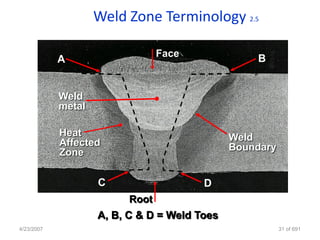
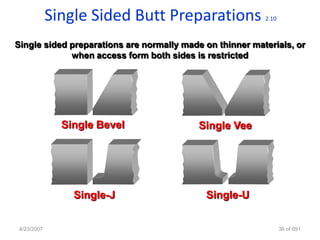
  • 628.
    Use of PAMS Wirefeed speed monitoring Incorporated pair of rolls connected to a tachogenerator 4/23/2007 674 of 691
  • 629.
    Use of PAMS Shielding gas flow rate monitoring Heating element sensor 4/23/2007 675 of 691
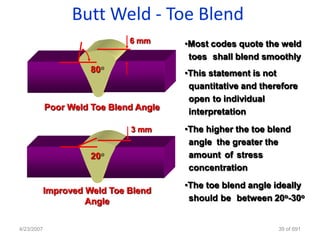
  • 630.
    Summary • a welding power source can only be calibrated if it has meters fitted • the inspector should check for calibration stickers, dates etc. • a welding power source without meters can only be validated that the control knobs provide repeatability • the main role is to carryout “in process monitoring” to ensure that the welding requirements are met during production 4/23/2007 676 of 691
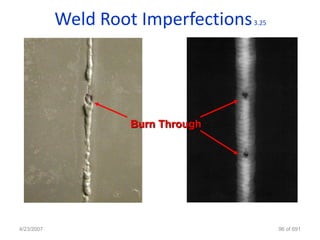
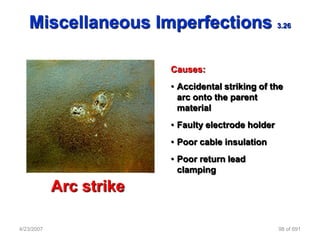
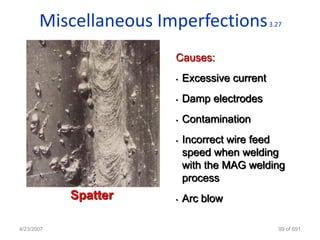
  • 631.
    Welding Inspector Macro/Micro Examination Section 25 4/23/2007 677 of 691
  • 632.
    Macro Preparation Purpose To examinethe weld cross-section to give assurance that: - • The weld has been made in accordance with the WPS • The weld is free from defects Specimen Preparation • Full thickness slice taken from the weld (typically ~10mm thick) • Width of slice sufficient to show all the weld and HAZ on both sides plus some unaffected base material • One face ground to a progressively fine finish (grit sizes 120 to ~ 400) • Prepared face heavily etched to show all weld runs & all HAZ • Prepared face examined at up to x10 (& usually photographed for records) • Prepared face may also be used for a hardness survey 4/23/2007 678 of 691
  • 633.
    Micro Preparation Purpose To examinea particular region of the weld or HAZ in order to:- • To examine the microstructure • Identify the nature of a crack or other imperfection Specimen Preparation • A small piece is cut from the region of interest (typically up to ~ 20mm x 20mm) • The piece is mounted in plastic mould and the surface of interest prepared by progressive grinding (to grit size 600 or 800) • Surface polished on diamond impregnated cloths to a mirror finish • Prepared face may be examined in as-polished condition & then lightly etched • Prepared face examined under the microscope at up to ~ x 600 4/23/2007 679 of 691
  • 634.
    Macro / MicroExamination Object: • Macro / microscopic examinations are used to give a visual evaluation of a cross-section of a welded joint • Carried out on full thickness specimens • The width of the specimen should include HAZ, weld and parent plate • They maybe cut from a stop/start area on a welders approval test 4/23/2007 680 of 691
  • 635.
    Macro / MicroExamination Will Reveal: • Weld soundness • Distribution of inclusions • Number of weld passes • Metallurgical structure of weld, fusion zone and HAZ • Location and depth of penetration of weld • Fillet weld leg and throat dimensions 4/23/2007 681 of 691
  • 636.
    Macro Micro • Visual examination for • Visual examination for defects defects & grain structure • Cut transverse from the • Cut transverse from a weld weld • Ground & polished P400 • Ground & polished P1200 grit paper grit paper, 1µm paste • Acid etch using 5-10% • Acid etch using 1-5% nitric acid solution nitric acid solution • Wash and dry • Wash and dry • Visual evaluation under 5x • Visual evaluation under magnification 100-1000x magnification • Report on results • Report on results 4/23/2007 682 of 691
  • 637.
    Metallographic Examination Macro examination Micro examination 4/23/2007 683 of 691