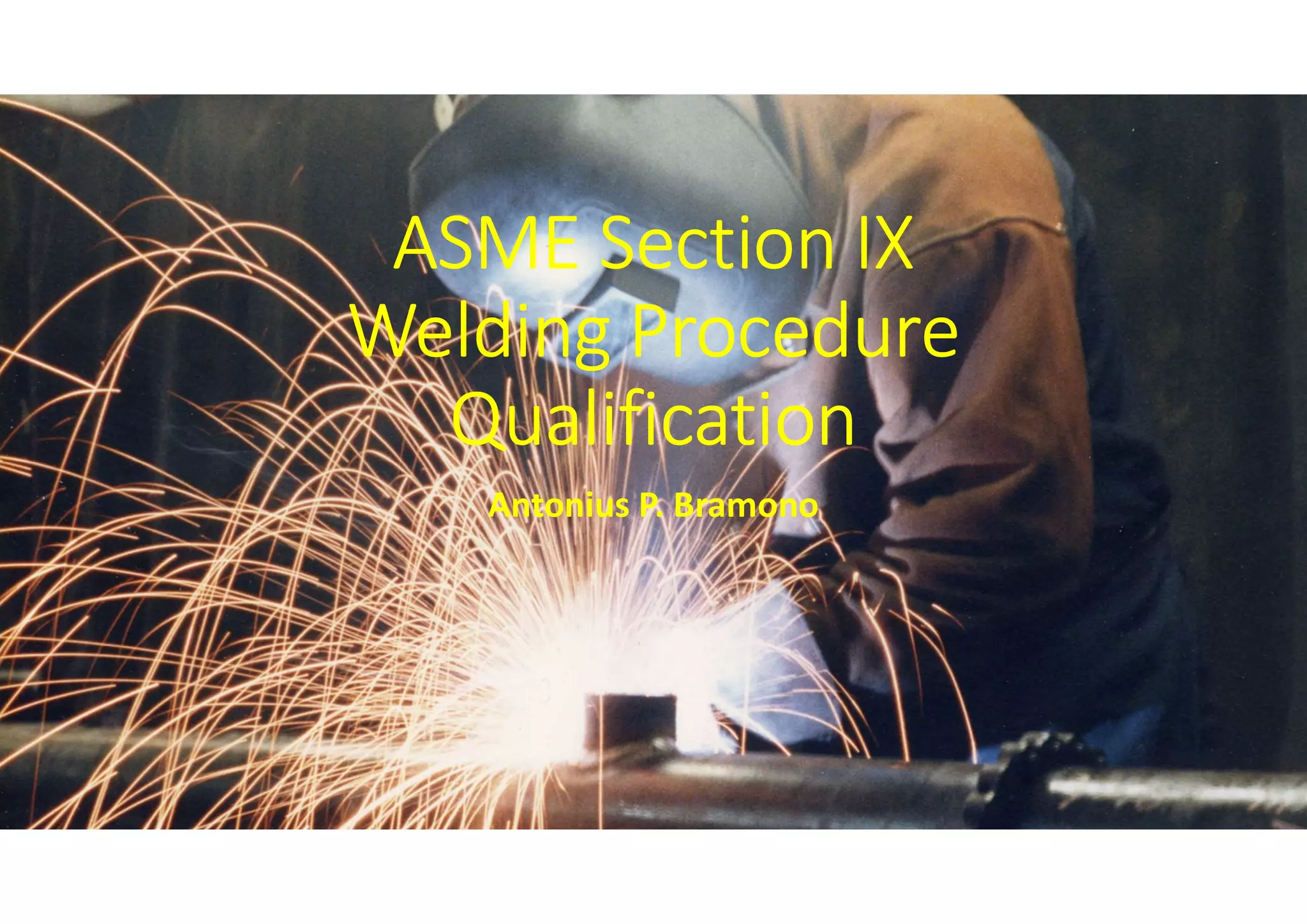
ASME Section IX
Welding Procedure
Qualification
Antonius P. Bramono
Welding Procedure Qualification
Primary purpose for procedure qualification:
To verify compatibility of materials and techniques to result
in a sound weld with acceptable mechanical properties
• WPS qualified by mechanical testing
• PQR is documentation to prove that a weld can be made
using the procedure and have acceptable mechanical
properties
Welding Procedure Qualification
How To Qualify A Welding Procedure?
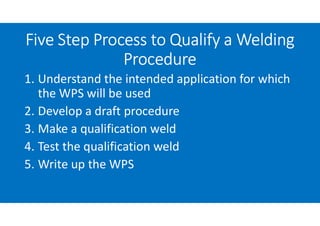
Five Step Process to Qualify a Welding
Procedure
1. Understand the intended application for which
the WPS will be used
2. Develop a draft procedure
3. Make a qualification weld
4. Test the qualification weld
5. Write up the WPS
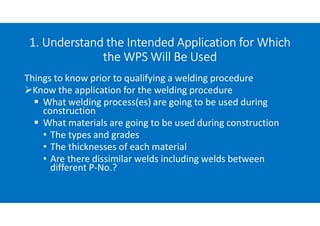
1. Understand the Intended Application for Which
the WPS Will Be Used
Things to know prior to qualifying a welding procedure
Know the application for the welding procedure
 What welding process(es) are going to be used during
construction
 What materials are going to be used during construction
• The types and grades
• The thicknesses of each material
• Are there dissimilar welds including welds between
different P-No.?
1. Understand the Intended Application for Which
the WPS Will Be Used
 Know the design requirements for the
application
 Does the design require specific material
toughness requirements?
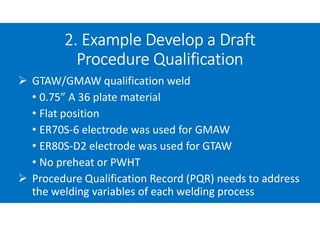
2. Example Develop a Draft
Procedure Qualification
 GTAW/GMAW qualification weld
• 0.75” A 36 plate material
• Flat position
• ER70S-6 electrode was used for GMAW
• ER80S-D2 electrode was used for GTAW
• No preheat or PWHT
 Procedure Qualification Record (PQR) needs to address
the welding variables of each welding process
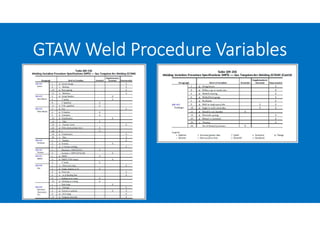
GTAW Weld Procedure Variables
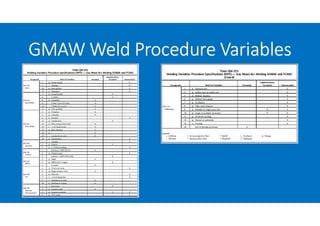
GMAW Weld Procedure Variables
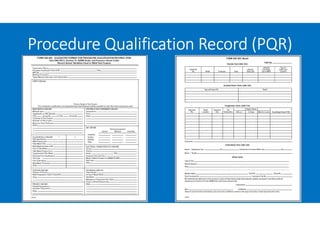
Procedure Qualification Record (PQR)
3. Procedure Qualification – Joint Variables
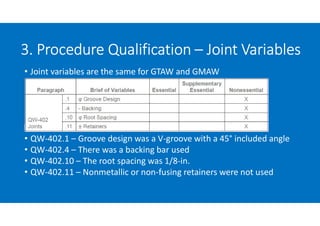
• Joint variables are the same for GTAW and GMAW

• QW-402.1 – Groove design was a V-groove with a 45° included angle
• QW-402.4 – There was a backing bar used
• QW-402.10 – The root spacing was 1/8-in.
• QW-402.11 – Nonmetallic or non-fusing retainers were not used
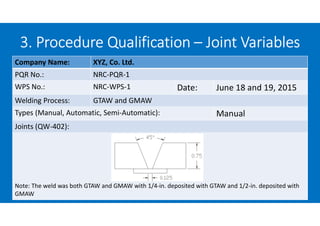
Company Name: XYZ, Co. Ltd.
PQR No.: NRC-PQR-1
WPS No.: NRC-WPS-1 Date: June 18 and 19, 2015
Welding Process: GTAW and GMAW
Types (Manual, Automatic, Semi-Automatic): Manual
Joints (QW-402):
Note: The weld was both GTAW and GMAW with 1/4-in. deposited with GTAW and 1/2-in. deposited with
GMAW
3. Procedure Qualification – Joint Variables
3. Procedure Qualification – Base Metal Variables
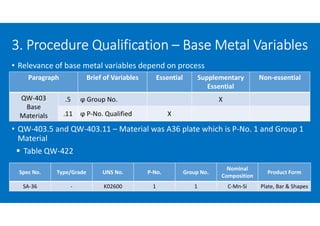
• Relevance of base metal variables depend on process
• QW-403.5 and QW-403.11 – Material was A36 plate which is P-No. 1 and Group 1
Material
 Table QW-422
Paragraph Brief of Variables Essential Supplementary
Essential
Non-essential
QW-403
Base
Materials
.5 ϕ Group No. X
.11 ϕ P-No. Qualified X
Spec No. Type/Grade UNS No. P-No. Group No.
Nominal
Composition
Product Form
SA-36 - K02600 1 1 C-Mn-Si Plate, Bar & Shapes
3. Procedure Qualification – Base Metal Variables
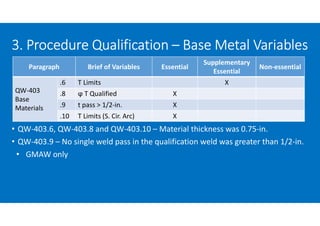
• QW-403.6, QW-403.8 and QW-403.10 – Material thickness was 0.75-in.
• QW-403.9 – No single weld pass in the qualification weld was greater than 1/2-in.
• GMAW only
Paragraph Brief of Variables Essential
Supplementary
Essential
Non-essential
QW-403
Base
Materials
.6 T Limits X
.8 ϕ T Qualified X
.9 t pass > 1/2-in. X
.10 T Limits (S. Cir. Arc) X
3. Procedure Qualification – Base Metal Variables
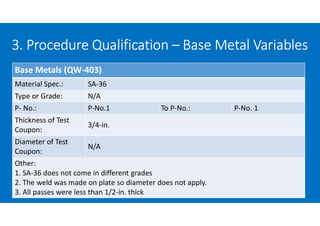
Base Metals (QW-403)
Material Spec.: SA-36
Type or Grade: N/A
P- No.: P-No.1 To P-No.: P-No. 1
Thickness of Test
Coupon:
3/4-in.
Diameter of Test
Coupon:
N/A
Other:
1. SA-36 does not come in different grades
2. The weld was made on plate so diameter does not apply.
3. All passes were less than 1/2-in. thick
3. Procedure Qualification – Filler Metal Variables
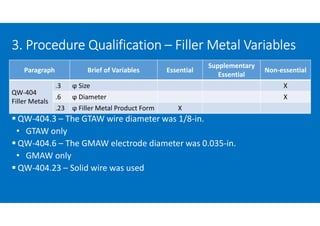
 QW-404.3 – The GTAW wire diameter was 1/8-in.
• GTAW only
 QW-404.6 – The GMAW electrode diameter was 0.035-in.
• GMAW only
 QW-404.23 – Solid wire was used
Paragraph Brief of Variables Essential
Supplementary
Essential
Non-essential
QW-404
Filler Metals
.3 ϕ Size X
.6 ϕ Diameter X
.23 ϕ Filler Metal Product Form X
3. Procedure Qualification – Filler Metal Variables
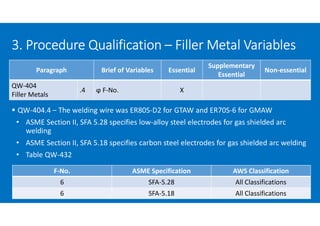
 QW-404.4 – The welding wire was ER80S-D2 for GTAW and ER70S-6 for GMAW
• ASME Section II, SFA 5.28 specifies low-alloy steel electrodes for gas shielded arc
welding
• ASME Section II, SFA 5.18 specifies carbon steel electrodes for gas shielded arc welding
• Table QW-432
Paragraph Brief of Variables Essential
Supplementary
Essential
Non-essential
QW-404
Filler Metals
.4 ϕ F-No. X
F-No. ASME Specification AWS Classification
6 SFA-5.28 All Classifications
6 SFA-5.18 All Classifications
3. Procedure Qualification – Filler Metal Variables
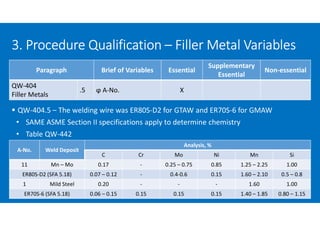
 QW-404.5 – The welding wire was ER80S-D2 for GTAW and ER70S-6 for GMAW
• SAME ASME Section II specifications apply to determine chemistry
• Table QW-442
Paragraph Brief of Variables Essential
Supplementary
Essential
Non-essential
QW-404
Filler Metals
.5 ϕ A-No. X
A-No. Weld Deposit
Analysis, %
C Cr Mo Ni Mn Si
11 Mn – Mo 0.17 - 0.25 – 0.75 0.85 1.25 – 2.25 1.00
ER80S-D2 (SFA 5.18) 0.07 – 0.12 - 0.4-0.6 0.15 1.60 – 2.10 0.5 – 0.8
1 Mild Steel 0.20 - - - 1.60 1.00
ER70S-6 (SFA 5.18) 0.06 – 0.15 0.15 0.15 0.15 1.40 – 1.85 0.80 – 1.15
3. Procedure Qualification – Filler Metal Variables
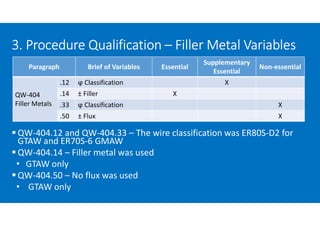
 QW-404.12 and QW-404.33 – The wire classification was ER80S-D2 for
GTAW and ER70S-6 GMAW
 QW-404.14 – Filler metal was used
• GTAW only
 QW-404.50 – No flux was used
• GTAW only
Paragraph Brief of Variables Essential
Supplementary
Essential
Non-essential
QW-404
Filler Metals
.12 ϕ Classification X
.14 ± Filler X
.33 ϕ Classification X
.50 ± Flux X
3. Procedure Qualification – Filler Metal Variables
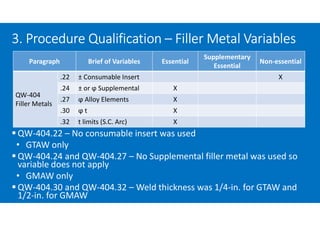
 QW-404.22 – No consumable insert was used
• GTAW only
 QW-404.24 and QW-404.27 – No Supplemental filler metal was used so
variable does not apply
• GMAW only
 QW-404.30 and QW-404.32 – Weld thickness was 1/4-in. for GTAW and
1/2-in. for GMAW
Paragraph Brief of Variables Essential
Supplementary
Essential
Non-essential
QW-404
Filler Metals
.22 ± Consumable Insert X
.24 ± or ϕ Supplemental X
.27 ϕ Alloy Elements X
.30 ϕ t X
.32 t limits (S.C. Arc) X
3. Procedure Qualification – Filler Metal Variables
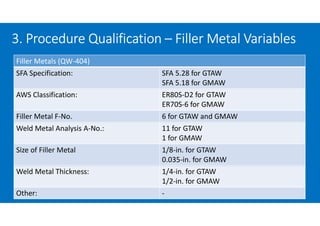
Filler Metals (QW-404)
SFA Specification: SFA 5.28 for GTAW
SFA 5.18 for GMAW
AWS Classification: ER80S-D2 for GTAW
ER70S-6 for GMAW
Filler Metal F-No. 6 for GTAW and GMAW
Weld Metal Analysis A-No.: 11 for GTAW
1 for GMAW
Size of Filler Metal 1/8-in. for GTAW
0.035-in. for GMAW
Weld Metal Thickness: 1/4-in. for GTAW
1/2-in. for GMAW
Other: -
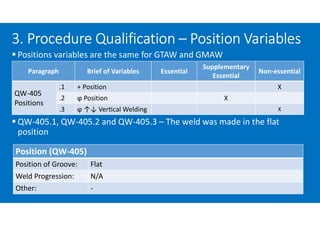
3. Procedure Qualification – Position Variables
 Positions variables are the same for GTAW and GMAW
 QW-405.1, QW-405.2 and QW-405.3 – The weld was made in the flat
position
Paragraph Brief of Variables Essential
Supplementary
Essential
Non-essential
QW-405
Positions
.1 + Position X
.2 ϕ Position X
.3 ϕ ↑↓ Ver cal Welding X
Position (QW-405)
Position of Groove: Flat
Weld Progression: N/A
Other: -
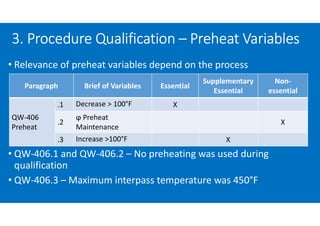
• Relevance of preheat variables depend on the process
• QW-406.1 and QW-406.2 – No preheating was used during
qualification
• QW-406.3 – Maximum interpass temperature was 450°F
3. Procedure Qualification – Preheat Variables
Paragraph Brief of Variables Essential
Supplementary
Essential
Non-
essential
QW-406
Preheat
.1 Decrease > 100°F X
.2
ϕ Preheat
Maintenance
X
.3 Increase >100°F X
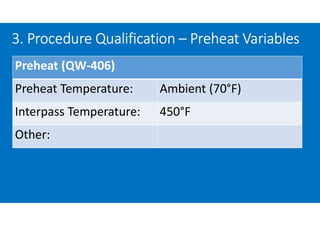
3. Procedure Qualification – Preheat Variables
Preheat (QW-406)
Preheat Temperature: Ambient (70°F)
Interpass Temperature: 450°F
Other:
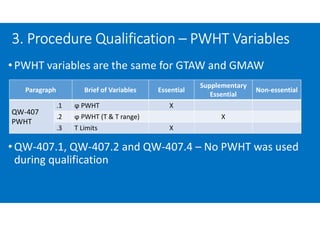
• PWHT variables are the same for GTAW and GMAW
• QW-407.1, QW-407.2 and QW-407.4 – No PWHT was used
during qualification
3. Procedure Qualification – PWHT Variables
Paragraph Brief of Variables Essential
Supplementary
Essential
Non-essential
QW-407
PWHT
.1 ϕ PWHT X
.2 ϕ PWHT (T & T range) X
.3 T Limits X
3. Procedure Qualification – Preheat Variables
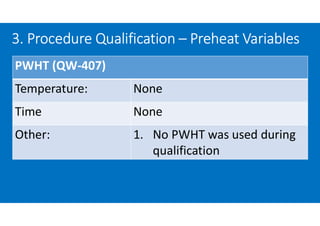
PWHT (QW-407)
Temperature: None
Time None
Other: 1. No PWHT was used during
qualification
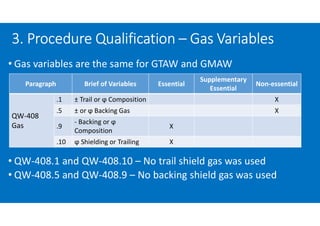
• Gas variables are the same for GTAW and GMAW
• QW-408.1 and QW-408.10 – No trail shield gas was used
• QW-408.5 and QW-408.9 – No backing shield gas was used
3. Procedure Qualification – Gas Variables
Paragraph Brief of Variables Essential
Supplementary
Essential
Non-essential
QW-408
Gas
.1 ± Trail or ϕ Composition X
.5 ± or ϕ Backing Gas X
.9
- Backing or ϕ
Composition
X
.10 ϕ Shielding or Trailing X
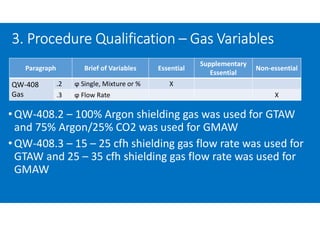
• QW-408.2 – 100% Argon shielding gas was used for GTAW
and 75% Argon/25% CO2 was used for GMAW
• QW-408.3 – 15 – 25 cfh shielding gas flow rate was used for
GTAW and 25 – 35 cfh shielding gas flow rate was used for
GMAW
3. Procedure Qualification – Gas Variables
Paragraph Brief of Variables Essential
Supplementary
Essential
Non-essential
QW-408
Gas
.2 ϕ Single, Mixture or % X
.3 ϕ Flow Rate X
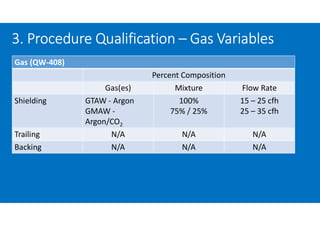
Gas (QW-408)
Percent Composition
Gas(es) Mixture Flow Rate
Shielding GTAW - Argon
GMAW -
Argon/CO2
100%
75% / 25%
15 – 25 cfh
25 – 35 cfh
Trailing N/A N/A N/A
Backing N/A N/A N/A
3. Procedure Qualification – Gas Variables
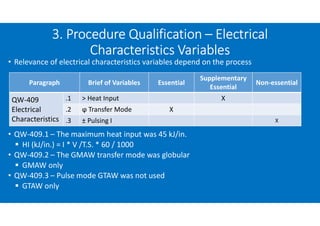
• Relevance of electrical characteristics variables depend on the process
• QW-409.1 – The maximum heat input was 45 kJ/in.
 HI (kJ/in.) = I * V /T.S. * 60 / 1000
• QW-409.2 – The GMAW transfer mode was globular
 GMAW only
• QW-409.3 – Pulse mode GTAW was not used
 GTAW only
3. Procedure Qualification – Electrical
Characteristics Variables
Paragraph Brief of Variables Essential
Supplementary
Essential
Non-essential
QW-409
Electrical
Characteristics
.1 > Heat Input X
.2 ϕ Transfer Mode X
.3 ± Pulsing I X
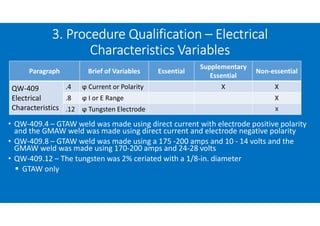
• QW-409.4 – GTAW weld was made using direct current with electrode positive polarity
and the GMAW weld was made using direct current and electrode negative polarity
• QW-409.8 – GTAW weld was made using a 175 -200 amps and 10 - 14 volts and the
GMAW weld was made using 170-200 amps and 24-28 volts
• QW-409.12 – The tungsten was 2% ceriated with a 1/8-in. diameter
 GTAW only
3. Procedure Qualification – Electrical
Characteristics Variables
Paragraph Brief of Variables Essential
Supplementary
Essential
Non-essential
QW-409
Electrical
Characteristics
.4 ϕ Current or Polarity X X
.8 ϕ I or E Range X
.12 ϕ Tungsten Electrode X
3. Procedure Qualification – Electrical
Characteristics Variables
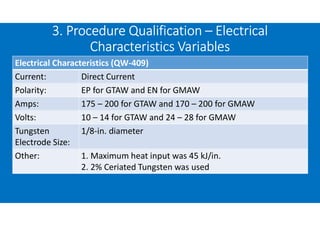
Electrical Characteristics (QW-409)
Current: Direct Current
Polarity: EP for GTAW and EN for GMAW
Amps: 175 – 200 for GTAW and 170 – 200 for GMAW
Volts: 10 – 14 for GTAW and 24 – 28 for GMAW
Tungsten
Electrode Size:
1/8-in. diameter
Other: 1. Maximum heat input was 45 kJ/in.
2. 2% Ceriated Tungsten was used
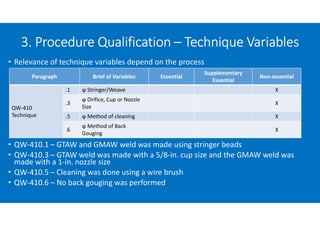
• Relevance of technique variables depend on the process
• QW-410.1 – GTAW and GMAW weld was made using stringer beads
• QW-410.3 – GTAW weld was made with a 5/8-in. cup size and the GMAW weld was
made with a 1-in. nozzle size
• QW-410.5 – Cleaning was done using a wire brush
• QW-410.6 – No back gouging was performed
3. Procedure Qualification – Technique Variables
Paragraph Brief of Variables Essential
Supplementary
Essential
Non-essential
QW-410
Technique
.1 ϕ Stringer/Weave X
.3
ϕ Orifice, Cup or Nozzle
Size
X
.5 ϕ Method of cleaning X
.6
ϕ Method of Back
Gouging
X
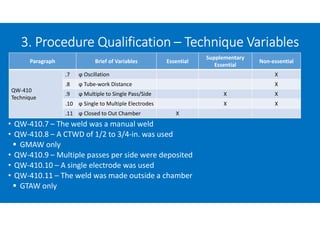
• QW-410.7 – The weld was a manual weld
• QW-410.8 – A CTWD of 1/2 to 3/4-in. was used
 GMAW only
• QW-410.9 – Multiple passes per side were deposited
• QW-410.10 – A single electrode was used
• QW-410.11 – The weld was made outside a chamber
 GTAW only
3. Procedure Qualification – Technique Variables
Paragraph Brief of Variables Essential
Supplementary
Essential
Non-essential
QW-410
Technique
.7 ϕ Oscillation X
.8 ϕ Tube-work Distance X
.9 ϕ Multiple to Single Pass/Side X X
.10 ϕ Single to Multiple Electrodes X X
.11 ϕ Closed to Out Chamber X
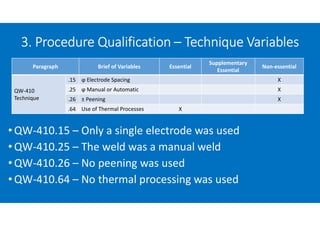
• QW-410.15 – Only a single electrode was used
• QW-410.25 – The weld was a manual weld
• QW-410.26 – No peening was used
• QW-410.64 – No thermal processing was used
3. Procedure Qualification – Technique Variables
Paragraph Brief of Variables Essential
Supplementary
Essential
Non-essential
QW-410
Technique
.15 ϕ Electrode Spacing X
.25 ϕ Manual or Automatic X
.26 ± Peening X
.64 Use of Thermal Processes X
3. Procedure Qualification – Electrical
Characteristics Variables
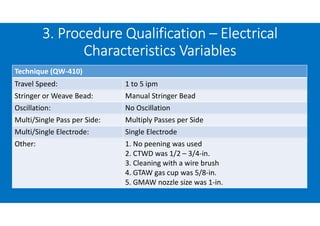
Technique (QW-410)
Travel Speed: 1 to 5 ipm
Stringer or Weave Bead: Manual Stringer Bead
Oscillation: No Oscillation
Multi/Single Pass per Side: Multiply Passes per Side
Multi/Single Electrode: Single Electrode
Other: 1. No peening was used
2. CTWD was 1/2 – 3/4-in.
3. Cleaning with a wire brush
4. GTAW gas cup was 5/8-in.
5. GMAW nozzle size was 1-in.
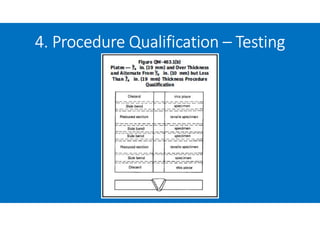
4. Procedure Qualification – Testing
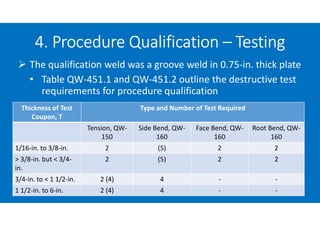
 The qualification weld was a groove weld in 0.75-in. thick plate
• Table QW-451.1 and QW-451.2 outline the destructive test
requirements for procedure qualification
Thickness of Test
Coupon, T
Type and Number of Test Required
Tension, QW-
150
Side Bend, QW-
160
Face Bend, QW-
160
Root Bend, QW-
160
1/16-in. to 3/8-in. 2 (5) 2 2
> 3/8-in. but < 3/4-
in.
2 (5) 2 2
3/4-in. to < 1 1/2-in. 2 (4) 4 - -
1 1/2-in. to 6-in. 2 (4) 4 - -
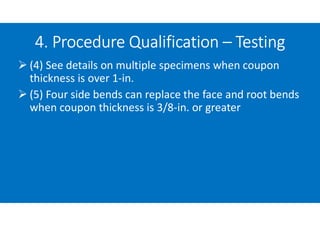
4. Procedure Qualification – Testing
 (4) See details on multiple specimens when coupon
thickness is over 1-in.
 (5) Four side bends can replace the face and root bends
when coupon thickness is 3/8-in. or greater
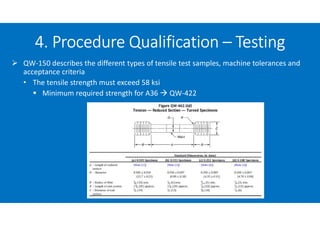
4. Procedure Qualification – Testing
 QW-150 describes the different types of tensile test samples, machine tolerances and
acceptance criteria
• The tensile strength must exceed 58 ksi
 Minimum required strength for A36  QW-422
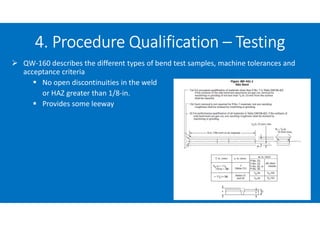
4. Procedure Qualification – Testing
 QW-160 describes the different types of bend test samples, machine tolerances and
acceptance criteria
 No open discontinuities in the weld
or HAZ greater than 1/8-in.
 Provides some leeway
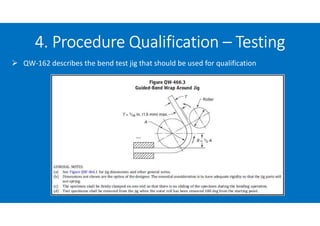
4. Procedure Qualification – Testing
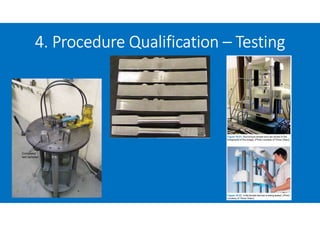
 QW-162 describes the bend test jig that should be used for qualification
4. Procedure Qualification – Testing
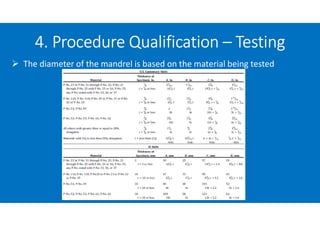
 The diameter of the mandrel is based on the material being tested
4. Procedure Qualification – Testing
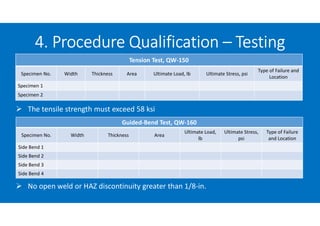
Tension Test, QW-150
Specimen No. Width Thickness Area Ultimate Load, lb Ultimate Stress, psi
Type of Failure and
Location
Specimen 1
Specimen 2
 The tensile strength must exceed 58 ksi
Guided-Bend Test, QW-160
Specimen No. Width Thickness Area
Ultimate Load,
lb
Ultimate Stress,
psi
Type of Failure
and Location
Side Bend 1
Side Bend 2
Side Bend 3
Side Bend 4
 No open weld or HAZ discontinuity greater than 1/8-in.
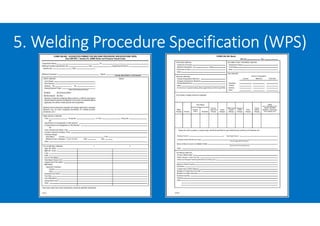
5. Welding Procedure Specification (WPS)
Feel free to contact:
Antonius P. Bramono
 E: pbramono@gmail.com

How to Qualify a Welding Procedure

  • 1.
    ASME Section IX WeldingProcedure Qualification Antonius P. Bramono
  • 2.
  • 3.
    Primary purpose forprocedure qualification: To verify compatibility of materials and techniques to result in a sound weld with acceptable mechanical properties • WPS qualified by mechanical testing • PQR is documentation to prove that a weld can be made using the procedure and have acceptable mechanical properties Welding Procedure Qualification
  • 4.
    How To QualifyA Welding Procedure?
  • 5.
    Five Step Processto Qualify a Welding Procedure 1. Understand the intended application for which the WPS will be used 2. Develop a draft procedure 3. Make a qualification weld 4. Test the qualification weld 5. Write up the WPS
  • 6.
    1. Understand theIntended Application for Which the WPS Will Be Used Things to know prior to qualifying a welding procedure Know the application for the welding procedure  What welding process(es) are going to be used during construction  What materials are going to be used during construction • The types and grades • The thicknesses of each material • Are there dissimilar welds including welds between different P-No.?
  • 7.
    1. Understand theIntended Application for Which the WPS Will Be Used  Know the design requirements for the application  Does the design require specific material toughness requirements?
  • 8.
    2. Example Developa Draft Procedure Qualification  GTAW/GMAW qualification weld • 0.75” A 36 plate material • Flat position • ER70S-6 electrode was used for GMAW • ER80S-D2 electrode was used for GTAW • No preheat or PWHT  Procedure Qualification Record (PQR) needs to address the welding variables of each welding process
  • 9.
  • 10.
  • 11.
  • 12.
    3. Procedure Qualification– Joint Variables • Joint variables are the same for GTAW and GMAW  • QW-402.1 – Groove design was a V-groove with a 45° included angle • QW-402.4 – There was a backing bar used • QW-402.10 – The root spacing was 1/8-in. • QW-402.11 – Nonmetallic or non-fusing retainers were not used
  • 13.
    Company Name: XYZ,Co. Ltd. PQR No.: NRC-PQR-1 WPS No.: NRC-WPS-1 Date: June 18 and 19, 2015 Welding Process: GTAW and GMAW Types (Manual, Automatic, Semi-Automatic): Manual Joints (QW-402): Note: The weld was both GTAW and GMAW with 1/4-in. deposited with GTAW and 1/2-in. deposited with GMAW 3. Procedure Qualification – Joint Variables
  • 14.
    3. Procedure Qualification– Base Metal Variables • Relevance of base metal variables depend on process • QW-403.5 and QW-403.11 – Material was A36 plate which is P-No. 1 and Group 1 Material  Table QW-422 Paragraph Brief of Variables Essential Supplementary Essential Non-essential QW-403 Base Materials .5 ϕ Group No. X .11 ϕ P-No. Qualified X Spec No. Type/Grade UNS No. P-No. Group No. Nominal Composition Product Form SA-36 - K02600 1 1 C-Mn-Si Plate, Bar & Shapes
  • 15.
    3. Procedure Qualification– Base Metal Variables • QW-403.6, QW-403.8 and QW-403.10 – Material thickness was 0.75-in. • QW-403.9 – No single weld pass in the qualification weld was greater than 1/2-in. • GMAW only Paragraph Brief of Variables Essential Supplementary Essential Non-essential QW-403 Base Materials .6 T Limits X .8 ϕ T Qualified X .9 t pass > 1/2-in. X .10 T Limits (S. Cir. Arc) X
  • 16.
    3. Procedure Qualification– Base Metal Variables Base Metals (QW-403) Material Spec.: SA-36 Type or Grade: N/A P- No.: P-No.1 To P-No.: P-No. 1 Thickness of Test Coupon: 3/4-in. Diameter of Test Coupon: N/A Other: 1. SA-36 does not come in different grades 2. The weld was made on plate so diameter does not apply. 3. All passes were less than 1/2-in. thick
  • 17.
    3. Procedure Qualification– Filler Metal Variables  QW-404.3 – The GTAW wire diameter was 1/8-in. • GTAW only  QW-404.6 – The GMAW electrode diameter was 0.035-in. • GMAW only  QW-404.23 – Solid wire was used Paragraph Brief of Variables Essential Supplementary Essential Non-essential QW-404 Filler Metals .3 ϕ Size X .6 ϕ Diameter X .23 ϕ Filler Metal Product Form X
  • 18.
    3. Procedure Qualification– Filler Metal Variables  QW-404.4 – The welding wire was ER80S-D2 for GTAW and ER70S-6 for GMAW • ASME Section II, SFA 5.28 specifies low-alloy steel electrodes for gas shielded arc welding • ASME Section II, SFA 5.18 specifies carbon steel electrodes for gas shielded arc welding • Table QW-432 Paragraph Brief of Variables Essential Supplementary Essential Non-essential QW-404 Filler Metals .4 ϕ F-No. X F-No. ASME Specification AWS Classification 6 SFA-5.28 All Classifications 6 SFA-5.18 All Classifications
  • 19.
    3. Procedure Qualification– Filler Metal Variables  QW-404.5 – The welding wire was ER80S-D2 for GTAW and ER70S-6 for GMAW • SAME ASME Section II specifications apply to determine chemistry • Table QW-442 Paragraph Brief of Variables Essential Supplementary Essential Non-essential QW-404 Filler Metals .5 ϕ A-No. X A-No. Weld Deposit Analysis, % C Cr Mo Ni Mn Si 11 Mn – Mo 0.17 - 0.25 – 0.75 0.85 1.25 – 2.25 1.00 ER80S-D2 (SFA 5.18) 0.07 – 0.12 - 0.4-0.6 0.15 1.60 – 2.10 0.5 – 0.8 1 Mild Steel 0.20 - - - 1.60 1.00 ER70S-6 (SFA 5.18) 0.06 – 0.15 0.15 0.15 0.15 1.40 – 1.85 0.80 – 1.15
  • 20.
    3. Procedure Qualification– Filler Metal Variables  QW-404.12 and QW-404.33 – The wire classification was ER80S-D2 for GTAW and ER70S-6 GMAW  QW-404.14 – Filler metal was used • GTAW only  QW-404.50 – No flux was used • GTAW only Paragraph Brief of Variables Essential Supplementary Essential Non-essential QW-404 Filler Metals .12 ϕ Classification X .14 ± Filler X .33 ϕ Classification X .50 ± Flux X
  • 21.
    3. Procedure Qualification– Filler Metal Variables  QW-404.22 – No consumable insert was used • GTAW only  QW-404.24 and QW-404.27 – No Supplemental filler metal was used so variable does not apply • GMAW only  QW-404.30 and QW-404.32 – Weld thickness was 1/4-in. for GTAW and 1/2-in. for GMAW Paragraph Brief of Variables Essential Supplementary Essential Non-essential QW-404 Filler Metals .22 ± Consumable Insert X .24 ± or ϕ Supplemental X .27 ϕ Alloy Elements X .30 ϕ t X .32 t limits (S.C. Arc) X
  • 22.
    3. Procedure Qualification– Filler Metal Variables Filler Metals (QW-404) SFA Specification: SFA 5.28 for GTAW SFA 5.18 for GMAW AWS Classification: ER80S-D2 for GTAW ER70S-6 for GMAW Filler Metal F-No. 6 for GTAW and GMAW Weld Metal Analysis A-No.: 11 for GTAW 1 for GMAW Size of Filler Metal 1/8-in. for GTAW 0.035-in. for GMAW Weld Metal Thickness: 1/4-in. for GTAW 1/2-in. for GMAW Other: -
  • 23.
    3. Procedure Qualification– Position Variables  Positions variables are the same for GTAW and GMAW  QW-405.1, QW-405.2 and QW-405.3 – The weld was made in the flat position Paragraph Brief of Variables Essential Supplementary Essential Non-essential QW-405 Positions .1 + Position X .2 ϕ Position X .3 ϕ ↑↓ Ver cal Welding X Position (QW-405) Position of Groove: Flat Weld Progression: N/A Other: -
  • 24.
    • Relevance ofpreheat variables depend on the process • QW-406.1 and QW-406.2 – No preheating was used during qualification • QW-406.3 – Maximum interpass temperature was 450°F 3. Procedure Qualification – Preheat Variables Paragraph Brief of Variables Essential Supplementary Essential Non- essential QW-406 Preheat .1 Decrease > 100°F X .2 ϕ Preheat Maintenance X .3 Increase >100°F X
  • 25.
    3. Procedure Qualification– Preheat Variables Preheat (QW-406) Preheat Temperature: Ambient (70°F) Interpass Temperature: 450°F Other:
  • 26.
    • PWHT variablesare the same for GTAW and GMAW • QW-407.1, QW-407.2 and QW-407.4 – No PWHT was used during qualification 3. Procedure Qualification – PWHT Variables Paragraph Brief of Variables Essential Supplementary Essential Non-essential QW-407 PWHT .1 ϕ PWHT X .2 ϕ PWHT (T & T range) X .3 T Limits X
  • 27.
    3. Procedure Qualification– Preheat Variables PWHT (QW-407) Temperature: None Time None Other: 1. No PWHT was used during qualification
  • 28.
    • Gas variablesare the same for GTAW and GMAW • QW-408.1 and QW-408.10 – No trail shield gas was used • QW-408.5 and QW-408.9 – No backing shield gas was used 3. Procedure Qualification – Gas Variables Paragraph Brief of Variables Essential Supplementary Essential Non-essential QW-408 Gas .1 ± Trail or ϕ Composition X .5 ± or ϕ Backing Gas X .9 - Backing or ϕ Composition X .10 ϕ Shielding or Trailing X
  • 29.
    • QW-408.2 –100% Argon shielding gas was used for GTAW and 75% Argon/25% CO2 was used for GMAW • QW-408.3 – 15 – 25 cfh shielding gas flow rate was used for GTAW and 25 – 35 cfh shielding gas flow rate was used for GMAW 3. Procedure Qualification – Gas Variables Paragraph Brief of Variables Essential Supplementary Essential Non-essential QW-408 Gas .2 ϕ Single, Mixture or % X .3 ϕ Flow Rate X
  • 30.
    Gas (QW-408) Percent Composition Gas(es)Mixture Flow Rate Shielding GTAW - Argon GMAW - Argon/CO2 100% 75% / 25% 15 – 25 cfh 25 – 35 cfh Trailing N/A N/A N/A Backing N/A N/A N/A 3. Procedure Qualification – Gas Variables
  • 31.
    • Relevance ofelectrical characteristics variables depend on the process • QW-409.1 – The maximum heat input was 45 kJ/in.  HI (kJ/in.) = I * V /T.S. * 60 / 1000 • QW-409.2 – The GMAW transfer mode was globular  GMAW only • QW-409.3 – Pulse mode GTAW was not used  GTAW only 3. Procedure Qualification – Electrical Characteristics Variables Paragraph Brief of Variables Essential Supplementary Essential Non-essential QW-409 Electrical Characteristics .1 > Heat Input X .2 ϕ Transfer Mode X .3 ± Pulsing I X
  • 32.
    • QW-409.4 –GTAW weld was made using direct current with electrode positive polarity and the GMAW weld was made using direct current and electrode negative polarity • QW-409.8 – GTAW weld was made using a 175 -200 amps and 10 - 14 volts and the GMAW weld was made using 170-200 amps and 24-28 volts • QW-409.12 – The tungsten was 2% ceriated with a 1/8-in. diameter  GTAW only 3. Procedure Qualification – Electrical Characteristics Variables Paragraph Brief of Variables Essential Supplementary Essential Non-essential QW-409 Electrical Characteristics .4 ϕ Current or Polarity X X .8 ϕ I or E Range X .12 ϕ Tungsten Electrode X
  • 33.
    3. Procedure Qualification– Electrical Characteristics Variables Electrical Characteristics (QW-409) Current: Direct Current Polarity: EP for GTAW and EN for GMAW Amps: 175 – 200 for GTAW and 170 – 200 for GMAW Volts: 10 – 14 for GTAW and 24 – 28 for GMAW Tungsten Electrode Size: 1/8-in. diameter Other: 1. Maximum heat input was 45 kJ/in. 2. 2% Ceriated Tungsten was used
  • 34.
    • Relevance oftechnique variables depend on the process • QW-410.1 – GTAW and GMAW weld was made using stringer beads • QW-410.3 – GTAW weld was made with a 5/8-in. cup size and the GMAW weld was made with a 1-in. nozzle size • QW-410.5 – Cleaning was done using a wire brush • QW-410.6 – No back gouging was performed 3. Procedure Qualification – Technique Variables Paragraph Brief of Variables Essential Supplementary Essential Non-essential QW-410 Technique .1 ϕ Stringer/Weave X .3 ϕ Orifice, Cup or Nozzle Size X .5 ϕ Method of cleaning X .6 ϕ Method of Back Gouging X
  • 35.
    • QW-410.7 –The weld was a manual weld • QW-410.8 – A CTWD of 1/2 to 3/4-in. was used  GMAW only • QW-410.9 – Multiple passes per side were deposited • QW-410.10 – A single electrode was used • QW-410.11 – The weld was made outside a chamber  GTAW only 3. Procedure Qualification – Technique Variables Paragraph Brief of Variables Essential Supplementary Essential Non-essential QW-410 Technique .7 ϕ Oscillation X .8 ϕ Tube-work Distance X .9 ϕ Multiple to Single Pass/Side X X .10 ϕ Single to Multiple Electrodes X X .11 ϕ Closed to Out Chamber X
  • 36.
    • QW-410.15 –Only a single electrode was used • QW-410.25 – The weld was a manual weld • QW-410.26 – No peening was used • QW-410.64 – No thermal processing was used 3. Procedure Qualification – Technique Variables Paragraph Brief of Variables Essential Supplementary Essential Non-essential QW-410 Technique .15 ϕ Electrode Spacing X .25 ϕ Manual or Automatic X .26 ± Peening X .64 Use of Thermal Processes X
  • 37.
    3. Procedure Qualification– Electrical Characteristics Variables Technique (QW-410) Travel Speed: 1 to 5 ipm Stringer or Weave Bead: Manual Stringer Bead Oscillation: No Oscillation Multi/Single Pass per Side: Multiply Passes per Side Multi/Single Electrode: Single Electrode Other: 1. No peening was used 2. CTWD was 1/2 – 3/4-in. 3. Cleaning with a wire brush 4. GTAW gas cup was 5/8-in. 5. GMAW nozzle size was 1-in.
  • 38.
    4. Procedure Qualification– Testing  The qualification weld was a groove weld in 0.75-in. thick plate • Table QW-451.1 and QW-451.2 outline the destructive test requirements for procedure qualification Thickness of Test Coupon, T Type and Number of Test Required Tension, QW- 150 Side Bend, QW- 160 Face Bend, QW- 160 Root Bend, QW- 160 1/16-in. to 3/8-in. 2 (5) 2 2 > 3/8-in. but < 3/4- in. 2 (5) 2 2 3/4-in. to < 1 1/2-in. 2 (4) 4 - - 1 1/2-in. to 6-in. 2 (4) 4 - -
  • 39.
    4. Procedure Qualification– Testing  (4) See details on multiple specimens when coupon thickness is over 1-in.  (5) Four side bends can replace the face and root bends when coupon thickness is 3/8-in. or greater
  • 40.
  • 41.
    4. Procedure Qualification– Testing  QW-150 describes the different types of tensile test samples, machine tolerances and acceptance criteria • The tensile strength must exceed 58 ksi  Minimum required strength for A36  QW-422
  • 42.
    4. Procedure Qualification– Testing  QW-160 describes the different types of bend test samples, machine tolerances and acceptance criteria  No open discontinuities in the weld or HAZ greater than 1/8-in.  Provides some leeway
  • 43.
    4. Procedure Qualification– Testing  QW-162 describes the bend test jig that should be used for qualification
  • 44.
    4. Procedure Qualification– Testing  The diameter of the mandrel is based on the material being tested
  • 45.
  • 46.
    4. Procedure Qualification– Testing Tension Test, QW-150 Specimen No. Width Thickness Area Ultimate Load, lb Ultimate Stress, psi Type of Failure and Location Specimen 1 Specimen 2  The tensile strength must exceed 58 ksi Guided-Bend Test, QW-160 Specimen No. Width Thickness Area Ultimate Load, lb Ultimate Stress, psi Type of Failure and Location Side Bend 1 Side Bend 2 Side Bend 3 Side Bend 4  No open weld or HAZ discontinuity greater than 1/8-in.
  • 47.
    5. Welding ProcedureSpecification (WPS)
  • 50.
    Feel free tocontact: Antonius P. Bramono  E: pbramono@gmail.com