DISTRUCTIVE & NON-
DESTRUCTIVE TESTING OF
MATERIAL
1
INTRODUCTION :
 Destructive testing :
In destructive testing (or destructive physical analysis, DPA) tests are carried out
to the specimen's failure, in order to understand a specimen's performance or
material behaviour under different loads.
 Non destructive testing :
Nondestructive testing (NDT) is a wide group of analysis techniques used in
science and technology industry to evaluate the properties of a material,
component or system without causing damage.
2
DESTRUCTIVE
TESTING OF
MATERIAL
3
DESTRUCTIVE TESTING OF MATERIAL
:
 In Destructive Testing (or Destructive Physical Analysis, DPA) tests are carried
out to the specimen's failure, in order to understand a specimen's performance or material
behavior under different loads.
 These tests are generally much easier to carry out, yield more information, and
are easier to interpret than nondestructive testing.
 Destructive testing is most suitable, and economic, for objects which will
be mass-produced, as the cost of destroying a small number of specimens is
negligible.
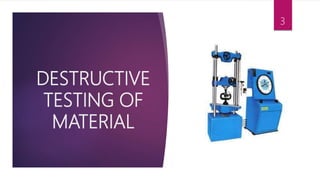
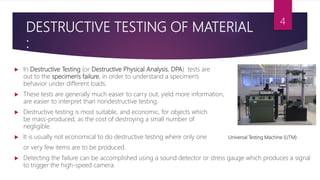
 It is usually not economical to do destructive testing where only one Universal Testing Machine (UTM)
or very few items are to be produced.
 Detecting the failure can be accomplished using a sound detector or stress gauge which produces a signal
to trigger the high-speed camera.
4
COMMONLY USED METHODS OF
DESTRUCTIVE TESTING OF MATERIAL :
 Ball Shear Strength
 Bond Strength
 DC I.V. Curve Tracing
 Die Shear Strength
 Digital Microscopy
 External Visual Inspection
 Fluorescence Microscopy
 Glassivation Layer Integrity
 Sub-Micron Real Time X-ray
 Internal Visual Inspection
 Cross-Sectioning
 Particle Impact Noise Detection
 Scanning Electron Microscopy
(SEM) Inspection
 SEM Metallization Inspection
 Solder Reflow/Moisture
Sensitivity Testing
 Metallization Thickness
 Hermeticity Testing
 SEM, XRF, and FTIR Elemental
Analysis
 Scanning Acoustic Microscopy (C
Mode)
 Ion Milling
 Acid De-encapsulation
 Sample De-lidding
5
POLDI HARDNESS TEST :
 The Poldi hardness tester is one of the portable hardness testers.
 The indentation is obtained on the test surface by striking a blow on
the ball which also produces indentation on the standard bar.
 he diameter of the indentation on the test surface and the standard bar
are correlated in the manufacturer’s table and the hardness number is
measured in BHN.
 This test method is not commonly used due to the availability of Poldi hardness tester
other accurate portable hardness testers in the industry.
 Ideally, the Brinell hardness number obtained by this method cannot be related to the direct Brinell
hardness values because of the basic difference in the method of indentation. Poldi uses impact method for
indentation.
6
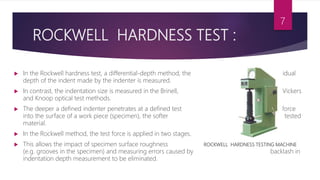
ROCKWELL HARDNESS TEST :
 In the Rockwell hardness test, a differential-depth method, the residual
depth of the indent made by the indenter is measured.
 In contrast, the indentation size is measured in the Brinell, Vickers
and Knoop optical test methods.
 The deeper a defined indenter penetrates at a defined test force
into the surface of a work piece (specimen), the softer the tested
material.
 In the Rockwell method, the test force is applied in two stages.
 This allows the impact of specimen surface roughness ROCKWELL HARDNESS TESTING MACHINE
(e.g. grooves in the specimen) and measuring errors caused by backlash in
indentation depth measurement to be eliminated.
7
NON
DESTRUCTIVE
TESTING OF
MATERIAL
8
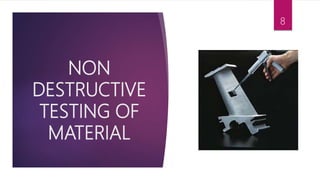
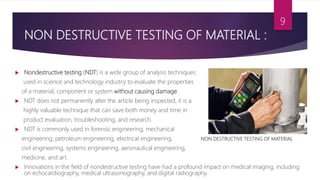
NON DESTRUCTIVE TESTING OF MATERIAL :
 Nondestructive testing (NDT) is a wide group of analysis techniques
used in science and technology industry to evaluate the properties
of a material, component or system without causing damage.
 NDT does not permanently alter the article being inspected, it is a
highly valuable technique that can save both money and time in
product evaluation, troubleshooting, and research.
 NDT is commonly used in forensic engineering, mechanical
engineering, petroleum engineering, electrical engineering, NON DESTRUCTIVE TESTING OF MATERIAL
civil engineering, systems engineering, aeronautical engineering,
medicine, and art.
 Innovations in the field of nondestructive testing have had a profound impact on medical imaging, including
on echocardiography, medical ultrasonography, and digital radiography.
9
COMMONLY USED METHODS OF NON
DESTRUCTIVE TESTING OF MATERIAL :
 Eddy-current
 Magnetic-particle
 liquid penetrant
 Radiographic
 Ultrasonic
 Visual testing
10
METHODS :
 NDT methods may rely upon use of electromagnetic radiation, sound and inherent properties of
materials to examine samples.
 This includes some kinds of microscopy to examine external surfaces in detail, although sample
preparation techniques for metallography, optical microscopy and electron microscopy are generally
destructive as the surfaces must be made smooth through polishing or the sample must be electron
transparent in thickness.
 The inside of a sample can be examined with penetrating radiation, such as X-
rays, neutrons or terahertz radiation.
 Sound waves are utilized in the case of ultrasonic testing.
 Analyzing and documenting a non-destructive failure mode can also be accomplished using a high-speed
camera recording continuously (movie-loop) until the failure is detected.
 Detecting the failure can be accomplished using a sound detector or stress gauge which produces a signal to trigger
the high-speed camera.
11
TESTINGS :
 Eddy-current testing :
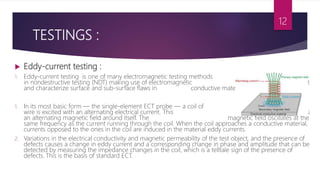
1. Eddy-current testing is one of many electromagnetic testing methods used
in nondestructive testing (NDT) making use of electromagnetic induction to detect
and characterize surface and sub-surface flaws in conductive materials.
1. In its most basic form — the single-element ECT probe — a coil of conductive
wire is excited with an alternating electrical current. This wire coil produces
an alternating magnetic field around itself. The magnetic field oscillates at the
same frequency as the current running through the coil. When the coil approaches a conductive material,
currents opposed to the ones in the coil are induced in the material eddy currents.
2. Variations in the electrical conductivity and magnetic permeability of the test object, and the presence of
defects causes a change in eddy current and a corresponding change in phase and amplitude that can be
detected by measuring the impedance changes in the coil, which is a telltale sign of the presence of
defects. This is the basis of standard ECT.
12
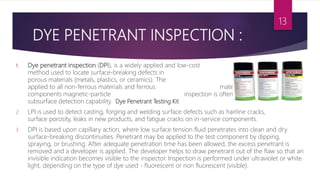
1. Dye penetrant inspection (DPI), is a widely applied and low-cost inspection
method used to locate surface-breaking defects in all non-
porous materials (metals, plastics, or ceramics). The penetrant may be
applied to all non-ferrous materials and ferrous materials, although for ferrous
components magnetic-particle inspection is often used instead for its
subsurface detection capability. Dye Penetrant Testing Kit
2. LPI is used to detect casting, forging and welding surface defects such as hairline cracks,
surface porosity, leaks in new products, and fatigue cracks on in-service components.
3. DPI is based upon capillary action, where low surface tension fluid penetrates into clean and dry
surface-breaking discontinuities. Penetrant may be applied to the test component by dipping,
spraying, or brushing. After adequate penetration time has been allowed, the excess penetrant is
removed and a developer is applied. The developer helps to draw penetrant out of the flaw so that an
invisible indication becomes visible to the inspector. Inspection is performed under ultraviolet or white
light, depending on the type of dye used - fluorescent or non fluorescent (visible).
13
DYE PENETRANT INSPECTION :
APPLICATIONS :
 NDT is used in a variety of settings that covers a
wide range of industrial activity, with new NDT
methods and applications, being continuously
developed.
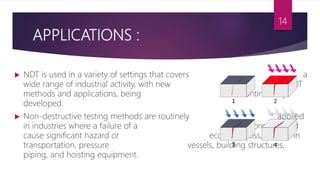
 Non-destructive testing methods are routinely applied
in industries where a failure of a component would
cause significant hazard or economic loss, such as in
transportation, pressure vessels, building structures,
piping, and hoisting equipment.
14
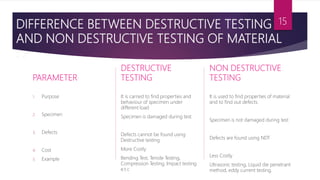
DIFFERENCE BETWEEN DESTRUCTIVE TESTING
AND NON DESTRUCTIVE TESTING OF MATERIAL
: :
PARAMETER
1. Purpose
2. Specimen
3. Defects
4. Cost
5. Example
DESTRUCTIVE
TESTING
It is carried to find properties and
behaviour of specimen under
different load
Specimen is damaged during test
Defects cannot be found using
Destructive testing
More Costly
Bending Test, Tensile Testing,
Compression Testing, Impact testing
e.t.c
NON DESTRUCTIVE
TESTING
It is used to find properties of material
and to find out defects.
Specimen is not damaged during test
Defects are found using NDT
Less Costly
Ultrasonic testing, Liquid die penetrant
method, eddy current testing.
15
THANK YOU
16

Destructive & Non Destructive Testing Of Materials

  • 1.
    DISTRUCTIVE & NON- DESTRUCTIVETESTING OF MATERIAL 1
  • 2.
    INTRODUCTION :  Destructivetesting : In destructive testing (or destructive physical analysis, DPA) tests are carried out to the specimen's failure, in order to understand a specimen's performance or material behaviour under different loads.  Non destructive testing : Nondestructive testing (NDT) is a wide group of analysis techniques used in science and technology industry to evaluate the properties of a material, component or system without causing damage. 2
  • 3.
  • 4.
    DESTRUCTIVE TESTING OFMATERIAL :  In Destructive Testing (or Destructive Physical Analysis, DPA) tests are carried out to the specimen's failure, in order to understand a specimen's performance or material behavior under different loads.  These tests are generally much easier to carry out, yield more information, and are easier to interpret than nondestructive testing.  Destructive testing is most suitable, and economic, for objects which will be mass-produced, as the cost of destroying a small number of specimens is negligible.  It is usually not economical to do destructive testing where only one Universal Testing Machine (UTM) or very few items are to be produced.  Detecting the failure can be accomplished using a sound detector or stress gauge which produces a signal to trigger the high-speed camera. 4
  • 5.
    COMMONLY USED METHODSOF DESTRUCTIVE TESTING OF MATERIAL :  Ball Shear Strength  Bond Strength  DC I.V. Curve Tracing  Die Shear Strength  Digital Microscopy  External Visual Inspection  Fluorescence Microscopy  Glassivation Layer Integrity  Sub-Micron Real Time X-ray  Internal Visual Inspection  Cross-Sectioning  Particle Impact Noise Detection  Scanning Electron Microscopy (SEM) Inspection  SEM Metallization Inspection  Solder Reflow/Moisture Sensitivity Testing  Metallization Thickness  Hermeticity Testing  SEM, XRF, and FTIR Elemental Analysis  Scanning Acoustic Microscopy (C Mode)  Ion Milling  Acid De-encapsulation  Sample De-lidding 5
  • 6.
    POLDI HARDNESS TEST:  The Poldi hardness tester is one of the portable hardness testers.  The indentation is obtained on the test surface by striking a blow on the ball which also produces indentation on the standard bar.  he diameter of the indentation on the test surface and the standard bar are correlated in the manufacturer’s table and the hardness number is measured in BHN.  This test method is not commonly used due to the availability of Poldi hardness tester other accurate portable hardness testers in the industry.  Ideally, the Brinell hardness number obtained by this method cannot be related to the direct Brinell hardness values because of the basic difference in the method of indentation. Poldi uses impact method for indentation. 6
  • 7.
    ROCKWELL HARDNESS TEST:  In the Rockwell hardness test, a differential-depth method, the residual depth of the indent made by the indenter is measured.  In contrast, the indentation size is measured in the Brinell, Vickers and Knoop optical test methods.  The deeper a defined indenter penetrates at a defined test force into the surface of a work piece (specimen), the softer the tested material.  In the Rockwell method, the test force is applied in two stages.  This allows the impact of specimen surface roughness ROCKWELL HARDNESS TESTING MACHINE (e.g. grooves in the specimen) and measuring errors caused by backlash in indentation depth measurement to be eliminated. 7
  • 8.
  • 9.
    NON DESTRUCTIVE TESTINGOF MATERIAL :  Nondestructive testing (NDT) is a wide group of analysis techniques used in science and technology industry to evaluate the properties of a material, component or system without causing damage.  NDT does not permanently alter the article being inspected, it is a highly valuable technique that can save both money and time in product evaluation, troubleshooting, and research.  NDT is commonly used in forensic engineering, mechanical engineering, petroleum engineering, electrical engineering, NON DESTRUCTIVE TESTING OF MATERIAL civil engineering, systems engineering, aeronautical engineering, medicine, and art.  Innovations in the field of nondestructive testing have had a profound impact on medical imaging, including on echocardiography, medical ultrasonography, and digital radiography. 9
  • 10.
    COMMONLY USED METHODSOF NON DESTRUCTIVE TESTING OF MATERIAL :  Eddy-current  Magnetic-particle  liquid penetrant  Radiographic  Ultrasonic  Visual testing 10
  • 11.
    METHODS :  NDTmethods may rely upon use of electromagnetic radiation, sound and inherent properties of materials to examine samples.  This includes some kinds of microscopy to examine external surfaces in detail, although sample preparation techniques for metallography, optical microscopy and electron microscopy are generally destructive as the surfaces must be made smooth through polishing or the sample must be electron transparent in thickness.  The inside of a sample can be examined with penetrating radiation, such as X- rays, neutrons or terahertz radiation.  Sound waves are utilized in the case of ultrasonic testing.  Analyzing and documenting a non-destructive failure mode can also be accomplished using a high-speed camera recording continuously (movie-loop) until the failure is detected.  Detecting the failure can be accomplished using a sound detector or stress gauge which produces a signal to trigger the high-speed camera. 11
  • 12.
    TESTINGS :  Eddy-currenttesting : 1. Eddy-current testing is one of many electromagnetic testing methods used in nondestructive testing (NDT) making use of electromagnetic induction to detect and characterize surface and sub-surface flaws in conductive materials. 1. In its most basic form — the single-element ECT probe — a coil of conductive wire is excited with an alternating electrical current. This wire coil produces an alternating magnetic field around itself. The magnetic field oscillates at the same frequency as the current running through the coil. When the coil approaches a conductive material, currents opposed to the ones in the coil are induced in the material eddy currents. 2. Variations in the electrical conductivity and magnetic permeability of the test object, and the presence of defects causes a change in eddy current and a corresponding change in phase and amplitude that can be detected by measuring the impedance changes in the coil, which is a telltale sign of the presence of defects. This is the basis of standard ECT. 12
  • 13.
    1. Dye penetrantinspection (DPI), is a widely applied and low-cost inspection method used to locate surface-breaking defects in all non- porous materials (metals, plastics, or ceramics). The penetrant may be applied to all non-ferrous materials and ferrous materials, although for ferrous components magnetic-particle inspection is often used instead for its subsurface detection capability. Dye Penetrant Testing Kit 2. LPI is used to detect casting, forging and welding surface defects such as hairline cracks, surface porosity, leaks in new products, and fatigue cracks on in-service components. 3. DPI is based upon capillary action, where low surface tension fluid penetrates into clean and dry surface-breaking discontinuities. Penetrant may be applied to the test component by dipping, spraying, or brushing. After adequate penetration time has been allowed, the excess penetrant is removed and a developer is applied. The developer helps to draw penetrant out of the flaw so that an invisible indication becomes visible to the inspector. Inspection is performed under ultraviolet or white light, depending on the type of dye used - fluorescent or non fluorescent (visible). 13 DYE PENETRANT INSPECTION :
  • 14.
    APPLICATIONS :  NDTis used in a variety of settings that covers a wide range of industrial activity, with new NDT methods and applications, being continuously developed.  Non-destructive testing methods are routinely applied in industries where a failure of a component would cause significant hazard or economic loss, such as in transportation, pressure vessels, building structures, piping, and hoisting equipment. 14
  • 15.
    DIFFERENCE BETWEEN DESTRUCTIVETESTING AND NON DESTRUCTIVE TESTING OF MATERIAL : : PARAMETER 1. Purpose 2. Specimen 3. Defects 4. Cost 5. Example DESTRUCTIVE TESTING It is carried to find properties and behaviour of specimen under different load Specimen is damaged during test Defects cannot be found using Destructive testing More Costly Bending Test, Tensile Testing, Compression Testing, Impact testing e.t.c NON DESTRUCTIVE TESTING It is used to find properties of material and to find out defects. Specimen is not damaged during test Defects are found using NDT Less Costly Ultrasonic testing, Liquid die penetrant method, eddy current testing. 15
  • 16.