Weld Repair
Antonius P. Bramono
Antonius P. Bramono - pbramono@gmail.com
• If a weldment fails inspection, the welding inspector will
review it in order to determine the extent of damage that
may be caused by repairing the weld and whether the
weldment can fulfill its function if the defect is allowed to
remain in place.
• If the function of the weldment is affected by the defect, the
weldment must be discarded and replaced. In some cases,
the defect may not affect the functionality of the weldment,
in which case it can be left. These determinations are made
on a case-by-case basis.
Introduction
Antonius P. Bramono - pbramono@gmail.com
• If a part requires rework, a thorough welding procedure should be
established to minimize the effect of the repair on the remaining portion
of the weld.
• This procedure must consider the procedure used to create the original
weld. It must also consider the following: the condition of the base
metal and weld
- the type of filler metal to be used in the repair
- the welding sequence
- any in-process inspection required during the repair
- tooling required for the repair
- the final weld’s mechanical properties
Introduction
Antonius P. Bramono - pbramono@gmail.com
• Incomplete consideration of any of these factors may result
in further rejection of the weld repair and possible failure of
the weld when placed into service.
Introduction
Antonius P. Bramono - pbramono@gmail.com
Weld Repair
Antonius P. Bramono - pbramono@gmail.com
•Dimensional repairs are repairs that are required
because the weld is too small for the material
and joint type. These repairs involve the addition
of material to increase weld size and are usually
necessary due to the insufficient addition of filler
metal during the welding operation.
Dimensional Repairs
Antonius P. Bramono - pbramono@gmail.com
•Conditions that require dimensional repairs are
as follows:
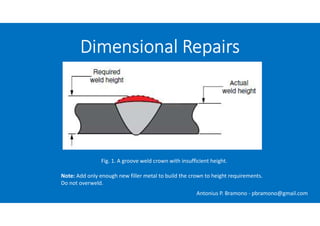
Crown height is too low, Figure 1. A low crown
does not provide adequate reinforcement of
the weld. Repair this type of defect with
stringer beads to minimize weld shrinkage. Add
only enough new filler metal to build the crown
to height requirements. Do not overweld.
Dimensional Repairs
Antonius P. Bramono - pbramono@gmail.com
Dimensional Repairs
Antonius P. Bramono - pbramono@gmail.com
Fig. 1. A groove weld crown with insufficient height.
Note: Add only enough new filler metal to build the crown to height requirements.
Do not overweld.
Surfacing or overlay type weld height is too
low, Figure 2. Surfacing or overlay that is not
high enough reduces the durability and service
life of the surfaced material. Repair this type of
defect with stringer beads to minimize dilution
and distortion.
Dimensional Repairs
Antonius P. Bramono - pbramono@gmail.com
Dimensional Repairs
Antonius P. Bramono - pbramono@gmail.com
Figure 2. An overlay weld deposit with insufficient height.
Fillet weld size is too small, Figure 3. A small
fillet weld does not provide adequate strength
in the joint. The weld is repaired by removing
the inadequate weld and rewelding to create
the proper size fillet weld.
Dimensional Repairs
Antonius P. Bramono - pbramono@gmail.com
Dimensional Repairs
Antonius P. Bramono - pbramono@gmail.com
Figure 3. Fillet weld leg length is satisfactory; however,
the weld is concave, which reduces the actual fillet weld size.
•Defects seen on the surface of the weld can
extend deep into the weld. For this reason, the
defect must be removed. After the defect has
been removed, the area must be re-inspected
before a repair can be attempted.
Surface Defect Repairs
Antonius P. Bramono - pbramono@gmail.com
•Common defects and factors to be considered
when repairing them are as follows:
•Longitudinal, transverse, or crater cracks, Figure
4. On steel and steel alloys, use a small grinding
wheel like the one shown in Figure 5 to remove
cracks. Remove only the amount of metal
required to eliminate the crack.
Surface Defect Repairs
Antonius P. Bramono - pbramono@gmail.com
Surface Defect Repairs
Antonius P. Bramono - pbramono@gmail.com
Figure 4. Types of cracks that may be found
on groove and fillet welds.
Surface Defect Repairs
Antonius P. Bramono - pbramono@gmail.com
Figure 5. A cutting or grinding wheel can be
used to remove cracks from the weld.
•For all other types of metal, use small rotary
tungsten carbide tools to remove the crack.
•Do not use grinding wheels on nonferrous
material. When repairing, add only sufficient
filler metal to match the adjacent weld contour.
Surface Defect Repairs
Antonius P. Bramono - pbramono@gmail.com
•Undercut at the edges of the weld, Figure 6. Dirt,
scale, and oxides may be present in the undercut
area. These impurities can cause further defects if
not removed prior to weld repair. Remove these
impurities by grinding or routing as previously
described.
•Be careful not to remove base metal adjacent to the
undercut. Since the repair will widen the original
crown size, use lower currents and sufficient wire to
prevent additional undercuts and underfill.
Surface Defect Repairs
Antonius P. Bramono - pbramono@gmail.com
Surface Defect Repairs
Antonius P. Bramono - pbramono@gmail.com
Figure 6. Undercut on flat groove welds can
occur on either edge of the weld. Groove
and fillet welds made in the horizontal
position will usually have undercut on the
upper part of the weld.
•Porosity, or pores in the weld, Figure 7. Remove
isolated or single pores with a rotary tool for weld
repair. Remove multiple and linear (aligned in a row)
pores by grinding or machining. Then re-inspect the
weld by radiographic or ultrasonic inspection to
ensure that the porosity has been completely
removed before repairs are started. For weld repair,
always fill the deepest part of the recessed area first.
Keep each layer of weld level until the area is filled.
Surface Defect Repairs
Antonius P. Bramono - pbramono@gmail.com
Surface Defect Repairs
Antonius P. Bramono - pbramono@gmail.com
Figure 7. Isolated pores can occur in any
portion of the weld. Linear (aligned) pores
usually are found near the bottom, along
the sidewall, or at weld intersections.
• Cold laps, Figure 8, are areas of the weld that have not fused with the
base metal. Cold laps can occur on fillet welds or butt welds, usually
as a result of a travel speed that is too slow.
• Since the extent of the overlap cannot be determined by NDT, remove
the entire area by grinding or routing. Use extreme care when
grinding into lap joints to prevent grinding into adjacent metal and
creating more problems.
• When the overlap material has been removed, perform a penetrant
test to determine if the defect is entirely gone. Continue removing
material until the penetrant test is satisfactory. If weld repair is
required to satisfy crown height requirements, use low currents and
sufficient wire to match the crown with adjoining material.
Surface Defect Repairs
Antonius P. Bramono - pbramono@gmail.com
Surface Defect Repairs
Antonius P. Bramono - pbramono@gmail.com
Figure 8. Fillet weld cold laps are usually
located on the bottom side of the weld. Butt
weld cold laps can occur on either side of
the weld crown.
• Incomplete penetration on the root side of butt welds.
Other types of defects can also occur on the root side of
the weld, such as concave root surface, cracks, porosity,
melt-through, etc. See Figure 9. Remove all of these areas
by grinding or routing.
• To ensure complete removal of all defects, perform a
penetrant test before repairing the weld.
• Since oxides form in this area during welding, clean the
repair area to bright metal before re-welding. Use
stringer beads and add only enough wire to build a small
crown.
Surface Defect Repairs
Antonius P. Bramono - pbramono@gmail.com
Surface Defect Repairs
Antonius P. Bramono - pbramono@gmail.com
Figure 9. The defects shown can occur on
the root side of the weld.
• Internal defects, Figure 10, may or may not extend to the
surface and might not be found by surface inspection.
They are generally found by radiographic and ultrasonic
testing.
• Once the defect has been located by a radiographic test,
the defect can be marked on the X-ray film. The film is
aligned over the weld, and a punch can be used to indent
the area over the defect. The next step is to determine
the depth of the defect from the top and root surface
using ultrasonic testing. Routing or grinding is done from
the surface nearest to the defect.
Internal Defect Repairs
Antonius P. Bramono - pbramono@gmail.com
•Finding the defect in the weld by grinding or routing
requires both skill and patience. Porosity and large
areas exhibiting lack of fusion are generally easy to
locate and remove. Cracks and small areas with
incomplete fusion are more difficult to locate.
•If the crack is not found after removing metal
halfway through the part, re-weld the ground area.
Then work from the opposite surface to remove the
crack.
Internal Defect Repairs
Antonius P. Bramono - pbramono@gmail.com
•Never grind a slot or a hole through the part.
Repairing a slot causes excessive distortion in the
adjacent areas or shrinkage and the possibility of
more defects.
•The removal of defects in fillet welds is difficult due
to limited access of the grinder. If the penetrant is
allowed to penetrate into the joint, it can cause
many problems during weld repair. For a fillet weld,
it is easier to use visual inspection or radiographic
tests to ensure that the defect has been removed.
Internal Defect Repairs
Antonius P. Bramono - pbramono@gmail.com
•After the defect is removed, prepare the area for
welding by removing all rough edges on the
ground area. Any oil, grease, scale, or penetrant
residue must be removed with alcohol or
acetone. Do not use grit blasting in the grooved
area. Grit material can become embedded in the
ground area and become trapped in the weld
repair.
Preparing for Repair
Antonius P. Bramono - pbramono@gmail.com
• If possible, use stringer beads with minimum amperage
for minimum shrinkage of the joint.
• Whenever possible, use a current-tapering (crater fill)
control on amperage to prevent crater cracks.
• Clean scale and oxides from each weld pass.
• Visually inspect each weld pass after cleaning.
• If the weld repair is deep, have an X-ray made after two
or three completed passes to confirm that new cracks
have not formed. This should also be done if there is any
doubt about removal of the original crack.
Welding for Repairs
Antonius P. Bramono - pbramono@gmail.com
• Always use a backing gas if the root of the weld may be
exposed to air.
• Where possible, use the original parameters for preheat, inter-
pass temperature, and post-heat.
• Do not build the repair crown any higher than is required. Each
pass that is made stresses the base of the weld due to
shrinkage.
• When the grain size must be controlled throughout the repair,
weld temper beads on top of the weld, as shown in Figure 10.
These beads reduce the surface grain size and are removed
after welding.
Welding for Repairs-cont’d
Antonius P. Bramono - pbramono@gmail.com
Welding for Repairs-cont’d
Antonius P. Bramono - pbramono@gmail.com
Figure 10. Temper beads are used to obtain
an even structure throughout the top area of
the weld. Since they add significant height to
the crown, they are usually removed after
welding.
•All of the nondestructive testing (NDT) required for
final acceptance of the weld must be completed
after the weld repair is done. This means that even if
several inspections were satisfactory before the weld
was rejected, all of the inspections must be redone.
Repairs can cause new problems in a weld.
•After a repair is made, the entire weldment must be
reinspected.
Post-weld Inspection
Antonius P. Bramono - pbramono@gmail.com
•Repairs are expensive and often detract from the
appearance of the final weld. Everything within
reason should be done to eliminate defects that
require costly repairs.
•Review every flaw and defect in the weld, regardless
of its severity, to determine its cause.
•Plan the possible corrective action that can be taken
in the future to eliminate similar problems.
Repair Review
Antonius P. Bramono - pbramono@gmail.com
Repair review should include the following areas:
•base material
•Tooling
•preparation for welding
•joint preparation
•process application (welding variables)
•welder training and skill
Repair Review-cont’d
Antonius P. Bramono - pbramono@gmail.com
Feel free to contact:
Antonius P. Bramono
 E: pbramono@gmail.com
Antonius P. Bramono - pbramono@gmail.com

Weld Repair

  • 1.
    Weld Repair Antonius P.Bramono Antonius P. Bramono - pbramono@gmail.com
  • 2.
    • If aweldment fails inspection, the welding inspector will review it in order to determine the extent of damage that may be caused by repairing the weld and whether the weldment can fulfill its function if the defect is allowed to remain in place. • If the function of the weldment is affected by the defect, the weldment must be discarded and replaced. In some cases, the defect may not affect the functionality of the weldment, in which case it can be left. These determinations are made on a case-by-case basis. Introduction Antonius P. Bramono - pbramono@gmail.com
  • 3.
    • If apart requires rework, a thorough welding procedure should be established to minimize the effect of the repair on the remaining portion of the weld. • This procedure must consider the procedure used to create the original weld. It must also consider the following: the condition of the base metal and weld - the type of filler metal to be used in the repair - the welding sequence - any in-process inspection required during the repair - tooling required for the repair - the final weld’s mechanical properties Introduction Antonius P. Bramono - pbramono@gmail.com
  • 4.
    • Incomplete considerationof any of these factors may result in further rejection of the weld repair and possible failure of the weld when placed into service. Introduction Antonius P. Bramono - pbramono@gmail.com
  • 5.
    Weld Repair Antonius P.Bramono - pbramono@gmail.com
  • 6.
    •Dimensional repairs arerepairs that are required because the weld is too small for the material and joint type. These repairs involve the addition of material to increase weld size and are usually necessary due to the insufficient addition of filler metal during the welding operation. Dimensional Repairs Antonius P. Bramono - pbramono@gmail.com
  • 7.
    •Conditions that requiredimensional repairs are as follows: Crown height is too low, Figure 1. A low crown does not provide adequate reinforcement of the weld. Repair this type of defect with stringer beads to minimize weld shrinkage. Add only enough new filler metal to build the crown to height requirements. Do not overweld. Dimensional Repairs Antonius P. Bramono - pbramono@gmail.com
  • 8.
    Dimensional Repairs Antonius P.Bramono - pbramono@gmail.com Fig. 1. A groove weld crown with insufficient height. Note: Add only enough new filler metal to build the crown to height requirements. Do not overweld.
  • 9.
    Surfacing or overlaytype weld height is too low, Figure 2. Surfacing or overlay that is not high enough reduces the durability and service life of the surfaced material. Repair this type of defect with stringer beads to minimize dilution and distortion. Dimensional Repairs Antonius P. Bramono - pbramono@gmail.com
  • 10.
    Dimensional Repairs Antonius P.Bramono - pbramono@gmail.com Figure 2. An overlay weld deposit with insufficient height.
  • 11.
    Fillet weld sizeis too small, Figure 3. A small fillet weld does not provide adequate strength in the joint. The weld is repaired by removing the inadequate weld and rewelding to create the proper size fillet weld. Dimensional Repairs Antonius P. Bramono - pbramono@gmail.com
  • 12.
    Dimensional Repairs Antonius P.Bramono - pbramono@gmail.com Figure 3. Fillet weld leg length is satisfactory; however, the weld is concave, which reduces the actual fillet weld size.
  • 13.
    •Defects seen onthe surface of the weld can extend deep into the weld. For this reason, the defect must be removed. After the defect has been removed, the area must be re-inspected before a repair can be attempted. Surface Defect Repairs Antonius P. Bramono - pbramono@gmail.com
  • 14.
    •Common defects andfactors to be considered when repairing them are as follows: •Longitudinal, transverse, or crater cracks, Figure 4. On steel and steel alloys, use a small grinding wheel like the one shown in Figure 5 to remove cracks. Remove only the amount of metal required to eliminate the crack. Surface Defect Repairs Antonius P. Bramono - pbramono@gmail.com
  • 15.
    Surface Defect Repairs AntoniusP. Bramono - pbramono@gmail.com Figure 4. Types of cracks that may be found on groove and fillet welds.
  • 16.
    Surface Defect Repairs AntoniusP. Bramono - pbramono@gmail.com Figure 5. A cutting or grinding wheel can be used to remove cracks from the weld.
  • 17.
    •For all othertypes of metal, use small rotary tungsten carbide tools to remove the crack. •Do not use grinding wheels on nonferrous material. When repairing, add only sufficient filler metal to match the adjacent weld contour. Surface Defect Repairs Antonius P. Bramono - pbramono@gmail.com
  • 18.
    •Undercut at theedges of the weld, Figure 6. Dirt, scale, and oxides may be present in the undercut area. These impurities can cause further defects if not removed prior to weld repair. Remove these impurities by grinding or routing as previously described. •Be careful not to remove base metal adjacent to the undercut. Since the repair will widen the original crown size, use lower currents and sufficient wire to prevent additional undercuts and underfill. Surface Defect Repairs Antonius P. Bramono - pbramono@gmail.com
  • 19.
    Surface Defect Repairs AntoniusP. Bramono - pbramono@gmail.com Figure 6. Undercut on flat groove welds can occur on either edge of the weld. Groove and fillet welds made in the horizontal position will usually have undercut on the upper part of the weld.
  • 20.
    •Porosity, or poresin the weld, Figure 7. Remove isolated or single pores with a rotary tool for weld repair. Remove multiple and linear (aligned in a row) pores by grinding or machining. Then re-inspect the weld by radiographic or ultrasonic inspection to ensure that the porosity has been completely removed before repairs are started. For weld repair, always fill the deepest part of the recessed area first. Keep each layer of weld level until the area is filled. Surface Defect Repairs Antonius P. Bramono - pbramono@gmail.com
  • 21.
    Surface Defect Repairs AntoniusP. Bramono - pbramono@gmail.com Figure 7. Isolated pores can occur in any portion of the weld. Linear (aligned) pores usually are found near the bottom, along the sidewall, or at weld intersections.
  • 22.
    • Cold laps,Figure 8, are areas of the weld that have not fused with the base metal. Cold laps can occur on fillet welds or butt welds, usually as a result of a travel speed that is too slow. • Since the extent of the overlap cannot be determined by NDT, remove the entire area by grinding or routing. Use extreme care when grinding into lap joints to prevent grinding into adjacent metal and creating more problems. • When the overlap material has been removed, perform a penetrant test to determine if the defect is entirely gone. Continue removing material until the penetrant test is satisfactory. If weld repair is required to satisfy crown height requirements, use low currents and sufficient wire to match the crown with adjoining material. Surface Defect Repairs Antonius P. Bramono - pbramono@gmail.com
  • 23.
    Surface Defect Repairs AntoniusP. Bramono - pbramono@gmail.com Figure 8. Fillet weld cold laps are usually located on the bottom side of the weld. Butt weld cold laps can occur on either side of the weld crown.
  • 24.
    • Incomplete penetrationon the root side of butt welds. Other types of defects can also occur on the root side of the weld, such as concave root surface, cracks, porosity, melt-through, etc. See Figure 9. Remove all of these areas by grinding or routing. • To ensure complete removal of all defects, perform a penetrant test before repairing the weld. • Since oxides form in this area during welding, clean the repair area to bright metal before re-welding. Use stringer beads and add only enough wire to build a small crown. Surface Defect Repairs Antonius P. Bramono - pbramono@gmail.com
  • 25.
    Surface Defect Repairs AntoniusP. Bramono - pbramono@gmail.com Figure 9. The defects shown can occur on the root side of the weld.
  • 26.
    • Internal defects,Figure 10, may or may not extend to the surface and might not be found by surface inspection. They are generally found by radiographic and ultrasonic testing. • Once the defect has been located by a radiographic test, the defect can be marked on the X-ray film. The film is aligned over the weld, and a punch can be used to indent the area over the defect. The next step is to determine the depth of the defect from the top and root surface using ultrasonic testing. Routing or grinding is done from the surface nearest to the defect. Internal Defect Repairs Antonius P. Bramono - pbramono@gmail.com
  • 27.
    •Finding the defectin the weld by grinding or routing requires both skill and patience. Porosity and large areas exhibiting lack of fusion are generally easy to locate and remove. Cracks and small areas with incomplete fusion are more difficult to locate. •If the crack is not found after removing metal halfway through the part, re-weld the ground area. Then work from the opposite surface to remove the crack. Internal Defect Repairs Antonius P. Bramono - pbramono@gmail.com
  • 28.
    •Never grind aslot or a hole through the part. Repairing a slot causes excessive distortion in the adjacent areas or shrinkage and the possibility of more defects. •The removal of defects in fillet welds is difficult due to limited access of the grinder. If the penetrant is allowed to penetrate into the joint, it can cause many problems during weld repair. For a fillet weld, it is easier to use visual inspection or radiographic tests to ensure that the defect has been removed. Internal Defect Repairs Antonius P. Bramono - pbramono@gmail.com
  • 29.
    •After the defectis removed, prepare the area for welding by removing all rough edges on the ground area. Any oil, grease, scale, or penetrant residue must be removed with alcohol or acetone. Do not use grit blasting in the grooved area. Grit material can become embedded in the ground area and become trapped in the weld repair. Preparing for Repair Antonius P. Bramono - pbramono@gmail.com
  • 30.
    • If possible,use stringer beads with minimum amperage for minimum shrinkage of the joint. • Whenever possible, use a current-tapering (crater fill) control on amperage to prevent crater cracks. • Clean scale and oxides from each weld pass. • Visually inspect each weld pass after cleaning. • If the weld repair is deep, have an X-ray made after two or three completed passes to confirm that new cracks have not formed. This should also be done if there is any doubt about removal of the original crack. Welding for Repairs Antonius P. Bramono - pbramono@gmail.com
  • 31.
    • Always usea backing gas if the root of the weld may be exposed to air. • Where possible, use the original parameters for preheat, inter- pass temperature, and post-heat. • Do not build the repair crown any higher than is required. Each pass that is made stresses the base of the weld due to shrinkage. • When the grain size must be controlled throughout the repair, weld temper beads on top of the weld, as shown in Figure 10. These beads reduce the surface grain size and are removed after welding. Welding for Repairs-cont’d Antonius P. Bramono - pbramono@gmail.com
  • 32.
    Welding for Repairs-cont’d AntoniusP. Bramono - pbramono@gmail.com Figure 10. Temper beads are used to obtain an even structure throughout the top area of the weld. Since they add significant height to the crown, they are usually removed after welding.
  • 33.
    •All of thenondestructive testing (NDT) required for final acceptance of the weld must be completed after the weld repair is done. This means that even if several inspections were satisfactory before the weld was rejected, all of the inspections must be redone. Repairs can cause new problems in a weld. •After a repair is made, the entire weldment must be reinspected. Post-weld Inspection Antonius P. Bramono - pbramono@gmail.com
  • 34.
    •Repairs are expensiveand often detract from the appearance of the final weld. Everything within reason should be done to eliminate defects that require costly repairs. •Review every flaw and defect in the weld, regardless of its severity, to determine its cause. •Plan the possible corrective action that can be taken in the future to eliminate similar problems. Repair Review Antonius P. Bramono - pbramono@gmail.com
  • 35.
    Repair review shouldinclude the following areas: •base material •Tooling •preparation for welding •joint preparation •process application (welding variables) •welder training and skill Repair Review-cont’d Antonius P. Bramono - pbramono@gmail.com
  • 36.
    Antonius P. Bramono- pbramono@gmail.com
  • 37.
    Antonius P. Bramono- pbramono@gmail.com
  • 38.
    Feel free tocontact: Antonius P. Bramono  E: pbramono@gmail.com Antonius P. Bramono - pbramono@gmail.com