AN INTRODUCTION TO
CSWIP 3.1

 By

 MR ANSAR BALOCH
Contents

Terms & Definition
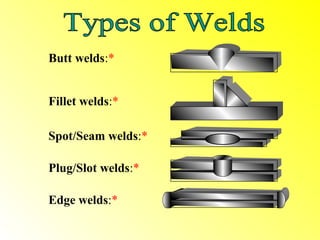
Types of Welds
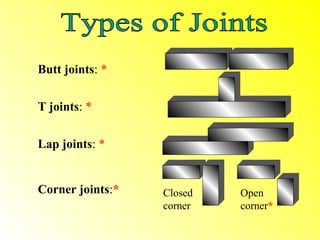
Types of Joints
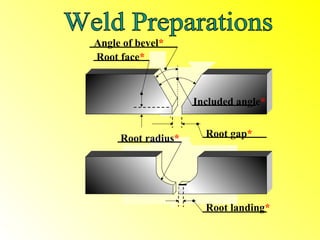
Weld Preparations
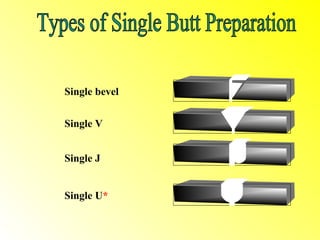
Types of Single Butt Preparation
Butt Welded Joint
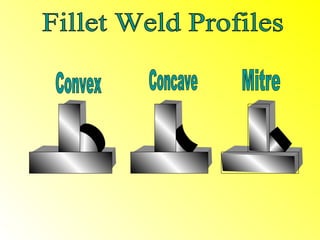
Fillet Weld Profile
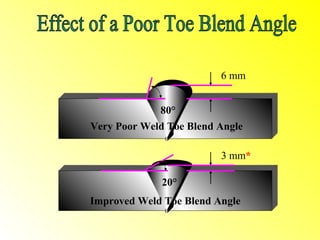
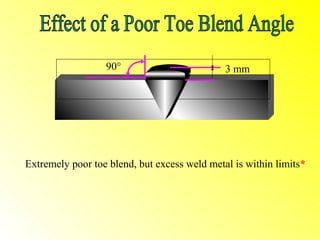
Effect of a Poor Toe Blend Angle
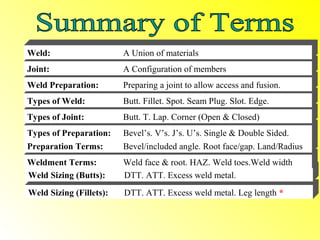
Summary of Terms
Duties of Welding Inspector
Responsibilities of Welding Inspector
Imperfections in Welded Joints
Mechanical Testing
Macro Inspection
A Weld:*    A union between materials caused by heat,
            and or pressure


A Joint:*   A configuration of members


                     Text Page Ref 1:1
Butt welds:*


Fillet welds:*

Spot/Seam welds:*

Plug/Slot welds:*

Edge welds:*
Butt joints: *


T joints: *


Lap joints: *


Corner joints:*   Closed   Open
                  corner   corner*
Angle of bevel*
Root face*


                    Included angle*


     Root radius*     Root gap*


                      Root landing*
Single bevel


Single V


Single J


Single U*
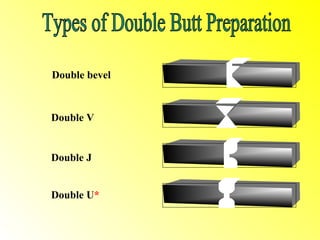
Double bevel


Double V


Double J


Double U*
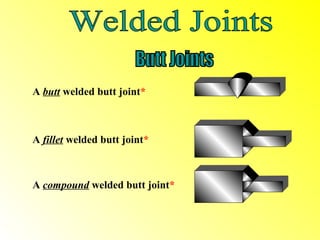
A butt welded butt joint*


A fillet welded butt joint*


A compound welded butt joint*
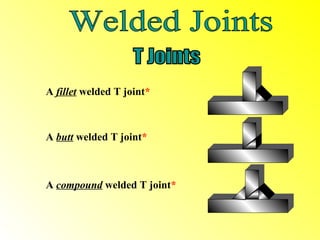
A fillet welded T joint*


A butt welded T joint*


A compound welded T joint*
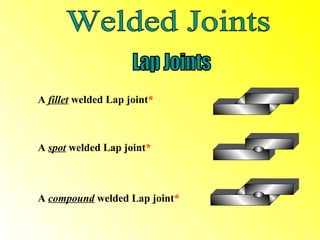
A fillet welded Lap joint*


A spot welded Lap joint*


A compound welded Lap joint*
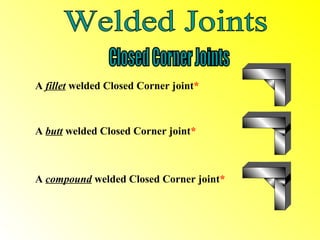
A fillet welded Closed Corner joint*


A butt welded Closed Corner joint*


A compound welded Closed Corner joint*
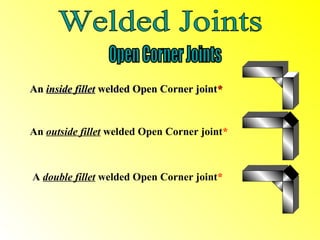
An inside fillet welded Open Corner joint*
                             C


An outside fillet welded Open Corner joint*


A double fillet welded Open Corner joint*
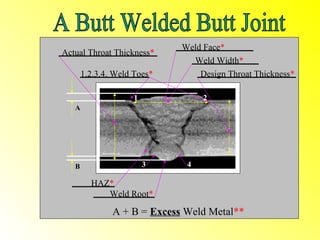
Weld Face*
Actual Throat Thickness*
                               Weld Width*
       1.2.3.4. Weld Toes*        Design Throat Thickness*

                    1             2
   A


   B                    3     4

         HAZ*
            Weld Root*

               A + B = Excess Weld Metal**
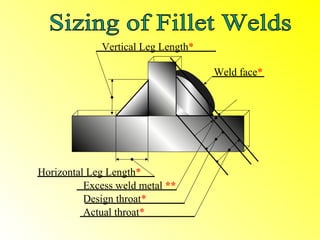
Vertical Leg Length*

                                    Weld face*


Horizontal Leg Length*
          Excess weld metal **
          Design throat*
          Actual throat*
6 mm


             80°
Very Poor Weld Toe Blend Angle

                         3 mm*

              20°
Improved Weld Toe Blend Angle
90°                         3 mm


Extremely poor toe blend, but excess weld metal is within limits*
Weld:                    A Union of materials
Joint:                   A Configuration of members
Weld Preparation:        Preparing a joint to allow access and fusion.
Types of Weld:           Butt. Fillet. Spot. Seam Plug. Slot. Edge.
Types of Joint:          Butt. T. Lap. Corner (Open & Closed)
Types of Preparation:    Bevel’s. V’s. J’s. U’s. Single & Double Sided.
Preparation Terms:       Bevel/included angle. Root face/gap. Land/Radius
Weldment Terms:          Weld face & root. HAZ. Weld toes.Weld width
Weld Sizing (Butts):     DTT. ATT. Excess weld metal.
Weld Sizing (Fillets):   DTT. ATT. Excess weld metal. Leg length *
It is the duty of all welding inspectors:
To ensure that welding operations are carried out in
accordance with written, or agreed practices or
specifications


   Before
                                                       *
   During
    After
Discuss the following
                        Before Welding:
1) Safety:
    Rules.
2) Documentation:
   Spec. Drawings. Procedures. Welder approvals. Certificates. Mill sheets

3) Welding Process and accessories:
   Equipment,Cables, Regulators, Ovens etc

4) Incoming Consumables:
    Materials/welding consumables (Size. Condition. Specification. Storage)
5) Marking out preparation & set up:
   Method. Angles/Root face/gap values. Distortion control. Pre-heat prior to
   tack welding if applicable*
During Welding:

1) Pre-Heating (Min 15 C as per UW-30 ASME Section VIII Div-I)
2) In process distortion control (Balance or sequence welding)
3) Consumable control. (Correct baking for E-7018 260-425 C and
   storage 30-140 C prior to use)
4) Welding process (Related parameters i.e. volts/amps. gas flow rate)
5) Welding run sequence and inter-pass cleaning
6) Minimum/maximum Inter-pass temperatures (150 C for SS, 250 C
   for CS.
7) Full compliance with all elements given on the WPS*
After Welding:

1) Visual Inspection
2) Non Destructive testing
3) Repairs*
4) Repair procedures (NDT/Welding/Welder approval)
5) PWHT
6) Hydro-static testing
7) Submission of all inspection reports to QC departments*
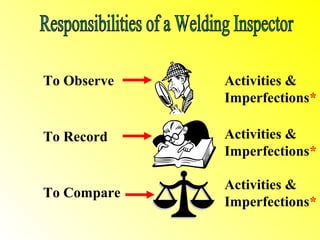
To Observe   Activities &
             Imperfections*

To Record    Activities &
             Imperfections*

             Activities &
To Compare
             Imperfections*
A Welding Inspectors toolbox should contain*
A welding gauge (Cambridge style, or high low gauges etc)
A tape measure and scale
A wire brush
A magnifying glass
A torch and mirror
A specification, pen and report, or note paper
Welding imperfections can be categorized into groups:

             1)     Cracks
             2)     Gas Pores & Porosity
             3)     Solid Inclusions
             4)     Lack of fusion
             5)     Profile & Lack of Filling
             6)     Mechanical or Surface damage
             7)     Misalignment*
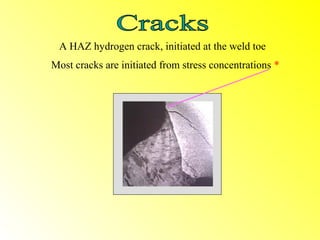
A HAZ hydrogen crack, initiated at the weld toe
Most cracks are initiated from stress concentrations *
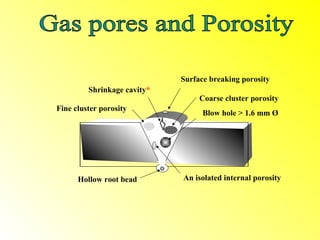
Surface breaking porosity
         Shrinkage cavity*
                                  Coarse cluster porosity
Fine cluster porosity
                                   Blow hole > 1.6 mm Ø


      Hollow root bead       An isolated internal porosity
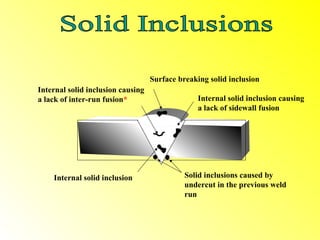
Surface breaking solid inclusion
Internal solid inclusion causing
a lack of inter-run fusion*                      Internal solid inclusion causing
                                                 a lack of sidewall fusion


    Internal solid inclusion                 Solid inclusions caused by
                                             undercut in the previous weld
                                             run
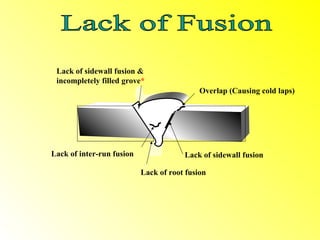
Lack of sidewall fusion &
 incompletely filled grove*
                                            Overlap (Causing cold laps)


Lack of inter-run fusion               Lack of sidewall fusion

                           Lack of root fusion
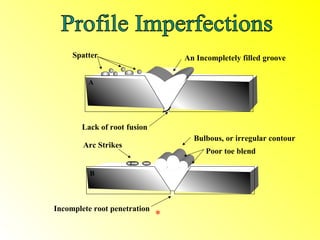
Spatter                      An Incompletely filled groove


         A


       Lack of root fusion
                                    Bulbous, or irregular contour
        Arc Strikes
                                        Poor toe blend

          B


Incomplete root penetration
                              *
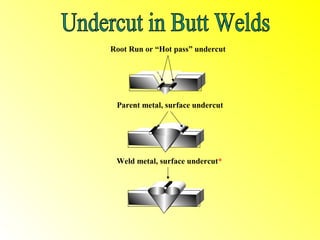
Root Run or “Hot pass” undercut


 Parent metal, surface undercut


 Weld metal, surface undercut*
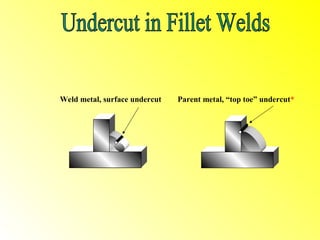
Weld metal, surface undercut   Parent metal, “top toe” undercut*
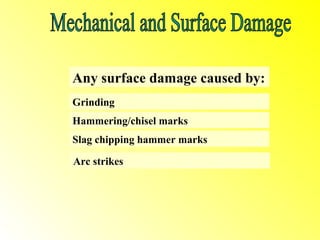
Any surface damage caused by:
Grinding
Hammering/chisel marks
Slag chipping hammer marks

Arc strikes
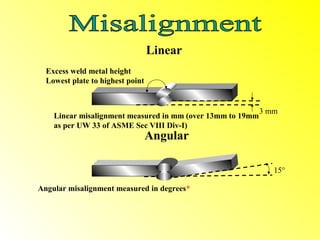
Linear
  Excess weld metal height
  Lowest plate to highest point


                                                            3 mm
    Linear misalignment measured in mm (over 13mm to 19mm
    as per UW 33 of ASME Sec VIII Div-I)
                                  Angular

                                                               15°

Angular misalignment measured in degrees*
Why ?*   To establish the level of mechanical properties*
                                              properties

Which properties ?*
            1)     Hardness*
            2)     Toughness (Impact Test)*
            3)     Tensile strength*
            4)     Ductility*
We test welds to establish minimum levels of mechanical
properties, and soundness of the welded joint*

We divide tests into Quantitative & Qualitative methods:*


      1) Quantitative tests:
     1) Quantitative tests:       (Have units)*
                                 (Have units)*


      2) Qualitative tests:
     2) Qualitative tests:        (Have no units)*
                                 (Have no units)*
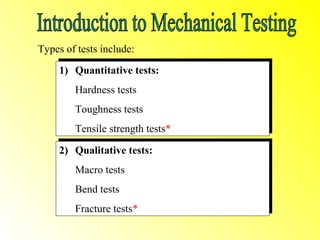
Types of tests include:
      1) Quantitative tests:
     1) Quantitative tests:
        Hardness tests
        Hardness tests
        Toughness tests
        Toughness tests
        Tensile strength tests*
        Tensile strength tests*
      2) Qualitative tests:
     2) Qualitative tests:
        Macro tests
        Macro tests
        Bend tests
        Bend tests
        Fracture tests*
        Fracture tests*
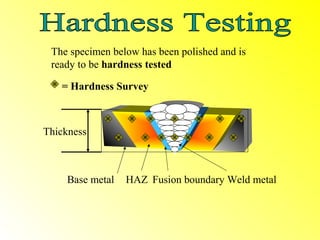
The specimen below has been polished and is
 ready to be hardness tested

   = Hardness Survey


Thickness


    Base metal   HAZ Fusion boundary Weld metal
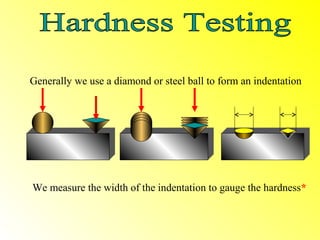
Generally we use a diamond or steel ball to form an indentation


We measure the width of the indentation to gauge the hardness*
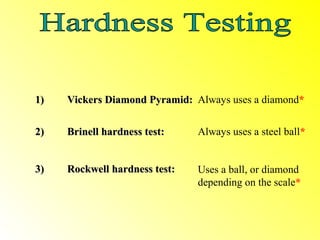
1)   Vickers Diamond Pyramid: Always uses a diamond*


2)   Brinell hardness test:    Always uses a steel ball*


3)   Rockwell hardness test:   Uses a ball, or diamond
                               depending on the scale*
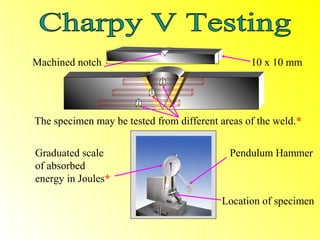
Machined notch                                   10 x 10 mm


The specimen may be tested from different areas of the weld.*


Graduated scale                             Pendulum Hammer
of absorbed
energy in Joules*

                                          Location of specimen
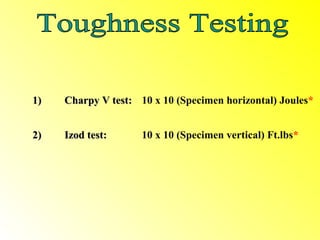
1)   Charpy V test: 10 x 10 (Specimen horizontal) Joules*


2)   Izod test:      10 x 10 (Specimen vertical) Ft.lbs*
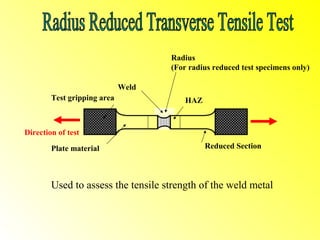
Radius
                                    (For radius reduced test specimens only)

                             Weld
        Test gripping area              HAZ


Direction of test
        Plate material                        Reduced Section


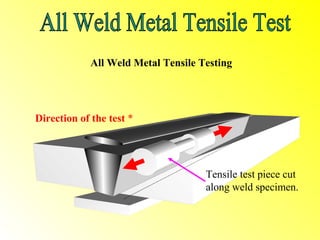
        Used to assess the tensile strength of the weld metal
All Weld Metal Tensile Testing


Direction of the test *


                                    Tensile test piece cut
                                    along weld specimen.
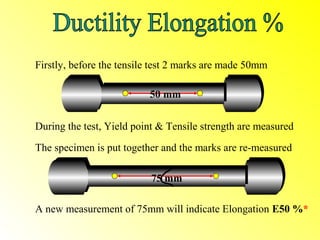
Firstly, before the tensile test 2 marks are made 50mm

                          50 mm


During the test, Yield point & Tensile strength are measured

The specimen is put together and the marks are re-measured

                          75 mm

A new measurement of 75mm will indicate Elongation E50 %*
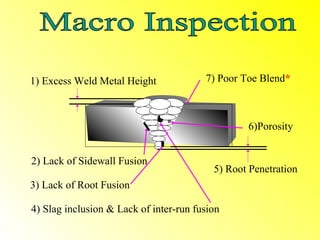
1) Excess Weld Metal Height             7) Poor Toe Blend*


                                                 6)Porosity


2) Lack of Sidewall Fusion
                                          5) Root Penetration
3) Lack of Root Fusion

4) Slag inclusion & Lack of inter-run fusion
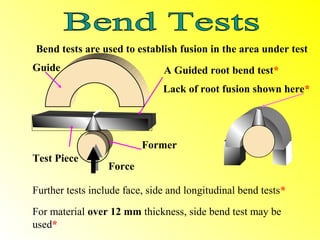
Bend tests are used to establish fusion in the area under test
Guide                          A Guided root bend test*
                               Lack of root fusion shown here*


                          Former
Test Piece
                  Force

Further tests include face, side and longitudinal bend tests*

For material over 12 mm thickness, side bend test may be
used*
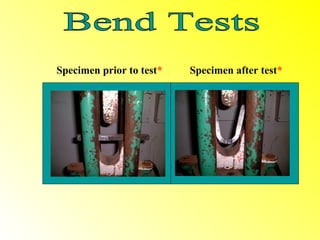
Specimen prior to test*   Specimen after test*
The main difference between Macro & Micro is that Micro is
the study of the micro-structure at much higher magnification


The limit of Macro inspection is magnification < X 10
The specimen is usually cut from a stop/start in the test piece
Remember! The process of inspection is to first:
Observe, then Report, then Compare!*

CSWIP Intro

  • 1.
    AN INTRODUCTION TO CSWIP3.1 By MR ANSAR BALOCH
  • 2.
    Contents Terms & Definition Typesof Welds Types of Joints Weld Preparations Types of Single Butt Preparation Butt Welded Joint Fillet Weld Profile Effect of a Poor Toe Blend Angle Summary of Terms Duties of Welding Inspector Responsibilities of Welding Inspector Imperfections in Welded Joints Mechanical Testing Macro Inspection
  • 3.
    A Weld:* A union between materials caused by heat, and or pressure A Joint:* A configuration of members Text Page Ref 1:1
  • 4.
    Butt welds:* Fillet welds:* Spot/Seamwelds:* Plug/Slot welds:* Edge welds:*
  • 5.
    Butt joints: * Tjoints: * Lap joints: * Corner joints:* Closed Open corner corner*
  • 6.
    Angle of bevel* Rootface* Included angle* Root radius* Root gap* Root landing*
  • 7.
  • 8.
  • 9.
    A butt weldedbutt joint* A fillet welded butt joint* A compound welded butt joint*
  • 10.
    A fillet weldedT joint* A butt welded T joint* A compound welded T joint*
  • 11.
    A fillet weldedLap joint* A spot welded Lap joint* A compound welded Lap joint*
  • 12.
    A fillet weldedClosed Corner joint* A butt welded Closed Corner joint* A compound welded Closed Corner joint*
  • 13.
    An inside filletwelded Open Corner joint* C An outside fillet welded Open Corner joint* A double fillet welded Open Corner joint*
  • 14.
    Weld Face* Actual ThroatThickness* Weld Width* 1.2.3.4. Weld Toes* Design Throat Thickness* 1 2 A B 3 4 HAZ* Weld Root* A + B = Excess Weld Metal**
  • 15.
    Vertical Leg Length* Weld face* Horizontal Leg Length* Excess weld metal ** Design throat* Actual throat*
  • 17.
    6 mm 80° Very Poor Weld Toe Blend Angle 3 mm* 20° Improved Weld Toe Blend Angle
  • 18.
    90° 3 mm Extremely poor toe blend, but excess weld metal is within limits*
  • 19.
    Weld: A Union of materials Joint: A Configuration of members Weld Preparation: Preparing a joint to allow access and fusion. Types of Weld: Butt. Fillet. Spot. Seam Plug. Slot. Edge. Types of Joint: Butt. T. Lap. Corner (Open & Closed) Types of Preparation: Bevel’s. V’s. J’s. U’s. Single & Double Sided. Preparation Terms: Bevel/included angle. Root face/gap. Land/Radius Weldment Terms: Weld face & root. HAZ. Weld toes.Weld width Weld Sizing (Butts): DTT. ATT. Excess weld metal. Weld Sizing (Fillets): DTT. ATT. Excess weld metal. Leg length *
  • 21.
    It is theduty of all welding inspectors: To ensure that welding operations are carried out in accordance with written, or agreed practices or specifications Before * During After
  • 22.
    Discuss the following Before Welding: 1) Safety: Rules. 2) Documentation: Spec. Drawings. Procedures. Welder approvals. Certificates. Mill sheets 3) Welding Process and accessories: Equipment,Cables, Regulators, Ovens etc 4) Incoming Consumables: Materials/welding consumables (Size. Condition. Specification. Storage) 5) Marking out preparation & set up: Method. Angles/Root face/gap values. Distortion control. Pre-heat prior to tack welding if applicable*
  • 23.
    During Welding: 1) Pre-Heating(Min 15 C as per UW-30 ASME Section VIII Div-I) 2) In process distortion control (Balance or sequence welding) 3) Consumable control. (Correct baking for E-7018 260-425 C and storage 30-140 C prior to use) 4) Welding process (Related parameters i.e. volts/amps. gas flow rate) 5) Welding run sequence and inter-pass cleaning 6) Minimum/maximum Inter-pass temperatures (150 C for SS, 250 C for CS. 7) Full compliance with all elements given on the WPS*
  • 24.
    After Welding: 1) VisualInspection 2) Non Destructive testing 3) Repairs* 4) Repair procedures (NDT/Welding/Welder approval) 5) PWHT 6) Hydro-static testing 7) Submission of all inspection reports to QC departments*
  • 25.
    To Observe Activities & Imperfections* To Record Activities & Imperfections* Activities & To Compare Imperfections*
  • 26.
    A Welding Inspectorstoolbox should contain* A welding gauge (Cambridge style, or high low gauges etc) A tape measure and scale A wire brush A magnifying glass A torch and mirror A specification, pen and report, or note paper
  • 27.
    Welding imperfections canbe categorized into groups: 1) Cracks 2) Gas Pores & Porosity 3) Solid Inclusions 4) Lack of fusion 5) Profile & Lack of Filling 6) Mechanical or Surface damage 7) Misalignment*
  • 28.
    A HAZ hydrogencrack, initiated at the weld toe Most cracks are initiated from stress concentrations *
  • 29.
    Surface breaking porosity Shrinkage cavity* Coarse cluster porosity Fine cluster porosity Blow hole > 1.6 mm Ø Hollow root bead An isolated internal porosity
  • 30.
    Surface breaking solidinclusion Internal solid inclusion causing a lack of inter-run fusion* Internal solid inclusion causing a lack of sidewall fusion Internal solid inclusion Solid inclusions caused by undercut in the previous weld run
  • 31.
    Lack of sidewallfusion & incompletely filled grove* Overlap (Causing cold laps) Lack of inter-run fusion Lack of sidewall fusion Lack of root fusion
  • 32.
    Spatter An Incompletely filled groove A Lack of root fusion Bulbous, or irregular contour Arc Strikes Poor toe blend B Incomplete root penetration *
  • 33.
    Root Run or“Hot pass” undercut Parent metal, surface undercut Weld metal, surface undercut*
  • 34.
    Weld metal, surfaceundercut Parent metal, “top toe” undercut*
  • 35.
    Any surface damagecaused by: Grinding Hammering/chisel marks Slag chipping hammer marks Arc strikes
  • 36.
    Linear Excessweld metal height Lowest plate to highest point 3 mm Linear misalignment measured in mm (over 13mm to 19mm as per UW 33 of ASME Sec VIII Div-I) Angular 15° Angular misalignment measured in degrees*
  • 37.
    Why ?* To establish the level of mechanical properties* properties Which properties ?* 1) Hardness* 2) Toughness (Impact Test)* 3) Tensile strength* 4) Ductility*
  • 38.
    We test weldsto establish minimum levels of mechanical properties, and soundness of the welded joint* We divide tests into Quantitative & Qualitative methods:* 1) Quantitative tests: 1) Quantitative tests: (Have units)* (Have units)* 2) Qualitative tests: 2) Qualitative tests: (Have no units)* (Have no units)*
  • 39.
    Types of testsinclude: 1) Quantitative tests: 1) Quantitative tests: Hardness tests Hardness tests Toughness tests Toughness tests Tensile strength tests* Tensile strength tests* 2) Qualitative tests: 2) Qualitative tests: Macro tests Macro tests Bend tests Bend tests Fracture tests* Fracture tests*
  • 40.
    The specimen belowhas been polished and is ready to be hardness tested = Hardness Survey Thickness Base metal HAZ Fusion boundary Weld metal
  • 41.
    Generally we usea diamond or steel ball to form an indentation We measure the width of the indentation to gauge the hardness*
  • 42.
    1) Vickers Diamond Pyramid: Always uses a diamond* 2) Brinell hardness test: Always uses a steel ball* 3) Rockwell hardness test: Uses a ball, or diamond depending on the scale*
  • 43.
    Machined notch 10 x 10 mm The specimen may be tested from different areas of the weld.* Graduated scale Pendulum Hammer of absorbed energy in Joules* Location of specimen
  • 44.
    1) Charpy V test: 10 x 10 (Specimen horizontal) Joules* 2) Izod test: 10 x 10 (Specimen vertical) Ft.lbs*
  • 45.
    Radius (For radius reduced test specimens only) Weld Test gripping area HAZ Direction of test Plate material Reduced Section Used to assess the tensile strength of the weld metal
  • 46.
    All Weld MetalTensile Testing Direction of the test * Tensile test piece cut along weld specimen.
  • 47.
    Firstly, before thetensile test 2 marks are made 50mm 50 mm During the test, Yield point & Tensile strength are measured The specimen is put together and the marks are re-measured 75 mm A new measurement of 75mm will indicate Elongation E50 %*
  • 48.
    1) Excess WeldMetal Height 7) Poor Toe Blend* 6)Porosity 2) Lack of Sidewall Fusion 5) Root Penetration 3) Lack of Root Fusion 4) Slag inclusion & Lack of inter-run fusion
  • 49.
    Bend tests areused to establish fusion in the area under test Guide A Guided root bend test* Lack of root fusion shown here* Former Test Piece Force Further tests include face, side and longitudinal bend tests* For material over 12 mm thickness, side bend test may be used*
  • 50.
    Specimen prior totest* Specimen after test*
  • 51.
    The main differencebetween Macro & Micro is that Micro is the study of the micro-structure at much higher magnification The limit of Macro inspection is magnification < X 10 The specimen is usually cut from a stop/start in the test piece
  • 52.
    Remember! The processof inspection is to first: Observe, then Report, then Compare!*