QUESTIONNAIRE & CHECKLIST
Prof Dr Nilima Sonawane
Principal
Institute Of Nursing Education , Mumbai
nilima.sonawane09@gmail.com
The contents
๏ต Define questionnaire.
๏ต types of questions.
๏ต guidelines for designing good questionnaire.
๏ต various methods of questionnaire administration.
๏ต advantages and disadvantages of questionnaire.
๏ต Define checklist.
๏ต characteristics and construction of checklist.
๏ต Discuss advantages and disadvantages of checklist.
Questionnaire
โ€ข Questionnaires is one of the most popular tool of collecting data
โ€ข They provide a convenient way to gathering information from a target
population.
โ€ข They are cost-effective and easy to construct and analyze.
โ€ข A questionnaire is a planned self-reported form designed to elicit
information though written or verbal responses of the subjects.
๏ต A questionnaire is a research instrument
consisting of a series of questions for the
purpose of gathering information from
respondents. Questionnaires can be thought of
as a kind of written interview. They can be
carried out face to face, by telephone, computer
or post.
๏ต Questionnaires provide a relatively cheap, quick
and efficient way of obtaining large amounts of
information from a large sample of people.
Definitions
๏ต A questionnaire is a structured instrument consisting of a series of data
prepared by researcher that a research subject is asked to complete, to
gather data from individuals about knowledge, attitude, beliefs and
feelings.
๏ต The instrument is called a questionnaire or sometimes a self-
administered questionnaire (SAQ),when respondents complete the
instrument themselves, usually in a paper and pencil format but
occasionally directly onto a computer.
๏ต A questionnaire is structured self-report paper and pencil instrument
that a research subject is asked to complete.
Types of questions
๏ต Open-format / Open ended questions
โ€ข provide opportunity to the respondents to
express their opinions and answers in their
own way. Open-ended questions enable the
respondent to answer in as much detail as they
like in their own words.
โ€ข For example: โ€œcan you tell me how happy you
feel right now?โ€
โ€ข Open โ€“format questions have followings characteristics:
1. There is no predetermined set of responses.
2. They provide true, insightful and unexpected suggestions.
๏ต An ideal questionnaire contains open-ended questions towards
the end of all the questions that would ask respondents about
the suggestions for changes or improvements.
Ex: state your opinion about the quality of health care services in
Maharashtra?
Open ended questions
๏ต Strengths
โ€ข Rich qualitative data is obtained as open questions allow the respondent to elaborate
on their answer.
๏ต Limitations
โ€ข Time-consuming to collect the data. It takes longer for the respondent to complete
open questions. This is a problem as a smaller sample size may be obtained.
โ€ข Time-consuming to analyze the data. It takes longer for the researcher to analyze
qualitative data as they have to read the answers and try to put them into categories by
coding, which is often subjective a
Closed-format Questions
๏ต These questions offer respondents a number of alternative
replies, from which the subjects must choose the one that
most likely matches the appropriate answer.
๏ต Closed-format questions have following characteristics:
1. They facilitate easy statistical calculation of data.
2. Provide easy preliminary analysis
3. Can be asked to different groups at different intervals.
4. Facilitate efficient tracking of opinion.
Subtypes of Closed-format questions
1. Dichotomous
questions
2. Multiple-choice
questions
3. Cafeteria questions
4. Rank order questions
5. Contingency questions
6. Rating questions
7. Importance questions
8. Likert questions
9. Bipolar questions
10. Matrix questions
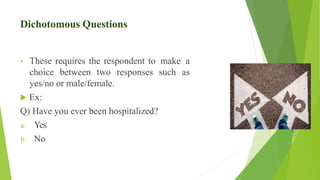
Dichotomous Questions
โ€ข These requires the respondent to make a
choice between two responses such as
yes/no or male/female.
๏ต Ex:
Q) Have you ever been hospitalized?
a. Yes
b. No
Multiple-choice questions
๏ต These questions require respondents to make a choice
between more than two response alternatives.
๏ต Ex:
Q)Which of the following disease is sexually transmitted ?
a. DM
b. Hypothyroidism
c. Syphilis
d. HTN
Cafeteria Questions
โ€ข These are special type of MCQโ€™s that ask the respondents to select a
response that most closely corresponds to their views.
๏ต Ex:
Q) What do you think about hormone replacement therapy?
a. It is dangerous, should be avoided.
b. One should be cautious while using it.
c. I am uncertain about my views.
d. It is beneficial, should be promoted.
Rank order Questions
โ€ข These questions ask respondents to rank their responses from
most favorable to least favorable.
๏ต Ex:
Q) What according to you is most important for your life. Rank from
most favorable to least favorable.
a. Money
b. Education
c. Family
d. Health
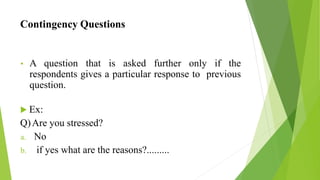
Contingency Questions
โ€ข A question that is asked further only if the
respondents gives a particular response to previous
question.
๏ต Ex:
Q)Are you stressed?
a. No
b. if yes what are the reasons?.........
Rating questions
โ€ข These questions ask respondents to judge something along
an ordered dimension.
โ€ข Respondent is asked to rate a particular issue on a scale that
ranges from Poor to Good.
โ€ข They may provide a number of choices.
๏ต Ex:
Q) How you rank the education quality in India?
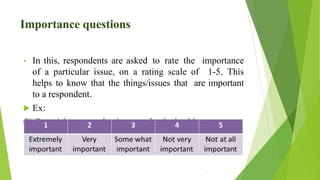
Importance questions
โ€ข In this, respondents are asked to rate the importance
of a particular issue, on a rating scale of 1-5. This
helps to know that the things/issues that are important
to a respondent.
๏ต Ex:
Q) Exercising every day is โ€ฆโ€ฆ..for the health.
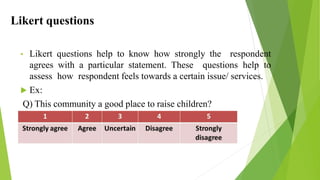
Likert questions
โ€ข Likert questions help to know how strongly the respondent
agrees with a particular statement. These questions help to
assess how respondent feels towards a certain issue/ services.
๏ต Ex:
Q) This community a good place to raise children?
Bipolar questions
โ€ข Bipolar questions are questions that have two extreme
answers.
โ€ข Respondent has to mark his or her response between
two opposite ends of the scale.
๏ต Ex:
Q) what is your balance of preference here?
โ€ข I Like Going For Walks [ ] [ ] [ ] [ ] [ ] I Like
Watching Movie
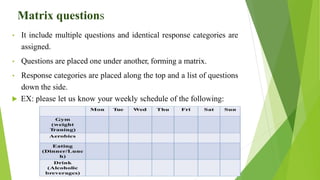
Matrix questions
โ€ข It include multiple questions and identical response categories are
assigned.
โ€ข Questions are placed one under another, forming a matrix.
โ€ข Response categories are placed along the top and a list of questions
down the side.
๏ต EX: please let us know your weekly schedule of the following:
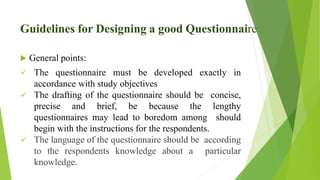
Guidelines for Designing a good Questionnaire
๏ต General points:
๏ƒผ The questionnaire must be developed exactly in
accordance with study objectives
๏ƒผ The drafting of the questionnaire should be concise,
precise and brief, be because the lengthy
questionnaires may lead to boredom among should
begin with the instructions for the respondents.
๏ƒผ The language of the questionnaire should be according
to the respondents knowledge about a particular
knowledge.
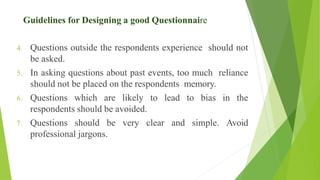
4. Questions outside the respondents experience should not
be asked.
5. In asking questions about past events, too much reliance
should not be placed on the respondents memory.
6. Questions which are likely to lead to bias in the
respondents should be avoided.
7. Questions should be very clear and simple. Avoid
professional jargons.
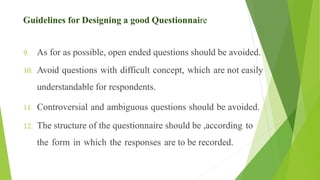
Guidelines for Designing a good Questionnaire
9. As for as possible, open ended questions should be avoided.
10. Avoid questions with difficult concept, which are not easily
understandable for respondents.
11. Controversial and ambiguous questions should be avoided.
12. The structure of the questionnaire should be ,according to
the form in which the responses are to be recorded.
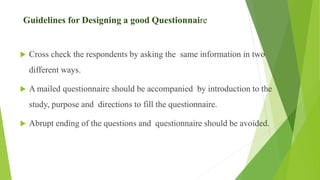
Guidelines for Designing a good Questionnaire
๏ต Cross check the respondents by asking the same information in two
different ways.
๏ต A mailed questionnaire should be accompanied by introduction to the
study, purpose and directions to fill the questionnaire.
๏ต Abrupt ending of the questions and questionnaire should be avoided.
Guidelines for Designing a good Questionnaire
Sequence of the Questions
โ€ข There should be logical sequence of the questions in the
questionnaire.
โ€ข Researcher must ensure that the answer to question is not
influenced by previous question.
โ€ข Questions should flow from more general to more specific.
โ€ข Questions should be flow from least to most sensitive.
โ€ข Sandwich theory states that a questionnaire should
generally start with demographic profile of subjects,
followed by specific questions according to the objectives
of the study.
Question Construction
โ€ข Use statements which can be interpreted in same way by all subjects.
โ€ข Use statements where persons that have different opinions or traits
will give different answers.
โ€ข Use only one aspect of the construct in which you are interested.
โ€ข Avoid asking double-barreled questions which contain two distinct
ideas or concepts.
๏ต Ex: are you satisfied with pay and fringe benefits?
โ€ข Avoid leading, loaded, ambiguous and long questions.
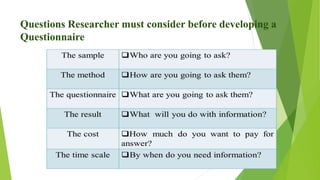
Questions Researcher must consider before developing a
Questionnaire
โ€ข Avoid negative and double negative questions
โ€ข Use a positive statements
โ€ข Do not make assumptions about respondent.
โ€ข Use clear and comprehensible wording.
โ€ข Use correct spelling, grammar and punctuation.
Guidelines for Designing a good Questionnaire
Methods of Questionnaire Administration
โ€ข A questionnaire may be administered with
following methods; each method has it unique
advantage as listed below.
1) Postal
2) Phone
3) Electronic
4) Personally administered
Advantage of Questionnaire
โ€ข Questionnaire are cost-effective.
โ€ข They are easy to analyze.
โ€ข They require less time and energy to administer.
โ€ข Questionnaire offer the possibility of anonymity.
โ€ข They reduce bias as interviewer not present.
โ€ข Questionnaire are used for large sample size.
โ€ข Questionnaire are less intrusive than phone or face-to-face
interview.
Disadvantage of Questionnaire
โ€ข Questionnaire are not suitable for all.
Ex: children, blind and illiterates.
โ€ข Low response rate.
โ€ข Questionnaire sent by mail may be filled by someone other than
the intended person.
โ€ข Questionnaire provide only superficial information.
โ€ข Probing of response is not possible.
โ€ข There are chances of misinterpretation.
โ€ข People can lie and answer the question vaguely.
Checklist
๏ต It is one of the most commonly used instruments for
performance evaluation.
๏ต Checklist enables the observer to note only whether or
not a trait is present.
๏ต It consist of listing the steps, activities and behaviors
which the observer records when an incident occurs.
Definition
๏ต A checklist is a simple instrument consisting prepared list
of expected items of performance or attributes, which are
checked by researcher for their presence or absence.
Characteristics of Checklists
๏ต Observe one respondent at one time.
๏ต Clearly specify the characteristics of behavior to be
observed.
๏ต Use only carefully prepared checklist.
๏ต The observer should be trained how to observe, what to
observe,& how to record the observed behavior.
๏ต Use checklist only when you are interested in calculating,
a particular characteristic.
Construction of Checklists
Following points should be kept in mind:
๏ต Express each item in clear, simple language.
๏ต An intensive survey of literature is made to determine type of
checklist to be used.
๏ต Checklist items may be continuous or divided into groups.
๏ต Checklist items formulated on the basis of judgement of experts.
๏ต Avoid negative statements whenever possible.
๏ต Each item should have clear responses: yes or no, true or false,& the
like.
๏ต Checklist must have quality of completeness & comprehensiveness.
Advantages of Checklist
๏ต It allow inter-individual comparisons.
๏ต A simple method to record observation.
๏ต Adaptable to subject matter areas.
๏ต Useful in evaluating learning activities & procedural
work.
๏ต Decreases the chances of error in observation.
๏ต It allow the observer to contain the direct attention.
Disadvantages of Checklist
๏ต Does not indicate quality of performance.
๏ต Only a limited component of clinical performance can be
evaluated.
๏ต Degree of accuracy of performance can not be assessed.
๏ต Limited use in qualitative research studies.
Designing Research Questionnaire & checklist

Designing Research Questionnaire & checklist

  • 1.
    QUESTIONNAIRE & CHECKLIST ProfDr Nilima Sonawane Principal Institute Of Nursing Education , Mumbai nilima.sonawane09@gmail.com
  • 3.
    The contents ๏ต Definequestionnaire. ๏ต types of questions. ๏ต guidelines for designing good questionnaire. ๏ต various methods of questionnaire administration. ๏ต advantages and disadvantages of questionnaire. ๏ต Define checklist. ๏ต characteristics and construction of checklist. ๏ต Discuss advantages and disadvantages of checklist.
  • 4.
    Questionnaire โ€ข Questionnaires isone of the most popular tool of collecting data โ€ข They provide a convenient way to gathering information from a target population. โ€ข They are cost-effective and easy to construct and analyze. โ€ข A questionnaire is a planned self-reported form designed to elicit information though written or verbal responses of the subjects.
  • 5.
    ๏ต A questionnaireis a research instrument consisting of a series of questions for the purpose of gathering information from respondents. Questionnaires can be thought of as a kind of written interview. They can be carried out face to face, by telephone, computer or post. ๏ต Questionnaires provide a relatively cheap, quick and efficient way of obtaining large amounts of information from a large sample of people.
  • 6.
    Definitions ๏ต A questionnaireis a structured instrument consisting of a series of data prepared by researcher that a research subject is asked to complete, to gather data from individuals about knowledge, attitude, beliefs and feelings. ๏ต The instrument is called a questionnaire or sometimes a self- administered questionnaire (SAQ),when respondents complete the instrument themselves, usually in a paper and pencil format but occasionally directly onto a computer. ๏ต A questionnaire is structured self-report paper and pencil instrument that a research subject is asked to complete.
  • 7.
    Types of questions ๏ตOpen-format / Open ended questions โ€ข provide opportunity to the respondents to express their opinions and answers in their own way. Open-ended questions enable the respondent to answer in as much detail as they like in their own words. โ€ข For example: โ€œcan you tell me how happy you feel right now?โ€
  • 8.
    โ€ข Open โ€“formatquestions have followings characteristics: 1. There is no predetermined set of responses. 2. They provide true, insightful and unexpected suggestions. ๏ต An ideal questionnaire contains open-ended questions towards the end of all the questions that would ask respondents about the suggestions for changes or improvements. Ex: state your opinion about the quality of health care services in Maharashtra?
  • 9.
    Open ended questions ๏ตStrengths โ€ข Rich qualitative data is obtained as open questions allow the respondent to elaborate on their answer. ๏ต Limitations โ€ข Time-consuming to collect the data. It takes longer for the respondent to complete open questions. This is a problem as a smaller sample size may be obtained. โ€ข Time-consuming to analyze the data. It takes longer for the researcher to analyze qualitative data as they have to read the answers and try to put them into categories by coding, which is often subjective a
  • 10.
    Closed-format Questions ๏ต Thesequestions offer respondents a number of alternative replies, from which the subjects must choose the one that most likely matches the appropriate answer. ๏ต Closed-format questions have following characteristics: 1. They facilitate easy statistical calculation of data. 2. Provide easy preliminary analysis 3. Can be asked to different groups at different intervals. 4. Facilitate efficient tracking of opinion.
  • 11.
    Subtypes of Closed-formatquestions 1. Dichotomous questions 2. Multiple-choice questions 3. Cafeteria questions 4. Rank order questions 5. Contingency questions 6. Rating questions 7. Importance questions 8. Likert questions 9. Bipolar questions 10. Matrix questions
  • 12.
    Dichotomous Questions โ€ข Theserequires the respondent to make a choice between two responses such as yes/no or male/female. ๏ต Ex: Q) Have you ever been hospitalized? a. Yes b. No
  • 13.
    Multiple-choice questions ๏ต Thesequestions require respondents to make a choice between more than two response alternatives. ๏ต Ex: Q)Which of the following disease is sexually transmitted ? a. DM b. Hypothyroidism c. Syphilis d. HTN
  • 14.
    Cafeteria Questions โ€ข Theseare special type of MCQโ€™s that ask the respondents to select a response that most closely corresponds to their views. ๏ต Ex: Q) What do you think about hormone replacement therapy? a. It is dangerous, should be avoided. b. One should be cautious while using it. c. I am uncertain about my views. d. It is beneficial, should be promoted.
  • 15.
    Rank order Questions โ€ขThese questions ask respondents to rank their responses from most favorable to least favorable. ๏ต Ex: Q) What according to you is most important for your life. Rank from most favorable to least favorable. a. Money b. Education c. Family d. Health
  • 16.
    Contingency Questions โ€ข Aquestion that is asked further only if the respondents gives a particular response to previous question. ๏ต Ex: Q)Are you stressed? a. No b. if yes what are the reasons?.........
  • 17.
    Rating questions โ€ข Thesequestions ask respondents to judge something along an ordered dimension. โ€ข Respondent is asked to rate a particular issue on a scale that ranges from Poor to Good. โ€ข They may provide a number of choices. ๏ต Ex: Q) How you rank the education quality in India?
  • 18.
    Importance questions โ€ข Inthis, respondents are asked to rate the importance of a particular issue, on a rating scale of 1-5. This helps to know that the things/issues that are important to a respondent. ๏ต Ex: Q) Exercising every day is โ€ฆโ€ฆ..for the health.
  • 19.
    Likert questions โ€ข Likertquestions help to know how strongly the respondent agrees with a particular statement. These questions help to assess how respondent feels towards a certain issue/ services. ๏ต Ex: Q) This community a good place to raise children?
  • 20.
    Bipolar questions โ€ข Bipolarquestions are questions that have two extreme answers. โ€ข Respondent has to mark his or her response between two opposite ends of the scale. ๏ต Ex: Q) what is your balance of preference here? โ€ข I Like Going For Walks [ ] [ ] [ ] [ ] [ ] I Like Watching Movie
  • 21.
    Matrix questions โ€ข Itinclude multiple questions and identical response categories are assigned. โ€ข Questions are placed one under another, forming a matrix. โ€ข Response categories are placed along the top and a list of questions down the side. ๏ต EX: please let us know your weekly schedule of the following:
  • 22.
    Guidelines for Designinga good Questionnaire ๏ต General points: ๏ƒผ The questionnaire must be developed exactly in accordance with study objectives ๏ƒผ The drafting of the questionnaire should be concise, precise and brief, be because the lengthy questionnaires may lead to boredom among should begin with the instructions for the respondents. ๏ƒผ The language of the questionnaire should be according to the respondents knowledge about a particular knowledge.
  • 23.
    4. Questions outsidethe respondents experience should not be asked. 5. In asking questions about past events, too much reliance should not be placed on the respondents memory. 6. Questions which are likely to lead to bias in the respondents should be avoided. 7. Questions should be very clear and simple. Avoid professional jargons. Guidelines for Designing a good Questionnaire
  • 24.
    9. As foras possible, open ended questions should be avoided. 10. Avoid questions with difficult concept, which are not easily understandable for respondents. 11. Controversial and ambiguous questions should be avoided. 12. The structure of the questionnaire should be ,according to the form in which the responses are to be recorded. Guidelines for Designing a good Questionnaire
  • 25.
    ๏ต Cross checkthe respondents by asking the same information in two different ways. ๏ต A mailed questionnaire should be accompanied by introduction to the study, purpose and directions to fill the questionnaire. ๏ต Abrupt ending of the questions and questionnaire should be avoided. Guidelines for Designing a good Questionnaire
  • 26.
    Sequence of theQuestions โ€ข There should be logical sequence of the questions in the questionnaire. โ€ข Researcher must ensure that the answer to question is not influenced by previous question. โ€ข Questions should flow from more general to more specific. โ€ข Questions should be flow from least to most sensitive. โ€ข Sandwich theory states that a questionnaire should generally start with demographic profile of subjects, followed by specific questions according to the objectives of the study.
  • 27.
    Question Construction โ€ข Usestatements which can be interpreted in same way by all subjects. โ€ข Use statements where persons that have different opinions or traits will give different answers. โ€ข Use only one aspect of the construct in which you are interested. โ€ข Avoid asking double-barreled questions which contain two distinct ideas or concepts. ๏ต Ex: are you satisfied with pay and fringe benefits? โ€ข Avoid leading, loaded, ambiguous and long questions.
  • 28.
    Questions Researcher mustconsider before developing a Questionnaire
  • 29.
    โ€ข Avoid negativeand double negative questions โ€ข Use a positive statements โ€ข Do not make assumptions about respondent. โ€ข Use clear and comprehensible wording. โ€ข Use correct spelling, grammar and punctuation. Guidelines for Designing a good Questionnaire
  • 30.
    Methods of QuestionnaireAdministration โ€ข A questionnaire may be administered with following methods; each method has it unique advantage as listed below. 1) Postal 2) Phone 3) Electronic 4) Personally administered
  • 31.
    Advantage of Questionnaire โ€ขQuestionnaire are cost-effective. โ€ข They are easy to analyze. โ€ข They require less time and energy to administer. โ€ข Questionnaire offer the possibility of anonymity. โ€ข They reduce bias as interviewer not present. โ€ข Questionnaire are used for large sample size. โ€ข Questionnaire are less intrusive than phone or face-to-face interview.
  • 32.
    Disadvantage of Questionnaire โ€ขQuestionnaire are not suitable for all. Ex: children, blind and illiterates. โ€ข Low response rate. โ€ข Questionnaire sent by mail may be filled by someone other than the intended person. โ€ข Questionnaire provide only superficial information. โ€ข Probing of response is not possible. โ€ข There are chances of misinterpretation. โ€ข People can lie and answer the question vaguely.
  • 33.
    Checklist ๏ต It isone of the most commonly used instruments for performance evaluation. ๏ต Checklist enables the observer to note only whether or not a trait is present. ๏ต It consist of listing the steps, activities and behaviors which the observer records when an incident occurs.
  • 34.
    Definition ๏ต A checklistis a simple instrument consisting prepared list of expected items of performance or attributes, which are checked by researcher for their presence or absence.
  • 35.
    Characteristics of Checklists ๏ตObserve one respondent at one time. ๏ต Clearly specify the characteristics of behavior to be observed. ๏ต Use only carefully prepared checklist. ๏ต The observer should be trained how to observe, what to observe,& how to record the observed behavior. ๏ต Use checklist only when you are interested in calculating, a particular characteristic.
  • 36.
    Construction of Checklists Followingpoints should be kept in mind: ๏ต Express each item in clear, simple language. ๏ต An intensive survey of literature is made to determine type of checklist to be used. ๏ต Checklist items may be continuous or divided into groups. ๏ต Checklist items formulated on the basis of judgement of experts. ๏ต Avoid negative statements whenever possible. ๏ต Each item should have clear responses: yes or no, true or false,& the like. ๏ต Checklist must have quality of completeness & comprehensiveness.
  • 37.
    Advantages of Checklist ๏ตIt allow inter-individual comparisons. ๏ต A simple method to record observation. ๏ต Adaptable to subject matter areas. ๏ต Useful in evaluating learning activities & procedural work. ๏ต Decreases the chances of error in observation. ๏ต It allow the observer to contain the direct attention.
  • 38.
    Disadvantages of Checklist ๏ตDoes not indicate quality of performance. ๏ต Only a limited component of clinical performance can be evaluated. ๏ต Degree of accuracy of performance can not be assessed. ๏ต Limited use in qualitative research studies.