Questionnaire
Sohel Ahmed
What is a Questionnaire?
• A questionnaire is a research instrument consisting a set of
predetermined questions to collect data from the respondents about
one or more specific topics that serves as a primary research
instrument in survey research
• Generally a questionnaire is a series of written questions for which
the respondents has to provide the answers (Bell 1999)
• The questionnaire was invented by the Statistical Society of London in
1838
Purpose of Questionnaire
• To extract data from respondents
• Inexpensive way to gather data from a potentially large number of
respondents
• It helps to Increases speed and accuracy of recording
• Helps to save time, money and energy
Elements of Questionnaire
Title
• It should be very clear and precise
General introduction
• This has a description of the purpose of study
Specific instructions
• This offers concise demonstration on how to carry on with the
business of responding to the questionnaire
Elements of Questionnaire
Questionnaire items
• It is the main part of the questionnaire schedule, to be clearly
separated from the aforementioned parts
Additional information
• It consist about information of the researcher/ administrator
CHARACTERISTICS OF A GOOD QUESTIONNAIRE
• Concerned with an important or specific topic
• It should be short and long enough to get the data
• Directions should be clear and simple
• Important item are clarified
• Questions should be objective, no clue, hint or suggestion should be
there
CHARACTERISTICS OF A GOOD QUESTIONNAIRE
• Embarrassing questions should be avoided e.g.
• What is your worst habit?
• Do you sing in the shower?
• Hypothetical questions should be avoided e.g.
• If you had one day left to live, what would you do first?
• If you were the opposite sex for a month, how would you spend it?
• Question Should be in an order from simple to complex
Cont…
• Should be attractive, neatly printed and clearly arranged
• Double barrel question should be avoided e.g.
• "How satisfied are you with your pay and job conditions?"
• Should be
• How satisfied are you with your pay?
• How satisfied are you with job condition?
• "How often and how much time do you spend on each visit to a hospital?“
Question development sequences
• First revision
• Accept or reject recommendation for any change
• Critical or peer review
• Pilot test
• Return rate of the question
• Reaching difficulty or any barrier
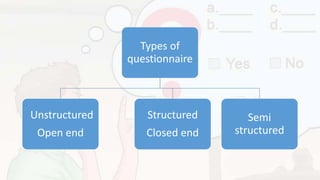
Types of
questionnaire
Unstructured
Open end
Structured
Closed end
Semi
structured
Open ended Questions
• Open ended questions give an opportunity to the respondents to
express their opinions in a free-flowing manner
• Freedom to express opinion
• Scope to obtain more information
• Data form is Qualitative Difficult to analyses/ coding statistically
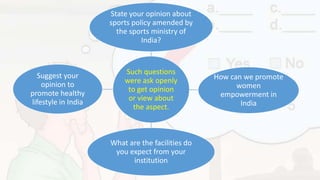
Such questions
were ask openly
to get opinion
or view about
the aspect.
State your opinion about
sports policy amended by
the sports ministry of
India?
How can we promote
women
empowerment in
India
What are the facilities do
you expect from your
institution
Suggest your
opinion to
promote healthy
lifestyle in India
Close Ended or Structured Questionnaires
• Respondents are restricted to choose among any of the given
multiple choice
• The advantages of this format questions is easy to design and analysis
• Closed ended questions can also be asked to different groups at
different intervals to efficiently track their opinion about a
product/service/ company over time
Cont…
• Limited Freedom to express opinion
• Data form is Quantitative
• Scope of getting extra information is very less
Dichotomous Questions
These kinds of questions has two possible responses only
• Yes / No
• True / False
• Agree / Disagree
E.g.. Have you ever experienced any pain
• Yes / No
Closed-ended - Multiple Choice
• When all response choices are known
e.g. Which of the warm up duration you follow before athletic
competition?
• 10 min
• 15 min
• 20 min
• 25 min
• more than 25 min
Closed Ended scale format
Likert Questions
• Likert questions can help you ascertain how strongly your
respondents agree to a particular statement
• Such type of questions also help you assess how your customers feel
towards a certain issue, product or service
Example
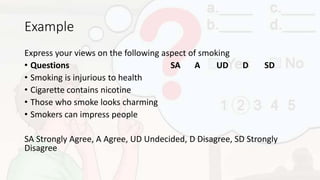
Express your views on the following aspect of smoking
• Questions SA A UD D SD
• Smoking is injurious to health
• Cigarette contains nicotine
• Those who smoke looks charming
• Smokers can impress people
SA Strongly Agree, A Agree, UD Undecided, D Disagree, SD Strongly
Disagree
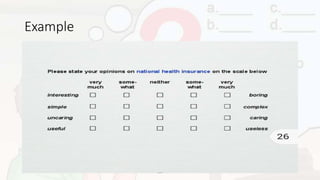
Bipolar Closed Ended Questions
Bipolar Questions
• Bipolar questions are the ones having two extreme answers written at
the opposite ends of the scale. The respondents are asked to mark
their responses between those two
Example
Matrix
A matrix question—are really, multiple questions presented on a grid—
is one of the most popular question types in online and traditional pen-
and-paper surveys
For survey creators, these bundled questions are easy to write and
program
For respondents, they’re generally easy to interpret (and answer) since
the scales and answer options stay the same across all items
Contingency
• A questioned that is answered only if the respondent gives a particular
respond to a previous question. This avoid asking questions to people that
do not apply to them
Do you smoke?
• Yes / No
If Yes, about how many times you smoke once
• 2 to 5 times
• 6 to 10 times
• 11 to 20 times
• more than 20 times in a day
Mixed Method
In some situations, you may have a partial list of answer choices, but you
may still have some doubt or uncertainty about other possible responses.
You can create a partially structured question such as the following
• Example of a Partially Structured Question
What purpose do you use web based resources?
• For research work
• To write assignments
• To improve subject knowledge
• For the purpose of seminar presentation Any other (Please specify)
1.________________ 2. ________________
Using questionnaire depends upon
• Type of information to be gathered
• Available resources for the experiment
Use in following circumstances
• When resources and money are limited
• Limited time
• When it is necessary to protect the privacy of the participants
Issues in Designing Questionnaire
• Determine the Parameters to be investigated
• Prepare the questions to be asked
• Select question type and specify the wording
• Design the question sequence and overall questionnaire layout
• Ask about what you need to know
• Content Oriented
• Population Oriented
Cont…
• Will the respondent be able to answer your question
• Simple to Complex
• General to Specific
• well known
• Will respondents want to answer the question
• Private questions
• silly questions
Cont…
• Respondents must represent the population
• Homogenous Group
• Similar characteristics
• More Similar, accurate information
• Full fill the purpose of questionnaires
Merits
• it’s very economical
• It’s a time saving process
• It covers the research in wide area
• It’s very suitable for special type of responses
• It is most reliable in special cases
Demerits
• Responses rate are low
• Lack of personal contact
• Greater possibility of wrong answers
• Chances of receiving incomplete response are more
• Sometimes answers may be illegible
• It may be useless in many problems

Questionnaire

  • 1.
  • 2.
    What is aQuestionnaire? • A questionnaire is a research instrument consisting a set of predetermined questions to collect data from the respondents about one or more specific topics that serves as a primary research instrument in survey research • Generally a questionnaire is a series of written questions for which the respondents has to provide the answers (Bell 1999) • The questionnaire was invented by the Statistical Society of London in 1838
  • 3.
    Purpose of Questionnaire •To extract data from respondents • Inexpensive way to gather data from a potentially large number of respondents • It helps to Increases speed and accuracy of recording • Helps to save time, money and energy
  • 4.
    Elements of Questionnaire Title •It should be very clear and precise General introduction • This has a description of the purpose of study Specific instructions • This offers concise demonstration on how to carry on with the business of responding to the questionnaire
  • 5.
    Elements of Questionnaire Questionnaireitems • It is the main part of the questionnaire schedule, to be clearly separated from the aforementioned parts Additional information • It consist about information of the researcher/ administrator
  • 6.
    CHARACTERISTICS OF AGOOD QUESTIONNAIRE • Concerned with an important or specific topic • It should be short and long enough to get the data • Directions should be clear and simple • Important item are clarified • Questions should be objective, no clue, hint or suggestion should be there
  • 7.
    CHARACTERISTICS OF AGOOD QUESTIONNAIRE • Embarrassing questions should be avoided e.g. • What is your worst habit? • Do you sing in the shower? • Hypothetical questions should be avoided e.g. • If you had one day left to live, what would you do first? • If you were the opposite sex for a month, how would you spend it? • Question Should be in an order from simple to complex
  • 8.
    Cont… • Should beattractive, neatly printed and clearly arranged • Double barrel question should be avoided e.g. • "How satisfied are you with your pay and job conditions?" • Should be • How satisfied are you with your pay? • How satisfied are you with job condition? • "How often and how much time do you spend on each visit to a hospital?“
  • 9.
    Question development sequences •First revision • Accept or reject recommendation for any change • Critical or peer review • Pilot test • Return rate of the question • Reaching difficulty or any barrier
  • 10.
  • 11.
    Open ended Questions •Open ended questions give an opportunity to the respondents to express their opinions in a free-flowing manner • Freedom to express opinion • Scope to obtain more information • Data form is Qualitative Difficult to analyses/ coding statistically
  • 12.
    Such questions were askopenly to get opinion or view about the aspect. State your opinion about sports policy amended by the sports ministry of India? How can we promote women empowerment in India What are the facilities do you expect from your institution Suggest your opinion to promote healthy lifestyle in India
  • 13.
    Close Ended orStructured Questionnaires • Respondents are restricted to choose among any of the given multiple choice • The advantages of this format questions is easy to design and analysis • Closed ended questions can also be asked to different groups at different intervals to efficiently track their opinion about a product/service/ company over time
  • 14.
    Cont… • Limited Freedomto express opinion • Data form is Quantitative • Scope of getting extra information is very less
  • 15.
    Dichotomous Questions These kindsof questions has two possible responses only • Yes / No • True / False • Agree / Disagree E.g.. Have you ever experienced any pain • Yes / No
  • 16.
    Closed-ended - MultipleChoice • When all response choices are known e.g. Which of the warm up duration you follow before athletic competition? • 10 min • 15 min • 20 min • 25 min • more than 25 min
  • 17.
    Closed Ended scaleformat Likert Questions • Likert questions can help you ascertain how strongly your respondents agree to a particular statement • Such type of questions also help you assess how your customers feel towards a certain issue, product or service
  • 18.
    Example Express your viewson the following aspect of smoking • Questions SA A UD D SD • Smoking is injurious to health • Cigarette contains nicotine • Those who smoke looks charming • Smokers can impress people SA Strongly Agree, A Agree, UD Undecided, D Disagree, SD Strongly Disagree
  • 19.
    Bipolar Closed EndedQuestions Bipolar Questions • Bipolar questions are the ones having two extreme answers written at the opposite ends of the scale. The respondents are asked to mark their responses between those two
  • 20.
  • 21.
    Matrix A matrix question—arereally, multiple questions presented on a grid— is one of the most popular question types in online and traditional pen- and-paper surveys For survey creators, these bundled questions are easy to write and program For respondents, they’re generally easy to interpret (and answer) since the scales and answer options stay the same across all items
  • 22.
    Contingency • A questionedthat is answered only if the respondent gives a particular respond to a previous question. This avoid asking questions to people that do not apply to them Do you smoke? • Yes / No If Yes, about how many times you smoke once • 2 to 5 times • 6 to 10 times • 11 to 20 times • more than 20 times in a day
  • 23.
    Mixed Method In somesituations, you may have a partial list of answer choices, but you may still have some doubt or uncertainty about other possible responses. You can create a partially structured question such as the following • Example of a Partially Structured Question What purpose do you use web based resources? • For research work • To write assignments • To improve subject knowledge • For the purpose of seminar presentation Any other (Please specify) 1.________________ 2. ________________
  • 24.
    Using questionnaire dependsupon • Type of information to be gathered • Available resources for the experiment Use in following circumstances • When resources and money are limited • Limited time • When it is necessary to protect the privacy of the participants
  • 25.
    Issues in DesigningQuestionnaire • Determine the Parameters to be investigated • Prepare the questions to be asked • Select question type and specify the wording • Design the question sequence and overall questionnaire layout • Ask about what you need to know • Content Oriented • Population Oriented
  • 26.
    Cont… • Will therespondent be able to answer your question • Simple to Complex • General to Specific • well known • Will respondents want to answer the question • Private questions • silly questions
  • 27.
    Cont… • Respondents mustrepresent the population • Homogenous Group • Similar characteristics • More Similar, accurate information • Full fill the purpose of questionnaires
  • 28.
    Merits • it’s veryeconomical • It’s a time saving process • It covers the research in wide area • It’s very suitable for special type of responses • It is most reliable in special cases
  • 29.
    Demerits • Responses rateare low • Lack of personal contact • Greater possibility of wrong answers • Chances of receiving incomplete response are more • Sometimes answers may be illegible • It may be useless in many problems