GATHERING
INFORMATION FROM
SURVEYS, EXPERIMENTS,
OR OBSERVATIONS
OBJECTIVES
Become familiar with the concept of survey questionnaire and how to
design, test, and revise questionnaire (CSEN11/12A-EAAP-lle-j-7).
By the end of this lesson you should be able to:
1. define a questionnaire;
2. compare and contrast the two types of questionnaire; and
3. design, test, and revise survey questionnaires.
Let us have a short activity to see what you already know the about the topic. Read each
statement below carefully. On your answer sheet, write TRUE or FALSE for each of the
following statements
1. A questionnaire is a research instrument consisting of a series of questions for the
purpose of gathering information from respondents.
2. Without a clear definition of the aim, it is clear what data you should collect.
3. A questionnaire ensures standardization and comparability of the data across
interviewers, increases speed and accuracy of recording, and facilitates data
processing.
4. Make the interview long and be equivocal that the respondents may be challenged to
think critically of their answers.
5. Large samples can be made use of and thus the results can be made more dependable
and reliable
Before we start exploring the topic, let us find out if you can
distinguish a well-written survey question from a confusing one.
Write YES if the question is good, and NO if otherwise
How short was Napoleon?
How would you describe Napoleon’s height?
Do you think special car seats should be required for infant passengers?
Should concerned parents use infant car seats?
How satisfied or dissatisfied are you with the pay and work benefits of your current job
Surveys are an effective way to
collect data from your customers.
They are helpful in evaluating
your offerings and finding ways to
make changes for the better.Yet,
some people struggle with survey
design and creation and create
surveys that aren’t giving them the
most accurate results.
SURVEY
Planned questions which are used to
measure attitudes, perceptions, and
opinions.
It contains responses directly related
to each specific research question. It
can either be in the form of an
interview or a questionnaire
QUESTIONNAIRE
List of questions to get specific
information. Responses in a
questionnaire are usually
dichotomous and use an
identification type of test.
SURVEY QUESTIONNAIRE
A set of questions used in a
survey.The survey questionnaire
is a type of data gathering
method that is utilized to collect,
analyze and interpret the different
views of a group of people from a
particular population.The survey
questionnaire has been used in
different fields such as research,
marketing, politics views,
psychology, etc.
QUESTIONNAIRE:
DEFINITION, EXAMPLES,
DESIGN AND TYPES
QUESTIONNAIRE
A questionnaire is a research instrument consisting of a
series of questions for the purpose of gathering information
from respondents. Questionnaires can be thought of as a
kind of written interview. They can be carried out face to
face, by telephone, computer or post
Questionnaires provide a relatively cheap, quick and efficient way
of obtaining large amounts of information from a large sample of
people. Data can be collected relatively quickly because the
researcher would not need to be present when the questionnaires
were completed. This is useful for large populations when
interviews would be impractical. However, a problem with
questionnaires is that respondents 10 may lie due to social
desirability. Most people want to present a positive image of
themselves and so may lie or bend the truth to look good, e.g.,
learners would exaggerate revision duration.
Questionnaires can be an effective means of
measuring the behavior, attitudes, preferences,
opinions and intentions of relatively large numbers
of subjects more cheaply and quickly than other
methods. An important distinction is between open-
ended and closed questions. Often a questionnaire
uses both open and closed questions to collect data.
This is beneficial as it means both quantitative and
qualitative data can be obtained
Types of questions
used in a Survey
Questionnaire
1.THE FREE-ANSWER TYPE
ALSO CALLED THE OPEN FORM, OPEN ENDED,
SUBJECTIVE, UNRESTRICTED, ESSAY, AND UNGUIDED
RESPONSE TYPE
2. THE GUIDED RESPONSE TYPE
THIS IS ALSO CALLED THE CLOSED FORM OR
RESTRICTED TYPE.
FREE-ANSWER TYPE OR
OPEN QUESTIONS
1.THE FREE-ANSWER TYPE
 These are open-ended questions that requires explanations and impressions.
Sample question:
As a student, what are the struggles you face everyday?
Response:
Time and budget management. We need to manage our time
properly but there have been a lot of projects, and other school
activities lately. We also need to budget our money to be able to
comply with our projects, school fees, food, and other stuff.
Open questions allow people to express what they think in their own words. Open-ended
questions enable the respondent to answer in as much detail as they like in their own words.
For example:“Can you tell me how happy you feel right now?” If you want to gather more in-
depth answers from your respondents, then open questions will work better.These give no
pre-set answer options and instead allow the respondents to put down exactly what they like in
their own words
Open questions are often used for complex questions that cannot be answered in a few simple
categories but require more detail and discussion. Lawrence Kohlberg presented his
participants with moral dilemmas. One of the most famous concerns a character called Heinz
who is faced with the choice between watching his wife die of cancer or stealing the only drug
that could help her. Participants were asked whether Heinz should steal the drug or not and,
more importantly, for their reasons why upholding or breaking the law is right
STRENGTHS
Rich qualitative data is obtained as open questions allow
the respondent to elaborate on their answer.This means
the research can find out why a person holds a certain
attitude.
LIMITATIONS
 Time-consuming to collect the data. It takes longer for the respondent to
complete open questions.This is a problem as a smaller sample size may
be obtained.
 Time-consuming to analyze the data. It takes longer for the researcher to
analyze qualitative data as they have to read the answers and try to put
them into categories by coding, which is often subjective and difficult.
However, Smith (1992) has devoted an entire book to the issues of
thematic content analysis the includes 14 different scoring systems for
open-ended questions.
 Not suitable for less educated respondents as open questions require
superior writing skills and a better ability to express one's feelings
verbally.
CLOSED QUESTIONS
Closed questions structure the answer by only allowing responses which
fit into pre-decided categories. Data that can be placed into a category is
called nominal data.The category can be restricted to as few as two
options, i.e., dichotomous (e.g.“yes” or “no”“male” or “female”) or
include quite complex lists of alternatives from which the respondent can
choose (e.g., polytomous).
Closed questions can also provide ordinal data (which can be ranked).
This often involves using a continuous rating scale to measure the
strength of attitudes or emotions. For example, strongly agree / agree /
neutral / disagree / strongly disagree / unable to answer. Closed
questions have been used to research type A personality (e.g., Friedman
& Rosenman, 1974), and also to assess life events which may cause stress
(Holmes & Rahe, 1967), and attachment (Fraley,Waller, & Brennan, 2000)
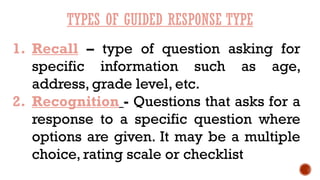
TYPES OF GUIDED RESPONSE TYPE
1. Recall – type of question asking for
specific information such as age,
address, grade level, etc.
2. Recognition - Questions that asks for a
response to a specific question where
options are given. It may be a multiple
choice, rating scale or checklist
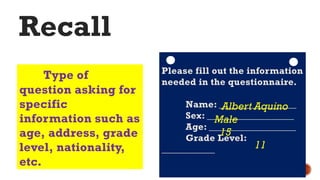
Type of
question asking for
specific
information such as
age, address, grade
level, nationality,
etc.
Recall
Please fill out the information
needed in the questionnaire.
Name: ________________
Sex: __________________
Age: __________________
Grade Level:
___________
Albert Aquino
Male
15
11
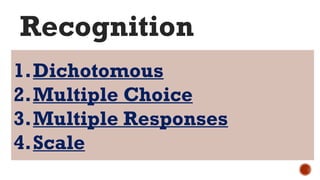
1.Dichotomous
2.Multiple Choice
3.Multiple Responses
4.Scale
Recognition
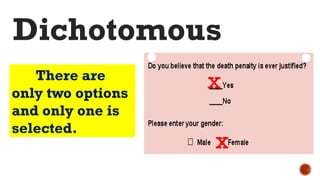
There are
only two options
and only one is
selected.
Dichotomous
x
x
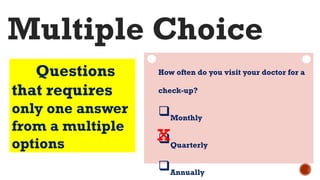
Questions
that requires
only one answer
from a multiple
options
Multiple Choice
How often do you visit your doctor for a
check-up?
Monthly
Quarterly
Annually
x
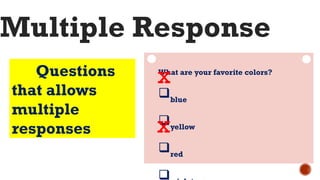
Questions
that allows
multiple
responses
Multiple Response
What are your favorite colors?
blue
yellow
red

x
x
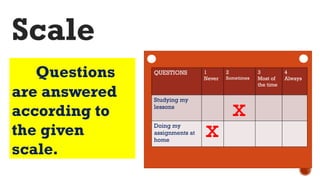
Questions
are answered
according to
the given
scale.
Scale
QUESTIONS 1
Never
2
Sometimes
3
Most of
the time
4
Always
Studying my
lessons
Doing my
assignments at
home
x
x
STRENGTHS
 They can be economical.This means they can provide large amounts of
research data for relatively low costs.Therefore, a large sample size can
be obtained which should be representative of the population, which a
researcher can then generalize from.
 The respondent provides information which can be easily converted into
quantitative data (e.g., count the number of 'yes' or 'no' answers), allowing
statistical analysis of the responses.
 The questions are standardized. All respondents are asked exactly the
same questions in the same order.This means a questionnaire can be
replicated easily to check for reliability.Therefore, a second researcher
can use the questionnaire to check that the results are consistent.
LIMITATIONS
 They lack detail. Because the responses are fixed, there is less scope
for respondents to supply answers which reflect their true feelings on
a topic.
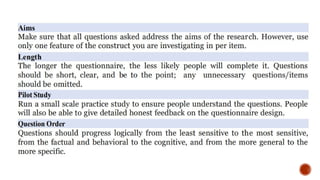
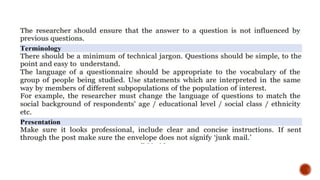
QUESTIONNAIRE DESIGN
With some questionnaires suffering from a response rate as
low as 5%, it is essential that a questionnaire is well
designed.There are a number of important factors in
questionnaire design
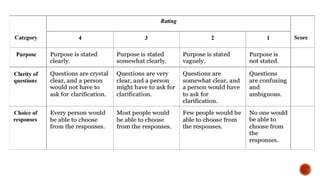
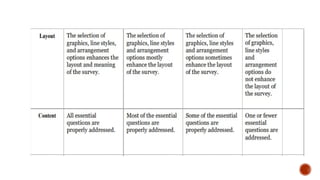
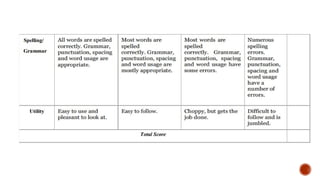
RUBRICS IN ASSESSING
SURVEYS
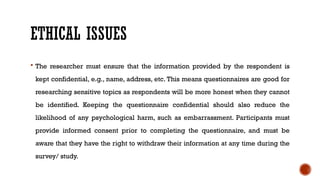
ETHICAL ISSUES
ETHICAL ISSUES
 The researcher must ensure that the information provided by the respondent is
kept confidential, e.g., name, address, etc. This means questionnaires are good for
researching sensitive topics as respondents will be more honest when they cannot
be identified. Keeping the questionnaire confidential should also reduce the
likelihood of any psychological harm, such as embarrassment. Participants must
provide informed consent prior to completing the questionnaire, and must be
aware that they have the right to withdraw their information at any time during the
survey/ study.

Gathering Information from Surveys, Experiments, or.pptx

  • 1.
  • 2.
    OBJECTIVES Become familiar withthe concept of survey questionnaire and how to design, test, and revise questionnaire (CSEN11/12A-EAAP-lle-j-7). By the end of this lesson you should be able to: 1. define a questionnaire; 2. compare and contrast the two types of questionnaire; and 3. design, test, and revise survey questionnaires.
  • 3.
    Let us havea short activity to see what you already know the about the topic. Read each statement below carefully. On your answer sheet, write TRUE or FALSE for each of the following statements 1. A questionnaire is a research instrument consisting of a series of questions for the purpose of gathering information from respondents. 2. Without a clear definition of the aim, it is clear what data you should collect. 3. A questionnaire ensures standardization and comparability of the data across interviewers, increases speed and accuracy of recording, and facilitates data processing. 4. Make the interview long and be equivocal that the respondents may be challenged to think critically of their answers. 5. Large samples can be made use of and thus the results can be made more dependable and reliable
  • 4.
    Before we startexploring the topic, let us find out if you can distinguish a well-written survey question from a confusing one. Write YES if the question is good, and NO if otherwise How short was Napoleon? How would you describe Napoleon’s height? Do you think special car seats should be required for infant passengers? Should concerned parents use infant car seats? How satisfied or dissatisfied are you with the pay and work benefits of your current job
  • 5.
    Surveys are aneffective way to collect data from your customers. They are helpful in evaluating your offerings and finding ways to make changes for the better.Yet, some people struggle with survey design and creation and create surveys that aren’t giving them the most accurate results.
  • 6.
    SURVEY Planned questions whichare used to measure attitudes, perceptions, and opinions. It contains responses directly related to each specific research question. It can either be in the form of an interview or a questionnaire QUESTIONNAIRE List of questions to get specific information. Responses in a questionnaire are usually dichotomous and use an identification type of test.
  • 7.
    SURVEY QUESTIONNAIRE A setof questions used in a survey.The survey questionnaire is a type of data gathering method that is utilized to collect, analyze and interpret the different views of a group of people from a particular population.The survey questionnaire has been used in different fields such as research, marketing, politics views, psychology, etc.
  • 8.
  • 9.
    QUESTIONNAIRE A questionnaire isa research instrument consisting of a series of questions for the purpose of gathering information from respondents. Questionnaires can be thought of as a kind of written interview. They can be carried out face to face, by telephone, computer or post
  • 10.
    Questionnaires provide arelatively cheap, quick and efficient way of obtaining large amounts of information from a large sample of people. Data can be collected relatively quickly because the researcher would not need to be present when the questionnaires were completed. This is useful for large populations when interviews would be impractical. However, a problem with questionnaires is that respondents 10 may lie due to social desirability. Most people want to present a positive image of themselves and so may lie or bend the truth to look good, e.g., learners would exaggerate revision duration.
  • 11.
    Questionnaires can bean effective means of measuring the behavior, attitudes, preferences, opinions and intentions of relatively large numbers of subjects more cheaply and quickly than other methods. An important distinction is between open- ended and closed questions. Often a questionnaire uses both open and closed questions to collect data. This is beneficial as it means both quantitative and qualitative data can be obtained
  • 12.
    Types of questions usedin a Survey Questionnaire
  • 13.
    1.THE FREE-ANSWER TYPE ALSOCALLED THE OPEN FORM, OPEN ENDED, SUBJECTIVE, UNRESTRICTED, ESSAY, AND UNGUIDED RESPONSE TYPE 2. THE GUIDED RESPONSE TYPE THIS IS ALSO CALLED THE CLOSED FORM OR RESTRICTED TYPE.
  • 14.
  • 15.
    1.THE FREE-ANSWER TYPE These are open-ended questions that requires explanations and impressions. Sample question: As a student, what are the struggles you face everyday? Response: Time and budget management. We need to manage our time properly but there have been a lot of projects, and other school activities lately. We also need to budget our money to be able to comply with our projects, school fees, food, and other stuff.
  • 16.
    Open questions allowpeople to express what they think in their own words. Open-ended questions enable the respondent to answer in as much detail as they like in their own words. For example:“Can you tell me how happy you feel right now?” If you want to gather more in- depth answers from your respondents, then open questions will work better.These give no pre-set answer options and instead allow the respondents to put down exactly what they like in their own words Open questions are often used for complex questions that cannot be answered in a few simple categories but require more detail and discussion. Lawrence Kohlberg presented his participants with moral dilemmas. One of the most famous concerns a character called Heinz who is faced with the choice between watching his wife die of cancer or stealing the only drug that could help her. Participants were asked whether Heinz should steal the drug or not and, more importantly, for their reasons why upholding or breaking the law is right
  • 17.
    STRENGTHS Rich qualitative datais obtained as open questions allow the respondent to elaborate on their answer.This means the research can find out why a person holds a certain attitude.
  • 18.
    LIMITATIONS  Time-consuming tocollect the data. It takes longer for the respondent to complete open questions.This is a problem as a smaller sample size may be obtained.  Time-consuming to analyze the data. It takes longer for the researcher to analyze qualitative data as they have to read the answers and try to put them into categories by coding, which is often subjective and difficult. However, Smith (1992) has devoted an entire book to the issues of thematic content analysis the includes 14 different scoring systems for open-ended questions.  Not suitable for less educated respondents as open questions require superior writing skills and a better ability to express one's feelings verbally.
  • 19.
  • 20.
    Closed questions structurethe answer by only allowing responses which fit into pre-decided categories. Data that can be placed into a category is called nominal data.The category can be restricted to as few as two options, i.e., dichotomous (e.g.“yes” or “no”“male” or “female”) or include quite complex lists of alternatives from which the respondent can choose (e.g., polytomous).
  • 21.
    Closed questions canalso provide ordinal data (which can be ranked). This often involves using a continuous rating scale to measure the strength of attitudes or emotions. For example, strongly agree / agree / neutral / disagree / strongly disagree / unable to answer. Closed questions have been used to research type A personality (e.g., Friedman & Rosenman, 1974), and also to assess life events which may cause stress (Holmes & Rahe, 1967), and attachment (Fraley,Waller, & Brennan, 2000)
  • 22.
    TYPES OF GUIDEDRESPONSE TYPE 1. Recall – type of question asking for specific information such as age, address, grade level, etc. 2. Recognition - Questions that asks for a response to a specific question where options are given. It may be a multiple choice, rating scale or checklist
  • 23.
    Type of question askingfor specific information such as age, address, grade level, nationality, etc. Recall Please fill out the information needed in the questionnaire. Name: ________________ Sex: __________________ Age: __________________ Grade Level: ___________ Albert Aquino Male 15 11
  • 24.
  • 25.
    There are only twooptions and only one is selected. Dichotomous x x
  • 26.
    Questions that requires only oneanswer from a multiple options Multiple Choice How often do you visit your doctor for a check-up? Monthly Quarterly Annually x
  • 27.
    Questions that allows multiple responses Multiple Response Whatare your favorite colors? blue yellow red  x x
  • 28.
    Questions are answered according to thegiven scale. Scale QUESTIONS 1 Never 2 Sometimes 3 Most of the time 4 Always Studying my lessons Doing my assignments at home x x
  • 29.
    STRENGTHS  They canbe economical.This means they can provide large amounts of research data for relatively low costs.Therefore, a large sample size can be obtained which should be representative of the population, which a researcher can then generalize from.  The respondent provides information which can be easily converted into quantitative data (e.g., count the number of 'yes' or 'no' answers), allowing statistical analysis of the responses.  The questions are standardized. All respondents are asked exactly the same questions in the same order.This means a questionnaire can be replicated easily to check for reliability.Therefore, a second researcher can use the questionnaire to check that the results are consistent.
  • 30.
    LIMITATIONS  They lackdetail. Because the responses are fixed, there is less scope for respondents to supply answers which reflect their true feelings on a topic.
  • 31.
  • 32.
    With some questionnairessuffering from a response rate as low as 5%, it is essential that a questionnaire is well designed.There are a number of important factors in questionnaire design
  • 35.
  • 39.
  • 40.
    ETHICAL ISSUES  Theresearcher must ensure that the information provided by the respondent is kept confidential, e.g., name, address, etc. This means questionnaires are good for researching sensitive topics as respondents will be more honest when they cannot be identified. Keeping the questionnaire confidential should also reduce the likelihood of any psychological harm, such as embarrassment. Participants must provide informed consent prior to completing the questionnaire, and must be aware that they have the right to withdraw their information at any time during the survey/ study.