SPLIT HALF AND
TEST-RETEST METHODS
AAMIR HUSSAIN
EPM 4TH NUML,
ISLAMABAD
INTRODUCTION
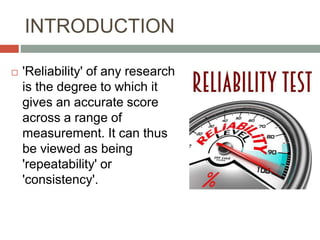
 'Reliability' of any research
is the degree to which it
gives an accurate score
across a range of
measurement. It can thus
be viewed as being
'repeatability' or
'consistency'.
TYPES
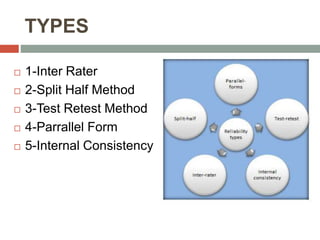
 1-Inter Rater
 2-Split Half Method
 3-Test Retest Method
 4-Parrallel Form
 5-Internal Consistency
SPLIT HALF METHOD
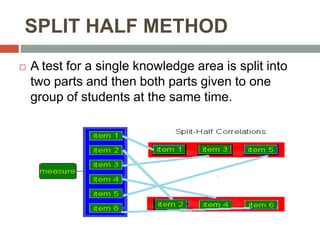
 A test for a single knowledge area is split into
two parts and then both parts given to one
group of students at the same time.
SPLIT HALF METHOD
 Split-half testing is a measure
of internal consistency. How well the
test components contribute to the
construct that’s being measured. It is
most commonly used for multiple
choice tests you can theoretically use
it for any type of test—even tests with
essay questions.
How to Split it half?
 first half and second half
 odd and even numbers.
 If the two halves of the test
provide similar results this would
suggest that the test has internal
reliability.
STEPS
 Administer the test to a large group
students (ideally, over about 30).
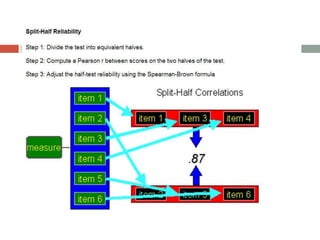
 Randomly divide the test questions into
two parts. For example, separate even
questions from odd questions.
 Score each half of the test for each
student.
 Find the correlation coefficient for the two
halves.
TEST RETEST
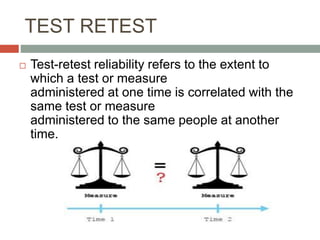
 Test-retest reliability refers to the extent to
which a test or measure
administered at one time is correlated with the
same test or measure
administered to the same people at another
time.
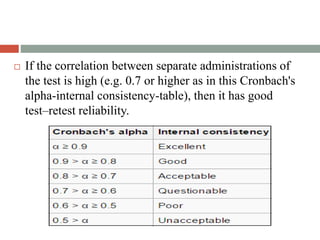
 If the correlation between separate administrations of
the test is high (e.g. 0.7 or higher as in this Cronbach's
alpha-internal consistency-table), then it has good
test–retest reliability.
CONDITIONS
 the same experimental tools
 the same observer
 the same measuring instrument, used under
the same conditions
 the same location
 Repetition over a short period of time.
 same objectives
DISADVANTAGES
 It takes a long time for results to be obtained.
 If the duration is to brief then participants may
recall information from the first test which
could bias the results.
 If the duration is too long it is feasible that the
participants could have changed in some
important way which could also bias the
results.
Reliability and its types: Split half method and test retest methods

Reliability and its types: Split half method and test retest methods

  • 1.
    SPLIT HALF AND TEST-RETESTMETHODS AAMIR HUSSAIN EPM 4TH NUML, ISLAMABAD
  • 2.
    INTRODUCTION  'Reliability' ofany research is the degree to which it gives an accurate score across a range of measurement. It can thus be viewed as being 'repeatability' or 'consistency'.
  • 3.
    TYPES  1-Inter Rater 2-Split Half Method  3-Test Retest Method  4-Parrallel Form  5-Internal Consistency
  • 4.
    SPLIT HALF METHOD A test for a single knowledge area is split into two parts and then both parts given to one group of students at the same time.
  • 5.
    SPLIT HALF METHOD Split-half testing is a measure of internal consistency. How well the test components contribute to the construct that’s being measured. It is most commonly used for multiple choice tests you can theoretically use it for any type of test—even tests with essay questions.
  • 6.
    How to Splitit half?  first half and second half  odd and even numbers.  If the two halves of the test provide similar results this would suggest that the test has internal reliability.
  • 7.
    STEPS  Administer thetest to a large group students (ideally, over about 30).  Randomly divide the test questions into two parts. For example, separate even questions from odd questions.  Score each half of the test for each student.  Find the correlation coefficient for the two halves.
  • 9.
    TEST RETEST  Test-retestreliability refers to the extent to which a test or measure administered at one time is correlated with the same test or measure administered to the same people at another time.
  • 10.
     If thecorrelation between separate administrations of the test is high (e.g. 0.7 or higher as in this Cronbach's alpha-internal consistency-table), then it has good test–retest reliability.
  • 11.
    CONDITIONS  the sameexperimental tools  the same observer  the same measuring instrument, used under the same conditions  the same location  Repetition over a short period of time.  same objectives
  • 12.
    DISADVANTAGES  It takesa long time for results to be obtained.  If the duration is to brief then participants may recall information from the first test which could bias the results.  If the duration is too long it is feasible that the participants could have changed in some important way which could also bias the results.