Questionnaire construction

Presented by: Prakash Aryal

P299,Spring Asia Program-2013/14
School of Urban and Regional Planning
University of Philippines, Diliman, Quezon City
October 31, 2013
Questionnaire construction

Presentation outline

•What is the nature or methods/analysis
•When it is used?
•How it is used?
With Examples.
Questionnaire
What is it?
•A list of questions that can be completed by
-Asking the respondents to complete the
questionnaire with the researcher not present
(mail, post )
-Respondents are asked the questions verbally in
the presence of researcher (also called structured
interview)
When it is used?
•Questionnaire are suitable for primary research.
•In order to collect relevant data we need to prepare
comprehensive questionnaire
•Measure many variables and test multiple hypothesis
and infer temporal order from questions about past
behavior, experiences and characteristics
Why?
•Cheap, require less time and effort compared to verbal
or telephone interviews.
Sequence!
•Design and Planning Phase
- Decide the type of survey (mail, interview), type of
respondent and population
-

Develop questionnaire

- Write questions-organize question sequence- design
questionnaire layout
-

Plan a system for recording answer-pilot test

•Data collection phase, analysis
How it is used?
•Researcher

conceptualizes

and

operationalizes

variables as questions
•Thinks ahead how s/he will record and organize the
data for analysis
•Researchers sample many respondents who answer the
same question.
Key concerns
•Will the questions be equally clear, relevant and
meaningful to all respondents?
•Questions writing takes skills, practice, patience and
creativity
Before writing
•Decide on what kind of information we wish to ask the
interviewees.
•A good questions should be able to achieve research
objective.
•Think about the population, age, sex and location.
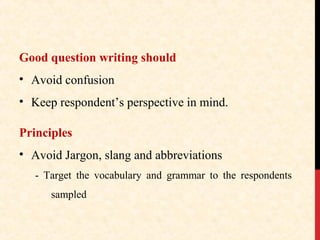
Good question writing should
• Avoid confusion
• Keep respondent’s perspective in mind.
Principles
• Avoid Jargon, slang and abbreviations
- Target the vocabulary and grammar to the respondents
sampled
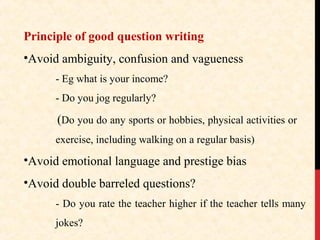
Principle of good question writing
•Avoid ambiguity, confusion and vagueness
- Eg what is your income?
- Do you jog regularly?

(Do you do any sports or hobbies, physical activities or
exercise, including walking on a regular basis)

•Avoid emotional language and prestige bias
•Avoid double barreled questions?
- Do you rate the teacher higher if the teacher tells many
jokes?
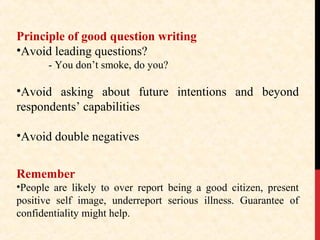
Principle of good question writing
•Avoid leading questions?
- You don’t smoke, do you?

•Avoid asking about future intentions and beyond
respondents’ capabilities
•Avoid double negatives
Remember
•People are likely to over report being a good citizen, present
positive self image, underreport serious illness. Guarantee of
confidentiality might help.
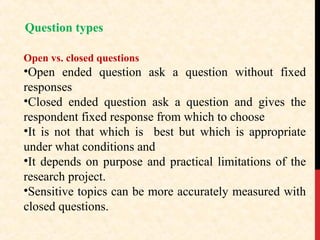
Question types
Open vs. closed questions

•Open ended question ask a question without fixed
responses
•Closed ended question ask a question and gives the
respondent fixed response from which to choose
•It is not that which is best but which is appropriate
under what conditions and
•It depends on purpose and practical limitations of the
research project.
•Sensitive topics can be more accurately measured with
closed questions.
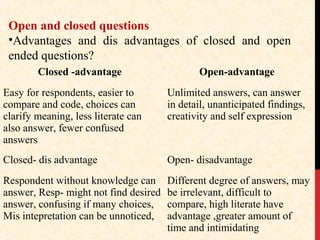
Open and closed questions
•Advantages and dis advantages of closed and open
ended questions?
Closed -advantage

Open-advantage

Easy for respondents, easier to
compare and code, choices can
clarify meaning, less literate can
also answer, fewer confused
answers

Unlimited answers, can answer
in detail, unanticipated findings,
creativity and self expression

Closed- dis advantage

Open- disadvantage

Respondent without knowledge can
answer, Resp- might not find desired
answer, confusing if many choices,
Mis intepretation can be unnoticed,

Different degree of answers, may
be irrelevant, difficult to
compare, high literate have
advantage ,greater amount of
time and intimidating
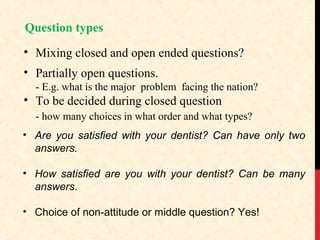
Question types
• Mixing closed and open ended questions?
• Partially open questions.
- E.g. what is the major problem facing the nation?

• To be decided during closed question
- how many choices in what order and what types?
• Are you satisfied with your dentist? Can have only two
answers.
• How satisfied are you with your dentist? Can be many
answers.
• Choice of non-attitude or middle question? Yes!
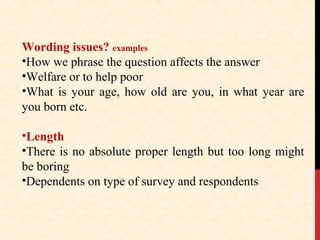
Wording issues? examples
•How we phrase the question affects the answer
•Welfare or to help poor
•What is your age, how old are you, in what year are
you born etc.
•Length
•There is no absolute proper length but too long might
be boring
•Dependents on type of survey and respondents
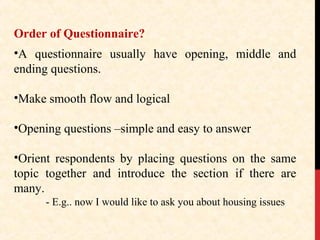
Order of Questionnaire?
•A questionnaire usually have opening, middle and
ending questions.
•Make smooth flow and logical
•Opening questions –simple and easy to answer
•Orient respondents by placing questions on the same
topic together and introduce the section if there are
many.
- E.g.. now I would like to ask you about housing issues
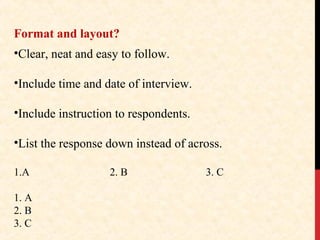
Format and layout?
•Clear, neat and easy to follow.
•Include time and date of interview.
•Include instruction to respondents.
•List the response down instead of across.
1.A
1. A
2. B
3. C

2. B

3. C
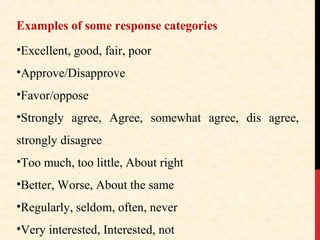
Examples of some response categories
•Excellent, good, fair, poor
•Approve/Disapprove
•Favor/oppose
•Strongly agree, Agree, somewhat agree, dis agree,
strongly disagree
•Too much, too little, About right
•Better, Worse, About the same
•Regularly, seldom, often, never
•Very interested, Interested, not
Remember
•Before formally starting your interviewees check your
questionnaire and make pre test with friends and
possibly you will get feed back to correct your
questions.
•Rephrase if necessary
Thank you!
References:
1. http://www.slideshare.net/BestEssay/how-to-write-a-dissertation-questionnaire
2. Social science research book

Questionnaire Construction

  • 1.
    Questionnaire construction Presented by:Prakash Aryal P299,Spring Asia Program-2013/14 School of Urban and Regional Planning University of Philippines, Diliman, Quezon City October 31, 2013
  • 2.
    Questionnaire construction Presentation outline •Whatis the nature or methods/analysis •When it is used? •How it is used? With Examples.
  • 3.
    Questionnaire What is it? •Alist of questions that can be completed by -Asking the respondents to complete the questionnaire with the researcher not present (mail, post ) -Respondents are asked the questions verbally in the presence of researcher (also called structured interview)
  • 4.
    When it isused? •Questionnaire are suitable for primary research. •In order to collect relevant data we need to prepare comprehensive questionnaire •Measure many variables and test multiple hypothesis and infer temporal order from questions about past behavior, experiences and characteristics Why? •Cheap, require less time and effort compared to verbal or telephone interviews.
  • 5.
    Sequence! •Design and PlanningPhase - Decide the type of survey (mail, interview), type of respondent and population - Develop questionnaire - Write questions-organize question sequence- design questionnaire layout - Plan a system for recording answer-pilot test •Data collection phase, analysis
  • 6.
    How it isused? •Researcher conceptualizes and operationalizes variables as questions •Thinks ahead how s/he will record and organize the data for analysis •Researchers sample many respondents who answer the same question.
  • 7.
    Key concerns •Will thequestions be equally clear, relevant and meaningful to all respondents? •Questions writing takes skills, practice, patience and creativity Before writing •Decide on what kind of information we wish to ask the interviewees. •A good questions should be able to achieve research objective. •Think about the population, age, sex and location.
  • 8.
    Good question writingshould • Avoid confusion • Keep respondent’s perspective in mind. Principles • Avoid Jargon, slang and abbreviations - Target the vocabulary and grammar to the respondents sampled
  • 9.
    Principle of goodquestion writing •Avoid ambiguity, confusion and vagueness - Eg what is your income? - Do you jog regularly? (Do you do any sports or hobbies, physical activities or exercise, including walking on a regular basis) •Avoid emotional language and prestige bias •Avoid double barreled questions? - Do you rate the teacher higher if the teacher tells many jokes?
  • 10.
    Principle of goodquestion writing •Avoid leading questions? - You don’t smoke, do you? •Avoid asking about future intentions and beyond respondents’ capabilities •Avoid double negatives Remember •People are likely to over report being a good citizen, present positive self image, underreport serious illness. Guarantee of confidentiality might help.
  • 11.
    Question types Open vs.closed questions •Open ended question ask a question without fixed responses •Closed ended question ask a question and gives the respondent fixed response from which to choose •It is not that which is best but which is appropriate under what conditions and •It depends on purpose and practical limitations of the research project. •Sensitive topics can be more accurately measured with closed questions.
  • 12.
    Open and closedquestions •Advantages and dis advantages of closed and open ended questions? Closed -advantage Open-advantage Easy for respondents, easier to compare and code, choices can clarify meaning, less literate can also answer, fewer confused answers Unlimited answers, can answer in detail, unanticipated findings, creativity and self expression Closed- dis advantage Open- disadvantage Respondent without knowledge can answer, Resp- might not find desired answer, confusing if many choices, Mis intepretation can be unnoticed, Different degree of answers, may be irrelevant, difficult to compare, high literate have advantage ,greater amount of time and intimidating
  • 13.
    Question types • Mixingclosed and open ended questions? • Partially open questions. - E.g. what is the major problem facing the nation? • To be decided during closed question - how many choices in what order and what types? • Are you satisfied with your dentist? Can have only two answers. • How satisfied are you with your dentist? Can be many answers. • Choice of non-attitude or middle question? Yes!
  • 14.
    Wording issues? examples •Howwe phrase the question affects the answer •Welfare or to help poor •What is your age, how old are you, in what year are you born etc. •Length •There is no absolute proper length but too long might be boring •Dependents on type of survey and respondents
  • 15.
    Order of Questionnaire? •Aquestionnaire usually have opening, middle and ending questions. •Make smooth flow and logical •Opening questions –simple and easy to answer •Orient respondents by placing questions on the same topic together and introduce the section if there are many. - E.g.. now I would like to ask you about housing issues
  • 16.
    Format and layout? •Clear,neat and easy to follow. •Include time and date of interview. •Include instruction to respondents. •List the response down instead of across. 1.A 1. A 2. B 3. C 2. B 3. C
  • 17.
    Examples of someresponse categories •Excellent, good, fair, poor •Approve/Disapprove •Favor/oppose •Strongly agree, Agree, somewhat agree, dis agree, strongly disagree •Too much, too little, About right •Better, Worse, About the same •Regularly, seldom, often, never •Very interested, Interested, not
  • 18.
    Remember •Before formally startingyour interviewees check your questionnaire and make pre test with friends and possibly you will get feed back to correct your questions. •Rephrase if necessary
  • 19.

Editor's Notes

  • #5 Infer temporal order –come to logical sequence, infer =guess, temporal order-relating to time
  • #8 Because of the diverse background ..same wording do may not have the same meaning .
  • #9 Because of the diverse background ..same wording do may not have the same meaning .
  • #10 Weekly, monthly, before or after tax etc, emotional-terrorist, crime, etc, prestige bias, the president did..
  • #11 Weekly, monthly, before or after tax etc
  • #12 Sensitive topics, liquor consumption, sexual behaviour
  • #13 Only two choices or more than 5 etc.
  • #14 Only two choices or more than 5 etc.
  • #15 Many fear that respondants want to be neutral
  • #16 Many fear that respondants want to be neutral
  • #17 Many fear that respondants want to be neutral
  • #18 Many fear that respondants want to be neutral