CHECKLIST
INTRODUCTION
• It is the one of the most commonly used
instruments for performance evaluation.
• A checklist enables the observer to note only
whether or not a trait is present.
• It consists of a listening of steps, activities and
behaviors which the observer records when an
incident occurs.
• The observer has to judge whether certain
behavior has taken place.
• In health care setting checklist is commonly
used to list of patients behaviors associated
with particular nursing interventions and the
assessor to check or tick within a space
provided whether or not those particulars
behaviors occurred.
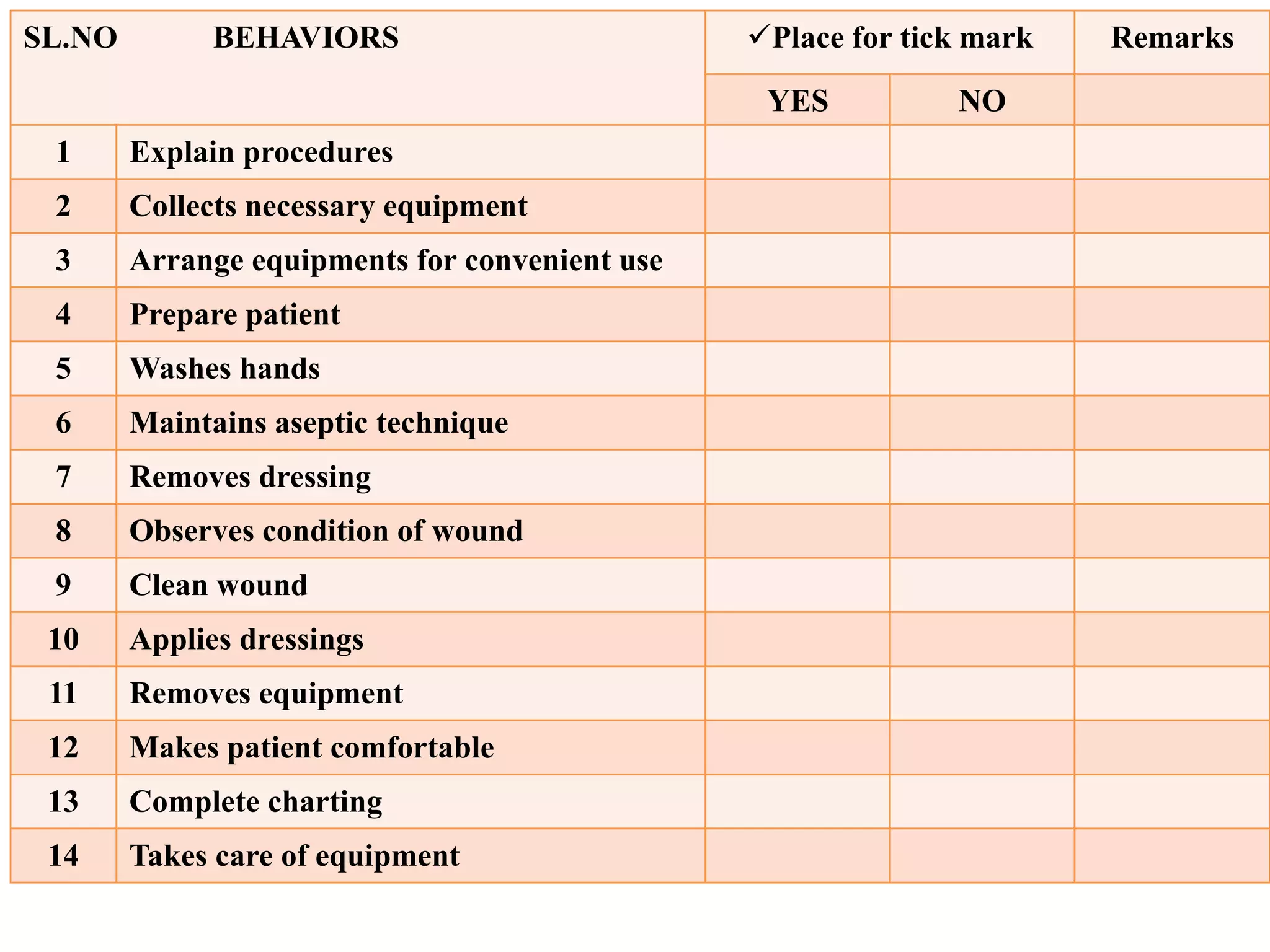
• An example of checklist is depicted in table
Definition
• A checklist is a simple instrument consisting
prepared list of expected items of performance
or attributes, which are checked by a
researcher for their presence or absence.
• Checklists are constructed by breaking a
performance and the quality of a product,
which specifies the presence or absence of an
attribute or trait which is then “checked” by
the rater/observer.
Characteristics of checklists
• Observe one respond at one time.
• Clearly specify the characteristics of behavior to
be observed.
• Use only carefully prepared checklist to avoid
more complex traits.
• The observer should be trained hoe to observe
and how to record the observed behavior.
• Use checklists only when you are interested in
calculating, a particular characteristics.
Checklist for evaluation of
students performance during
surgical dressing
SL.NO BEHAVIORS Place for tick mark Remarks
YES NO
1 Explain procedures
2 Collects necessary equipment
3 Arrange equipments for convenient use
4 Prepare patient
5 Washes hands
6 Maintains aseptic technique
7 Removes dressing
8 Observes condition of wound
9 Clean wound
10 Applies dressings
11 Removes equipment
12 Makes patient comfortable
13 Complete charting
14 Takes care of equipment
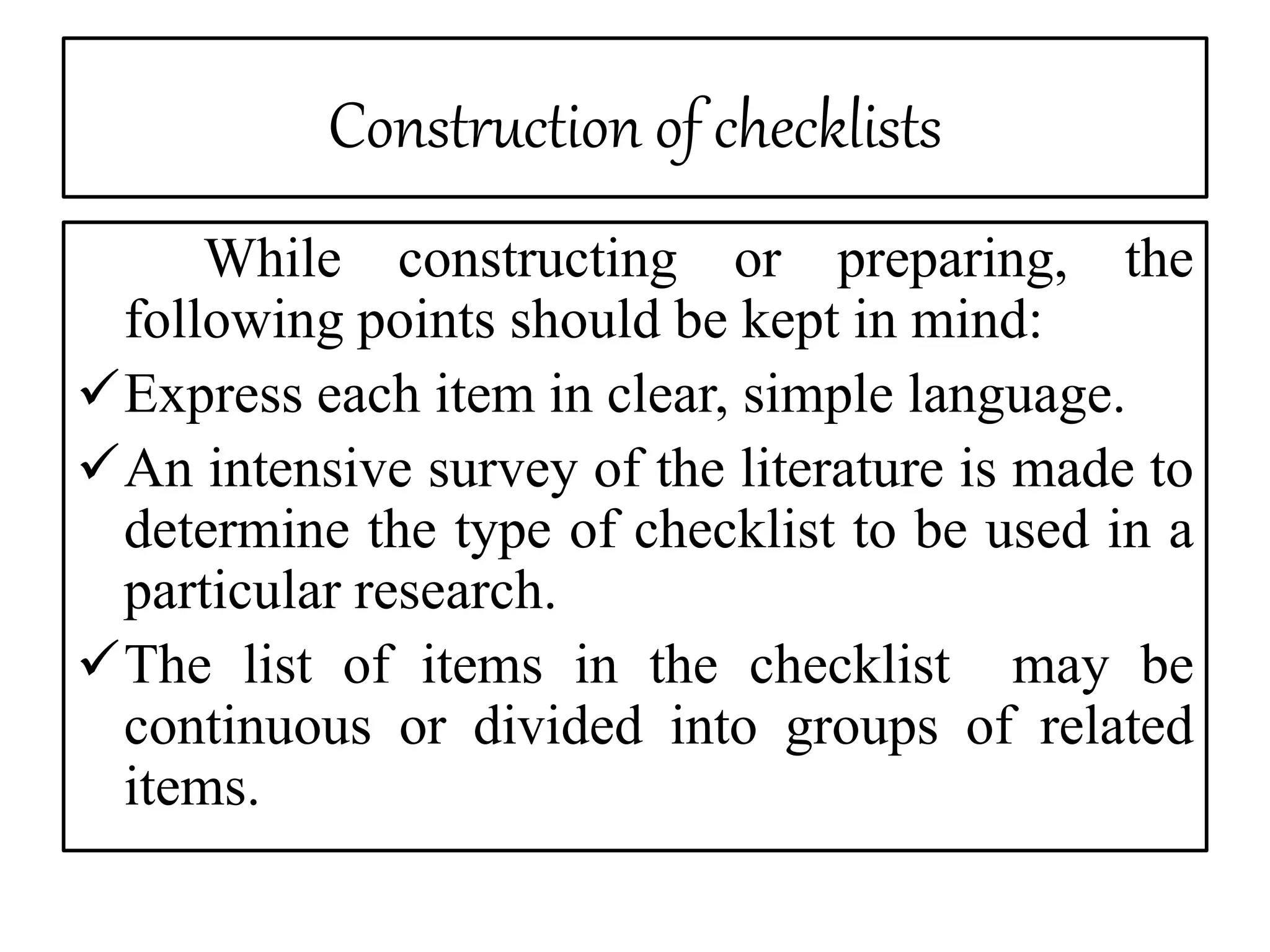
Construction of checklists
While constructing or preparing, the
following points should be kept in mind:
Express each item in clear, simple language.
An intensive survey of the literature is made to
determine the type of checklist to be used in a
particular research.
The list of items in the checklist may be
continuous or divided into groups of related
items.
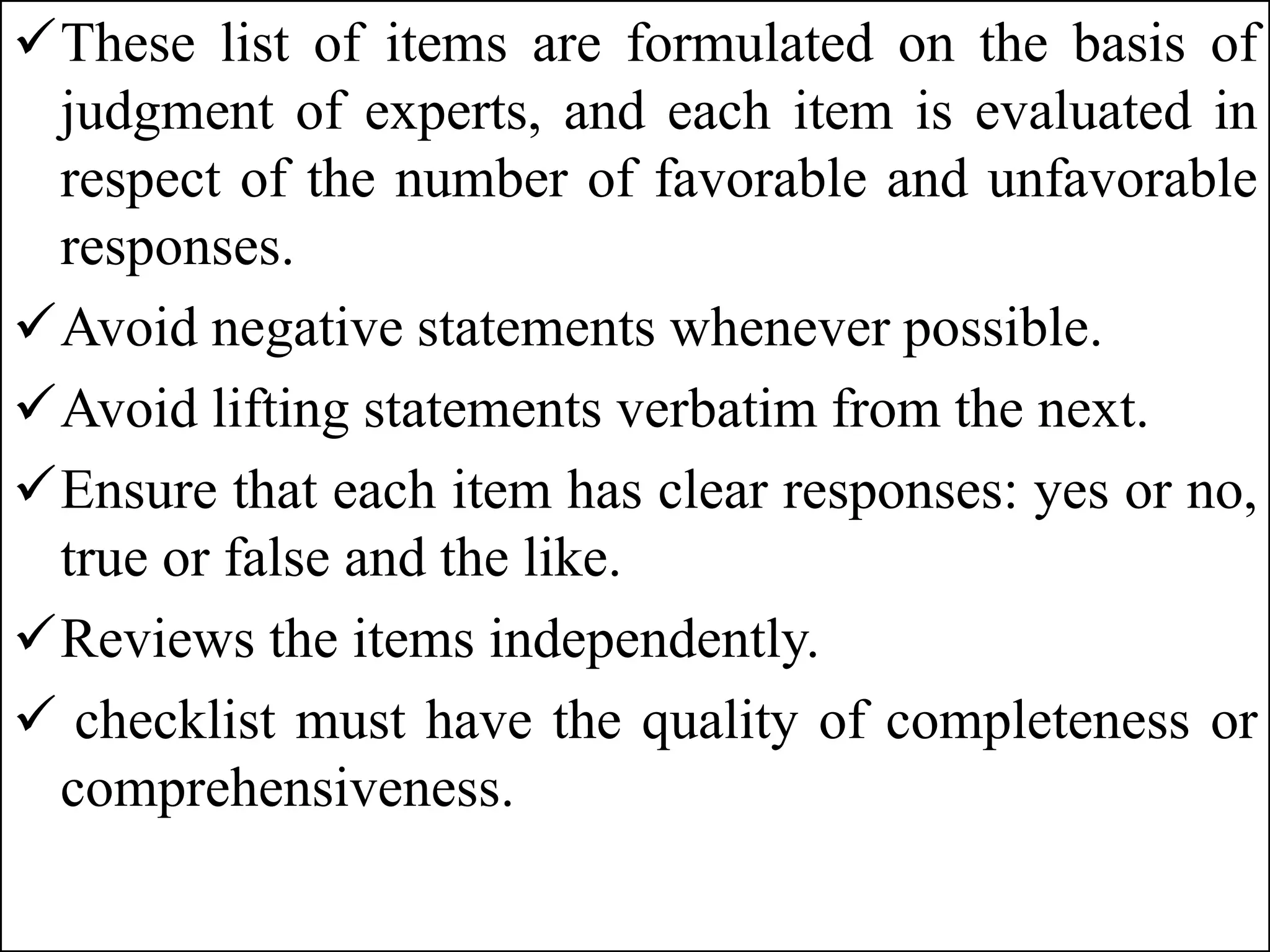
These list of items are formulated on the basis of
judgment of experts, and each item is evaluated in
respect of the number of favorable and unfavorable
responses.
Avoid negative statements whenever possible.
Avoid lifting statements verbatim from the next.
Ensure that each item has clear responses: yes or no,
true or false and the like.
Reviews the items independently.
 checklist must have the quality of completeness or
comprehensiveness.
Advantages of checklist
• Checklist allow inter-individual comparisons.
• It provides a simple method to record
observation.
• Adaptable to subject matter areas.
• It is useful in evaluating learning activities.
• Helpful in evaluating procedural work.
• Properly prepared, it allows the observer to
contain the direct attention.
• Checklist have the objectivity to evaluate
characteristics.
• Useful for evaluating those processes that can
be subdivided into a series of actions.
• Decreases the chance of error in observation.
Disadvantages of checklist
• Does not indicate the quality of performance,
so usefulness of checklist is limited.
• Only a limited component of overall clinical
performance can be evaluated.
• Only the presence or absence of an attribute,
behavior or performance can not be assessed.
• it has a limited use in qualitative research
studies.
CONCLUSION
THANK YOU

Checklist ON RESEARCH

  • 2.
  • 3.
    INTRODUCTION • It isthe one of the most commonly used instruments for performance evaluation. • A checklist enables the observer to note only whether or not a trait is present. • It consists of a listening of steps, activities and behaviors which the observer records when an incident occurs. • The observer has to judge whether certain behavior has taken place.
  • 4.
    • In healthcare setting checklist is commonly used to list of patients behaviors associated with particular nursing interventions and the assessor to check or tick within a space provided whether or not those particulars behaviors occurred. • An example of checklist is depicted in table
  • 5.
    Definition • A checklistis a simple instrument consisting prepared list of expected items of performance or attributes, which are checked by a researcher for their presence or absence. • Checklists are constructed by breaking a performance and the quality of a product, which specifies the presence or absence of an attribute or trait which is then “checked” by the rater/observer.
  • 6.
    Characteristics of checklists •Observe one respond at one time. • Clearly specify the characteristics of behavior to be observed. • Use only carefully prepared checklist to avoid more complex traits. • The observer should be trained hoe to observe and how to record the observed behavior. • Use checklists only when you are interested in calculating, a particular characteristics.
  • 7.
    Checklist for evaluationof students performance during surgical dressing
  • 8.
    SL.NO BEHAVIORS Placefor tick mark Remarks YES NO 1 Explain procedures 2 Collects necessary equipment 3 Arrange equipments for convenient use 4 Prepare patient 5 Washes hands 6 Maintains aseptic technique 7 Removes dressing 8 Observes condition of wound 9 Clean wound 10 Applies dressings 11 Removes equipment 12 Makes patient comfortable 13 Complete charting 14 Takes care of equipment
  • 9.
    Construction of checklists Whileconstructing or preparing, the following points should be kept in mind: Express each item in clear, simple language. An intensive survey of the literature is made to determine the type of checklist to be used in a particular research. The list of items in the checklist may be continuous or divided into groups of related items.
  • 10.
    These list ofitems are formulated on the basis of judgment of experts, and each item is evaluated in respect of the number of favorable and unfavorable responses. Avoid negative statements whenever possible. Avoid lifting statements verbatim from the next. Ensure that each item has clear responses: yes or no, true or false and the like. Reviews the items independently.  checklist must have the quality of completeness or comprehensiveness.
  • 11.
    Advantages of checklist •Checklist allow inter-individual comparisons. • It provides a simple method to record observation. • Adaptable to subject matter areas. • It is useful in evaluating learning activities. • Helpful in evaluating procedural work. • Properly prepared, it allows the observer to contain the direct attention.
  • 12.
    • Checklist havethe objectivity to evaluate characteristics. • Useful for evaluating those processes that can be subdivided into a series of actions. • Decreases the chance of error in observation.
  • 13.
    Disadvantages of checklist •Does not indicate the quality of performance, so usefulness of checklist is limited. • Only a limited component of overall clinical performance can be evaluated. • Only the presence or absence of an attribute, behavior or performance can not be assessed. • it has a limited use in qualitative research studies.
  • 14.
  • 15.