RELATED TERMS
HISTORY
Meaningful record of human achievement
RESEARCH
Formal, systematic application of scientific method to
the study of problems
(Gay and Mills)
HISTORICAL RESEARCH
 Historical research is a procedure
supplementary to observation in which the
researcher seeks to test the authenticity of
the reports or observation made by others.
 Historical research involving analysis of
events that occurred in the remote or recent
past.
CON……..
 Historical research has been defined as the
systematic and objective location, evaluation
and synthesis of evidence in order to
establish facts and draw conclusions about
past events.
 It involves a critical inquiry of a previous age
with the aim of reconstructing a faithful
representation of the past.
EXAMPLE
 How does a philosophy and religion shape a
society.
Research question
 What impact did Buddhism, Christinity,
Hindoism,etc on the society.
 How was a religion text(Quran, Bible) is used to
justify power ,change etc.
 What were the causes or impacts of the spread of
political philosophy.
 How did a religion get adopted or change as it
CHARACTERISTICS OF HISTORICAL RESEARCH
 It is not a mere accumulation of facts and
data
 It is a flowing, vibrant report of past events
 Collecting and reading the research material
 It deals with discovery of data
 It is analytical in that it uses logical
induction.
 It has a variety of f foci such as issues,
events, movement, concept.
TYPES OF HISTORICAL RESEARCH
 Social issues
 Study of specific individuals, educational institutions &
social movements
 Exploration of relationships between events
 Synthesis of data
 Reinterpretation of past events .
PURPOSES OF HISTORICAL RESEARCH
1.To solve contemporary problems.
2. Learn from past failures and success .
3. Make prediction.
4. To re-evaluate data in relation to selected
hypotheses, theories and generalizations
5. To understand how and why educational theories
and
practices developed.
STEPS OF HISTORICAL RESEARCH
Identify the research topic
Formulate the research problem or
question.
Data collection or literature review
Evaluation of materials
Data synthesis
Report preparation or preparation of the
narrative exposition
WHY WOULD A PERSON WANT TO CONDUCT
HISTORICAL RESEARCH?
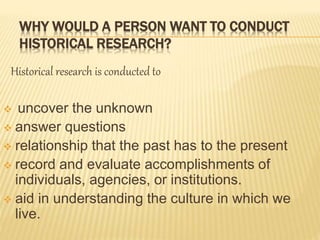
Historical research is conducted to
 uncover the unknown
 answer questions
 relationship that the past has to the present
 record and evaluate accomplishments of
individuals, agencies, or institutions.
 aid in understanding the culture in which we
live.
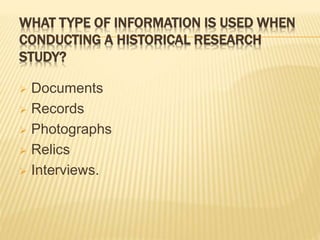
WHAT TYPE OF INFORMATION IS USED WHEN
CONDUCTING A HISTORICAL RESEARCH
STUDY?
 Documents
 Records
 Photographs
 Relics
 Interviews.
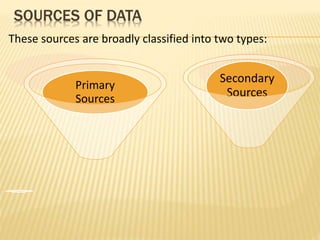
SOURCES OF DATA
These sources are broadly classified into two types:
Secondary
Sources
Primary
Sources
Secondary Sources:
 Text Book
 Encyclopedia
 Biography
 Periodicals
 Other reference
Primary sources :
 Documents
 Numerical records
 Oral statement
 Relics and Remains
 Artifacts
DIFFERENCES BETWEEN PRIMARY AND
SECONDARY RESOURCES
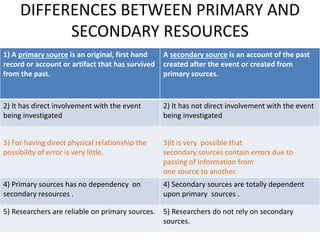
1) A primary source is an original, first hand
record or account or artifact that has survived
from the past.
A secondary source is an account of the past
created after the event or created from
primary sources.
2) It has direct involvement with the event
being investigated
2) It has not direct involvement with the event
being investigated
3) For having direct physical relationship the
possibility of error is very little.
3)It is very possible that
secondary sources contain errors due to
passing of information from
one source to another.
4) Primary sources has no dependency on
secondary resources .
4) Secondary sources are totally dependent
upon primary sources .
5) Researchers are reliable on primary sources. 5) Researchers do not rely on secondary
sources.
EXAMPLE
Diplomas, cartoons, diaries, memoirs,
newspapers, photos, yearbooks, memos,
periodicals, reports, files, attendance records,
census reports, budgets, maps, and tests
articles of clothing, buildings, books,
architectural plans, desks, or any other object
that might provide useful information about the
past.
KEY DATA COLLECTION TECHNIQUES
 Surveys
 Questionnaire
 Panel questionnaire designs
 Interviews
 Experimental treatments
SCOPES OF HISTORICAL RESEARCH IN
EDUCATION
 General educational history of specific
periods
 History of national education policies.
 History of the role of the teacher.
 History of specific types of education
CON…
 History of specific components of
education
 History of admission processes in
professional
 Historical biographies of major
contributors to education
 Comparative history of education
 Historical study of the system
CON…
 History of teacher education.
 History of educational administration,
finance, legislation, planning.
 Historical study of the relationship between
politics and education.
PROBLEMS AND WEAKNESS TO BE AVOIDED IN
HISTORICAL RESEARCH
 The researcher needs to synthesize facts
into meaningful chronological patterns.
 The researcher needs to be aware of his/her
own personal values.
 Adequate criticism of sources of historical
data is essential.
HOW CAN HISTORICAL RESEARCH TELLS US ANYTHING
ABOUT THE PRESENT
 Historical research can show patterns
 Understanding this can add perspective on
how we examine current events and
educational practices.
 It can also show us that we do not need to
continually reinvent the wheel because we
should always start with what history tells us.
IMPORTANCE IN THE FIELD OF EDUCATION
 It enables educationists to find out solutions to
temporary problems which have their roots in
the past.
 It throws light on present trends and can help in
predicting future trends.
 It enables a researcher to re-evaluate data in
relation to select hypothesis, theories and
generalizations that are presently held about the
past.
 It enables us to understand how and why
educational theories and practices developed.
CRITICISM
(i) External Criticism of Data
ii) Internal Criticism of Data
MODEL OF HISTORICAL RESEARCH
1.Research Topic : Education during the first half of the
fifteen century.
2.Research Question.
3.Data Collection.
4.Evaluation.
5.Data Synthesis.
6.Report Preparation.
WITH THEIR BEST COOPERATION
1. Md. shamim Hossain- 11130
2. Tahmina Nasrin- 11139
3. Harun or Rashid- 11140
4. Abdul Mazid- 11144
5. Tanvira Tasneem- 11152
6. S.M Saiduzzaman- 11174
7. Lucky Das- 11184
8. Nazmun Nahar Nazneen-11202
9. Nazmul Chokder-11203
10. Md. Jasim Uddin- 11131
ANY QUERY
Thanks Everybody

Historical research

  • 2.
    RELATED TERMS HISTORY Meaningful recordof human achievement RESEARCH Formal, systematic application of scientific method to the study of problems (Gay and Mills)
  • 3.
    HISTORICAL RESEARCH  Historicalresearch is a procedure supplementary to observation in which the researcher seeks to test the authenticity of the reports or observation made by others.  Historical research involving analysis of events that occurred in the remote or recent past.
  • 4.
    CON……..  Historical researchhas been defined as the systematic and objective location, evaluation and synthesis of evidence in order to establish facts and draw conclusions about past events.  It involves a critical inquiry of a previous age with the aim of reconstructing a faithful representation of the past.
  • 5.
    EXAMPLE  How doesa philosophy and religion shape a society. Research question  What impact did Buddhism, Christinity, Hindoism,etc on the society.  How was a religion text(Quran, Bible) is used to justify power ,change etc.  What were the causes or impacts of the spread of political philosophy.  How did a religion get adopted or change as it
  • 6.
    CHARACTERISTICS OF HISTORICALRESEARCH  It is not a mere accumulation of facts and data  It is a flowing, vibrant report of past events  Collecting and reading the research material  It deals with discovery of data  It is analytical in that it uses logical induction.  It has a variety of f foci such as issues, events, movement, concept.
  • 7.
    TYPES OF HISTORICALRESEARCH  Social issues  Study of specific individuals, educational institutions & social movements  Exploration of relationships between events  Synthesis of data  Reinterpretation of past events .
  • 8.
    PURPOSES OF HISTORICALRESEARCH 1.To solve contemporary problems. 2. Learn from past failures and success . 3. Make prediction. 4. To re-evaluate data in relation to selected hypotheses, theories and generalizations 5. To understand how and why educational theories and practices developed.
  • 9.
    STEPS OF HISTORICALRESEARCH Identify the research topic Formulate the research problem or question. Data collection or literature review Evaluation of materials Data synthesis Report preparation or preparation of the narrative exposition
  • 10.
    WHY WOULD APERSON WANT TO CONDUCT HISTORICAL RESEARCH? Historical research is conducted to  uncover the unknown  answer questions  relationship that the past has to the present  record and evaluate accomplishments of individuals, agencies, or institutions.  aid in understanding the culture in which we live.
  • 11.
    WHAT TYPE OFINFORMATION IS USED WHEN CONDUCTING A HISTORICAL RESEARCH STUDY?  Documents  Records  Photographs  Relics  Interviews.
  • 12.
    SOURCES OF DATA Thesesources are broadly classified into two types: Secondary Sources Primary Sources
  • 13.
    Secondary Sources:  TextBook  Encyclopedia  Biography  Periodicals  Other reference Primary sources :  Documents  Numerical records  Oral statement  Relics and Remains  Artifacts
  • 14.
    DIFFERENCES BETWEEN PRIMARYAND SECONDARY RESOURCES 1) A primary source is an original, first hand record or account or artifact that has survived from the past. A secondary source is an account of the past created after the event or created from primary sources. 2) It has direct involvement with the event being investigated 2) It has not direct involvement with the event being investigated 3) For having direct physical relationship the possibility of error is very little. 3)It is very possible that secondary sources contain errors due to passing of information from one source to another. 4) Primary sources has no dependency on secondary resources . 4) Secondary sources are totally dependent upon primary sources . 5) Researchers are reliable on primary sources. 5) Researchers do not rely on secondary sources.
  • 15.
    EXAMPLE Diplomas, cartoons, diaries,memoirs, newspapers, photos, yearbooks, memos, periodicals, reports, files, attendance records, census reports, budgets, maps, and tests articles of clothing, buildings, books, architectural plans, desks, or any other object that might provide useful information about the past.
  • 16.
    KEY DATA COLLECTIONTECHNIQUES  Surveys  Questionnaire  Panel questionnaire designs  Interviews  Experimental treatments
  • 17.
    SCOPES OF HISTORICALRESEARCH IN EDUCATION  General educational history of specific periods  History of national education policies.  History of the role of the teacher.  History of specific types of education
  • 18.
    CON…  History ofspecific components of education  History of admission processes in professional  Historical biographies of major contributors to education  Comparative history of education  Historical study of the system
  • 19.
    CON…  History ofteacher education.  History of educational administration, finance, legislation, planning.  Historical study of the relationship between politics and education.
  • 20.
    PROBLEMS AND WEAKNESSTO BE AVOIDED IN HISTORICAL RESEARCH  The researcher needs to synthesize facts into meaningful chronological patterns.  The researcher needs to be aware of his/her own personal values.  Adequate criticism of sources of historical data is essential.
  • 21.
    HOW CAN HISTORICALRESEARCH TELLS US ANYTHING ABOUT THE PRESENT  Historical research can show patterns  Understanding this can add perspective on how we examine current events and educational practices.  It can also show us that we do not need to continually reinvent the wheel because we should always start with what history tells us.
  • 22.
    IMPORTANCE IN THEFIELD OF EDUCATION  It enables educationists to find out solutions to temporary problems which have their roots in the past.  It throws light on present trends and can help in predicting future trends.  It enables a researcher to re-evaluate data in relation to select hypothesis, theories and generalizations that are presently held about the past.  It enables us to understand how and why educational theories and practices developed.
  • 23.
    CRITICISM (i) External Criticismof Data ii) Internal Criticism of Data
  • 24.
    MODEL OF HISTORICALRESEARCH 1.Research Topic : Education during the first half of the fifteen century. 2.Research Question. 3.Data Collection. 4.Evaluation. 5.Data Synthesis. 6.Report Preparation.
  • 25.
    WITH THEIR BESTCOOPERATION 1. Md. shamim Hossain- 11130 2. Tahmina Nasrin- 11139 3. Harun or Rashid- 11140 4. Abdul Mazid- 11144 5. Tanvira Tasneem- 11152 6. S.M Saiduzzaman- 11174 7. Lucky Das- 11184 8. Nazmun Nahar Nazneen-11202 9. Nazmul Chokder-11203 10. Md. Jasim Uddin- 11131
  • 26.