Unit
Unit III
III
DEVELOPMENT OF
DEVELOPMENT OF SURVEY
SURVEY INSTRUMENTS
INSTRUMENTS
ITEM ANALYSIS FOR
ITEM ANALYSIS FOR THE
THE QUESTIONNAIRES
QUESTIONNAIRES
DEEPA.M.J
DEEPA.M.J
1
1
Introduction
Introduction :
:
“
“Survey
Survey”
” refers to a descriptive research
refers to a descriptive research
technique or methodology (also includes interviews,
and focus groups)
and focus groups)
“
“Questionnaire
Questionnaire” refers to a paper and pencil
” refers to a paper and pencil
instrument through which information is obtained
For the purposes of outcomes assessment,
questionnaires are frequently developed to survey a
population .
population .
“
“Questionnaire”
Questionnaire” consists of a number of questions
consists of a number of questions
printed or typed in a definite order on a form or set of forms.
2
2
The basic functions of questionnaire :
It translates research objectives to be questions
It translates research objectives to be questions
It standardizes the questions and the response
It standardizes the questions and the response
categories: every respondents can give the information
that we want
that we want
It keeps communicating with respondents in a
It keeps communicating with respondents in a
professional way (cooperation and motivation).
It is the permanent records of survey
It is the permanent records of survey
It is helpful for the process of data analysis
It is helpful for the process of data analysis
3
3
The
The importance
importance of
of questionnaire
questionnaire :
:
It ensures quality of data collected : reliable
It ensures quality of data collected : reliable
data is very useful for analysis
It provides effective and efficient survey
It provides effective and efficient survey
It accomplishes the research objectives
It accomplishes the research objectives.
.
4
4
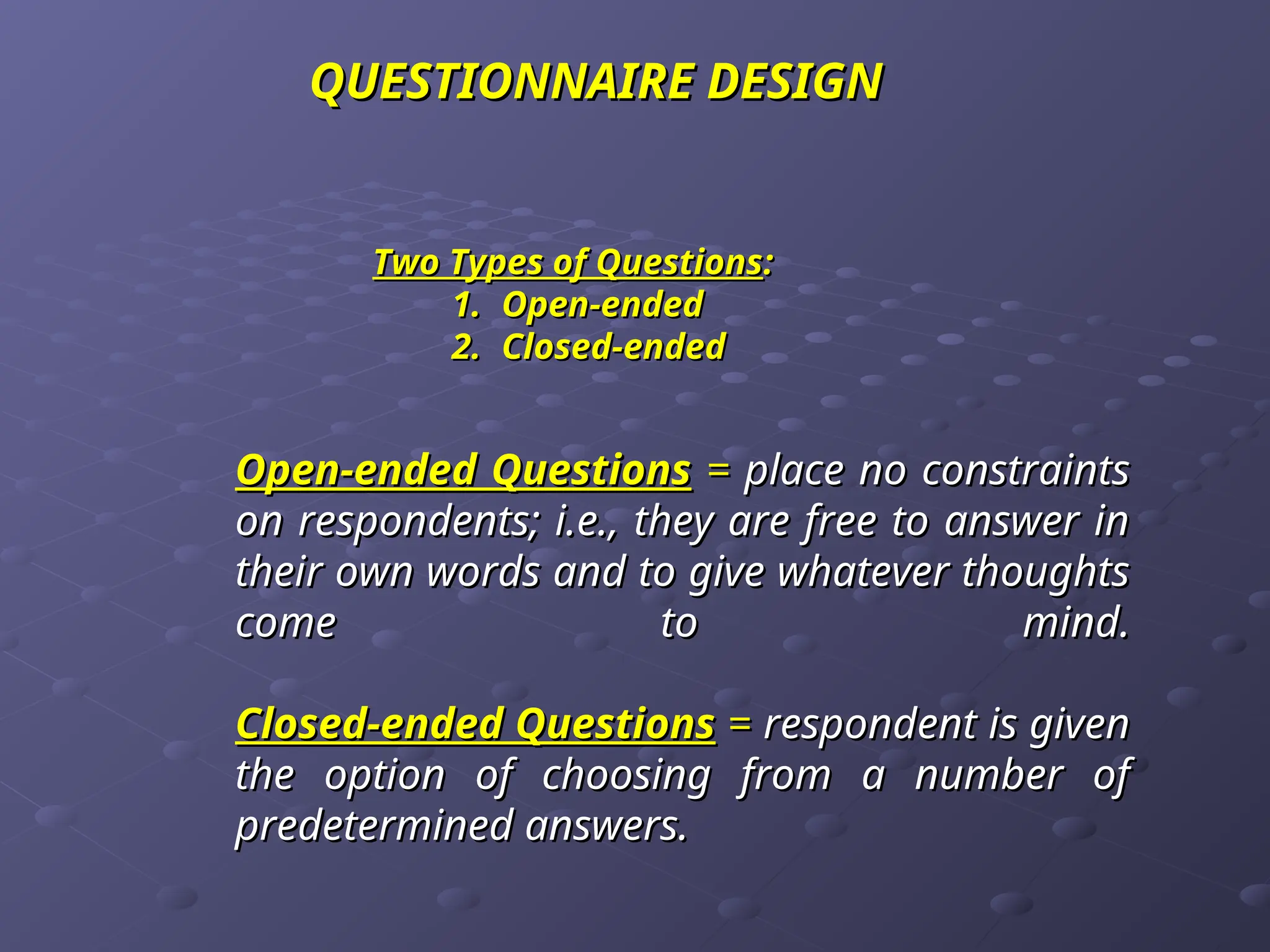
Open-ended Questions
Open-ended Questions =
= place no constraints
place no constraints
on respondents; i.e., they are free to answer in
their own words and to give whatever thoughts
come to mind.
come to mind.
Closed-ended Questions
Closed-ended Questions =
= respondent is given
respondent is given
the option of choosing from a number of
predetermined answers.
Two Types of Questions
Two Types of Questions:
:
1.
1. Open-ended
Open-ended
2.
2. Closed-ended
Closed-ended
QUESTIONNAIRE
QUESTIONNAIRE DESIGN
DESIGN
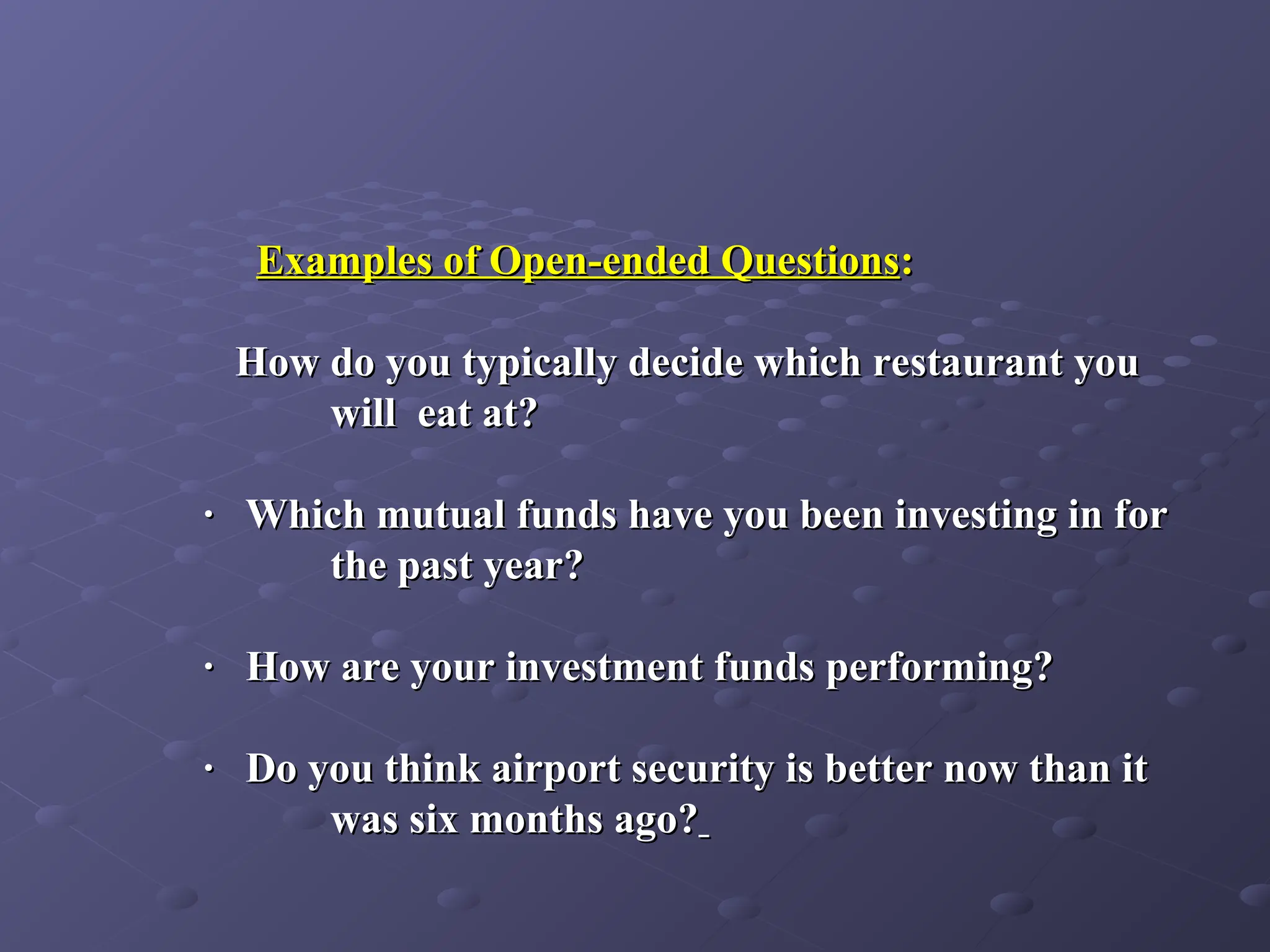
Examples of Open-ended Questions
Examples of Open-ended Questions:
:
How do you typically decide which restaurant you
will eat at?
will eat at?
· Which mutual funds have you been investing in for
the past year?
the past year?
· How are your investment funds performing?
· Do you think airport security is better now than it
was six months ago?
was six months ago?
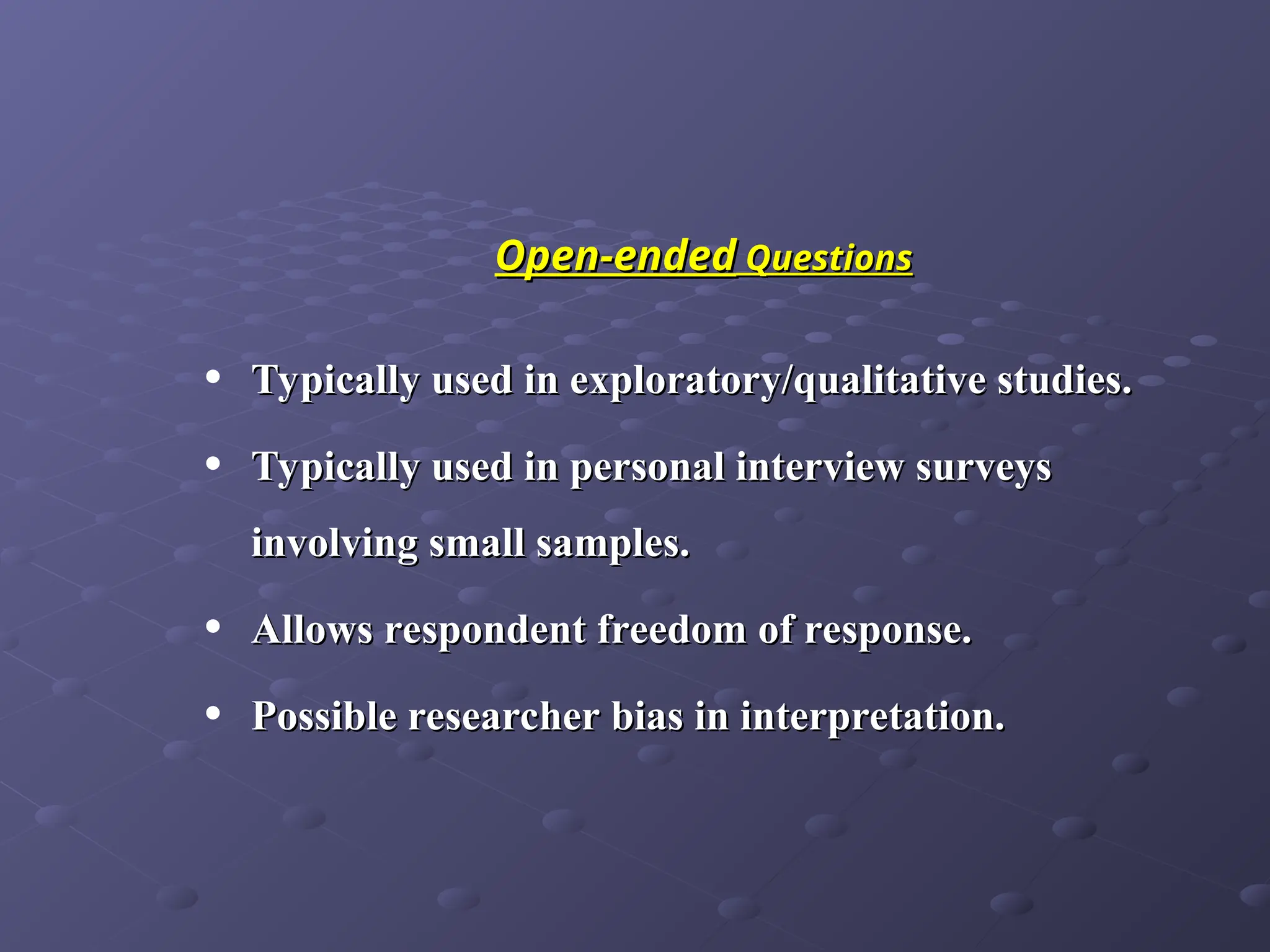
Open-ended
Open-ended Questions
Questions
• Typically used in exploratory/qualitative studies.
Typically used in exploratory/qualitative studies.
• Typically used in personal interview surveys
Typically used in personal interview surveys
involving small samples.
• Allows respondent freedom of response.
Allows respondent freedom of response.
• Possible researcher bias in interpretation.
Possible researcher bias in interpretation.
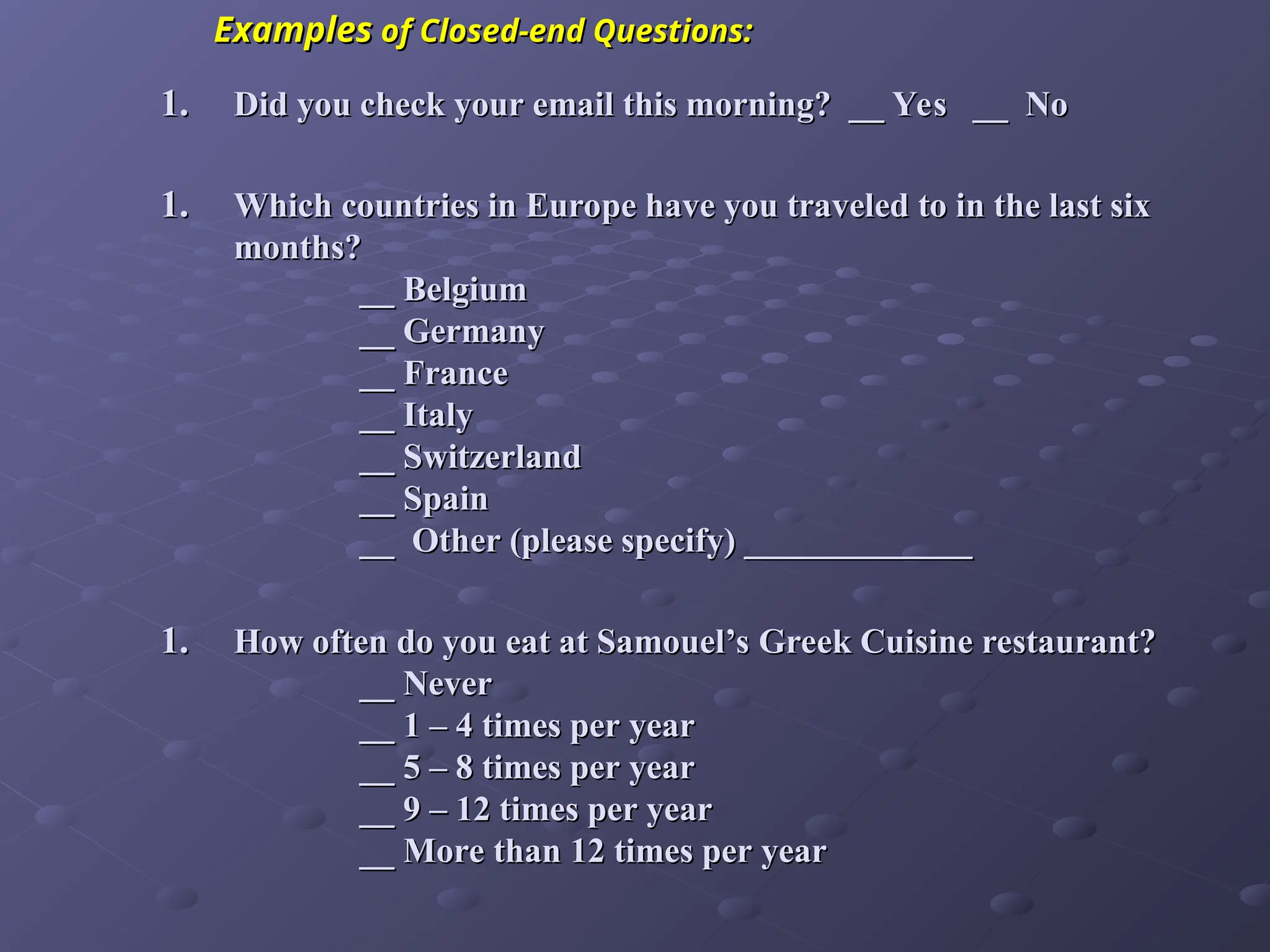
1.
1. Did you check your email this morning? __ Yes __ No
Did you check your email this morning? __ Yes __ No
1.
1. Which countries in Europe have you traveled to in the last six
Which countries in Europe have you traveled to in the last six
months?
months?
__ Belgium
__ Belgium
__ Germany
__ Germany
__ France
__ France
__ Italy
__ Italy
__ Switzerland
__ Switzerland
__ Spain
__ Spain
__ Other (please specify) _____________
1.
1. How often do you eat at Samouel’s Greek Cuisine restaurant?
How often do you eat at Samouel’s Greek Cuisine restaurant?
__ Never
__ Never
__ 1 – 4 times per year
__ 5 – 8 times per year
__ 9 – 12 times per year
__ More than 12 times per year
Examples
Examples of Closed-end Questions:
of Closed-end Questions:
Closed-end
Closed-end Questions
Questions
• Typically used in quantitative studies.
Typically used in quantitative studies.
• Used in studies involving large samples.
Used in studies involving large samples.
• Limited range of response options.
Limited range of response options.
Types of Questionnaire :
Structured questionnaire:
Structured questionnaire:
It include definite, concrete and
pre-obtained questions which were prepared
in advance.
in advance.
Closed-form questionnaire:
Closed-form questionnaire:
It is used when categorized data is
required.
required.
10
10
Pictorial questionnaire:
Pictorial questionnaire:
It is used to promote interest in
answering after seeing the pictures on a particular
theme.
theme.
Unstructured questionnaire:
Unstructured questionnaire:
Designed to obtained view points,
opinions, attitudes and to show relationships and
inter-connections between data.
11
11
Steps in Questionnaire Design
Steps in Questionnaire Design:
:
1.
1. Initial Considerations – problem, objectives,
Initial Considerations – problem, objectives,
target population, sampling, etc.
2.
2. Clarification of Concepts – select variables,
Clarification of Concepts – select variables,
constructs, measurement approach, etc.
3.
3. Developing the Questionnaire
Developing the Questionnaire
 Length and sequence.
Length and sequence.
 Types of questions.
Types of questions.
 Sources of questions.
Sources of questions.
 Wording, coding, layout and instructions.
Wording, coding, layout and instructions.
4.
4. Pre-testing the Questionnaire.
Pre-testing the Questionnaire.
5.
5. Questionnaire Administration Planning.
Questionnaire Administration Planning.
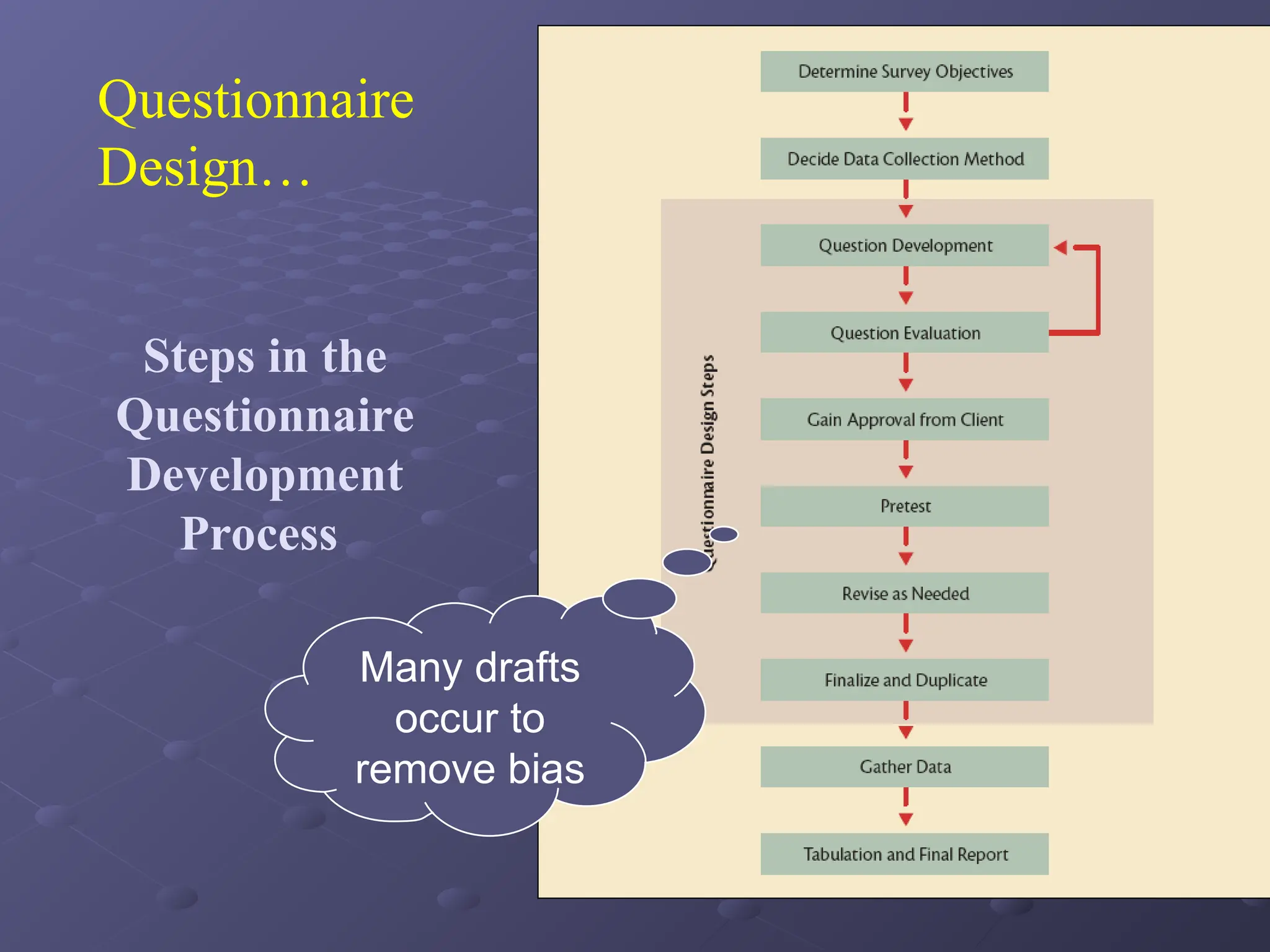
Steps in the
Questionnaire
Development
Process
Many drafts
occur to
remove bias
Questionnaire
Design…
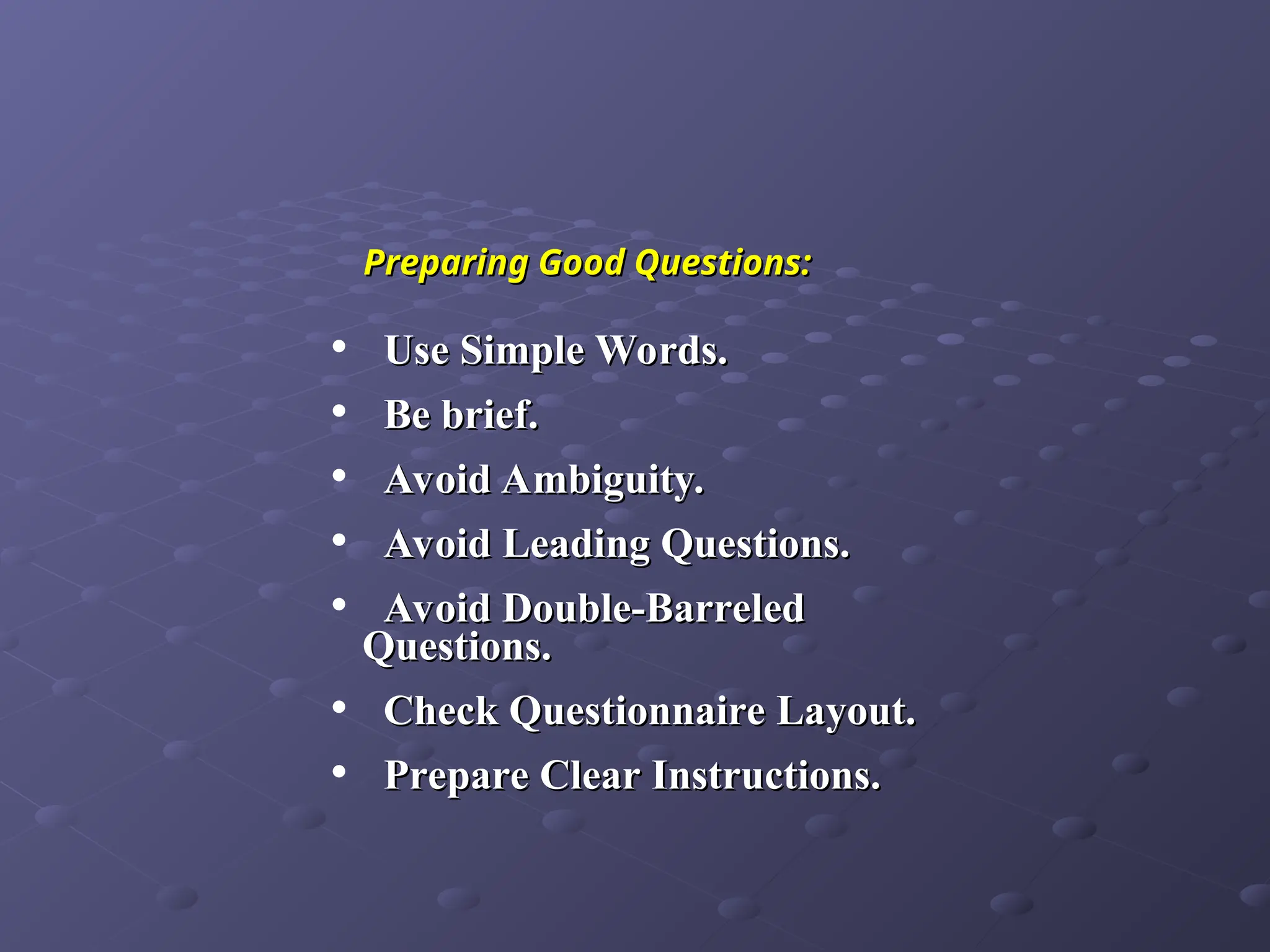
Preparing Good Questions:
• Use Simple Words.
Use Simple Words.
• Be brief.
Be brief.
• Avoid Ambiguity.
Avoid Ambiguity.
• Avoid Leading Questions.
Avoid Leading Questions.
• Avoid Double-Barreled
Avoid Double-Barreled
Questions.
Questions.
• Check Questionnaire Layout.
Check Questionnaire Layout.
• Prepare Clear Instructions.
Prepare Clear Instructions.
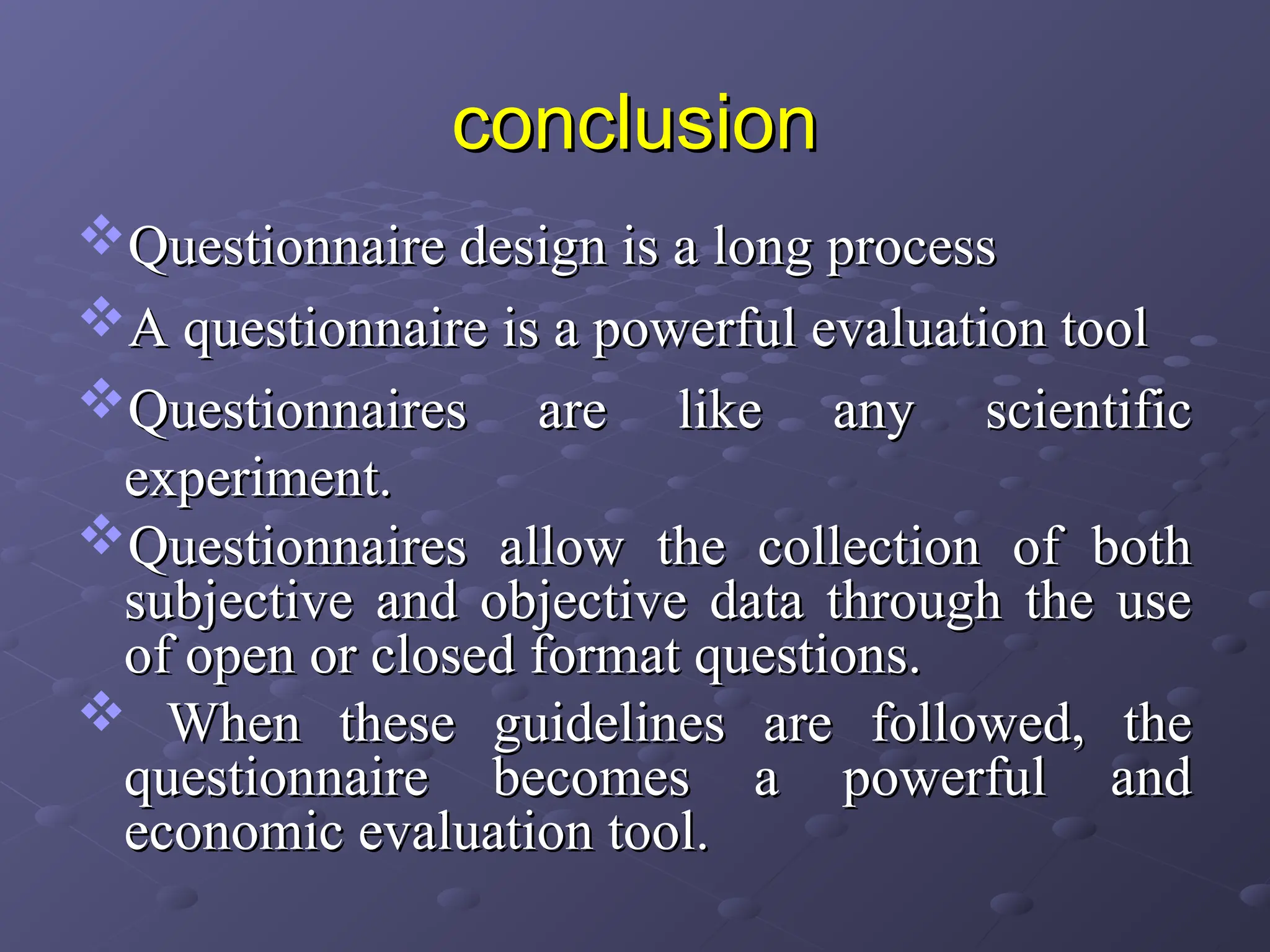
conclusion
conclusion
Questionnaire design is a long process
Questionnaire design is a long process
A questionnaire is a powerful evaluation tool
A questionnaire is a powerful evaluation tool
Questionnaires are like any scientific
Questionnaires are like any scientific
experiment.
experiment.
Questionnaires allow the collection of both
Questionnaires allow the collection of both
subjective and objective data through the use
of open or closed format questions.
 When these guidelines are followed, the
When these guidelines are followed, the
questionnaire becomes a powerful and
economic evaluation tool.
THANK YOU…..
THANK YOU…..
16
16

Data Collection survey instruments & methods of Questionnaire

  • 1.
    Unit Unit III III DEVELOPMENT OF DEVELOPMENTOF SURVEY SURVEY INSTRUMENTS INSTRUMENTS ITEM ANALYSIS FOR ITEM ANALYSIS FOR THE THE QUESTIONNAIRES QUESTIONNAIRES DEEPA.M.J DEEPA.M.J 1 1
  • 2.
    Introduction Introduction : : “ “Survey Survey” ” refersto a descriptive research refers to a descriptive research technique or methodology (also includes interviews, technique or methodology (also includes interviews, and focus groups) and focus groups) “ “Questionnaire Questionnaire” refers to a paper and pencil ” refers to a paper and pencil instrument through which information is obtained instrument through which information is obtained For the purposes of outcomes assessment, For the purposes of outcomes assessment, questionnaires are frequently developed to survey a questionnaires are frequently developed to survey a population . population . “ “Questionnaire” Questionnaire” consists of a number of questions consists of a number of questions printed or typed in a definite order on a form or set of forms. printed or typed in a definite order on a form or set of forms. 2 2
  • 3.
    The basic functionsof questionnaire : The basic functions of questionnaire : It translates research objectives to be questions It translates research objectives to be questions It standardizes the questions and the response It standardizes the questions and the response categories: every respondents can give the information categories: every respondents can give the information that we want that we want It keeps communicating with respondents in a It keeps communicating with respondents in a professional way (cooperation and motivation). professional way (cooperation and motivation). It is the permanent records of survey It is the permanent records of survey It is helpful for the process of data analysis It is helpful for the process of data analysis 3 3
  • 4.
    The The importance importance of ofquestionnaire questionnaire : : It ensures quality of data collected : reliable It ensures quality of data collected : reliable data is very useful for analysis data is very useful for analysis It provides effective and efficient survey It provides effective and efficient survey It accomplishes the research objectives It accomplishes the research objectives. . 4 4
  • 5.
    Open-ended Questions Open-ended Questions= = place no constraints place no constraints on respondents; i.e., they are free to answer in on respondents; i.e., they are free to answer in their own words and to give whatever thoughts their own words and to give whatever thoughts come to mind. come to mind. Closed-ended Questions Closed-ended Questions = = respondent is given respondent is given the option of choosing from a number of the option of choosing from a number of predetermined answers. predetermined answers. Two Types of Questions Two Types of Questions: : 1. 1. Open-ended Open-ended 2. 2. Closed-ended Closed-ended QUESTIONNAIRE QUESTIONNAIRE DESIGN DESIGN
  • 6.
    Examples of Open-endedQuestions Examples of Open-ended Questions: : How do you typically decide which restaurant you How do you typically decide which restaurant you will eat at? will eat at? · Which mutual funds have you been investing in for · Which mutual funds have you been investing in for the past year? the past year? · How are your investment funds performing? · How are your investment funds performing? · Do you think airport security is better now than it · Do you think airport security is better now than it was six months ago? was six months ago?
  • 7.
    Open-ended Open-ended Questions Questions • Typicallyused in exploratory/qualitative studies. Typically used in exploratory/qualitative studies. • Typically used in personal interview surveys Typically used in personal interview surveys involving small samples. involving small samples. • Allows respondent freedom of response. Allows respondent freedom of response. • Possible researcher bias in interpretation. Possible researcher bias in interpretation.
  • 8.
    1. 1. Did youcheck your email this morning? __ Yes __ No Did you check your email this morning? __ Yes __ No 1. 1. Which countries in Europe have you traveled to in the last six Which countries in Europe have you traveled to in the last six months? months? __ Belgium __ Belgium __ Germany __ Germany __ France __ France __ Italy __ Italy __ Switzerland __ Switzerland __ Spain __ Spain __ Other (please specify) _____________ __ Other (please specify) _____________ 1. 1. How often do you eat at Samouel’s Greek Cuisine restaurant? How often do you eat at Samouel’s Greek Cuisine restaurant? __ Never __ Never __ 1 – 4 times per year __ 1 – 4 times per year __ 5 – 8 times per year __ 5 – 8 times per year __ 9 – 12 times per year __ 9 – 12 times per year __ More than 12 times per year __ More than 12 times per year Examples Examples of Closed-end Questions: of Closed-end Questions:
  • 9.
    Closed-end Closed-end Questions Questions • Typicallyused in quantitative studies. Typically used in quantitative studies. • Used in studies involving large samples. Used in studies involving large samples. • Limited range of response options. Limited range of response options.
  • 10.
    Types of Questionnaire: Types of Questionnaire : Structured questionnaire: Structured questionnaire: It include definite, concrete and It include definite, concrete and pre-obtained questions which were prepared pre-obtained questions which were prepared in advance. in advance. Closed-form questionnaire: Closed-form questionnaire: It is used when categorized data is It is used when categorized data is required. required. 10 10
  • 11.
    Pictorial questionnaire: Pictorial questionnaire: Itis used to promote interest in It is used to promote interest in answering after seeing the pictures on a particular answering after seeing the pictures on a particular theme. theme. Unstructured questionnaire: Unstructured questionnaire: Designed to obtained view points, Designed to obtained view points, opinions, attitudes and to show relationships and opinions, attitudes and to show relationships and inter-connections between data. inter-connections between data. 11 11
  • 12.
    Steps in QuestionnaireDesign Steps in Questionnaire Design: : 1. 1. Initial Considerations – problem, objectives, Initial Considerations – problem, objectives, target population, sampling, etc. target population, sampling, etc. 2. 2. Clarification of Concepts – select variables, Clarification of Concepts – select variables, constructs, measurement approach, etc. constructs, measurement approach, etc. 3. 3. Developing the Questionnaire Developing the Questionnaire  Length and sequence. Length and sequence.  Types of questions. Types of questions.  Sources of questions. Sources of questions.  Wording, coding, layout and instructions. Wording, coding, layout and instructions. 4. 4. Pre-testing the Questionnaire. Pre-testing the Questionnaire. 5. 5. Questionnaire Administration Planning. Questionnaire Administration Planning.
  • 13.
    Steps in the Questionnaire Development Process Manydrafts occur to remove bias Questionnaire Design…
  • 14.
    Preparing Good Questions: PreparingGood Questions: • Use Simple Words. Use Simple Words. • Be brief. Be brief. • Avoid Ambiguity. Avoid Ambiguity. • Avoid Leading Questions. Avoid Leading Questions. • Avoid Double-Barreled Avoid Double-Barreled Questions. Questions. • Check Questionnaire Layout. Check Questionnaire Layout. • Prepare Clear Instructions. Prepare Clear Instructions.
  • 15.
    conclusion conclusion Questionnaire design isa long process Questionnaire design is a long process A questionnaire is a powerful evaluation tool A questionnaire is a powerful evaluation tool Questionnaires are like any scientific Questionnaires are like any scientific experiment. experiment. Questionnaires allow the collection of both Questionnaires allow the collection of both subjective and objective data through the use subjective and objective data through the use of open or closed format questions. of open or closed format questions.  When these guidelines are followed, the When these guidelines are followed, the questionnaire becomes a powerful and questionnaire becomes a powerful and economic evaluation tool. economic evaluation tool.
  • 16.