EVIDENCE BASED NEONATAL CARE
DR NILIMA SONAWANE
Principal
Institute of Nursing Education, Sir J J Hospital
Campus , Mumbai ,Maharashtra, India
NEONATE
A neonate is a baby who is Birth to 4 weeks old
Period of transition from intra uterine to extra Uterine
world.
Newborns: improving survival and well-being
• Although the global number of newborns deaths declined from 5 million
in 1990 to 2.4 million in 2019, children face the greatest risk of death in
their first 28 days.
• In 2019, 47% of all under-5 deaths occurred in the newborn period with
about one third dying on the day of birth and close to three quarters dying
within the first week of life.
• Children who die within the first 28 days of birth suffer from conditions
and diseases associated with lack of quality care at birth or skilled care
and treatment immediately after birth and in the first days of life.
• Preterm birth, intrapartum-related complications (birth asphyxia or lack
of breathing at birth), infections and birth defects cause most neonatal
deaths.
• Women who receive midwife-led continuity of care (MLCC) provided by
professional midwives, educated and regulated to internationals
standards, are 16% less likely to lose their baby and 24% less likely to
experience pre-term birth.
INDIA NEWBORN ACTION PLAN (INAP)

The India Newborn Action Plan (INAP) was launched in
September 2014 with the aim of ending preventable
newborn deaths and stillbirths by 2030.
 The salient features are:
  INAP has set the goals for neonatal mortality and
stillbirths. The goal is to attain Single Digit Neonatal
Mortality and Stillbirth Rates by 2030.

  INAP is to be implemented within the existing
Reproductive, Maternal, Newborn, Child and Adolescent
health (RMNCH+A) framework of the National Health
Mission (NHM).
CAUSES OF NEWBORN DEATHS IN INDIA
Essential Antenatal care is a great evidence of
positive fetal outcome
 Early registration
 Tetanus toxoids immunization
 Management of Anemia &
Hypertension
 Maternal Nutrition
 Birth preparation
 Danger sign identification
and proper treatment
CLEAN CHAIN- CLEAN BIRTH PRACTICE
Skill attendance at birth
 The WHO six “cleans”
1. Clean hands of the attendant
2. Clean Delivery surface
3. Clean cord cutting instrument
4. Clean cord tie
5. Clean towels to dry the baby and then
wrap the baby
6. Clean cloth to wrap the mother
Timely Access to Emergency Obstetric care
Effects of Birthing Room Design on Maternal and Neonate
Outcomes
 The aesthetic nature of the birthing room
environment may alter the need for obstetrical
interventions.
DESIGNING SENSORY BIRTHING ROOM
The concept of sensory delivery
rooms was introduced in 2013.
These rooms offer programmable
calming lights, restful pictures
displayed on a wall , big screen,
and sound effects.
The physical healthcare
environment has significant
effects on health and well-being.
Research indicates that birthing
environments can impact women
during labor and birth.
In India successful natural birth center emerging under the
supervision of skill attendance & birthing expert
Birth Village Natural Birthing center
Kochi Kerala
Dai Maas Natural Biith and Wellness
centre , Mumbai
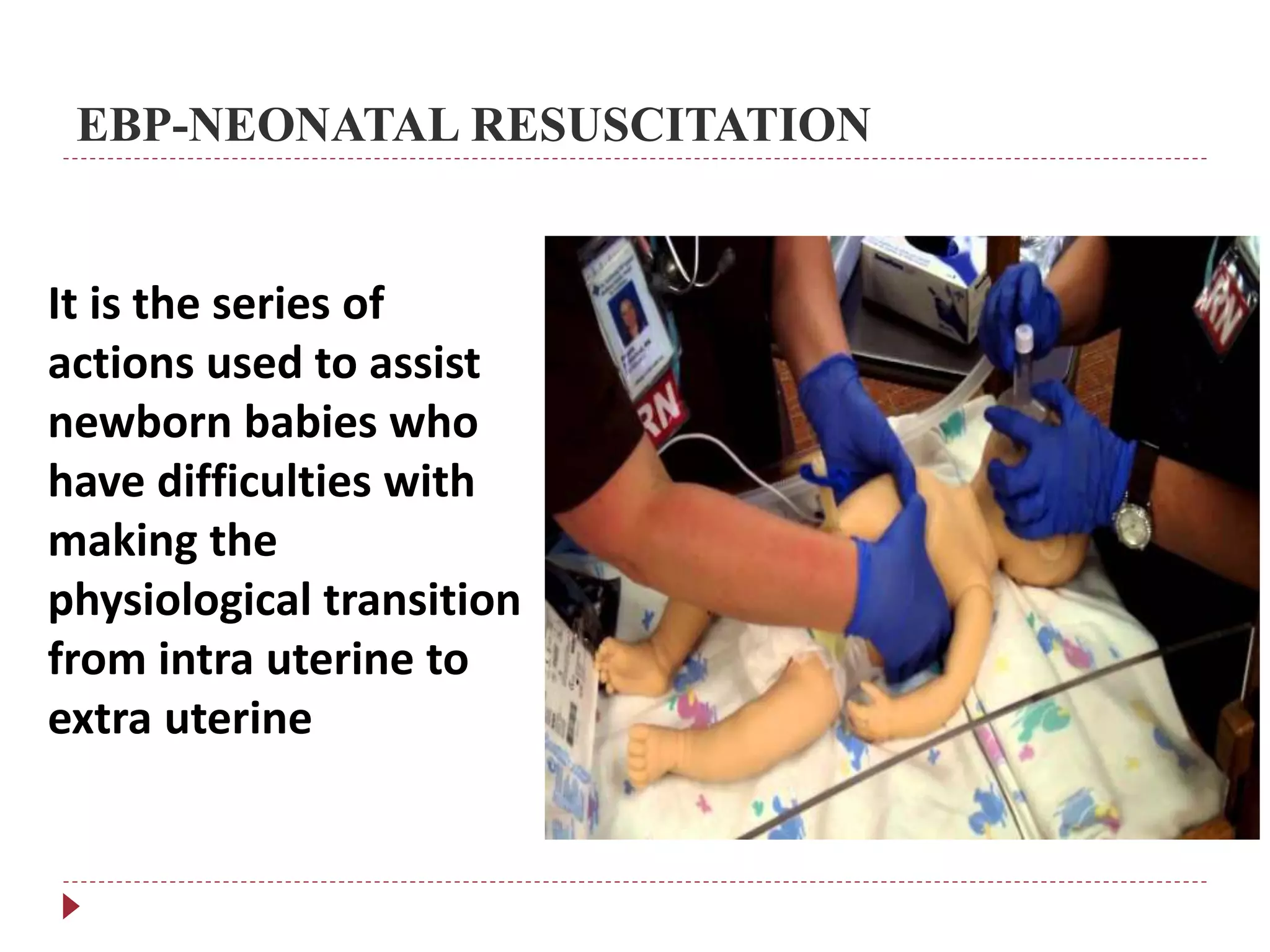
EBP-NEONATAL RESUSCITATION
It is the series of
actions used to assist
newborn babies who
have difficulties with
making the
physiological transition
from intra uterine to
extra uterine
SUCTIONING AT BIRTH
 The World Health Organization (WHO) now advises against
routine bulb suctioning of neonates in the minutes following
birth. If the baby is born through clear amniotic fluid and
begins breathing on their own shortly after birth, do
not suction.
 Evidence based clinical guidelines recommend not suctioning
a baby’s airways unless they are unresponsive, floppy and
require resuscitation.
 There is no benefit to this practice, and it can cause
bradycardia and apnea. Instead, wipe the baby’s mouth and
nose with a towel to clear excess secretions and stimulate
respiration.
SUCTIONING AT BIRTH
NP suctioning does improve certain aspects of infants'
respiratory status. There are presumed benefits to NP
suctioning. However, there are also potential risks. Nasal-
pharyngeal suctioning can produce bradycardia,
laryngospasm, cardiac dysrhythmias, and edema and
trauma to mucous membranes (Oberc, 1991), tachycardia,
emotional distress, bronchospasm, and cardiac arrest
(Young, 1988).
The latest research shows that babies who have their faces
wiped after birth have a clinical outcome that is exactly the
same as those who are suctioned, but without the
damaging risks.
THERMOREGULATION
Prevention of Hypothermia
Thermal care (including prompt
drying and covering at birth,
maximizing skin-to-skin
contact, delayed bathing,
maintaining “warm chain”)
Thermocol boxes prove lifesavers for the newborn
WARM CHAIN
 Warm delivery room 25 c
 Warm resuscitation
 Dry baby immediately
 Postpone bathing for 24 hrs
 Breast feeding
 Skin to skin contact
 Warm clothing
 Mother Baby together
 Professional Alertness
 Warm transportation
KANGAROO MOTHER CARE
HOMEBASED NEWBORN CARE HBNC
 Breast feeding
 Cord care
 Maintenance of
temperature
 Early detection of
pneumonia and sepsis
 Promoting Hygienic
practices
 Recognition of post partum
complications
EARLY INITIATION OF BREAST FEEDING
Prevention of Hypoglycemia
DELAYED CORD CLAMPING
"wait a minute" policy
No Risk
It decreases the risk of anemia
The benefits are even greater for preterm
babies
It is safe process
Placental transfusion for 45 s or milking the
cord for 15s s improves cardiovascular
adaptation, with better hemodynamic
stability
Decreased intra ventricular hemorrhages,
need for transfusion, and late-onset sepsis.
EVIDENCE BASED CLEAN CORD CARE PRACTICES
 Cleaning with Alcohol delay healing
 The effect of topical antimicrobials in reducing infections
is less clear.
 Hand washing
 washing cord with soap and water & keep it Dry
 Exposed to air or cover with loose cotton cloths
 No unnecessary use of Topical antimicrobials on cord
stump
 Recent studies have proven that salt is effective at
treating umbilical granulomas. It is thought that
the salt draws water out of the cells and causes the
granuloma to shrink.
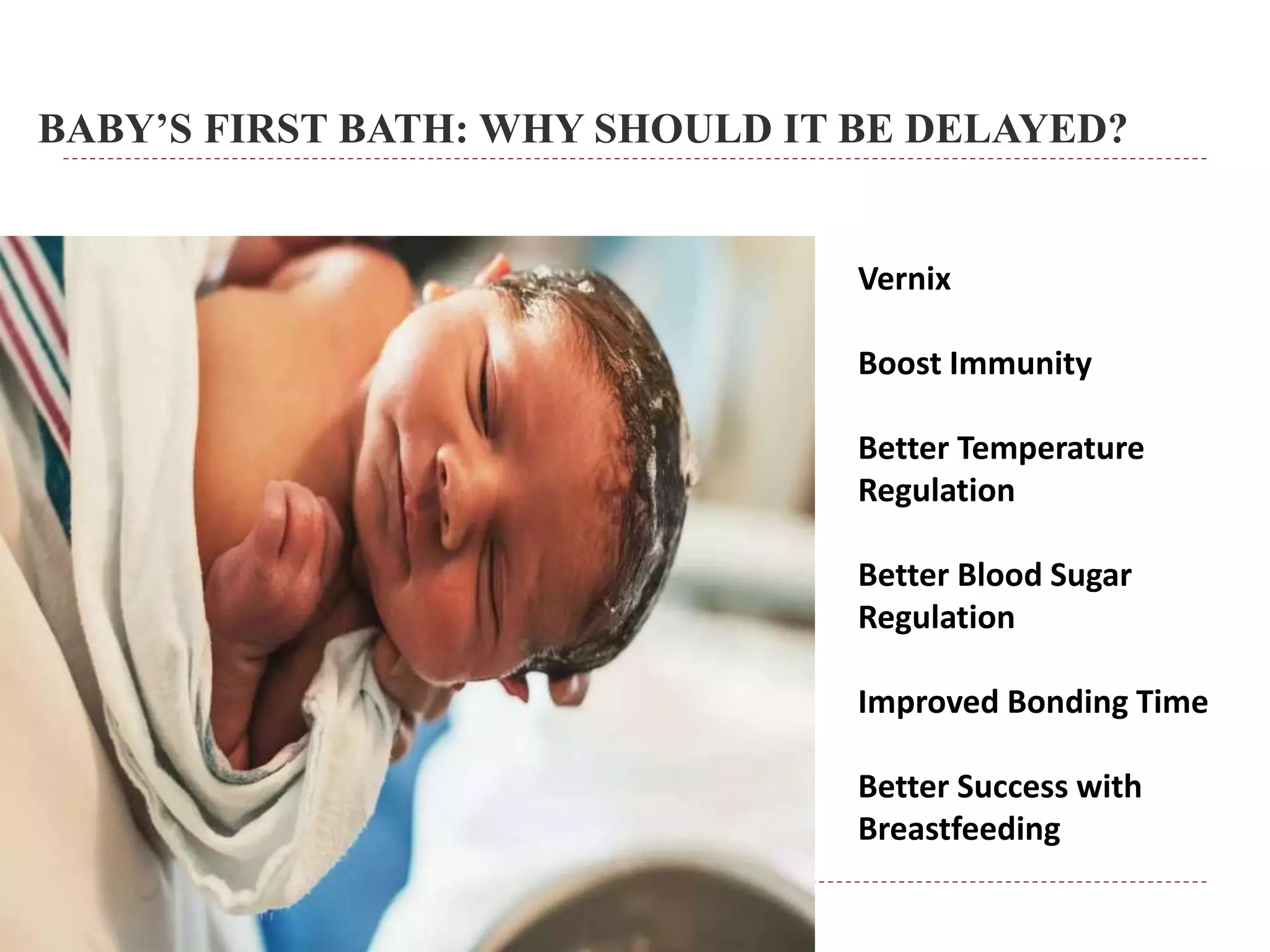
BABY’S FIRST BATH: WHY SHOULD IT BE DELAYED?
Vernix
Boost Immunity
Better Temperature
Regulation
Better Blood Sugar
Regulation
Improved Bonding Time
Better Success with
Breastfeeding
HEALTH EDUCATION : KEY TO SUCCESS
Working with individual family and community
To improve maternal and newborn health
IMNCI PLUS ETAT
Emergency Triage Assessment and Treatment
10 BRILLIANT TECHNOLOGICAL INNOVATIONS TO SAVE
MOMS AND BABIES
10 BRILLIANT TECHNOLOGICAL INNOVATIONS TO SAVE
MOMS AND BABIES
10 BRILLIANT TECHNOLOGICAL INNOVATIONS TO SAVE MOMS
AND BABIES
10 BRILLIANT TECHNOLOGICAL INNOVATIONS TO SAVE
MOMS AND BABIES
Evidence based neonatal care 2021

Evidence based neonatal care 2021

  • 1.
    EVIDENCE BASED NEONATALCARE DR NILIMA SONAWANE Principal Institute of Nursing Education, Sir J J Hospital Campus , Mumbai ,Maharashtra, India
  • 3.
    NEONATE A neonate isa baby who is Birth to 4 weeks old Period of transition from intra uterine to extra Uterine world.
  • 4.
    Newborns: improving survivaland well-being • Although the global number of newborns deaths declined from 5 million in 1990 to 2.4 million in 2019, children face the greatest risk of death in their first 28 days. • In 2019, 47% of all under-5 deaths occurred in the newborn period with about one third dying on the day of birth and close to three quarters dying within the first week of life. • Children who die within the first 28 days of birth suffer from conditions and diseases associated with lack of quality care at birth or skilled care and treatment immediately after birth and in the first days of life. • Preterm birth, intrapartum-related complications (birth asphyxia or lack of breathing at birth), infections and birth defects cause most neonatal deaths. • Women who receive midwife-led continuity of care (MLCC) provided by professional midwives, educated and regulated to internationals standards, are 16% less likely to lose their baby and 24% less likely to experience pre-term birth.
  • 9.
    INDIA NEWBORN ACTIONPLAN (INAP)  The India Newborn Action Plan (INAP) was launched in September 2014 with the aim of ending preventable newborn deaths and stillbirths by 2030.  The salient features are:   INAP has set the goals for neonatal mortality and stillbirths. The goal is to attain Single Digit Neonatal Mortality and Stillbirth Rates by 2030.    INAP is to be implemented within the existing Reproductive, Maternal, Newborn, Child and Adolescent health (RMNCH+A) framework of the National Health Mission (NHM).
  • 10.
    CAUSES OF NEWBORNDEATHS IN INDIA
  • 11.
    Essential Antenatal careis a great evidence of positive fetal outcome  Early registration  Tetanus toxoids immunization  Management of Anemia & Hypertension  Maternal Nutrition  Birth preparation  Danger sign identification and proper treatment
  • 12.
    CLEAN CHAIN- CLEANBIRTH PRACTICE Skill attendance at birth  The WHO six “cleans” 1. Clean hands of the attendant 2. Clean Delivery surface 3. Clean cord cutting instrument 4. Clean cord tie 5. Clean towels to dry the baby and then wrap the baby 6. Clean cloth to wrap the mother Timely Access to Emergency Obstetric care
  • 13.
    Effects of BirthingRoom Design on Maternal and Neonate Outcomes  The aesthetic nature of the birthing room environment may alter the need for obstetrical interventions.
  • 14.
    DESIGNING SENSORY BIRTHINGROOM The concept of sensory delivery rooms was introduced in 2013. These rooms offer programmable calming lights, restful pictures displayed on a wall , big screen, and sound effects. The physical healthcare environment has significant effects on health and well-being. Research indicates that birthing environments can impact women during labor and birth.
  • 15.
    In India successfulnatural birth center emerging under the supervision of skill attendance & birthing expert Birth Village Natural Birthing center Kochi Kerala Dai Maas Natural Biith and Wellness centre , Mumbai
  • 16.
    EBP-NEONATAL RESUSCITATION It isthe series of actions used to assist newborn babies who have difficulties with making the physiological transition from intra uterine to extra uterine
  • 17.
    SUCTIONING AT BIRTH The World Health Organization (WHO) now advises against routine bulb suctioning of neonates in the minutes following birth. If the baby is born through clear amniotic fluid and begins breathing on their own shortly after birth, do not suction.  Evidence based clinical guidelines recommend not suctioning a baby’s airways unless they are unresponsive, floppy and require resuscitation.  There is no benefit to this practice, and it can cause bradycardia and apnea. Instead, wipe the baby’s mouth and nose with a towel to clear excess secretions and stimulate respiration.
  • 18.
    SUCTIONING AT BIRTH NPsuctioning does improve certain aspects of infants' respiratory status. There are presumed benefits to NP suctioning. However, there are also potential risks. Nasal- pharyngeal suctioning can produce bradycardia, laryngospasm, cardiac dysrhythmias, and edema and trauma to mucous membranes (Oberc, 1991), tachycardia, emotional distress, bronchospasm, and cardiac arrest (Young, 1988). The latest research shows that babies who have their faces wiped after birth have a clinical outcome that is exactly the same as those who are suctioned, but without the damaging risks.
  • 19.
    THERMOREGULATION Prevention of Hypothermia Thermalcare (including prompt drying and covering at birth, maximizing skin-to-skin contact, delayed bathing, maintaining “warm chain”)
  • 20.
    Thermocol boxes provelifesavers for the newborn
  • 21.
    WARM CHAIN  Warmdelivery room 25 c  Warm resuscitation  Dry baby immediately  Postpone bathing for 24 hrs  Breast feeding  Skin to skin contact  Warm clothing  Mother Baby together  Professional Alertness  Warm transportation
  • 22.
  • 23.
    HOMEBASED NEWBORN CAREHBNC  Breast feeding  Cord care  Maintenance of temperature  Early detection of pneumonia and sepsis  Promoting Hygienic practices  Recognition of post partum complications
  • 24.
    EARLY INITIATION OFBREAST FEEDING Prevention of Hypoglycemia
  • 25.
    DELAYED CORD CLAMPING "waita minute" policy No Risk It decreases the risk of anemia The benefits are even greater for preterm babies It is safe process Placental transfusion for 45 s or milking the cord for 15s s improves cardiovascular adaptation, with better hemodynamic stability Decreased intra ventricular hemorrhages, need for transfusion, and late-onset sepsis.
  • 26.
    EVIDENCE BASED CLEANCORD CARE PRACTICES  Cleaning with Alcohol delay healing  The effect of topical antimicrobials in reducing infections is less clear.  Hand washing  washing cord with soap and water & keep it Dry  Exposed to air or cover with loose cotton cloths  No unnecessary use of Topical antimicrobials on cord stump  Recent studies have proven that salt is effective at treating umbilical granulomas. It is thought that the salt draws water out of the cells and causes the granuloma to shrink.
  • 27.
    BABY’S FIRST BATH:WHY SHOULD IT BE DELAYED? Vernix Boost Immunity Better Temperature Regulation Better Blood Sugar Regulation Improved Bonding Time Better Success with Breastfeeding
  • 28.
    HEALTH EDUCATION :KEY TO SUCCESS Working with individual family and community To improve maternal and newborn health
  • 29.
    IMNCI PLUS ETAT EmergencyTriage Assessment and Treatment
  • 30.
    10 BRILLIANT TECHNOLOGICALINNOVATIONS TO SAVE MOMS AND BABIES
  • 32.
    10 BRILLIANT TECHNOLOGICALINNOVATIONS TO SAVE MOMS AND BABIES
  • 33.
    10 BRILLIANT TECHNOLOGICALINNOVATIONS TO SAVE MOMS AND BABIES
  • 34.
    10 BRILLIANT TECHNOLOGICALINNOVATIONS TO SAVE MOMS AND BABIES