Designing Research
Questionnaire
Akmal Samsor
asamsor@jscs.af
Outline
• Questionnaire
• Functions of a questionnaire
• Types of questionnaire
• Questionnaire design process
• Basic principles of writing questions
• Review of sample questionnaires
• Q&A ?
What is a Questionnaire?
• A questionnaire is the vehicle used to pose the
questions that the researcher wants
respondents to answer.
The Functions of a Questionnaire
• Translates the research objectives into specific
questions
• Standardizes those questions and the response
categories
• Fosters cooperation and motivation
• Serves as permanent records of the research
• Can speed up the process of data analysis
• Can serve as the basis for reliability and validity
measures
Types of Questionnaire
Depending on type of study (qualitative or
quantative), skills and number of data collectors
involved and method of data collection
questionnaires are :
• Unstructured questionnaire
• Semi-Structured questionnaire
• Structured questionnaire
Questionnaire Design
• Questionnaire design is a systematic process
in which the researcher contemplates various
question formats, considers a number of
factors characterizing the research at hand,
ultimately words the various questions very
carefully, and organizes the questionnaire’s
layout.
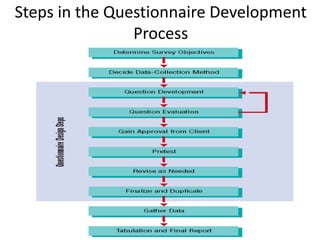
Steps in the Questionnaire Development
Process
The flowerpot approach of
questionnaire design
• This scientific approach involves a series of
activities that have a logical, hierarchical
order.
• The flowerpot notion is symbolically derived
from the natural shape associated with a clay
pot used for planting and growing flowers.
• The shape is wide at the top and tapered (or
narrower) at the bottom—symbolizing a
natural flow of data from general to specific.
The flowerpot approach of
questionnaire design
• According to the flowerpot concept, in a good
questionnaire design, the data will flow from a
general information level, down to a more specific
information level, and end with identification
data.
• A questionnaire should begin with an introductory
section that gives the respondent a basic idea of
the main topic of the research. This section should
also include general instructions for filling out the
questionnaire. The introduction’s appearance will
vary with the desired data collection method.
The Introductory Section of the
Questionnaire
• The main role of the introductory section should
be that of winning over the respondent’s
cooperation and willingness to participate in the
research project.
• In other words, the introductory section should
help persuade a prospective respondent either to
fill out the questionnaire and return it in a timely
fashion or to participate in the current interview.
Developing Introductory Section
• Factor 1. Personalization
This section should be addressed to the particular
person who was randomly selected as a prospective
respondent.
• Factor 2. Identification of the Organization Doing
the Study
Clear identification of the name of the research firm
conducting the survey or interview; decide on
disguised or undisguised approach of revealing the
actual client (or sponsor) of the study
Developing of Introductory Section
• Factor 3. Clear Statement of the Study’s Purpose
and Importance
Describe the general topic of the research and
emphasize its importance to the prospective
purpose and importance respondent.
• Factor 4. Anonymity and Confidentiality
Give assurances that the prospective respondent’s
name will not be revealed. Explain how the
respondent was chosen, and stress that his or her
meaningful input is important to the study’s
success.
Developing of Introductory Section
• Factor 5. Time Frame
Communicate the overall time frame of the survey
or interview. It should state the actual completion
time requirements and any compensation that
might be offered.
• Factor 6. Reinforcement of the Importance of
the Respondent’s Participation
Where appropriate, communicate the importance
of prospective respondents’ participation.
Developing of Introductory Section
• Factor 7. Time Requirements and
Compensation
Clearly communicate the approximate time
required to complete the survey; discuss incentive
compensations program, if any.
• Factor 8. Advance thank-you statement for
willingness to participate
Thank the prospective respondent for his or her
cooperation.
In Class Practice
• Lets review the introductory part and
subsequent sections of a questionnaire and
observe if flower pot approach is properly
followed in the questionnaire
Principles of Questionnaire Writing
• Be clear and precise.
Principles of Questionnaire Writing
• Be clear and precise.
• Bad: “Tell me what you think about this product?”
• Good “On a scale from 1 to 10 how fresh is this bagel?”
(circle one)
Very Stale 1 2 3 4 5 6 7 8 9 10 Very Fresh
Principles of Questionnaire Writing
• Be clear and precise.
• Response choices should not overlap.
Principles of Questionnaire Writing
• Be clear and precise.
• Response choices should not overlap.
• Bad: What is your income level?
$0 - $10,000
$10,000 - $20,000
$20,000 - $30,000
$30,000 or more.
• Be clear and precise.
• Response choices should not overlap.
• Use natural and familiar language.
Principles of Questionnaire Writing
• Be clear and precise.
• Response choices should not overlap.
• Use natural and familiar language.
• Bad: “Moribund 1 2 3 4 5 6 7 8 9 10 Lively”
Principles of Questionnaire Writing
• Be clear and precise.
• Response choices should not overlap.
• Use natural and familiar language.
• Do not use words or phrases that show bias.
Principles of Questionnaire Writing
• Be clear and precise.
• Response choices should not overlap.
• Use natural and familiar language.
• Do not use words or phrases that show
bias.
• Bad: “Why isn’t this brand better liked?”
• Good: “What is it that you like least about this brand?”
Principles of Questionnaire Writing
• Be clear and precise.
• Response choices should not overlap.
• Use natural and familiar language.
• Do not use words or phrases that show bias.
• Avoid double-barreled questions.
Principles of Questionnaire Writing
• Be clear and precise.
• Response choices should not overlap.
• Use natural and familiar language.
• Do not use words or phrases that show
bias.
• Avoid double-barreled questions.
• Bad: “Do you like the taste and the feel of this brand?”
Principles of Questionnaire Writing
• Be clear and precise.
• Response choices should not overlap.
• Use natural and familiar language.
• Do not use words or phrases that show bias.
• Avoid double-barreled questions.
• State explicit alternatives.
Principles of Questionnaire Writing
• Be clear and precise.
• Response choices should not overlap.
• Use natural and familiar language.
• Do not use words or phrases that show
bias.
• Avoid double-barreled questions.
• State explicit alternatives.
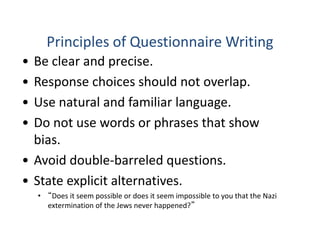
• “Does it seem possible or does it seem impossible to you that the Nazi
extermination of the Jews never happened?”
Principles of Questionnaire Writing
• Be clear and precise.
• Response choices should not overlap.
• Use natural and familiar language.
• Do not use words or phrases that show bias.
• Avoid double-barreled questions.
• State explicit alternatives.
• Questions should be reliable and valid.
Thank You
• Questions/Comments ?

Designing research questionnaire

  • 1.
  • 2.
    Outline • Questionnaire • Functionsof a questionnaire • Types of questionnaire • Questionnaire design process • Basic principles of writing questions • Review of sample questionnaires • Q&A ?
  • 3.
    What is aQuestionnaire? • A questionnaire is the vehicle used to pose the questions that the researcher wants respondents to answer.
  • 4.
    The Functions ofa Questionnaire • Translates the research objectives into specific questions • Standardizes those questions and the response categories • Fosters cooperation and motivation • Serves as permanent records of the research • Can speed up the process of data analysis • Can serve as the basis for reliability and validity measures
  • 5.
  • 6.
    Types of Questionnaire Dependingon type of study (qualitative or quantative), skills and number of data collectors involved and method of data collection questionnaires are : • Unstructured questionnaire • Semi-Structured questionnaire • Structured questionnaire
  • 7.
    Questionnaire Design • Questionnairedesign is a systematic process in which the researcher contemplates various question formats, considers a number of factors characterizing the research at hand, ultimately words the various questions very carefully, and organizes the questionnaire’s layout.
  • 8.
    Steps in theQuestionnaire Development Process
  • 9.
    The flowerpot approachof questionnaire design • This scientific approach involves a series of activities that have a logical, hierarchical order. • The flowerpot notion is symbolically derived from the natural shape associated with a clay pot used for planting and growing flowers. • The shape is wide at the top and tapered (or narrower) at the bottom—symbolizing a natural flow of data from general to specific.
  • 11.
    The flowerpot approachof questionnaire design • According to the flowerpot concept, in a good questionnaire design, the data will flow from a general information level, down to a more specific information level, and end with identification data. • A questionnaire should begin with an introductory section that gives the respondent a basic idea of the main topic of the research. This section should also include general instructions for filling out the questionnaire. The introduction’s appearance will vary with the desired data collection method.
  • 12.
    The Introductory Sectionof the Questionnaire • The main role of the introductory section should be that of winning over the respondent’s cooperation and willingness to participate in the research project. • In other words, the introductory section should help persuade a prospective respondent either to fill out the questionnaire and return it in a timely fashion or to participate in the current interview.
  • 13.
    Developing Introductory Section •Factor 1. Personalization This section should be addressed to the particular person who was randomly selected as a prospective respondent. • Factor 2. Identification of the Organization Doing the Study Clear identification of the name of the research firm conducting the survey or interview; decide on disguised or undisguised approach of revealing the actual client (or sponsor) of the study
  • 14.
    Developing of IntroductorySection • Factor 3. Clear Statement of the Study’s Purpose and Importance Describe the general topic of the research and emphasize its importance to the prospective purpose and importance respondent. • Factor 4. Anonymity and Confidentiality Give assurances that the prospective respondent’s name will not be revealed. Explain how the respondent was chosen, and stress that his or her meaningful input is important to the study’s success.
  • 15.
    Developing of IntroductorySection • Factor 5. Time Frame Communicate the overall time frame of the survey or interview. It should state the actual completion time requirements and any compensation that might be offered. • Factor 6. Reinforcement of the Importance of the Respondent’s Participation Where appropriate, communicate the importance of prospective respondents’ participation.
  • 16.
    Developing of IntroductorySection • Factor 7. Time Requirements and Compensation Clearly communicate the approximate time required to complete the survey; discuss incentive compensations program, if any. • Factor 8. Advance thank-you statement for willingness to participate Thank the prospective respondent for his or her cooperation.
  • 17.
    In Class Practice •Lets review the introductory part and subsequent sections of a questionnaire and observe if flower pot approach is properly followed in the questionnaire
  • 18.
    Principles of QuestionnaireWriting • Be clear and precise.
  • 19.
    Principles of QuestionnaireWriting • Be clear and precise. • Bad: “Tell me what you think about this product?” • Good “On a scale from 1 to 10 how fresh is this bagel?” (circle one) Very Stale 1 2 3 4 5 6 7 8 9 10 Very Fresh
  • 20.
    Principles of QuestionnaireWriting • Be clear and precise. • Response choices should not overlap.
  • 21.
    Principles of QuestionnaireWriting • Be clear and precise. • Response choices should not overlap. • Bad: What is your income level? $0 - $10,000 $10,000 - $20,000 $20,000 - $30,000 $30,000 or more.
  • 22.
    • Be clearand precise. • Response choices should not overlap. • Use natural and familiar language. Principles of Questionnaire Writing
  • 23.
    • Be clearand precise. • Response choices should not overlap. • Use natural and familiar language. • Bad: “Moribund 1 2 3 4 5 6 7 8 9 10 Lively” Principles of Questionnaire Writing
  • 24.
    Principles of QuestionnaireWriting • Be clear and precise. • Response choices should not overlap. • Use natural and familiar language. • Do not use words or phrases that show bias.
  • 25.
    Principles of QuestionnaireWriting • Be clear and precise. • Response choices should not overlap. • Use natural and familiar language. • Do not use words or phrases that show bias. • Bad: “Why isn’t this brand better liked?” • Good: “What is it that you like least about this brand?”
  • 26.
    Principles of QuestionnaireWriting • Be clear and precise. • Response choices should not overlap. • Use natural and familiar language. • Do not use words or phrases that show bias. • Avoid double-barreled questions.
  • 27.
    Principles of QuestionnaireWriting • Be clear and precise. • Response choices should not overlap. • Use natural and familiar language. • Do not use words or phrases that show bias. • Avoid double-barreled questions. • Bad: “Do you like the taste and the feel of this brand?”
  • 28.
    Principles of QuestionnaireWriting • Be clear and precise. • Response choices should not overlap. • Use natural and familiar language. • Do not use words or phrases that show bias. • Avoid double-barreled questions. • State explicit alternatives.
  • 29.
    Principles of QuestionnaireWriting • Be clear and precise. • Response choices should not overlap. • Use natural and familiar language. • Do not use words or phrases that show bias. • Avoid double-barreled questions. • State explicit alternatives. • “Does it seem possible or does it seem impossible to you that the Nazi extermination of the Jews never happened?”
  • 30.
    Principles of QuestionnaireWriting • Be clear and precise. • Response choices should not overlap. • Use natural and familiar language. • Do not use words or phrases that show bias. • Avoid double-barreled questions. • State explicit alternatives. • Questions should be reliable and valid.
  • 31.

Editor's Notes

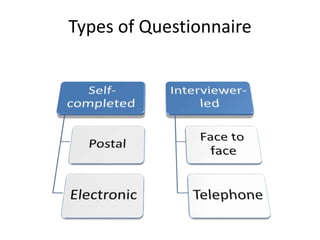
  • #6 The way questionnaires are used can be broadly divided into two groups; Self-completed questionnaires; where respondents provide their answers themselves without any other input, and Interviewer-lead; where the questions are read out to the respondent by the interviewer and their responses are noted. Self-completed questionnaires commonly include paper-based postal surveys and those delivered electronically such as internet surveys or other electronic device such as kiosks or hand-held computers. Interviewer lead questionnaires commonly includes face-to-face approaches or questionnaires conducted over the telephone. Additional info: There are pros and cons to using each method According to the HTA review, no one mode of administration consistently outperforms all others.