Describe: bacterial genome b.stev
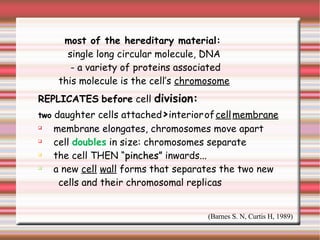
REPLICATES   before  cell  division: two  daughter cells attached > interior   of   cell   membrane membrane elongates, chromosomes move apart cell  doubles  in size: chromosomes separate the cell THEN “ pinches”  inwards...  a new  cell   wall  forms that separates the two new cells and their chromosomal replicas most of the hereditary material:   single long circular molecule, DNA - a variety of proteins associated this molecule is the cell’s  chromosome (Barnes S. N, Curtis H, 1989)
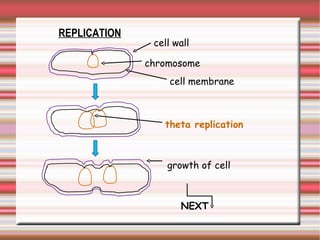
cell wall chromosome cell membrane theta replication growth of cell NEXT REPLICATION
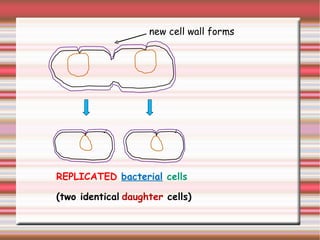
new cell wall forms REPLICATED   bacterial   cells (two identical   daughter  cells)
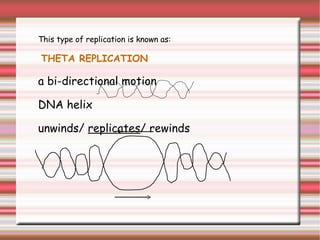
This type of replication is known as: THETA REPLICATION a bi-directional motion  DNA helix unwinds/  replicates / rewinds
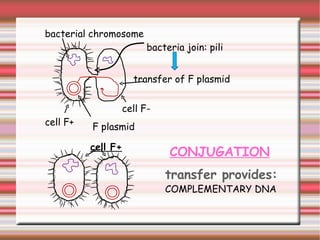
cell F- cell F+ bacterial chromosome F plasmid  bacteria join: pili transfer of F plasmid cell F+ transfer provides:   COMPLEMENTARY DNA CONJUGATION
PLASMIDS are small pockets of DNA that occur in bacteria carry genetic material for a specific purpose plasmids often conjugate to another bacterium THIS: provides the bacterium with complementary DNA KNOWN AS,” rolling circle replication ” plasmid   moves to bacterium via the use of an  extension  made by host [ carrier ] cell: - this extension is called:  pili   (Barnes S. N, Curtis H, 1989)
Bibliography Barnes S. N, Curtis H. (1989).  Biology (5th ed.) . New York: Worth Wikipedia. (2008).  Bacterial conjugation – wikipedia, the free encyclopedia .  Retrieved October 23, 2008, from  en.wikipedia.org/wiki/Bacterial _ conjugation  - 41k - The basics – replication . (n.d). Retrieved October 23, 2008, from  http//:www. socrates.acadiau.ca/courses/biol/microbiology/ Replication .htm - 9k -

Describe - Bacterial Genome

  • 1.
  • 2.
    REPLICATES before cell division: two daughter cells attached > interior of cell membrane membrane elongates, chromosomes move apart cell doubles in size: chromosomes separate the cell THEN “ pinches” inwards... a new cell wall forms that separates the two new cells and their chromosomal replicas most of the hereditary material: single long circular molecule, DNA - a variety of proteins associated this molecule is the cell’s chromosome (Barnes S. N, Curtis H, 1989)
  • 3.
    cell wall chromosomecell membrane theta replication growth of cell NEXT REPLICATION
  • 4.
    new cell wallforms REPLICATED bacterial cells (two identical daughter cells)
  • 5.
    This type ofreplication is known as: THETA REPLICATION a bi-directional motion DNA helix unwinds/ replicates / rewinds
  • 6.
    cell F- cellF+ bacterial chromosome F plasmid bacteria join: pili transfer of F plasmid cell F+ transfer provides: COMPLEMENTARY DNA CONJUGATION
  • 7.
    PLASMIDS are smallpockets of DNA that occur in bacteria carry genetic material for a specific purpose plasmids often conjugate to another bacterium THIS: provides the bacterium with complementary DNA KNOWN AS,” rolling circle replication ” plasmid moves to bacterium via the use of an extension made by host [ carrier ] cell: - this extension is called: pili (Barnes S. N, Curtis H, 1989)
  • 8.
    Bibliography Barnes S.N, Curtis H. (1989). Biology (5th ed.) . New York: Worth Wikipedia. (2008). Bacterial conjugation – wikipedia, the free encyclopedia . Retrieved October 23, 2008, from en.wikipedia.org/wiki/Bacterial _ conjugation - 41k - The basics – replication . (n.d). Retrieved October 23, 2008, from http//:www. socrates.acadiau.ca/courses/biol/microbiology/ Replication .htm - 9k -