MOLECULAR CLONING VECTORS
Presented By,
Sonia John
II M.Sc Zoology
CLONING VECTORS
• DNA molecules that can carry a foreign DNA fragment when
inserted into it
• Share four common properties:
1. Ability to promote autonomous replication.
2. Contain a genetic marker (usually dominant) for selection.
3. Unique restriction sites to facilitate cloning of insert DNA.
4. Minimum amount of nonessential DNA to optimize cloning.
DIFFERENT TYPES
• PLASMIDS
• PHAGES
• HYBRID VECTORS
• ARTIFICIAL CHROMOSOMES
PLASMIDS
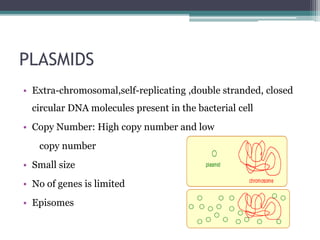
• Extra-chromosomal,self-replicating ,double stranded, closed
circular DNA molecules present in the bacterial cell
• Copy Number: High copy number and low
copy number
• Small size
• No of genes is limited
• Episomes
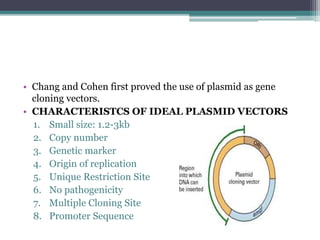
• Chang and Cohen first proved the use of plasmid as gene
cloning vectors.
• CHARACTERISTCS OF IDEAL PLASMID VECTORS
1. Small size: 1.2-3kb
2. Copy number
3. Genetic marker
4. Origin of replication
5. Unique Restriction Site
6. No pathogenicity
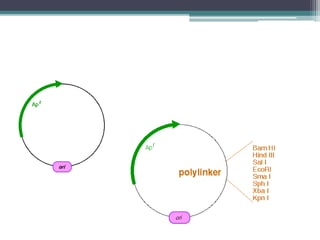
7. Multiple Cloning Site
8. Promoter Sequence
NATURAL AND ARTIFICIAL PLAMIDS
• Plasmids isolated from bacteria&directly used for gene
cloning without any modification :-Natural Plasmid
• But not used in gene cloning due to large size,confer
pathogenicity etc
• Artificial/derived plasmids constructed by cutting out
unwanted portions from wild type plasmids.Eg:pBR322
• These are of much use in gene transfer
ADVANTAGES AND DISADVANTAGES
• ADVANTAGES:
1. Readily isolated from cells
2. Can be reintroduced into a bacterial cell
3. Possess a single restriction site for 1 or more restriction enzyme
4. MCS
5. Introduction of a linear molecule does not alter its replication
• DISADVANTAGES
1. Cannot accept large fragments
LAMBDA PHAGE VECTORS
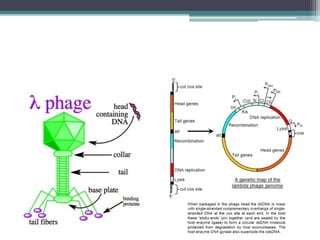
• Lambda phage is a bacterial virus that infects E.coli.
• Consists of an icosahedral head and flexible tail.
• Phage DNA packed inside the head
• Lambda DNA is a linear DNA duplex with cohesive single strand
extensions
• The single stranded extensions of the DNA are COMPLEMENTARY
to each other and consists of 12 nucleotides:: Cos Sites
• Free end of the cos site has a 5’ phosphate group
• Lambda Phage DNA can carry large DNA fragments and integrate
into host chromosome
• Wild type Lambda DNA can carry only small fragments;The
unwanted seq are cut out:- CONSTRUCTED LAMBDA DNA
VECTOR
• It is of 2 types:
1. Insertion Vectors- 1 restriction site;fragments upto 18kb
2. Replacement Vectors-2 restriction sites;Removal of stuffer seq
ADVANTAGES & DISADVANTAGES
• ADVANTAGES
1. Large DNA fragments upto 23kb can be carried
2. Efficiency of gene transfer is high
• DISADVANTAGES
1. Rec.DNA may enter lytic cycle
2. Lambda phage has narrow host range
M13 BACTERIOPHAGE VECTOR
• A single stranded DNA contaning phage virus;Can infect F+
cells
• Consists of about 6402 b.p
• The Intergenic Seq (IS) of M13 modified so as to introduce
additional restriction site
• The gene LacZ is integrated and then introduced into the IS to
get M13 Vector
HYBRID VECTORS:
Cosmids and Phagemids
COSMIDS
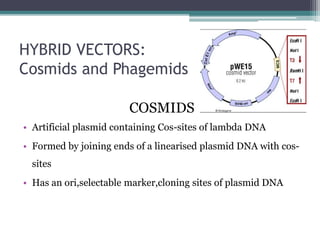
• Artificial plasmid containing Cos-sites of lambda DNA
• Formed by joining ends of a linearised plasmid DNA with cos-
sites
• Has an ori,selectable marker,cloning sites of plasmid DNA
Features fo COSMID
• Circular,ds DNA
• 2 complementary ss regions- cos sites
• Cosmid DNA does not code for phage protein and host cell
lysis
• Does not involve in multiplication of phage particles
• Has an ori from plasmid- for independent repl.
• Has selectable marker gene & gene cloning site of plasmid
DNA
ADVANTAGES AND DISADVANTAGES
• ADVANTAGES
1. Large DNA fragments
2. Used to establish gene libraries of lower &higher organisms
3. Gene cloning through cosmid helps in the study of non-
sense seq in the genome of organism
• DISADVANTAGES
1. The packaging enzyme fails to pack rec cosmid into phage
heads if 1 of cos-sites is missing;
PHAGEMIDS
• A.k.a Phasmids
• A hybrid vector that has origin of repl from a a plasmid and a
lambda phage DNA
• It is constructed by inserting a linearised plasmid DNA into a
cleaved lambda DNA
ADVANTAGES
• PHAGEMIDS can be maintained as plamids or phage
particles in E.coli
• The desired gene can be integrated into chromosomal DNA of
E.coli using phagemids
• Plasmid portion can be released free from a phagemid after
rec.phagemid is introduced into an E.coli Strain
• The phages having rec.phagemids can be stored easily for a
long time
ARTIFICIAL CHROMOSOMES
• YEAST ARTIFICIAL CHROMOSOME(YAC)
• Purpose:
• Cloning vehicles that propogate in eukaryotic cell hosts as
eukaryotic Chromosomes
• Clone very large inserts of DNA: 100 kb - 10 Mb
• Features:
YAC cloning vehicles are plasmids
Final chimeric DNA is a linear DNA molecule with telomeric ends:
Artificial Chromosome
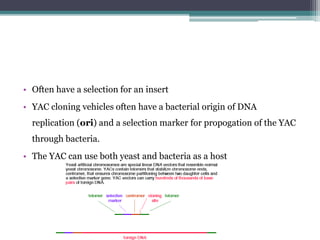
• Often have a selection for an insert
• YAC cloning vehicles often have a bacterial origin of DNA
replication (ori) and a selection marker for propogation of the YAC
through bacteria.
• The YAC can use both yeast and bacteria as a host
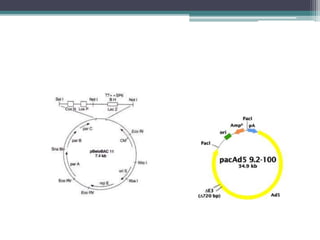
BAC AND PAC
• BACs - Bacterial Artificial
Chromosomes
• These chimeric DNA
molecules use a naturally-
occurring low-copy number
bacterial plasmid origin of
replication, such as that of F-
plasmid in E. coli.
• Can be cloned as a plasmid in
a bacterial host, and its natural
stability generally permits
cloning of large pieces of insert
DNA, i.e. up to a few hundred
kb of DNA.
• PACs - P1-derived Artificial
Chromosomes
• E. coli bacteriophage P1 is
similar to phage lambda in that
it can exist in E. coli in a
prophage state.
• Exists in the E. coli cell as a
plasmid, NOT integrated into
the E. coli chromosome.
• P1 cloning vehicles have
been constructed that permit
cloning of large DNA
fragments- few hundred kb of
DNA
• Cloning and propogation of the
chimeric DNA as a P1 plasmid
inside E. coli cells
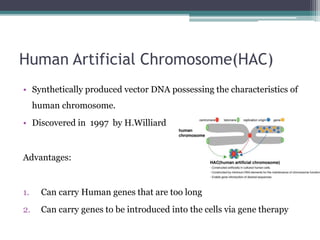
Human Artificial Chromosome(HAC)
• Synthetically produced vector DNA possessing the characteristics of
human chromosome.
• Discovered in 1997 by H.Williard
Advantages:
1. Can carry Human genes that are too long
2. Can carry genes to be introduced into the cells via gene therapy
Other types
• Expression vectors
• Shuttle vectors
• Integration Vectors
• Transposons,Retroviruses,Adenoviruses,Baculo
viruses
CONCLUSION
• There are different types of cloning vectors used in Genetic
Engineering
• These include: Plasmids, Phages,Hybrid Vectors and Artificial
Chromosome
• The best vector is chosen for use according to the purpose of
use and according to how large/short the DNA fragment to be
carried is
REFERENCES
1. Kumaresan.V. Bitotechnology.2001.Saras Publications
2. Rastogi.S.C. Biotechnology:Principles and Applications.
Narosa Publishing House
3. Sasidhara.R. Animal Biotechnology.MJP Publications
4. Satyanarayana.U. Biotechnology . Books and Allied (P)Ltd.
5. http://en.wikipedia.org
Molecular cloning vectors

Molecular cloning vectors

  • 1.
    MOLECULAR CLONING VECTORS PresentedBy, Sonia John II M.Sc Zoology
  • 2.
    CLONING VECTORS • DNAmolecules that can carry a foreign DNA fragment when inserted into it • Share four common properties: 1. Ability to promote autonomous replication. 2. Contain a genetic marker (usually dominant) for selection. 3. Unique restriction sites to facilitate cloning of insert DNA. 4. Minimum amount of nonessential DNA to optimize cloning.
  • 3.
    DIFFERENT TYPES • PLASMIDS •PHAGES • HYBRID VECTORS • ARTIFICIAL CHROMOSOMES
  • 4.
    PLASMIDS • Extra-chromosomal,self-replicating ,doublestranded, closed circular DNA molecules present in the bacterial cell • Copy Number: High copy number and low copy number • Small size • No of genes is limited • Episomes
  • 5.
    • Chang andCohen first proved the use of plasmid as gene cloning vectors. • CHARACTERISTCS OF IDEAL PLASMID VECTORS 1. Small size: 1.2-3kb 2. Copy number 3. Genetic marker 4. Origin of replication 5. Unique Restriction Site 6. No pathogenicity 7. Multiple Cloning Site 8. Promoter Sequence
  • 7.
    NATURAL AND ARTIFICIALPLAMIDS • Plasmids isolated from bacteria&directly used for gene cloning without any modification :-Natural Plasmid • But not used in gene cloning due to large size,confer pathogenicity etc • Artificial/derived plasmids constructed by cutting out unwanted portions from wild type plasmids.Eg:pBR322 • These are of much use in gene transfer
  • 8.
    ADVANTAGES AND DISADVANTAGES •ADVANTAGES: 1. Readily isolated from cells 2. Can be reintroduced into a bacterial cell 3. Possess a single restriction site for 1 or more restriction enzyme 4. MCS 5. Introduction of a linear molecule does not alter its replication • DISADVANTAGES 1. Cannot accept large fragments
  • 9.
    LAMBDA PHAGE VECTORS •Lambda phage is a bacterial virus that infects E.coli. • Consists of an icosahedral head and flexible tail. • Phage DNA packed inside the head • Lambda DNA is a linear DNA duplex with cohesive single strand extensions • The single stranded extensions of the DNA are COMPLEMENTARY to each other and consists of 12 nucleotides:: Cos Sites • Free end of the cos site has a 5’ phosphate group
  • 11.
    • Lambda PhageDNA can carry large DNA fragments and integrate into host chromosome • Wild type Lambda DNA can carry only small fragments;The unwanted seq are cut out:- CONSTRUCTED LAMBDA DNA VECTOR • It is of 2 types: 1. Insertion Vectors- 1 restriction site;fragments upto 18kb 2. Replacement Vectors-2 restriction sites;Removal of stuffer seq
  • 12.
    ADVANTAGES & DISADVANTAGES •ADVANTAGES 1. Large DNA fragments upto 23kb can be carried 2. Efficiency of gene transfer is high • DISADVANTAGES 1. Rec.DNA may enter lytic cycle 2. Lambda phage has narrow host range
  • 13.
    M13 BACTERIOPHAGE VECTOR •A single stranded DNA contaning phage virus;Can infect F+ cells • Consists of about 6402 b.p • The Intergenic Seq (IS) of M13 modified so as to introduce additional restriction site • The gene LacZ is integrated and then introduced into the IS to get M13 Vector
  • 14.
    HYBRID VECTORS: Cosmids andPhagemids COSMIDS • Artificial plasmid containing Cos-sites of lambda DNA • Formed by joining ends of a linearised plasmid DNA with cos- sites • Has an ori,selectable marker,cloning sites of plasmid DNA
  • 15.
    Features fo COSMID •Circular,ds DNA • 2 complementary ss regions- cos sites • Cosmid DNA does not code for phage protein and host cell lysis • Does not involve in multiplication of phage particles • Has an ori from plasmid- for independent repl. • Has selectable marker gene & gene cloning site of plasmid DNA
  • 16.
    ADVANTAGES AND DISADVANTAGES •ADVANTAGES 1. Large DNA fragments 2. Used to establish gene libraries of lower &higher organisms 3. Gene cloning through cosmid helps in the study of non- sense seq in the genome of organism • DISADVANTAGES 1. The packaging enzyme fails to pack rec cosmid into phage heads if 1 of cos-sites is missing;
  • 17.
    PHAGEMIDS • A.k.a Phasmids •A hybrid vector that has origin of repl from a a plasmid and a lambda phage DNA • It is constructed by inserting a linearised plasmid DNA into a cleaved lambda DNA
  • 18.
    ADVANTAGES • PHAGEMIDS canbe maintained as plamids or phage particles in E.coli • The desired gene can be integrated into chromosomal DNA of E.coli using phagemids • Plasmid portion can be released free from a phagemid after rec.phagemid is introduced into an E.coli Strain • The phages having rec.phagemids can be stored easily for a long time
  • 19.
    ARTIFICIAL CHROMOSOMES • YEASTARTIFICIAL CHROMOSOME(YAC) • Purpose: • Cloning vehicles that propogate in eukaryotic cell hosts as eukaryotic Chromosomes • Clone very large inserts of DNA: 100 kb - 10 Mb • Features: YAC cloning vehicles are plasmids Final chimeric DNA is a linear DNA molecule with telomeric ends: Artificial Chromosome
  • 20.
    • Often havea selection for an insert • YAC cloning vehicles often have a bacterial origin of DNA replication (ori) and a selection marker for propogation of the YAC through bacteria. • The YAC can use both yeast and bacteria as a host
  • 21.
    BAC AND PAC •BACs - Bacterial Artificial Chromosomes • These chimeric DNA molecules use a naturally- occurring low-copy number bacterial plasmid origin of replication, such as that of F- plasmid in E. coli. • Can be cloned as a plasmid in a bacterial host, and its natural stability generally permits cloning of large pieces of insert DNA, i.e. up to a few hundred kb of DNA. • PACs - P1-derived Artificial Chromosomes • E. coli bacteriophage P1 is similar to phage lambda in that it can exist in E. coli in a prophage state. • Exists in the E. coli cell as a plasmid, NOT integrated into the E. coli chromosome. • P1 cloning vehicles have been constructed that permit cloning of large DNA fragments- few hundred kb of DNA • Cloning and propogation of the chimeric DNA as a P1 plasmid inside E. coli cells
  • 23.
    Human Artificial Chromosome(HAC) •Synthetically produced vector DNA possessing the characteristics of human chromosome. • Discovered in 1997 by H.Williard Advantages: 1. Can carry Human genes that are too long 2. Can carry genes to be introduced into the cells via gene therapy
  • 24.
    Other types • Expressionvectors • Shuttle vectors • Integration Vectors • Transposons,Retroviruses,Adenoviruses,Baculo viruses
  • 25.
    CONCLUSION • There aredifferent types of cloning vectors used in Genetic Engineering • These include: Plasmids, Phages,Hybrid Vectors and Artificial Chromosome • The best vector is chosen for use according to the purpose of use and according to how large/short the DNA fragment to be carried is
  • 26.
    REFERENCES 1. Kumaresan.V. Bitotechnology.2001.SarasPublications 2. Rastogi.S.C. Biotechnology:Principles and Applications. Narosa Publishing House 3. Sasidhara.R. Animal Biotechnology.MJP Publications 4. Satyanarayana.U. Biotechnology . Books and Allied (P)Ltd. 5. http://en.wikipedia.org