b.stev Microbial Biomass in Soil
What is  MICROBIAL   BIOMASS ?
SOIL BIOTA IS INFLUENCED BY: HOW  the land is used Management  techniques CHANGE  of the practises this has effect to the microbial process  & their functions of survival in the soil
RESIDUE  left after  CROPS  are harvested is  nutrient   to soil &  facilitates  the next crop growth .
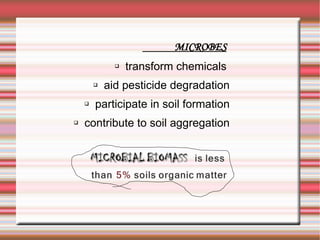
MICROBES   transform chemicals  aid pesticide degradation participate in soil formation contribute to soil aggregation
The limits of measurement: analytical cost involved ambiguous relationship to product benchmark values/ interpretation requires time to establish results cumbersome/ time needs
DEMAND HAS INCREASED: can monitor soil quality an environmental monitor rapid/ improved techniques gives the rates of turnover ANALYSIS for  clean  food
HOW is this DONE? Extraction of soil is done with a hollow rod to a depth of 10-15 cm Samples are filtered to remove:  stones/ roots/ finer fibres: size 2mm Storage is at 4 o C SAMPLES are taken in squares at appropriate spacings to ensure  all land variations are included;  it is quite an extensive process
20g soil are fumigated for a period of 24hrs with CHLOROFORM (CHCl 3 ) in a humid dessicator THEN: sample is inoculated with 0.5g fresh soil & placed in 1L airtight jars incubated 10 days at room temperature Controls  - 20.5g samples are put  in glass jars at time of fumigation are put to incubation : 10 days method :  chloroform fumigation, incubation  analyses the concentrations: carbon & nitrogen
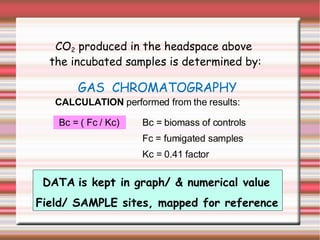
CO 2  produced in the headspace above  the incubated samples is determined by: GAS  CHROMATOGRAPHY Bc = ( Fc / Kc) CALCULATION  performed from the results: Kc = 0.41 factor Bc = biomass of controls Fc = fumigated samples DATA   is kept in graph/ & numerical value Field/ SAMPLE sites, mapped for reference
Manufacturer, “ Heinemeyer ”-  produced an instrument that  determines microbial biomass by  INFRARED ANALYSER Soil pH -  potentiometric   0.01M CaCl 2   suspension H 2 O content: samples -  oven dried  105 o C 24hr CNS-2000   analysis  uses dry combustion to measure both the carbon & nitrogen content SOME OTHER METHODS & analysis to perform ARE:
Bibliography Archbold Biological Station. (2008).  Soil microbial biomass . Retrieved  September 26, 2008, from  http://www.archbold-station.org/abs /publicationPDF/Groffman,etal.-2004-Ecosystems.pdf. Soil Quality Pty Ltd. (2007).  Soil quality . Retrieved September 25, 2008, from http://www.soilquality.org.au/factsheets/microbial-biomass Rothamsted Research. (2004).  Method download - soil microbial biomass group - rothamsted . Retrieved September 26, 2008, from  http://www.rothamsted. ac.uk/aen/smbweb1/methods.php?id=903

Microbial Biomass in Soil

  • 1.
  • 2.
    What is MICROBIAL BIOMASS ?
  • 3.
    SOIL BIOTA ISINFLUENCED BY: HOW the land is used Management techniques CHANGE of the practises this has effect to the microbial process & their functions of survival in the soil
  • 4.
    RESIDUE leftafter CROPS are harvested is nutrient to soil & facilitates the next crop growth .
  • 5.
    MICROBES transform chemicals aid pesticide degradation participate in soil formation contribute to soil aggregation
  • 6.
    The limits ofmeasurement: analytical cost involved ambiguous relationship to product benchmark values/ interpretation requires time to establish results cumbersome/ time needs
  • 7.
    DEMAND HAS INCREASED:can monitor soil quality an environmental monitor rapid/ improved techniques gives the rates of turnover ANALYSIS for clean food
  • 8.
    HOW is thisDONE? Extraction of soil is done with a hollow rod to a depth of 10-15 cm Samples are filtered to remove: stones/ roots/ finer fibres: size 2mm Storage is at 4 o C SAMPLES are taken in squares at appropriate spacings to ensure all land variations are included; it is quite an extensive process
  • 9.
    20g soil arefumigated for a period of 24hrs with CHLOROFORM (CHCl 3 ) in a humid dessicator THEN: sample is inoculated with 0.5g fresh soil & placed in 1L airtight jars incubated 10 days at room temperature Controls - 20.5g samples are put in glass jars at time of fumigation are put to incubation : 10 days method : chloroform fumigation, incubation analyses the concentrations: carbon & nitrogen
  • 10.
    CO 2 produced in the headspace above the incubated samples is determined by: GAS CHROMATOGRAPHY Bc = ( Fc / Kc) CALCULATION performed from the results: Kc = 0.41 factor Bc = biomass of controls Fc = fumigated samples DATA is kept in graph/ & numerical value Field/ SAMPLE sites, mapped for reference
  • 11.
    Manufacturer, “ Heinemeyer”- produced an instrument that determines microbial biomass by INFRARED ANALYSER Soil pH - potentiometric 0.01M CaCl 2 suspension H 2 O content: samples - oven dried 105 o C 24hr CNS-2000 analysis uses dry combustion to measure both the carbon & nitrogen content SOME OTHER METHODS & analysis to perform ARE:
  • 12.
    Bibliography Archbold BiologicalStation. (2008). Soil microbial biomass . Retrieved September 26, 2008, from http://www.archbold-station.org/abs /publicationPDF/Groffman,etal.-2004-Ecosystems.pdf. Soil Quality Pty Ltd. (2007). Soil quality . Retrieved September 25, 2008, from http://www.soilquality.org.au/factsheets/microbial-biomass Rothamsted Research. (2004). Method download - soil microbial biomass group - rothamsted . Retrieved September 26, 2008, from http://www.rothamsted. ac.uk/aen/smbweb1/methods.php?id=903