Cloning and Expression systems in
Yeast
Submitted by
Ranjitha H B
P-2082
BTY
Why To Use Yeast Vectors?
• Yeast are eukaryotes, contain complex internal cell structures
• Post-translational modifications
• easy to manipulate as E. coli
• absence of pyrogenic toxins
• cell growth is faster, easier
• less expensive than other eukaryotic cells
• Higher expression levels
• a well-defined genetic system
• highly versatile DNA transformation system
• yeast-specific origin of replication (ORI) and a means of selection in
yeast cells, in addition to the bacterial ORI and antibiotic selection
markers
• All contain unique target sites for a number of restriction endonucleases
• can all replicate in E. coli, often at high copy number
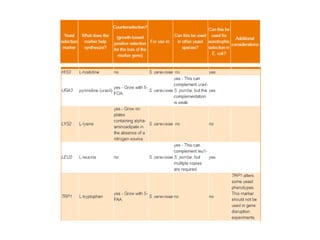
• The four most widely used markers are His3, Leu2, Trp1, and Ura3.
Introducing DNA into fungi
• use of spheroplasts (i.e. wall-less cells) and was first developed for S.
cerevisiae (Hinnen et al., 1978)
• cell wall is removed enzymically & resulting spheroplasts are fused with
ethylene glycol in the presence of DNA and CaCl2
• spheroplasts are then allowed to generate new cell walls in a stabilizing
medium containing 3% agar
• Electroporation provides a simpler & more convenient
• DNA can also be introduced into yeasts & filamentous fungi by conjugation
• Types of Yeast plasmid vector
 Yeast Integrating plasmids (YIp)
 yeast episomal plasmids (YEps)
 yeast replicating plasmids (YRps)
 Yeast centromere plasmids (Ycps)
 yeast artificial chromosomes (YACs)
Yeast Integrating plasmids (YIp):
• lack an ORI and must be integrated directly
into the host chromosome via homologous
recombination for efficient multiplication
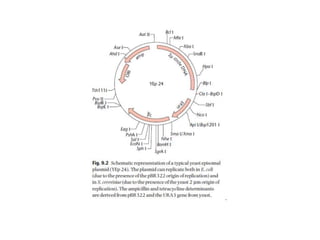
 Yeast Episomal plasmids (YEp):
• Beggs (1978)
• recombining an E. coli cloning vector with the naturally
occurring yeast 2 μm plasmid
• 6.3 kb in size
• High copy number of 50–100 per cell
 Yeast Replicating plasmids (YRp):
• contain an Autonomously Replicating Sequence (ARS)
derived from the yeast chromosome.
• can replicate independently of the yeast chromosome
• unstable and may be lost during budding
Yeast centromere plasmids
• carry an ars, most of the recombinants were unstable in yeast
• plasmid-borne centromere sequences have the same distinctive
chromatin structure that occurs in the centromere region of yeast
chromosomes (Bloom & Carbon 1982)
• Three characteristics
• Mitotically stable in the absence of selective pressure
• Segregate during meiosis in a Mendelian manner
• found at low copy number in the host cell
Yeast artificial chromosomes
• All autonomous plasmid vectors described above are
maintained in yeast as circular DNA molecules, even the YCp
vectors, which possess yeast centromeres
• Thus, none of these vectors resembles the normal yeast
chromosomes, which have a linear structure
• DNA insert size- 500 kbp
• The ends of all yeast chromosomes, like those of all
other linear eukaryotic chromosomes, have unique
structures that are called telomeres
 Yeast autonomously replicating sequence (ARS1)
• Struhl et al. (1979)
• carry sequences that enable E. coli vectors to replicate in yeast cells
• sequences are known as ars autonomously replicating sequences
• An ars is quite different from a centromere
• ars acts as an origin of replication , Centromer is involved in chromosome
segregation
 Yeast telomeres (TEL)
• Telomeres are the specific sequences (5-TGTGGGTGTGGTG-3), present at ends of
chromosomes in multiple copies, necessary for replication & chromosome
maintenance.
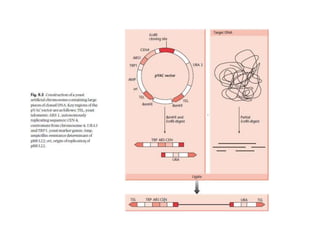
 Genes for YAC selection in yeast
• URA3, a gene involved in uracil biosynthesis
• TRP1, a gene involved in tryptophan biosynthesis
• Auxotrophic method of selection
 Bacterial replication origin & a bacterial selectable marker
• To propagate the YAC vector in bacterial cells, prior to insertion of
genomic
• DNA, YAC vectors usually contain the ColE1 ori and the ampicillin
• resistance gene for growth and analysis in E. coli.
• Three main species of yeast
 Saccharomyces cerevisiae
 Pichia pastoris
 Schizosaccharomyces pombe
Saccharomyces cerevisiae
• Baker’s yeast
• Single-celled eukaryote
• Grows rapidly (a doubling time of approximately 90 min)
• Simple, defined media
• Many, but not all, of the post-translation modifications
• Strong constitutive promoters
 Promoters of phosphoglycerate kinase (PGK), glyceraldehyde-
3-phosphate dehydrogenase (GPD) and alcohol
dehydrogenase (ADH1)
• Suffer similar problems as constitutive E. coli expression
systems
• Inducible production
 The GAL System
 The CUP1 System
(Cereghino and Cregg, 1999)
The GAL System
• Galactose is converted to glucose-6-phosphate by enzymes of
Leloir pathway
• Leloir pathway structural genes (GAL genes) are expressed at
a high level (0.5–1% of total cellular Mrna), galactose as sole
carbon source
• GAL genes promoter- sites for the transcriptional activator
Gal4p
(St John and Davis, 1981)
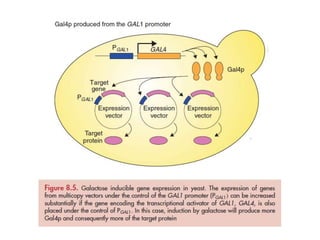
• Glucose as carbon source - less Gal4p
• Raffinose as carbon source - Gal4p is produced, binds to GAL
structure gene promoters, but a repressor, Gal80p, inhibits its
activity
• Gal80p binds to Gal4p, mask its activation domain
• Unable to recruit the transcriptional machinery
• Galactose- inhibitory effect of Gal80p
(Griggs and Johnston, 1991)
(Lue et al., 1987)
The CUP1 System
• Copper ions (Cu2+ and Cu+) are essential, toxic at high levels
• S. cerevisiae, copper homeostasis - uptake, distribution and
detoxification mechanisms
• At high concentrations, detoxification is mediated by a copper ion
sensing metalloregulatory transcription factor- Ace1p
• Upon interaction with copper, Ace1p binds DNA upstream of the
CUP1 gene, encodes a metallothionein protein & induces its
transcription
(Eide, 1998)
(Winge, 1998)
• Expression vectors harbouring CUP1 promoter- induce target
gene expression in a copper-dependent fashion
• Can be grown on rich carbon sources, such as glucose, to high
cell density & protein production is initiated by the addition of
copper sulphate (0.5 mM final concentration)
• Drawback-
 presence of copper ions in yeast growth media, and indeed in
water supplies
(Mascorrogallardo et al., 1996)
Pichia Pastoris
• Methylotrophic yeast,
• Metabolize methanol as carbon source
• Metabolism of methanol- oxidation of methanol to formaldehyde
using molecular oxygen (O2) by the enzyme alcohol oxidase
• Alcohol oxidase has a poor affinity for O2, compensates by
generating large amounts of enzyme
• Promoter regulating the production of alcohol oxidase (AOX1) can
be used to drive heterologous protein expression
(Koutz et al., 1989)
(Tschopp et al., 1987)
• P. pastoris cells containing the expression vector, integrated into
the genome as single or multiple copies
• Grow in glycerol (glucose represses AOX1 transcription, even in
presence of methanol) to extremely high cell density
• Induce target protein expression by addition of methanol
• 0.5 to tens of grams of protein per litre of yeast culture
• Expression of gene encoding recombinant hepatitis B surface
antigen- production of more than 1 g of the antigen from 1 L of P.
pastoris cells
(Hardy et al., 2000)
• P. pastoris may have an advantage in the glycosylation of
secreted proteins
• Glycoproteins generated in P. pastoris more closely resemble
the glycoprotein structure of those found in higher eukaryotes
(Cregg, Vedvick and Raschke, 1993)
Schizosaccharomyces pombe
• Properties similar to those found in higher-eukaryotic
organisms
• Chromosome structure and function, cell-cycle control, RNA
splicing and codon usage, ideal candidate for the production of
eukaryotic proteins (Giga-Hama and Kumagai, 1999)
• Folding properly, which may reduce protein insolubility
• Protein production controlled by the expression from the nmt1 (no
message in thiamine) promoter
• Active when the cells are grown in the absence of thiamine,
allowing downstream transcription of genes under its control, while
in the presence of greater than 0.5 μM thiamine, the promoter is
turned off
(Maundrell, 1993)
(Maundrell, 1990)
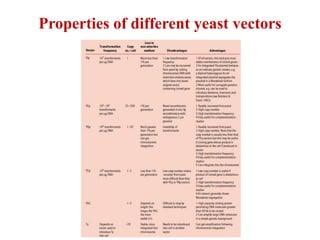
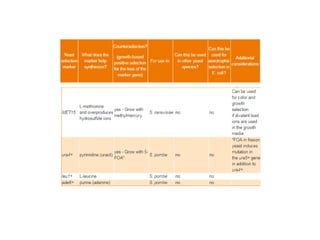
Properties of different yeast vectors
THANK YOU

cloning and expression system in yeast

  • 1.
    Cloning and Expressionsystems in Yeast Submitted by Ranjitha H B P-2082 BTY
  • 2.
    Why To UseYeast Vectors? • Yeast are eukaryotes, contain complex internal cell structures • Post-translational modifications • easy to manipulate as E. coli • absence of pyrogenic toxins • cell growth is faster, easier • less expensive than other eukaryotic cells • Higher expression levels • a well-defined genetic system
  • 3.
    • highly versatileDNA transformation system • yeast-specific origin of replication (ORI) and a means of selection in yeast cells, in addition to the bacterial ORI and antibiotic selection markers • All contain unique target sites for a number of restriction endonucleases • can all replicate in E. coli, often at high copy number • The four most widely used markers are His3, Leu2, Trp1, and Ura3.
  • 4.
    Introducing DNA intofungi • use of spheroplasts (i.e. wall-less cells) and was first developed for S. cerevisiae (Hinnen et al., 1978) • cell wall is removed enzymically & resulting spheroplasts are fused with ethylene glycol in the presence of DNA and CaCl2 • spheroplasts are then allowed to generate new cell walls in a stabilizing medium containing 3% agar • Electroporation provides a simpler & more convenient • DNA can also be introduced into yeasts & filamentous fungi by conjugation
  • 5.
    • Types ofYeast plasmid vector  Yeast Integrating plasmids (YIp)  yeast episomal plasmids (YEps)  yeast replicating plasmids (YRps)  Yeast centromere plasmids (Ycps)  yeast artificial chromosomes (YACs)
  • 6.
    Yeast Integrating plasmids(YIp): • lack an ORI and must be integrated directly into the host chromosome via homologous recombination for efficient multiplication
  • 7.
     Yeast Episomalplasmids (YEp): • Beggs (1978) • recombining an E. coli cloning vector with the naturally occurring yeast 2 μm plasmid • 6.3 kb in size • High copy number of 50–100 per cell
  • 9.
     Yeast Replicatingplasmids (YRp): • contain an Autonomously Replicating Sequence (ARS) derived from the yeast chromosome. • can replicate independently of the yeast chromosome • unstable and may be lost during budding
  • 10.
    Yeast centromere plasmids •carry an ars, most of the recombinants were unstable in yeast • plasmid-borne centromere sequences have the same distinctive chromatin structure that occurs in the centromere region of yeast chromosomes (Bloom & Carbon 1982) • Three characteristics • Mitotically stable in the absence of selective pressure • Segregate during meiosis in a Mendelian manner • found at low copy number in the host cell
  • 11.
    Yeast artificial chromosomes •All autonomous plasmid vectors described above are maintained in yeast as circular DNA molecules, even the YCp vectors, which possess yeast centromeres • Thus, none of these vectors resembles the normal yeast chromosomes, which have a linear structure
  • 12.
    • DNA insertsize- 500 kbp • The ends of all yeast chromosomes, like those of all other linear eukaryotic chromosomes, have unique structures that are called telomeres
  • 13.
     Yeast autonomouslyreplicating sequence (ARS1) • Struhl et al. (1979) • carry sequences that enable E. coli vectors to replicate in yeast cells • sequences are known as ars autonomously replicating sequences • An ars is quite different from a centromere • ars acts as an origin of replication , Centromer is involved in chromosome segregation  Yeast telomeres (TEL) • Telomeres are the specific sequences (5-TGTGGGTGTGGTG-3), present at ends of chromosomes in multiple copies, necessary for replication & chromosome maintenance.
  • 14.
     Genes forYAC selection in yeast • URA3, a gene involved in uracil biosynthesis • TRP1, a gene involved in tryptophan biosynthesis • Auxotrophic method of selection  Bacterial replication origin & a bacterial selectable marker • To propagate the YAC vector in bacterial cells, prior to insertion of genomic • DNA, YAC vectors usually contain the ColE1 ori and the ampicillin • resistance gene for growth and analysis in E. coli.
  • 16.
    • Three mainspecies of yeast  Saccharomyces cerevisiae  Pichia pastoris  Schizosaccharomyces pombe
  • 17.
    Saccharomyces cerevisiae • Baker’syeast • Single-celled eukaryote • Grows rapidly (a doubling time of approximately 90 min) • Simple, defined media • Many, but not all, of the post-translation modifications
  • 18.
    • Strong constitutivepromoters  Promoters of phosphoglycerate kinase (PGK), glyceraldehyde- 3-phosphate dehydrogenase (GPD) and alcohol dehydrogenase (ADH1) • Suffer similar problems as constitutive E. coli expression systems • Inducible production  The GAL System  The CUP1 System (Cereghino and Cregg, 1999)
  • 19.
    The GAL System •Galactose is converted to glucose-6-phosphate by enzymes of Leloir pathway • Leloir pathway structural genes (GAL genes) are expressed at a high level (0.5–1% of total cellular Mrna), galactose as sole carbon source • GAL genes promoter- sites for the transcriptional activator Gal4p (St John and Davis, 1981)
  • 20.
    • Glucose ascarbon source - less Gal4p • Raffinose as carbon source - Gal4p is produced, binds to GAL structure gene promoters, but a repressor, Gal80p, inhibits its activity • Gal80p binds to Gal4p, mask its activation domain • Unable to recruit the transcriptional machinery • Galactose- inhibitory effect of Gal80p (Griggs and Johnston, 1991) (Lue et al., 1987)
  • 22.
    The CUP1 System •Copper ions (Cu2+ and Cu+) are essential, toxic at high levels • S. cerevisiae, copper homeostasis - uptake, distribution and detoxification mechanisms • At high concentrations, detoxification is mediated by a copper ion sensing metalloregulatory transcription factor- Ace1p • Upon interaction with copper, Ace1p binds DNA upstream of the CUP1 gene, encodes a metallothionein protein & induces its transcription (Eide, 1998) (Winge, 1998)
  • 23.
    • Expression vectorsharbouring CUP1 promoter- induce target gene expression in a copper-dependent fashion • Can be grown on rich carbon sources, such as glucose, to high cell density & protein production is initiated by the addition of copper sulphate (0.5 mM final concentration) • Drawback-  presence of copper ions in yeast growth media, and indeed in water supplies (Mascorrogallardo et al., 1996)
  • 24.
    Pichia Pastoris • Methylotrophicyeast, • Metabolize methanol as carbon source • Metabolism of methanol- oxidation of methanol to formaldehyde using molecular oxygen (O2) by the enzyme alcohol oxidase • Alcohol oxidase has a poor affinity for O2, compensates by generating large amounts of enzyme • Promoter regulating the production of alcohol oxidase (AOX1) can be used to drive heterologous protein expression (Koutz et al., 1989) (Tschopp et al., 1987)
  • 25.
    • P. pastoriscells containing the expression vector, integrated into the genome as single or multiple copies • Grow in glycerol (glucose represses AOX1 transcription, even in presence of methanol) to extremely high cell density • Induce target protein expression by addition of methanol • 0.5 to tens of grams of protein per litre of yeast culture • Expression of gene encoding recombinant hepatitis B surface antigen- production of more than 1 g of the antigen from 1 L of P. pastoris cells (Hardy et al., 2000)
  • 26.
    • P. pastorismay have an advantage in the glycosylation of secreted proteins • Glycoproteins generated in P. pastoris more closely resemble the glycoprotein structure of those found in higher eukaryotes (Cregg, Vedvick and Raschke, 1993)
  • 27.
    Schizosaccharomyces pombe • Propertiessimilar to those found in higher-eukaryotic organisms • Chromosome structure and function, cell-cycle control, RNA splicing and codon usage, ideal candidate for the production of eukaryotic proteins (Giga-Hama and Kumagai, 1999) • Folding properly, which may reduce protein insolubility
  • 28.
    • Protein productioncontrolled by the expression from the nmt1 (no message in thiamine) promoter • Active when the cells are grown in the absence of thiamine, allowing downstream transcription of genes under its control, while in the presence of greater than 0.5 μM thiamine, the promoter is turned off (Maundrell, 1993) (Maundrell, 1990)
  • 29.
  • 32.