Forward and Reverse genetic
approaches
MBB:601 Advances in plant molecular biology 3+0
1
Presented by
Ekatpure Sachin Chandrakant
PhD research Scholar
Department of Plant Biotechnology
Introduction
• In molecular biology there are number of
techniques are available to understand the
function of the gene
• For identification of gene function there are
two methods used commonly
– Forward genetics (Classical genetics)
– Reverse genetics
2
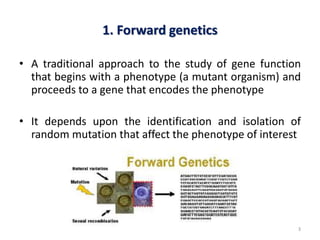
1. Forward genetics
• A traditional approach to the study of gene function
that begins with a phenotype (a mutant organism) and
proceeds to a gene that encodes the phenotype
• It depends upon the identification and isolation of
random mutation that affect the phenotype of interest
3
Forward genetics cont…
• Initially scientist are depends on the mutation that are occurs
naturally, but after the discovery of mutagenic agent increases the
rate of mutation
• First experimentally created mutation - using X rays - to induce X
linked mutation in Drosophila melanogaster- by H. J. Muller in
1927
• Two types of mutations were majorly used in the forward mutation
– A. Spontaneous mutation
– B. Creating random mutation
4
A. Spontaneous Mutation
• It arises spontaneously from natural changes in
DNA structure or from error in the replication
• i.e. mutation results from both internal and
external factors
• Where as the changes caused by the radiation or
environmental chemicals are called as induced
mutation
5
B. Creating random mutation
• It depends upon the identification and
isolation of random mutation that affect the
phenotype
• Radiation (X rays), chemical mutagen (EMS)
and transposable elements (insert within a
coding region and disrupt the amino acid
sequence ) are used to create the mutation
6
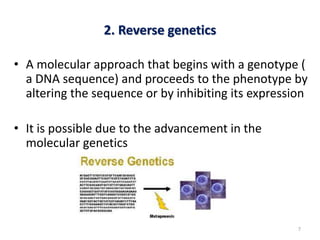
2. Reverse genetics
• A molecular approach that begins with a genotype (
a DNA sequence) and proceeds to the phenotype by
altering the sequence or by inhibiting its expression
• It is possible due to the advancement in the
molecular genetics
7
a) Large-scale random mutagenesis and screening
• Use forward mutagenesis (e.g. EMS), except
instead of screening for a particular phenotype,
screen your gene of interest for nucleotide
changes
• Typically requires that screen 1000’s or 10,000’s
of individuals
• This is done by performing PCR for gene of
interest and looking for slight differences in the
migration of the PCR product on a gel or column
8
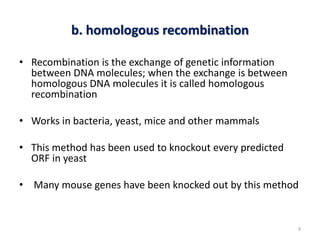
b. homologous recombination
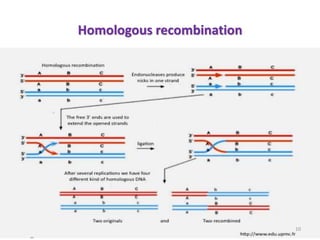
• Recombination is the exchange of genetic information
between DNA molecules; when the exchange is between
homologous DNA molecules it is called homologous
recombination
• Works in bacteria, yeast, mice and other mammals
• This method has been used to knockout every predicted
ORF in yeast
• Many mouse genes have been knocked out by this method
9
Homologous recombination
10
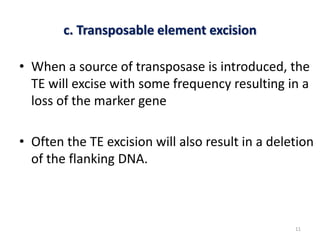
c. Transposable element excision
• When a source of transposase is introduced, the
TE will excise with some frequency resulting in a
loss of the marker gene
• Often the TE excision will also result in a deletion
of the flanking DNA.
11
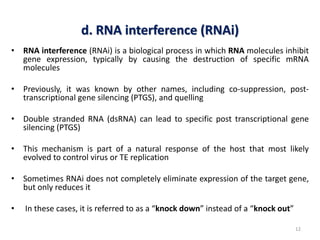
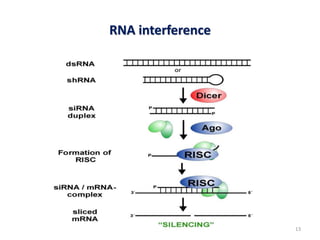
d. RNA interference (RNAi)
• RNA interference (RNAi) is a biological process in which RNA molecules inhibit
gene expression, typically by causing the destruction of specific mRNA
molecules
• Previously, it was known by other names, including co-suppression, post-
transcriptional gene silencing (PTGS), and quelling
• Double stranded RNA (dsRNA) can lead to specific post transcriptional gene
silencing (PTGS)
• This mechanism is part of a natural response of the host that most likely
evolved to control virus or TE replication
• Sometimes RNAi does not completely eliminate expression of the target gene,
but only reduces it
• In these cases, it is referred to as a “knock down” instead of a “knock out”
12
RNA interference
13
e. Genome editing
• Several methods have been developed to target mutations
to a specific location in the genome
• These can be used to knock-out target genes, make specific
point mutations in a target gene, or even insert new genes
or DNA sequences at a specific target site in the genome
• E.g.
– Zinc-finger nucleases (ZFNs)
– Transcription activator-like effector nucleases (TALENs)
– Clustered regularly interspaced short palindromic repeat
(CRISPR) and CRISPR associated (Cas) nucleases
14
f. Site-directed mutagenesis and transgenics
• Can make a specific nucleotide changes at an exact site
in gene of interest or in DNA
• Requires: Gene of interest cloned into plasmid, host
with null background (knockout)
• Mutagenesis is performed in vitro on the cloned gene in
a plasmid replicated in bacteria
• Then the mutated gene is inserted into the host genome
in a transposable element vector
15
16

Forward and reverse genetics

  • 1.
    Forward and Reversegenetic approaches MBB:601 Advances in plant molecular biology 3+0 1 Presented by Ekatpure Sachin Chandrakant PhD research Scholar Department of Plant Biotechnology
  • 2.
    Introduction • In molecularbiology there are number of techniques are available to understand the function of the gene • For identification of gene function there are two methods used commonly – Forward genetics (Classical genetics) – Reverse genetics 2
  • 3.
    1. Forward genetics •A traditional approach to the study of gene function that begins with a phenotype (a mutant organism) and proceeds to a gene that encodes the phenotype • It depends upon the identification and isolation of random mutation that affect the phenotype of interest 3
  • 4.
    Forward genetics cont… •Initially scientist are depends on the mutation that are occurs naturally, but after the discovery of mutagenic agent increases the rate of mutation • First experimentally created mutation - using X rays - to induce X linked mutation in Drosophila melanogaster- by H. J. Muller in 1927 • Two types of mutations were majorly used in the forward mutation – A. Spontaneous mutation – B. Creating random mutation 4
  • 5.
    A. Spontaneous Mutation •It arises spontaneously from natural changes in DNA structure or from error in the replication • i.e. mutation results from both internal and external factors • Where as the changes caused by the radiation or environmental chemicals are called as induced mutation 5
  • 6.
    B. Creating randommutation • It depends upon the identification and isolation of random mutation that affect the phenotype • Radiation (X rays), chemical mutagen (EMS) and transposable elements (insert within a coding region and disrupt the amino acid sequence ) are used to create the mutation 6
  • 7.
    2. Reverse genetics •A molecular approach that begins with a genotype ( a DNA sequence) and proceeds to the phenotype by altering the sequence or by inhibiting its expression • It is possible due to the advancement in the molecular genetics 7
  • 8.
    a) Large-scale randommutagenesis and screening • Use forward mutagenesis (e.g. EMS), except instead of screening for a particular phenotype, screen your gene of interest for nucleotide changes • Typically requires that screen 1000’s or 10,000’s of individuals • This is done by performing PCR for gene of interest and looking for slight differences in the migration of the PCR product on a gel or column 8
  • 9.
    b. homologous recombination •Recombination is the exchange of genetic information between DNA molecules; when the exchange is between homologous DNA molecules it is called homologous recombination • Works in bacteria, yeast, mice and other mammals • This method has been used to knockout every predicted ORF in yeast • Many mouse genes have been knocked out by this method 9
  • 10.
  • 11.
    c. Transposable elementexcision • When a source of transposase is introduced, the TE will excise with some frequency resulting in a loss of the marker gene • Often the TE excision will also result in a deletion of the flanking DNA. 11
  • 12.
    d. RNA interference(RNAi) • RNA interference (RNAi) is a biological process in which RNA molecules inhibit gene expression, typically by causing the destruction of specific mRNA molecules • Previously, it was known by other names, including co-suppression, post- transcriptional gene silencing (PTGS), and quelling • Double stranded RNA (dsRNA) can lead to specific post transcriptional gene silencing (PTGS) • This mechanism is part of a natural response of the host that most likely evolved to control virus or TE replication • Sometimes RNAi does not completely eliminate expression of the target gene, but only reduces it • In these cases, it is referred to as a “knock down” instead of a “knock out” 12
  • 13.
  • 14.
    e. Genome editing •Several methods have been developed to target mutations to a specific location in the genome • These can be used to knock-out target genes, make specific point mutations in a target gene, or even insert new genes or DNA sequences at a specific target site in the genome • E.g. – Zinc-finger nucleases (ZFNs) – Transcription activator-like effector nucleases (TALENs) – Clustered regularly interspaced short palindromic repeat (CRISPR) and CRISPR associated (Cas) nucleases 14
  • 15.
    f. Site-directed mutagenesisand transgenics • Can make a specific nucleotide changes at an exact site in gene of interest or in DNA • Requires: Gene of interest cloned into plasmid, host with null background (knockout) • Mutagenesis is performed in vitro on the cloned gene in a plasmid replicated in bacteria • Then the mutated gene is inserted into the host genome in a transposable element vector 15
  • 16.