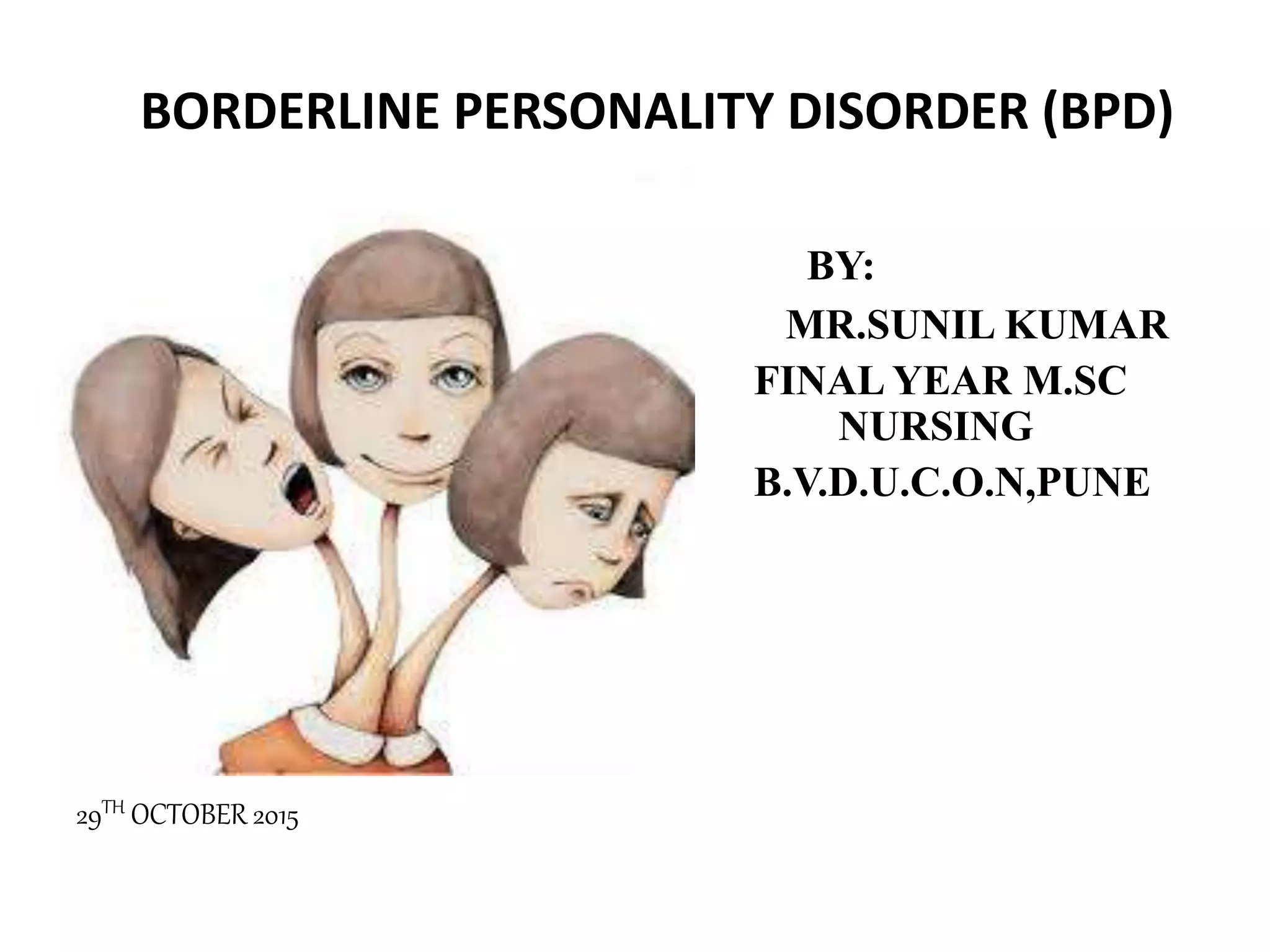
BORDERLINE PERSONALITY DISORDER (BPD)
BY:
MR.SUNIL KUMAR
FINAL YEAR M.SC
NURSING
B.V.D.U.C.O.N,PUNE
29TH OCTOBER 2015
INTRODUCTION
Before going on my topic I would like to ask you
one question “what do you mean by
personality?”
• Personality refers to individual
differences in characteristic patterns
of thinking, feeling and behaving.
• If there is any disturbance in maintaining
in your personality more than few weeks
than it leads to personality disorder.
PERSONALITY DISORDERS
• Personality disorders are conditions in
which an individual differs significantly
from an average person, in terms of how
they think, perceive, feel or relate to
others.
Changes in how a person feels and
distorted beliefs about other people can
lead to odd behaviour, which can be
distressing and may upset others.
INCIDENCE
• 5-15 % of adults have one or more
personality disorder
TYPES OF PERSONALITY
DISORDER
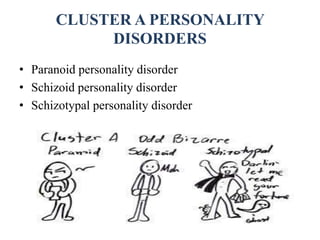
CLUSTER A PERSONALITY
DISORDERS
• Paranoid personality disorder
• Schizoid personality disorder
• Schizotypal personality disorder
Cluster B personality disorders
• Antisocial personality disorder
• Borderline personality disorder
• Histrionic personality disorder
• Narcissistic personality disorder
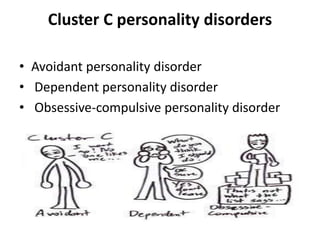
Cluster C personality disorders
• Avoidant personality disorder
• Dependent personality disorder
• Obsessive-compulsive personality disorder
DEFINITION
OF
BODERLINE PERSONALITY
DISORDER
(BPD)
Borderline personality disorder (BPD)
is a serious mental illness marked by
unstable moods, behaviour, and
relationships.
CAUSES OF BODERLINE PERSONALITY
DISRDERS:
• Genetic
• Traumatic childhood
• Vulnerable temperament
• Stressful maturational events in
adolescence and childhood
• Childhood abuse or trauma or neglect
CAUSES Contn:
• Abuse (emotional, sexual, physical) by
the care takers
• Chronic stress
• Unresolved life events
• Over involvement and under involvement
of parents
• Defective family environment
CAUSE contn…
• Alteration in level of neurotransmitters,
e.g. serotonin, acetylcholine, GABA and
norepinephrine
• Affective disorders
• Substance abuse disorder
• Post-traumatic stress disorder
SYMPTOMS
• You feel very worried about people
abandoning you, and would do anything
to stop that happening.
• You have very intense emotions that last
from a few hours to a few days and can
change quickly (for example, from
feeling very happy and confident in the
morning to feeling low and sad in the
afternoon).
• You don't have a strong sense of who
you are, and it can change depending on
who you're with.
• You find it very hard to make and keep
stable relationships.
• You act impulsively and do things that
could harm you (such as binge eating,
unsafe sex, using drugs or driving
dangerously).
• You have suicidal thoughts or self-
harming behaviour such as cutting.
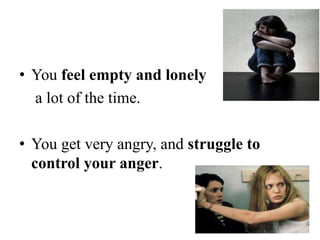
• You feel empty and lonely
a lot of the time.
• You get very angry, and struggle to
control your anger.
• When very stressed, sometimes
you might:
–feel paranoid
–have psychotic experiences, such as
seeing or hearing things other people
don't
–Feel numb or 'checked out' and not
remember things properly after they've
happened.
DIAGNOSIS
• Self- reported experiences of the client
• A comprehensive personal and family history
• A physical examination
• Blood test to exclude HIV or Syphilis
• EEG, CT scan to exclude epilepsy and brain
lesions
• Mental state examination
To be diagnosed with BPD, a person
must experience at least five of the
following symptoms:
• Fear of abandonment
• Unstable or changing relationships
• Unstable self-image; struggles with
identity or sense of self
• Impulsive or self-damaging behaviours
(e.g., excessive spending, unsafe sex,
substance abuse, reckless driving, binge
eating).
• Suicidal behaviour or self-injury
• Varied or random mood swings
• Constant feelings of worthlessness or
sadness
• Problems with anger, including frequent
loss of temper or physical fights
• Stress-related paranoia or loss of contact
with reality
TREATMENT
1.Counselling and therapy
2.Medications
DIALECTICAL BEHAVIOUR
THERAPY (DBT)
• Dialectical behaviour therapy (DBT).
This type of therapy focuses on the
concept of mindfulness, or being
aware of and attentive to the current
situation.
• DBT teaches skills to control intense
emotions, reduces self-destructive
behaviours, and improves relationships.
This therapy differs from CBT in that it
seeks a balance between changing and
accepting beliefs and behaviours.
• Individual, Family and marital
counselling may be require according
to needs.
MEDICINE
• Typical antipsychotics :- Haloperidol
• Atypical antipsychotic:- Aripiprazole,
• Mood stabilizers:- valproate sodium,
• antidepressants:- Amitriptyline
• . Omega-3 fatty acid
HEALTHY HABITS
• Such as getting enough sleep, eating healthy
foods, getting regular exercise, and avoiding
alcohol and drugs. These habits can help
reduce stress and anxiety. And they can help
make your symptoms less severe and less
frequent.
NURSING MANAGEMENT
• Place the client near to the nurses’ station
• Have a keen insight into client’s
behaviour in all the means, e.g.
communication, performing activities
• If the client is developing destructive
behavioural tendency, observe
closely, never allow the client to keep
potentially dangerous objects like
knife, blade, etc.
• Based on client’s need one-to-one
relationship has to be maintained.
• Identify the stressors which promote
undesirable behaviour of the client, try to
avoid them
• Remove sharp and dangerous objects in
the client’s environment
• Encourage the client to interact and share
his past experiences, review the events,
explore the feelings related to these
episodes
• Allow the client to participate in small
group discussions, where he can
exchange his feelings.
• Set clear and realistic goals for client
activities.
• Set limitations for client’s inappropriate
behaviour like destructive behaviour .e.g
.mutilation behaviour, fears related
leaving alone or verbal or physical
threats.
• Rotate the staff for client’s care, so that
he will not develop any dependency.
• Motivate the client to establish and
maintain effective communication skills
and relationship with significant members
• Avoid labelling the client by his
activities.
• Never show sympathy or empathy to the
client’s humiliation attitude or activities.
• Give positive reinforcement for client’s
appropriate behaviour.
• Promote consistency.
• A written contract has to be established
for acceptable and appropriate behaviour.
• Encourage the client to participate
actively in assertiveness techniques,
problem solving techniques.
• Never do argument or criticism for
client’s activities
CONCLUSION
• So, today we have deal with bipolar
personality disorder. And it’s our
responsibility as a nurse to identify the
patients and give proper care,
counselling, and support to cope up with
the life situations
REFERENCES
• Neeraja KP.Essentials of Mental Health and Psychiatric
Nursing .New Delhi.Jaypee Brothers Medical
Publishers.2011.p.454
• http://www.nimh.nih.gov/health/topics/borderline-personality-
disorder/index.shtml#part_145390
• http://www.mind.org.uk/information-support/types-of-mental-
health-problems/borderline-personality-disorder-
bpd/#.Vio9bvkrLIU
• https://en.wikipedia.org/wiki/Borderline_personality_disorder
• http://www.borderlinepersonalitydisorder.com/what-is-
bpd/bpd-overview/
• http://www.webmd.com/mental-health/tc/borderline-
personality-disorder-topic-overview
THANK YOU

BODERLINE PERSONALITY DISORDER

  • 1.
    BORDERLINE PERSONALITY DISORDER(BPD) BY: MR.SUNIL KUMAR FINAL YEAR M.SC NURSING B.V.D.U.C.O.N,PUNE 29TH OCTOBER 2015
  • 2.
    INTRODUCTION Before going onmy topic I would like to ask you one question “what do you mean by personality?”
  • 3.
    • Personality refersto individual differences in characteristic patterns of thinking, feeling and behaving.
  • 4.
    • If thereis any disturbance in maintaining in your personality more than few weeks than it leads to personality disorder.
  • 5.
    PERSONALITY DISORDERS • Personalitydisorders are conditions in which an individual differs significantly from an average person, in terms of how they think, perceive, feel or relate to others.
  • 6.
    Changes in howa person feels and distorted beliefs about other people can lead to odd behaviour, which can be distressing and may upset others.
  • 7.
    INCIDENCE • 5-15 %of adults have one or more personality disorder
  • 8.
  • 9.
    CLUSTER A PERSONALITY DISORDERS •Paranoid personality disorder • Schizoid personality disorder • Schizotypal personality disorder
  • 10.
    Cluster B personalitydisorders • Antisocial personality disorder • Borderline personality disorder • Histrionic personality disorder • Narcissistic personality disorder
  • 11.
    Cluster C personalitydisorders • Avoidant personality disorder • Dependent personality disorder • Obsessive-compulsive personality disorder
  • 12.
  • 13.
    Borderline personality disorder(BPD) is a serious mental illness marked by unstable moods, behaviour, and relationships.
  • 14.
    CAUSES OF BODERLINEPERSONALITY DISRDERS: • Genetic • Traumatic childhood • Vulnerable temperament • Stressful maturational events in adolescence and childhood • Childhood abuse or trauma or neglect
  • 15.
    CAUSES Contn: • Abuse(emotional, sexual, physical) by the care takers • Chronic stress • Unresolved life events • Over involvement and under involvement of parents • Defective family environment
  • 16.
    CAUSE contn… • Alterationin level of neurotransmitters, e.g. serotonin, acetylcholine, GABA and norepinephrine • Affective disorders • Substance abuse disorder • Post-traumatic stress disorder
  • 17.
    SYMPTOMS • You feelvery worried about people abandoning you, and would do anything to stop that happening.
  • 18.
    • You havevery intense emotions that last from a few hours to a few days and can change quickly (for example, from feeling very happy and confident in the morning to feeling low and sad in the afternoon).
  • 19.
    • You don'thave a strong sense of who you are, and it can change depending on who you're with. • You find it very hard to make and keep stable relationships.
  • 20.
    • You actimpulsively and do things that could harm you (such as binge eating, unsafe sex, using drugs or driving dangerously). • You have suicidal thoughts or self- harming behaviour such as cutting.
  • 21.
    • You feelempty and lonely a lot of the time. • You get very angry, and struggle to control your anger.
  • 22.
    • When verystressed, sometimes you might: –feel paranoid –have psychotic experiences, such as seeing or hearing things other people don't –Feel numb or 'checked out' and not remember things properly after they've happened.
  • 23.
    DIAGNOSIS • Self- reportedexperiences of the client • A comprehensive personal and family history • A physical examination • Blood test to exclude HIV or Syphilis • EEG, CT scan to exclude epilepsy and brain lesions • Mental state examination
  • 24.
    To be diagnosedwith BPD, a person must experience at least five of the following symptoms:
  • 25.
    • Fear ofabandonment • Unstable or changing relationships • Unstable self-image; struggles with identity or sense of self • Impulsive or self-damaging behaviours (e.g., excessive spending, unsafe sex, substance abuse, reckless driving, binge eating).
  • 26.
    • Suicidal behaviouror self-injury • Varied or random mood swings • Constant feelings of worthlessness or sadness • Problems with anger, including frequent loss of temper or physical fights • Stress-related paranoia or loss of contact with reality
  • 27.
  • 28.
    DIALECTICAL BEHAVIOUR THERAPY (DBT) •Dialectical behaviour therapy (DBT). This type of therapy focuses on the concept of mindfulness, or being aware of and attentive to the current situation.
  • 29.
    • DBT teachesskills to control intense emotions, reduces self-destructive behaviours, and improves relationships.
  • 30.
    This therapy differsfrom CBT in that it seeks a balance between changing and accepting beliefs and behaviours.
  • 31.
    • Individual, Familyand marital counselling may be require according to needs.
  • 32.
    MEDICINE • Typical antipsychotics:- Haloperidol • Atypical antipsychotic:- Aripiprazole, • Mood stabilizers:- valproate sodium, • antidepressants:- Amitriptyline • . Omega-3 fatty acid
  • 33.
    HEALTHY HABITS • Suchas getting enough sleep, eating healthy foods, getting regular exercise, and avoiding alcohol and drugs. These habits can help reduce stress and anxiety. And they can help make your symptoms less severe and less frequent.
  • 34.
    NURSING MANAGEMENT • Placethe client near to the nurses’ station • Have a keen insight into client’s behaviour in all the means, e.g. communication, performing activities
  • 35.
    • If theclient is developing destructive behavioural tendency, observe closely, never allow the client to keep potentially dangerous objects like knife, blade, etc.
  • 36.
    • Based onclient’s need one-to-one relationship has to be maintained. • Identify the stressors which promote undesirable behaviour of the client, try to avoid them
  • 37.
    • Remove sharpand dangerous objects in the client’s environment • Encourage the client to interact and share his past experiences, review the events, explore the feelings related to these episodes • Allow the client to participate in small group discussions, where he can exchange his feelings.
  • 38.
    • Set clearand realistic goals for client activities. • Set limitations for client’s inappropriate behaviour like destructive behaviour .e.g .mutilation behaviour, fears related leaving alone or verbal or physical threats.
  • 39.
    • Rotate thestaff for client’s care, so that he will not develop any dependency. • Motivate the client to establish and maintain effective communication skills and relationship with significant members
  • 40.
    • Avoid labellingthe client by his activities. • Never show sympathy or empathy to the client’s humiliation attitude or activities. • Give positive reinforcement for client’s appropriate behaviour.
  • 41.
    • Promote consistency. •A written contract has to be established for acceptable and appropriate behaviour.
  • 42.
    • Encourage theclient to participate actively in assertiveness techniques, problem solving techniques. • Never do argument or criticism for client’s activities
  • 43.
    CONCLUSION • So, todaywe have deal with bipolar personality disorder. And it’s our responsibility as a nurse to identify the patients and give proper care, counselling, and support to cope up with the life situations
  • 45.
    REFERENCES • Neeraja KP.Essentialsof Mental Health and Psychiatric Nursing .New Delhi.Jaypee Brothers Medical Publishers.2011.p.454 • http://www.nimh.nih.gov/health/topics/borderline-personality- disorder/index.shtml#part_145390 • http://www.mind.org.uk/information-support/types-of-mental- health-problems/borderline-personality-disorder- bpd/#.Vio9bvkrLIU • https://en.wikipedia.org/wiki/Borderline_personality_disorder • http://www.borderlinepersonalitydisorder.com/what-is- bpd/bpd-overview/ • http://www.webmd.com/mental-health/tc/borderline- personality-disorder-topic-overview
  • 46.