DELUSION
2
Definition:
“Delusion is a false, unshakeable belief that is out
of keeping with the patient’s social and cultural
background”
The belief is not one ordinarily accepted by other
members of the person's culture or subculture.
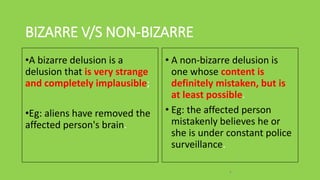
BIZARRE V/S NON-BIZARRE
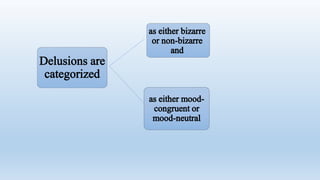
•A bizarre delusion is a
delusion that is very strange
and completely implausible;
•Eg: aliens have removed the
affected person's brain.
• A non-bizarre delusion is
one whose content is
definitely mistaken, but is
at least possible.
• Eg: the affected person
mistakenly believes he or
she is under constant police
surveillance.
4
MOOD CONGRUENT V/S NEUTRAL
•Delusion whose content is
consistent with either a
depressive or manic state.
•Eg: a depressed person may
believe that news anchors on
the TV highly disapprove of
him or her
A mood-neutral delusion
does not relate to the
sufferer's emotional state.
Eg: a belief that an extra limb
is growing out of the back of
one's head is neutral to either
depression or mania.
5
COMMON THEMES OF DELUSION
6
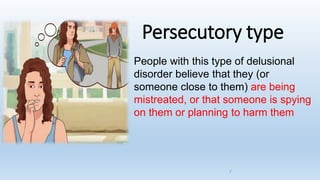
Persecutory type
7
People with this type of delusional
disorder believe that they (or
someone close to them) are being
mistreated, or that someone is spying
on them or planning to harm them
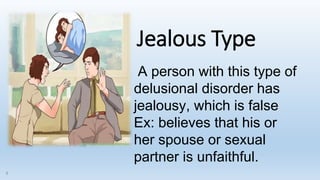
Jealous Type
8
A person with this type of
delusional disorder has
jealousy, which is false
Ex: believes that his or
her spouse or sexual
partner is unfaithful.
Erotomanic type
⊷ Someone with this type of delusional disorder believes
that another person, often someone important or
famous, is in love with him or her.
⊷ The person might attempt to contact the object of the
delusion, and stalking behavior is not uncommon.
9
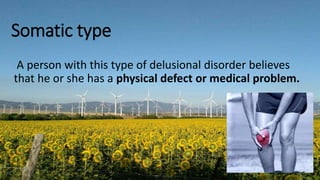
Somatic type
A person with this type of delusional disorder believes
that he or she has a physical defect or medical problem.
10
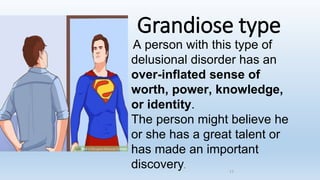
Grandiose type
11
A person with this type of
delusional disorder has an
over-inflated sense of
worth, power, knowledge,
or identity.
The person might believe he
or she has a great talent or
has made an important
discovery.
Mixed type
12
People with this type of
delusional disorder
have two or more of the
types of delusions listed
above.
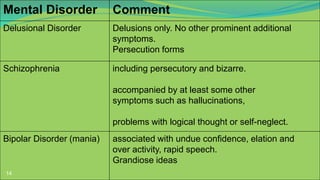
14
Mental Disorder Comment
Delusional Disorder Delusions only. No other prominent additional
symptoms.
Persecution forms
Schizophrenia including persecutory and bizarre.
accompanied by at least some other
symptoms such as hallucinations,
problems with logical thought or self-neglect.
Bipolar Disorder (mania) associated with undue confidence, elation and
over activity, rapid speech.
Grandiose ideas
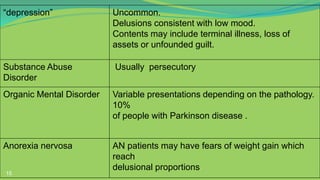
15
“depression” Uncommon.
Delusions consistent with low mood.
Contents may include terminal illness, loss of
assets or unfounded guilt.
Substance Abuse
Disorder
Usually persecutory
Organic Mental Disorder Variable presentations depending on the pathology.
10%
of people with Parkinson disease .
Anorexia nervosa AN patients may have fears of weight gain which
reach
delusional proportions
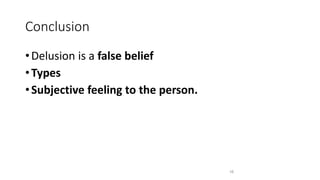
Conclusion
•Delusion is a false belief
•Types
•Subjective feeling to the person.
16
17
18
THANKYOU

delusion

  • 1.
  • 2.
    2 Definition: “Delusion is afalse, unshakeable belief that is out of keeping with the patient’s social and cultural background” The belief is not one ordinarily accepted by other members of the person's culture or subculture.
  • 4.
    BIZARRE V/S NON-BIZARRE •Abizarre delusion is a delusion that is very strange and completely implausible; •Eg: aliens have removed the affected person's brain. • A non-bizarre delusion is one whose content is definitely mistaken, but is at least possible. • Eg: the affected person mistakenly believes he or she is under constant police surveillance. 4
  • 5.
    MOOD CONGRUENT V/SNEUTRAL •Delusion whose content is consistent with either a depressive or manic state. •Eg: a depressed person may believe that news anchors on the TV highly disapprove of him or her A mood-neutral delusion does not relate to the sufferer's emotional state. Eg: a belief that an extra limb is growing out of the back of one's head is neutral to either depression or mania. 5
  • 6.
    COMMON THEMES OFDELUSION 6
  • 7.
    Persecutory type 7 People withthis type of delusional disorder believe that they (or someone close to them) are being mistreated, or that someone is spying on them or planning to harm them
  • 8.
    Jealous Type 8 A personwith this type of delusional disorder has jealousy, which is false Ex: believes that his or her spouse or sexual partner is unfaithful.
  • 9.
    Erotomanic type ⊷ Someonewith this type of delusional disorder believes that another person, often someone important or famous, is in love with him or her. ⊷ The person might attempt to contact the object of the delusion, and stalking behavior is not uncommon. 9
  • 10.
    Somatic type A personwith this type of delusional disorder believes that he or she has a physical defect or medical problem. 10
  • 11.
    Grandiose type 11 A personwith this type of delusional disorder has an over-inflated sense of worth, power, knowledge, or identity. The person might believe he or she has a great talent or has made an important discovery.
  • 12.
    Mixed type 12 People withthis type of delusional disorder have two or more of the types of delusions listed above.
  • 14.
    14 Mental Disorder Comment DelusionalDisorder Delusions only. No other prominent additional symptoms. Persecution forms Schizophrenia including persecutory and bizarre. accompanied by at least some other symptoms such as hallucinations, problems with logical thought or self-neglect. Bipolar Disorder (mania) associated with undue confidence, elation and over activity, rapid speech. Grandiose ideas
  • 15.
    15 “depression” Uncommon. Delusions consistentwith low mood. Contents may include terminal illness, loss of assets or unfounded guilt. Substance Abuse Disorder Usually persecutory Organic Mental Disorder Variable presentations depending on the pathology. 10% of people with Parkinson disease . Anorexia nervosa AN patients may have fears of weight gain which reach delusional proportions
  • 16.
    Conclusion •Delusion is afalse belief •Types •Subjective feeling to the person. 16
  • 17.
  • 18.
  • 19.