Dementia Arden L Aylor, MD Geriatrics Texas Tech University
Goals & Objectives Statistics Clinical Features Diagnostic Criteria Assessment Methods Treatment Methods
Normal vs. Abnormal Aging >40 year-old: Age Associated Memory Impairment Decline in Hepatic & Renal function Vision changes Hearing changes
Dementia Definition: The loss of cognitive and intellectual function, without impairment of perception or consciousness  Characterized by disorientation, impaired memory, judgment, intellect and labile affect
Did you Know… Five major types of Dementia Alzheimer’s:  60-70%  Cerebrovascular:  15-25% Lewybody:  5-8% Frontotemporal:  3-5%  Parkinson's with Dementia: 1-3% Estimated by 2040, 120 million   Arch Neuro, 2005
Did you Know… Prevalence:  6-8% 60 yrs and doubles every 5 years 80 yrs:  47-50% population suffer from some form of dementia www.aoa.dhhs.gov
Did you Know… 2006 - total cost world wide exceeded $220 billion  acute care long-term care  home health care  lost productivity for caregivers   www.aoa.dhhs.gov
Genetics The two major  risk  factors for dementia age  family history Alzheimer’s:  50% penetrance in first degree relatives by age 80
Genetics Alzheimer’s  (AD):  before age 60 genetic mutations on chromosomes 1, 14, 21 Alzheimer’s  (AD):  after age 60 apolipoprotein E gene  (APOE)  on chromosome 19
Genetics APOE* 4/4 allele 6x increase risk in ( AD) APOE* 2 appears to be protective Other risk factors: head injury, education level, estrogen replacement after menopause, long-term NSAID’s
Clinical Features Memory Impairment Early Dementia:  difficulty learning and retaining new information Late Dementia:  inability to access distant memories, impaired judgment and executive function
Clinical Features Dementia has a profound effect on the patient’s daily life: ADL’S  (eating, bathing, grooming) planning meals managing finances  medications communication driving
Clinical Features Early behavior and mood changes are common: personality alterations irritability anxiety  depression Late findings: Delusions, hallucinations, aggression and wandering
Clinical Features Dementia and depression often overlap Depressed patients usually exhibit intact language and motor skills 55% over 65 yrs with mild cognitive impairment + depression, progress to moderate to severe dementia within 5 yrs  Arch Neuro,  2005
Clinical Features Dementia & Agitation  undiagnosed medical problem pain  depression/ anxiety delirium environmental changes
Six Diagnostic Criteria for Dementia  1. Multiple cognitive deficits  a. Memory impairment b. One or more of the following: aphasia  apraxia  agnosia  disturbance in executive function  Core Geri, 2005
Six Diagnostic Criteria for Dementia   2.  Cognitive deficits in 1a and 1b causing an impairment in social or occupational  function which represents a significant  decline from a previous level  3.  Course is characterized by gradual onset  and continued cognitive decline
Six Diagnostic Criteria for Dementia 4. Cognitive deficits in 1a and 1b are not due  to any of the following: central nervous system condition causing progressive deficits in memory or cognition systemic condition  substance-induced condition
Six Diagnostic Criteria for Dementia 5. Deficits do not occur exclusively during the  course of a delirium  6. Disturbance is not better accounted for by  another Axis I disorder  (major depression,  schizophrenia )
Mild Dementia Disorientation for dates Naming difficulties  (anomia) Recent recall problems Difficulty copying figures Decreased insight Social withdrawal Irritability, mood changes Problems managing finances
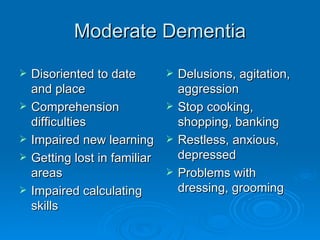
Moderate Dementia Disoriented to date and place Comprehension difficulties  Impaired new learning Getting lost in familiar areas Impaired calculating skills Delusions, agitation, aggression Stop cooking, shopping, banking Restless, anxious, depressed Problems with dressing, grooming
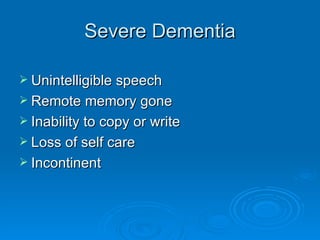
Severe Dementia Unintelligible speech Remote memory gone Inability to copy or write Loss of self care Incontinent
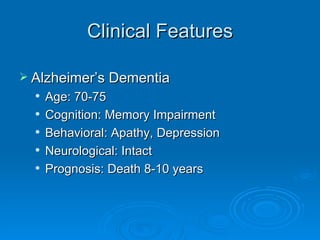
Clinical Features Alzheimer’s Dementia Age: 70-75 Cognition: Memory Impairment Behavioral: Apathy, Depression Neurological: Intact Prognosis: Death 8-10 years
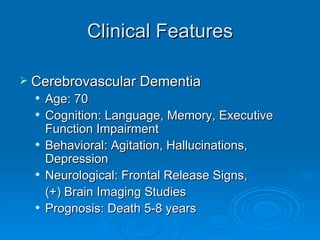
Clinical Features Cerebrovascular Dementia Age: 70 Cognition: Language, Memory, Executive Function Impairment Behavioral: Agitation, Hallucinations, Depression Neurological: Frontal Release Signs,  (+) Brain Imaging Studies Prognosis: Death 5-8 years
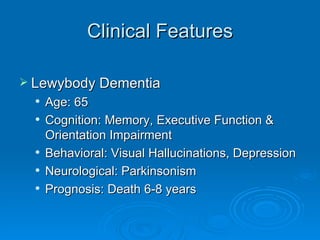
Clinical Features Lewybody Dementia Age: 65 Cognition: Memory, Executive Function & Orientation Impairment Behavioral: Visual Hallucinations, Depression Neurological: Parkinsonism Prognosis: Death 6-8 years
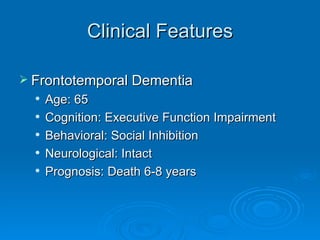
Clinical Features Frontotemporal Dementia Age: 65 Cognition: Executive Function Impairment Behavioral: Social Inhibition Neurological: Intact Prognosis: Death 6-8 years
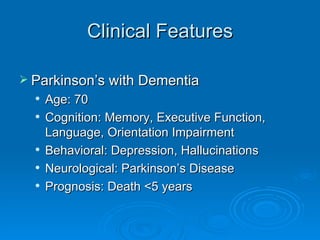
Clinical Features Parkinson’s with Dementia Age: 70 Cognition: Memory, Executive Function, Language, Orientation Impairment Behavioral: Depression, Hallucinations Neurological: Parkinson’s Disease Prognosis: Death <5 years
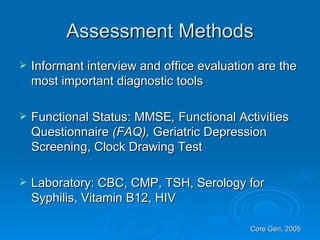
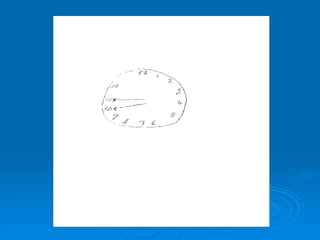
Assessment Methods Informant interview and office evaluation are the most important diagnostic tools Functional Status: MMSE ,  Functional Activities Questionnaire  (FAQ),  Geriatric Depression Screening, Clock Drawing Test Laboratory: CBC, CMP, TSH, Serology for Syphilis, Vitamin B12, HIV Core Geri, 2005
Assessment Methods Brain Imaging  (CT, MRI, PET) atrophy space-occupying lesions vascular disease whiter matter disease
 
Assessment Methods Imaging Studies Order if-- onset before 60 yrs post-acute illness less that 18 months neurologic finding are asymmetric gait disturbance incontinence unexplained
Treatment and Management Goal: Enhance quality of life, maximize function, improve cognition, mood and behavior non-pharmacological pharmacological
Nonpharmacologic Cognitive Enhancement reality orientation and memory training Individual and Group Therapy emotional orientated psychotherapy stimulation orientated therapy art and exercise
Other Nonpharmacologic Communication with family and caregiver Medical and legal Advance Directives Environmental Modifications moderate stimulation only memory measures clocks, calendars, to-do lists name tags, alert bracelets
Pharmacologic Individualized treatment Monitor renal clearance and hepatic metabolism Anticholinergic medications worsen cognitive impairment  “ Start low and go slow” Avoid starting multiple medications
Pharmacologic Alzheimer’s Dementia  Cholinesterase Inhibitors  Donepezil  (Aricept)   Galantamine  (Razadyne)   Rivastigmine  (Exelon)   Memantine  (Namenda) SSRI’s
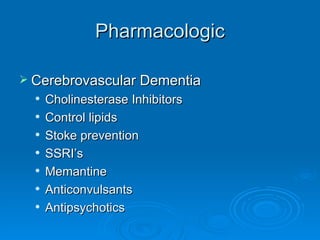
Pharmacologic Cerebrovascular Dementia Cholinesterase Inhibitors Control lipids Stoke prevention SSRI’s Memantine Anticonvulsants Antipsychotics
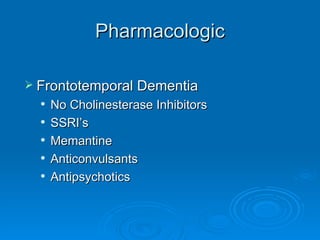
Pharmacologic Frontotemporal Dementia No Cholinesterase Inhibitors SSRI’s Memantine Anticonvulsants Antipsychotics
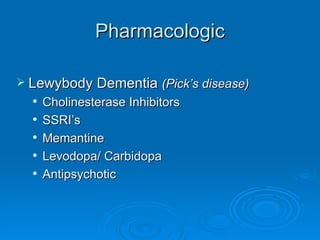
Pharmacologic Lewybody Dementia  (Pick’s disease) Cholinesterase Inhibitors SSRI’s Memantine Levodopa/ Carbidopa Antipsychotic
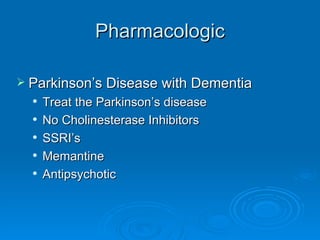
Pharmacologic Parkinson’s Disease with Dementia Treat the Parkinson’s disease No Cholinesterase Inhibitors  SSRI’s Memantine Antipsychotic
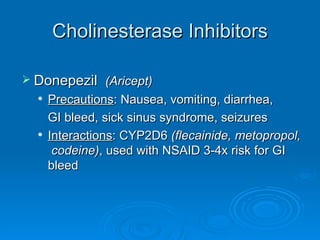
Cholinesterase Inhibitors Donepezil  (Aricept) Precautions : Nausea, vomiting, diarrhea,  GI bleed, sick sinus syndrome, seizures Interactions : CYP2D6  (flecainide, metopropol,  codeine) , used with NSAID 3-4x risk for GI bleed
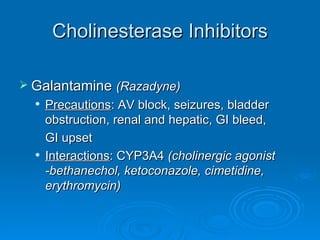
Cholinesterase Inhibitors Galantamine  (Razadyne) Precautions : AV block, seizures, bladder obstruction, renal and hepatic, GI bleed,  GI upset Interactions : CYP3A4  (cholinergic agonist -bethanechol, ketoconazole, cimetidine, erythromycin)
Cholinesterase Inhibitors Rivastigmine  (new q 24 Exelon Patch) Precautions : Nausea, vomiting, anoxia,  GI bleed, sick sinus syndrome, seizures Interactions : CYP2D6 and CYP3A4, potentates muscle relaxants, used with NSAID 3-4x risk for GI bleed
NMDA [glutamate] antagonist Memantine  (Namenda) Precautions : Dizziness, headache, alkalinized urine  (ATN, UTI)  seizures, GI upset Interactions : Other NMDA antagonists  (amantadine, dextromethorphan),  decreased by renally-excreted drugs  (HCTZ)
Mild to Moderate Dementia Cholinesterase Inhibitors slow cognitive decline Meta Analysis - Delayed nursing home placement by 1.2 years NNT 9.6 www.aoa.dhhs.gov
Moderate to Severe Memantine: 1-3 year delay in progression of symptoms NNT 16.2 Memantine + Cholinesterase inhibitor No definitive data early combination may decrease progression from mild to severe dementia by 4-5 years      Ann Intern Med , 2004
Research: What’s New Tramiprostate  (Alzhemed) mechanism: Inhibits GAG & A β  protein fibrillization reduces amyloid formation and accumulation  Tarenflurbil  (Flurizan) r-flurbiprofen mechanism: Selective Amyloid-Lowering Agent (SALA) inhibits A β 42 amyloid plaques cascade Alzheimer’s Vaccine
Research   Other studies estrogen  NSAIDS vitamin E  (increase cardiac events) selective monoamine oxidase-B inhibitor  ginko biloba  prophylaxis cholinesterase treatment J Gerontol a Bio Sci Med , 2004
Antidepressants Guidelines  (American & UK Geriatric Society) treating all patients with dementia and signs of depression/ anxiety with an SSRI or SNRI
All SSRI are not Equal Paroxetine  (Paxil):  Drug interaction, anti-cholinergic  Fluoxetine  (Prozac):  Long half life, anorexia  Sertraline  (Zoloft):  Good, sleepy Citalopram  (Celexa):  Good, mild hypotension Escitlopram  (Lexapro):  Good, mild  hypotension
“ Sundowning” Mild Dementia late afternoon or evening confusion Severe Dementia agitation, irritability restlessness
“ Sundowning” Etiology:  lack of clues from light/ dark cycling decrease sensory input environmental changes lack of a structure daily routine change in caregivers
“ Sundowning” Recommendations R/O occult medical problems infection medication changes avoid dramatic changes in living environment encourage familiar home surroundings
Key Points Interviews & office evaluations are the most important diagnostic tools Goal: Enhance quality of life, maximize function, improve cognition, mood and behavior Not all SSRI’s are equal Individualized treatment mild - moderate: cholinesterase inhibitors, SSRI’s moderate - severe: memantine, SSRI’s or combinations
References Cobb, Duthie, Murphy; Geriatric Review Syllabus: A Core curriculum in Geriatrics, 5th ed, 2005, 117-129 Peterson, Smith, Waring, Mild Cognitive Impairment,  Arch Neurol ., 2005(3): 303-308 Royall, Chaiodo, Polk, Subclinical Cognitive Impairment,  J Gerontol a Bio Sci Med , 2004;55 (9):M541-M546 Grifford, Holloway, Frankel, Improving adherence to dementia,  A randomized Controlled Trial, Ann Intern Med , 2004;131(40):237-246 Governmental Administration on Aging & Research  www.aoa.dhhs.gov Alzheimer Research Forum,  www.alzhforum.org/drug
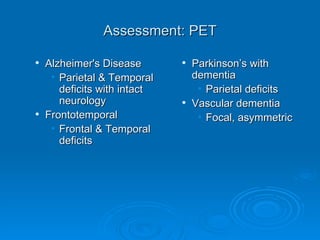
Assessment: PET Alzheimer's Disease   Parietal & Temporal deficits with intact neurology Frontotemporal  Frontal & Temporal deficits Parkinson’s with dementia   Parietal deficits Vascular dementia Focal, asymmetric

Dementia.2

  • 1.
    Dementia Arden LAylor, MD Geriatrics Texas Tech University
  • 2.
    Goals & ObjectivesStatistics Clinical Features Diagnostic Criteria Assessment Methods Treatment Methods
  • 3.
    Normal vs. AbnormalAging >40 year-old: Age Associated Memory Impairment Decline in Hepatic & Renal function Vision changes Hearing changes
  • 4.
    Dementia Definition: Theloss of cognitive and intellectual function, without impairment of perception or consciousness Characterized by disorientation, impaired memory, judgment, intellect and labile affect
  • 5.
    Did you Know…Five major types of Dementia Alzheimer’s: 60-70% Cerebrovascular: 15-25% Lewybody: 5-8% Frontotemporal: 3-5% Parkinson's with Dementia: 1-3% Estimated by 2040, 120 million Arch Neuro, 2005
  • 6.
    Did you Know…Prevalence: 6-8% 60 yrs and doubles every 5 years 80 yrs: 47-50% population suffer from some form of dementia www.aoa.dhhs.gov
  • 7.
    Did you Know…2006 - total cost world wide exceeded $220 billion acute care long-term care home health care lost productivity for caregivers www.aoa.dhhs.gov
  • 8.
    Genetics The twomajor risk factors for dementia age family history Alzheimer’s: 50% penetrance in first degree relatives by age 80
  • 9.
    Genetics Alzheimer’s (AD): before age 60 genetic mutations on chromosomes 1, 14, 21 Alzheimer’s (AD): after age 60 apolipoprotein E gene (APOE) on chromosome 19
  • 10.
    Genetics APOE* 4/4allele 6x increase risk in ( AD) APOE* 2 appears to be protective Other risk factors: head injury, education level, estrogen replacement after menopause, long-term NSAID’s
  • 11.
    Clinical Features MemoryImpairment Early Dementia: difficulty learning and retaining new information Late Dementia: inability to access distant memories, impaired judgment and executive function
  • 12.
    Clinical Features Dementiahas a profound effect on the patient’s daily life: ADL’S (eating, bathing, grooming) planning meals managing finances medications communication driving
  • 13.
    Clinical Features Earlybehavior and mood changes are common: personality alterations irritability anxiety depression Late findings: Delusions, hallucinations, aggression and wandering
  • 14.
    Clinical Features Dementiaand depression often overlap Depressed patients usually exhibit intact language and motor skills 55% over 65 yrs with mild cognitive impairment + depression, progress to moderate to severe dementia within 5 yrs Arch Neuro, 2005
  • 15.
    Clinical Features Dementia& Agitation undiagnosed medical problem pain depression/ anxiety delirium environmental changes
  • 16.
    Six Diagnostic Criteriafor Dementia 1. Multiple cognitive deficits a. Memory impairment b. One or more of the following: aphasia apraxia agnosia disturbance in executive function Core Geri, 2005
  • 17.
    Six Diagnostic Criteriafor Dementia 2. Cognitive deficits in 1a and 1b causing an impairment in social or occupational function which represents a significant decline from a previous level 3. Course is characterized by gradual onset and continued cognitive decline
  • 18.
    Six Diagnostic Criteriafor Dementia 4. Cognitive deficits in 1a and 1b are not due to any of the following: central nervous system condition causing progressive deficits in memory or cognition systemic condition substance-induced condition
  • 19.
    Six Diagnostic Criteriafor Dementia 5. Deficits do not occur exclusively during the course of a delirium 6. Disturbance is not better accounted for by another Axis I disorder (major depression, schizophrenia )
  • 20.
    Mild Dementia Disorientationfor dates Naming difficulties (anomia) Recent recall problems Difficulty copying figures Decreased insight Social withdrawal Irritability, mood changes Problems managing finances
  • 21.
    Moderate Dementia Disorientedto date and place Comprehension difficulties Impaired new learning Getting lost in familiar areas Impaired calculating skills Delusions, agitation, aggression Stop cooking, shopping, banking Restless, anxious, depressed Problems with dressing, grooming
  • 22.
    Severe Dementia Unintelligiblespeech Remote memory gone Inability to copy or write Loss of self care Incontinent
  • 23.
    Clinical Features Alzheimer’sDementia Age: 70-75 Cognition: Memory Impairment Behavioral: Apathy, Depression Neurological: Intact Prognosis: Death 8-10 years
  • 24.
    Clinical Features CerebrovascularDementia Age: 70 Cognition: Language, Memory, Executive Function Impairment Behavioral: Agitation, Hallucinations, Depression Neurological: Frontal Release Signs, (+) Brain Imaging Studies Prognosis: Death 5-8 years
  • 25.
    Clinical Features LewybodyDementia Age: 65 Cognition: Memory, Executive Function & Orientation Impairment Behavioral: Visual Hallucinations, Depression Neurological: Parkinsonism Prognosis: Death 6-8 years
  • 26.
    Clinical Features FrontotemporalDementia Age: 65 Cognition: Executive Function Impairment Behavioral: Social Inhibition Neurological: Intact Prognosis: Death 6-8 years
  • 27.
    Clinical Features Parkinson’swith Dementia Age: 70 Cognition: Memory, Executive Function, Language, Orientation Impairment Behavioral: Depression, Hallucinations Neurological: Parkinson’s Disease Prognosis: Death <5 years
  • 28.
    Assessment Methods Informantinterview and office evaluation are the most important diagnostic tools Functional Status: MMSE , Functional Activities Questionnaire (FAQ), Geriatric Depression Screening, Clock Drawing Test Laboratory: CBC, CMP, TSH, Serology for Syphilis, Vitamin B12, HIV Core Geri, 2005
  • 29.
    Assessment Methods BrainImaging (CT, MRI, PET) atrophy space-occupying lesions vascular disease whiter matter disease
  • 30.
  • 31.
    Assessment Methods ImagingStudies Order if-- onset before 60 yrs post-acute illness less that 18 months neurologic finding are asymmetric gait disturbance incontinence unexplained
  • 32.
    Treatment and ManagementGoal: Enhance quality of life, maximize function, improve cognition, mood and behavior non-pharmacological pharmacological
  • 33.
    Nonpharmacologic Cognitive Enhancementreality orientation and memory training Individual and Group Therapy emotional orientated psychotherapy stimulation orientated therapy art and exercise
  • 34.
    Other Nonpharmacologic Communicationwith family and caregiver Medical and legal Advance Directives Environmental Modifications moderate stimulation only memory measures clocks, calendars, to-do lists name tags, alert bracelets
  • 35.
    Pharmacologic Individualized treatmentMonitor renal clearance and hepatic metabolism Anticholinergic medications worsen cognitive impairment “ Start low and go slow” Avoid starting multiple medications
  • 36.
    Pharmacologic Alzheimer’s Dementia Cholinesterase Inhibitors Donepezil (Aricept) Galantamine (Razadyne) Rivastigmine (Exelon) Memantine (Namenda) SSRI’s
  • 37.
    Pharmacologic Cerebrovascular DementiaCholinesterase Inhibitors Control lipids Stoke prevention SSRI’s Memantine Anticonvulsants Antipsychotics
  • 38.
    Pharmacologic Frontotemporal DementiaNo Cholinesterase Inhibitors SSRI’s Memantine Anticonvulsants Antipsychotics
  • 39.
    Pharmacologic Lewybody Dementia (Pick’s disease) Cholinesterase Inhibitors SSRI’s Memantine Levodopa/ Carbidopa Antipsychotic
  • 40.
    Pharmacologic Parkinson’s Diseasewith Dementia Treat the Parkinson’s disease No Cholinesterase Inhibitors SSRI’s Memantine Antipsychotic
  • 41.
    Cholinesterase Inhibitors Donepezil (Aricept) Precautions : Nausea, vomiting, diarrhea, GI bleed, sick sinus syndrome, seizures Interactions : CYP2D6 (flecainide, metopropol, codeine) , used with NSAID 3-4x risk for GI bleed
  • 42.
    Cholinesterase Inhibitors Galantamine (Razadyne) Precautions : AV block, seizures, bladder obstruction, renal and hepatic, GI bleed, GI upset Interactions : CYP3A4 (cholinergic agonist -bethanechol, ketoconazole, cimetidine, erythromycin)
  • 43.
    Cholinesterase Inhibitors Rivastigmine (new q 24 Exelon Patch) Precautions : Nausea, vomiting, anoxia, GI bleed, sick sinus syndrome, seizures Interactions : CYP2D6 and CYP3A4, potentates muscle relaxants, used with NSAID 3-4x risk for GI bleed
  • 44.
    NMDA [glutamate] antagonistMemantine (Namenda) Precautions : Dizziness, headache, alkalinized urine (ATN, UTI) seizures, GI upset Interactions : Other NMDA antagonists (amantadine, dextromethorphan), decreased by renally-excreted drugs (HCTZ)
  • 45.
    Mild to ModerateDementia Cholinesterase Inhibitors slow cognitive decline Meta Analysis - Delayed nursing home placement by 1.2 years NNT 9.6 www.aoa.dhhs.gov
  • 46.
    Moderate to SevereMemantine: 1-3 year delay in progression of symptoms NNT 16.2 Memantine + Cholinesterase inhibitor No definitive data early combination may decrease progression from mild to severe dementia by 4-5 years Ann Intern Med , 2004
  • 47.
    Research: What’s NewTramiprostate (Alzhemed) mechanism: Inhibits GAG & A β protein fibrillization reduces amyloid formation and accumulation Tarenflurbil (Flurizan) r-flurbiprofen mechanism: Selective Amyloid-Lowering Agent (SALA) inhibits A β 42 amyloid plaques cascade Alzheimer’s Vaccine
  • 48.
    Research Other studies estrogen NSAIDS vitamin E (increase cardiac events) selective monoamine oxidase-B inhibitor ginko biloba prophylaxis cholinesterase treatment J Gerontol a Bio Sci Med , 2004
  • 49.
    Antidepressants Guidelines (American & UK Geriatric Society) treating all patients with dementia and signs of depression/ anxiety with an SSRI or SNRI
  • 50.
    All SSRI arenot Equal Paroxetine (Paxil): Drug interaction, anti-cholinergic Fluoxetine (Prozac): Long half life, anorexia Sertraline (Zoloft): Good, sleepy Citalopram (Celexa): Good, mild hypotension Escitlopram (Lexapro): Good, mild hypotension
  • 51.
    “ Sundowning” MildDementia late afternoon or evening confusion Severe Dementia agitation, irritability restlessness
  • 52.
    “ Sundowning” Etiology: lack of clues from light/ dark cycling decrease sensory input environmental changes lack of a structure daily routine change in caregivers
  • 53.
    “ Sundowning” RecommendationsR/O occult medical problems infection medication changes avoid dramatic changes in living environment encourage familiar home surroundings
  • 54.
    Key Points Interviews& office evaluations are the most important diagnostic tools Goal: Enhance quality of life, maximize function, improve cognition, mood and behavior Not all SSRI’s are equal Individualized treatment mild - moderate: cholinesterase inhibitors, SSRI’s moderate - severe: memantine, SSRI’s or combinations
  • 55.
    References Cobb, Duthie,Murphy; Geriatric Review Syllabus: A Core curriculum in Geriatrics, 5th ed, 2005, 117-129 Peterson, Smith, Waring, Mild Cognitive Impairment, Arch Neurol ., 2005(3): 303-308 Royall, Chaiodo, Polk, Subclinical Cognitive Impairment, J Gerontol a Bio Sci Med , 2004;55 (9):M541-M546 Grifford, Holloway, Frankel, Improving adherence to dementia, A randomized Controlled Trial, Ann Intern Med , 2004;131(40):237-246 Governmental Administration on Aging & Research www.aoa.dhhs.gov Alzheimer Research Forum, www.alzhforum.org/drug
  • 56.
    Assessment: PET Alzheimer'sDisease Parietal & Temporal deficits with intact neurology Frontotemporal Frontal & Temporal deficits Parkinson’s with dementia Parietal deficits Vascular dementia Focal, asymmetric