SMOKING   cessation   Robert Mallin, MD Department Family Medicine Medical University of South Carolina
General Reading Recommendations A Clinical Practice Guideline for Treating Tobacco Use and Dependence: A US Public Health Service Report The Tobacco Use and Dependence Clinical Practice Guideline Panel, Staff, and Consortium Representatives JAMA.  2000;283:3244-3254.
General Reading Recommendations Mallin R ,  Management of Smoking Cessation: Integration of Behavior and  Pharmacotherapy. American Family Physician 65:6 1107-14 2002
Module 1   EPIDEMIOLOGY
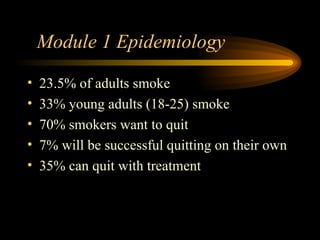
Module 1 Epidemiology 23.5% of adults smoke 33% young adults (18-25) smoke 70% smokers want to quit 7% will be successful quitting on their own 35% can quit with treatment
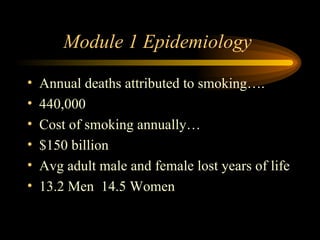
Module 1 Epidemiology  Annual deaths attributed to smoking…. 440,000 Cost of smoking annually… $150 billion Avg adult male and female lost years of life 13.2 Men  14.5 Women
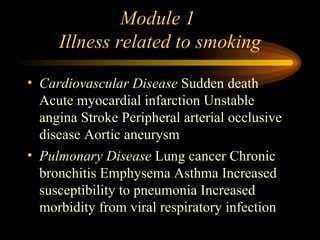
Module 1  Illness related to smoking Cardiovascular Disease  Sudden death Acute myocardial infarction Unstable angina Stroke Peripheral arterial occlusive disease Aortic aneurysm Pulmonary Disease  Lung cancer Chronic bronchitis Emphysema Asthma Increased susceptibility to pneumonia Increased morbidity from viral respiratory infection
Module 1 Illness related to smoking Gastrointestinal Disease  Peptic ulcer Esophageal reflux Reproductive Disturbances  Reduced fertility Premature birth Lower birth weight Spontaneous abortion Abruptio placentae Premature rupture of membranes Increased perinatal mortality
Module 1  Illness related to smoking Oral Disease (Smokeless Tobacco)  Oral cancer Leukoplakia Gingivitis Gingival recession Tooth staining Other  Earlier menopause Osteoporosis Cataract Premature skin wrinkling Aggravation of hypothyroidism Altered drug metabolism or effects
Module 1  Cancers associated with smoking Lung Larynx Oral cavity Esophagus Pancreas Bladder Kidney Stomach Leukemia Cervix
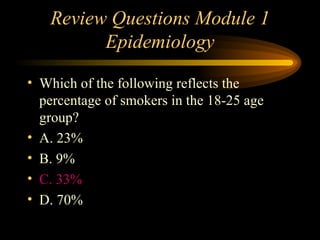
Review Questions Module 1 Epidemiology Which of the following reflects the percentage of smokers in the 18-25 age group? A. 23% B. 9% C. 33% D. 70%
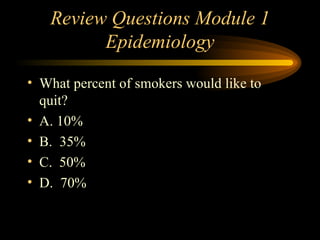
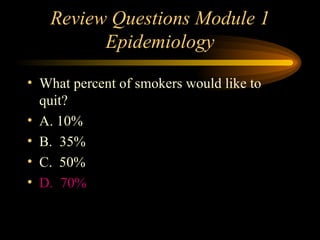
Review Questions Module 1 Epidemiology What percent of smokers would like to quit? A. 10% B.  35% C. 50% D.  70%
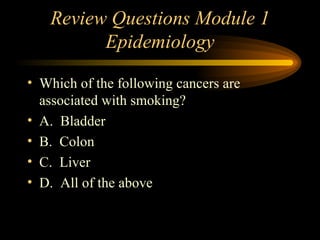
Review Questions Module 1 Epidemiology Which of the following cancers are associated with smoking? A.  Bladder B.  Colon C.  Liver D.  All of the above
Module 2  5 A’s of Smoking Cessation
Module 2  Agency for Healthcare Research and Quality Clinical Guidelines Three truths about tobacco 1. All tobacco products exact devastating costs on the nation’s health and welfare. 2. For most users tobacco use results in drug dependence comparable to that of opiates, amphetamines and cocaine. 3. Chronic tobacco use warrants repeated clinical intervention as do other addictions.
Module 2  Empirical Basis for Guidelines Consensus panel reviewed over 300 RCT of tobacco-use cessation interventions came to the following conclusions; Effective smoking cessation treatments are available, and every patient who smokes should be offered one or more of these treatments It is essential that clinicians determine and document the tobacco-use status of every patient treated in a health care setting.
Module 2  Empirical Basis for Guidelines Brief cessation treatments are effective, and at least a minimal intervention should be provided to every patient who uses tobacco.  A dose-response relation exists between the intensity and duration of a treatment and its effectiveness. In general, the more intense the treatment, the more effective it is in producing long-term abstinence from tobacco
Module 2  Empirical Basis for Guidelines Three treatment elements, in particular, are effective, and one or more of these elements should be included in smoking cessation treatment  Nicotine replacement therapy (nicotine patches or gum) Social support (clinician-provided encouragement and assistance) Skills training and problem solving (techniques on achieving and maintaining abstinence)
Module 2  Empirical Basis for Guidelines Effective reduction of tobacco use requires that health care systems make institutional changes that result in systematic identification of, and intervention with, all tobacco users at every visit.
Module 2  Primary Care Interventions 5A’s of smoking cessation 1.  Ask  the patient if he or she uses tobacco 2.  Advise  him or her to quit 3.  Assess  willingness to make a quit attempt 4.  Assist  those willing to quit 5.  Arrange  for follow-up contact to prevent relapse
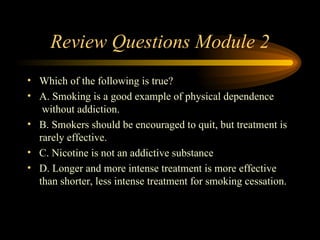
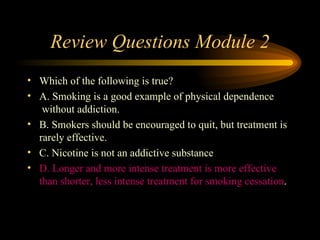
Review Questions Module 2 Which of the following is true? A. Smoking is a good example of physical dependence    without addiction.  B. Smokers should be encouraged to quit, but treatment is rarely effective. C. Nicotine is not an addictive substance D. Longer and more intense treatment is more effective than shorter, less intense treatment for smoking cessation.
Review Questions Module 2 Which of the following is true? A. Smoking is a good example of physical dependence    without addiction.  B. Smokers should be encouraged to quit, but treatment is rarely effective. C. Nicotine is not an addictive substance D. Longer and more intense treatment is more effective than shorter, less intense treatment for smoking cessation .
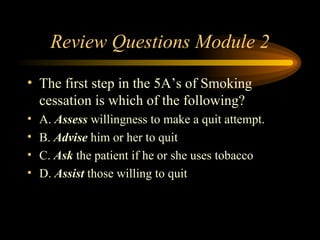
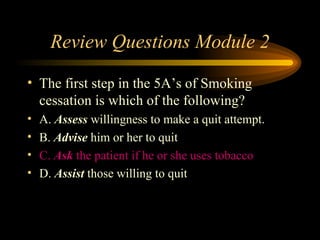
Review Questions Module 2 The first step in the 5A’s of Smoking cessation is which of the following? A.  Assess  willingness to make a quit attempt. B.  Advise  him or her to quit C.  Ask  the patient if he or she uses tobacco D.  Assist  those willing to quit
Module 3  Assess   Tobacco Use
Module 3   Assess Tobacco Use Ask if patient uses tobacco Tobacco use as a Vital Sign One of the most effective ways to Ask patients about their tobacco use if to include it in the Vital sign section of the chart. When office personnel record the patient’s tobacco use at each visit, the health care provider is three times more likely to address the issue with the patient.
Module 3   Assess Tobacco Use If your patient smokes or uses tobacco, take a tobacco use history. How much do you smoke? When did you begin smoking? Have you ever quit smoking? If so, how long were you abstinent? What happened to make you start smoking again?
Module 3   Assess Tobacco Use Would you like to stop smoking? Do you think you would like to make a quit attempt in the next few weeks or months? Do you have any questions about smoking cessation?
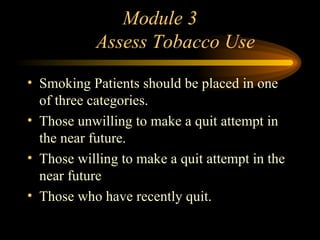
Module 3   Assess Tobacco Use Smoking Patients should be placed in one of three categories. Those unwilling to make a quit attempt in the near future. Those willing to make a quit attempt in the near future Those who have recently quit.
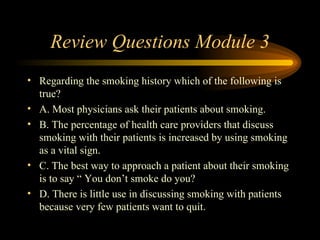
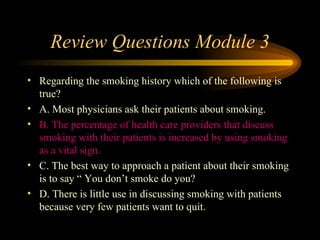
Review Questions Module 3 Regarding the smoking history which of the following is true? A. Most physicians ask their patients about smoking. B. The percentage of health care providers that discuss smoking with their patients is increased by using smoking as a vital sign. C. The best way to approach a patient about their smoking is to say “ You don’t smoke do you? D. There is little use in discussing smoking with patients because very few patients want to quit.
Module 4 Advise Your patient to quit
Advise  him or her to quit  In a clear, strong, and personalized manner, urge every tobacco user to quit.  Clear —"I think it is important for you to quit smoking now and I can help you.” "Cutting down while you are ill is not enough."  Strong—"As your doctor, I need you to know that quitting smoking is the most important thing you can do to protect your health now and in the future. The clinic staff and I will help you."
Advise  him or her to quit In a clear, strong, and personalized manner, urge every tobacco user to quit. Personalized —Tie tobacco use to current health/ illness, and/or its social and economic costs, motivation level/readiness to quit, and/or the impact of tobacco use on children and others in the household “Your asthma will improve when you stop smoking”
  Assess  willingness to make a quit attempt Ask every tobacco user if he or she is willing to make a quit attempt at this time (e.g., within the next 30 days). Current users who are willing to quit Current users unwilling to quit at this time
Review Questions Module 4 Which of the following is the most appropriate message to give your patient about smoking? A. “You know you should quit smoking, don’t you?” B. “If you cannot quit smoking, I think you should find another doctor.” C. “You will certainly die if you continue to smoke” D. “ Mr. Jones, as your doctor, I have to tell you that the most important action you can take to improve your health would be to quit smoking.”
Module 5  Stages of Change
Module 5 Reading  A 'stages of change' approach to helping patients change behavior.  Zimmerman GL -  Am Fam Physician  - 1-Mar-2000; 61(5): 1409-16
Stages of Change Prochaska and DiClemente used smoking cessation as the model for the development of the stages of change.  This model may be used to assess the readiness of your patient to change and can guide you in which techniques of motivational interviewing (discussed later) will be most effective in helping your patient move closer to their goal.
Stages of Change Precontemplative “ I don’t have a problem.” These are patient’s who really do not think that smoking is a problem for them.  They are not considering quitting Contemplative “  I think I may need to quit, but I’m not ready.” These patients recognize that they need to quit smoking and may even want to quit but are currently not ready to commit to giving it a try.
Stages of Change Preparation “ I want to quit.” This is a patient who is ready to commit to making a quit attempt.  Action “ I stopped smoking today.”  Maintenance/Relapse  Refers the continuation of the behavior change or the relapse to old behavior (smoking) after the change has been made.
Stages of Change Remember, patients predictably go through these stages when they make any significant change.  They cannot “jump” stages.  Consequently, expecting a patient to move from precontemplation to action without going through contemplation and preparation is unrealistic.  So your goal for the patient in precontemplation should be for them to get to contemplation.  This has considerable importance as we discuss motivational interviewing techniques
Review Questions Module 5 Choose the appropriate stage of change for the following statement.  “ Doc, this scare about smoking is a government conspiracy to get the tobacco companies.” A. Precontemplation B. Contemplation C. Preparation D. Action E. Maintenance
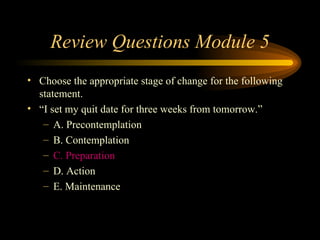
Review Questions Module 5 Choose the appropriate stage of change for the following statement.  “ I set my quit date for three weeks from tomorrow.” A. Precontemplation B. Contemplation C. Preparation D. Action E. Maintenance
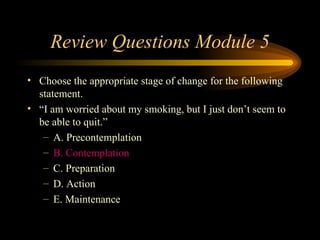
Review Questions Module 5 Choose the appropriate stage of change for the following statement.  “ I am worried about my smoking, but I just don’t seem to be able to quit.” A. Precontemplation B. Contemplation C. Preparation D. Action E. Maintenance
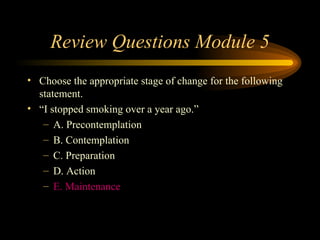
Review Questions Module 5 Choose the appropriate stage of change for the following statement.  “ I stopped smoking over a year ago.” A. Precontemplation B. Contemplation C. Preparation D. Action E. Maintenance
Module 6 Motivational Interviewing For those unwilling to make a quit attempt at this time
Reading for Module 6 Motivational interviewing in health care settings: Opportunities and limitations,   Karen M. Emmons and Stephen Rollnick  American Journal of Preventive Medicine   Volume 20, Issue 1  , January 2001, Pages 68-74
Motivational Interviewing Motivational interviewing as developed by Miller and Rollnick is a technique to help patients change behavior.  In the context of this module you will learn suggestions that will help your patients move to the next stage of change in.
Motivational Interviewing General Principles Expressing empathy by the use of reflective listening. Developing discrepancy between the patients goals and current behavior by the use of reflective listening and objective feedback. Avoiding arguments by assuming that the patient is responsible for the decision to change. Rolling with resistance rather than confronting or opposing it. Supporting self efficacy and optimism for change.
Motivational Interviewing General Principles Examples Expressing empathy by the use of reflective listening. “ Stopping smoking is difficult, I can see that you have tried hard to quit.” Developing discrepancy between the patients goals and current behavior by the use of reflective listening and objective feedback. “ I heard you say that you are concerned for your health, and that you know that smoking is harming your health. I wonder how it makes you feel to be continuing to smoke under these conditions?”
Motivational Interviewing Avoiding arguments by assuming that the patient is responsible for the decision to change. “ I’d really like to help you, but only you can decide of you want to quit.” Rolling with resistance rather than confronting or opposing it.  “ It sounds like you are not ready to consider quitting right now.  Would it be ok if we continued this conversation another time?” Supporting self efficacy and optimism for change. Stopping smoking is really hard, but I am certain that you can be successful.”
Motivational Interviewing for the Precontemplative/Contemplative 5Rs Relevance Risks Rewards Roadblocks Repitition
Motivational Interviewing for the Pre-contemplative/Contemplative Relevance Encourage the patient to indicate why  quitting is personally relevant to their disease status or risk factors.  “Your family history and hypertension increase your risk for cardiovascular disease.  Stopping smoking would improve your risk greatly.”
Motivational Interviewing for the Pre-contemplative/Contemplative Risks Ask the patient to identify potential negative effects of smoking Acute risks: SOB, exacerbation of Asthma, cough Long term risks: MI, CVA, cancer, lung, bladder, cervix, COPD, costs for extended care Environmental risks: Increased risk of lung cancer, in non-smokers exposed, low birth weight, increased respiratory infections in children
Motivational Interviewing for the Pre-contemplative/Contemplative Rewards Ask the patient to identify potential benefits of stopping smoking that seem most relevant to the patient improved smell and taste,  saved money improved conditioning reduced skin damage healthier children
Motivational Interviewing for the Pre-contemplative/Contemplative Roadblocks Ask the patient to identify potential barriers lack of support depression loss of enjoyment of tobacco weight gain cost of pharmacotherapy
Motivational Interviewing for the Pre-contemplative/Contemplative Repetition repeat motivational interviewing each time you see patient. Failed attempts to quit should be met with the understanding that most people require multiple attempts to quit “You will almost certainly be successful if you keep trying.”
Review Questions Module 6 Which of the following statements reflect empathy on the part of the interviewer? A. “I heard you say that you are concerned for your health, and that you know that smoking is harming your health. I wonder how it makes you feel to be continuing to smoke under these conditions?”  B. “I’d really like to help you, but only you can decide of you want to quit.” C. “Stopping smoking is really hard, but I am certain that you can be successful.” D. “Stopping smoking is difficult, I can see that you have tried hard to quit.”
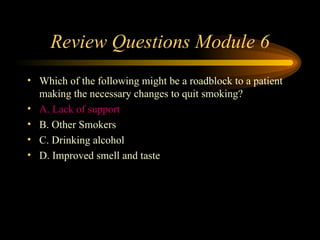
Review Questions Module 6 Which of the following might be a roadblock to a patient making the necessary changes to quit smoking? A. Lack of support B. Other Smokers C. Drinking alcohol D. Improved smell and taste
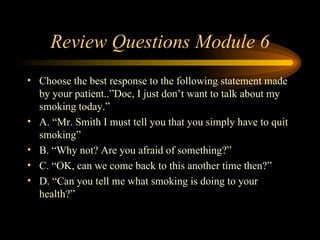
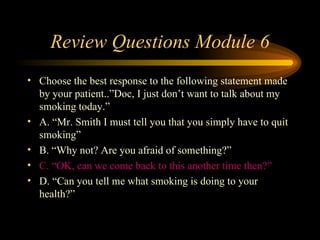
Review Questions Module 6 Choose the best response to the following statement made by your patient..”Doc, I just don’t want to talk about my smoking today.” A. “Mr. Smith I must tell you that you simply have to quit smoking” B. “Why not? Are you afraid of something?” C. “OK, can we come back to this another time then?” D. “Can you tell me what smoking is doing to your health?”
Module 7 Assist Those willing to attempt to quit
Module 7 Finally! Your patient tells you they are ready to make a quit attempt.  What now? Write a Rx for Zyban or the patch and tell them good luck?  Hardly!  Now the real work begins.
Motivational Interviewing for Preparation/Action Stages Identification of triggers Other smokers Drinking alcohol Experiencing urges Stressful situations
Motivational Interviewing for Preparation/Action Stages Identification of Coping Strategies Anticipate, and avoid temptation. Cognitive strategies reduce stress and negative mood. Lifestyle changes that improve quality of life. Learning cognitive and behavioral strategies to deal with urges to smoke.
Motivational Interviewing for Preparation/Action Stages Provide basic information about smoking and successful quitting Any smoking will likely result in relapse Withdrawal typically peaks between 1-3 weeks of smoking cessation Withdrawal symptoms include depressed mood, irritability, urges to smoke, and difficulty concentrating.
Motivational Interviewing for Preparation/Action Stages Intratreatment Support Encourage the patient to quit Effective treatment for nicotine dependence is available. Half of the people who have ever smoked have quit. “ You can quit smoking, I am certain of it.”
Motivational Interviewing for Preparation/Action Stages Intratreatment Support Communicate caring and concern Ask patient how they feel about quitting. Directly express concern and willingness to help. Be open to the patients fears about quitting, difficulties experienced, and ambivalent feelings.
Motivational Interviewing for Preparation/Action Stages Intratreatment Support Encourage the patient to talk about the quitting process Ask about Reasons patient wants to quit Concerns or worries about quitting Success patient has achieved Difficulties encountered while quitting
Motivational Interviewing for Preparation/Action Stages Extra treatment support Train Patient in support solicitation skills Videos Practice asking family friends, co-workers for support Help patient to establish smoke free home
Motivational Interviewing for Preparation/Action Stages Extra treatment support Prompt support seeking Help patient identify support Remind patient to call supportive others Community resources of support
Motivational Interviewing for Preparation/Action Stages Extra treatment support Clinician arranges outside support Mail letters to supportive others Call supportive others Assign patients to be “buddies” to one another
Specific Recommendations in Preparation for Smoking Cessation Set a quit date. Read educational materials Make a list of triggers Make a list of coping strategies Make a list of support network Remove all smoking paraphernalia from home, car office. Be sure to understand the appropriate use of pharmacological aids
Pharmacotherapy for Smoking Cessation  Two Goals: 1.Reduce the symptoms of nicotine withdrawal. (physical dependence) 2.Reduce craving for nicotine. (addiction) Nicotine replacement therapy addresses the first goal Bupropion addresses both goals. Either nicotine replacement, or bupropion increases quit rates from 7% (no therapy) to about 30% (with therapy and social support). There is suggestive evidence that using both bupropion and nicotine replacement is somewhat better than either one alone.
Pharmacotherapy for Preparation/Action Stages Who should get pharmacotherapy? All smokers except smoking less than 10 cigarettes/d Pregnant Breast feeding Adolescent
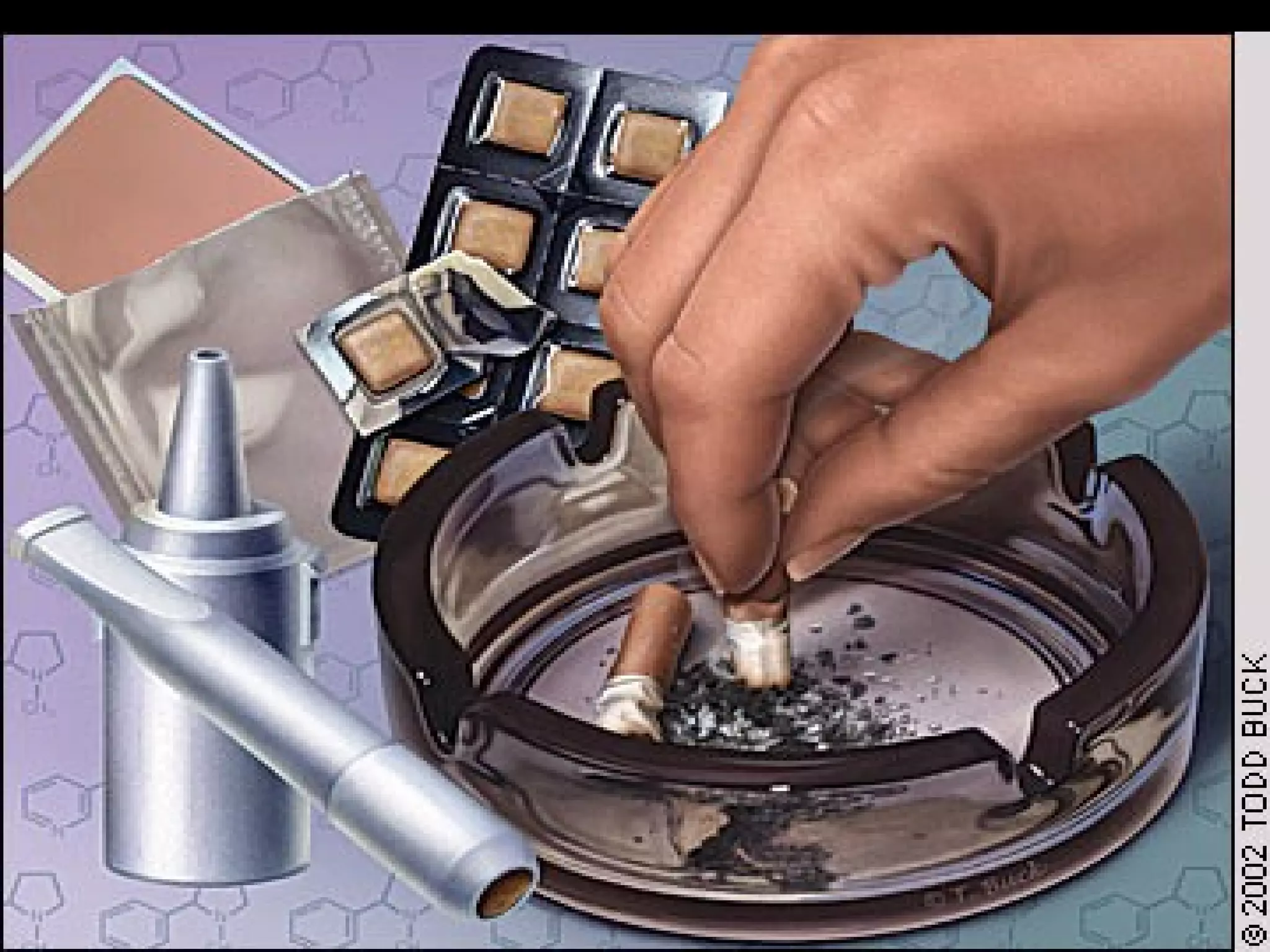
Pharmacotherapy for Preparation/Action Stages Which treatments are considered first line, FDA approved? Bupropion Nicotine gum Nicotine inhaler Nicotine nasal spray Nicotine patches
Pharmacotherapy for Preparation/Action Stages Bupropion (sustained release) Precautions/Contraindications Seizure, eating disorders Adverse effects Insomnia, Dry mouth Dose 150mg QD X3 then 150mg BID Begin 2 wks prior to quit date
Pharmacotherapy for Preparation/Action Stages Bupropion (sustained release) Duration 7-12 wks up to 6 mos. Cost/day $3.30/day
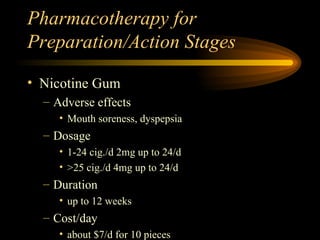
Pharmacotherapy for Preparation/Action Stages Nicotine Gum Adverse effects Mouth soreness, dyspepsia Dosage 1-24 cig./d 2mg up to 24/d >25 cig./d 4mg up to 24/d Duration up to 12 weeks Cost/day about $7/d for 10 pieces
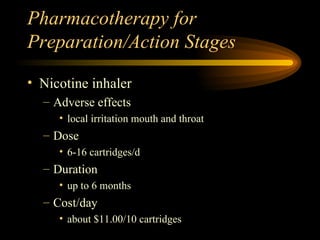
Pharmacotherapy for Preparation/Action Stages Nicotine inhaler Adverse effects local irritation mouth and throat Dose 6-16 cartridges/d Duration up to 6 months Cost/day about $11.00/10 cartridges
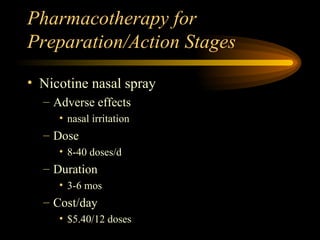
Pharmacotherapy for Preparation/Action Stages Nicotine nasal spray Adverse effects nasal irritation Dose 8-40 doses/d Duration 3-6 mos Cost/day $5.40/12 doses
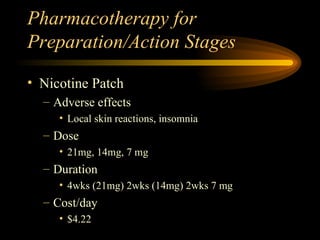
Pharmacotherapy for Preparation/Action Stages Nicotine Patch Adverse effects Local skin reactions, insomnia Dose 21mg, 14mg, 7 mg Duration 4wks (21mg) 2wks (14mg) 2wks 7 mg Cost/day $4.22
Pharmacotherapy for Preparation/Action Stages All of the nicotine replacement therapies appear to be equally efficacious.  Consequently it is best to allow the patient to choose which type of nicotine delivery system they prefer. More than one system can be used, ie. gum in addition to the patch. If the patient is perceiving withdrawal symptoms on the patch alone.
Pharmacotherapy for Preparation/Action Stages Second line medications Clonidine  Adverse reactions: dry mouth drowsiness, dizziness sedation Dose: 0.15-0.75mg/d Duration: 3-10 wks Cost/day: $0.25
Pharmacotherapy for Preparation/Action Stages Second line Medications Nortryptaline Precautions: risk of arrythmias Adverse effects: sedation dry mouth Dose: 75-100mg /d Duration: 12 wks Cost: $0.75/d
Choosing Nicotine Replacement Dose Modified Fagerstrom Score 1. How many cigarettes do you smoke daily?  0-10  0 points 10-20  1 point 20+  2 points
Choosing Nicotine Replacement Dose 2. How soon after waking do you smoke? 1hour +  0 points 30m-1hr  1 point < 30m 2 points
Choosing Nicotine Replacement Dose 3. How long can you comfortably go w/o smoking? >2 hrs  0 points 1-2 hrs  1 point <1 hr  2 points
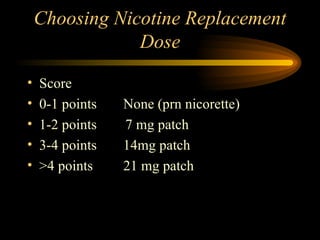
Choosing Nicotine Replacement Dose Score 0-1 points  None (prn nicorette) 1-2 points  7 mg patch 3-4 points 14mg patch >4 points  21 mg patch
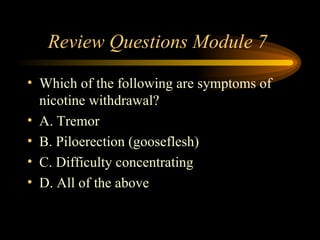
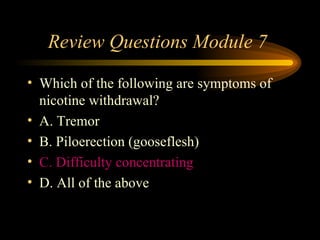
Review Questions Module 7  Which of the following are symptoms of nicotine withdrawal? A. Tremor B. Piloerection (gooseflesh) C. Difficulty concentrating D. All of the above
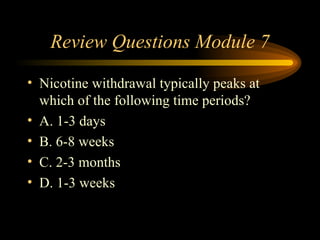
Review Questions Module 7 Nicotine withdrawal typically peaks at which of the following time periods? A. 1-3 days B. 6-8 weeks C. 2-3 months D. 1-3 weeks
Review Questions Module 7 Your patient identifies  after meals  as a potential trigger.  He likes to have a cigarette after his meals.  Which of the following coping strategies would be best to recommend? A. Think about something other than smoking after meals. B. Plan a different activity after meals, (go for a walk). C. Take a tranquilizer during the meal. D. Have a couple of beers instead.
Review Questions Module 7 Your patient identifies  after meals  as a potential trigger.  He likes to have a cigarette after his meals.  Which of the following coping strategies would be best to recommend? A. Think about something other than smoking after meals. B.  Plan a different activity after meals, (go for a walk). C. Take a tranquilizer during the meal. D. Have a couple of beers instead.
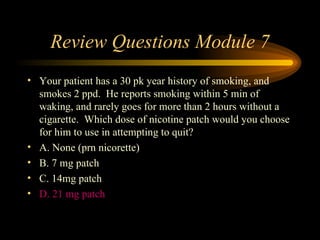
Review Questions Module 7 Your patient has a 30 pk year history of smoking, and smokes 2 ppd.  He reports smoking within 5 min of waking, and rarely goes for more than 2 hours without a cigarette.  Which dose of nicotine patch would you choose for him to use in attempting to quit? A. None (prn nicorette) B. 7 mg patch C. 14mg patch D. 21 mg patch
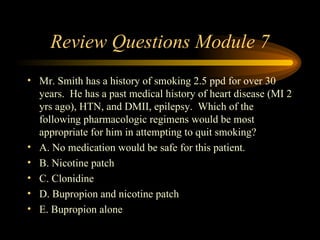
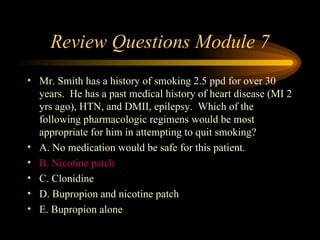
Review Questions Module 7 Mr. Smith has a history of smoking 2.5 ppd for over 30 years.  He has a past medical history of heart disease (MI 2 yrs ago), HTN, and DMII, epilepsy.  Which of the following pharmacologic regimens would be most appropriate for him in attempting to quit smoking? A. No medication would be safe for this patient. B. Nicotine patch C. Clonidine D. Bupropion and nicotine patch E. Bupropion alone
Module 8 Arrange for follow-up
Module 8 Just as pharmacotherapy without appropriate preparation is not effective for smoking cessation, neglecting to have close contact during the action stage is likely to result in relapse. There is a relationship between the frequency, intensity and duration of the contact and success in abstinence.
Module 8 Considerations in follow-up care: Daily contact in person or by phone is best for the first few weeks Discuss level of abstinence Discuss side effects from medication Discuss breakthrough withdrawal Discuss feelings regarding quit attempt Discuss triggers and coping responses
Module 8 Relapse Common, given the best practice quit rate of about 35% Empathetic, optimistic support. “ I know you have tried hard to quit, and I am certain if you continue to try, you will eventually become successful.” “ When you are ready to try again, we will take a look at what went wrong this time and develop a plan to consider those problems.”
Summary Ask: Find out who smokes. Advise: Tell them they need to quit. Assess: Who is ready to quit. Determine their readiness for change  Use motivational interviewing skills  Assist: those willing to quit Education about smoking, quitting ext. Identification of triggers Development of coping strategies Development of support network Arrange: follow-up  anticipate relapse
 

Smoking Cessation Tutorial

  • 1.
  • 2.
    SMOKING cessation Robert Mallin, MD Department Family Medicine Medical University of South Carolina
  • 3.
    General Reading RecommendationsA Clinical Practice Guideline for Treating Tobacco Use and Dependence: A US Public Health Service Report The Tobacco Use and Dependence Clinical Practice Guideline Panel, Staff, and Consortium Representatives JAMA. 2000;283:3244-3254.
  • 4.
    General Reading RecommendationsMallin R , Management of Smoking Cessation: Integration of Behavior and Pharmacotherapy. American Family Physician 65:6 1107-14 2002
  • 5.
    Module 1 EPIDEMIOLOGY
  • 6.
    Module 1 Epidemiology23.5% of adults smoke 33% young adults (18-25) smoke 70% smokers want to quit 7% will be successful quitting on their own 35% can quit with treatment
  • 7.
    Module 1 Epidemiology Annual deaths attributed to smoking…. 440,000 Cost of smoking annually… $150 billion Avg adult male and female lost years of life 13.2 Men 14.5 Women
  • 8.
    Module 1 Illness related to smoking Cardiovascular Disease Sudden death Acute myocardial infarction Unstable angina Stroke Peripheral arterial occlusive disease Aortic aneurysm Pulmonary Disease Lung cancer Chronic bronchitis Emphysema Asthma Increased susceptibility to pneumonia Increased morbidity from viral respiratory infection
  • 9.
    Module 1 Illnessrelated to smoking Gastrointestinal Disease Peptic ulcer Esophageal reflux Reproductive Disturbances Reduced fertility Premature birth Lower birth weight Spontaneous abortion Abruptio placentae Premature rupture of membranes Increased perinatal mortality
  • 10.
    Module 1 Illness related to smoking Oral Disease (Smokeless Tobacco) Oral cancer Leukoplakia Gingivitis Gingival recession Tooth staining Other Earlier menopause Osteoporosis Cataract Premature skin wrinkling Aggravation of hypothyroidism Altered drug metabolism or effects
  • 11.
    Module 1 Cancers associated with smoking Lung Larynx Oral cavity Esophagus Pancreas Bladder Kidney Stomach Leukemia Cervix
  • 12.
    Review Questions Module1 Epidemiology Which of the following reflects the percentage of smokers in the 18-25 age group? A. 23% B. 9% C. 33% D. 70%
  • 13.
    Review Questions Module1 Epidemiology Which of the following reflects the percentage of smokers in the 18-25 age group? A. 23% B. 9% C. 33% D. 70%
  • 14.
    Review Questions Module1 Epidemiology What percent of smokers would like to quit? A. 10% B. 35% C. 50% D. 70%
  • 15.
    Review Questions Module1 Epidemiology What percent of smokers would like to quit? A. 10% B. 35% C. 50% D. 70%
  • 16.
    Review Questions Module1 Epidemiology Which of the following cancers are associated with smoking? A. Bladder B. Colon C. Liver D. All of the above
  • 17.
    Review Questions Module1 Epidemiology Which of the following cancers are associated with smoking? A. Bladder B. Colon C. Liver D. All of the above
  • 18.
    Module 2 5 A’s of Smoking Cessation
  • 19.
    Module 2 Agency for Healthcare Research and Quality Clinical Guidelines Three truths about tobacco 1. All tobacco products exact devastating costs on the nation’s health and welfare. 2. For most users tobacco use results in drug dependence comparable to that of opiates, amphetamines and cocaine. 3. Chronic tobacco use warrants repeated clinical intervention as do other addictions.
  • 20.
    Module 2 Empirical Basis for Guidelines Consensus panel reviewed over 300 RCT of tobacco-use cessation interventions came to the following conclusions; Effective smoking cessation treatments are available, and every patient who smokes should be offered one or more of these treatments It is essential that clinicians determine and document the tobacco-use status of every patient treated in a health care setting.
  • 21.
    Module 2 Empirical Basis for Guidelines Brief cessation treatments are effective, and at least a minimal intervention should be provided to every patient who uses tobacco. A dose-response relation exists between the intensity and duration of a treatment and its effectiveness. In general, the more intense the treatment, the more effective it is in producing long-term abstinence from tobacco
  • 22.
    Module 2 Empirical Basis for Guidelines Three treatment elements, in particular, are effective, and one or more of these elements should be included in smoking cessation treatment Nicotine replacement therapy (nicotine patches or gum) Social support (clinician-provided encouragement and assistance) Skills training and problem solving (techniques on achieving and maintaining abstinence)
  • 23.
    Module 2 Empirical Basis for Guidelines Effective reduction of tobacco use requires that health care systems make institutional changes that result in systematic identification of, and intervention with, all tobacco users at every visit.
  • 24.
    Module 2 Primary Care Interventions 5A’s of smoking cessation 1. Ask the patient if he or she uses tobacco 2. Advise him or her to quit 3. Assess willingness to make a quit attempt 4. Assist those willing to quit 5. Arrange for follow-up contact to prevent relapse
  • 25.
    Review Questions Module2 Which of the following is true? A. Smoking is a good example of physical dependence without addiction. B. Smokers should be encouraged to quit, but treatment is rarely effective. C. Nicotine is not an addictive substance D. Longer and more intense treatment is more effective than shorter, less intense treatment for smoking cessation.
  • 26.
    Review Questions Module2 Which of the following is true? A. Smoking is a good example of physical dependence without addiction. B. Smokers should be encouraged to quit, but treatment is rarely effective. C. Nicotine is not an addictive substance D. Longer and more intense treatment is more effective than shorter, less intense treatment for smoking cessation .
  • 27.
    Review Questions Module2 The first step in the 5A’s of Smoking cessation is which of the following? A. Assess willingness to make a quit attempt. B. Advise him or her to quit C. Ask the patient if he or she uses tobacco D. Assist those willing to quit
  • 28.
    Review Questions Module2 The first step in the 5A’s of Smoking cessation is which of the following? A. Assess willingness to make a quit attempt. B. Advise him or her to quit C. Ask the patient if he or she uses tobacco D. Assist those willing to quit
  • 29.
    Module 3 Assess Tobacco Use
  • 30.
    Module 3 Assess Tobacco Use Ask if patient uses tobacco Tobacco use as a Vital Sign One of the most effective ways to Ask patients about their tobacco use if to include it in the Vital sign section of the chart. When office personnel record the patient’s tobacco use at each visit, the health care provider is three times more likely to address the issue with the patient.
  • 31.
    Module 3 Assess Tobacco Use If your patient smokes or uses tobacco, take a tobacco use history. How much do you smoke? When did you begin smoking? Have you ever quit smoking? If so, how long were you abstinent? What happened to make you start smoking again?
  • 32.
    Module 3 Assess Tobacco Use Would you like to stop smoking? Do you think you would like to make a quit attempt in the next few weeks or months? Do you have any questions about smoking cessation?
  • 33.
    Module 3 Assess Tobacco Use Smoking Patients should be placed in one of three categories. Those unwilling to make a quit attempt in the near future. Those willing to make a quit attempt in the near future Those who have recently quit.
  • 34.
    Review Questions Module3 Regarding the smoking history which of the following is true? A. Most physicians ask their patients about smoking. B. The percentage of health care providers that discuss smoking with their patients is increased by using smoking as a vital sign. C. The best way to approach a patient about their smoking is to say “ You don’t smoke do you? D. There is little use in discussing smoking with patients because very few patients want to quit.
  • 35.
    Review Questions Module3 Regarding the smoking history which of the following is true? A. Most physicians ask their patients about smoking. B. The percentage of health care providers that discuss smoking with their patients is increased by using smoking as a vital sign. C. The best way to approach a patient about their smoking is to say “ You don’t smoke do you? D. There is little use in discussing smoking with patients because very few patients want to quit.
  • 36.
    Module 4 AdviseYour patient to quit
  • 37.
    Advise himor her to quit In a clear, strong, and personalized manner, urge every tobacco user to quit. Clear —&quot;I think it is important for you to quit smoking now and I can help you.” &quot;Cutting down while you are ill is not enough.&quot; Strong—&quot;As your doctor, I need you to know that quitting smoking is the most important thing you can do to protect your health now and in the future. The clinic staff and I will help you.&quot;
  • 38.
    Advise himor her to quit In a clear, strong, and personalized manner, urge every tobacco user to quit. Personalized —Tie tobacco use to current health/ illness, and/or its social and economic costs, motivation level/readiness to quit, and/or the impact of tobacco use on children and others in the household “Your asthma will improve when you stop smoking”
  • 39.
    Assess willingness to make a quit attempt Ask every tobacco user if he or she is willing to make a quit attempt at this time (e.g., within the next 30 days). Current users who are willing to quit Current users unwilling to quit at this time
  • 40.
    Review Questions Module4 Which of the following is the most appropriate message to give your patient about smoking? A. “You know you should quit smoking, don’t you?” B. “If you cannot quit smoking, I think you should find another doctor.” C. “You will certainly die if you continue to smoke” D. “ Mr. Jones, as your doctor, I have to tell you that the most important action you can take to improve your health would be to quit smoking.”
  • 41.
    Review Questions Module4 Which of the following is the most appropriate message to give your patient about smoking? A. “You know you should quit smoking, don’t you?” B. “If you cannot quit smoking, I think you should find another doctor.” C. “You will certainly die if you continue to smoke” D. “ Mr. Jones, as your doctor, I have to tell you that the most important action you can take to improve your health would be to quit smoking.”
  • 42.
    Module 5 Stages of Change
  • 43.
    Module 5 Reading A 'stages of change' approach to helping patients change behavior. Zimmerman GL - Am Fam Physician - 1-Mar-2000; 61(5): 1409-16
  • 44.
    Stages of ChangeProchaska and DiClemente used smoking cessation as the model for the development of the stages of change. This model may be used to assess the readiness of your patient to change and can guide you in which techniques of motivational interviewing (discussed later) will be most effective in helping your patient move closer to their goal.
  • 45.
    Stages of ChangePrecontemplative “ I don’t have a problem.” These are patient’s who really do not think that smoking is a problem for them. They are not considering quitting Contemplative “ I think I may need to quit, but I’m not ready.” These patients recognize that they need to quit smoking and may even want to quit but are currently not ready to commit to giving it a try.
  • 46.
    Stages of ChangePreparation “ I want to quit.” This is a patient who is ready to commit to making a quit attempt. Action “ I stopped smoking today.” Maintenance/Relapse Refers the continuation of the behavior change or the relapse to old behavior (smoking) after the change has been made.
  • 47.
    Stages of ChangeRemember, patients predictably go through these stages when they make any significant change. They cannot “jump” stages. Consequently, expecting a patient to move from precontemplation to action without going through contemplation and preparation is unrealistic. So your goal for the patient in precontemplation should be for them to get to contemplation. This has considerable importance as we discuss motivational interviewing techniques
  • 48.
    Review Questions Module5 Choose the appropriate stage of change for the following statement. “ Doc, this scare about smoking is a government conspiracy to get the tobacco companies.” A. Precontemplation B. Contemplation C. Preparation D. Action E. Maintenance
  • 49.
    Review Questions Module5 Choose the appropriate stage of change for the following statement. “ Doc, this scare about smoking is a government conspiracy to get the tobacco companies.” A. Precontemplation B. Contemplation C. Preparation D. Action E. Maintenance
  • 50.
    Review Questions Module5 Choose the appropriate stage of change for the following statement. “ I set my quit date for three weeks from tomorrow.” A. Precontemplation B. Contemplation C. Preparation D. Action E. Maintenance
  • 51.
    Review Questions Module5 Choose the appropriate stage of change for the following statement. “ I set my quit date for three weeks from tomorrow.” A. Precontemplation B. Contemplation C. Preparation D. Action E. Maintenance
  • 52.
    Review Questions Module5 Choose the appropriate stage of change for the following statement. “ I am worried about my smoking, but I just don’t seem to be able to quit.” A. Precontemplation B. Contemplation C. Preparation D. Action E. Maintenance
  • 53.
    Review Questions Module5 Choose the appropriate stage of change for the following statement. “ I am worried about my smoking, but I just don’t seem to be able to quit.” A. Precontemplation B. Contemplation C. Preparation D. Action E. Maintenance
  • 54.
    Review Questions Module5 Choose the appropriate stage of change for the following statement. “ I stopped smoking over a year ago.” A. Precontemplation B. Contemplation C. Preparation D. Action E. Maintenance
  • 55.
    Review Questions Module5 Choose the appropriate stage of change for the following statement. “ I stopped smoking over a year ago.” A. Precontemplation B. Contemplation C. Preparation D. Action E. Maintenance
  • 56.
    Module 6 MotivationalInterviewing For those unwilling to make a quit attempt at this time
  • 57.
    Reading for Module6 Motivational interviewing in health care settings: Opportunities and limitations, Karen M. Emmons and Stephen Rollnick American Journal of Preventive Medicine Volume 20, Issue 1 , January 2001, Pages 68-74
  • 58.
    Motivational Interviewing Motivationalinterviewing as developed by Miller and Rollnick is a technique to help patients change behavior. In the context of this module you will learn suggestions that will help your patients move to the next stage of change in.
  • 59.
    Motivational Interviewing GeneralPrinciples Expressing empathy by the use of reflective listening. Developing discrepancy between the patients goals and current behavior by the use of reflective listening and objective feedback. Avoiding arguments by assuming that the patient is responsible for the decision to change. Rolling with resistance rather than confronting or opposing it. Supporting self efficacy and optimism for change.
  • 60.
    Motivational Interviewing GeneralPrinciples Examples Expressing empathy by the use of reflective listening. “ Stopping smoking is difficult, I can see that you have tried hard to quit.” Developing discrepancy between the patients goals and current behavior by the use of reflective listening and objective feedback. “ I heard you say that you are concerned for your health, and that you know that smoking is harming your health. I wonder how it makes you feel to be continuing to smoke under these conditions?”
  • 61.
    Motivational Interviewing Avoidingarguments by assuming that the patient is responsible for the decision to change. “ I’d really like to help you, but only you can decide of you want to quit.” Rolling with resistance rather than confronting or opposing it. “ It sounds like you are not ready to consider quitting right now. Would it be ok if we continued this conversation another time?” Supporting self efficacy and optimism for change. Stopping smoking is really hard, but I am certain that you can be successful.”
  • 62.
    Motivational Interviewing forthe Precontemplative/Contemplative 5Rs Relevance Risks Rewards Roadblocks Repitition
  • 63.
    Motivational Interviewing forthe Pre-contemplative/Contemplative Relevance Encourage the patient to indicate why quitting is personally relevant to their disease status or risk factors. “Your family history and hypertension increase your risk for cardiovascular disease. Stopping smoking would improve your risk greatly.”
  • 64.
    Motivational Interviewing forthe Pre-contemplative/Contemplative Risks Ask the patient to identify potential negative effects of smoking Acute risks: SOB, exacerbation of Asthma, cough Long term risks: MI, CVA, cancer, lung, bladder, cervix, COPD, costs for extended care Environmental risks: Increased risk of lung cancer, in non-smokers exposed, low birth weight, increased respiratory infections in children
  • 65.
    Motivational Interviewing forthe Pre-contemplative/Contemplative Rewards Ask the patient to identify potential benefits of stopping smoking that seem most relevant to the patient improved smell and taste, saved money improved conditioning reduced skin damage healthier children
  • 66.
    Motivational Interviewing forthe Pre-contemplative/Contemplative Roadblocks Ask the patient to identify potential barriers lack of support depression loss of enjoyment of tobacco weight gain cost of pharmacotherapy
  • 67.
    Motivational Interviewing forthe Pre-contemplative/Contemplative Repetition repeat motivational interviewing each time you see patient. Failed attempts to quit should be met with the understanding that most people require multiple attempts to quit “You will almost certainly be successful if you keep trying.”
  • 68.
    Review Questions Module6 Which of the following statements reflect empathy on the part of the interviewer? A. “I heard you say that you are concerned for your health, and that you know that smoking is harming your health. I wonder how it makes you feel to be continuing to smoke under these conditions?” B. “I’d really like to help you, but only you can decide of you want to quit.” C. “Stopping smoking is really hard, but I am certain that you can be successful.” D. “Stopping smoking is difficult, I can see that you have tried hard to quit.”
  • 69.
    Review Questions Module6 Which of the following statements reflect empathy on the part of the interviewer? A. “I heard you say that you are concerned for your health, and that you know that smoking is harming your health. I wonder how it makes you feel to be continuing to smoke under these conditions?” B. “I’d really like to help you, but only you can decide of you want to quit.” C. “Stopping smoking is really hard, but I am certain that you can be successful.” D. “Stopping smoking is difficult, I can see that you have tried hard to quit.”
  • 70.
    Review Questions Module6 Which of the following might be a roadblock to a patient making the necessary changes to quit smoking? A. Lack of support B. Other Smokers C. Drinking alcohol D. Improved smell and taste
  • 71.
    Review Questions Module6 Which of the following might be a roadblock to a patient making the necessary changes to quit smoking? A. Lack of support B. Other Smokers C. Drinking alcohol D. Improved smell and taste
  • 72.
    Review Questions Module6 Choose the best response to the following statement made by your patient..”Doc, I just don’t want to talk about my smoking today.” A. “Mr. Smith I must tell you that you simply have to quit smoking” B. “Why not? Are you afraid of something?” C. “OK, can we come back to this another time then?” D. “Can you tell me what smoking is doing to your health?”
  • 73.
    Review Questions Module6 Choose the best response to the following statement made by your patient..”Doc, I just don’t want to talk about my smoking today.” A. “Mr. Smith I must tell you that you simply have to quit smoking” B. “Why not? Are you afraid of something?” C. “OK, can we come back to this another time then?” D. “Can you tell me what smoking is doing to your health?”
  • 74.
    Module 7 AssistThose willing to attempt to quit
  • 75.
    Module 7 Finally!Your patient tells you they are ready to make a quit attempt. What now? Write a Rx for Zyban or the patch and tell them good luck? Hardly! Now the real work begins.
  • 76.
    Motivational Interviewing forPreparation/Action Stages Identification of triggers Other smokers Drinking alcohol Experiencing urges Stressful situations
  • 77.
    Motivational Interviewing forPreparation/Action Stages Identification of Coping Strategies Anticipate, and avoid temptation. Cognitive strategies reduce stress and negative mood. Lifestyle changes that improve quality of life. Learning cognitive and behavioral strategies to deal with urges to smoke.
  • 78.
    Motivational Interviewing forPreparation/Action Stages Provide basic information about smoking and successful quitting Any smoking will likely result in relapse Withdrawal typically peaks between 1-3 weeks of smoking cessation Withdrawal symptoms include depressed mood, irritability, urges to smoke, and difficulty concentrating.
  • 79.
    Motivational Interviewing forPreparation/Action Stages Intratreatment Support Encourage the patient to quit Effective treatment for nicotine dependence is available. Half of the people who have ever smoked have quit. “ You can quit smoking, I am certain of it.”
  • 80.
    Motivational Interviewing forPreparation/Action Stages Intratreatment Support Communicate caring and concern Ask patient how they feel about quitting. Directly express concern and willingness to help. Be open to the patients fears about quitting, difficulties experienced, and ambivalent feelings.
  • 81.
    Motivational Interviewing forPreparation/Action Stages Intratreatment Support Encourage the patient to talk about the quitting process Ask about Reasons patient wants to quit Concerns or worries about quitting Success patient has achieved Difficulties encountered while quitting
  • 82.
    Motivational Interviewing forPreparation/Action Stages Extra treatment support Train Patient in support solicitation skills Videos Practice asking family friends, co-workers for support Help patient to establish smoke free home
  • 83.
    Motivational Interviewing forPreparation/Action Stages Extra treatment support Prompt support seeking Help patient identify support Remind patient to call supportive others Community resources of support
  • 84.
    Motivational Interviewing forPreparation/Action Stages Extra treatment support Clinician arranges outside support Mail letters to supportive others Call supportive others Assign patients to be “buddies” to one another
  • 85.
    Specific Recommendations inPreparation for Smoking Cessation Set a quit date. Read educational materials Make a list of triggers Make a list of coping strategies Make a list of support network Remove all smoking paraphernalia from home, car office. Be sure to understand the appropriate use of pharmacological aids
  • 86.
    Pharmacotherapy for SmokingCessation Two Goals: 1.Reduce the symptoms of nicotine withdrawal. (physical dependence) 2.Reduce craving for nicotine. (addiction) Nicotine replacement therapy addresses the first goal Bupropion addresses both goals. Either nicotine replacement, or bupropion increases quit rates from 7% (no therapy) to about 30% (with therapy and social support). There is suggestive evidence that using both bupropion and nicotine replacement is somewhat better than either one alone.
  • 87.
    Pharmacotherapy for Preparation/ActionStages Who should get pharmacotherapy? All smokers except smoking less than 10 cigarettes/d Pregnant Breast feeding Adolescent
  • 88.
    Pharmacotherapy for Preparation/ActionStages Which treatments are considered first line, FDA approved? Bupropion Nicotine gum Nicotine inhaler Nicotine nasal spray Nicotine patches
  • 89.
    Pharmacotherapy for Preparation/ActionStages Bupropion (sustained release) Precautions/Contraindications Seizure, eating disorders Adverse effects Insomnia, Dry mouth Dose 150mg QD X3 then 150mg BID Begin 2 wks prior to quit date
  • 90.
    Pharmacotherapy for Preparation/ActionStages Bupropion (sustained release) Duration 7-12 wks up to 6 mos. Cost/day $3.30/day
  • 91.
    Pharmacotherapy for Preparation/ActionStages Nicotine Gum Adverse effects Mouth soreness, dyspepsia Dosage 1-24 cig./d 2mg up to 24/d >25 cig./d 4mg up to 24/d Duration up to 12 weeks Cost/day about $7/d for 10 pieces
  • 92.
    Pharmacotherapy for Preparation/ActionStages Nicotine inhaler Adverse effects local irritation mouth and throat Dose 6-16 cartridges/d Duration up to 6 months Cost/day about $11.00/10 cartridges
  • 93.
    Pharmacotherapy for Preparation/ActionStages Nicotine nasal spray Adverse effects nasal irritation Dose 8-40 doses/d Duration 3-6 mos Cost/day $5.40/12 doses
  • 94.
    Pharmacotherapy for Preparation/ActionStages Nicotine Patch Adverse effects Local skin reactions, insomnia Dose 21mg, 14mg, 7 mg Duration 4wks (21mg) 2wks (14mg) 2wks 7 mg Cost/day $4.22
  • 95.
    Pharmacotherapy for Preparation/ActionStages All of the nicotine replacement therapies appear to be equally efficacious. Consequently it is best to allow the patient to choose which type of nicotine delivery system they prefer. More than one system can be used, ie. gum in addition to the patch. If the patient is perceiving withdrawal symptoms on the patch alone.
  • 96.
    Pharmacotherapy for Preparation/ActionStages Second line medications Clonidine Adverse reactions: dry mouth drowsiness, dizziness sedation Dose: 0.15-0.75mg/d Duration: 3-10 wks Cost/day: $0.25
  • 97.
    Pharmacotherapy for Preparation/ActionStages Second line Medications Nortryptaline Precautions: risk of arrythmias Adverse effects: sedation dry mouth Dose: 75-100mg /d Duration: 12 wks Cost: $0.75/d
  • 98.
    Choosing Nicotine ReplacementDose Modified Fagerstrom Score 1. How many cigarettes do you smoke daily? 0-10 0 points 10-20 1 point 20+ 2 points
  • 99.
    Choosing Nicotine ReplacementDose 2. How soon after waking do you smoke? 1hour + 0 points 30m-1hr 1 point < 30m 2 points
  • 100.
    Choosing Nicotine ReplacementDose 3. How long can you comfortably go w/o smoking? >2 hrs 0 points 1-2 hrs 1 point <1 hr 2 points
  • 101.
    Choosing Nicotine ReplacementDose Score 0-1 points None (prn nicorette) 1-2 points 7 mg patch 3-4 points 14mg patch >4 points 21 mg patch
  • 102.
    Review Questions Module7 Which of the following are symptoms of nicotine withdrawal? A. Tremor B. Piloerection (gooseflesh) C. Difficulty concentrating D. All of the above
  • 103.
    Review Questions Module7 Which of the following are symptoms of nicotine withdrawal? A. Tremor B. Piloerection (gooseflesh) C. Difficulty concentrating D. All of the above
  • 104.
    Review Questions Module7 Nicotine withdrawal typically peaks at which of the following time periods? A. 1-3 days B. 6-8 weeks C. 2-3 months D. 1-3 weeks
  • 105.
    Review Questions Module7 Nicotine withdrawal typically peaks at which of the following time periods? A. 1-3 days B. 6-8 weeks C. 2-3 months D. 1-3 weeks
  • 106.
    Review Questions Module7 Your patient identifies after meals as a potential trigger. He likes to have a cigarette after his meals. Which of the following coping strategies would be best to recommend? A. Think about something other than smoking after meals. B. Plan a different activity after meals, (go for a walk). C. Take a tranquilizer during the meal. D. Have a couple of beers instead.
  • 107.
    Review Questions Module7 Your patient identifies after meals as a potential trigger. He likes to have a cigarette after his meals. Which of the following coping strategies would be best to recommend? A. Think about something other than smoking after meals. B. Plan a different activity after meals, (go for a walk). C. Take a tranquilizer during the meal. D. Have a couple of beers instead.
  • 108.
    Review Questions Module7 Your patient has a 30 pk year history of smoking, and smokes 2 ppd. He reports smoking within 5 min of waking, and rarely goes for more than 2 hours without a cigarette. Which dose of nicotine patch would you choose for him to use in attempting to quit? A. None (prn nicorette) B. 7 mg patch C. 14mg patch D. 21 mg patch
  • 109.
    Review Questions Module7 Your patient has a 30 pk year history of smoking, and smokes 2 ppd. He reports smoking within 5 min of waking, and rarely goes for more than 2 hours without a cigarette. Which dose of nicotine patch would you choose for him to use in attempting to quit? A. None (prn nicorette) B. 7 mg patch C. 14mg patch D. 21 mg patch
  • 110.
    Review Questions Module7 Mr. Smith has a history of smoking 2.5 ppd for over 30 years. He has a past medical history of heart disease (MI 2 yrs ago), HTN, and DMII, epilepsy. Which of the following pharmacologic regimens would be most appropriate for him in attempting to quit smoking? A. No medication would be safe for this patient. B. Nicotine patch C. Clonidine D. Bupropion and nicotine patch E. Bupropion alone
  • 111.
    Review Questions Module7 Mr. Smith has a history of smoking 2.5 ppd for over 30 years. He has a past medical history of heart disease (MI 2 yrs ago), HTN, and DMII, epilepsy. Which of the following pharmacologic regimens would be most appropriate for him in attempting to quit smoking? A. No medication would be safe for this patient. B. Nicotine patch C. Clonidine D. Bupropion and nicotine patch E. Bupropion alone
  • 112.
    Module 8 Arrangefor follow-up
  • 113.
    Module 8 Justas pharmacotherapy without appropriate preparation is not effective for smoking cessation, neglecting to have close contact during the action stage is likely to result in relapse. There is a relationship between the frequency, intensity and duration of the contact and success in abstinence.
  • 114.
    Module 8 Considerationsin follow-up care: Daily contact in person or by phone is best for the first few weeks Discuss level of abstinence Discuss side effects from medication Discuss breakthrough withdrawal Discuss feelings regarding quit attempt Discuss triggers and coping responses
  • 115.
    Module 8 RelapseCommon, given the best practice quit rate of about 35% Empathetic, optimistic support. “ I know you have tried hard to quit, and I am certain if you continue to try, you will eventually become successful.” “ When you are ready to try again, we will take a look at what went wrong this time and develop a plan to consider those problems.”
  • 116.
    Summary Ask: Findout who smokes. Advise: Tell them they need to quit. Assess: Who is ready to quit. Determine their readiness for change Use motivational interviewing skills Assist: those willing to quit Education about smoking, quitting ext. Identification of triggers Development of coping strategies Development of support network Arrange: follow-up anticipate relapse
  • 117.