
Presented By- Vikas
Sharma
Dementia
About Dementia
ļ‚— A chronic or persistent disorder of the mental
processes caused by brain disease or injury and
marked by memory disorders, personality
changes, and impaired reasoning.
ļ‚— Dementia is a syndrome caused by brain cell
death. Neurodegenerative disease is behind most
dementias.
ļ‚— There are an estimated 47.5 million dementia
sufferers worldwide.
ļ‚— This figure is expected to increase to 75.6 million
by 2030 and 135.5 million by 2050.
ļ‚— The current cost of dementia to worldwide
healthcare systems is estimated to be $604
billion.
Symptoms
ļ‚— Memory loss that disrupts daily life.
ļ‚— Difficulty solving problems.
ļ‚— Difficulty completing familiar tasks.
ļ‚— Confusion related to time or place.
ļ‚— Problems understanding visual images or spatial
relationships.
ļ‚— Problems speaking or writing.
ļ‚— Misplacing items.
ļ‚— Poor judgment.
ļ‚— Withdrawal from work or social life.
ļ‚— Changes in personality or mood.
Causes of Dementia
ļ‚— Degenerative neurological diseases
ļ‚— Traumatic brain injury
ļ‚— Infections of the central nervous system such as
meningitis, HIV etc.
ļ‚— Chronic alcohol or drug use
ļ‚— Depression
ļ‚— Certain types of hydrocephalus, an excess
accumulation of fluid in the brain that can result
from developmental abnormalities, infections,
injury, or brain tumors
Types of Dementia
ļ‚— Dementia can be split into two broad categories --
the cortical dementias and the subcortical
dementias -- based on which part of the brain is
affected--
ļ‚— Cortical dementias arise from a disorder
affecting the cerebral cortex, the outer layers of
the brain that play a critical role in thinking
abilities like memory and language. Alzheimer's
and Creutzfeldt-Jakob disease are two forms of
cortical dementia. People with cortical dementia
typically show severe memory loss and aphasia --
the inability to recall words and understand
language.
.
ļ‚— Subcortical dementias result from dysfunction
in the parts of the brain that are beneath the
cortex. Usually, the forgetfulness and language
difficulties that are characteristic of cortical
dementias are not present. Rather, people with
subcortical dementias, such as Parkinson's
disease, Huntington's disease, and AIDS
dementia complex, tend to show changes in
their speed of thinking and ability to initiate
activities.
Management of Dementia
ļ‚— Symptoms of Dementia can be reduced by drugs
to help improve an individual's quality of life - there
are four drugs in a class called cholinesterase
inhibitor.
ļ‚— Donepezil
ļ‚— Alantamine
ļ‚— Rivastigmine
ļ‚— Tacrine
ļ‚— A different kind of drug, Memantine an "NMDA
receptor antagonist", may also be used, alone or in
combination with a cholinesterase inhibitor.
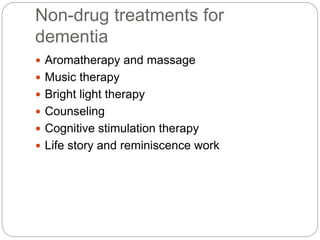
Non-drug treatments for
dementia
ļ‚— Aromatherapy and massage
ļ‚— Music therapy
ļ‚— Bright light therapy
ļ‚— Counseling
ļ‚— Cognitive stimulation therapy
ļ‚— Life story and reminiscence work
Reference
ļ‚— http://www.alzheimers.org.uk/site/scripts/docume
nts_info.php?documentID=2231&pageNumber=2
ļ‚— http://www.medicalnewstoday.com/articles/14221
4.php?page=2#treatment_and_prevention
ļ‚— http://www.webmd.com/alzheimers/guide/alzheim
ers-dementia
Dementia & Management

Dementia & Management

  • 1.
  • 2.
    About Dementia ļ‚— Achronic or persistent disorder of the mental processes caused by brain disease or injury and marked by memory disorders, personality changes, and impaired reasoning. ļ‚— Dementia is a syndrome caused by brain cell death. Neurodegenerative disease is behind most dementias. ļ‚— There are an estimated 47.5 million dementia sufferers worldwide. ļ‚— This figure is expected to increase to 75.6 million by 2030 and 135.5 million by 2050. ļ‚— The current cost of dementia to worldwide healthcare systems is estimated to be $604 billion.
  • 4.
    Symptoms ļ‚— Memory lossthat disrupts daily life. ļ‚— Difficulty solving problems. ļ‚— Difficulty completing familiar tasks. ļ‚— Confusion related to time or place. ļ‚— Problems understanding visual images or spatial relationships. ļ‚— Problems speaking or writing. ļ‚— Misplacing items. ļ‚— Poor judgment. ļ‚— Withdrawal from work or social life. ļ‚— Changes in personality or mood.
  • 5.
    Causes of Dementia ļ‚—Degenerative neurological diseases ļ‚— Traumatic brain injury ļ‚— Infections of the central nervous system such as meningitis, HIV etc. ļ‚— Chronic alcohol or drug use ļ‚— Depression ļ‚— Certain types of hydrocephalus, an excess accumulation of fluid in the brain that can result from developmental abnormalities, infections, injury, or brain tumors
  • 6.
    Types of Dementia ļ‚—Dementia can be split into two broad categories -- the cortical dementias and the subcortical dementias -- based on which part of the brain is affected-- ļ‚— Cortical dementias arise from a disorder affecting the cerebral cortex, the outer layers of the brain that play a critical role in thinking abilities like memory and language. Alzheimer's and Creutzfeldt-Jakob disease are two forms of cortical dementia. People with cortical dementia typically show severe memory loss and aphasia -- the inability to recall words and understand language.
  • 7.
    . ļ‚— Subcortical dementiasresult from dysfunction in the parts of the brain that are beneath the cortex. Usually, the forgetfulness and language difficulties that are characteristic of cortical dementias are not present. Rather, people with subcortical dementias, such as Parkinson's disease, Huntington's disease, and AIDS dementia complex, tend to show changes in their speed of thinking and ability to initiate activities.
  • 8.
    Management of Dementia ļ‚—Symptoms of Dementia can be reduced by drugs to help improve an individual's quality of life - there are four drugs in a class called cholinesterase inhibitor. ļ‚— Donepezil ļ‚— Alantamine ļ‚— Rivastigmine ļ‚— Tacrine ļ‚— A different kind of drug, Memantine an "NMDA receptor antagonist", may also be used, alone or in combination with a cholinesterase inhibitor.
  • 9.
    Non-drug treatments for dementia ļ‚—Aromatherapy and massage ļ‚— Music therapy ļ‚— Bright light therapy ļ‚— Counseling ļ‚— Cognitive stimulation therapy ļ‚— Life story and reminiscence work
  • 10.