1
DEMENTIA
Dr Kamal Kejriwal MD AAFP, CMD
Geriatric Fellowship Program
Director, Kaiser Fontana
Dr Sherif Iskander Geriatric Fellows
Dr Marian Assal, Geriatrician,
Kaiser Fontana
2
OBJECTIVES
Know and understand:
• The risks for and causes of dementia
• The evaluation of patients with dementia
• How to plan behavioral and pharmacologic
treatment strategies to minimize the personal,
social, & financial impacts of dementia
• How to refer patients and caregivers to
available community resources
3
TOPICS COVERED
• Epidemiology and Societal Impact
• Risk Factors and Prevention
• Assessment Methods
• Differential Diagnosis
• Treatment and Management
• Resources
http://www.aoa.gov/AoARoot/Aging_Statistics/future_growth/future_growth.aspx#
gender
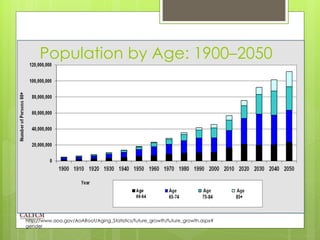
Population by Age: 1900–2050
5October 23, 2014
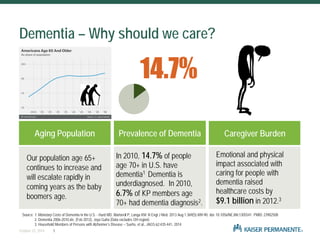
Dementia – Why should we care?
Aging Population Prevalence of Dementia Caregiver Burden
Our population age 65+
continues to increase and
will escalate rapidly in
coming years as the baby
boomers age.
In 2010, 14.7% of people
age 70+ in U.S. have
dementia1 Dementia is
underdiagnosed. In 2010,
6.7% of KP members age
70+ had dementia diagnosis2.
Emotional and physical
impact associated with
caring for people with
dementia raised
healthcare costs by
$9.1 billion in 2012.3
14.7%
Source: 1. Monetary Costs of Dementia in the U.S. - Hurd MD, Martorell P, Langa KM. N Engl J Med. 2013 Aug 1;369(5):489-90. doi: 10.1056/NEJMc1305541. PMID: 23902508
2. Dementia 2006-2010.xls. (Feb 2012), Joya Guha (Data excludes OH region)
3. Household Members of Persons with Alzheimer’s Disease – Suehs, et al., JAGS 62:435-441, 2014
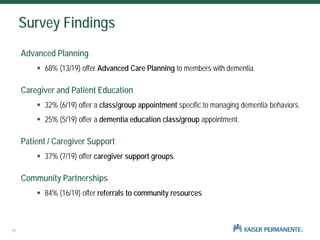
Survey Findings
Dementia Care looks very different across regions
KP is on track with many National and State standards, but there is room for
improvement
Advanced Planning
 68% (13/19) offer Advanced Care Planning to members with dementia.
Caregiver and Patient Education
 32% (6/19) offer a class/group appointment specific to managing dementia behaviors.
 25% (5/19) offer a dementia education class/group appointment.
Patient / Caregiver Support
 37% (7/19) offer caregiver support groups.
Community Partnerships
 84% (16/19) offer referrals to community resources.
11
4
WHAT IS DEMENTIA?
• An acquired syndrome of decline in memory
and other cognitive functions sufficient to
affect daily life in an alert patient
• Progressive and disabling
• Not an inherent aspect of aging
• Different from normal cognitive lapses
5
THE EPIDEMIOLOGY OF
DEMENTIA
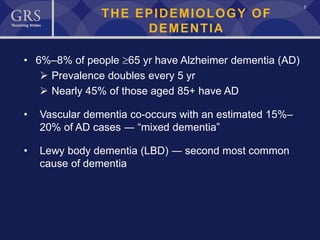
• 6%‒8% of people ≥65 yr have Alzheimer dementia (AD)
 Prevalence doubles every 5 yr
 Nearly 45% of those aged 85+ have AD
• Vascular dementia co-occurs with an estimated 15%–
20% of AD cases ― “mixed dementia”
• Lewy body dementia (LBD) ― second most common
cause of dementia
7
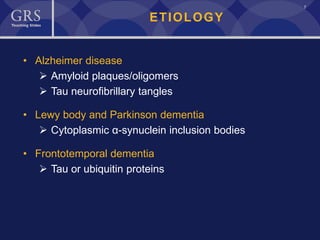
ETIOLOGY
• Alzheimer disease
 Amyloid plaques/oligomers
 Tau neurofibrillary tangles
• Lewy body and Parkinson dementia
 Cytoplasmic α-synuclein inclusion bodies
• Frontotemporal dementia
 Tau or ubiquitin proteins
9
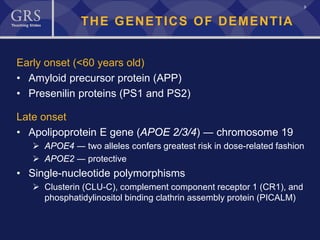
THE GENETICS OF DEMENTIA
Early onset (<60 years old)
• Amyloid precursor protein (APP)
• Presenilin proteins (PS1 and PS2)
Late onset
• Apolipoprotein E gene (APOE 2/3/4) ― chromosome 19
 APOE4 ― two alleles confers greatest risk in dose-related fashion
 APOE2 ― protective
• Single-nucleotide polymorphisms
 Clusterin (CLU-C), complement component receptor 1 (CR1), and
phosphatidylinositol binding clathrin assembly protein (PICALM)
8
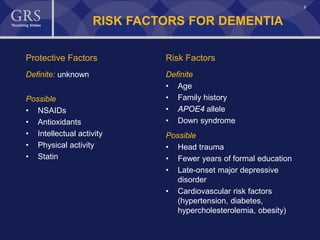
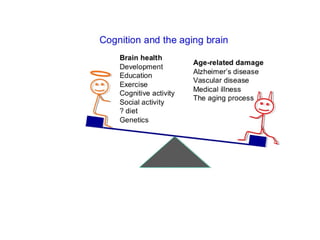
RISK FACTORS FOR DEMENTIA
Protective Factors
Definite: unknown
Possible
• NSAIDs
• Antioxidants
• Intellectual activity
• Physical activity
• Statin
Risk Factors
Definite
• Age
• Family history
• APOE4 allele
• Down syndrome
Possible
• Head trauma
• Fewer years of formal education
• Late-onset major depressive
disorder
• Cardiovascular risk factors
(hypertension, diabetes,
hypercholesterolemia, obesity)
10
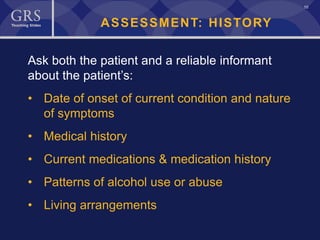
ASSESSMENT: HISTORY
Ask both the patient and a reliable informant
about the patient’s:
• Date of onset of current condition and nature
of symptoms
• Medical history
• Current medications & medication history
• Patterns of alcohol use or abuse
• Living arrangements
11
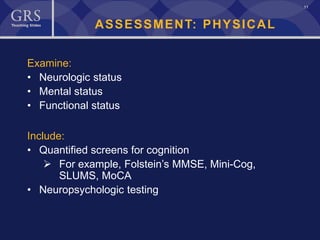
ASSESSMENT: PHYSICAL
Examine:
• Neurologic status
• Mental status
• Functional status
Include:
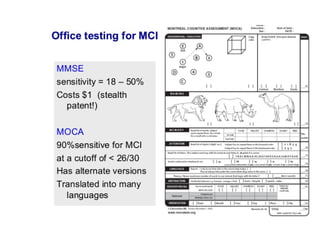
• Quantified screens for cognition
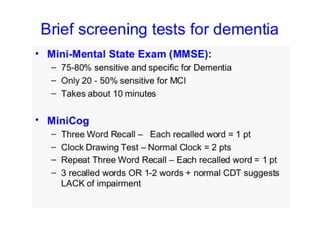
 For example, Folstein’s MMSE, Mini-Cog,
SLUMS, MoCA
• Neuropsychologic testing
12
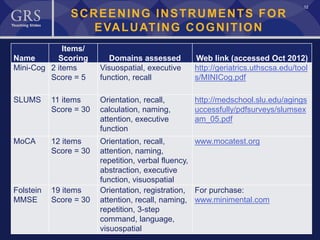
SCREENING INSTRUMENTS FOR
EVALUATING COGNITION
Name
Items/
Scoring Domains assessed Web link (accessed Oct 2012)
Mini-Cog 2 items
Score = 5
Visuospatial, executive
function, recall
http://geriatrics.uthscsa.edu/tool
s/MINICog.pdf
SLUMS 11 items
Score = 30
Orientation, recall,
calculation, naming,
attention, executive
function
http://medschool.slu.edu/agings
uccessfully/pdfsurveys/slumsex
am_05.pdf
MoCA 12 items
Score = 30
Orientation, recall,
attention, naming,
repetition, verbal fluency,
abstraction, executive
function, visuospatial
www.mocatest.org
Folstein
MMSE
19 items
Score = 30
Orientation, registration,
attention, recall, naming,
repetition, 3-step
command, language,
visuospatial
For purchase:
www.minimental.com
13
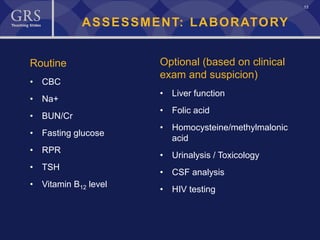
ASSESSMENT: LABORATORY
Routine
• CBC
• Na+
• BUN/Cr
• Fasting glucose
• RPR
• TSH
• Vitamin B12 level
Optional (based on clinical
exam and suspicion)
• Liver function
• Folic acid
• Homocysteine/methylmalonic
acid
• Urinalysis / Toxicology
• CSF analysis
• HIV testing
14
ASSESSMENT: BRAIN IMAGING
Consider imaging when:
• Onset occurs at age <65 years
• Neurologic signs are asymmetric or focal
• Clinical picture suggests normal-pressure hydrocephalus
• Patient has had recent fall or other head trauma
Consider:
• Noncontrast computed topography head scan
• Magnetic resonance imaging
• Positron emission tomography
15
DIFFERENTIAL DIAGNOSIS
• Normal aging
• Mild cognitive impairment
• Delirium
• Depression
• Alzheimer disease
• Vascular dementia
• Lewy body dementia
• Other (frontotemporal dementia, alcohol, Parkinson
disease, neurosyphilis)
16
NORMAL AGING
• No consistent, progressive deviations on testing
of memory
• Some decline in processing and recall of new
information: slower, harder
• Reminders work—visual tips, notes
• Absence of significant effects on ADLs or IADLs
due to cognition
17
MILD COGNITIVE IMPAIRMENT
• Subjective complaint of decline in at least one cognitive
domain: noticeable and measurable
• No impairment in independent living
• 9.4 to 14.3/1000 person-years convert to Alzheimer
disease
• ~50% with amnestic MCI maintain stable level of
impairment or return to normal cognitive status in 3−5 yr
18
DELIRIUM VS. DEMENTIA
• Delirium and dementia often occur together in older
hospitalized patients
• The distinguishing signs of delirium are:
 Acute onset
 Cognitive fluctuations over hours or days
 Impaired consciousness and attention
 Altered sleep cycles
 Search for underlying dementia once delirium cleared
19
DEPRESSION VS. DEMENTIA (1 of 2)
The symptoms of depression and dementia often
overlap:
• Impaired concentration
• Lack of motivation, loss of interest, apathy
• Psychomotor retardation
• Sleep disturbance
20
DEPRESSION VS. DEMENTIA (2 of 2)
• Patients with primary depression are generally
unlike those with dementia in that they:
 Demonstrate ↓ motivation during cognitive testing
 Express cognitive complaints that exceed
measured deficits
 Maintain language and motor skills
• ~50% presenting with reversible dementia and
depression progress to dementia within 5 yr
21
ALZHEIMER DISEASE
• Onset: gradual
• Cognitive symptoms: memory impairment core feature
with difficulty learning new information
• Motor symptoms: rare early, apraxia later
• Progression: gradual, over 8–10 yr on average
• Lab tests: normal
• Imaging: possible global atrophy, small hippocampal
volumes
22
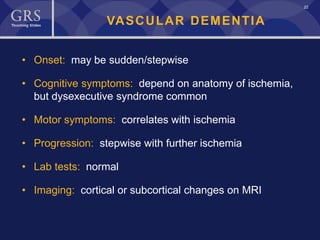
VASCULAR DEMENTIA
• Onset: may be sudden/stepwise
• Cognitive symptoms: depend on anatomy of ischemia,
but dysexecutive syndrome common
• Motor symptoms: correlates with ischemia
• Progression: stepwise with further ischemia
• Lab tests: normal
• Imaging: cortical or subcortical changes on MRI
23
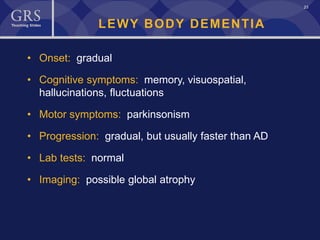
LEWY BODY DEMENTIA
• Onset: gradual
• Cognitive symptoms: memory, visuospatial,
hallucinations, fluctuations
• Motor symptoms: parkinsonism
• Progression: gradual, but usually faster than AD
• Lab tests: normal
• Imaging: possible global atrophy
24
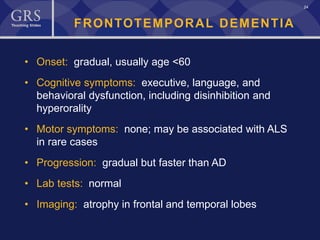
FRONTOTEMPORAL DEMENTIA
• Onset: gradual, usually age <60
• Cognitive symptoms: executive, language, and
behavioral dysfunction, including disinhibition and
hyperorality
• Motor symptoms: none; may be associated with ALS
in rare cases
• Progression: gradual but faster than AD
• Lab tests: normal
• Imaging: atrophy in frontal and temporal lobes
27
PRIMARY GOAL OF TREATMENT
To enhance quality of life and
maximize functional performance by
improving cognition, mood, and behavior
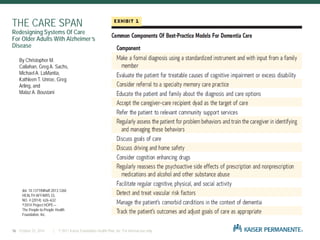
THE CARE SPAN
Redesigning Systems Of Care
For Older Adults With Alzheimer’s
Disease
16 | © 2011 Kaiser Foundation Health Plan, Inc. For internal use only.October 23, 2014
doi: 10.1377/hlthaff.2013.1260
HEALTH AFFAIRS 33,
NO. 4 (2014): 626–632
©2014 Project HOPE—
The People-to-People Health
Foundation, Inc.
By Christopher M.
Callahan, Greg A. Sachs,
Michael A. LaMantia,
Kathleen T. Unroe, Greg
Arling, and
Malaz A. Boustani
25
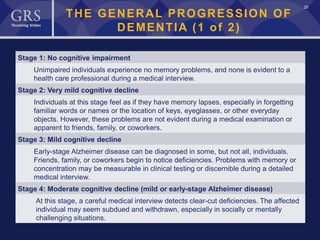
Stage 1: No cognitive impairment
Unimpaired individuals experience no memory problems, and none is evident to a
health care professional during a medical interview.
Stage 2: Very mild cognitive decline
Individuals at this stage feel as if they have memory lapses, especially in forgetting
familiar words or names or the location of keys, eyeglasses, or other everyday
objects. However, these problems are not evident during a medical examination or
apparent to friends, family, or coworkers.
Stage 3: Mild cognitive decline
Early-stage Alzheimer disease can be diagnosed in some, but not all, individuals.
Friends, family, or coworkers begin to notice deficiencies. Problems with memory or
concentration may be measurable in clinical testing or discernible during a detailed
medical interview.
Stage 4: Moderate cognitive decline (mild or early-stage Alzheimer disease)
At this stage, a careful medical interview detects clear-cut deficiencies. The affected
individual may seem subdued and withdrawn, especially in socially or mentally
challenging situations.
THE GENERAL PROGRESSION OF
DEMENTIA (1 of 2)
26
Stage 5: Moderately severe cognitive decline (moderate or mid-stage Alzheimer
disease)
Major gaps in memory and deficits in cognitive function emerge. Some assistance with
day-to-day activities becomes essential.
Stage 6: Severe cognitive decline (moderately severe or mid-stage Alzheimer disease)
Memory difficulties continue to worsen, significant personality changes may emerge,
and affected individuals need extensive help with customary daily activities.
Stage 7: Very severe cognitive decline (severe or late-stage Alzheimer disease)
This is the final stage of the disease when individuals lose the ability to respond to their
environment, to speak, and ultimately to control movement.
THE GENERAL PROGRESSION OF
DEMENTIA (2 of 2)
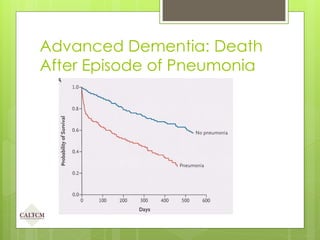
Advanced Dementia: Death
After Episode of Pneumonia
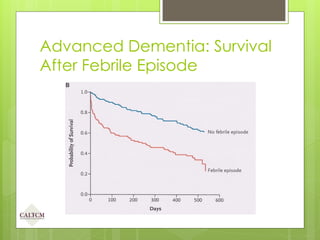
Advanced Dementia: Survival
After Febrile Episode
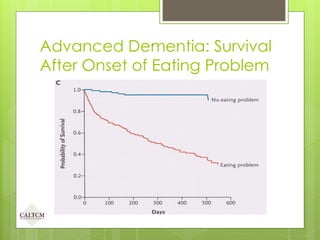
Advanced Dementia: Survival
After Onset of Eating Problem
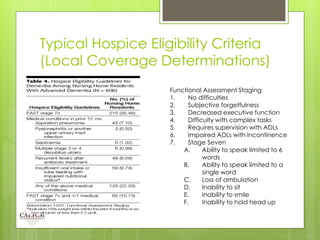
Typical Hospice Eligibility Criteria
(Local Coverage Determinations)
Functional Assessment Staging
1. No difficulties
2. Subjective forgetfulness
3. Decreased executive function
4. Difficulty with complex tasks
5. Requires supervision with ADLs
6. Impaired ADLs with incontinence
7. Stage Seven
A. Ability to speak limited to 6
words
B. Ability to speak limited to a
single word
C. Loss of ambulation
D. Inability to sit
E. Inability to smile
F. Inability to hold head up
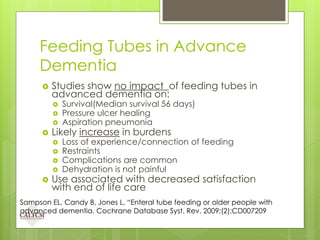
Feeding Tubes in Advance
Dementia
 Studies show no impact of feeding tubes in
advanced dementia on:
 Survival(Median survival 56 days)
 Pressure ulcer healing
 Aspiration pneumonia
 Likely increase in burdens
 Loss of experience/connection of feeding
 Restraints
 Complications are common
 Dehydration is not painful
 Use associated with decreased satisfaction
with end of life care
Sampson EL, Candy B, Jones L, “Enteral tube feeding or older people with
advanced dementia. Cochrane Database Syst. Rev. 2009;(2):CD007209
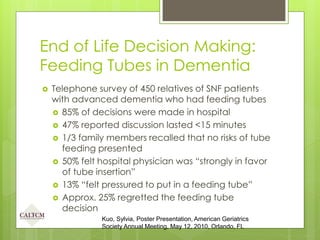
End of Life Decision Making:
Feeding Tubes in Dementia
 Telephone survey of 450 relatives of SNF patients
with advanced dementia who had feeding tubes
 85% of decisions were made in hospital
 47% reported discussion lasted <15 minutes
 1/3 family members recalled that no risks of tube
feeding presented
 50% felt hospital physician was “strongly in favor
of tube insertion”
 13% “felt pressured to put in a feeding tube”
 Approx. 25% regretted the feeding tube
decision
Kuo, Sylvia, Poster Presentation, American Geriatrics
Society Annual Meeting, May 12, 2010, Orlando, FL
Non-pharmacologic Interventions for
Behavioral Problems
 Many programs have worked, but difficult to
generalize as to what can be dispensed or
spread
 Pain and symptom control
 Exercise
 Music/Recordings
 Optimal level of activity
 Environmental changes: light, reassuring
picture
 Treating each patient with personalized care
Resources: A Systematic Evidence Review of Non-pharmacological Interventions for Behavioral Symptoms of Dementia
(VA’s Health Services Research & Development Service’s (HSR&D’s) Evidence-based Synthesis Program (2011)
http://www.hsrd.research.va.gov/publications/esp/Dementia-Nonpharm.pdf
See also extensive materials below from IA Adapt, Interact, Hand in Hand
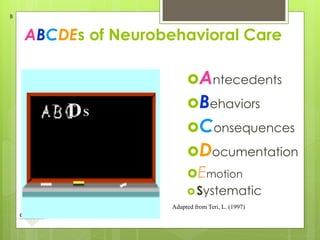
ABCDEs of Neurobehavioral Care
Antecedents
Behaviors
Consequences
Documentation
Emotion
Systematic
D
Adapted from Teri, L. (1997)
S
B
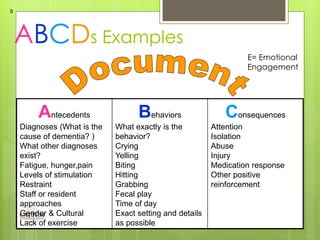
ABCDs Examples
Antecedents
Diagnoses (What is the
cause of dementia? )
What other diagnoses
exist?
Fatigue, hunger,pain
Levels of stimulation
Restraint
Staff or resident
approaches
Gender & Cultural
Lack of exercise
Behaviors
What exactly is the
behavior?
Crying
Yelling
Biting
Hitting
Grabbing
Fecal play
Time of day
Exact setting and details
as possible
Consequences
Attention
Isolation
Abuse
Injury
Medication response
Other positive
reinforcement
B
E= Emotional
Engagement
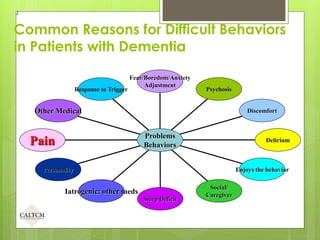
Common Reasons for Difficult Behaviors
in Patients with Dementia
Response to Trigger
Other Medical
Pain
Personality
Iatrogenic: other meds
Sleep Deficit
Social/
Caregiver
Enjoys the behavior
Delirium
Discomfort
Psychosis
Fear/Boredom/Anxiety
Adjustment
Problems
Behaviors
J
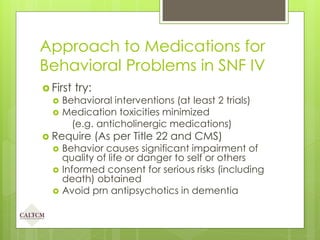
Approach to Medications for
Behavioral Problems in SNF IV
 First try:
 Behavioral interventions (at least 2 trials)
 Medication toxicities minimized
(e.g. anticholinergic medications)
 Require (As per Title 22 and CMS)
 Behavior causes significant impairment of
quality of life or danger to self or others
 Informed consent for serious risks (including
death) obtained
 Avoid prn antipsychotics in dementia
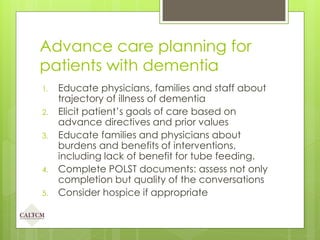
Advance care planning for
patients with dementia
1. Educate physicians, families and staff about
trajectory of illness of dementia
2. Elicit patient’s goals of care based on
advance directives and prior values
3. Educate families and physicians about
burdens and benefits of interventions,
including lack of benefit for tube feeding.
4. Complete POLST documents: assess not only
completion but quality of the conversations
5. Consider hospice if appropriate
28
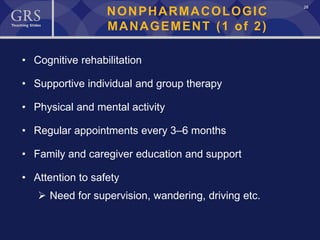
NONPHARMACOLOGIC
MANAGEMENT (1 of 2)
• Cognitive rehabilitation
• Supportive individual and group therapy
• Physical and mental activity
• Regular appointments every 3–6 months
• Family and caregiver education and support
• Attention to safety
 Need for supervision, wandering, driving etc.
29
NONPHARMACOLOGIC
MANAGEMENT (2 of 2)
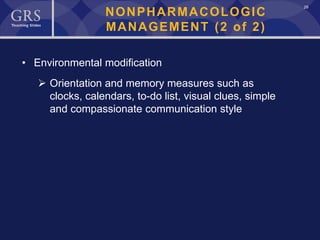
• Environmental modification
 Orientation and memory measures such as
clocks, calendars, to-do list, visual clues, simple
and compassionate communication style
30
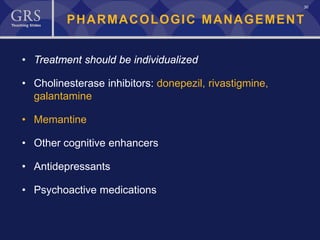
PHARMACOLOGIC MANAGEMENT
• Treatment should be individualized
• Cholinesterase inhibitors: donepezil, rivastigmine,
galantamine
• Memantine
• Other cognitive enhancers
• Antidepressants
• Psychoactive medications
31
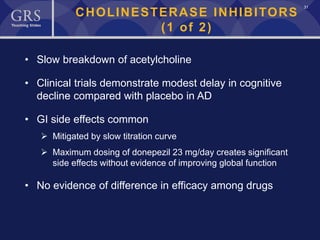
CHOLINESTERASE INHIBITORS
(1 of 2)
• Slow breakdown of acetylcholine
• Clinical trials demonstrate modest delay in cognitive
decline compared with placebo in AD
• GI side effects common
 Mitigated by slow titration curve
 Maximum dosing of donepezil 23 mg/day creates significant
side effects without evidence of improving global function
• No evidence of difference in efficacy among drugs
32
CHOLINESTERASE INHIBITORS
(2 of 2)
• Use in other dementias
 Widespread use in vascular dementia not
recommended
 Behavioral disturbances in Lewy body dementia can
benefit from treatment
 Rivastigmine is FDA-approved for mild to moderate
dementia in Parkinson dementia
 Treatment in frontotemporal dementia may worsen
agitation
33
MEMANTINE
• Neuroprotective effect is to reduce glutamate-mediated
excitotoxicity
• Modest benefit on cognition, ADLs, and behavior in AD
• Limited effect on cognition and no evidence to support
widespread use in vascular dementia
• FDA-approved for moderate to severe AD
• Common adverse events: constipation, dizziness,
headache
34
OTHER COGNITIVE
ENHANCERS
• Vitamin E (α–tocopherol) may lower rate of decline, but
no evidence of cognitive improvement in AD
 No longer recommended due to evidence of increased
mortality with high-dose supplementation
• Selegiline may low rate of decline, but no evidence of
cognitive improvement in AD
• Ginkgo biloba offers no benefit in slowing cognitive
decline in MCI
35
SYMPTOM MANAGEMENT (1 of 2)
• Psychoactive medications
 Behavioral disturbances best managed nonpharmacologically,
eg, reducing overstimulation, environmental modification
• Antidepressants
 Depressed mood, low appetite, insomnia, fatigue, irritability,
agitation
 Possibly effective for disinhibition and compulsive behaviors
 Caution: falls and anticholinergic effects that may worsen
confusion (ie, paroxetine)
36
SYMPTOM MANAGEMENT (2 of 2)
• 1st/2nd-generation antipsychotics
 Limited evidence of efficacy and increased risk of all-cause
mortality in dementia
 Should be used with caution in targeting delusions, hallucinations,
and paranoia ― frequently attempt to taper off
• Valproic acid and carbamazepine
 Possible options, but with limited evidence and increased risk of
mortality
• Benzodiazepines and anticholinergic medications should
be avoided
37
RESOURCES FOR
MANAGING DEMENTIA (1 of 2)
• Specialist referral to:
 Geriatric psychiatrist
 Neurologist
 Neuropsychologist
• Social worker
• Physical therapist
• Nurse
38
RESOURCES FOR
MANAGING DEMENTIA (2 of 2)
• Attorney for will, conservatorship, estate planning
• Community: neighbors & friends, aging & mental health
networks, adult day care, respite care, home-health
agency
• Organizations: Alzheimer’s Association, Area Agencies
on Aging, Councils on Aging
• Services: Meals-on-Wheels, senior citizen centers
39
SUMMARY (1 of 2)
• Dementia is common in older adults but is not
an inherent part of aging
• AD is the most common type of dementia,
followed by vascular dementia and dementia
with Lewy bodies
• Evaluation includes history with informant,
physical & functional assessment, focused
labs, & possibly brain imaging
40
SUMMARY (2 of 2)
• Primary treatment goals: enhance quality of life
and maximize function by improving cognition,
mood, behavior
• Treatment may involve both medications and
nonpharmacologic interventions
• Community resources should be used to
support patient, family, caregivers
41
CASE 1 (1 of 4)
• An 80-year-old woman is brought to the office because
she has hallucinations of children and small animals
when she is alone in a room. The hallucinations
sometimes disturb and agitate her.
• Her family also notes that she is having more difficulty
walking and has hand tremors when she sits quietly.
• She has a 9-month history of short-term memory loss;
problems with orientation that sometimes worsen
dramatically; and difficulty managing her finances,
preparing complex meals, and following TV shows.
42
CASE 1 (2 of 4)
• Her score on the Mini–Mental State Examination is
23 of 30.
• On physical examination, there are signs of cogwheel
rigidity and resting tremors, which have been noted
for the past year.
43
CASE 1 (3 of 4)
Which of the following is the most likely diagnosis?
A. Dementia with Lewy bodies
B. Alzheimer disease
C. Parkinson disease with dementia
D. Huntington disease
44
CASE 1 (4 of 4)
Which of the following is the most likely diagnosis?
A. Dementia with Lewy bodies
B. Alzheimer disease
C. Parkinson disease with dementia
D. Huntington disease
45
CASE 2 (1 of 4)
• A 67-year-old man comes to the office to establish care.
• History includes mild hypertension.
• The patient is married and maintains an active
professional and social life. He is physically active,
does not smoke, and drinks 1–2 glasses of wine daily.
• Medications include hydrochlorothiazide 12.5 mg/day,
aspirin 81 mg/day, and a daily multivitamin.
46
CASE 2 (2 of 4)
• Family history is notable for an 84-year-old maternal
aunt who recently died after 6 years in the memory-
disorders unit of a nursing home.
• His aunt’s death has caused the patient to worry about
his own risk of dementia. He requests a referral for
genetic testing for Alzheimer disease.
• Physical examination is unremarkable.
47
CASE 2 (3 of 4)
Which of the following is true about risk of Alzheimer
disease?
A. Mutations in 4 known deterministic (causative) genes
are associated with autosomal-dominant AD.
B. The lifetime risk of developing AD in the general
population is approximately 20%, assuming a life span
of 75 to 80 years.
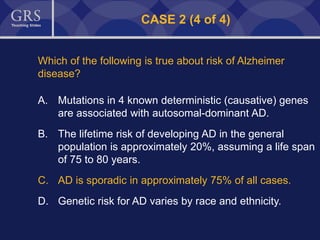
C. AD is sporadic in approximately 75% of all cases.
D. Genetic risk for AD varies by race and ethnicity.
48
CASE 2 (4 of 4)
Which of the following is true about risk of Alzheimer
disease?
A. Mutations in 4 known deterministic (causative) genes
are associated with autosomal-dominant AD.
B. The lifetime risk of developing AD in the general
population is approximately 20%, assuming a life span
of 75 to 80 years.
C. AD is sporadic in approximately 75% of all cases.
D. Genetic risk for AD varies by race and ethnicity.
50
CASE 3 (2 of 4)
• The patient’s wife expresses concern about his ability
to drive safely. She sometimes feels nervous riding
with him. She notes that he has stopped driving at
night or when it rains, that he drives shorter distances
and less often since he retired 5 years ago, and that he
received a traffic citation about 4 years ago. He has
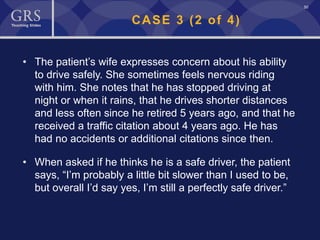
had no accidents or additional citations since then.
• When asked if he thinks he is a safe driver, the patient
says, “I’m probably a little bit slower than I used to be,
but overall I’d say yes, I’m still a perfectly safe driver.”
51
CASE 3 (3 of 4)
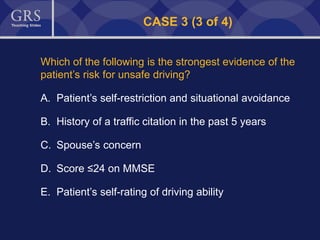
Which of the following is the strongest evidence of the
patient’s risk for unsafe driving?
A. Patient’s self-restriction and situational avoidance
B. History of a traffic citation in the past 5 years
C. Spouse’s concern
D. Score ≤24 on MMSE
E. Patient’s self-rating of driving ability
52
CASE 3 (4 of 4)
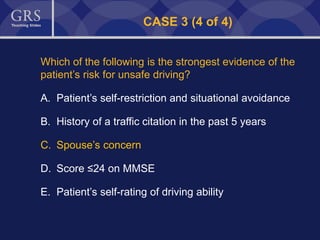
Which of the following is the strongest evidence of the
patient’s risk for unsafe driving?
A. Patient’s self-restriction and situational avoidance
B. History of a traffic citation in the past 5 years
C. Spouse’s concern
D. Score ≤24 on MMSE
E. Patient’s self-rating of driving ability
53
GRS8 Slides Editor: Annette Medina-Walpole, MD, AGSF
GRS8 Chapter Authors: Alexander Threlfall, MD, MA
Cynthia Barton, RN, MSN
Kristine Yaffe, MD
GRS8 Question Writer: Amy E. Sanders, MD
Medical Writers: Beverly A. Caley
Faith Reidenbach
Managing Editor: Andrea N. Sherman, MS
Slide 53
Copyright © 2013 American Geriatrics Society Slide 53
Dementia las vegas (1)

Dementia las vegas (1)

  • 1.
    1 DEMENTIA Dr Kamal KejriwalMD AAFP, CMD Geriatric Fellowship Program Director, Kaiser Fontana Dr Sherif Iskander Geriatric Fellows Dr Marian Assal, Geriatrician, Kaiser Fontana
  • 2.
    2 OBJECTIVES Know and understand: •The risks for and causes of dementia • The evaluation of patients with dementia • How to plan behavioral and pharmacologic treatment strategies to minimize the personal, social, & financial impacts of dementia • How to refer patients and caregivers to available community resources
  • 3.
    3 TOPICS COVERED • Epidemiologyand Societal Impact • Risk Factors and Prevention • Assessment Methods • Differential Diagnosis • Treatment and Management • Resources
  • 4.
  • 5.
    5October 23, 2014 Dementia– Why should we care? Aging Population Prevalence of Dementia Caregiver Burden Our population age 65+ continues to increase and will escalate rapidly in coming years as the baby boomers age. In 2010, 14.7% of people age 70+ in U.S. have dementia1 Dementia is underdiagnosed. In 2010, 6.7% of KP members age 70+ had dementia diagnosis2. Emotional and physical impact associated with caring for people with dementia raised healthcare costs by $9.1 billion in 2012.3 14.7% Source: 1. Monetary Costs of Dementia in the U.S. - Hurd MD, Martorell P, Langa KM. N Engl J Med. 2013 Aug 1;369(5):489-90. doi: 10.1056/NEJMc1305541. PMID: 23902508 2. Dementia 2006-2010.xls. (Feb 2012), Joya Guha (Data excludes OH region) 3. Household Members of Persons with Alzheimer’s Disease – Suehs, et al., JAGS 62:435-441, 2014
  • 6.
    Survey Findings Dementia Carelooks very different across regions KP is on track with many National and State standards, but there is room for improvement Advanced Planning  68% (13/19) offer Advanced Care Planning to members with dementia. Caregiver and Patient Education  32% (6/19) offer a class/group appointment specific to managing dementia behaviors.  25% (5/19) offer a dementia education class/group appointment. Patient / Caregiver Support  37% (7/19) offer caregiver support groups. Community Partnerships  84% (16/19) offer referrals to community resources. 11
  • 7.
    4 WHAT IS DEMENTIA? •An acquired syndrome of decline in memory and other cognitive functions sufficient to affect daily life in an alert patient • Progressive and disabling • Not an inherent aspect of aging • Different from normal cognitive lapses
  • 11.
    5 THE EPIDEMIOLOGY OF DEMENTIA •6%‒8% of people ≥65 yr have Alzheimer dementia (AD)  Prevalence doubles every 5 yr  Nearly 45% of those aged 85+ have AD • Vascular dementia co-occurs with an estimated 15%– 20% of AD cases ― “mixed dementia” • Lewy body dementia (LBD) ― second most common cause of dementia
  • 13.
    7 ETIOLOGY • Alzheimer disease Amyloid plaques/oligomers  Tau neurofibrillary tangles • Lewy body and Parkinson dementia  Cytoplasmic α-synuclein inclusion bodies • Frontotemporal dementia  Tau or ubiquitin proteins
  • 14.
    9 THE GENETICS OFDEMENTIA Early onset (<60 years old) • Amyloid precursor protein (APP) • Presenilin proteins (PS1 and PS2) Late onset • Apolipoprotein E gene (APOE 2/3/4) ― chromosome 19  APOE4 ― two alleles confers greatest risk in dose-related fashion  APOE2 ― protective • Single-nucleotide polymorphisms  Clusterin (CLU-C), complement component receptor 1 (CR1), and phosphatidylinositol binding clathrin assembly protein (PICALM)
  • 15.
    8 RISK FACTORS FORDEMENTIA Protective Factors Definite: unknown Possible • NSAIDs • Antioxidants • Intellectual activity • Physical activity • Statin Risk Factors Definite • Age • Family history • APOE4 allele • Down syndrome Possible • Head trauma • Fewer years of formal education • Late-onset major depressive disorder • Cardiovascular risk factors (hypertension, diabetes, hypercholesterolemia, obesity)
  • 16.
    10 ASSESSMENT: HISTORY Ask boththe patient and a reliable informant about the patient’s: • Date of onset of current condition and nature of symptoms • Medical history • Current medications & medication history • Patterns of alcohol use or abuse • Living arrangements
  • 17.
    11 ASSESSMENT: PHYSICAL Examine: • Neurologicstatus • Mental status • Functional status Include: • Quantified screens for cognition  For example, Folstein’s MMSE, Mini-Cog, SLUMS, MoCA • Neuropsychologic testing
  • 18.
    12 SCREENING INSTRUMENTS FOR EVALUATINGCOGNITION Name Items/ Scoring Domains assessed Web link (accessed Oct 2012) Mini-Cog 2 items Score = 5 Visuospatial, executive function, recall http://geriatrics.uthscsa.edu/tool s/MINICog.pdf SLUMS 11 items Score = 30 Orientation, recall, calculation, naming, attention, executive function http://medschool.slu.edu/agings uccessfully/pdfsurveys/slumsex am_05.pdf MoCA 12 items Score = 30 Orientation, recall, attention, naming, repetition, verbal fluency, abstraction, executive function, visuospatial www.mocatest.org Folstein MMSE 19 items Score = 30 Orientation, registration, attention, recall, naming, repetition, 3-step command, language, visuospatial For purchase: www.minimental.com
  • 20.
    13 ASSESSMENT: LABORATORY Routine • CBC •Na+ • BUN/Cr • Fasting glucose • RPR • TSH • Vitamin B12 level Optional (based on clinical exam and suspicion) • Liver function • Folic acid • Homocysteine/methylmalonic acid • Urinalysis / Toxicology • CSF analysis • HIV testing
  • 21.
    14 ASSESSMENT: BRAIN IMAGING Considerimaging when: • Onset occurs at age <65 years • Neurologic signs are asymmetric or focal • Clinical picture suggests normal-pressure hydrocephalus • Patient has had recent fall or other head trauma Consider: • Noncontrast computed topography head scan • Magnetic resonance imaging • Positron emission tomography
  • 22.
    15 DIFFERENTIAL DIAGNOSIS • Normalaging • Mild cognitive impairment • Delirium • Depression • Alzheimer disease • Vascular dementia • Lewy body dementia • Other (frontotemporal dementia, alcohol, Parkinson disease, neurosyphilis)
  • 23.
    16 NORMAL AGING • Noconsistent, progressive deviations on testing of memory • Some decline in processing and recall of new information: slower, harder • Reminders work—visual tips, notes • Absence of significant effects on ADLs or IADLs due to cognition
  • 24.
    17 MILD COGNITIVE IMPAIRMENT •Subjective complaint of decline in at least one cognitive domain: noticeable and measurable • No impairment in independent living • 9.4 to 14.3/1000 person-years convert to Alzheimer disease • ~50% with amnestic MCI maintain stable level of impairment or return to normal cognitive status in 3−5 yr
  • 25.
    18 DELIRIUM VS. DEMENTIA •Delirium and dementia often occur together in older hospitalized patients • The distinguishing signs of delirium are:  Acute onset  Cognitive fluctuations over hours or days  Impaired consciousness and attention  Altered sleep cycles  Search for underlying dementia once delirium cleared
  • 26.
    19 DEPRESSION VS. DEMENTIA(1 of 2) The symptoms of depression and dementia often overlap: • Impaired concentration • Lack of motivation, loss of interest, apathy • Psychomotor retardation • Sleep disturbance
  • 27.
    20 DEPRESSION VS. DEMENTIA(2 of 2) • Patients with primary depression are generally unlike those with dementia in that they:  Demonstrate ↓ motivation during cognitive testing  Express cognitive complaints that exceed measured deficits  Maintain language and motor skills • ~50% presenting with reversible dementia and depression progress to dementia within 5 yr
  • 28.
    21 ALZHEIMER DISEASE • Onset:gradual • Cognitive symptoms: memory impairment core feature with difficulty learning new information • Motor symptoms: rare early, apraxia later • Progression: gradual, over 8–10 yr on average • Lab tests: normal • Imaging: possible global atrophy, small hippocampal volumes
  • 29.
    22 VASCULAR DEMENTIA • Onset:may be sudden/stepwise • Cognitive symptoms: depend on anatomy of ischemia, but dysexecutive syndrome common • Motor symptoms: correlates with ischemia • Progression: stepwise with further ischemia • Lab tests: normal • Imaging: cortical or subcortical changes on MRI
  • 30.
    23 LEWY BODY DEMENTIA •Onset: gradual • Cognitive symptoms: memory, visuospatial, hallucinations, fluctuations • Motor symptoms: parkinsonism • Progression: gradual, but usually faster than AD • Lab tests: normal • Imaging: possible global atrophy
  • 31.
    24 FRONTOTEMPORAL DEMENTIA • Onset:gradual, usually age <60 • Cognitive symptoms: executive, language, and behavioral dysfunction, including disinhibition and hyperorality • Motor symptoms: none; may be associated with ALS in rare cases • Progression: gradual but faster than AD • Lab tests: normal • Imaging: atrophy in frontal and temporal lobes
  • 32.
    27 PRIMARY GOAL OFTREATMENT To enhance quality of life and maximize functional performance by improving cognition, mood, and behavior
  • 33.
    THE CARE SPAN RedesigningSystems Of Care For Older Adults With Alzheimer’s Disease 16 | © 2011 Kaiser Foundation Health Plan, Inc. For internal use only.October 23, 2014 doi: 10.1377/hlthaff.2013.1260 HEALTH AFFAIRS 33, NO. 4 (2014): 626–632 ©2014 Project HOPE— The People-to-People Health Foundation, Inc. By Christopher M. Callahan, Greg A. Sachs, Michael A. LaMantia, Kathleen T. Unroe, Greg Arling, and Malaz A. Boustani
  • 34.
    25 Stage 1: Nocognitive impairment Unimpaired individuals experience no memory problems, and none is evident to a health care professional during a medical interview. Stage 2: Very mild cognitive decline Individuals at this stage feel as if they have memory lapses, especially in forgetting familiar words or names or the location of keys, eyeglasses, or other everyday objects. However, these problems are not evident during a medical examination or apparent to friends, family, or coworkers. Stage 3: Mild cognitive decline Early-stage Alzheimer disease can be diagnosed in some, but not all, individuals. Friends, family, or coworkers begin to notice deficiencies. Problems with memory or concentration may be measurable in clinical testing or discernible during a detailed medical interview. Stage 4: Moderate cognitive decline (mild or early-stage Alzheimer disease) At this stage, a careful medical interview detects clear-cut deficiencies. The affected individual may seem subdued and withdrawn, especially in socially or mentally challenging situations. THE GENERAL PROGRESSION OF DEMENTIA (1 of 2)
  • 35.
    26 Stage 5: Moderatelysevere cognitive decline (moderate or mid-stage Alzheimer disease) Major gaps in memory and deficits in cognitive function emerge. Some assistance with day-to-day activities becomes essential. Stage 6: Severe cognitive decline (moderately severe or mid-stage Alzheimer disease) Memory difficulties continue to worsen, significant personality changes may emerge, and affected individuals need extensive help with customary daily activities. Stage 7: Very severe cognitive decline (severe or late-stage Alzheimer disease) This is the final stage of the disease when individuals lose the ability to respond to their environment, to speak, and ultimately to control movement. THE GENERAL PROGRESSION OF DEMENTIA (2 of 2)
  • 36.
    Advanced Dementia: Death AfterEpisode of Pneumonia
  • 37.
  • 38.
    Advanced Dementia: Survival AfterOnset of Eating Problem
  • 39.
    Typical Hospice EligibilityCriteria (Local Coverage Determinations) Functional Assessment Staging 1. No difficulties 2. Subjective forgetfulness 3. Decreased executive function 4. Difficulty with complex tasks 5. Requires supervision with ADLs 6. Impaired ADLs with incontinence 7. Stage Seven A. Ability to speak limited to 6 words B. Ability to speak limited to a single word C. Loss of ambulation D. Inability to sit E. Inability to smile F. Inability to hold head up
  • 40.
    Feeding Tubes inAdvance Dementia  Studies show no impact of feeding tubes in advanced dementia on:  Survival(Median survival 56 days)  Pressure ulcer healing  Aspiration pneumonia  Likely increase in burdens  Loss of experience/connection of feeding  Restraints  Complications are common  Dehydration is not painful  Use associated with decreased satisfaction with end of life care Sampson EL, Candy B, Jones L, “Enteral tube feeding or older people with advanced dementia. Cochrane Database Syst. Rev. 2009;(2):CD007209
  • 41.
    End of LifeDecision Making: Feeding Tubes in Dementia  Telephone survey of 450 relatives of SNF patients with advanced dementia who had feeding tubes  85% of decisions were made in hospital  47% reported discussion lasted <15 minutes  1/3 family members recalled that no risks of tube feeding presented  50% felt hospital physician was “strongly in favor of tube insertion”  13% “felt pressured to put in a feeding tube”  Approx. 25% regretted the feeding tube decision Kuo, Sylvia, Poster Presentation, American Geriatrics Society Annual Meeting, May 12, 2010, Orlando, FL
  • 42.
    Non-pharmacologic Interventions for BehavioralProblems  Many programs have worked, but difficult to generalize as to what can be dispensed or spread  Pain and symptom control  Exercise  Music/Recordings  Optimal level of activity  Environmental changes: light, reassuring picture  Treating each patient with personalized care Resources: A Systematic Evidence Review of Non-pharmacological Interventions for Behavioral Symptoms of Dementia (VA’s Health Services Research & Development Service’s (HSR&D’s) Evidence-based Synthesis Program (2011) http://www.hsrd.research.va.gov/publications/esp/Dementia-Nonpharm.pdf See also extensive materials below from IA Adapt, Interact, Hand in Hand
  • 43.
    ABCDEs of NeurobehavioralCare Antecedents Behaviors Consequences Documentation Emotion Systematic D Adapted from Teri, L. (1997) S B
  • 44.
    ABCDs Examples Antecedents Diagnoses (Whatis the cause of dementia? ) What other diagnoses exist? Fatigue, hunger,pain Levels of stimulation Restraint Staff or resident approaches Gender & Cultural Lack of exercise Behaviors What exactly is the behavior? Crying Yelling Biting Hitting Grabbing Fecal play Time of day Exact setting and details as possible Consequences Attention Isolation Abuse Injury Medication response Other positive reinforcement B E= Emotional Engagement
  • 45.
    Common Reasons forDifficult Behaviors in Patients with Dementia Response to Trigger Other Medical Pain Personality Iatrogenic: other meds Sleep Deficit Social/ Caregiver Enjoys the behavior Delirium Discomfort Psychosis Fear/Boredom/Anxiety Adjustment Problems Behaviors J
  • 46.
    Approach to Medicationsfor Behavioral Problems in SNF IV  First try:  Behavioral interventions (at least 2 trials)  Medication toxicities minimized (e.g. anticholinergic medications)  Require (As per Title 22 and CMS)  Behavior causes significant impairment of quality of life or danger to self or others  Informed consent for serious risks (including death) obtained  Avoid prn antipsychotics in dementia
  • 47.
    Advance care planningfor patients with dementia 1. Educate physicians, families and staff about trajectory of illness of dementia 2. Elicit patient’s goals of care based on advance directives and prior values 3. Educate families and physicians about burdens and benefits of interventions, including lack of benefit for tube feeding. 4. Complete POLST documents: assess not only completion but quality of the conversations 5. Consider hospice if appropriate
  • 48.
    28 NONPHARMACOLOGIC MANAGEMENT (1 of2) • Cognitive rehabilitation • Supportive individual and group therapy • Physical and mental activity • Regular appointments every 3–6 months • Family and caregiver education and support • Attention to safety  Need for supervision, wandering, driving etc.
  • 53.
    29 NONPHARMACOLOGIC MANAGEMENT (2 of2) • Environmental modification  Orientation and memory measures such as clocks, calendars, to-do list, visual clues, simple and compassionate communication style
  • 55.
    30 PHARMACOLOGIC MANAGEMENT • Treatmentshould be individualized • Cholinesterase inhibitors: donepezil, rivastigmine, galantamine • Memantine • Other cognitive enhancers • Antidepressants • Psychoactive medications
  • 56.
    31 CHOLINESTERASE INHIBITORS (1 of2) • Slow breakdown of acetylcholine • Clinical trials demonstrate modest delay in cognitive decline compared with placebo in AD • GI side effects common  Mitigated by slow titration curve  Maximum dosing of donepezil 23 mg/day creates significant side effects without evidence of improving global function • No evidence of difference in efficacy among drugs
  • 57.
    32 CHOLINESTERASE INHIBITORS (2 of2) • Use in other dementias  Widespread use in vascular dementia not recommended  Behavioral disturbances in Lewy body dementia can benefit from treatment  Rivastigmine is FDA-approved for mild to moderate dementia in Parkinson dementia  Treatment in frontotemporal dementia may worsen agitation
  • 58.
    33 MEMANTINE • Neuroprotective effectis to reduce glutamate-mediated excitotoxicity • Modest benefit on cognition, ADLs, and behavior in AD • Limited effect on cognition and no evidence to support widespread use in vascular dementia • FDA-approved for moderate to severe AD • Common adverse events: constipation, dizziness, headache
  • 59.
    34 OTHER COGNITIVE ENHANCERS • VitaminE (α–tocopherol) may lower rate of decline, but no evidence of cognitive improvement in AD  No longer recommended due to evidence of increased mortality with high-dose supplementation • Selegiline may low rate of decline, but no evidence of cognitive improvement in AD • Ginkgo biloba offers no benefit in slowing cognitive decline in MCI
  • 60.
    35 SYMPTOM MANAGEMENT (1of 2) • Psychoactive medications  Behavioral disturbances best managed nonpharmacologically, eg, reducing overstimulation, environmental modification • Antidepressants  Depressed mood, low appetite, insomnia, fatigue, irritability, agitation  Possibly effective for disinhibition and compulsive behaviors  Caution: falls and anticholinergic effects that may worsen confusion (ie, paroxetine)
  • 61.
    36 SYMPTOM MANAGEMENT (2of 2) • 1st/2nd-generation antipsychotics  Limited evidence of efficacy and increased risk of all-cause mortality in dementia  Should be used with caution in targeting delusions, hallucinations, and paranoia ― frequently attempt to taper off • Valproic acid and carbamazepine  Possible options, but with limited evidence and increased risk of mortality • Benzodiazepines and anticholinergic medications should be avoided
  • 62.
    37 RESOURCES FOR MANAGING DEMENTIA(1 of 2) • Specialist referral to:  Geriatric psychiatrist  Neurologist  Neuropsychologist • Social worker • Physical therapist • Nurse
  • 63.
    38 RESOURCES FOR MANAGING DEMENTIA(2 of 2) • Attorney for will, conservatorship, estate planning • Community: neighbors & friends, aging & mental health networks, adult day care, respite care, home-health agency • Organizations: Alzheimer’s Association, Area Agencies on Aging, Councils on Aging • Services: Meals-on-Wheels, senior citizen centers
  • 64.
    39 SUMMARY (1 of2) • Dementia is common in older adults but is not an inherent part of aging • AD is the most common type of dementia, followed by vascular dementia and dementia with Lewy bodies • Evaluation includes history with informant, physical & functional assessment, focused labs, & possibly brain imaging
  • 65.
    40 SUMMARY (2 of2) • Primary treatment goals: enhance quality of life and maximize function by improving cognition, mood, behavior • Treatment may involve both medications and nonpharmacologic interventions • Community resources should be used to support patient, family, caregivers
  • 67.
    41 CASE 1 (1of 4) • An 80-year-old woman is brought to the office because she has hallucinations of children and small animals when she is alone in a room. The hallucinations sometimes disturb and agitate her. • Her family also notes that she is having more difficulty walking and has hand tremors when she sits quietly. • She has a 9-month history of short-term memory loss; problems with orientation that sometimes worsen dramatically; and difficulty managing her finances, preparing complex meals, and following TV shows.
  • 68.
    42 CASE 1 (2of 4) • Her score on the Mini–Mental State Examination is 23 of 30. • On physical examination, there are signs of cogwheel rigidity and resting tremors, which have been noted for the past year.
  • 69.
    43 CASE 1 (3of 4) Which of the following is the most likely diagnosis? A. Dementia with Lewy bodies B. Alzheimer disease C. Parkinson disease with dementia D. Huntington disease
  • 70.
    44 CASE 1 (4of 4) Which of the following is the most likely diagnosis? A. Dementia with Lewy bodies B. Alzheimer disease C. Parkinson disease with dementia D. Huntington disease
  • 71.
    45 CASE 2 (1of 4) • A 67-year-old man comes to the office to establish care. • History includes mild hypertension. • The patient is married and maintains an active professional and social life. He is physically active, does not smoke, and drinks 1–2 glasses of wine daily. • Medications include hydrochlorothiazide 12.5 mg/day, aspirin 81 mg/day, and a daily multivitamin.
  • 72.
    46 CASE 2 (2of 4) • Family history is notable for an 84-year-old maternal aunt who recently died after 6 years in the memory- disorders unit of a nursing home. • His aunt’s death has caused the patient to worry about his own risk of dementia. He requests a referral for genetic testing for Alzheimer disease. • Physical examination is unremarkable.
  • 73.
    47 CASE 2 (3of 4) Which of the following is true about risk of Alzheimer disease? A. Mutations in 4 known deterministic (causative) genes are associated with autosomal-dominant AD. B. The lifetime risk of developing AD in the general population is approximately 20%, assuming a life span of 75 to 80 years. C. AD is sporadic in approximately 75% of all cases. D. Genetic risk for AD varies by race and ethnicity.
  • 74.
    48 CASE 2 (4of 4) Which of the following is true about risk of Alzheimer disease? A. Mutations in 4 known deterministic (causative) genes are associated with autosomal-dominant AD. B. The lifetime risk of developing AD in the general population is approximately 20%, assuming a life span of 75 to 80 years. C. AD is sporadic in approximately 75% of all cases. D. Genetic risk for AD varies by race and ethnicity.
  • 75.
    50 CASE 3 (2of 4) • The patient’s wife expresses concern about his ability to drive safely. She sometimes feels nervous riding with him. She notes that he has stopped driving at night or when it rains, that he drives shorter distances and less often since he retired 5 years ago, and that he received a traffic citation about 4 years ago. He has had no accidents or additional citations since then. • When asked if he thinks he is a safe driver, the patient says, “I’m probably a little bit slower than I used to be, but overall I’d say yes, I’m still a perfectly safe driver.”
  • 76.
    51 CASE 3 (3of 4) Which of the following is the strongest evidence of the patient’s risk for unsafe driving? A. Patient’s self-restriction and situational avoidance B. History of a traffic citation in the past 5 years C. Spouse’s concern D. Score ≤24 on MMSE E. Patient’s self-rating of driving ability
  • 77.
    52 CASE 3 (4of 4) Which of the following is the strongest evidence of the patient’s risk for unsafe driving? A. Patient’s self-restriction and situational avoidance B. History of a traffic citation in the past 5 years C. Spouse’s concern D. Score ≤24 on MMSE E. Patient’s self-rating of driving ability
  • 78.
    53 GRS8 Slides Editor:Annette Medina-Walpole, MD, AGSF GRS8 Chapter Authors: Alexander Threlfall, MD, MA Cynthia Barton, RN, MSN Kristine Yaffe, MD GRS8 Question Writer: Amy E. Sanders, MD Medical Writers: Beverly A. Caley Faith Reidenbach Managing Editor: Andrea N. Sherman, MS Slide 53 Copyright © 2013 American Geriatrics Society Slide 53