Dementia
Randi Jones, Ph.D.
4/11/2008
Positive Impact
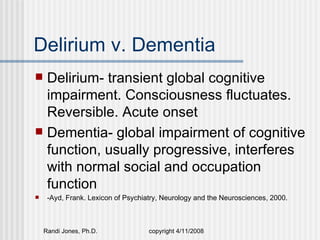
Delirium v. Dementia
 Delirium- transient global cognitive
  impairment. Consciousness fluctuates.
  Reversible. Acute onset
 Dementia- global impairment of cognitive
  function, usually progressive, interferes
  with normal social and occupation
  function
    -Ayd, Frank. Lexicon of Psychiatry, Neurology and the Neurosciences, 2000.


    Randi Jones, Ph.D.              copyright 4/11/2008
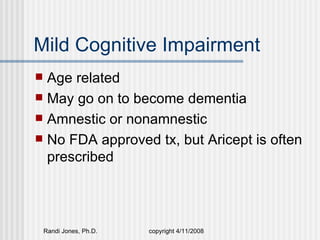
Mild Cognitive Impairment
 Age related
 May go on to become dementia
 Amnestic or nonamnestic
 No FDA approved tx, but Aricept is often
  prescribed


    Randi Jones, Ph.D.   copyright 4/11/2008
Broad Classification by Brain
Area Affected
 Cortical
 Subcortical
 A way to categorize and
  understand.Could be viewed as
  continuum.
 Some disorders affect a variety of areas
  in the brain, so don’t categorize neatly

    Randi Jones, Ph.D.   copyright 4/11/2008
Cortical Characteristics
 Short-term memory problems. Encoding
  and storage
 Information is lost
 Verbal ability declines-anomia
 Aphasia, apraxia, agnosia


    Randi Jones, Ph.D.   copyright 4/11/2008
Subcortical Characteristics
 Verbal comprehension is retained
 Memory problems due to retrieval
 Slowed mentation, but much remains
  intact, including general IQ
 Typically frontal sx: attention,
  organization, judgment, disinhibited
  behavior, apathy
 Depression is very common


    Randi Jones, Ph.D.   copyright 4/11/2008
Classification by Possibility of
Recovery
 “Pseudodementia”-cognitive impairment
  caused by a psychiatric disorder. Most
  often depression, but also NPH,
  meningiomas, etc.
 Toxic conditions
 Alcohol or drug induced


    Randi Jones, Ph.D.   copyright 4/11/2008
Alzheimer’s spectrum
 Early v. late onset. Early has greater
  possibility of genetic etiology.
 Hippocampus, amygdala
 Treatments: Aricept,Reminyl, Exelon [Cognex
  rarely used now]. acetylcholinesterase inhibition.
  NMDA action: Namenda
 Environmental stimulation and enrichment
 Education of family caregivers


    Randi Jones, Ph.D.   copyright 4/11/2008
HIV (Aids Related Dementia
Complex)
    Subcortical, frontal areas affected.
    Motor sx possible.
    Depression is common. Watch for suicidal behavior.
    Rate initially declined as result of antiretroviral tx, but is
     on the rise again.
    ADC increases chances for more rapid progression,
     early death
    May distinguish “haves” from “have nots.”
    HIV Dementia Scale (4 subtests) and Memorial Sloan
     Kettering Rating Scale (research)
    HAART can improve dementia sx.

    Randi Jones, Ph.D.       copyright 4/11/2008
Vascular
 2nd most common cause of dementia
 Mostly subcortical, but varies with brain
  area affected.
 Treatment designed to minimize causes
  such as hypertension or treat depression
 Possibility of physical limitations as well
  such as hemiparesis and neglect.

    Randi Jones, Ph.D.   copyright 4/11/2008
Alcohol or other Substance
Induced
 Korsakoff’s syndrome. Hippocampus.
  Thiamine deficiency.
 Alcohol dementia. Separate disorder?
  Frontal, cerebellum
 Some recovery is possible with
  abstinence.


    Randi Jones, Ph.D.   copyright 4/11/2008
Parkinson’s & other typically
subcortical dementias
    Parkinson’s disease: some genetic component for
     specific phenotypes, but largely causes remain
     idiopathic. Includes parkinson pugilistica.
    Huntington’s disease: genetic. Midlife onset. Fully
     penetrant, autosomal dominant. Course 15-20 years.
     No treatment.
    Spinal cerebellar ataxias: many are genetic, some are
     dominant, some recessive.
    Multiple sclerosis. Dementia more common in primary
     progressive, but cognitive impairment is expected in
     ~50% of patients.


    Randi Jones, Ph.D.    copyright 4/11/2008
Nonmedical Treatment Issues
    Optimizing function
    Assessing disability, if still employed
    Driving
    Competency
    End of life decisions
    Location of care
    Family dysfunction/reorganization
    Family education and caregiving

    Randi Jones, Ph.D.   copyright 4/11/2008

Dementia Slides

  • 1.
  • 2.
    Delirium v. Dementia Delirium- transient global cognitive impairment. Consciousness fluctuates. Reversible. Acute onset  Dementia- global impairment of cognitive function, usually progressive, interferes with normal social and occupation function  -Ayd, Frank. Lexicon of Psychiatry, Neurology and the Neurosciences, 2000. Randi Jones, Ph.D. copyright 4/11/2008
  • 3.
    Mild Cognitive Impairment Age related  May go on to become dementia  Amnestic or nonamnestic  No FDA approved tx, but Aricept is often prescribed Randi Jones, Ph.D. copyright 4/11/2008
  • 4.
    Broad Classification byBrain Area Affected  Cortical  Subcortical  A way to categorize and understand.Could be viewed as continuum.  Some disorders affect a variety of areas in the brain, so don’t categorize neatly Randi Jones, Ph.D. copyright 4/11/2008
  • 5.
    Cortical Characteristics  Short-termmemory problems. Encoding and storage  Information is lost  Verbal ability declines-anomia  Aphasia, apraxia, agnosia Randi Jones, Ph.D. copyright 4/11/2008
  • 6.
    Subcortical Characteristics  Verbalcomprehension is retained  Memory problems due to retrieval  Slowed mentation, but much remains intact, including general IQ  Typically frontal sx: attention, organization, judgment, disinhibited behavior, apathy  Depression is very common Randi Jones, Ph.D. copyright 4/11/2008
  • 7.
    Classification by Possibilityof Recovery  “Pseudodementia”-cognitive impairment caused by a psychiatric disorder. Most often depression, but also NPH, meningiomas, etc.  Toxic conditions  Alcohol or drug induced Randi Jones, Ph.D. copyright 4/11/2008
  • 8.
    Alzheimer’s spectrum  Earlyv. late onset. Early has greater possibility of genetic etiology.  Hippocampus, amygdala  Treatments: Aricept,Reminyl, Exelon [Cognex rarely used now]. acetylcholinesterase inhibition. NMDA action: Namenda  Environmental stimulation and enrichment  Education of family caregivers Randi Jones, Ph.D. copyright 4/11/2008
  • 9.
    HIV (Aids RelatedDementia Complex)  Subcortical, frontal areas affected.  Motor sx possible.  Depression is common. Watch for suicidal behavior.  Rate initially declined as result of antiretroviral tx, but is on the rise again.  ADC increases chances for more rapid progression, early death  May distinguish “haves” from “have nots.”  HIV Dementia Scale (4 subtests) and Memorial Sloan Kettering Rating Scale (research)  HAART can improve dementia sx. Randi Jones, Ph.D. copyright 4/11/2008
  • 10.
    Vascular  2nd mostcommon cause of dementia  Mostly subcortical, but varies with brain area affected.  Treatment designed to minimize causes such as hypertension or treat depression  Possibility of physical limitations as well such as hemiparesis and neglect. Randi Jones, Ph.D. copyright 4/11/2008
  • 11.
    Alcohol or otherSubstance Induced  Korsakoff’s syndrome. Hippocampus. Thiamine deficiency.  Alcohol dementia. Separate disorder? Frontal, cerebellum  Some recovery is possible with abstinence. Randi Jones, Ph.D. copyright 4/11/2008
  • 12.
    Parkinson’s & othertypically subcortical dementias  Parkinson’s disease: some genetic component for specific phenotypes, but largely causes remain idiopathic. Includes parkinson pugilistica.  Huntington’s disease: genetic. Midlife onset. Fully penetrant, autosomal dominant. Course 15-20 years. No treatment.  Spinal cerebellar ataxias: many are genetic, some are dominant, some recessive.  Multiple sclerosis. Dementia more common in primary progressive, but cognitive impairment is expected in ~50% of patients. Randi Jones, Ph.D. copyright 4/11/2008
  • 13.
    Nonmedical Treatment Issues  Optimizing function  Assessing disability, if still employed  Driving  Competency  End of life decisions  Location of care  Family dysfunction/reorganization  Family education and caregiving Randi Jones, Ph.D. copyright 4/11/2008