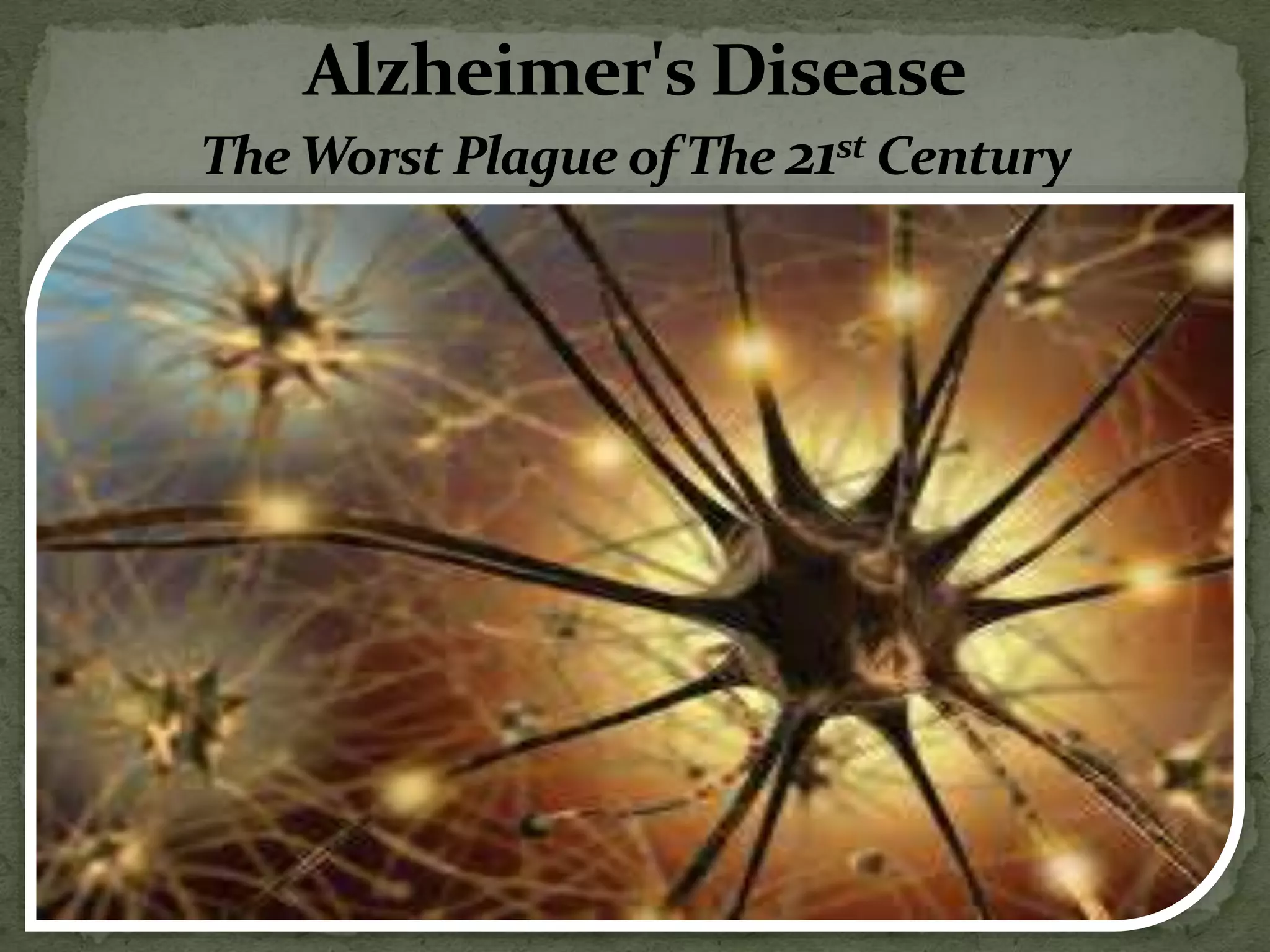
Alzheimer's Disease
The Worst Plague of The 21st Century
What is Alzheimer's disease?
Alzheimer's disease is a neurological
disorder in which the death of brain
cells causes memory loss and cognitive
decline.
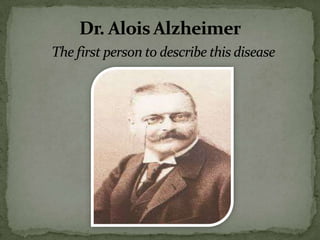
Dr. Alois Alzheimer
The first person to describe this disease
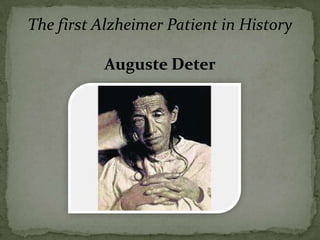
The first Alzheimer Patient in History
Auguste Deter
The Haunting case of Auguste D.
A 51 years old women, a patient who had
profound memory loss, unfounded suspicions
about her family, shrinkage in her brain and other
worsening psychological changes like, cognitive
and language deficits, auditory hallucinations,
delusions, paranoia and aggressive behaviour.
What causes Alzheimer's disease
Scientists don’t yet fully understand what causes
Alzheimer’s disease, but it is clear that it develops because
of a complex series of events that take place in the brain
over a long period of time. It is likely that the causes
include genetic, environmental, and lifestyle factors.
Because people differ in their genetic make-up and lifestyle,
the importance of these factors for preventing or delaying
Alzheimer’s differs from person to person.
Signs and Symptoms
Very early sign and symptoms
Memory problems are typically one of the first
warning signs of cognitive loss, possibly due to the
development of Alzheimer’s disease. A decline in
other aspects of cognition, such as word-finding,
vision/spatial issues, and impaired reasoning or
judgment, may also signal the very early stages of
Alzheimer’s disease.
Mild Alzheimer's Disease

Alzheimer’s disease progresses,
memory loss worsens, and changes in
other cognitive abilities which are
evident.
Moderate Alzheimer’s disease

In this stage, damage occurs in areas of the
brain that control language, reasoning,
sensory processing, and conscious thought.
Memory loss and confusion grow worse,
and people begin to have problems
recognizing family and friends.
Severe Alzheimer’s disease
By the final stage, plaques and tangles have
spread throughout the brain, and brain tissue has
shrunk significantly. People with severe
Alzheimer’s cannot communicate and are
completely dependent on others for their care.
Near the end, the person may be in bed most or all
of the time as the body shuts down.
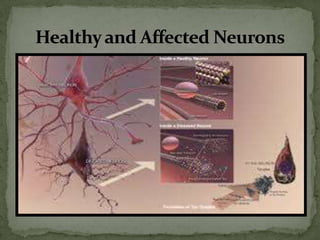
Healthy and Affected Neurons
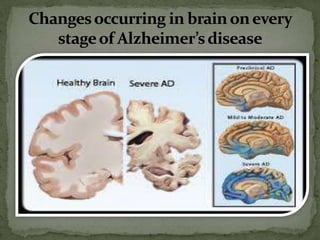
Changes occurring in brain on every
stage of Alzheimer’s disease
Genetics
Alzheimer's disease have a tendency to
pass from generation to generation. It is
a genetic disease which has maximum
chances of getting inherited from
parents.
Diagnosing Alzheimer's disease
To diagnose Alzheimer’s, doctors may:
● Ask questions about overall health, past medical
problems, ability to carry out daily activities, and
changes in behaviour and personality.
● Conduct tests of memory, problem solving, attention,
counting, and language.
● Carry out standard medical tests, such as blood and
urine tests, to identify other possible causes of the
problem.
● Perform brain scans, such as computed tomography
(CT) or magnetic resonance imaging (MRI), to
distinguish Alzheimer’s from other possible causes
for symptoms, like stroke or tumor.
Treatment
There is no specific treatment to cure Alzheimer’s
disease completely with the prescribed medicines
as it is most complex disease ever found in history.
There are some prescribed medicines by U.S. food
and drug administration to treat Alzheimer’s
disease but can’t cure it completely, it can just
stabilize the memory and some brain function for
limited period of time.
References
http://www.medicalnewstodayhttp://www.medicinenet.com/dementia
_pictures_slideshow/article.htm
http://www.medicalnewstoday.com/articles/159442.php
http://www.alz.org/alzheimers_disease_what_is_alzheimers.asp
http://www.alzheimers.org.uk/site/scripts/documents_info.php?docu
mentID=100
http://www.nytimes.com/health/guides/disease/alzheimersdisease/overview.html.com/articles/159442.php

Alzheimers

  • 1.
    Alzheimer's Disease The WorstPlague of The 21st Century
  • 2.
    What is Alzheimer'sdisease? Alzheimer's disease is a neurological disorder in which the death of brain cells causes memory loss and cognitive decline.
  • 3.
    Dr. Alois Alzheimer Thefirst person to describe this disease
  • 4.
    The first AlzheimerPatient in History Auguste Deter
  • 5.
    The Haunting caseof Auguste D. A 51 years old women, a patient who had profound memory loss, unfounded suspicions about her family, shrinkage in her brain and other worsening psychological changes like, cognitive and language deficits, auditory hallucinations, delusions, paranoia and aggressive behaviour.
  • 6.
    What causes Alzheimer'sdisease Scientists don’t yet fully understand what causes Alzheimer’s disease, but it is clear that it develops because of a complex series of events that take place in the brain over a long period of time. It is likely that the causes include genetic, environmental, and lifestyle factors. Because people differ in their genetic make-up and lifestyle, the importance of these factors for preventing or delaying Alzheimer’s differs from person to person.
  • 7.
    Signs and Symptoms Veryearly sign and symptoms Memory problems are typically one of the first warning signs of cognitive loss, possibly due to the development of Alzheimer’s disease. A decline in other aspects of cognition, such as word-finding, vision/spatial issues, and impaired reasoning or judgment, may also signal the very early stages of Alzheimer’s disease.
  • 8.
    Mild Alzheimer's Disease Alzheimer’sdisease progresses, memory loss worsens, and changes in other cognitive abilities which are evident.
  • 9.
    Moderate Alzheimer’s disease Inthis stage, damage occurs in areas of the brain that control language, reasoning, sensory processing, and conscious thought. Memory loss and confusion grow worse, and people begin to have problems recognizing family and friends.
  • 10.
    Severe Alzheimer’s disease Bythe final stage, plaques and tangles have spread throughout the brain, and brain tissue has shrunk significantly. People with severe Alzheimer’s cannot communicate and are completely dependent on others for their care. Near the end, the person may be in bed most or all of the time as the body shuts down.
  • 11.
  • 12.
    Changes occurring inbrain on every stage of Alzheimer’s disease
  • 14.
    Genetics Alzheimer's disease havea tendency to pass from generation to generation. It is a genetic disease which has maximum chances of getting inherited from parents.
  • 15.
    Diagnosing Alzheimer's disease Todiagnose Alzheimer’s, doctors may: ● Ask questions about overall health, past medical problems, ability to carry out daily activities, and changes in behaviour and personality. ● Conduct tests of memory, problem solving, attention, counting, and language. ● Carry out standard medical tests, such as blood and urine tests, to identify other possible causes of the problem. ● Perform brain scans, such as computed tomography (CT) or magnetic resonance imaging (MRI), to distinguish Alzheimer’s from other possible causes for symptoms, like stroke or tumor.
  • 16.
    Treatment There is nospecific treatment to cure Alzheimer’s disease completely with the prescribed medicines as it is most complex disease ever found in history. There are some prescribed medicines by U.S. food and drug administration to treat Alzheimer’s disease but can’t cure it completely, it can just stabilize the memory and some brain function for limited period of time.
  • 17.