GOODmorning
By:
Mr. Pranay P Shelokar
PRANAY SHELOKAR
PRACTICETEACHING
ON
DEMENTIA
Introduction:
• Cognition is that operation of the mind
process by which we become aware of objects
of thought and perception, including all
aspects of perceiving, thinking &
remembering. Organic brain syndrome is
general term referring to many physical
disorders that cause impaired mental
function.
 Classification of organic brain
disorders:
• (F00-f09) organic, including
symptomatic, mental disorders
• (F00) Dementia in Alzheimer’s disease
• (F01) Vascular dementia
• (F02) Dementia in other diseases

classified elsewhere
• (F03) unspecified dementia
• (F04) organic amnestic syndrome, not
induced by alcohol and other
psychoactive substances

• (F05) delirium not induced by alcohol and
other psychoactive substances
• (F06) Other mental disorders due to brain
damage and dysfunction and to physical
disease
• (F07) personality and behavioural disorders
due to brain disease, damage and dysfunction
• (F09) unspecified organic or symptomatic
mental disorder.
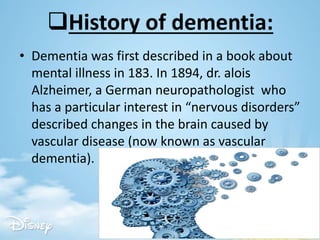
History of dementia:
• Dementia was first described in a book about
mental illness in 183. In 1894, dr. alois
Alzheimer, a German neuropathologist who
has a particular interest in “nervous disorders”
described changes in the brain caused by
vascular disease (now known as vascular
dementia).
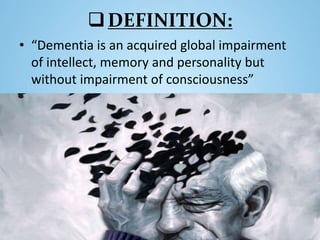
DEFINITION:
• “Dementia is an acquired global impairment
of intellect, memory and personality but
without impairment of consciousness”
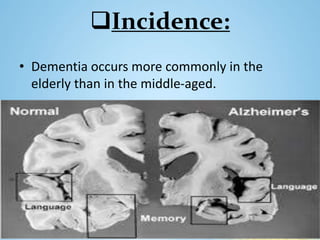
Incidence:
• Dementia occurs more commonly in the
elderly than in the middle-aged.
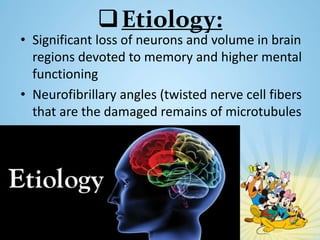
Etiology:
• Significant loss of neurons and volume in brain
regions devoted to memory and higher mental
functioning
• Neurofibrillary angles (twisted nerve cell fibers
that are the damaged remains of microtubules
• Environmental factors: infection, metals
and toxins.
• Excessive amount of metal ions, such as
zinc and copper, in brain
• Deficiencies of vitamin B6,B12 And
Folate Possible Risk Factor Due To
Increased Levels Of Hemocysteine
(amino acid that may interfere with
nerve cell repair)
• Early depression: common genetic
factors seen in those with early
depression and Alzheimer's disease
Untreatable and irreversible
cause of dementia
• Degenerating disorders of CNS
• Alzheimer’s disease (this is the most common
of all dementing illnesses)
• Pick’s disease
• Huntington’s chorea
• Parkinson’s disease
Treatable and reversible
causes of dementia
• Vascular-multi-infarct dementia
• Intracranial space occupying lesions
• Metabolic disorders-hepatic failure, renal failure
• Endocrine disorders- myxedema, Addison’s
disease
• Infections- AIDS, meningitis, encephalitis
• Intoxication- Alcohol, heavy metals (lead,
arsenic),
• Anoxia- Anemia, post-anesthesia, chronic
respiratory failure
• Vitamin deficiency, especially deficiency of thiamine
and nicotine
Physiologic:
• Normal pressure hydrocephalus
Metabolic:
• Endocrinopathies (e.g. hypothyroidism)
Tumor:
• Primary or metastatic (e.g. meningioma or
metastatic breast or lung cancer)
Traumatic:
• Subdural hematoma
Types of dementia:
the classifications include.
Cortical dementia: dementia where the brain
damage primarily affects the brain’s cortex, or
outer layer. Cortical dementias tend to cause
problems with memory, language, thinking,
and social behaviour.
Subcortical dementia: dementia that affects
parts of the brain below the cortex. Sub-
cortical dementia tends to cause changes in
emotions and emotions and movement in
addition to problems with memory.
Progressive dementia: dementia that gets
worse over time, gradually interfering with
more and more cognitive abilities.
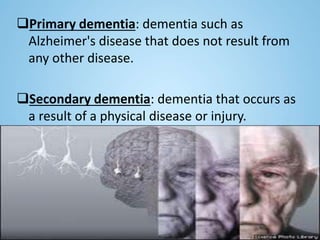
Primary dementia: dementia such as
Alzheimer's disease that does not result from
any other disease.
Secondary dementia: dementia that occurs as
a result of a physical disease or injury.
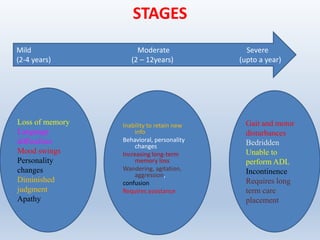
Stages of dementia:
Stage I: Early stage (2 to 4 years):
• Forgetfulness
• Declining interest in environment
• Hesitancy in initiating actions
• Poor performance at work
Stage II: Middle stage (2 to 12 years):
• Progressive memory loss
• Hesitates in response to questions
• Has difficulty in following simple instructions
• Irritable, anxious
• Wandering
• Neglects personal hygiene
• Social isolation
Stage III: Final stage (up to a year):
• Marked loss of weight because of
inadequate intake of food
• Unable to communicate
• Does not recognize family
• Incontinence of urine and feces
• Loses the ability to stand and walk
• Death is caused by aspiration
pneumonia
STAGES
Mild Moderate Severe
(2-4 years) (2 – 12years) (upto a year)
Loss of memory
Language
difficulties
Mood swings
Personality
changes
Diminished
judgment
Apathy
Inability to retain new
info
Behavioral, personality
changes
Increasing long-term
memory loss
Wandering, agitation,
aggression,
confusion
Requires assistance
Gait and motor
disturbances
Bedridden
Unable to
perform ADL
Incontinence
Requires long
term care
placement
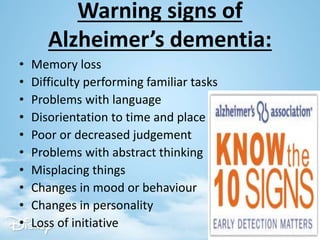
Warning signs of
Alzheimer’s dementia:
• Memory loss
• Difficulty performing familiar tasks
• Problems with language
• Disorientation to time and place
• Poor or decreased judgement
• Problems with abstract thinking
• Misplacing things
• Changes in mood or behaviour
• Changes in personality
• Loss of initiative
Clinical features (For
Alzheimer’s type)
• Personality changes: lack of interest in
day-to-day activities, easy mental
fatigability, self-centred, withdrawn,
decreased self-care.
• Memory impairment: recent memory is
prominently affected.
• Cognitive impairment: disorientation
poor judgement, difficulty in
abstraction, decreased attention span.
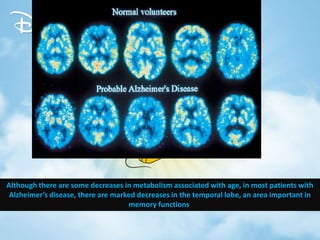
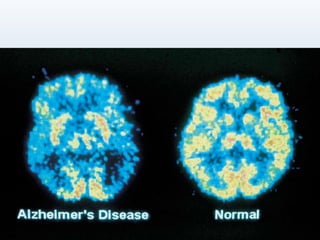
Although there are some decreases in metabolism associated with age, in most patients with
Alzheimer’s disease, there are marked decreases in the temporal lobe, an area important in
memory functions.
• Affective impairment: labile mood,
irritableness, depression
• Behavioural impairment: stereotyped
behaviour, alteration in sexual drives and
activities, psychotic behaviour.
• Neurological impairment: stereotyped
behaviour, alteration in sexual drives and
activities,
Diagnosis:
• Following test are used for diagnosis:
• Cognitive assessment evaluation- mini
mental status examination (MMSE) –
shows cognitive impairment
• Functional dementia scale (to indicate
the degree of dementia)
• Magnetic resonance imaging (MRI): of
the brain shows structural and
neurologic changes.
• Spinal fluid analysis shows increased
beta amyloid deposits
Treatment modalities:
• Tacrine hydrochloride (cognex)
• Donepezil hydrochloride (Aricept)
NMDA ANTAGONISTS.
• Memantine
ANTIPSYCHOTIC AGENTS
• Risperidone, quetiapine, and
• olanzapine
ANTIDEPRESSANT AGENTS AND MOOD
STABILIZERS
• Low doses of the selective serotonin reuptake
inhibitors and other newer antidepressive
agents should be considered.
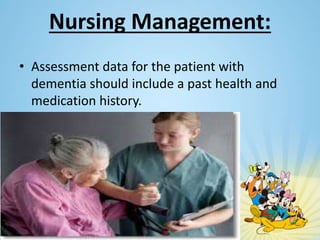
Nursing Management:
• Assessment data for the patient with
dementia should include a past health and
medication history.
Data to be included for nursing assessment
• Disorientation
• Mood changes
• Fear
• Suspiciousness
• Self-care deficit
• Social behaviour
• Level of mobility, wandering behaviour
• Judgement ability
• Sleep disturbances
• Speech or language impairment
• Hallucinations, illusions or delusions
• Bowel and bladder incontinence
• Apathy
• Any decline in nutritional status
• Recognition of family members
• Identify primary care giver, support system
and the knowledge base of the family
members.
Nursing intervention:
• Daily routine
• Nutrition & body weight
• Personal hygiene
• Toilet habits and incontinence
• Accidents
• Fluid management
• Moods and emotions
• Wandering
• Disturbed sleep
• Interpersonal relationship
Summary:
 Introduction
 Classification
 History
 Definition
 Etiology
 Types
 Stages
 Warning signs
 Clinical features
 Diagnosis
 Treatment modalities
 Nursing management
Conclusion:
• Dementia is a serious cognitive disorder all
together dementia is a far common in the
geriatric population, it may be occur in any
stage of childhood
• So as a nurse we need to get aware about the
preventive measures of dementia and
educative the individuals about its signs and
symptoms with its treatment
Bibliography:
• R Sreevani, a guide to mental health and
psychiatric nursing,
jaypee publishers,
3rd edition, pg.no: 310-311
• Townsend c Mary, text book on “Psychiatric
Mental Health Nursing.”
Jaypee publications.
5th edition, page 387-405
Dementia PRESENTATION

Dementia PRESENTATION

  • 1.
  • 2.
  • 3.
  • 5.
    Introduction: • Cognition isthat operation of the mind process by which we become aware of objects of thought and perception, including all aspects of perceiving, thinking & remembering. Organic brain syndrome is general term referring to many physical disorders that cause impaired mental function.
  • 6.
     Classification oforganic brain disorders: • (F00-f09) organic, including symptomatic, mental disorders • (F00) Dementia in Alzheimer’s disease • (F01) Vascular dementia • (F02) Dementia in other diseases classified elsewhere • (F03) unspecified dementia • (F04) organic amnestic syndrome, not induced by alcohol and other psychoactive substances
  • 7.
    • (F05) deliriumnot induced by alcohol and other psychoactive substances • (F06) Other mental disorders due to brain damage and dysfunction and to physical disease • (F07) personality and behavioural disorders due to brain disease, damage and dysfunction • (F09) unspecified organic or symptomatic mental disorder.
  • 8.
    History of dementia: •Dementia was first described in a book about mental illness in 183. In 1894, dr. alois Alzheimer, a German neuropathologist who has a particular interest in “nervous disorders” described changes in the brain caused by vascular disease (now known as vascular dementia).
  • 9.
    DEFINITION: • “Dementia isan acquired global impairment of intellect, memory and personality but without impairment of consciousness”
  • 10.
    Incidence: • Dementia occursmore commonly in the elderly than in the middle-aged.
  • 11.
    Etiology: • Significant lossof neurons and volume in brain regions devoted to memory and higher mental functioning • Neurofibrillary angles (twisted nerve cell fibers that are the damaged remains of microtubules
  • 12.
    • Environmental factors:infection, metals and toxins. • Excessive amount of metal ions, such as zinc and copper, in brain • Deficiencies of vitamin B6,B12 And Folate Possible Risk Factor Due To Increased Levels Of Hemocysteine (amino acid that may interfere with nerve cell repair) • Early depression: common genetic factors seen in those with early depression and Alzheimer's disease
  • 13.
    Untreatable and irreversible causeof dementia • Degenerating disorders of CNS • Alzheimer’s disease (this is the most common of all dementing illnesses) • Pick’s disease • Huntington’s chorea • Parkinson’s disease
  • 14.
    Treatable and reversible causesof dementia • Vascular-multi-infarct dementia • Intracranial space occupying lesions • Metabolic disorders-hepatic failure, renal failure • Endocrine disorders- myxedema, Addison’s disease • Infections- AIDS, meningitis, encephalitis • Intoxication- Alcohol, heavy metals (lead, arsenic), • Anoxia- Anemia, post-anesthesia, chronic respiratory failure
  • 15.
    • Vitamin deficiency,especially deficiency of thiamine and nicotine Physiologic: • Normal pressure hydrocephalus Metabolic: • Endocrinopathies (e.g. hypothyroidism) Tumor: • Primary or metastatic (e.g. meningioma or metastatic breast or lung cancer) Traumatic: • Subdural hematoma
  • 16.
    Types of dementia: theclassifications include. Cortical dementia: dementia where the brain damage primarily affects the brain’s cortex, or outer layer. Cortical dementias tend to cause problems with memory, language, thinking, and social behaviour.
  • 17.
    Subcortical dementia: dementiathat affects parts of the brain below the cortex. Sub- cortical dementia tends to cause changes in emotions and emotions and movement in addition to problems with memory. Progressive dementia: dementia that gets worse over time, gradually interfering with more and more cognitive abilities.
  • 18.
    Primary dementia: dementiasuch as Alzheimer's disease that does not result from any other disease. Secondary dementia: dementia that occurs as a result of a physical disease or injury.
  • 20.
    Stages of dementia: StageI: Early stage (2 to 4 years): • Forgetfulness • Declining interest in environment • Hesitancy in initiating actions • Poor performance at work
  • 21.
    Stage II: Middlestage (2 to 12 years): • Progressive memory loss • Hesitates in response to questions • Has difficulty in following simple instructions • Irritable, anxious • Wandering • Neglects personal hygiene • Social isolation
  • 22.
    Stage III: Finalstage (up to a year): • Marked loss of weight because of inadequate intake of food • Unable to communicate • Does not recognize family • Incontinence of urine and feces • Loses the ability to stand and walk • Death is caused by aspiration pneumonia
  • 23.
    STAGES Mild Moderate Severe (2-4years) (2 – 12years) (upto a year) Loss of memory Language difficulties Mood swings Personality changes Diminished judgment Apathy Inability to retain new info Behavioral, personality changes Increasing long-term memory loss Wandering, agitation, aggression, confusion Requires assistance Gait and motor disturbances Bedridden Unable to perform ADL Incontinence Requires long term care placement
  • 24.
    Warning signs of Alzheimer’sdementia: • Memory loss • Difficulty performing familiar tasks • Problems with language • Disorientation to time and place • Poor or decreased judgement • Problems with abstract thinking • Misplacing things • Changes in mood or behaviour • Changes in personality • Loss of initiative
  • 25.
    Clinical features (For Alzheimer’stype) • Personality changes: lack of interest in day-to-day activities, easy mental fatigability, self-centred, withdrawn, decreased self-care. • Memory impairment: recent memory is prominently affected. • Cognitive impairment: disorientation poor judgement, difficulty in abstraction, decreased attention span.
  • 26.
    Although there aresome decreases in metabolism associated with age, in most patients with Alzheimer’s disease, there are marked decreases in the temporal lobe, an area important in memory functions.
  • 27.
    • Affective impairment:labile mood, irritableness, depression • Behavioural impairment: stereotyped behaviour, alteration in sexual drives and activities, psychotic behaviour. • Neurological impairment: stereotyped behaviour, alteration in sexual drives and activities,
  • 28.
    Diagnosis: • Following testare used for diagnosis: • Cognitive assessment evaluation- mini mental status examination (MMSE) – shows cognitive impairment • Functional dementia scale (to indicate the degree of dementia) • Magnetic resonance imaging (MRI): of the brain shows structural and neurologic changes. • Spinal fluid analysis shows increased beta amyloid deposits
  • 30.
    Treatment modalities: • Tacrinehydrochloride (cognex) • Donepezil hydrochloride (Aricept) NMDA ANTAGONISTS. • Memantine ANTIPSYCHOTIC AGENTS • Risperidone, quetiapine, and • olanzapine
  • 31.
    ANTIDEPRESSANT AGENTS ANDMOOD STABILIZERS • Low doses of the selective serotonin reuptake inhibitors and other newer antidepressive agents should be considered.
  • 32.
    Nursing Management: • Assessmentdata for the patient with dementia should include a past health and medication history.
  • 33.
    Data to beincluded for nursing assessment • Disorientation • Mood changes • Fear • Suspiciousness • Self-care deficit • Social behaviour • Level of mobility, wandering behaviour • Judgement ability • Sleep disturbances • Speech or language impairment • Hallucinations, illusions or delusions
  • 34.
    • Bowel andbladder incontinence • Apathy • Any decline in nutritional status • Recognition of family members • Identify primary care giver, support system and the knowledge base of the family members.
  • 35.
    Nursing intervention: • Dailyroutine • Nutrition & body weight • Personal hygiene • Toilet habits and incontinence • Accidents • Fluid management • Moods and emotions • Wandering • Disturbed sleep • Interpersonal relationship
  • 36.
    Summary:  Introduction  Classification History  Definition  Etiology  Types  Stages  Warning signs  Clinical features  Diagnosis  Treatment modalities  Nursing management
  • 37.
    Conclusion: • Dementia isa serious cognitive disorder all together dementia is a far common in the geriatric population, it may be occur in any stage of childhood • So as a nurse we need to get aware about the preventive measures of dementia and educative the individuals about its signs and symptoms with its treatment
  • 38.
    Bibliography: • R Sreevani,a guide to mental health and psychiatric nursing, jaypee publishers, 3rd edition, pg.no: 310-311 • Townsend c Mary, text book on “Psychiatric Mental Health Nursing.” Jaypee publications. 5th edition, page 387-405