











Alzheimer’s Disease
Overview
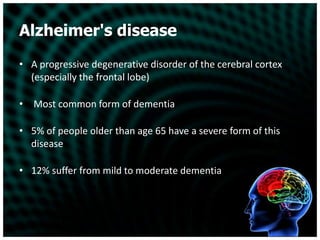
Alzheimer's diseaseA progressive degenerative disorder of the cerebral cortex (especially the frontal lobe) Most common form of dementia5% of people older than age 65 have a severe form of this disease12% suffer from mild to moderate dementia
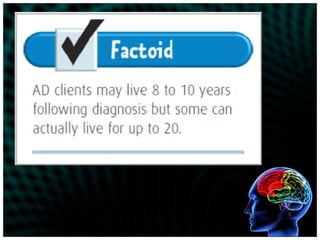
Alzheimer's diseaseCharacterized by:Progressive impairment in memory, cognitive function, language, judgment, and ADLUltimately, patients cannot perform self-care activities and become dependent on caregiversPrognosis: poor
Pathophysiology and Etiology
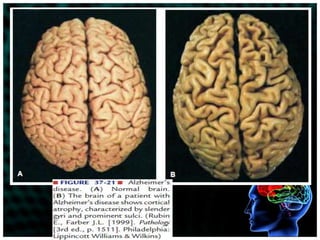
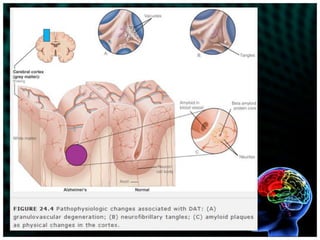
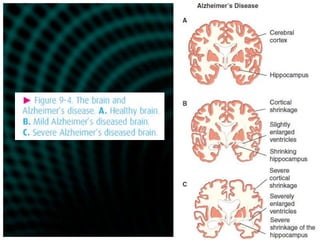
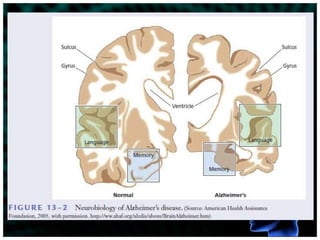
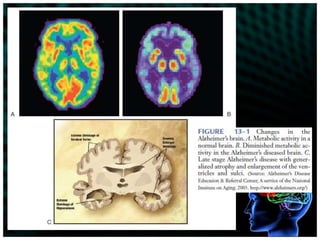
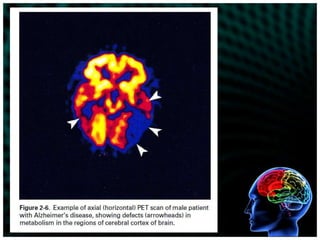
Gross pathophysiologic changes:cortical atrophyenlarged ventriclesbasal ganglia wastingMicroscopically:Changes in the proteins of the nerve cells of the cerebral cortexaccumulation of neurofibrillary tangles and neuritic plaques (deposits of protein and altered cell structures on the interneuronal junctions) granulovascular degenerationloss of cholinergic nerve cells (important in memory, function, cognition)
Biochemically:neurotransmitter systems are impairedCause: unknownRisk factors:genetics and female genderViruses, environmental toxins, silent brain infarcts, and previous head injury may also play a role
Clinical manifestations
Disease onset: subtle and insidiousInitially, a gradual decline of cognitive function from a previously higher levelShort-term memory impairment is commonly the first characteristic in earliest stages of the diseaseForgetful and difficulty learning and retaining new informationDifficulty planning meals, managing finances, using a telephone, or driving without getting lost
Functional deficits:Language disturbance (word-finding difficulty)Visual-processing difficultyInability to perform skilled motor activitiesPoor abstract reasoning and concentrationPersonality changes:IrritabilitySuspiciousnessPersonal neglect of appearanceDisorientation to time and space
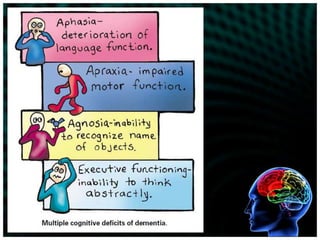
Middle stage:Repetitive actions (perseveration)Nocturnal restlessnessApraxia (impaired ability to perform purposeful activity)Aphasia (inability to speak)Agraphia (inability to write)Signs of frontal lobe dysfunction:Loss of social inhibitionsLoss of spontaneity
Middle and late stages:DelusionsHallucinationsAggressionWandering behaviorPatients in the advanced stage of Alzheimer's disease require total careUrinary and fecal incontinenceEmaciationIncreased irritabilityUnresponsiveness or coma
complications
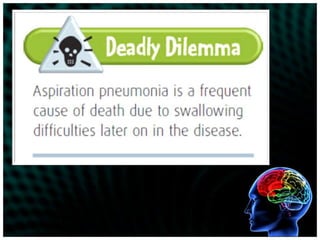
Increased incidence of functional declineInjury due to lack of insight, hallucinations, confusion, wandering, own violent bahaviorPneumonia and other infections, especially if the patient doesn't get enough exerciseMalnutrition and dehydration due to inattention to mealtime and hunger or lack of ability to prepare mealsAspiration
Diagnostic evaluation
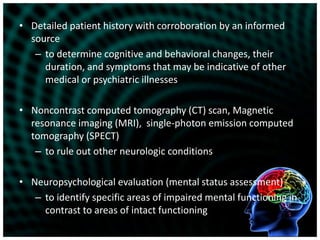
Detailed patient history with corroboration by an informed sourceto determine cognitive and behavioral changes, their duration, and symptoms that may be indicative of other medical or psychiatric illnessesNoncontrast computed tomography (CT) scan, Magnetic resonance imaging (MRI),  single-photon emission computed tomography (SPECT) to rule out other neurologic conditionsNeuropsychological evaluation (mental status assessment)to identify specific areas of impaired mental functioning in contrast to areas of intact functioning
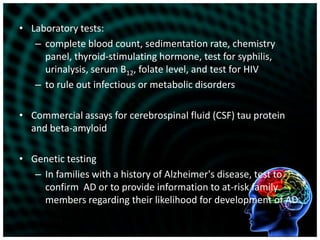
Laboratory tests:complete blood count, sedimentation rate, chemistry panel, thyroid-stimulating hormone, test for syphilis, urinalysis, serum B12, folate level, and test for HIVto rule out infectious or metabolic disordersCommercial assays for cerebrospinal fluid (CSF) tau protein and beta-amyloidGenetic testingIn families with a history of Alzheimer's disease, test to confirm  AD or to provide information to at-risk family members regarding their likelihood for development of AD
management
Primary goals of treatment for Alzheimer's disease:To maximize functional abilities and improve quality of life by enhancing mood, cognition, and behaviorNo curative treatment existsCholinesterase inhibitors first treatment for cognitive impairment of ADImprove cholinergic neurotransmission to help delay decline in function over time
Donepezil (Aricept)Widely used in mild to moderate cases because it can be given once daily and is well toleratedStarting at 5 mg hs and increased to 10 mg after 4 to 6 weeksGalantamine (Reminyl) Given with food in dosage of 4 to 12 mg bidShould be restarted at 4 mg bid if interrupted for several daysDose should be reduced in cases of renal or hepatic impairment
Rivastigmine (Exelon) Given 1.5 mg bid with meals and increased up to 6 to 12 mg per dayMemantine (Namenda)NMDA-receptor antagonistThe first of a new class approved for moderate to severe Alzheimer'sDosage is 10 mg bidCan be used with a cholinesterase inhibitor
Patients with depressive symptoms should be considered for antidepressant therapyBehavioral disturbances may require pharmacologic treatmentanxiolytics, antipsychotics,  anticonvulsantsNonpharmacologic treatments used to improve cognition:Environmental manipulation that decreases stimulationPet therapyAromatherapyMassageMusic therapyExercise
Drug AlertCholinesterase inhibitors initially aimed at improving memory and cognitionseem to have an important impact on the behavioral changes that occur in patients with cognitive impairmentimproves the apathy, disinhibition, pacing, and hallucinations commonly noted in dementiaBe alert for drug interactions with NSAIDs, succinylcholine-type muscle relaxants, cholinergic and anticholinergic agents, drugs that slow the heart, and other drugs that are metabolized by the hepatic CYP2D6 or CYP3A4 pathways
Nursing assessment
Perform cognitive assessment:orientation, insight, abstract thinking, concentration, memory, verbal abilityAssess for changes in behavior and ability to perform ADLsEvaluate nutrition and hydrationcheck weight, skin turgor, meal habitsAssess motor ability, strength, muscle tone, flexibility
Nursing diagnoses
Bathing or hygiene self-care deficitConstipationDisabled family copingDisturbed thought processesDressing or grooming self-care deficitFeeding self-care deficitImbalanced nutrition: Less than body requirementsImpaired verbal communicationIneffective copingInterrupted family processesRisk for infectionRisk for injuryToileting self-care deficit
Key outcomes
The patient willperform bathing and hygiene needsmaintain a regular bowel elimination pattern(Family members will) use support systems and develop adequate coping behaviorsremain oriented to time, person, place, and situation to the fullest extent possibleperform dressing and grooming needs within the confines of the disease processconsume daily calorie requirements
The patient willshow no signs of malnutritioneffectively communicate needs verbally or through the use of alternative means of communicationuse support systems and develop adequate coping behaviors(Family members will) discuss the impact of the patient's condition on the family unitremain free from signs and symptoms of infection(Family members will) identify strategies to make the patient's environment as safe as possibleperform toileting needs within the confines of the disease process
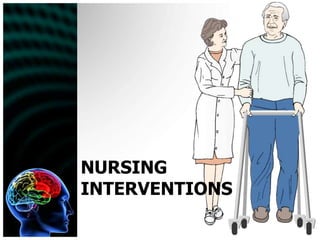
Nursing interventions
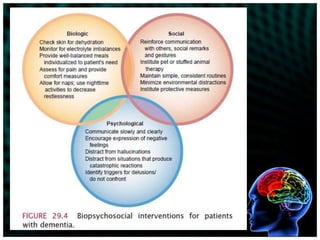
Establish an effective communication system with the patient and his familyto help them adjust to the patient's altered cognitive abilitiesProvide emotional support to the patient and his familyEncourage them to talk about their concernsListen carefully to themAnswer their questions honestly and completelyUse a soft tone and a slow, calm manner when speaking to himBecause the patient may misperceive his environment,
Allow the patient sufficient time to answer your questions his thought processes are slow, impairing his ability to communicate verballyAdminister ordered medications to the patient and note their effectsIf the patient has trouble swallowing, check with a pharmacist to see if tablets can be crushed or capsules can be opened and mixed with a semi-soft foodProtect the patient from injury Provide a safe, structured environmentProvide rest periods between activities because these patients tire easily
Encourage the patient to exerciseto help maintain mobilityEncourage patient independenceallow ample time for the patient to perform tasksEncourage sufficient fluid intake and adequate nutritionProvide assistance with menu selectionallow the patient to feed himself as much as he canProvide a well-balanced diet with adequate fiberAvoid stimulants, such as coffee, tea, cola, and chocolate
Give the patient semisolid foods if he has dysphagiaInsert and care for a nasogastric tube or a gastrostomy tube for feeding as orderedBecause the patient may be disoriented or neuromuscular functioning may be impaired, take the patient to the bathroom at least every 2 hoursMake sure he knows the location of the bathroomAssist the patient with hygiene and dressing as necessaryMany patients with Alzheimer's disease are incapable of performing these tasks
Patient teaching
Teach the patient's family about the diseaseExplain that the cause of the disease is unknownReview the signs and symptoms of the diseaseBe sure to explain that the disease progresses but at an unpredictable rate and that patients eventually suffer complete memory loss and total physical deteriorationReview the diagnostic tests that are to be performed and treatment the patient requiresAdvise family members to provide the patient with exerciseSuggest physical activities, such as walking or light housework, that occupy and satisfy the patient
Stress the importance of dietLimit the number of foods on the patient's plate so he doesn't have to make decisionsIf the patient has coordination problems, cut his food and to provide finger foods, such as fruit and sandwichesSuggest using plates with rim guards, easy-grip utensils, and cups with lids and spoutsAllow the patient as much independence as possible while ensuring his and others' safetyCreate a routine for all the patient's activities, which helps them avoid confusionIf the patient becomes belligerent, advise family members to remain calm and try to distract himRefer family members to support groups
Teaching patient about alzheimer’s disease
Counsel family members to expect progressive deterioration in the patient with Alzheimer's diseaseTo help them plan future patient care, discuss the stages of this relentless neurodegenerative diseaseBear in mind that family members may refuse to believe that the disease is advancingBe sensitive to their concerns and, if necessary, review the information again when they're more receptive
ForgetfulnessThe patient becomes forgetful, especially of recent eventsHe frequently loses everyday objects such as keysAware of his loss of function, he may compensate by relinquishing tasks that might reveal his forgetfulnessBecause his behavior isn't disruptive and may be attributed to stress, fatigue, or normal aging, he usually doesn't consult a physician at this stage
ConfusionThe patient has increasing difficulty at activities that require planning, decision making, and judgment, such as managing personal finances, driving a car, and performing his jobHe does retain skills such as personal groomingSocial withdrawal occurs when the patient feels overwhelmed by a changing environment and his inability to cope with multiple stimuliTravel is difficult and tiringAs he becomes aware of his progressive loss of function, he may become severely depressedSafety becomes a concern when the patient forgets to turn off appliances or recognize unsafe situations such as boiling waterAt this point, the family may need to consider day care or a supervised residential facility
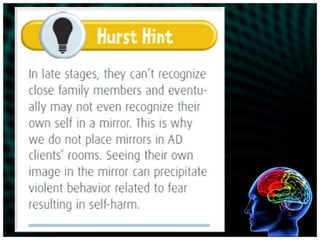
Decline in activities of daily livingThe patient at this stage loses his ability to perform such daily activities as eating or washing without direct supervisionWeight loss may occurHe withdraws from the family and increasingly depends on the primary caregiverCommunication becomes difficult as his understanding of written and spoken language declinesAgitation, wandering, pacing, and nighttime awakening are linked to his inability to cope with a multisensory environmentHe may mistake his mirror image for a real person (pseudohallucination)Caregivers must be constantly vigilant, which may lead to physical and emotional exhaustionThey may also be angry and feel a sense of loss.
Total deteriorationIn the final stage of Alzheimer's disease, the patient no longer recognizes himself, his body parts, or other family membersHe becomes bedridden, and his activity consists of small, purposeless movementsVerbal communication stops, although he may scream spontaneouslyComplications of immobility may include pressure ulcers, urinary tract infections, pneumonia, and contractures
Learning activity
True or False: Alzheimer’s disease is a memory-related disease that is reversible with medications.
FALSEAlzheimer’s disease is a progressive degenerative disorder of the brain that is irreversibleThe exact cause is unknown; initial stages include recent memory loss and impaired judgment, inability to learn and retain new information, and difficulty finding words; later stages include decreased abilility to care for self, wandering, agitation and hostility, and possibly eventually inability to walk, incontinence, and no intelligible speechMedications may help improve memory in early stages, but there is no cureIt is typically diagnosed when other dementia-producing conditions have been ruled out
http://nurseRD.blogspot.comwww.authorstream.com/reynel89/Nursingwww.slideshare.net/reynel89/slideshowsTHANK  YOU!Have a nice day  :  )- RDG

Alzheimer’s disease: Management

  • 1.
  • 2.
  • 3.
    Alzheimer's diseaseA progressivedegenerative disorder of the cerebral cortex (especially the frontal lobe) Most common form of dementia5% of people older than age 65 have a severe form of this disease12% suffer from mild to moderate dementia
  • 5.
    Alzheimer's diseaseCharacterized by:Progressiveimpairment in memory, cognitive function, language, judgment, and ADLUltimately, patients cannot perform self-care activities and become dependent on caregiversPrognosis: poor
  • 6.
  • 7.
    Gross pathophysiologic changes:corticalatrophyenlarged ventriclesbasal ganglia wastingMicroscopically:Changes in the proteins of the nerve cells of the cerebral cortexaccumulation of neurofibrillary tangles and neuritic plaques (deposits of protein and altered cell structures on the interneuronal junctions) granulovascular degenerationloss of cholinergic nerve cells (important in memory, function, cognition)
  • 11.
    Biochemically:neurotransmitter systems areimpairedCause: unknownRisk factors:genetics and female genderViruses, environmental toxins, silent brain infarcts, and previous head injury may also play a role
  • 12.
  • 13.
    Disease onset: subtleand insidiousInitially, a gradual decline of cognitive function from a previously higher levelShort-term memory impairment is commonly the first characteristic in earliest stages of the diseaseForgetful and difficulty learning and retaining new informationDifficulty planning meals, managing finances, using a telephone, or driving without getting lost
  • 15.
    Functional deficits:Language disturbance(word-finding difficulty)Visual-processing difficultyInability to perform skilled motor activitiesPoor abstract reasoning and concentrationPersonality changes:IrritabilitySuspiciousnessPersonal neglect of appearanceDisorientation to time and space
  • 16.
    Middle stage:Repetitive actions(perseveration)Nocturnal restlessnessApraxia (impaired ability to perform purposeful activity)Aphasia (inability to speak)Agraphia (inability to write)Signs of frontal lobe dysfunction:Loss of social inhibitionsLoss of spontaneity
  • 18.
    Middle and latestages:DelusionsHallucinationsAggressionWandering behaviorPatients in the advanced stage of Alzheimer's disease require total careUrinary and fecal incontinenceEmaciationIncreased irritabilityUnresponsiveness or coma
  • 21.
  • 22.
    Increased incidence offunctional declineInjury due to lack of insight, hallucinations, confusion, wandering, own violent bahaviorPneumonia and other infections, especially if the patient doesn't get enough exerciseMalnutrition and dehydration due to inattention to mealtime and hunger or lack of ability to prepare mealsAspiration
  • 25.
  • 26.
    Detailed patient historywith corroboration by an informed sourceto determine cognitive and behavioral changes, their duration, and symptoms that may be indicative of other medical or psychiatric illnessesNoncontrast computed tomography (CT) scan, Magnetic resonance imaging (MRI), single-photon emission computed tomography (SPECT) to rule out other neurologic conditionsNeuropsychological evaluation (mental status assessment)to identify specific areas of impaired mental functioning in contrast to areas of intact functioning
  • 29.
    Laboratory tests:complete bloodcount, sedimentation rate, chemistry panel, thyroid-stimulating hormone, test for syphilis, urinalysis, serum B12, folate level, and test for HIVto rule out infectious or metabolic disordersCommercial assays for cerebrospinal fluid (CSF) tau protein and beta-amyloidGenetic testingIn families with a history of Alzheimer's disease, test to confirm AD or to provide information to at-risk family members regarding their likelihood for development of AD
  • 30.
  • 31.
    Primary goals oftreatment for Alzheimer's disease:To maximize functional abilities and improve quality of life by enhancing mood, cognition, and behaviorNo curative treatment existsCholinesterase inhibitors first treatment for cognitive impairment of ADImprove cholinergic neurotransmission to help delay decline in function over time
  • 32.
    Donepezil (Aricept)Widely usedin mild to moderate cases because it can be given once daily and is well toleratedStarting at 5 mg hs and increased to 10 mg after 4 to 6 weeksGalantamine (Reminyl) Given with food in dosage of 4 to 12 mg bidShould be restarted at 4 mg bid if interrupted for several daysDose should be reduced in cases of renal or hepatic impairment
  • 33.
    Rivastigmine (Exelon) Given1.5 mg bid with meals and increased up to 6 to 12 mg per dayMemantine (Namenda)NMDA-receptor antagonistThe first of a new class approved for moderate to severe Alzheimer'sDosage is 10 mg bidCan be used with a cholinesterase inhibitor
  • 34.
    Patients with depressivesymptoms should be considered for antidepressant therapyBehavioral disturbances may require pharmacologic treatmentanxiolytics, antipsychotics, anticonvulsantsNonpharmacologic treatments used to improve cognition:Environmental manipulation that decreases stimulationPet therapyAromatherapyMassageMusic therapyExercise
  • 35.
    Drug AlertCholinesterase inhibitorsinitially aimed at improving memory and cognitionseem to have an important impact on the behavioral changes that occur in patients with cognitive impairmentimproves the apathy, disinhibition, pacing, and hallucinations commonly noted in dementiaBe alert for drug interactions with NSAIDs, succinylcholine-type muscle relaxants, cholinergic and anticholinergic agents, drugs that slow the heart, and other drugs that are metabolized by the hepatic CYP2D6 or CYP3A4 pathways
  • 36.
  • 37.
    Perform cognitive assessment:orientation,insight, abstract thinking, concentration, memory, verbal abilityAssess for changes in behavior and ability to perform ADLsEvaluate nutrition and hydrationcheck weight, skin turgor, meal habitsAssess motor ability, strength, muscle tone, flexibility
  • 38.
  • 39.
    Bathing or hygieneself-care deficitConstipationDisabled family copingDisturbed thought processesDressing or grooming self-care deficitFeeding self-care deficitImbalanced nutrition: Less than body requirementsImpaired verbal communicationIneffective copingInterrupted family processesRisk for infectionRisk for injuryToileting self-care deficit
  • 40.
  • 41.
    The patient willperformbathing and hygiene needsmaintain a regular bowel elimination pattern(Family members will) use support systems and develop adequate coping behaviorsremain oriented to time, person, place, and situation to the fullest extent possibleperform dressing and grooming needs within the confines of the disease processconsume daily calorie requirements
  • 42.
    The patient willshowno signs of malnutritioneffectively communicate needs verbally or through the use of alternative means of communicationuse support systems and develop adequate coping behaviors(Family members will) discuss the impact of the patient's condition on the family unitremain free from signs and symptoms of infection(Family members will) identify strategies to make the patient's environment as safe as possibleperform toileting needs within the confines of the disease process
  • 43.
  • 45.
    Establish an effectivecommunication system with the patient and his familyto help them adjust to the patient's altered cognitive abilitiesProvide emotional support to the patient and his familyEncourage them to talk about their concernsListen carefully to themAnswer their questions honestly and completelyUse a soft tone and a slow, calm manner when speaking to himBecause the patient may misperceive his environment,
  • 46.
    Allow the patientsufficient time to answer your questions his thought processes are slow, impairing his ability to communicate verballyAdminister ordered medications to the patient and note their effectsIf the patient has trouble swallowing, check with a pharmacist to see if tablets can be crushed or capsules can be opened and mixed with a semi-soft foodProtect the patient from injury Provide a safe, structured environmentProvide rest periods between activities because these patients tire easily
  • 47.
    Encourage the patientto exerciseto help maintain mobilityEncourage patient independenceallow ample time for the patient to perform tasksEncourage sufficient fluid intake and adequate nutritionProvide assistance with menu selectionallow the patient to feed himself as much as he canProvide a well-balanced diet with adequate fiberAvoid stimulants, such as coffee, tea, cola, and chocolate
  • 48.
    Give the patientsemisolid foods if he has dysphagiaInsert and care for a nasogastric tube or a gastrostomy tube for feeding as orderedBecause the patient may be disoriented or neuromuscular functioning may be impaired, take the patient to the bathroom at least every 2 hoursMake sure he knows the location of the bathroomAssist the patient with hygiene and dressing as necessaryMany patients with Alzheimer's disease are incapable of performing these tasks
  • 49.
  • 50.
    Teach the patient'sfamily about the diseaseExplain that the cause of the disease is unknownReview the signs and symptoms of the diseaseBe sure to explain that the disease progresses but at an unpredictable rate and that patients eventually suffer complete memory loss and total physical deteriorationReview the diagnostic tests that are to be performed and treatment the patient requiresAdvise family members to provide the patient with exerciseSuggest physical activities, such as walking or light housework, that occupy and satisfy the patient
  • 51.
    Stress the importanceof dietLimit the number of foods on the patient's plate so he doesn't have to make decisionsIf the patient has coordination problems, cut his food and to provide finger foods, such as fruit and sandwichesSuggest using plates with rim guards, easy-grip utensils, and cups with lids and spoutsAllow the patient as much independence as possible while ensuring his and others' safetyCreate a routine for all the patient's activities, which helps them avoid confusionIf the patient becomes belligerent, advise family members to remain calm and try to distract himRefer family members to support groups
  • 52.
    Teaching patient aboutalzheimer’s disease
  • 53.
    Counsel family membersto expect progressive deterioration in the patient with Alzheimer's diseaseTo help them plan future patient care, discuss the stages of this relentless neurodegenerative diseaseBear in mind that family members may refuse to believe that the disease is advancingBe sensitive to their concerns and, if necessary, review the information again when they're more receptive
  • 54.
    ForgetfulnessThe patient becomesforgetful, especially of recent eventsHe frequently loses everyday objects such as keysAware of his loss of function, he may compensate by relinquishing tasks that might reveal his forgetfulnessBecause his behavior isn't disruptive and may be attributed to stress, fatigue, or normal aging, he usually doesn't consult a physician at this stage
  • 55.
    ConfusionThe patient hasincreasing difficulty at activities that require planning, decision making, and judgment, such as managing personal finances, driving a car, and performing his jobHe does retain skills such as personal groomingSocial withdrawal occurs when the patient feels overwhelmed by a changing environment and his inability to cope with multiple stimuliTravel is difficult and tiringAs he becomes aware of his progressive loss of function, he may become severely depressedSafety becomes a concern when the patient forgets to turn off appliances or recognize unsafe situations such as boiling waterAt this point, the family may need to consider day care or a supervised residential facility
  • 56.
    Decline in activitiesof daily livingThe patient at this stage loses his ability to perform such daily activities as eating or washing without direct supervisionWeight loss may occurHe withdraws from the family and increasingly depends on the primary caregiverCommunication becomes difficult as his understanding of written and spoken language declinesAgitation, wandering, pacing, and nighttime awakening are linked to his inability to cope with a multisensory environmentHe may mistake his mirror image for a real person (pseudohallucination)Caregivers must be constantly vigilant, which may lead to physical and emotional exhaustionThey may also be angry and feel a sense of loss.
  • 57.
    Total deteriorationIn thefinal stage of Alzheimer's disease, the patient no longer recognizes himself, his body parts, or other family membersHe becomes bedridden, and his activity consists of small, purposeless movementsVerbal communication stops, although he may scream spontaneouslyComplications of immobility may include pressure ulcers, urinary tract infections, pneumonia, and contractures
  • 58.
  • 59.
    True or False:Alzheimer’s disease is a memory-related disease that is reversible with medications.
  • 60.
    FALSEAlzheimer’s disease isa progressive degenerative disorder of the brain that is irreversibleThe exact cause is unknown; initial stages include recent memory loss and impaired judgment, inability to learn and retain new information, and difficulty finding words; later stages include decreased abilility to care for self, wandering, agitation and hostility, and possibly eventually inability to walk, incontinence, and no intelligible speechMedications may help improve memory in early stages, but there is no cureIt is typically diagnosed when other dementia-producing conditions have been ruled out
  • 61.