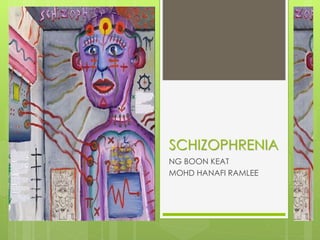
SCHIZOPHRENIA
NG BOON KEAT
MOHD HANAFI RAMLEE
To Know Schizophrenia is to
know Psychiatry
 The most devastating
illness that psychiatrist
treat.
 One of the most
challenging disease in
medicine
 1% of population has
schizo.
 An enormous economic
burden
 ? A major health concern
StoriesofSchizophrenia
History
 Emil Kraepelin- original term-
dementia praecox-early age,
chronic deteriorating course.
 Eugen Bleuler- coined the term
schizophrenia (split mind) 
affective blunting, loosening of
associations, autism (withdrawal)
and ambivalence (coexisting
conflicting ideas) - 4 As- earned
acceptance in USA
 Kurt Schneider  first rank
symptom
Definition
Psychotic mental disorder of
unknown aetiology
characterized by
disturbances in
 Thinking (e.g. distortion of
reality, delusions and
hallucinations)
 Mood (e.g. ambivalence,
inappropriate affect)
 Behaviour (e.g. Apathetic
withdrawal, bizarre activity)
at least 6 months
Epidemiology
•Lifetime prevalence 1-1.5%
•There is 7351 cases had been reported from 2003-2005
•The incidence was noted higher in males, urban and migrant
population
Incidence and prevalence(In Malaysia)
•60% of the schizophrenia cases are man
Sex ratio
•Prevalence > low socioeconomic groups
Socioeconomic status
•Common between 15 and 35, rare before 10 and after 40
years old. Earlier onset for ♂
Age of onset
Epidemiology: Sex
Epidemiology: Race
54
28
9
9
Malay Chinese
Indian Others
BUT IT CAN ALSO
AFFECT ANYONE
WITHOUT
PREDISPOSITIONS !
Aetiology
Uncertain; however there is
evidence for several risk
factors.
Several models which can be
grouped into….
Biological Social
Psychological
Aetiology – Bio
Genetics Consideration
 1st degree & 2nd degree relative
Environmental
 Abnormalities of pregnancy and delivery
[2%]
 Maternal Influenza – 2nd trimester [2%]
 Fetal Malnutrition [2%]
 Winter & Low Social Class birth [1.1%]
Social
 Studies have shown an excess of
schizophrenic patients in lower
socioeconomic groups and in urbanised
areas. This used to be attributed to “social
drift”
 Cannabis abusers [2%]
Psychological
 abnormalities in
processing sensory
information, in
separating “signal from
background noise”, or in
manipulating abstract
information
 Excess life traumas
against controls at first
presentation
Pathophysiology
 disorder of dopaminergic
function:
 related to increased dopamine
activity in certain neuronal
tracts.
 Other neurotransmitter
abnormalities implicated in
schizophrenia:
 elevated serotonin.
 elevated norepinephrine.
 decreased gamma-
aminobutyric acid (GABA).
Schizophrenia
Subtypes
Classically divided into five
subtypes
 Paranoid [stable, often persecutory
delusion/hallucinations only]
 Hebephrenic [thought/affective changes +
-ve symptoms]
 Undifferentiated [psychosis w/out clear
predominance]
 Catatonic [prominent psychomotor
disturbances]
 Residual [low intensity +ve symtoms]
THREE PHASES OF SCHIZOPHRENIA
Prodromal
•Decline in
functioning that
precedes 1st
psychotic
episode
•Socially
withdrawn,
irritable
•Physical
complaints
•Newfound
interest in religion
/ the occult
Psychotic
(acute phase)
•Positive
symptoms
•Perceptual
disturbances
(e.g. auditory
hallucinations)
•Delusions (usually
secondary,
delusion of
reference
common)
•Disordered
thought process
/ content
Residual
(chronic phase)
•Occurs between
episodes of
psychosis
•Marked by
negative
symptoms (flat
affect, social
withdrawal)
•odd thinking and
behaviour
Clinical Features
Acute syndrome
(positive symptoms)
• Hallucinations
• Delusion
• Disorganised
speech/thinking/
behaviour
• Catatonic behaviours
• Delusion of reference
Chronic syndrome
(negative symptoms)
• Affective Flattening
• Alogia
• Avolition
• Anhedonia
• Attention(poor)
DIAGNOSIS
CRITERIA OF
SCHIZOPHRENIA
The diagnosis of
schizophrenia is based
entirely on the clinical
presentation – history and
examination.
(ICD-10)
(DSM-
IV)
ICD diagnostic criteria –
1 of the following
At least one of the symptoms a-d or
two of the symptoms e- i
a. Thought echo, insertion, or
withdrawal and thought
broadcasting
b. Delusions of control, influence, or
passivity; delusional perception
c. Hallucinatory voices-running
commentary or other < part of body
d. Persistent delusions of other kinds
ICD diagnostic criteria –
2 of the following
e. Persistent hallucinations in any modality
occurring everyday for weeks or months
f. Breaks or interpolation in the train of thought >
incoherence or irrelevant speech, or
neologism
g. Catatonic behavior, such as excitement,
posturing, or waxy flexibility, negativism,
mutism, stupor
h. ‘negative’ symptoms; apathy, paucity of
speech, blunting of emotional response
i. A significant and consistent change in
behavior > aimless, idle, self-absorbed att
DSM-IV diagnostic criteria
A. Characteristic
symptoms. At least 2 of
the following; each for
1- month period:
a. delusions
b. hallucinations
c. disorganized speech
d. grossly disorganized
or catatonic behavior
e. negative symptoms,
i.e. avolition, flattening
of affect, alogia
(poverty of speech)
F. Social/occupational
dysfunction
G. Continuous signs of the
disturbance persists for
at least six months
H. Schizoaffective and
mood disorder exclusion
I. Substance/medical
condition exclusion
J. Relationship to pervasive
developmental disorder
autism+ schiz.<D/H-1 m
Difference between DSMIV
and ICD 10
DSMIV ICD-10
The classification of
schizophrenia
Course and
functional
impairment
Schneider’s first
rank sign
The duration of illness 6 months 1 month
Prodromal and residual
period
included Not included
Occupational and social
functional deficiency
Expected since the
onset of the
disorder
Expected in the
course of the
disorder
Kurt Schneider (German psychiatrist) ’s
symptoms of first rank
1. Auditory hallucinations:
audible thought or thought
echo ; referring third person;
running commentary.
2. Alienation of thought: thought
insertion or withdrawal
3. Diffusion of thought (thought
broadcasting)
4. Sensation of feelings, impulses
or acts being controlled by
external forces
5. Somatic passivity < external
agency (e.g. X-rays, hypnosis)
6. Delusional perception
Schneider first rank symptoms
of schizophrenia
 Individual symptoms that
are highly specific for
schizophrenia
 Occur in about 80% of
schizo pts, 40% in bipolar
mood disorder ( only
mania)& 20% in severe
major depression
DIFFERENTIALS &
MANAGEMENTS
Differential diagnosis
 Organic syndrome
 Drug
 Temporal lobe epilepsy
 Delirium
 Dementia
 Diffuse brain disease
 Psychotic mood disorder
 Personality disorder
 Schizoaffective disorder
Course
• Complete recovery20%
• Recurrent acute illness
20%
• Chronic disease
starting acutely20%
• Chronic disease
starting insidiously20%
• Suicide10-15%
Prognosis
 Recover completely/long
term minimal symptoms-
30%(The percentage on
the rise)
 Recurrent illness -poorer
prognosis
 Young patient -high risk
of suicide
Predictors for poor outcome
Features of the illness Insidious onset
Long 1st episode
Previous psychiatric history
Negative symptoms
Younger age at onset
Features of the patient Male
Single, separated, widowed or
divorced
Poor psychosexual adjustment
Poor employment
Social isolation
Poor compliance
Assessment
 No confirmatory laboratory
studies.
 Diagnosis made based on
psychotic symptoms and
functional deterioration.
 Diagnostic evaluation: aim
 Establish the presense of
psychosis
 Eliminate other differential
diagnosis
Component of Evaluation
Evaluation of of
psychosis
Medical evaluation
Mental status and
siucidality
Evaluation of of psychosis
Medical evaluation
Mental status and siucidality
Management
 Treatment of Schizophrenia
 Acute phase
 Relapse prevention phase
 Stable phase
 Psychosocial care and
rehabilitation
36
Need rapid
tranquilisation
Urgent
No
Yes Combination of
parenteral treatment
Yes
Yes
No
Identify Phases of Illness
No
Adequate
dose &
duration
 Oral medication is preferred
 When parenteral needed, use a single agent
•Provide comprehensive plan (pharmacological, psychosocial & service level interventions)
•Offer conventional APs (300-1000mg CPZ equivalent) or AMS or OLZ
•Monitor clinical response, side effects & treatment adherence
Poor
response
Optimise APs usage
•Exclude substance abuse, treatment
non-adherence & concurrent other
general medical conditions
•Optimise psychosocial interventions
•Refer to psychiatrist for trial of
clozapine
Yes
No
•Plan for recovery (ACT, family intervention, psychoeducation, social skills training & supported employment)
•APs usage to continue with single oral agent from acute phase; use depot when non-adherent
•Monitor for clinical response, side effects & treatment adherence
Acute
phase
Relapse
prevention
ALGORITHM FOR MANAGEMENT OF SCHIZOPHRENIA
Diagnosis of
Schizophrenia
Stable
phase
 Follow-up at primary care
 Follow manual on Garispanduan
Perkhidmatan Rawatan Susulan
Pesakit Mental di Klinik Kesihatan
Prevention & management of side effects of APs at all phases
aonitor EPS/akathisia/weight gain/diabetes/heart
disease/sexual dysfunction
Follow schedule of physical care as per follow-up manual
Acute phase
 From home to hospital
 Restrain
 Aid from policemen
 Safety of care provider, family members
and patient is crucial
 In the hospital
 Room of seclusion
 Consider involuntary admission
Physical restrain
Family education and
counselling
Emergency medication
Antipsychotic
Combination: antipsychotic
+ benzodiazepine
Administered parenterally
If cooperative, oral
administration allowed.
Relapse prevention phase
 Started on routine anripsychotic as early
as possible.
 Maintenance doses of medication
established and side effect reviewed.
 Patient education and reassurance.
 Building a therapeutic alliance with
patient and family
 Treatment resistance – Clozapine
 Assertive Community Therapy(ACT)
ACT?
 Combined medication and
psychosocial treatments with
aggressive delivery and
follow-up.
 Activities:
 Daily home visit
 “eyes-on” medication
administration
 Transportation to clinician
appointment
Stable phase
Follow up at primary care
clinic.
Life long medication
Remission for at least 1
year achieve in 70 – 80%
of patient taking
antipsychotic at full doses
Psychosocial support
Psychosocial and
rehabilitation care
 Social skill training
 Employment training
 Cognitive remediation therapy
 Psychoeducation
 Family therapy
 Don’t forget medical illness too…
Medications
Traditional Atypical
Haloperidol (2-30 mg) Risperidone (4-16mg)
Chlorpromazine (100-600mg) Olanzapine (5-20mg)
Trifuoperazine (5-30mg) Sertindole (12-20mg)
Sulpiride (400-800 mg) Clozapine (100-900 mg)
 Benzodiazepine - Lorazepam
 Atypical antipsychotic for treatment
resistant schizophrenia
- Clozapine
THANK YOU
NG BOON KEAT
MOHD HANAFI RAMLEE
Differential
Diagnosis
Psychotic
Symptom
Time
Course
Ruled out
secondary
causes
Primary
Psychosis
Chronic
(>1 mo)
Schizoaffective
Disorder
Schizophrenia
Delusional
Disorder
Psychosis NOS
Brief
(<1 mo)
Brief Psychotic
Disorder
Psychosis NOS
DiagnosisSpecifiers
Chronic
Primary
Psychosis
Criterion A Sx
and 6 mo
dysfunction?
Simultaneously
meet criteria for
mood disordes?
Schzioaffective
Disorder
Schizophrenia
Prominent
Delusions?
Delusional
Disorder
Psychosis NOS
yes
no
no
no
yes
yes
Diagnosis
Brief Primary
Psychosis
Between 1 day
and 1 mo Sx with
full recovery
Brief Psychotic
Disorder
Psychosis NOS
yes
no

Schizophrenia

  • 1.
  • 2.
    To Know Schizophreniais to know Psychiatry  The most devastating illness that psychiatrist treat.  One of the most challenging disease in medicine  1% of population has schizo.  An enormous economic burden  ? A major health concern
  • 3.
  • 4.
    History  Emil Kraepelin-original term- dementia praecox-early age, chronic deteriorating course.  Eugen Bleuler- coined the term schizophrenia (split mind)  affective blunting, loosening of associations, autism (withdrawal) and ambivalence (coexisting conflicting ideas) - 4 As- earned acceptance in USA  Kurt Schneider  first rank symptom
  • 5.
    Definition Psychotic mental disorderof unknown aetiology characterized by disturbances in  Thinking (e.g. distortion of reality, delusions and hallucinations)  Mood (e.g. ambivalence, inappropriate affect)  Behaviour (e.g. Apathetic withdrawal, bizarre activity) at least 6 months
  • 6.
    Epidemiology •Lifetime prevalence 1-1.5% •Thereis 7351 cases had been reported from 2003-2005 •The incidence was noted higher in males, urban and migrant population Incidence and prevalence(In Malaysia) •60% of the schizophrenia cases are man Sex ratio •Prevalence > low socioeconomic groups Socioeconomic status •Common between 15 and 35, rare before 10 and after 40 years old. Earlier onset for ♂ Age of onset
  • 7.
  • 8.
    Epidemiology: Race 54 28 9 9 Malay Chinese IndianOthers BUT IT CAN ALSO AFFECT ANYONE WITHOUT PREDISPOSITIONS !
  • 9.
    Aetiology Uncertain; however thereis evidence for several risk factors. Several models which can be grouped into…. Biological Social Psychological
  • 10.
    Aetiology – Bio GeneticsConsideration  1st degree & 2nd degree relative Environmental  Abnormalities of pregnancy and delivery [2%]  Maternal Influenza – 2nd trimester [2%]  Fetal Malnutrition [2%]  Winter & Low Social Class birth [1.1%]
  • 12.
    Social  Studies haveshown an excess of schizophrenic patients in lower socioeconomic groups and in urbanised areas. This used to be attributed to “social drift”  Cannabis abusers [2%]
  • 13.
    Psychological  abnormalities in processingsensory information, in separating “signal from background noise”, or in manipulating abstract information  Excess life traumas against controls at first presentation
  • 14.
    Pathophysiology  disorder ofdopaminergic function:  related to increased dopamine activity in certain neuronal tracts.  Other neurotransmitter abnormalities implicated in schizophrenia:  elevated serotonin.  elevated norepinephrine.  decreased gamma- aminobutyric acid (GABA).
  • 15.
    Schizophrenia Subtypes Classically divided intofive subtypes  Paranoid [stable, often persecutory delusion/hallucinations only]  Hebephrenic [thought/affective changes + -ve symptoms]  Undifferentiated [psychosis w/out clear predominance]  Catatonic [prominent psychomotor disturbances]  Residual [low intensity +ve symtoms]
  • 16.
    THREE PHASES OFSCHIZOPHRENIA Prodromal •Decline in functioning that precedes 1st psychotic episode •Socially withdrawn, irritable •Physical complaints •Newfound interest in religion / the occult Psychotic (acute phase) •Positive symptoms •Perceptual disturbances (e.g. auditory hallucinations) •Delusions (usually secondary, delusion of reference common) •Disordered thought process / content Residual (chronic phase) •Occurs between episodes of psychosis •Marked by negative symptoms (flat affect, social withdrawal) •odd thinking and behaviour
  • 17.
    Clinical Features Acute syndrome (positivesymptoms) • Hallucinations • Delusion • Disorganised speech/thinking/ behaviour • Catatonic behaviours • Delusion of reference Chronic syndrome (negative symptoms) • Affective Flattening • Alogia • Avolition • Anhedonia • Attention(poor)
  • 18.
    DIAGNOSIS CRITERIA OF SCHIZOPHRENIA The diagnosisof schizophrenia is based entirely on the clinical presentation – history and examination. (ICD-10) (DSM- IV)
  • 19.
    ICD diagnostic criteria– 1 of the following At least one of the symptoms a-d or two of the symptoms e- i a. Thought echo, insertion, or withdrawal and thought broadcasting b. Delusions of control, influence, or passivity; delusional perception c. Hallucinatory voices-running commentary or other < part of body d. Persistent delusions of other kinds
  • 20.
    ICD diagnostic criteria– 2 of the following e. Persistent hallucinations in any modality occurring everyday for weeks or months f. Breaks or interpolation in the train of thought > incoherence or irrelevant speech, or neologism g. Catatonic behavior, such as excitement, posturing, or waxy flexibility, negativism, mutism, stupor h. ‘negative’ symptoms; apathy, paucity of speech, blunting of emotional response i. A significant and consistent change in behavior > aimless, idle, self-absorbed att
  • 21.
    DSM-IV diagnostic criteria A.Characteristic symptoms. At least 2 of the following; each for 1- month period: a. delusions b. hallucinations c. disorganized speech d. grossly disorganized or catatonic behavior e. negative symptoms, i.e. avolition, flattening of affect, alogia (poverty of speech) F. Social/occupational dysfunction G. Continuous signs of the disturbance persists for at least six months H. Schizoaffective and mood disorder exclusion I. Substance/medical condition exclusion J. Relationship to pervasive developmental disorder autism+ schiz.<D/H-1 m
  • 22.
    Difference between DSMIV andICD 10 DSMIV ICD-10 The classification of schizophrenia Course and functional impairment Schneider’s first rank sign The duration of illness 6 months 1 month Prodromal and residual period included Not included Occupational and social functional deficiency Expected since the onset of the disorder Expected in the course of the disorder
  • 23.
    Kurt Schneider (Germanpsychiatrist) ’s symptoms of first rank 1. Auditory hallucinations: audible thought or thought echo ; referring third person; running commentary. 2. Alienation of thought: thought insertion or withdrawal 3. Diffusion of thought (thought broadcasting) 4. Sensation of feelings, impulses or acts being controlled by external forces 5. Somatic passivity < external agency (e.g. X-rays, hypnosis) 6. Delusional perception
  • 24.
    Schneider first ranksymptoms of schizophrenia  Individual symptoms that are highly specific for schizophrenia  Occur in about 80% of schizo pts, 40% in bipolar mood disorder ( only mania)& 20% in severe major depression
  • 25.
  • 26.
    Differential diagnosis  Organicsyndrome  Drug  Temporal lobe epilepsy  Delirium  Dementia  Diffuse brain disease  Psychotic mood disorder  Personality disorder  Schizoaffective disorder
  • 27.
    Course • Complete recovery20% •Recurrent acute illness 20% • Chronic disease starting acutely20% • Chronic disease starting insidiously20% • Suicide10-15%
  • 28.
    Prognosis  Recover completely/long termminimal symptoms- 30%(The percentage on the rise)  Recurrent illness -poorer prognosis  Young patient -high risk of suicide
  • 29.
    Predictors for pooroutcome Features of the illness Insidious onset Long 1st episode Previous psychiatric history Negative symptoms Younger age at onset Features of the patient Male Single, separated, widowed or divorced Poor psychosexual adjustment Poor employment Social isolation Poor compliance
  • 30.
    Assessment  No confirmatorylaboratory studies.  Diagnosis made based on psychotic symptoms and functional deterioration.  Diagnostic evaluation: aim  Establish the presense of psychosis  Eliminate other differential diagnosis
  • 31.
    Component of Evaluation Evaluationof of psychosis Medical evaluation Mental status and siucidality
  • 32.
  • 33.
  • 34.
    Mental status andsiucidality
  • 35.
    Management  Treatment ofSchizophrenia  Acute phase  Relapse prevention phase  Stable phase  Psychosocial care and rehabilitation
  • 36.
    36 Need rapid tranquilisation Urgent No Yes Combinationof parenteral treatment Yes Yes No Identify Phases of Illness No Adequate dose & duration  Oral medication is preferred  When parenteral needed, use a single agent •Provide comprehensive plan (pharmacological, psychosocial & service level interventions) •Offer conventional APs (300-1000mg CPZ equivalent) or AMS or OLZ •Monitor clinical response, side effects & treatment adherence Poor response Optimise APs usage •Exclude substance abuse, treatment non-adherence & concurrent other general medical conditions •Optimise psychosocial interventions •Refer to psychiatrist for trial of clozapine Yes No •Plan for recovery (ACT, family intervention, psychoeducation, social skills training & supported employment) •APs usage to continue with single oral agent from acute phase; use depot when non-adherent •Monitor for clinical response, side effects & treatment adherence Acute phase Relapse prevention ALGORITHM FOR MANAGEMENT OF SCHIZOPHRENIA Diagnosis of Schizophrenia Stable phase  Follow-up at primary care  Follow manual on Garispanduan Perkhidmatan Rawatan Susulan Pesakit Mental di Klinik Kesihatan Prevention & management of side effects of APs at all phases aonitor EPS/akathisia/weight gain/diabetes/heart disease/sexual dysfunction Follow schedule of physical care as per follow-up manual
  • 37.
    Acute phase  Fromhome to hospital  Restrain  Aid from policemen  Safety of care provider, family members and patient is crucial  In the hospital  Room of seclusion  Consider involuntary admission
  • 38.
    Physical restrain Family educationand counselling Emergency medication Antipsychotic Combination: antipsychotic + benzodiazepine Administered parenterally If cooperative, oral administration allowed.
  • 39.
    Relapse prevention phase Started on routine anripsychotic as early as possible.  Maintenance doses of medication established and side effect reviewed.  Patient education and reassurance.  Building a therapeutic alliance with patient and family  Treatment resistance – Clozapine  Assertive Community Therapy(ACT)
  • 40.
    ACT?  Combined medicationand psychosocial treatments with aggressive delivery and follow-up.  Activities:  Daily home visit  “eyes-on” medication administration  Transportation to clinician appointment
  • 41.
    Stable phase Follow upat primary care clinic. Life long medication Remission for at least 1 year achieve in 70 – 80% of patient taking antipsychotic at full doses Psychosocial support
  • 42.
    Psychosocial and rehabilitation care Social skill training  Employment training  Cognitive remediation therapy  Psychoeducation  Family therapy  Don’t forget medical illness too…
  • 43.
    Medications Traditional Atypical Haloperidol (2-30mg) Risperidone (4-16mg) Chlorpromazine (100-600mg) Olanzapine (5-20mg) Trifuoperazine (5-30mg) Sertindole (12-20mg) Sulpiride (400-800 mg) Clozapine (100-900 mg)
  • 44.
     Benzodiazepine -Lorazepam  Atypical antipsychotic for treatment resistant schizophrenia - Clozapine
  • 45.
    THANK YOU NG BOONKEAT MOHD HANAFI RAMLEE
  • 46.
  • 47.
    DiagnosisSpecifiers Chronic Primary Psychosis Criterion A Sx and6 mo dysfunction? Simultaneously meet criteria for mood disordes? Schzioaffective Disorder Schizophrenia Prominent Delusions? Delusional Disorder Psychosis NOS yes no no no yes yes
  • 48.
    Diagnosis Brief Primary Psychosis Between 1day and 1 mo Sx with full recovery Brief Psychotic Disorder Psychosis NOS yes no

Editor's Notes

  • #4 JOHN FORBES NASH JR. Born on June 13, 1928, (age 78)Maths professor - Winner of the Nobel Prize in Economics (1994) - Known for –Nash equilibrium -Nash embedding theorem -Algebraic geometry SUFFERING FROM schizophrenia SINCE HE WAS 30 YEARS OLD
  • #7 Severity – more wore in men sue to more negative symptoms and less able to function in society
  • #16 Hebephrenic = Disorganised The DSM-IV-TR contains five sub-classifications of schizophrenia, although the developers of DSM-5 are recommending they be dropped from the new classification The ICD-10 defines two additional subtypes. Post-schizophrenic depression: A depressive episode arising in the aftermath of a schizophrenic illness where some low-level schizophrenic symptoms may still be present. (ICD code F20.4) Simple schizophrenia: Insidious and progressive development of prominent negative symptoms with no history of psychotic episodes.