DementiaDementia with Lewywith Lewy
BodiesBodies
American Academy ofAmerican Academy of
NeurologyNeurology
John Hart, Jr., M.D.John Hart, Jr., M.D.
Dementia with Lewy BodiesDementia with Lewy Bodies
• Definition: clinically defined by the presence ofDefinition: clinically defined by the presence of
dementia, prominent hallucinations anddementia, prominent hallucinations and
delusions (yet sensitive to antipsychoticdelusions (yet sensitive to antipsychotic
medications), fluctuations in alertness, andmedications), fluctuations in alertness, and
gait/balance disordergait/balance disorder (McKeith et al., Neurology(McKeith et al., Neurology
1996;47:1113-1124)1996;47:1113-1124)
• Accounts for up to 20-30% of degenerativeAccounts for up to 20-30% of degenerative
dementiasdementias (Hansen et al., Neurology 1990;40:1-8)(Hansen et al., Neurology 1990;40:1-8)
– Second in occurrence behind ADSecond in occurrence behind AD
Dementia with Lewy BodiesDementia with Lewy Bodies
• Autopsy shows 15-36% of dementedAutopsy shows 15-36% of demented
cases presenting for autopsy have Lewycases presenting for autopsy have Lewy
Bodies (LB) in neocortex and brainstemBodies (LB) in neocortex and brainstem
– Most also AD changesMost also AD changes
– Typically include pure dementia casesTypically include pure dementia cases
with cortical Lewy Bodies and thosewith cortical Lewy Bodies and those
those with AD+LB under Dementiathose with AD+LB under Dementia
with Lewy Bodieswith Lewy Bodies
Dementia with Lewy BodiesDementia with Lewy Bodies
DemographicsDemographics
• Age of onset comparable to ADAge of onset comparable to AD
• Males more susceptible (1.5:1) and haveMales more susceptible (1.5:1) and have
worse prognosisworse prognosis
• Duration may be rapid (1-5 years) orDuration may be rapid (1-5 years) or
typical to AD in other casestypical to AD in other cases
Dementia with Lewy BodiesDementia with Lewy Bodies
• Established clinical consensus criteriaEstablished clinical consensus criteria
(McKeith et al., Neurology 1996;47:1113-1124)(McKeith et al., Neurology 1996;47:1113-1124)
• Dementia (DSM-IV) where prominent orDementia (DSM-IV) where prominent or
persistent memory impairments may notpersistent memory impairments may not
necessarily occur in the early stages butnecessarily occur in the early stages but
occurs with progression. Attention,occurs with progression. Attention,
frontal-subcortical, and visuospatialfrontal-subcortical, and visuospatial
skills may be prominentskills may be prominent
Dementia with Lewy BodiesDementia with Lewy Bodies
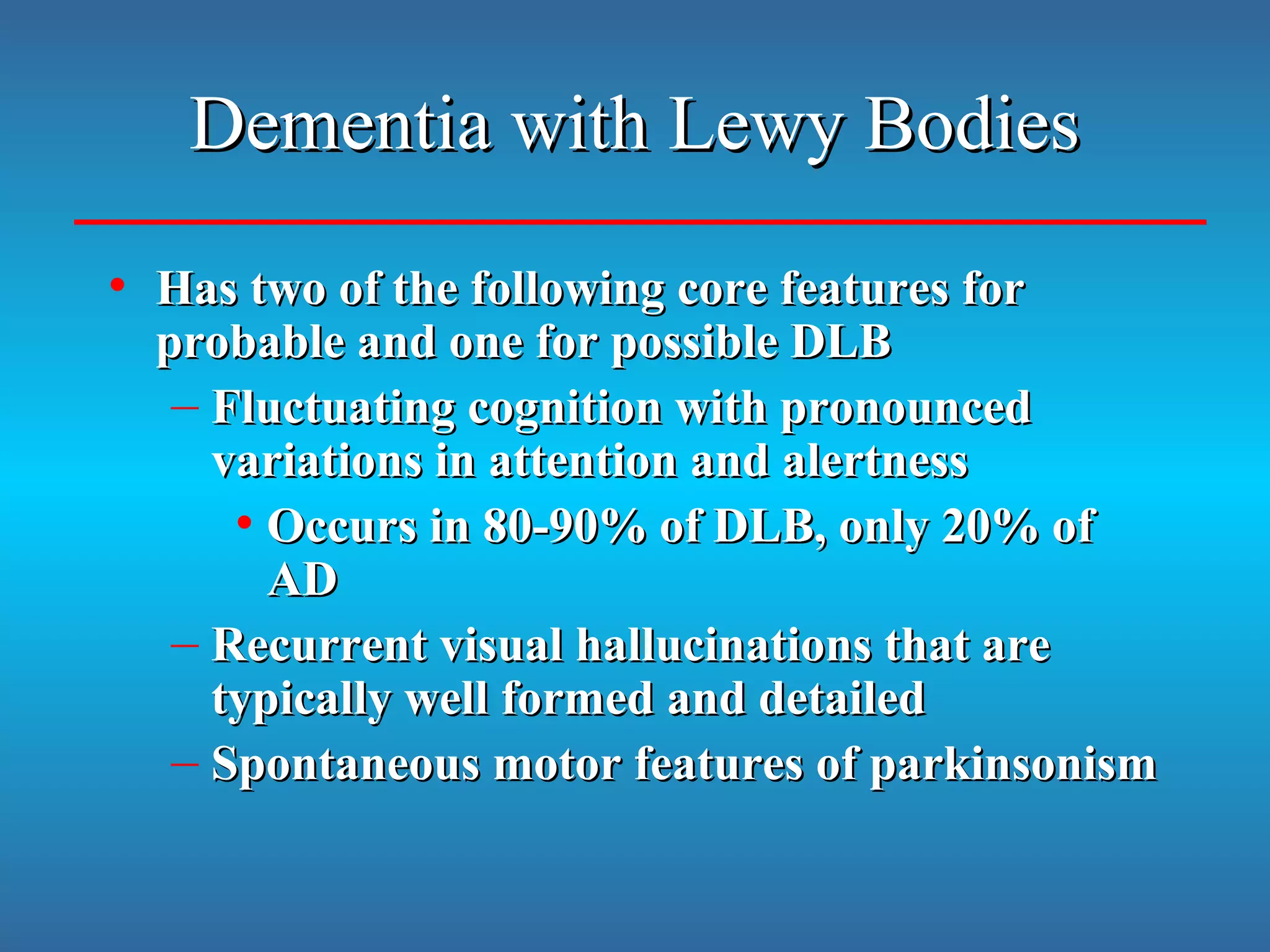
• Has two of the following core features forHas two of the following core features for
probable and one for possible DLBprobable and one for possible DLB
– Fluctuating cognition with pronouncedFluctuating cognition with pronounced
variations in attention and alertnessvariations in attention and alertness
• Occurs in 80-90% of DLB, only 20% ofOccurs in 80-90% of DLB, only 20% of
ADAD
– Recurrent visual hallucinations that areRecurrent visual hallucinations that are
typically well formed and detailedtypically well formed and detailed
– Spontaneous motor features of parkinsonismSpontaneous motor features of parkinsonism
Dementia with Lewy BodiesDementia with Lewy Bodies
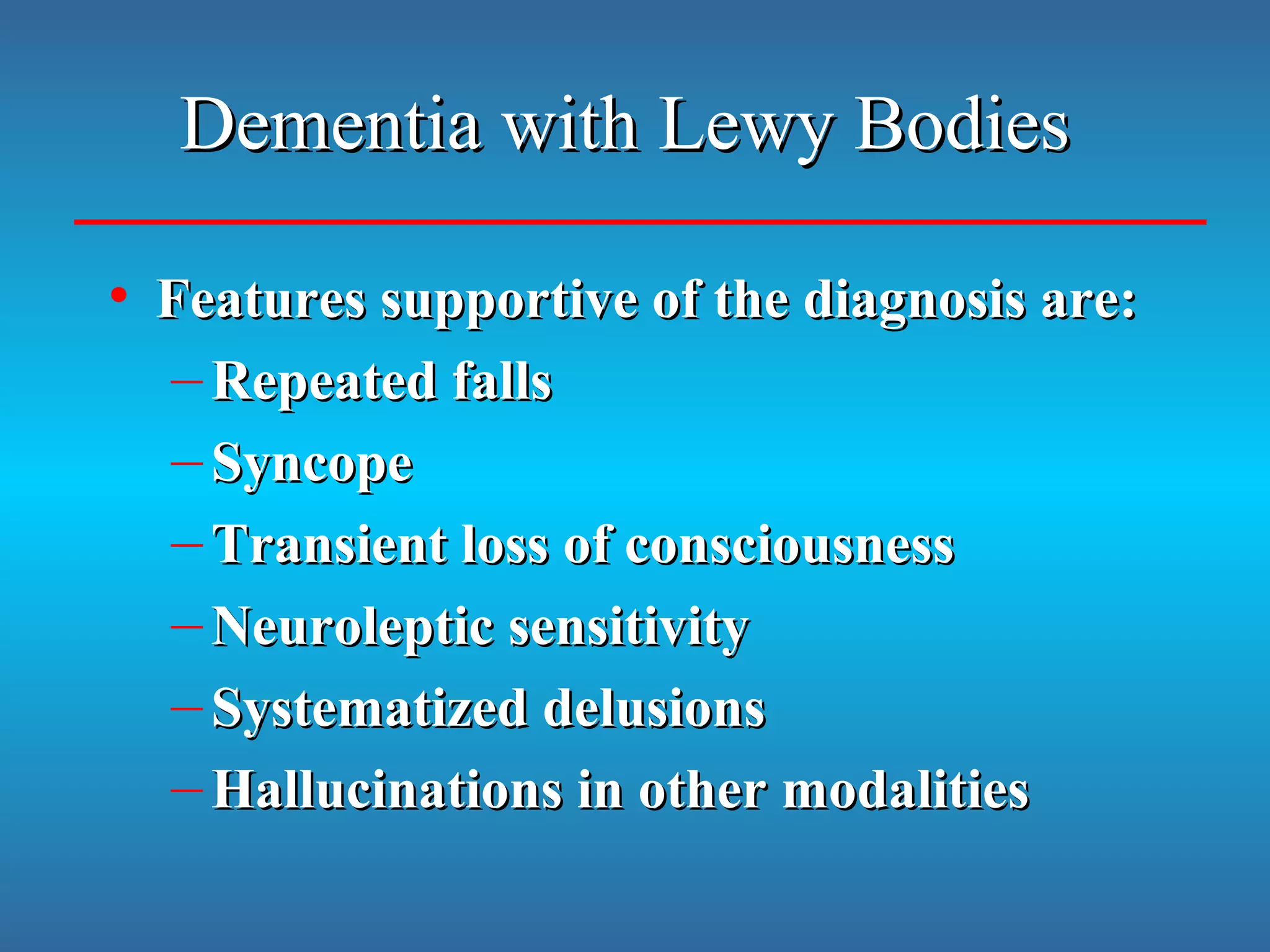
• Features supportive of the diagnosis are:Features supportive of the diagnosis are:
– Repeated fallsRepeated falls
– SyncopeSyncope
– Transient loss of consciousnessTransient loss of consciousness
– Neuroleptic sensitivityNeuroleptic sensitivity
– Systematized delusionsSystematized delusions
– Hallucinations in other modalitiesHallucinations in other modalities
Dementia with Lewy BodiesDementia with Lewy Bodies
• Neuropsychology:Neuropsychology:
– Impaired visuoconstructional skills andImpaired visuoconstructional skills and
attention with relative sparing of memoryattention with relative sparing of memory
• Imaging:Imaging:
– MRI shows DLB patients with hippocampalMRI shows DLB patients with hippocampal
volume between those of normal controlsvolume between those of normal controls
and AD patientsand AD patients (Hashimoto et al., Neurology(Hashimoto et al., Neurology
1998;51:357-362)1998;51:357-362)
– More hypoperfusion in the occipital lobesMore hypoperfusion in the occipital lobes
than ADthan AD (Knopman et al., Neurology 2001;56:1143-1153)(Knopman et al., Neurology 2001;56:1143-1153)
PathologyPathology
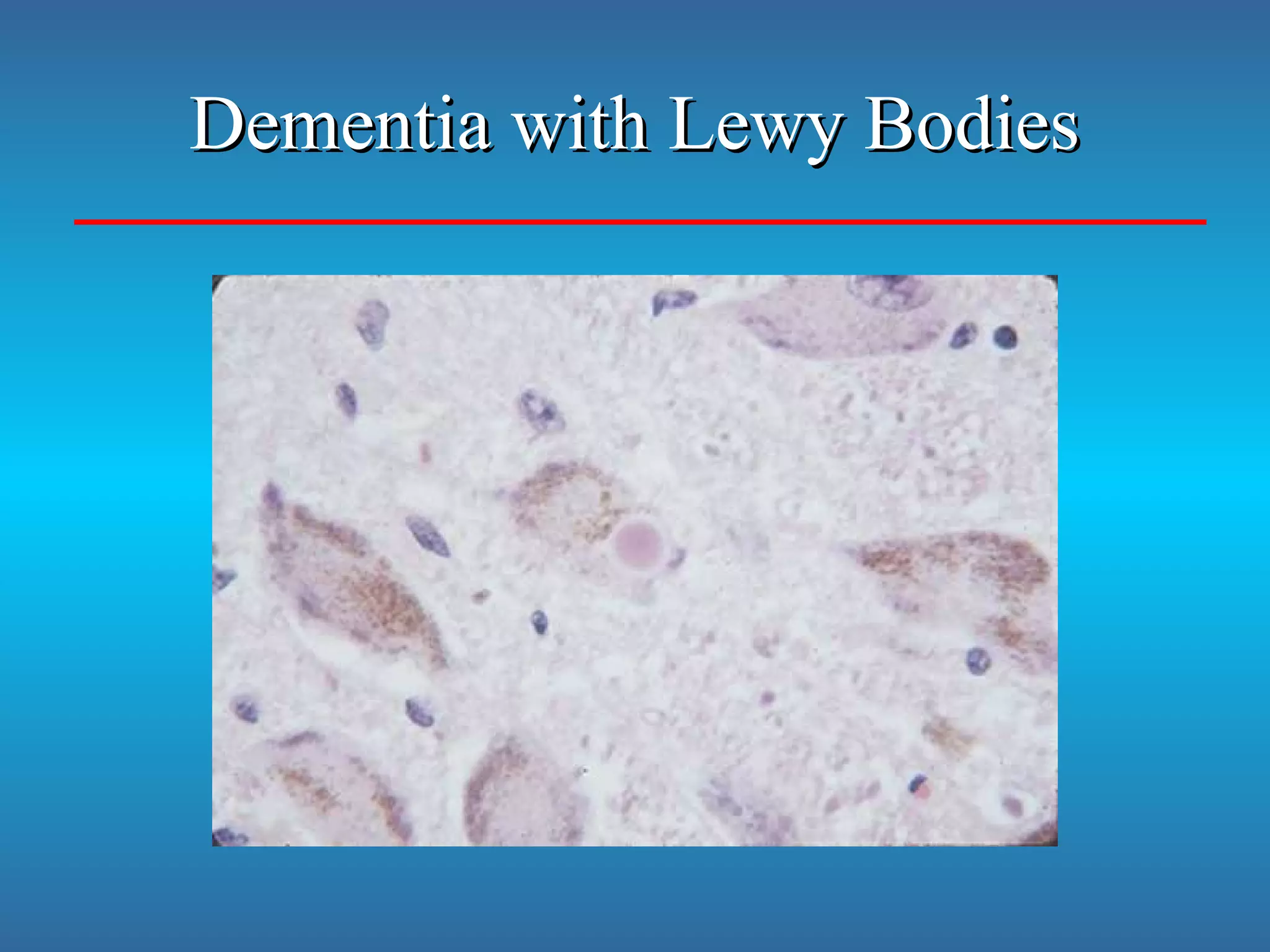
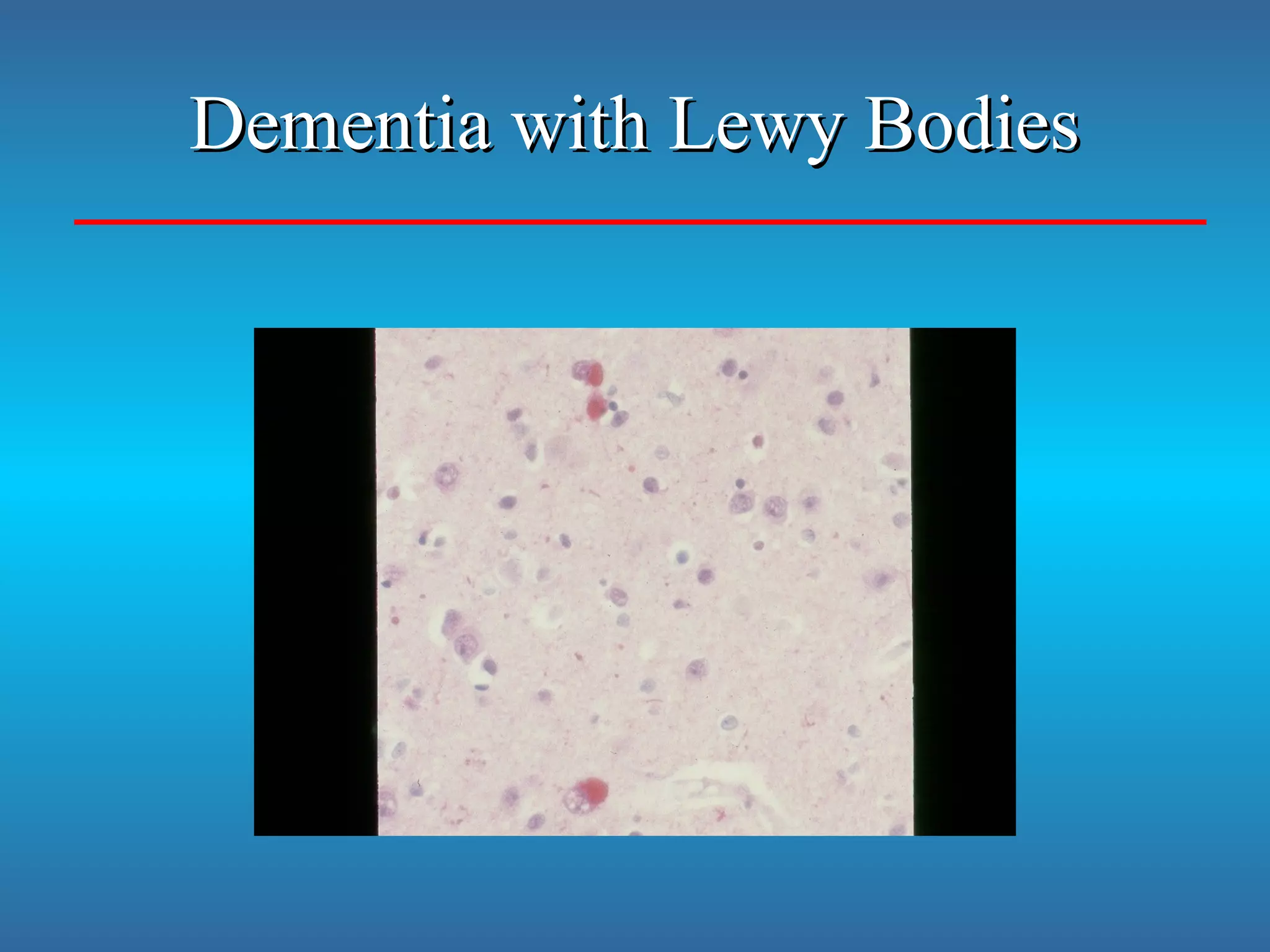
• Lewy bodies in the cortex and brainstemLewy bodies in the cortex and brainstem
– Subcortical nuclei, limbic cortex,Subcortical nuclei, limbic cortex,
neocortex (temporal > frontal =neocortex (temporal > frontal =
parietal)parietal)
• May have beta amyloid deposition andMay have beta amyloid deposition and
plaques like AD, but few neurofibrillaryplaques like AD, but few neurofibrillary
tanglestangles
Dementia with Lewy BodiesDementia with Lewy Bodies
• Term is conventionally used in clinical andTerm is conventionally used in clinical and
pathological diagnosespathological diagnoses
• No other specific code captures the clinical orNo other specific code captures the clinical or
pathological spectrumpathological spectrum
• General dementia or AD diagnosis (290 or 331)General dementia or AD diagnosis (290 or 331)
ignores established criteria, allows no trackingignores established criteria, allows no tracking
of DLB, and is the 2of DLB, and is the 2ndnd
largest etiology oflargest etiology of
neurodegenerative dementiasneurodegenerative dementias
Dementia with Lewy BodiesDementia with Lewy Bodies
• Differs from the other codes includingDiffers from the other codes including
AD, Parkinson’s disease and dementiaAD, Parkinson’s disease and dementia
• ADAD  early hallucinations, fluctuation inearly hallucinations, fluctuation in
alertness, sensitivity to neuroleptics arealertness, sensitivity to neuroleptics are
important to differentiateimportant to differentiate
• Parkinson’s disease and dementiaParkinson’s disease and dementia  thethe
dementia with PD is subcortical withdementia with PD is subcortical with
different symptomsdifferent symptoms
Dementia with Lewy BodiesDementia with Lewy Bodies

LEWY BODY DEMENTIA

  • 1.
    DementiaDementia with LewywithLewy BodiesBodies American Academy ofAmerican Academy of NeurologyNeurology John Hart, Jr., M.D.John Hart, Jr., M.D.
  • 2.
    Dementia with LewyBodiesDementia with Lewy Bodies • Definition: clinically defined by the presence ofDefinition: clinically defined by the presence of dementia, prominent hallucinations anddementia, prominent hallucinations and delusions (yet sensitive to antipsychoticdelusions (yet sensitive to antipsychotic medications), fluctuations in alertness, andmedications), fluctuations in alertness, and gait/balance disordergait/balance disorder (McKeith et al., Neurology(McKeith et al., Neurology 1996;47:1113-1124)1996;47:1113-1124) • Accounts for up to 20-30% of degenerativeAccounts for up to 20-30% of degenerative dementiasdementias (Hansen et al., Neurology 1990;40:1-8)(Hansen et al., Neurology 1990;40:1-8) – Second in occurrence behind ADSecond in occurrence behind AD
  • 3.
    Dementia with LewyBodiesDementia with Lewy Bodies • Autopsy shows 15-36% of dementedAutopsy shows 15-36% of demented cases presenting for autopsy have Lewycases presenting for autopsy have Lewy Bodies (LB) in neocortex and brainstemBodies (LB) in neocortex and brainstem – Most also AD changesMost also AD changes – Typically include pure dementia casesTypically include pure dementia cases with cortical Lewy Bodies and thosewith cortical Lewy Bodies and those those with AD+LB under Dementiathose with AD+LB under Dementia with Lewy Bodieswith Lewy Bodies
  • 4.
    Dementia with LewyBodiesDementia with Lewy Bodies
  • 5.
    DemographicsDemographics • Age ofonset comparable to ADAge of onset comparable to AD • Males more susceptible (1.5:1) and haveMales more susceptible (1.5:1) and have worse prognosisworse prognosis • Duration may be rapid (1-5 years) orDuration may be rapid (1-5 years) or typical to AD in other casestypical to AD in other cases
  • 6.
    Dementia with LewyBodiesDementia with Lewy Bodies • Established clinical consensus criteriaEstablished clinical consensus criteria (McKeith et al., Neurology 1996;47:1113-1124)(McKeith et al., Neurology 1996;47:1113-1124) • Dementia (DSM-IV) where prominent orDementia (DSM-IV) where prominent or persistent memory impairments may notpersistent memory impairments may not necessarily occur in the early stages butnecessarily occur in the early stages but occurs with progression. Attention,occurs with progression. Attention, frontal-subcortical, and visuospatialfrontal-subcortical, and visuospatial skills may be prominentskills may be prominent
  • 7.
    Dementia with LewyBodiesDementia with Lewy Bodies • Has two of the following core features forHas two of the following core features for probable and one for possible DLBprobable and one for possible DLB – Fluctuating cognition with pronouncedFluctuating cognition with pronounced variations in attention and alertnessvariations in attention and alertness • Occurs in 80-90% of DLB, only 20% ofOccurs in 80-90% of DLB, only 20% of ADAD – Recurrent visual hallucinations that areRecurrent visual hallucinations that are typically well formed and detailedtypically well formed and detailed – Spontaneous motor features of parkinsonismSpontaneous motor features of parkinsonism
  • 8.
    Dementia with LewyBodiesDementia with Lewy Bodies • Features supportive of the diagnosis are:Features supportive of the diagnosis are: – Repeated fallsRepeated falls – SyncopeSyncope – Transient loss of consciousnessTransient loss of consciousness – Neuroleptic sensitivityNeuroleptic sensitivity – Systematized delusionsSystematized delusions – Hallucinations in other modalitiesHallucinations in other modalities
  • 9.
    Dementia with LewyBodiesDementia with Lewy Bodies • Neuropsychology:Neuropsychology: – Impaired visuoconstructional skills andImpaired visuoconstructional skills and attention with relative sparing of memoryattention with relative sparing of memory • Imaging:Imaging: – MRI shows DLB patients with hippocampalMRI shows DLB patients with hippocampal volume between those of normal controlsvolume between those of normal controls and AD patientsand AD patients (Hashimoto et al., Neurology(Hashimoto et al., Neurology 1998;51:357-362)1998;51:357-362) – More hypoperfusion in the occipital lobesMore hypoperfusion in the occipital lobes than ADthan AD (Knopman et al., Neurology 2001;56:1143-1153)(Knopman et al., Neurology 2001;56:1143-1153)
  • 10.
    PathologyPathology • Lewy bodiesin the cortex and brainstemLewy bodies in the cortex and brainstem – Subcortical nuclei, limbic cortex,Subcortical nuclei, limbic cortex, neocortex (temporal > frontal =neocortex (temporal > frontal = parietal)parietal) • May have beta amyloid deposition andMay have beta amyloid deposition and plaques like AD, but few neurofibrillaryplaques like AD, but few neurofibrillary tanglestangles
  • 11.
    Dementia with LewyBodiesDementia with Lewy Bodies
  • 12.
    Dementia with LewyBodiesDementia with Lewy Bodies • Term is conventionally used in clinical andTerm is conventionally used in clinical and pathological diagnosespathological diagnoses • No other specific code captures the clinical orNo other specific code captures the clinical or pathological spectrumpathological spectrum • General dementia or AD diagnosis (290 or 331)General dementia or AD diagnosis (290 or 331) ignores established criteria, allows no trackingignores established criteria, allows no tracking of DLB, and is the 2of DLB, and is the 2ndnd largest etiology oflargest etiology of neurodegenerative dementiasneurodegenerative dementias
  • 13.
    Dementia with LewyBodiesDementia with Lewy Bodies • Differs from the other codes includingDiffers from the other codes including AD, Parkinson’s disease and dementiaAD, Parkinson’s disease and dementia • ADAD  early hallucinations, fluctuation inearly hallucinations, fluctuation in alertness, sensitivity to neuroleptics arealertness, sensitivity to neuroleptics are important to differentiateimportant to differentiate • Parkinson’s disease and dementiaParkinson’s disease and dementia  thethe dementia with PD is subcortical withdementia with PD is subcortical with different symptomsdifferent symptoms
  • 14.
    Dementia with LewyBodiesDementia with Lewy Bodies
  • 15.
    Dementia with LewyBodiesDementia with Lewy Bodies
  • 16.
    Dementia with LewyBodiesDementia with Lewy Bodies