welcome
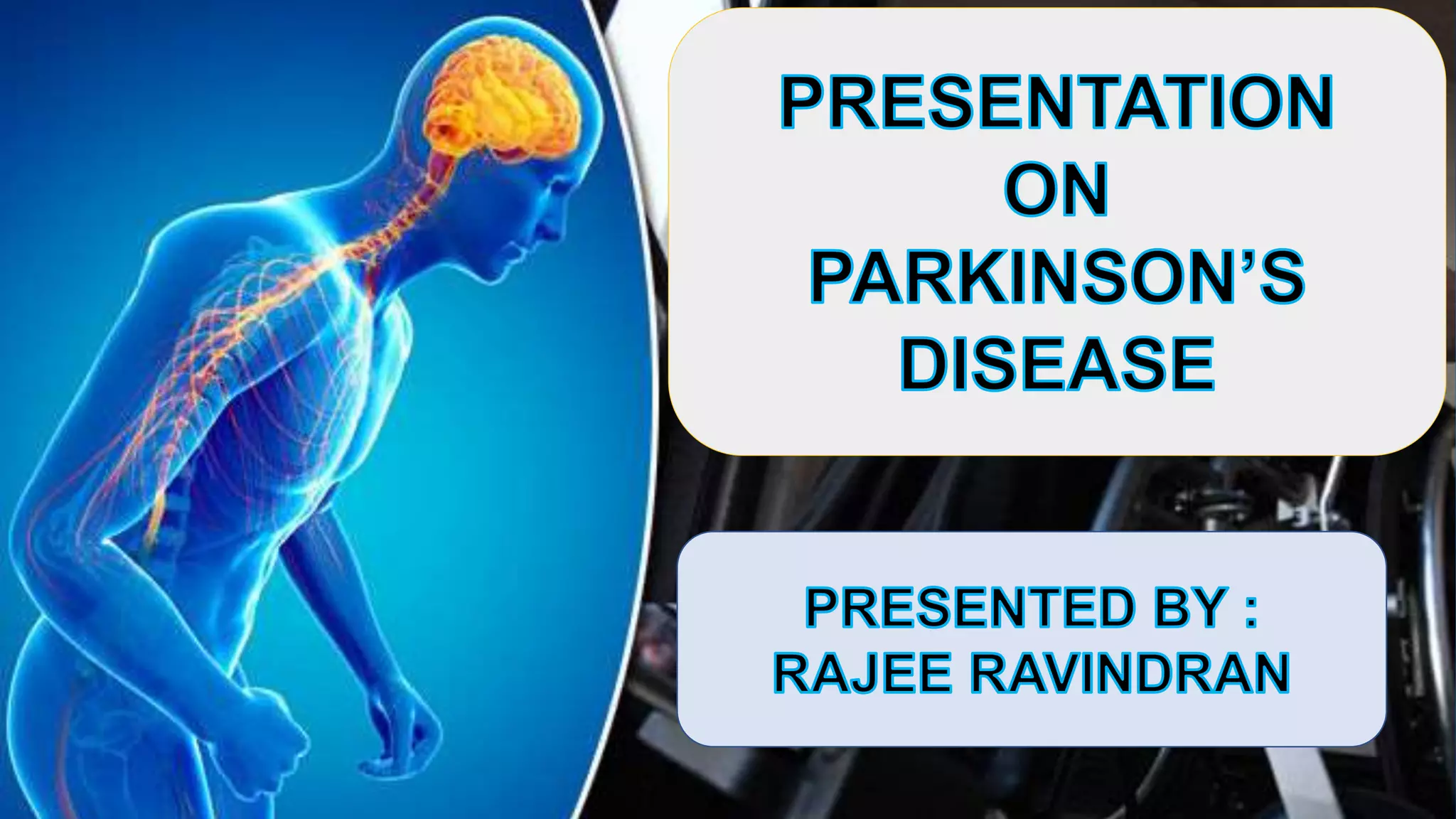
What is Parkinson’s disease?
HISTORY
It was described by the physician Galen as “shaking palsy”
In 1817 an essay on “shaking palsy” was published by Dr. James
Parkinson
Jean-Martin Charcot was the first to truly recognise the importance
of Dr. Parkinson’s work and renamed the disease after him.
FAMOUS PERSONALITIES WITH
PARKINSON’S DISEASE
BILLY CONNOLLY ROBIN WILLIAMS
MUHAMMAD ALI ADOLF HITLER
DEFINITION
Parkinson’s disease is a chronic, progressive loss
of dopaminergic neurons in the substantia nigra pars
compacta
ANATOMY AND PHYSIOLOGY OF BRAIN
ETIOLOGY
Idopathic
Age (typically around 60years)
Certain pesticides(agrochemicals such as paraquat and
maneb)
Virus
Drugs
Tumors
CLASSIFICATION
Idiopathic Parkinsonism
Atypical Parkinsonism / Parkinson Plus Syndrome
DIAGNOSIS
Medical History
Neurological Examination
Physical Examination
Magnetic Resonance Imaging
Computed Tomography
Positron Emission Tomography
SURGICAL MANAGEMENT
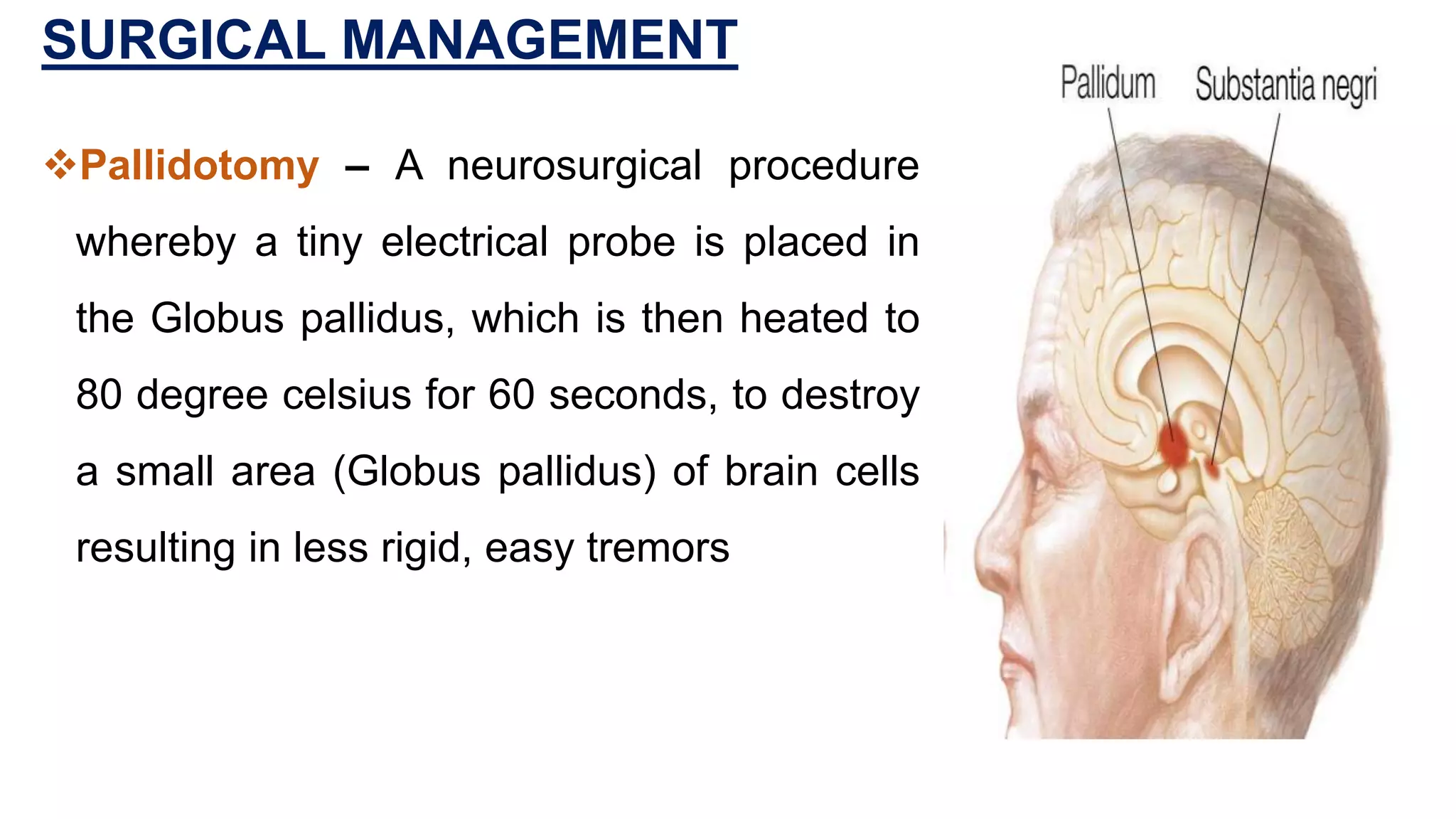
Pallidotomy – A neurosurgical procedure
whereby a tiny electrical probe is placed in
the Globus pallidus, which is then heated to
80 degree celsius for 60 seconds, to destroy
a small area (Globus pallidus) of brain cells
resulting in less rigid, easy tremors
SURGICAL MANAGEMENT
Thalamotomy- A surgical procedure
in which an opening is made into the
thalamus to block the things that
causes the tremors from reaching the
muscles.
SURGICAL MANAGEMENT
Deep Brain Stimulation- A small device is
placed inside the chest which sends electrical
impulses to the brain. These impulses block
nerve signals that causes Parkinson’s
symptoms.
REHABILITATION
 Regular physical exercise
 Strategies such as utilizing assistive
equipment (pole walking and treadmill
walking)
 Occupational therapy
REHABILITATION
 Slow rotational movements of the extremities and trunk
 Speech therapy
 Diaphragmatic breathing
NURSING MANAGEMENT
Assist with ambulation and provide assistive devices.
Instruct client to rock back and forth to initiate movement.
Instruct the client to wear low-heeled shoes.
Encourage the client to lift feet when walking and avoid prolonged sitting.
Provide a firm mattress, and position the client prone, without a pillow, to facilitate
proper posture.
Instruct in proper posture by teaching the client to hold the hands behind the back
to keep the spine and neck erect.
NURSING MANAGEMENT
Promote physical therapy and rehabilitation.
Administer anticholinergic medications as prescribed to treat tremors and
rigidity and to inhibit the action of acetylcholine.
Administer antiparkinsonian medications to increase the level of dopamine in
the CNS.
Instruct the client to avoid foods high in vitamin B6 because they block the
effects of antiparkinsonian medications.
SUMMARY
• Introduction to the topic
• Definition
• Anatomy and physiology of brain
• Etiology
• Classification
• Pathophysiology
• Signs and symptoms
• Diagnosis
• Management
CONCLUSION
Parkinson’s disease requires long term treatment.
Treatment of Parkinson’s disease becomes challenging as time
progresses.
In addition to medicines, the person suffering with the disease should
remain active, happy and perform regular exercise and physiotherapy
BIBLIOGRAPHY
Black MJ. Management of clients with degenerative neurological disorders. In:
Carroll GR, Keene MA, Melander S (eds.) Medical Surgical Nursing. 7th ed.
Missouri, Elsevier; 2005.p2170-2175
Chintamani. Nursing management of chronic neurologic problems. In: Mani
m(ed). Medical Surgical Nursing. Elsevier 2011. P1513-1520
Brunner, Suddarth. Management of patients with oncologic or degenerative
neurologic disorders. In: Kluwer W (ed). Medical Surgical Nursing. 12th ed.
Philadelphia; 2009.p1986-1992
https://www.mayfieldclinic.com/PE-PD.html
PARKINSON'S DISEASE  Presentation by Rajee

PARKINSON'S DISEASE Presentation by Rajee

  • 2.
  • 3.
  • 4.
    HISTORY It was describedby the physician Galen as “shaking palsy” In 1817 an essay on “shaking palsy” was published by Dr. James Parkinson Jean-Martin Charcot was the first to truly recognise the importance of Dr. Parkinson’s work and renamed the disease after him.
  • 5.
    FAMOUS PERSONALITIES WITH PARKINSON’SDISEASE BILLY CONNOLLY ROBIN WILLIAMS MUHAMMAD ALI ADOLF HITLER
  • 6.
    DEFINITION Parkinson’s disease isa chronic, progressive loss of dopaminergic neurons in the substantia nigra pars compacta
  • 7.
  • 8.
  • 9.
    ETIOLOGY Idopathic Age (typically around60years) Certain pesticides(agrochemicals such as paraquat and maneb) Virus Drugs Tumors
  • 10.
  • 15.
    DIAGNOSIS Medical History Neurological Examination PhysicalExamination Magnetic Resonance Imaging Computed Tomography Positron Emission Tomography
  • 17.
    SURGICAL MANAGEMENT Pallidotomy –A neurosurgical procedure whereby a tiny electrical probe is placed in the Globus pallidus, which is then heated to 80 degree celsius for 60 seconds, to destroy a small area (Globus pallidus) of brain cells resulting in less rigid, easy tremors
  • 18.
    SURGICAL MANAGEMENT Thalamotomy- Asurgical procedure in which an opening is made into the thalamus to block the things that causes the tremors from reaching the muscles.
  • 19.
    SURGICAL MANAGEMENT Deep BrainStimulation- A small device is placed inside the chest which sends electrical impulses to the brain. These impulses block nerve signals that causes Parkinson’s symptoms.
  • 20.
    REHABILITATION  Regular physicalexercise  Strategies such as utilizing assistive equipment (pole walking and treadmill walking)  Occupational therapy
  • 21.
    REHABILITATION  Slow rotationalmovements of the extremities and trunk  Speech therapy  Diaphragmatic breathing
  • 22.
    NURSING MANAGEMENT Assist withambulation and provide assistive devices. Instruct client to rock back and forth to initiate movement. Instruct the client to wear low-heeled shoes. Encourage the client to lift feet when walking and avoid prolonged sitting. Provide a firm mattress, and position the client prone, without a pillow, to facilitate proper posture. Instruct in proper posture by teaching the client to hold the hands behind the back to keep the spine and neck erect.
  • 23.
    NURSING MANAGEMENT Promote physicaltherapy and rehabilitation. Administer anticholinergic medications as prescribed to treat tremors and rigidity and to inhibit the action of acetylcholine. Administer antiparkinsonian medications to increase the level of dopamine in the CNS. Instruct the client to avoid foods high in vitamin B6 because they block the effects of antiparkinsonian medications.
  • 24.
    SUMMARY • Introduction tothe topic • Definition • Anatomy and physiology of brain • Etiology • Classification • Pathophysiology • Signs and symptoms • Diagnosis • Management
  • 25.
    CONCLUSION Parkinson’s disease requireslong term treatment. Treatment of Parkinson’s disease becomes challenging as time progresses. In addition to medicines, the person suffering with the disease should remain active, happy and perform regular exercise and physiotherapy
  • 26.
    BIBLIOGRAPHY Black MJ. Managementof clients with degenerative neurological disorders. In: Carroll GR, Keene MA, Melander S (eds.) Medical Surgical Nursing. 7th ed. Missouri, Elsevier; 2005.p2170-2175 Chintamani. Nursing management of chronic neurologic problems. In: Mani m(ed). Medical Surgical Nursing. Elsevier 2011. P1513-1520 Brunner, Suddarth. Management of patients with oncologic or degenerative neurologic disorders. In: Kluwer W (ed). Medical Surgical Nursing. 12th ed. Philadelphia; 2009.p1986-1992 https://www.mayfieldclinic.com/PE-PD.html